Daily reading
Septuagesima
Double · February 5 · Sanctoral
February 5, 2021
From Dom Guéranger’s The Liturgical Year.
A Double leads the weekday.Rubric
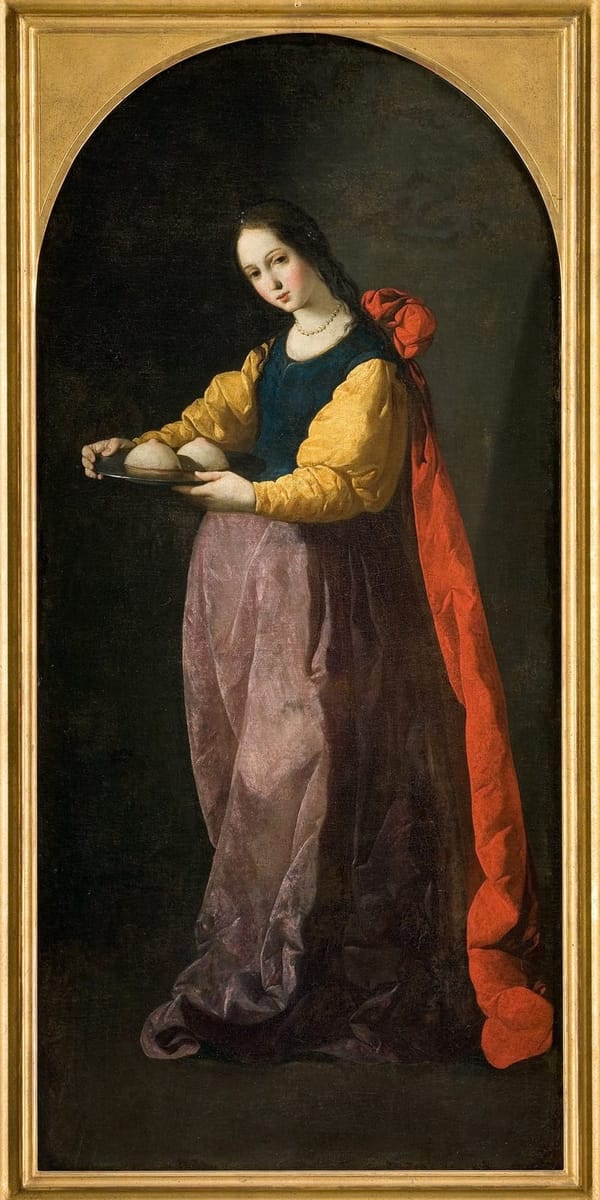 |
February 5: St. Agatha, Virgin and Martyr
Since the commencement of the ecclesiastical year, we have kept the feasts of two out of the four illustrious virgins whose names are daily honoured in the holy Sacrifice of the Lamb: the third comes to-day, lighting up the heaven of the Church with her bright soft rays. Lucy first, then Agnes, and now the gracious visit of Agatha. The fourth, Cecily, the immortal Cecily, is to be one of that magnificent constellation which gives such splendour to the closing of the year. To-day, then, let us keep a feast in honour of Agatha, the virgin daughter of that same fair Sicily which can boast of her Lucy. We must not allow the holy sadness of our present season to take aught from the devotion we owe to our saint. The joy wherewith we celebrate her merits will lead us to study her virtues. She will repay us by her prayers; she will encourage us to persevere in the path which is to bring us to the God she so nobly loved and served, and with whom she is now for ever united.
Let us begin by reading what the Church tells us of the virtues and combats of this glorious bride of Christ.
The ancient books of the liturgy abound with verses in honour of St. Agatha; but most of them are so poor in sentiment that we pass them over. The following beautiful hymn is the composition of Pope St. Damasus.
Hymn
Virginis emicat eximiæ:
Christus eam sibi qua sociat,
Et diadema duplex decorat.
Sed magia actibus atque fide,
Terrea prospera nil reputans,
Jussa Dei sibi corde ligans.
Exposuit sua membra flagris,
Pectore quam fuerit valido
Torta mamilla docet patulo.
Pastor ovem Petrus hanc recreat:
Inde gavisa magisque flagrans,
Cuncta flagella cucurrit ovans.
Hujus et ipsa meretur opem;
Quos fidei titulus decorat,
His Venerem magis ipsa premat.
Pro miseris supplica Domino,
Sio tua festa coli faciat,
Te celebrantibus ut faveat.
Spirituique proinde sacro,
Qui Deus unus et omnipotens
Hanc nostri faciat memorem.
of the glorious martyr and virgin Agatha,
when Christ took her to himself,
and a double crown wreathed her brow.
her grandest riches were her deeds and her faith.
Earthly prosperity was nothing in her eyes,
but her whole heart was on the precepts of her God.
she flinched not as they lashed her limbs:
and her wounded breast
reveals a dauntless heart.
where the pastor Peter heals his bleeding lamb;
and thence once more she runs to suffer,
gladder and braver at every wound.
was saved by Agatha’s prayer.
The same can check, in Christian hearts,
the threatening fire of lust.
intercede with him for us miserable sinners,
that he grant us so to spend thy feast,
that our celebration may draw down his grace.
and the Holy Ghost.
May the one almighty God
grant that this his saint be mindful of us.
How lovely are thy palms, O Agatha! But how long and cruel was thy combat for them! The day was thine; thy faith and thy virginity triumphed, but the battle-field streamed with thy blood, and thy glorious wounds bear testimony to the angels how stern was the courage of thy fidelity to Jesus thy Spouse. When thine enemies left thee, it was to Him thou didst look up; and then thy soul flew to its rest, in the bosom of thy King and God. The whole Church keeps feast to-day, praising her Lord in thee, great martyr and virgin! She knows the love thou bearest her, and how, amidst the joys of heaven, her interests and her wants are the object of thy prayers. Thou art our sister; be, too, our mother, by interceding for us. Centuries have passed away since that day, whereon thy soul quitted the body thou hadst sanctified by purity and suffering; but the great battle between the spirit and the flesh is still waging here on earth, and will do so to the end of time. Assist us in the struggle; keep up within our hearts the holy fire, which the world and our passions are ever seeking to quench.
It is now the season when every Christian should renew his whole being by repentance and compunction. We know the power of thy prayer; let it procure us these gifts: the fear of God, which keeps down the workings of corrupt nature; the spirit of penance, which repairs the injuries caused by our sins; and a solid love for our dear Lord, which sweetens the yoke, and ensures perseverance. More than once a whole people has witnessed how a relic of thine, thy veil, has checked the stream of lava which rolled down the sides of Etna; we are threatened with a torrent of vice, which will drive the world back to pagan corruption, unless divine mercy stay its wild fury; and prayers such as thine can obtain it for us. Delay not, O Agatha! each day gives strength to the danger. Not a nation but is now infected with the poison of a literature that is infidel and immoral; by thy prayers keep the poisonous cup from them that have not tasted, neutralize its power in them that have drunk its venom of death. Oh! spare us the shame of seeing our Europe the slave of sensuality, and the dupe of hell.
Friday of Septuagesima Week
The curse, which is henceforth to lie so heavily on every human being, has been expressed in the sentence pronounced against Eve; the curse, to which the earth itself is to be subjected, is Adam’s sentence. ‘Because thou hast hearkened to the voice of thy wife, and hast eaten of the tree, whereof I commanded thee that thou shouldst not eat, cursed is the earth in thy work (that is, on account of what thou hast done).’1 Adam had excused his sin. God does not admit his excuse; yet He mercifully makes allowance for him, seeing that he sinned, not so much to gratify himself, as to please the frail creature that had been formed out of his own substance. He is not the originator of the disobedient act. God, therefore, sentences him to the personal humiliation of labour and toil, and of eating his bread in the sweat of his brow.2 Outside the garden of Eden, there lies the immense desert of the earth. It is to be the valley of tears; and there must Adam dwell in exile for upwards of nine hundred years, with the sad recollection in his heart of the few happy days spent in paradise! This desert is barren: Adam must give it fruitfulness by his toil, and draw from it, by the sweat of his brow, his own and his children’s nourishment. If, in after ages, some men shall live without toil, they are the exception confirming the general law and chastisement. They rest, because others have laboured long and hard for them; neither will God ratify their exceptional dispensation from labour, except on the condition that they give encouragement, by their charity and other virtues, to their fellow-men, in whom Adam’s sentence is literally carried out. Such is the necessity of toil, that if it be refused, the earth will yield but thorns and thistles;3 such, too, the importance of this law imposed on fallen man, that idleness shall not only corrupt his heart, it shall also enervate his bodily strength.
Before his sin, the trees of paradise bent down their branches, and man fed on their delicious fruits; but now he must till the earth and draw from it, with anxiety and fatigue, the seed which is to give him bread. Nothing could better express the penal relation between him and the earth, from which he was originally formed, and which is henceforth to be his tomb, than this law to which God sentences him, of being indebted to the earth for the nourishment which is to keep him in life. And yet here also divine mercy shall show itself; for, when God shall have been appeased, it shall be granted to man to unite himself to his Creator by eating the Bread of life, which is to come down from heaven, and whose efficacy for the nourishing of our souls shall be greater than ever the fruit of the tree of life could have been for the immortalizing of our bodily existence.
In Dominica Tyrophagi
| Previous Thursday of Septuagesima Week | Next Friday of Septuagesima Week |