Daily reading
Septuagesima
Double · February 8 · Sanctoral
February 8, 2021
From Dom Guéranger’s The Liturgical Year.
A Double leads the weekday.Rubric
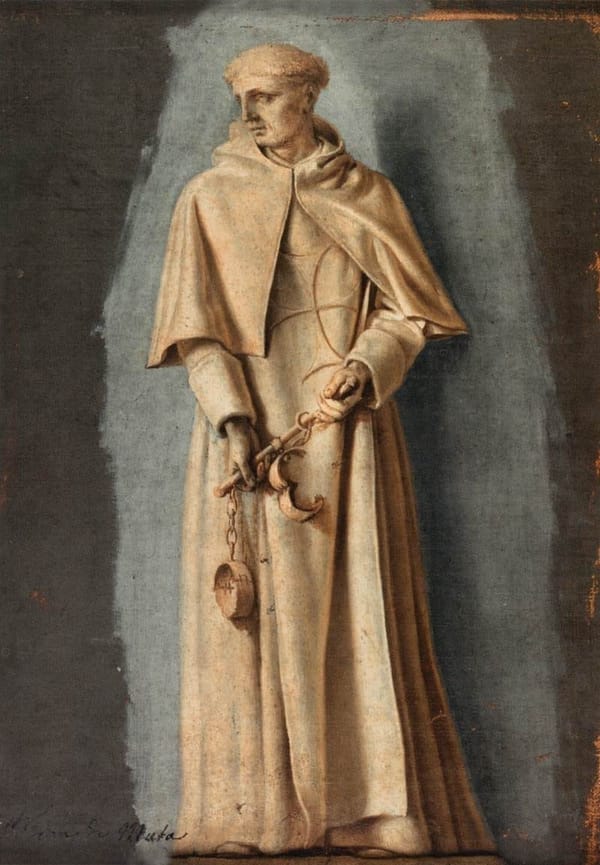 |
February 8: St. John of Matha, Confessor
We were celebrating, not many days ago, the memory of Peter Nolasco, who was inspired, by the holy Mother of God, to found an Order for the ransoming of Christian captives from the infidels: to-day, we have to honour the generous saint, to whom this sublime work was first revealed. He established, under the name of the most holy Trinity, a body of religious men, who bound themselves by vow to devote their energies, their privations, their liberty, nay, their very life, to the service of the poor slaves who were groaning under the Saracen yoke. The Order of the Trinitarians, and the Order of Mercy, though distinct, have the same end in view, and the result of their labours, during the six hundred years of their existence, has been the restoration to liberty and preservation from apostasy of upwards of a million slaves. John of Matha, assisted by his faithful co-operator, Felix of Valois (whose feast we shall keep at the close of the year), established the centre of his grand work at Meaux, in France. We are preparing for Lent, when one of our great duties will have to be that of charity towards our suffering brethren: what finer model could we have than John of Matha, and his whole Order, which was called into existence for no other object than that of delivering from the horrors of slavery brethren who were utter strangers to their deliverers, but were in suffering and in bondage. Can we imagine any almsgiving, let it be ever so generous, which can bear comparison with this devotedness of men, who bind themselves by their rule, not only to traverse every Christian land begging alms for the ransom of slaves, but to change places with the poor captives, if their liberty cannot be otherwise obtained? Is it not, as far as human weakness permits, following to the very letter the example of the Son of God Himself, who came down from heaven that He might be our ransom and our Redeemer? We repeat it: with such models as these before us, we shall feel ourselves urged to follow the injunction we are shortly to receive from the Church, of exercising works of mercy towards our fellow-creatures, as being one of the essential elements of our lenten penance.
But it is time we should listen to the account given us by the liturgy of the virtues of this apostolic man, who has endeared himself, both to the Church and to mankind, by his heroism of charity.
And now, generous-hearted saint, enjoy the fruits of thy devoted charity. Our blessed Redeemer recognizes thee as one of His most faithful imitators, and the whole court of heaven is witness of the recompense wherewith He loves to honour thy likeness to Himself. We must imitate thee; we must walk in thy footsteps; for we too hope to reach the same eternal resting-place. Fraternal charity will lead us to heaven, for the works it inspires us to do have the power of freeing the soul from sin, as our Lord assures us.1 Thy charity was formed on the model of that which is in the heart of God, who loves our soul yet disdains not to provide for the wants of our body. Seeing so many souls in danger of apostasy, thou didst run to their aid, and men were taught to love a religion which can produce heroes of charity like thee. Thy heart bled at hearing of the bodily sufferings of these captives, and thy hand broke the chains of their galling slavery. Teach us the secret of ardent charity. Is it possible that we can see a soul in danger of being lost, and remain indifferent? Have we forgotten the divine promise, told us by the apostle: ‘He that causeth a sinner to be converted from the error of his way, shall save his soul from death, and shall cover a multitude of his own sins’?2 Obtain for us, also, a tender compassion for such as are in bodily suffering and poverty, that so we may be generous in comforting them under these trials, which are but too often an occasion of their blaspheming Providence. Dear friend and liberator of slaves! pray, during this holy season, for those who groan under the captivity of sin and Satan; for those, especially, who, taken with the frenzy of earthly pleasures, feel not the weight of their chains, but sleep on peacefully through their slavery. Ransom them by thy prayers, convert them to the Lord their God, lead them back to the land of freedom. Pray for France which was thy country, and save her from infidelity. Protect the venerable remnants of thy Order, that so it may labour for the present wants of the Christian world, since the object for which thou didst institute it has ceased to require its devotedness.
Monday of Sexagesima Week
All flesh had corrupted its way upon the earth.1 The terrible lesson, then, which men had received, by being driven out of paradise in the person of our first parents, had been without effect. Neither the certainty of death, when they would have to stand before the divine Judge, nor the humiliations which attend man’s first coming into this world, nor the pains and fatigues and trials which beset the whole path of life, had subdued men’s hearts, or brought them into submission to that sovereign Master whose hand lay thus heavy upon them. They had the divine promise that a Saviour should be given to them, and that this Redeemer (who was to be the Son of her that was to crush the serpent’s head), would not only bring them salvation, but would moreover reinstate them in all the happiness and honours they had lost. But even this was not enough to make them rise above the base passions of corrupt nature. The example of Adam’s nine hundred years’ penance, and the admonitions he could so feelingly give who had received such proofs of God’s love and anger, began to lose their influence upon his children; and when he at last descended into the grave, his posterity grew more and more heedless of what they owed to their Creator. The long life, which had been granted to man in this the first age of the world, was made but a fresh means of offending Him who gave it. When, finally, the sons of Seth took to themselves wives of the family of Cain, the human race reached the height of wickedness, rebelled against the Lord, and made their own passions their god.
Yet, all this while, they had had granted to them the power of resisting the evil propensities of their hearts. God had offered them His grace, whereby they were enabled to conquer pride and concupiscence. The merits of the Redeemer to come were even then present to divine justice, and the Lamb, slain, as St. John tells us, from the beginning of the world,2 applied the merits of His Blood to this as to every generation which existed before the great Sacrifice was really immolated. Each individual of the human family might have been just, as Noah was, and, like him, have found favour with the Most High; but the thought of their heart was bent upon evil, and not upon good, and the earth became peopled with enemies of God. Then it was that it repented God that He had made man,3 as the sacred Scripture forcibly expresses it. He decreed that man’s life on earth should be shortened, in order that the thought of death might be ever before us. He, moreover, resolved to destroy, by a universal deluge, the whole of this perverse generation, saving only one family. The world would thus be renewed, and man would learn from this awful chastisement to serve and love this his sovereign Lord and God.
We find the following liturgical formula in the Mozarabic missal. Nothing could be more appropriate to the season of Septuagesima.
Missa
(Dominica ante carnes tollendas.)
| Previous February 7: St. Romuald, Abbot | Next Monday of Sexagesima Week |