Daily reading
Septuagesima
Double · February 10 · Sanctoral
February 10, 2021
From Dom Guéranger’s The Liturgical Year.
A Double leads the weekday.Rubric
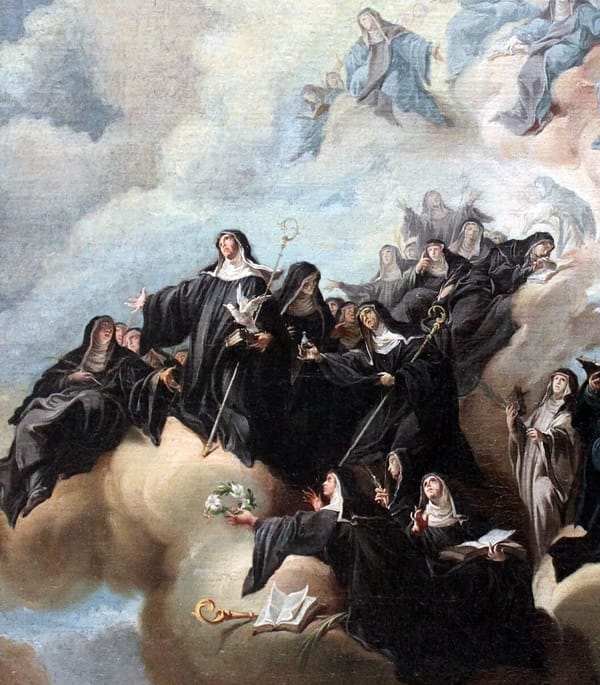 |
February 10: St. Scholastica, Virgin
The sister of the patriarch St. Benedict comes to us to-day, sweetly inviting us to follow her to heaven. Apollonia the martyr is succeeded by Scholastica, the fervent daughter of the cloister. Both of them are the brides of Jesus, both of them wear crowns, for both of them fought hard, and won the palm. Apollonia’s battle was with cruel persecutors, and in those hard times when one had to die to conquer; Scholastica’s combat was the lifelong struggle, whose only truce is the soldier’s dying breath. The martyr and the nun are sisters now in the Heart of Him they both so bravely loved.
God, in His infinite wisdom, gave to St. Benedict a faithful co-operatrix, a sister of such angelic gentleness of character, that she would be a sort of counterpoise to the brother, whose vocation, as the legislator of monastic life, needed a certain dignity of grave and stern resolve. We continually meet with these contrasts in the lives of the saints; and they show us that there is a link, of which flesh and blood know nothing; a link which binds two souls together, gives them power, harmonizes their differences of character, and renders each complete. Thus it is in heaven with the several hierarchies of the angels; a mutual love, which is founded on God Himself, unites them together, and makes them live in the eternal happiness of the tenderest brotherly affection.
Scholastica’s earthly pilgrimage was not a short one; and yet it has left us but the history of the dove, which told the brother, by its flight to heaven, that his sister had reached the eternal home before him. We have to thank St. Gregory the Great for even this much, which he tells us as a sequel to the holy dispute she had with Benedict, three days previous to her death. But how admirable is the portrait thus drawn in St. Gregory’s best style! We seem to understand the whole character of Scholastica:—an earnest simplicity, and a child-like eagerness for what was worth desiring; an affectionate and unshaken confidence in God; a winning persuasiveness, where there was opposition to God’s will, which, when it met such an opponent as Benedict, called on God to interpose, and gained its cause. The old poets tell us strange things about the swan, how sweetly it can sing when dying; how lovely must have been the last notes of the dove of the Benedictine cloister, as she was soaring from earth to heaven!
But how came Scholastica, the humble retiring nun, by that energy, which could make her resist the will of her brother, whom she revered as her master and guide? What was it told her that her prayer was not a rash one, and that what she asked was a higher good than Benedict’s unflinching fidelity to the rule he had written, and which it was his duty to teach by his own observance of it? Let us hear St. Gregory’s answer: 'It is not to be wondered at, that the sister, who wished to prolong her brother’s stay, should have prevailed over him; for, whereas St. John tells us that God is charity, it happened, by a most just judgment, that she that had the stronger love had the stronger power.’
Our season is appropriate for the beautiful lesson taught us by St. Scholastica, fraternal charity. Her example should excite us to the love of our neighbour, that love for which God bids us labour, now that we are intent on giving Him our undivided service, and our complete conversion. The Easter solemnity for which we are preparing, is to unite us all in the grand banquet, where we are all to feast on the one divine Victim of love. Let us have our nuptial garment ready: for He that invites us insists on our having union of heart when we dwell in His house.1
The Church has inserted in her Office of this feast the account given by St. Gregory of the last interview between St. Scholastica and St. Benedict. It is as follows:
We select the following from the monastic Office for the feast of our saint:
Responsories and Antiphons
The same Benedictine breviary gives us these two hymns for this feast:
Hymn
Te columba virginum,
Siderum tollunt coloni
Laudibus, Scholastica:
Nostra te lætis salutant
Vocibus præcordia.
Docta quondam spernere,
Dogma fratris insecuta
Atque sanctæ regulæ,
Ex odore gratiarum,
Astra nosti quærere.
O decus victoriæ!
Dum fluentis lacrymarum
Cogis imbres currere,
Ore Nursini parentis
Verba cœli suscipis.
In polorum vertice,
Clara flammis charitatis
Cum nitore gratiæ:
Juncta Sponso conquiescis
In decore gloriæ.
Cordibus fidelium,
Ut serena fronte splendens
Sol perennis luminis,
Sempiternæ claritatis
Impleat nos gaudiis.
Unicoque Filio;
Par tributum proferamus
Inclyto Paraclito,
Nutibus cujus creantur,
Et reguntur sæcula.
O dove of the cloister!
the citizens of heaven proclaim thy merits,
and we, too, sing thy praises
with joyful hymns
and loving hearts.
the honours and glory of the world;
thou didst follow the teaching of thy brother
and his holy rule;
and, rich in the fragrance of every grace,
thou caredst for heaven alone.
and how glorious thy victory,
when thy tears drew rain from the skies,
and forced the patriarch of Nursia
to tell thee what he knew
of the land above!
in heaven’s longed for light;
thou art as a seraph in thy burning love,
beautiful in thy bright grace;
and united with thy divine Spouse,
thou art reposing in the splendour of glory.
and drive from us the miseries
which cloud our hearts;
that thus the Sun of light eternal
may sweetly shine upon us,
and fill us with the joys of his everlasting beams.
and to his only Son;
let us give an equal homage of our praise
to the blessed Paraclete:
yea, to God, the Creator and Ruler of all,
be glory without end.
Hymn
Dies cupita nascitur,
Qua virgini Scholasticæ
Sponsus perennis jungitur.
Fugantur imbres nubibus,
Vernantque campi siderum
Æternitatis fiori bus.
Dilecta pennas induit;
Ardens ad oris oscula
Columba velox evolat.
O chara proles Principis!
Nursinus Abbas aspicit,
Grates rependit Nummi.
Metit coronas debitas,
Immersa rivis gloriæ,
Deique pota gaudiis.
Patremque cum Paraclito,
Cunctos per orbis cardines
Adoret omne sæculum.
the longed-for day is come,
when the virgin Scholastica
is united to her God, her Spouse.
the rainy clouds are gone;
and the Spring of the starry land
yields its eternal flowers.
and she, taking the wings of a dove,
flies swiftly to the embrace
so ardently desired.
dear daughter of the King!
Thy brother, the abbot, sees thee,
and fervently thanks his God.
and the crown her works have won;
inebriated with the torrent of glory,
she drinks of the joys of her Lord.
of every age adore thee,
O Jesus, sweet Flower of the vale,
together with the Father and the Holy Ghost.
Dear bride of the Lamb! Innocent and simple dove! How rapid was thy flight to thy Jesus, when called home from thine exile! Thy brother’s eye followed thee for an instant, and then heaven received thee, with a joyous welcome from the choirs of the angels and saints. Thou art now at the very source of that love, which here filled thy soul, and gained thee everything thou askedst of thy divine Master. Drink of this fount of life to thy heart’s eternal content. Satiate the ambition taught thee by thy brother in his rule, when he says that we must ‘desire heaven with all the might of our spirit.’2 Feed on that sovereign Beauty, who Himself feeds, as He tells us, among the lilies.3
But forget not this lower world, which was to thee, what it is to us, a place of trial for winning heavenly honours. During thy sojourn here, thou wast the dove in the clefts of the rock,4 as the Canticle describes a soul like thine own; there was nothing on this earth which tempted thee to spread thy wings in its pursuit, there was nothing worthy of the love which God had put in thy heart. Timid before men, and simple as innocence ever is, thou knewest not that thou hadst wounded the Heart of the Spouse.5 Thy prayers were made to Him with all the humility and confidence of a soul that had never been disloyal; and He granted thee thy petitions with the promptness of tender love: so that thy brother, the venerable saint, who was accustomed to see nature obedient to his command, was overcome by thee in that contest, wherein thy simplicity was more penetrating than his profound wisdom.
And who was it, O Scholastica, that gave thee this sublime knowledge, and made thee, on that day of thy last visit, wiser than the great patriarch, who was raised up in the Church to be the living rule of them that are called to perfection? It was the same God, who chose Benedict to be one of the pillars of the religious state, but who wished to show that a holy and pure and tender charity is dearer to Him than the most scrupulous fidelity to rules, which are only made for leading men to what thou hadst already attained. Benedict, himself such a lover of God, knew all this; the subject so dear to thy heart was renewed, and brother and sister were soon lost in the contemplation of that infinite Beauty, who had just given such a proof that He would have thee neglect all else. Thou wast ripe for heaven, O Scholastica! Creatures could teach thee no more love of thy Creator; He would take thee to Himself. A few short hours more, and the divine Spouse would speak to thee those words of the ineffable Canticle, which the holy Spirit seems to have dictated for a soul like thine: 'Arise, make haste, my love, my dove, my beautiful one, and come! Show me thy face; let thy voice sound in mine ears; for thy voice is sweet, and comely is thy face.’6
Thou hast left us, O Scholastica! but do not forget us. Our souls have not the same beauty in the eyes of our God as thine, and yet they are called to the same heaven. It may be that years are still needed to fit them for the celestial abode, where we shall see thy grand glory. Thy prayer drew down a torrent of rain upon the earth; let it now be offered for us, and obtain for us tears of repentance. Thou couldst endure no conversation which had not eternity for its subject; give us a disgust for useless and dangerous talk, and a relish for hearing of God and of heaven. Thy heart had mastered the secret of fraternal charity, yea of that affectionate charity which is so well-pleasing to our Lord; soften our hearts to the love of our neighbour, banish from them all coldness and indifference, and make us love one another as God would have us love.
Dear dove of holy solitude! remember the tree, whose branches gave thee shelter here on earth. The Benedictine cloister venerates thee, not only as the sister, but also as the daughter of its sainted patriarch. Cast thine eye upon the remnants of that tree, which was once so vigorous in its beauty and its fruits, and under whose shadow the nations of the west found shelter for so many long ages. Alas! the hack and hew of impious persecutions have struck its root and branches. Every land of Europe, as well as our own, sits weeping over the ruins. And yet, root and branches, both must needs revive; for we know that it is the will of thy divine Spouse, O Scholastica, that the destinies of this venerable tree keep pace with those of the Church herself. Pray that its primitive vigour be soon restored; protect, with thy maternal care, the tender buds it is now giving forth; cover them from the storm; bless them; make them worthy of the confidence wherewith the Church deigns to honour them!
Wednesday of Sexagesima Week
O God of infinite justice! we have sinned; we have abused the life Thou hast given us: and when we read, in Thy Scriptures, how Thine anger chastised the sinners of former days, we are forced to acknowledge, that we have deserved to be treated in like manner. We have the happiness to be Christians and children of Thy Church; the light of faith, and the power of Thy grace, have brought us once more into Thy friendship; but how can we forget that we were once Thy enemies? And are we so deeply rooted in virtue, that we can promise ourselves perseverance in it to the end? Pierce, O Lord! pierce my flesh with Thy fear.1 Man’s heart is hard, and unless it fear Thy sovereign Majesty, it may again offend Thee.
We are penetrated with fear, when we remember that Thou didst bury the world and destroy mankind by the waters of the deluge; for we learn by this, how Thy patience and long-suffering may be changed into inexorable anger. Thou art just, O Lord! and who shall presume to take scandal, or to murmur, when Thy wrath is enkindled against sinners?
We have defied Thy justice, we have braved Thine anger; for, though Thou hast told us that Thou wilt never more destroy sinners by a deluge of water, yet we know that Thou hast created, in Thy hatred for sin, a fire, which shall eternally prey on them that depart this life without being first reconciled with Thy offended Majesty.
O wonderful dignity of our human nature! We cannot be indifferent towards that infinite Being that created us: we must be His friends or His enemies! It could not have been otherwise. Ile gave us understanding and free-will: we know what is good and what is evil, and we must choose the one or the other: we cannot remain neutral. If we choose good, God turns towards us and loves us; if evil, we separate from Him, who is our sovereign Good. But, whereas He bears most tender mercy towards this frail creature whom He created out of pure love, and because He wills that all men should be saved, He waits with patience for the sinner to return to Him, and, in countless ways, draws his heart to repentance.
But woe to him that obeys not the divine call, when that call is the last! Then justice takes the place of mercy, and revelation tells us how fearful a thing it is to fall into the hands of the living God.2 Let us, then, flee from the wrath to come,3 by making our peace with the God we have offended. If we be already restored to grace, let us walk in His fear, until love shall have grown strong enough in our hearts to make us run the way of the commandments.4
The following prayer is from the Mozarabic breviary of the Gothic Church of Spain.
Oratio
(In capite jejunii.)
| Previous Tuesday of Sexagesima Week | Next Wednesday of Sexagesima Week |