Daily reading
February 11 · Sanctoral
February 11, 2021
From Dom Guéranger’s The Liturgical Year.
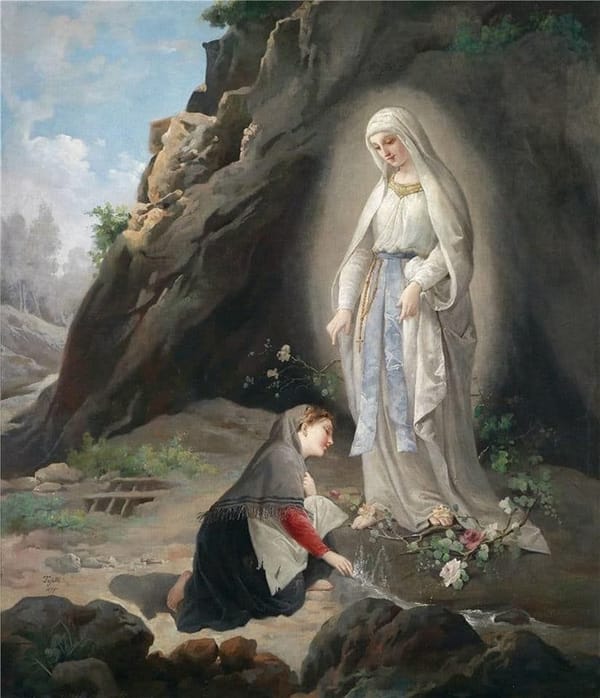
February 11: Our Lady of Lourdes
My bow shall appear in the clouds and I will remember My covenant with you.1
The lessons at Matins on February 11, 1854 (Thursday in Sexagesima week) recalled these words, and the world soon learned that on this very day Mary had appeared, more fair than the sign of hope which typified her at the time of the deluge.
Portents, the realization of which we see in these days, were being multiplied. Mankind had grown old, and seemed about to perish in a deluge more dreadful than the former one. ‘I am the Immaculate Conception,’ said the Mother of divine grace to the humble child whom she chose at such a time to bear her message to the captain of the Ark of salvation. She pierced the gathering darkness with the light of that sublime privilege which the supreme pilot, to his eternal glory, had declared three years before to be dogma.
Indeed, if, as the beloved disciple says, it is our faith to which victory on earth is promised,2 and if faith is nourished by light—what individual dogma is there which so presupposes and recalls all other dogmatic truths, and at the same time throws such light upon them? It is a royal crown on the brow of the victorious queen, resplendent like the rainbow which breaks through the clouds with all the glories of heaven.
But perchance it was still necessary to open the eyes of the blind to these splendours, to inspire courage into hearts saddened by hell’s denials, and to infuse strength to make an act of faith into so many understandings weakened by the education of these days. The Immaculate Virgin summoned the multitudes to the scene of her blessed visit, and both sweetly and strongly succoured the weakness of souls by healing bodies. She smiled upon publicity, welcomed investigation, and confirmed by the authority of miracles her own words and the definition of the Vicar of Christ.
The Psalmist said that the works of God tell His praises in all tongues,3 and St. Paul taxes with folly and impiety those who will not accept this testimony.4 So, too, we may say that the men of these times have no excuse if they do not recognize the blessed Virgin in her works. May she extend the field of her beneficence and take pity on that worst of diseases—that weakness of soul which refuses to see out of a secret fear of the conclusions to be drawn from the evidence, and struggles against the truth until the mind is filled with contradictions and the heart with darkness, so that it seems as though the reason itself were given over to that reprobate sense5 which St. Paul describes as striking the pagans in their flesh.
The things that take place at Lourdes are as famous as any events of contemporary history. Let us listen to the short account which the Church has enshrined in the Liturgy:
‘O Mary, conceived without sin, pray for us who have recourse to thee!’ Thou didst teach us this prayer in 1830 as a safeguard against the dangers of the future. In 1846 the two shepherds of La Salette reminded us of thy tears and exhortations: ‘Pray for poor sinners, pray for the world which is so disturbed.’ To-day the little seer of the grotto of Massabielle brings us thy message: ‘Penitence! Penitence! Penitence!’
We desire to obey thee, O blessed Virgin, to combat in ourselves and all around us that enemy of mankind who is our only real enemy, and sin, that supreme evil which is the source of all others. Praise be to the Almighty, who saved thee from all stain of sin, and thus inaugurated in thee the full restoration of our fallen race. Praise be to thee, who, having no debts of thy own, didst pay our debts with the Blood of thy Son and the tears of His Mother, thus reconciling heaven and earth and crushing the head of the serpent.
Prayer, expiation—the Church from apostolic times has ever urged these thoughts upon us during the days which immediately precede Lent. Dear Mother in heaven, we bless thee for having thus united thy voice to that of our Mother on earth. The world no longer desired, no longer understood, the infallible but indispensable remedy offered by the justice and mercy of God to the misery of man.
Men seemed to have forgotten the words: 'Except you do penance, you shall all perish.’6 Thy pity wakes us from this fatal stupor, O Mary. Thou knowest our weakness, and hast mingled sweetness in the bitter draught. Thou lavishest temporal favours upon man in order that he may ask of thee eternal blessings. We will not be like those children who welcome their mother’s caresses, but neglect her admonitions and the corrections which her tenderness sought to make acceptable. We will pray and suffer in union with Jesus and thee. By thine assistance during this Lent we will be converted and do penance.
Thursday of Sexagesima Week
God promised Noah that He would never more punish the earth with a deluge. But, in His justice, He has many times visited the sins of men with a scourge which, in more senses than one, bears a resemblance to a deluge: the invasion of enemies. We meet with these invasions in every age; and each time we see the hand of God. We can trace the crimes that each of them was sent to punish, and in each we find a manifest proof of the infinite justice wherewith God governs the world.
It is not requisite that we should here mention the long list of these revolutions, which we might almost say make up the history of mankind, for in its every page we read of conquests, extinction of races, destruction of nations, and violent amalgamations, which effaced the traditions and character of the several peoples that were thus forced into union. We will confine our considerations to the two great invasions, which the just anger of God has permitted to come upon the world since the commencement of the Christian era.
The Roman Empire had made itself as preeminent in crime as it was in power. It conquered the world, and then corrupted it. Idolatry and immorality were the civilization it gave to the nations which had come under its sway. Christianity could save individuals in the great empire, but the empire itself could not be made Christian. God let loose upon it the deluge of barbarians. The stream of the wild invasion rose to the very dome of the Capitol; the empire was engulfed. The ruthless ministers of divine justice were conscious of their being chosen for this mission of vengeance, and they gave themselves the name of ‘God's scourge.’
When, later on, the Christian nations of the east had lost the faith which they themselves had transmitted to the western world; when they had disfigured the sacred symbol of faith by their blasphemous heresies; the anger of God sent upon them, from Arabia, the deluge of Mahometanism. It swept away the Christian Churches, that had existed from the very times of the apostles. Jerusalem, the favoured Jerusalem, on which Jesus had lavished His tenderest love, even she became a victim to the infidel hordes. Antioch and Alexandria, with their patriarchates, were plunged into the vilest slavery; and at length Constantinople, that had so obstinately provoked the divine indignation, was made the very capital of the Turkish empire.
And we, the western nations, if we return not to the Lord our God, shall we be spared? Shall the flood-gates of heaven's vengeance, the torrent of fresh Vandals, ever be menacing to burst upon us, yet never come? Where is the country of our own Europe, that has not corrupted its way, as in the days of Noah? that has not made conventions against the Lord and against His Christ?1 that has not clamoured out that old cry of revolt: Let us break their bonds asunder, let us cast away their yoke from us?2 Well may we fear lest the time is at hand, when, despite our haughty confidence in our means of defence, Christ our Lord, to whom all nations have been given by the Father, shall rule us with a rod of iron, and break us in pieces like a potter’s vessel.3 Let us propitiate the anger of our offended God, and follow the inspired counsel of the royal prophets Serve ye the Lord with fear; embrace the discipline of His Law; lest, at any time, the Lord be angry, and ye perish from the just way.4
We find the following beautiful words in the Ambrosian liturgy for Septuagesima. They occur in the missal.
Transitorium
(Dominica in Quinquagesima.)
| Previous Wednesday of Sexagesima Week | Next Thursday of Sexagesima Week |