lyp.network

Daily reading

Septuagesima

Double · February 12 · Sanctoral

February 12, 2021

From Dom Guéranger’s The Liturgical Year.

A Double leads the weekday.Rubric
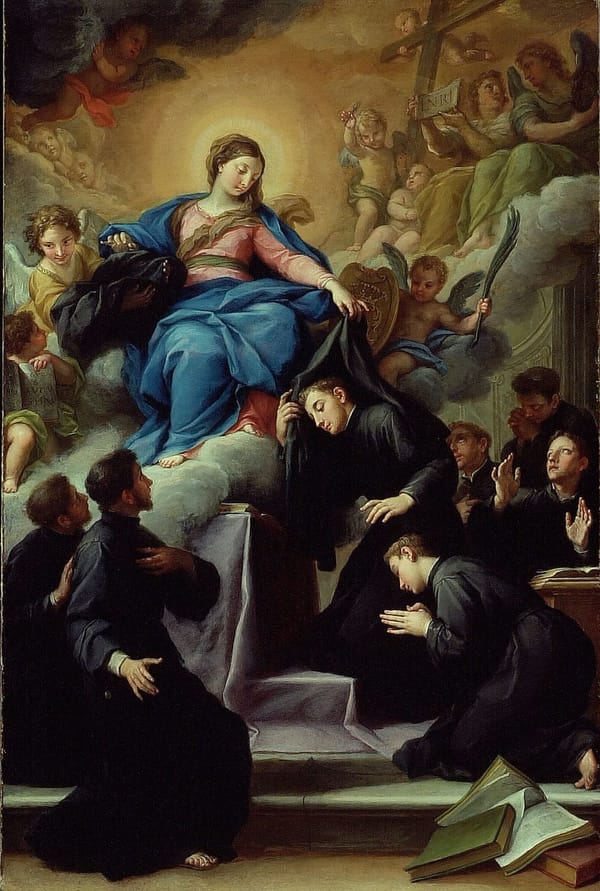
The Madonna with the Seven Founders of the Servite Order
The Madonna with the Seven Founders of the Servite Order, Agostino Masucci (1691–1758), 1728. Credits

February 12: The Seven Holy Founders of the Order of Servites, Confessors

Clouds are gathering over Holy Church. We are reminded on every side of the approach of those days when our Emmanuel will show Himself to us in the pitiable state to which our sins have brought Him. Bethlehem is so soon followed by Calvary. We shall find the Mother of divine grace at the foot of the Cross as we found her at Ephrata. She brought forth her firstborn in joy, but now in tears she is to bring forth those brothers of His whose birth cost her so much. We have shared her joy, and we shall not refuse to weep and suffer with her.

Let us take for our models the saints whom the Church honours to-day. They passed their lives in the contemplation of our Lady’s sorrows, and the Order which they founded has the special mission to spread this devotion. St. Francis of Assisi raised the standard of the Cross anew in a world grown cold. The work of redemption seemed to be taken up afresh, and, as on the great Friday Jesus would not manifest Himself without Mary, the Servites completed the work of the Founder of the Friars Minor. Men regained confidence as they meditated on the Passion of the Son and the Compassion of the Mother.

The two feasts consecrated to the Dolours of our Lady will teach us in due course what place her compassion had in the economy of the Redemption. The Queen of heaven herself showed her predilection for the Order which made itself her apostle, in the striking outpouring of holiness which marked its origin. The simultaneous blooming of seven lilies, gathered on earth to-day by the angels, was a sight new even to heaven. Peter of Verona had a vision of them when they were implanting themselves on Monte Senario; and the future martyr saw the blessed Virgin smile as she gazed on that mountain where countless other flowers sprang up to perfume holy Church. Florence, the city of flowers, had never before given such blooms to God. Hell multiplied its attacks against the noble city, but could not prevail against Mary within its walls. We shall be reminded of these things by the feasts of St. Juliana Falconieri and St. Philip Benizi, which were established before the one we are keeping to-day. Let us unite our gratitude to that which the Church feels for the Religious family of the Servites. The world owes to them the grace of a new development in the knowledge and love of the Mother of God, who became our Mother at the price of unparalleled sufferings.

The lessons read by the Church on this day speak of the merits of our Saints and the favours with which our Lady rewarded their fidelity. February 11, the day first chosen as their common feast, is not the anniversary of the death of any one of them, but the day on which, in the year 1304, after passing through many vicissitudes, their Order obtained the definitive approbation of the Church.

Sæculo tertio decimo, cum Friderici secundi diro schismate, cruentisque factionibus cultiores Italiæ populi scinderentur, providens Dei misericordia præter alios sanctitate illustres, septem e Fiorentina nobilitate viros suscitavit, qui in caritate conjuncti, præclarum fraternæ dilectionis præberent exemplum. Hi, nimirum, Bonfilius Monaldius, Bonajuncta Manettus, Manettus Antelensis, Amedeus de Amideis, Uguccio Uguccionum, Sostenus de Sosteneis et Alexius Falconerius, cum anno trigesimo tertio ejus sæculi, die sacra cælo Virgini receptæ, in quodam piorum hominum conventu, Laudantium nuncupato, ferventius orarent; ab eadem Deipara singulis apparente sunt admoniti, ut sanctius perfectiusque vitæ genus amplecterentur. Re itaque prius cum Florentino præsule collata, hi septem viri, generis nobilitate divitiisque posthabitis, sub vilissimis detritisque vestibus cilicio induti, octava die Septembris in ruralem quamdam ædiculam secessere, ut ea die primordia vitæ sanctioris auspicarentur, qua ipsa Dei Genitrix mortalibus orta sanctissimam vitam inceperat.
Hoc vitæ institutum quam sibi foret acceptum Deus miraculo ostendit. Nam cum paulo deinceps hi septem viri per Florentinam urbem ostiatim eleemosynam emendicarent, accidit, ut repente infantium voce, quos inter fuit sanctus Philippus Benitius quintum ætatis mensem vix ingressus, beatæMariæ Servi acelamarentur: quo deinde nomine semper appellati sunt. Quare, vitandi populi occursus ac solitudinis amore ducti in Senarii montis recessu omnes convenere, ibique cæleste quoddam vitæ genus aggressi sunt. Victitabant enim in speluncis, sola aqua herbisque contenti: vigiliis aliisque asperitatibus corpus attenebant: Christi passionem ac mœstissimæ ejusdem Genitricis dolores assidue meditantes. Quod quum olim sacra Parasceves die impensius exsequerentur, ipsa beata Virgo illis iterato apparens, lugubrem vestem quam induerent, ostendit, sibique acceptissimum fore significavit, ut novum in Ecclesia regularem Ordinem excitarent, qui jugem recoleret ac promoveret memoriam dolorum, quos ipsa pertulit sub cruce Domini. Hæc sanctus Petrus, inclytus Ordinis Prædicatorum martyr, ex familiari cum sanctis illis viris consuetudine ac peculiari etiam Deiparæ visione quum didicisset; iis auctor fuit ut Ordinem Regularem sub appellatione Servorum beatæ Virginis instituerent; qui postea ab Innocentio quarto Pontifice Maximo approbatus fuit.
Porro sancti illi viri, quum plures sibi socios adjunxissent, Italiæ civitates atque oppida, præsertim Etruriæ, excurrere cœperunt, prædicantes ubique Christum cruci fixum, civiles discordias compescentes, et innumeros fere devios ad virtutis semitam revocantes. Neque Italiam modo, sed et Galliam, Germaniam ac Poloniam suis evangelicis laboribus excoluerunt. Denique quum bonum Christi odorem longe lateque diffudissent, portentorum quoque gloria illustres, migrarunt ad Dominum. Sed quos unus veræ fraternitatis ac religionis amor in vita scoiaverat, unum pariter demortuos contexit sepulchrum, unaque populi veneratio prosecuta est. Quapropter Clemensundecimus et Benedictus decimus tertius Pontifices Maximi delatum iisdem a pluribus sæculis individuum cultum confirmarunt: ac Leo decimus tertius, approbatis antea miraculis, post indultam venerationem ad collectivam earumdem invocationem a Deo patratis, eosdem anno quinquagesimo sacerdotii sui Sanctorum honoribus cumulavit eorumque memoriam Officio ac Missa in universa Ecclesia quotannis recolendam instituit.
When in the thirteenth century the most cultured peoples of Italy were divided by factions, and the schism fostered by Frederic II, the merciful providence of God raised up many persons remarkable for their holiness, among whom were seven noble Florentines whose union of spirit gave to the world a striking example of fraternal love. They were Bonfilius Monaldi, Bonagiunta Manetti, Manettus dell' Antella, Amadeus de Amadei, Hugo Lippi, Gerard Sostegni, and Alexis Falconieri. The Mother of God appeared to each of them on the feast of her Assumption, 1233, when they were praying fervently in the Chapel of the pious Confraternity of the Laudesi, and exhorted them to embrace a more perfect life. They took counsel with the Bishop of Florence, and at once bade farewell to their wealth and rank, clothing themselves in hair cloth and old and ragged garments. On September 8 they established themselves in a humble retreat outside the city, desiring to begin their new life on the day when the Mother of God began her own most holy life upon earth.
God showed by a miracle that their resolution was pleasing to him. One day shortly afterwards, when all seven were begging from door to door in Florence, they were hailed by the voices of children, among whom was St. Philip Benizi, then only five months old, as the “Servants of Mary,” which was for the future to be their title. This prodigy and their love of solitude led them to choose Monte Senario as a place of retreat, that thus they might avoid great concourse of people. Their life was truly heavenly. They lived in caves, took no food but herbs and water, and subdued their bodies by vigils and penances. The Passion of Christ and the Dolours of his afflicted Mother were the subject of their continual meditations. One Good Friday, when they were absorbed in fervent prayer, the blessed Virgin appeared to them all in person a second time, showed them the sombre habit they were to adopt, and told them that she wished them to found a new Order of Religious, whose mission was to cultivate and spread devotion to the sorrows which she endured at the foot of the Cross. They were aided in this work by Peter, an illustrious Friar Preacher, who died the death of a martyr. He was their intimate friend, and had been instructed about the new Order in a vision by the blessed Virgin herself. The Order received the name of Servites, or Servants of the blessed Virgin Mary, and was approved by Innocent IV.
The holy Founders were soon joined by many disciples, and began to preach Christ Crucified in the towns and cities of Italy, especially in Tuscany. They brought civil feuds to an end, and recalled numbers of sinners to the paths of virtue. Not only Italy, but France, Germany, and Poland benefited by their apostolic labours, and their miracles made them famous. Finally, after having carried the good odour of Christ into distant lands, they went to God. In life they were one in their love of religion and of the brotherhood, in death they wore united in one tomb and in the veneration of the people. Popes Clement XI. and Benedict XIII. confirmed the cultus which had been paid to them unitedly for many centuries. Leo XIII., having approved this devotion, and recognized the miracles wrought by God in answer to this collective invocation, proceeded to their formal canonization in the fiftieth year of his priesthood, and ordered that their Office and Mass should be said every year throughout the Church.

You made the sorrows of Mary your own, and now she shares her eternal joys with you. The vine with its miraculously ripening grapes, which prefigured your fruitfulness in a frozen world, still yields a sweet odour in this land of exile, and the faithful still appreciate its fruit. Philip and Juliana have long been honoured as branches of this blessed vine, and to-day we pay our homage to the sevenfold root from which they sprang. You rejoiced in the obscurity which covered the life upon earth of the Queen of saints herself, but to-day the glory of Mary pierces all clouds, and no shadow can withdraw the servants from the radiance which surrounds the Mistress. May your glory be increased by the favours you bestow upon men! Teach an aged world to seek warmth at the fire whence you draw a love strong enough to triumph over the world and sacrifice self for God.

O Heart of Mary, pierced by the sword of sorrow, furnace of love which throughout all eternity feeds the fires of the very Seraphim, be our model, our refuge, and our consolation until the dawn of that blissful day which is to be the end of our exile in this vale of tears.


Friday of Sexagesima Week

God chastises the world by the deluge; but He is faithful to the promise made to our first parents, that the head of the serpent should be crushed. The human race has to be preserved, therefore, until the time shall come for the fulfilment of this promise. The Ark gives shelter to the just Noah, and to his family. The angry waters reach even to the tops of the highest mountains; but the frail yet safe vessel rides peacefully on the waves. When the day fixed by God shall come, they that dwell in this Ark shall once more tread the earth, purified as it then will be; and God will say to them, as heretofore to our first parents: ‘Increase, and multiply, and fill the earth.'1

Mankind, then, owes its safety to the Ark. O saving Ark, that wast planned by God Himself, and didst sail unhurt amidst the universal wreck! But if we can thus bless this contemptible wood,2 how fervently should we love that other Ark, of which Noah’s was but the figure, and which, for now eighteen hundred years, has been saving and bringing men to their God! How fervently should we bless that Church, the bride of our Jesus, out of which there is no salvation, and in which we find that truth which delivers us from error and doubt,3 that grace which purifies the heart, and that food which nourishes the soul and fits her for immortality!

O sacred Ark! thou art inhabited, not by one family alone, but by people of every nation under the sun. Ever since that glorious day, when our Lord launched thee in the sea of this world, thou hast been tossed by tempests, yet never wrecked. Thou wilt reach the eternal shore, witnessing, by thy unworn vigour and beauty, to the divine guidance of the Pilot, who loves thee, both for thine own sake, and for the work thou art doing for His glory. It is by thee that He peoples the world with His elect, and it is for them that He created the world.4 When He is angry, He remembers mercy,5 because of thee, for it is through thee that He has made His covenant with mankind.

O venerable Ark! be thou our refuge in the deluge. When Rome’s great empire, that was drunk with the blood of the martyrs,6 sank beneath the invasion of the barbarians, the Christians were safe, because sheltered by thee; the waters slowly subsided, and the race of men that had fled to thee for protection, though conquered according to the flesh, was victorious by the spirit. Kings, who till then had been haughty despots and barbarians, kissed reverently the hand of the slave, who was now their pastor and baptized them. New peoples sprang up, and, with the Gospel as their law, began their glorious career in those very countries which the Cæsars had degraded and forfeited.

When the Saracen invasion came sweeping into ruin the eastern world, and menacing the whole of Europe, which would have been lost had not the energy of thy sons repelled the infidel horde, was it not within thee, O Ark of salvation! that the few Christians took refuge, who had resisted schism and heresy, and who, whilst the rest of their brethren apostatized from the faith, still kept alive the holy flame? Under thy protection they are even now perpetuating, in their unfortunate countries, the traditions of faith, until the divine mercy shall bring happier times, and they be permitted to multiply, as did of old the sons of Sem, in that land once so glorious and holy.

Oh! happy we, dear Church of God! that are sheltered within thee, and protected by thee against that wild sea of anarchy, which the sins of men have let loose on our earth! We beseech our Lord to check the tempest with that word of His omnipotence: 'Thus far shalt thou come, and no further, and here shalt thou break thy swelling waves.’7 But if His divine justice has decreed that it prevail for a time, we know that it cannot reach such as dwell in thee. Of this happy number are we. In thy peaceful bosom, dear mother, we find those true riches, the riches of the soul, of which no violence can deprive us.8 The life thou givest us is the only real life. Our true fatherland is the kingdom formed by thee. Keep us, O thou Ark of our God! Keep us, and all that are dear to us, and shelter us beneath thy roof, until the deluge of iniquity be passed away.9 When the earth, purified by its chastisements, shall once more receive the seed of the divine word which produces the children of God, those among us, whom thou shalt not have led to our eternal home, will then venture forth, and preach to the world the principles of authority and law, of family and social rights: those sacred principles, which came from heaven, and which thou, O holy Church, art commissioned to maintain and teach, even to the end of time.

We borrow from the Mozarabic missal the following eloquent appeal to divine mercy.

Prayer (In Dominica V. post Epiphaniam .)

Exaudi nos Domino Dens noster, et humanæ iniquitatis oblitus, divinæsolius misericordiæ recordare. Exaudi, quæsumus, dum peccare non pateris, dura emendare nos præcipis, dum rogare permittis: dum patientia reditum quærendæ correctionis exspectat; dum justitia metum futuræ discussionis insinuat: dum misericordia locum evadendæ mortis ostentat. Inveniant ante oculos tuos sacrificia nostra gratiam: peccata veniam: vulnera medicinam: suspiria pietatem: flagella consolationem: lamenta temperiem: temporaquietem: officia dignitatem: vota mercedem. Mereatur petitio effectum, contritio solatium, consecratio Sacramentum. Oblatio sanctificatione pinguescat, trepidatio securitate discedat, benedictio salubritate proficiat; ut in omnibus multiplici pietatis tuæ gratia redundante, erigas plebem, dum lætificas sacerdotem. Amen.
Graciously hear, O Lord our God, and forgetting man’s iniquity, remember only thine own mercy. Graciously hear us, we beseech thee, O thou that forbiddest us to sin, that commandest us to repent, that permittest us to pray! Thy patience awaits our return to the needed repentance; thy justice inspires us with a fear of the future judgment; thy mercy shows us how we may avoid death. May our sacrifices find favour in thine eyes; our sins, pardon; our wounds, cure; our sighs, pity; our chastisements, consolation; our tears, joy; our days, peace; our duties, honour; our prayers, reward. May our petition produce its effect; our contrition, forgiveness; our consecration, the sacred mystery. May our oblation be rich unto sanctification, our fear be cast out by security, and our blessing be fruitful unto salvation; that thus in all things, by the manifold and overflowing grace of thy mercy, thou mayst bless the people, whilst thou givest joy to the priest. Amen.
  1. Gen. ix. 1. ↩︎
  2. Wisd. x. 4. ↩︎
  3. St. John viii. 32. ↩︎
  4. St. Matt. xxiv. 22. ↩︎
  5. Hab. iii. 2. ↩︎
  6. Apoc. xvii. 6. ↩︎
  7. Job xxxviii. 11. ↩︎
  8. St. Matt. vi. 20. ↩︎
  9. Ps. lvi. 2. ↩︎
Previous
Thursday of Sexagesima Week
Next
Friday of Sexagesima Week