Daily reading
Semidouble · Movable from Easter · Temporal
March 4, 2021
From Dom Guéranger’s The Liturgical Year.
Thursday of the Second Week of Lent
The Station for to-day is in the celebrated basilica, St. Mary’s across the Tiber. It was consecrated in the third century, under the pontificate of St. Callixtus, and was the first church built in Rome in honour of our blessed Lady.
Collect
Epistle
Cap. xvii.Hæc dicit Dominus Deus: Maledictus homo qui confidit in homine, et ponit carnem nem brachium euum, et a Domino recedit cor ejus. Erit enim quasi myricæ in deserto, et non videbit cum venerit bonum; sed habitant in siccitate in deserto, in terra salsuginis et inhabitabili. Benedictus vir, qui confidit in Domino, et erit Dominus fiducia ejus. Et erit quasi lignum quod transplantatur super aquas, quod ad humorem mittit radices euas: et non timebit cum venerit æstus. Et erit folium ejus viride, et in tempore siccitatis non erit sollicitum, nec aliquando desinet facere fructum. Pravum est cor omnium et inscrutabile: quis cognoscet illud? Ego Dominus scrutans cor, et probans renes; qui do unicuique juxta viam suam, et juxta fructum adinventionum suarum, dicit Dominus omnipotens.
Ch. xvii.Thus saith the Lord: Cursed be the man that trusteth in man, and maketh flesh his arm, and whose heart departeth from the Lord. For he shall be like tamarick in the desert, and he shall not see when good shall come; but he shall dwell in dryness in the desert, in a salt land and not inhabited. Blessed be the man that trusteth in the Lord, and the Lord shall be his confidence. And he shall be as a tree that is planted by the waters, and spreadeth out its roots towards moisture; and it shall not fear when the heat cometh. And the leaf thereof shall be green, and in the time of drought it shall not be solicitous, neither shall it cease at any time to bring forth fruit. The heart is perverse above all things, and unsearchable; who can know it? I am the Lord who search the heart, and prove the reins; who give to every one according to his way, and according to the fruit of his devices, said the Lord almighty.
The Epistle and Gospel for to-day are intended as instructions upon Christian morality. Let us, for a moment, turn away our eyes from the sad spectacle of the plot which is being formed against our Redeemer, by His enemies; let us, to-day, think of our own sins, and how to apply a remedy. The prophet Jeremias here gives us the description of two classes of men: to which class do we belong? There are some men who make flesh their arm; that is to say, they care only for this present life and for created things; and this disposition of mind necessarily leads them to frequent violations of the commandments of their Creator. It was so with US, when we sinned: we lost sight of our last end, and the threefold concupiscence blinded us. Let us lose no time, but return to the Lord our God; a delay might bring upon us that curse, which our prophet says overtakes the unrepenting sinner; he shall not see goody when good shall come. The holy season of Lent is fast advancing; the choicest graces are being daily offered us; woe to the man whose mind is distracted by the fashion of this world that passeth away,1 and takes no thought for eternity and heaven, and, even in this time of grace, is like tamarick a worthless weed of the desert. Oh how numerous is this class! and how terrible is their spiritual indifference! Pray for them, O ye faithful children of the Church, pray for them without ceasing. Offer up your penances and your almsgivings for them. Despair not; and remember that, each year, many straying sheep are brought to the fold by such intercession as this.
The prophet next describes the man that trusteth in the Lord; his whole hope is in God, and his whole care is to serve Him and to do His blessed will. He is like a beautiful tree that is planted near a stream of water, with its leaf ever green, and its fruit abundant. ‘I have appointed you,’says our Redeemer, ‘that you should go, and should bring forth fruit, and your fruit should remain. ’2 Let us become this favoured and ever fruitful tree. The Church, during this holy time, is pouring out upon our hearts rich streams of God's grace: let us faithfully welcome them. The Lord searcheth the heart: if He find that our desire to be converted is sincere, what an Easter will the coming one be to us!
Gospel
Cap. xvi.In illo tempore: Dixit Jesus pharisaeis: Homo quidam erat dives, qui induebatur purpura et bysso: et epulabatur quotidie splendide. Et erat quidam mendicus, nomine Lazarus, qui jacebat ad januam ejus, ulceribus plenus, cupiens saturan de micis quæ cadebant de mensa divitis, et nemo illi dabat; sed et canes veniebant, et lingebant ulcera ejus. Factum est autem ut moreretur mendicus, et portaretur ab angelis in sinum Abrahæ. Mortuus est autem et dives, et sepultus est in inferno. Elevans autem oculos suos, cum esset in tormentis, vidit Abraham a longe, et Lazarum in sinu ejus: et ipse damans dixit: Pater Abraham miserere mei, et mitte Lazarum ut in tingat extremum digiti 8ui in aquam, ut ref rigeret linguam meam, quia crucior in hac flamma. Et dixit illi Abraham: Fili, recordare quia recepisti bona in vita tua, et Lazarus similiter mala: nunc autem hic consolatur, tu vero cruciaris. Et in his omnibus, inter nos et vos chaos magnum firmatum est: ut hi, qui volunt hinc transire ad vos, non possint, neque inde hue transmeare. Et ait: Rogo ergo te, pater, ut mittas eum in domum patris mei; habeo enim quinque fratres, ut testetur illis, ne et ipsi veniant in hunc locum tormento rum. Et ait illi Abraham: Habent Moysen et prophetas: audiant ülos. At ille dixit: Non, pater Abraham: sed si quis ex mortuis ierit ad eos, pœnitentiam agent. Ait autem illi: Si Moysen et prophetae non audiunt, neque si quis ex mortuis resurrexerit, credent.
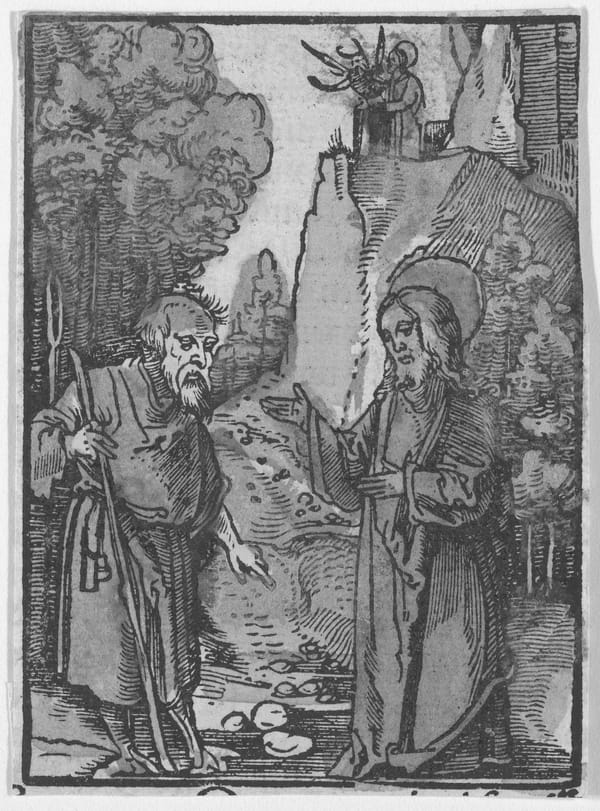
Ch. xvi.At that time: Jesus said to the pharisees: There was a certain rich man, who was clothed in purple and fine linen, and feasted sumptuously every day. And there was a certain beggar, named Lazarus, who lay at his gate, full of sores, desiring to be fed with the crumbs that fell from the rich man’s table, and no one did give him: moreover the dogs came and licked hia sores. And it came to pass that the beggar died, and was carried by the angels into Abraham’s bosom. And the rich man also died, and he was buried in hell. And lifting up his eyes, when he was in torments, he saw Abraham afar off, and Lazarus in his bosom. And he cried and said: Father Abraham, have mercy on me, and .send Lazarus that he may dip the tip of his finger in water, to cool my tongue, for I am tormented in this flame. And Abraham said to him: Son, remember that thou didst receive good things in thy lifetime, and likewise Lazarus evil things: but now he is comforted, and thou art tormented. And besides all this, between us and you there is fixed a great chaos; so that they who would pass from hence to you, cannot, nor from thence come hither. And he said: Then, father, I beseech thee that thou wouldst send him to my father’s house; for I have five brethren, that he may testify unto them, lest they also come into this place of torments. And Abraham said to him: They have Moses and the prophets; let them hear them. But he said: No, father Abraham, but if any one went to them from the dead, they will do penance. And he said to him; If they hear not Moses and the prophets, neither will they believe if one rise again from the dead.
The commandments of God cannot be broken with impunity; he that sins shall be punished. This is the teaching of to-day’s Gospel; and after reading it, we exclaim with the apostle: ‘How fearful a thing it is to fall into the hands of the living God!’3 What a terrible truth is here told us! A man is in the enjoyment of every comfort and luxury this life can give; when suddenly death surprises him, and he is buried in hell! In the midst of those eternal burnings, he asks for a drop of water, and that drop is refused him. Other men, whom he knew on earth a few hours ago, are now in the abode of eternal happiness, and a great chaos separates him from them for ever. Oh, what misery! To be in despair for endless ages! And yet there are men that live and die without giving so much as one day to think upon hell! Happy, then, are they that fear, for this fear will aid them to lighten that weight of their sins, which would drag them into the bottomless pit.
Alas! what strange darkness has come upon the mind of man as a consequence of sin! People that are shrewd, and prudent, and far-sighted in everything that regards their temporal concerns, are mere idiots and fools in every question that regards eternity. Can we imagine anything more frightful than their surprise when they awaken in the next world and find themselves buried in hell? Observe, too, that our Saviour, in order to make His instruction more impressive, has not here described the condemnation of one whose crimes scandalize the neighbourhood, and make even worldlings look upon him as a sure prey of hell. The history He gives us is that of a man who led a quiet life; he was agreeable in company, and sought after; he was respected, and did honour to the position he held in society. He is not accused of any public scandals; there is no mention made of any atrocious crime; our Saviour simply says of him: he was clothed in purple and fine linen, and feasted sumptuously every day. It is true, he was not charitable to the poor man who lay at his gate; hut he did not ill-treat him: he allowed him to lie there, and did not even insult his misery. Why, then, was this rich man condemned to bum eternally in that fire which God created for the wicked? It is because a man who leads a life of luxury and feasting, such as he lived — never thinking of eternity, caring for nothing but this world, which we are told to use as though we used it not,4 with nothing about him of the spirit of the cross of Christ—such a man as this is already a victim to the triple concupiscence of pride, avarice, and luxury; he is their slave, and seems determined to continue so, for he never makes an effort to throw off their tyranny. He has yielded himself up to them; and they have worked their work in him—the death of the soul. It was not enough that he should not ill-treat the poor man that sat at his gate, he ought to have shown him kindness and charity, for such is God’s commandment. His very dogs had more compassion than he; therefore, his condemnation and perdition were most just. But had he been told of his duty? Yes, he had the Scriptures; he had Moses and the prophets; nay more, he had Jesus and the Church. Men who are leading a life like this, are now surrounded by the graces of the holy season of Lent. What excuse will they have, if they so far neglect them, that they do not even give themselves the trouble to think of them? They will have turned their Lent into judgment against themselves, and it will have been but one great step nearer to eternal misery.
The hymn of Prudentius, which we have followed with so much interest during this week, thus closes:
Hymn
Quod consecrati tu magister dogmatis
Tuis dedisti, Christe, sectatoribus;
Ut quum vorandi vicerit libidinem,
Late triumphet imperator spiritus.
Mundi, polique quod gubornator probat,
Altarie aram quod facit plac&bilem,
Quod dormientis excitat cordis fidem,
Quod limat ægram pectorum rubiginem.
Nec sic calente sole tabescunt nives,
Ut turbidarum scabra culparum seges
Vanescit almo trita sub jejunio,
Si blanda semper misceatur largitas.
Operire nudos, indigentes pascere,
Opem benignam ferre supplicantibus,
Unam paremque sortis humanæ vicern
Inter potentes, atque egenos ducere.
Laudis rapacem, prodigam pecuniae,
Cujus sinistra dulce factum nesciat.
Ilium perennes protinus complent opes,
Ditatque fructus foenerantem centuplex.
grant that we may all now walk courageously
in the path thou hast marked out for thy followers;
that our spirit, having subdued gluttony,
may in all things triumph and be master.
it is dear to the King of earth and heaven;
it makes the great sacrifice of tho altar acceptable:
it stirs up the faith of the drowsy heart;
it takes from the soul the rust that clogs her power.
or as snow is melted by a scorching sun;
so (but by a higher law) are the wild weeds of our base sins
uprooted by the sacred power of fasting,
when joined with charitable alms unstintingly bestowed.
to clothe the naked, to feed the hungry,
to kindfy help the needy, and to behave towards all,
both rich and poor,
as members of the one great family of mankind.
whose right hand works the praiseworthy deed of lavish alms,
but whose left hand knows not the sweet charity done!
Such a man shall receive eternal riches,
and interest a hundredfold shall be given to him who thus lends to the poor.
March 4: St. Casimir, Confessor
It is from a court that we are to be taught to-day the most heroic virtues. Casimir is a prince; he is surrounded by all the allurements of youth and luxury; and yet he passes through the snares of the world with as much safety and prudence, as though he were an angel in human form. His example shows us what we may do. The world has not smiled on us as it did on Casimir; but how much we have loved it! If we have gone so far as to make it our idol, we must now break what we have adored, and give our service to the sovereign Lord, who alone has a right to it. When we read the lives of the saints, and find that persons who were in the ordinary walks of life practised extraordinary virtues, we are inclined to think that they were not exposed to great temptations, or that the misfortunes they met with in the world made them give themselves up unreservedly to God’s service. Such interpretations of the actions of the saints are shallow and false, for they ignore this great fact, that there is no condition or state, however humble, in which man has not to combat the evil inclinations of his heart, and that corrupt nature alone is strong enough to iead him to sin. But in such a saint as Casimir we have no difficulty in recognizing that all his Christian energy was from God, and not from any natural source; and we rightly conclude that we, who have the same good God, may well hope that this season of spiritual regeneration will change and better us. Casimir preferred death to sin. But is not every Christian bound to be thus minded every hour of the day? And yet, such is the infatuation produced by the pleasures or advantages of this present life, that we every day see men plunging themselves into sin, which is the death of the soul; and this, not for the sake of saving the life of the body, but for a vile and transient gratification, which is oftentimes contrary to their temporal interests. What stronger proof could there be than this, of the sad effects produced in us by original sin? The examples of the saints are given us as a light to lead us in the right path, let us follow it, and we shall be saved. Besides, we have a powerful aid in their merits and intercession: let us take courage at the thought that these friends of God have a most affectionate compassion for us their brethren, who are surrounded by so many and great dangers.
The Church, in her liturgy, thus describes to us the virtues of our young prince:
Enjoy thy well-earned rest in heaven, O Casimir! Neither the world with all its riches, nor the court with all its pleasures, could distract thy heart from the eternal joys it alone coveted and loved. Thy life was short, but full of merit. The remembrance of heaven made thee forget the earth. God yielded to the impatience of thy desire to be with Him, and took thee speedily from among men. Thy life, though most innocent, was one of penance, for knowing the evil tendencies of corrupt nature, thou hadst a dread of a life of comfort. When shall we be made to understand that penance is a debt we owe to God, a debt of expiation for the sins we have committed against Him? Thou didst prefer death to sin; obtain for as a fear of sin, that greatest of all the evils that can befall as, because it is an evil which strikes at God Himself. Pray for as daring this holy season, which is intended as a preparation for penance; impress our minds with the truths now put before us. The Christian world is honouring thee to-day; repay its homage by thy blessing. Poland, thy fatherland, once the bulwark of the Church, which kept back the invasion of schism, heresy, and infidelity, beseeches thy prayers.
March 4 (the Same Day): St. Lucius, Pope and Martyr
On this day a commemoration is made of St. Lucius, Pope and Martyr. He was a Roman by birth, and succeeded Pope Cornelius in 252. Shortly after his accession he was sent into exile by the Emperor Gallus, but was soon recalled, to the great joy of the Roman people. St. Cyprian quotes decrees issued by him against the Novatians. He died after a very short pontificate on March 4, 253. His relics were translated to the church of St. Cecilia, where they are exposed to the veneration of the Faithful.
Antiphon
| Previous Wednesday of the Second Week of Lent | Next March 4: St. Casimir, Confessor |