Daily reading
Lent
Double · March 12 · Sanctoral
March 12, 2021
From Dom Guéranger’s The Liturgical Year.
A Double leads the weekday.Rubric
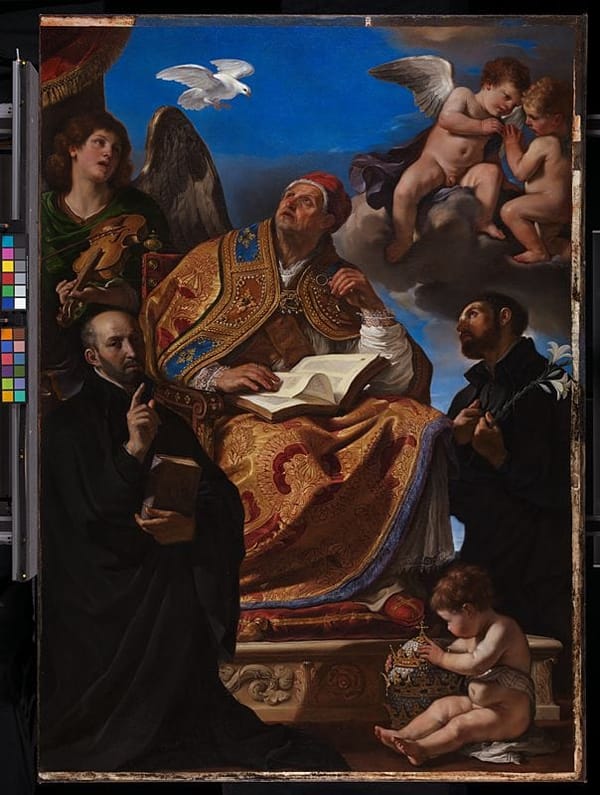 |
March 12: St. Gregory the Great, Pope and Doctor of the Church
Among all the pastors whom our Lord Jesus Christ has placed, as His vicegerents, over the universal Church, there is not one whose merits and renown have surpassed those of the holy Pope, whose feast we keep to-day. His name is Gregory, which signifies watchfulness; his surname is ‘the Great,’ and he was in possession of that title, when God sent the Seventh Gregory, the glorious Hildebrand, to govern His Church.
In recounting the glories of this illustrious Pontiff, it is but natural we should begin with his zeal for the services of the Church. The Roman liturgy, which owes to him some of its finest hymns, may be considered as his work, at least in this sense, that it is he who collected together and classified the prayers and rites drawn up by his predecessors, and reduced them to the form in which we now have them. He collected also the ancient chants of the Church, and arranged them in accordance with the rules and requirements of the divine Service. Hence it is, that our sacred music, which gives such solemnity to the liturgy, and inspires the soul with respect and devotion during the celebration of the great mysteries of our faith, is known as the Gregorian chant.
He is, then, the apostle of the liturgy, and this alone would have immortalized his name; but we must look for far greater things from such a Pontiff as Gregory. His name was added to the three, who had hitherto been honoured as the great Doctors of the Latin Church. These three are Ambrose, Augustine, and Jerome; who else could be the fourth but Gregory? The Church found in his writings such evidence of his having been guided by the Holy Ghost, such a knowledge of the sacred Scriptures, such a clear appreciation of the mysteries of faith, and such unction and authority in his teachings, that she gladly welcomed him as a new guide for her children.
Such was the respect wherewith everything he wrote was treated, that his very letters were preserved as so many precious treasures. This immense correspondence shows us that there was not a country, scarcely even a city, of the Christian world, on which the Pontiff had not his watchful eye steadily fixed; that there was not a question, however local or personal, which, if it interested religion, did not excite his zeal and arbitration as the Bishop of the universal Church. If certain writers of modern times had but taken the pains to glance at these letters, written by a Pope of the sixth century, they would never have asserted, as they have, that the prerogatives of the Roman Pontiff are based on documents fabricated, as they say, two hundred years after the death of Gregory.
Throned on the apostolic See, our saint proved himself to be a rightful heir of the apostles, not only as the representative and depositary of their authority, but as a fellow-sharer in their mission of calling nations to the true faith. To whom does England owe her having been, for so many ages, ‘the island of saints’? To Gregory, who, touched with compassion for those Angli, of whom, as he playfully said, he would fain make Angeli, sent to their island the monk Augustine with forty companions, all of them, as was Gregory himself, children of St. Benedict. The faith had been sown in this land as early as the second century, but it had been trodden down by the invasion of an infidel race. This time the seed fructified, and so rapidly that Gregory lived to see a plentiful harvest. It is beautiful to hear the aged Pontiff speaking with enthusiasm about the results of his English mission. He thus speaks in the twenty-seventh Book of his Morals: ‘Lo! the language of Britain, which could once mutter naught save barbarous sounds, has long since begun to sing, in the divine praises, the Hebrew Alleluia! Lo! that swelling sea is now calm, and saints walk on its waves. The tide of barbarians, which the sword of earthly princes could not keep back, is now hemmed in at the simple bidding of God’s priests.’*
During the fourteen years that this holy Pope held the place of Peter, he was the object of the admiration of the Christian world, both in the east and in the west. His profound learning, his talent for administration, his position, all tended to make him beloved and respected. But who could describe the virtue of his great soul? That contempt for the world and its riches, which led him to seek obscurity in the cloister; that humility, which made him flee the honours of the papacy, and hide himself in a cave, where, at length, he was miraculously discovered, and God Himself put into his hands the keys of heaven, which he was evidently worthy to hold, because he feared the responsibility; that zeal for the whole flock, of which he considered himself not the master, but the servant, so much so indeed that he assumed the title, which the Popes have ever since retained, of ‘servant of the servants of God’ that charity which took care of the poor throughout the whole world; that ceaseless solicitude, which provided for every calamity, whether public or private; that unruffled sweetness of manner, which he showed to all around him, in spite of the bodily sufferings which never left him during the whole period of his laborious pontificate; that firmness in defending the deposit of the faith, and crushing error wheresoever it showed itself; in a word, that vigilance with regard to discipline, which made itself felt for long ages after in the whole Church? All these services and glorious examples of virtue have endeared our saint to the whole world, and will cause his name to be blessed by all future generations, even to the end of time.
Let us now read the abridged life of our saint, as given us in the liturgy.
To these admirable lessons we subjoin a selection of antiphons and responsories, which are taken from an Office approved of by the holy See, for this feast of so great a saint.
Antiphons and Responsories*
St. Peter Damian, whose feast we kept a few days back, composed the following hymn in honour of our apostle:
Nunc angelorum eocius,
Ut tunc, Gregori, gentibus
Succurre jam credentibus.
Omnemque mundi gloriam
Spernis, ut inops inopem
Jesum sequaris principem.
Dum stipem petit angelus;
Tu munus jam post geminum,
Præbes et vas argenteum.
Suæ præfert Ecclesiæ:
Sic Petri gradum percipis,
Cujus et normam sequeris.
Lux et decus Ecclesiæ,
Non sinas in periculis,
Quos tot mandatis instruis.
Tua distillant labia,
Fragrantum vim aromatum
Tuum vincit eloquium.
Mire solvis ænigmata,
Theorica mysteria
Te docet ipsa Veritas.
Vicem simul et gloriam,
Nos solve culpæ nexibus,
Redde polorum sedibus.
Sit decus Unigenito,
Sit utriusque pariti
Majestas summa Flamini.
and now art a companion of the angels!
protect now, as of old, the nations
that believe in Christ.
and all the glory of the world,
that so thou, being poor,
mayst follow the Lord Jesus, who was poor.
in the garb of one that was shipwrecked, and asks an alms;
thou first makest him a double gift,
and then thou givest him a silver vase.
for thou didst imitate the virtues,
and now thou hast
the honours, of Peter.
Light and ornament of the Church!
Thou hast so richly instructed us,
assist us in our dangers.
that brings sweetness to the heart.
Thy words are more fragrant
than the richest perfume.
the obscure figures of sacred Writ.
The divine mysteries are taught thee
by him that is the very Truth.
the office and the glory of the apostles,
pray for us, that we may be loosed from the bonds of sin,
and obtain the thrones prepared for us above.
and to his only-begotten Son,
and to the Spirit of them
both be praise and highest kingship.
Father of the Christian people! Vicar of the charity, as well as of the authority, of Christ! O Gregory, vigilant Pastor! the Church, which thou hast so faithfully loved and served, turns to thee with confidence. Thou canst not forget the flock, which keeps up such an affectionate remembrance of thee; hear the prayer she offers thee on this thy solemnity. Protect and guide the Pontiff, who now holds the place of Peter, as thou didst; enlighten and encourage him in the difficulties wherewith he is beset. Bless the hierarchy of the pastors, which has received from thee such magnificent teachings and such admirable examples. Assist it to maintain inviolate the sacred trust of faith; bless the eSorts it is now making for the restoration of ecclesiastical discipline, without which all is disorder and confusion. God chose thee as the regulator of the divine service, the holy liturgy; foster, by thy blessing, the zeal which is now rising up among us for those holy traditions of prayer, which have been so neglected; teach us the long-forgotten secret, that the best way of praying is to use the prayers of the Church. Unite all Churches in obedience to the apostolic See, which is the ground and pillar of faith, and the fountain of spiritual authority.
But there is one country which was most dear to thee—our own native land. O apostle of England! look down with aSection on this island, which has now rebelled from Rome, and has become the resort of countless false religions. But now, after three centuries of apostasy from the true faith, the hand of God’s mercy is pressing her to conversion. She is thine own child in Christ Jesus: wilt thou not aid her to return to Him? Wilt thou not guide her, by thy prayers, to come forth out of the darkness, which still so thickly clouds her, and follow the light which heaven holds out to her? Oh! if England were once more Catholic, who can tell the good she would do? For what country is there that can do grander things for the propagation of the faith? Pray for her, then; she may regain her glorious title of Isle of Saints, for she has thee for her apostle!
These are the days of salvation; pray for the faithful, who have entered on their career of penance. Obtain for them compunction of heart, love of prayer, and an appreciation of the liturgy and its mysteries. The solemn ami devout homilies which thou didst address, at this season, to the people of Rome, are still read to ns; may they sink into our hearts and fill them with fear of God’s justice, and hope in His mercy, for His justice and mercy change not to suit the time. We are weak and timid, and this makes us count as harsh the laws of the Church which oblige us to fasting and abstinence; get us brave hearts, brave with the spirit of mortification. Thy holy life is an example to us, and thy writings are our instruction; what we still want is to be made true penitents, and this thy intercession must do for us: that so we may return, with the joy of a purified conscience, to the divine Alleluia, which thou hast taught us to sing on earth, and which we hope to chant together with thee in heaven.
* We may be permitted to express a hope, that the day is not far distant, when the Proper Offices, approved of by the holy See, will be adopted in England, for those saints in whom England has a special interest. Proper hymns, &c., have been composed and approved for St. Augustine of Canterbury and St. Anselm. [TRANSULATOR.]
* Moral, in Job. Lib. xxvii. Cap. xi. ↩︎
Friday of the Third Week of Lent
The Station is at the church of Saint Laurence in Lucina. In this venerable and celebrated church is kept the gridiron, on which the holy archdeacon consummated his martyrdom.
Collect
Epistle
Cap. xx.In diebus illis: Convenerunt filii Israël adversum Moysen et Aaron: et versi in seditionem, dixerunt: Date nobis aquam, ut bibamus. Ingressusque Moyses et Aaron, dimissa multitudine, tabernaculum fœderis, corruerunt proni in terram, clamaveruntque ad Dominura, atque dixerunt: Domine Deus, audi clamorem hujus populi, et aperi eis thesaurum tuum, fontem aquæ vivæ, ut satiati, cesset murmuratio eorum. Et apparuit gloria Domini super eos. Locutusque est Dominus ad Moysen, dicens: Tolle virgam, et congrega populum, tu et Aaron frater tuus, et loquimini ad petram coram eis, et ilia dabit aquas. Cumque eduxeris aquam de petra, bibet omnis multitudo, et jumenta ejus. Tulit igitur Moyses virgam, quæ erat in conspectus Domini, sicut præceperat ei, congregata multitudine ante petram, dixitque eis: Audite, rebelles et increduli: num de petra hac vobis aquam poterimus ejicere? Cumque elevasset Moyses manum, percutiens virga bis silicem, egressæ sunt aquæ largissimæ, ita ut populus biberet, et jumenta. Dixitque Dominus ad Moysen et Aaron: Quia non credidistis mihi, ut sanctificaretis me coram filiis Israël, non introducetis hos populos in terram quam dabo eis. Hæc est aqua contradictionis, ubi jurgati sunt filii Israël contra Dominum, et sanctificatus est in eis.
Ch. xx.In those days: The children of Israël came together against Moses and Aaron: and making a sedition they said: Give us water to drink. And Moses and Aaron leaving the multitude, went into the tabernacle of the oovenant, and fell flat upon the ground, and cried to the Lord and said: O Lord God, hear the cry of this people, and open to them thy treasure, a fountain of living water, that being satisfied, they may cease to murmur. And the glory of the Lord appeared over them. And the Lord spoke to Moses, saying: Take the rod, and assemble the people together, thou and Aaron thy brother, and speak to the rock before them, and it shall yield waters. And when thou hast brought forth water out of the rock, all the multitude and their cattle shall drink. Moses therefore took the rod which was before the Lord, as he had commanded him, and having gathered together the multitude before the rock, he said to them: Hear, ye rebellious and incredulous; can we bring you forth water out of this rock? And when Moses had lifted up his hand, and struck the rock twice with the rod, there came forth water in great abundance, so that the people and their cattle drank. And the Lord said to Moses and Aaron: Because you have not believed me, to sanctify me before the children of Israël, you shall not bring these people into the land which I will give them. This is the water of contradiction, where the children of Israël strove with words against the Lord, and he was sanctified in them.
Here we have one of the most expressive figures of the old Testament: it symbolizes the Sacrament of Baptism, for which our catechumens are now preparing. A whole people asks for water; if it be denied them, they must perish in the wilderness. St. Paul, the sublime interpreter of the types of the old Testament, tells us that the rock is Christ,1 from whom came forth the fountain of living water, which quenches the thirst of our souls, and purifies them. The holy fathers observe that the rock yielded not its waters until it had been struck with the rod, which signifies the Passion of our Redeemer. The rod itself, as we are told by some of the earliest commentators of the Scriptures, is the symbol of the cross; and the two strokes, wherewith the rock was struck, represent the two parts of which the cross was formed. The paintings which the primitive Church has left us in the catacombs of Rome, frequently represent Moses in the act of striking the rock, from which flows a stream of water; and a glass, found in the same catacombs, bears an inscription, telling us that the first Christians considered Moses as the type of St. Peter, who, in the new Covenant, opened to God’s people the fountain of grace, when he preached to them on the day of Pentecost; and gave also to the Gentiles to drink of this same water when he received Cornelius, the centurion, into the Church. This symbol of Moses striking the rock, and the figures of the old Testament which we have already come across, or shall still meet with, in the lessons given by the Church to the catechumens, are not only found in the earliest frescoes of the Roman catacombs, but we have numerous proofs that they were represented in all the Churches both of the east and of the west. Up to the thirteenth century and even later, we find them in the windows of our cathedrals, and in the traditional form or type which was given to them in the early times. It is to be regretted that these Christian symbols, which were so dear to our Catholic forefathers, should now be so forgotten as to be almost treated with contempt. Let us love them, and, by the study of the holy liturgy, let us return to those sacred traditions, which inspired our ancestors with heroic faith, and made them undertake such grand things for God and for their fellow-men.
Gospel
Cap. iv.In illo tempore: Venit Jesus in civitatem Samariæ, quæ dicitur Sichar, juxta prædium quod dedit Jacob Joseph filio suo. Erat autem ibi fons Jacob. Jesus ergo fatigatus ex itinere, sedebat sic supra fontem. Hora erat quasi sexta. Venit mulier de Samaria haurire aquam. Dicit ei Jesus: Da mihi bibere. (Discipuli enim ejus abierant in civitatem ut cibos emerent.) Dicit ergo ei mulier illa Samaritana: Quomodo tu, Judaeus cum sis, bibere a me poscis, quæ sum mulier Samaritana? Non enim coutuntur Judæi Samaritanis. Respondit Jesus, et dixit ei: Si scires donum Dei, et quis est qui dicit tibi: Da mihi bibere: tu forsitan petisses ab eo, et dedisset tibi aquam vivam. Dicit ei mulier: Domine, neque in quo haurias, habes, et puteus altus est: unde ergo habes aquam vivam? Numquid tumajor es patre nostro Jacob, qui dedit nobis puteum, et ipse ex eo bibit, et filii ejus, et pecora ejus? Respondit Jesus, et dixit ei: Omnis qui bibit ex aqua hac, sitiet iterum: qui autem biberit ex aqua, quam ego dabo ei, non sitiet in æteraum; sed aqua, quam ego dabo ei, fiet in eo fons aquæ salientis in vitam ætemam. Dicit ad cum mulier: Domine, da mihi hanc aquam, ut non sitiam, neque veniam huc haurire. Dicit ei Jesus: Vade, voca virum tuum, et veni huc. Respondit mulier, et dixit: Non habeo virum. Dicit ei Jesus: Bene dixisti, quia non habeo virum: quinque enim viros habuisti, et nunc quem habes, non est tuus vir: hoc vere dixisti. Dicit ei mulier: Domine, video quia propheta es tu. Patres nostri in monte hoc adoraverunt, et vos dicitis, quia Jerosolymis est locus, ubi adorare oportet. Dicit ei Jesus: Mulier, crede mihi, quia venit hora, quando neque in monte hoc neque in Jerosolymis adorabitis Patrem. Vos adoratis quod nescitis: nos adoramus quod scimus, quia salus ex Judæis est. Sed venit hora, et nunc est, quando veri adoratores adorabunt Patrem in spiritu et veritate. Nam et Pater tales quærit, qui adorent eum. Spiritus est Deus: et eos qui adorant eum, in spiritu et veritate oportet adorare. Dicit ei mulier: Scio quia Messias venit (qui dicitur Christus). Cum ergo venerit ille, nobis anmmtiabit omnia. Dioit ei Jesus: Ego sum, qui loquor tecum. Et continuo venerunt discipuli ejus: et mirabantur quia cum muliere loquebatur. Nemo tamen dixit: Quid quæris, aut quid loqueris cum ea? Reliquit ergo hydriam suam mulier, et abiit in civitatem, et dicit illis hominibus: Venite, et videte hominem qui dixit mihi omnia quæcumque feci: numquid ipse est Christus? Exierunt ergo de civitate, et veniebant ad eum. Interea rogabant cum discipuli dicentes: Rabbi, manduca. Ille autem dicit eis: Ego cibum habeo manducare, quem vos nescitis. Dicebant ergo discipuli ad invicem: Numquid aliquis attulit ei manducare? Dicit eis Jesus: Meus cibus est ut faciam voluntatem ejus qui misit me, ut perficiam opus ejus. Nonne vos dicitis, quod adhuc quatuor menses sunt, et messis venit? Ecce dico vobis: Levate oculos vestros, et videte regiones, quia albæ sunt jam ad messem. Et qui metit, mercedem accipit, et congregat fructum in vitam æternam: ut et qui seminat, simul gaudeat, et qui metit. In hoc enim est verbum verum: quia alius est qui seminat, et alius est qui metit. Ego misi vos metere, quod vos non laborastis: alii laboraverunt, et vos in labores eorum introistis. Ex civitate autem ilia multi crediderunt in cum Samaritanorum, propter verbum mulieris testimonium perhibentis: Quia dixit mihi omnia quæcumque feci. Gum venissent ergo ad ilium Samaritani, rogaverunt cum ut ibi maneret. Et mansit ibi duos dies. Et multo plures crediderunt in cum propter sermonem ejus. Et mulieri dicebant: Quia jam non propter tuam loquelam credimus: ipsi enim audivimus, et scimus quia hic est vere Salvator mundi.
Ch. iv.At that time: Jesus came to a city of Samaria which is called Sichar, near the land which Jacob gave to his son Joseph. Now Jacob’s well was there. Jesus therefore being wearied with his journey, sat thus on the well. It was about the sixth hour. There cometh a woman of Samaria to draw water. Jesus saith to her: Give me to drink. For his disciples were gone into the city to buy meats. Then that Samaritan woman saith to him: How dost thou, being a Jew, ask of me to drink, who am a Samaritan woman? For the Jews do not communicate with the Samaritans. Jesus answered, and said to her: If thou didst know the Gift of God, and who he is that saith to thee, Give me to drink: thou perhaps wouldst have asked of him, and he would have given thee living water. The woman saith to him: Sir, thou hast nothing wherein to draw, and the well is deep; from whence then hast thou living water? Art thou greater than our father Jacob, who gave us the well, and drank thereof himself, and his children, and his cattle? Jesus answered, and said to her: Whosoever drinketh of this water, shall thirst again: but he that shall drink of the water that I will give him, shall not thirst for ever. But the water that I will give him, shall become in him a fountain of water springing up into life everlasting. The woman saith to him: Sir, give me this water, that I may not thirst, nor come hither to draw. Jesus saith to her: Go, call thy husband, and come hither. The woman answered, and said: I have no husband. Jesus said to her: Thou hast said well, I have no husband; for thou hast had five husbands; and he whom thou now hast, is not thy husband. This thou hast said truly. The woman saith to him: Sir, I perceive that thou art a prophet. Our fathers adored on this mountain, and you say that at Jerusalem is the place where men must adore. Jesus saith to her: Woman, believe me, that the hour cometh, when you shall neither on this mountain, nor in Jerusalem, adore the Father. You adore that which you know not; we adore that which we know, for salvation is of the Jews. But the hour cometh, and now is, when the true adorers shall adore the Father in spirit and in truth. For the Father also seeketh such to adore him. God is a spirit; and they that adore him, must adore him in spirit and in truth. The woman saith to him: I know that the Messias cometh, who is called Christ; therefore when he is come, he will tell us all things. Jesus saith to her: I am he, who am speaking with thee. And immediately his disciples came; and they wondered that he talked with the woman. Yet no man said: What seekeet thou, or why talkest thou with her? The woman therefore left her waterpot, and went her way into the city, and saith to the men there: Come, and see a man who has told me all things whatsoever I have done. Is not he the Christ? They went therefore out of the city, and came unto him. In the meantime the disciples prayed him, saying: Rabbi, eat. But he said to them: I have meat to eat which you know not. The disciples therefore said one to another: Hath any man brought him to eat? Jesus saith to them: My meat is to do the will of him that sent me, that I may perfect his work. Do not you say, there are yet four months and then the harvest cometh? Behold I say to you, lift up your eyes, and see the countries, for they are white already to harvest. And he that reapeth receiveth wages, and gathereth fruit unto life everlasting; that both he that soweth, and he that reapeth may rejoice together. For in this is the saying true: that it is one man that soweth, and it is another that reapeth. I have sent you to reap that in which you did not labour; others have laboured, and you have entered into their labours. Now of that city many of the Samaritans believed in him, for the word of the woman giving testimony: He told me all things whatsoever I had done. So when the Samaritans were come to him, they desired him that he would tarry there. And he abode there two days. And many more believed in him because of his own word. And they said to the woman: We now believe, not for thy `saying; for we ourselves have heard him, and know that this is indeed the Saviour of the world.
Our Gospel shows us the Son of God continuing the ministry of Moses, by revealing to the Samaritan woman, who represents the Gentiles, the mystery of the water that gives life everlasting. We find this subject painted on the walls of the catacombs, and carved on the tombs of the Christians, as far back as the fifth, and even the fourth century. Let us, then, meditate upon this event of our Lord’s life, for it tells us of His wonderful mercy. Jesus is wearied with His journey; He, the Son of God, who had but to speak and the world was created, is fatigued seeking after His lost sheep. He is obliged to rest His wearied limbs; He sits; but it is near a well. He finds a Samaritan woman there; she is a Gentile, an idolatress; she comes to draw water from the well; she has no idea of a water of eternal life: Jesus intends to reveal the mystery to her. He begins by telling her that He is tired and thirsty. A few days hence, when expiring on His cross, He will say:’I thirst’: and so now, He says to this woman: Give me to drink. So true is it that, in order to appreciate the grace brought us by our Redeemer, we must first know this Redeemer in His weakness and sufferings.
But before the woman has time to give Jesus what He asks, He tells her of a water, of which he that drinks shall not thirst for ever: He invites her to draw from a fountain, that springeth up into life everlasting. The woman longs to drink of this water; she knows not who He is that is speaking with her, and yet she has faith in what He says. This idolatress evinces a docility of heart, which the Jews never showed to their Messias; and she is docile, notwithstanding that He who speaks to her belongs to a nation which despises all Samaritans. The confidence wherewith she listens to Jesus is rewarded by His offering still greater graces. He begins by putting her to the test. Go, He says, eall thy husband, and come hither. She was living in sin, and Jesus would have her confess it. She does so without the slightest hesitation; her humility is rewarded, for she at once recognizes Jesus to be a Prophet, and she begins to drink of the living water. Thus was it with the Gentiles. The apostles preached the Gospel to them; they reproached them with their crimes, and showed them the holiness of the God they had offended; but the Gentiles did not therefore reject their teaching; on the contrary, they were docile, and only wanted to know what they should do to render themselves pleasing to their Creator. The faith had need of martyrs; and they were found in abundance amidst these converts from paganism and its abominations.
Jesus seeing such simple-heartedness in the Samaritan, mercifully reveals to her who He is. He tells this poor sinner that the time has come when all men shall adore God; He tells her that the Messias has come upon the earth, and that He Himself is that Messias. It is thus that Christ treats a soul that is simple and obedient. He shows Himself to her without reserve. When the disciples arrived, they wondered; they had as yet too much of the Jew in them; they, therefore, could not understand how their Master could show anything like mercy to this Samaritan. But the time will soon come, when they will say with the great apostle St. Paul: ‘There is neither Jew nor Greek; there is neither bond nor free; there is neither male nor female; for all are one in Christ Jesus.’2
Meanwhile, the Samaritan becomes an apostle, for she is filled with heavenly ardour. She leaves her pitcher at the well: what cares she for its water, now that Jesus has given her to drink of the living water? She goes back to the city; but it is that she may preach Jesus there, and bring to Him, if she can, all the inhabitants of Samaria. In her humility, she gives this proof of His being a great Prophet: that He has told her all the sins of her life! These pagans, whom the Jews despised, hasten to the well, where Jesus has remained speaking to His disciples on the coming harvest. They acknowledge Him to be the Messias, the Saviour of the world; and Jesus condescends to abide two days in this city, where there was no other religion than that of idolatry, with a fragment here and there of some Jewish practice. Tradition tells us that the name of the Samaritan woman was Photina. She and the Magi were the first-fruits of the new people of God. She suffered martyrdom for Him who revealed Himself to her at Jacob’s well. The Church honours her memory each year, in the Roman martyrology, on March 20.
The Mozarabic liturgy celebrates the vocation of the Samaritan woman in the following beautiful Preface:
Illatio
(In DominicaI. Quadrajesimæ)
| Previous Thursday of the Third Week of Lent | Next Friday of the Third Week of Lent |