Daily reading
Lent
Double of the I Class · March 19 · Sanctoral
March 19, 2021
From Dom Guéranger’s The Liturgical Year.
A Double of the I Class leads the weekday.Rubric

|
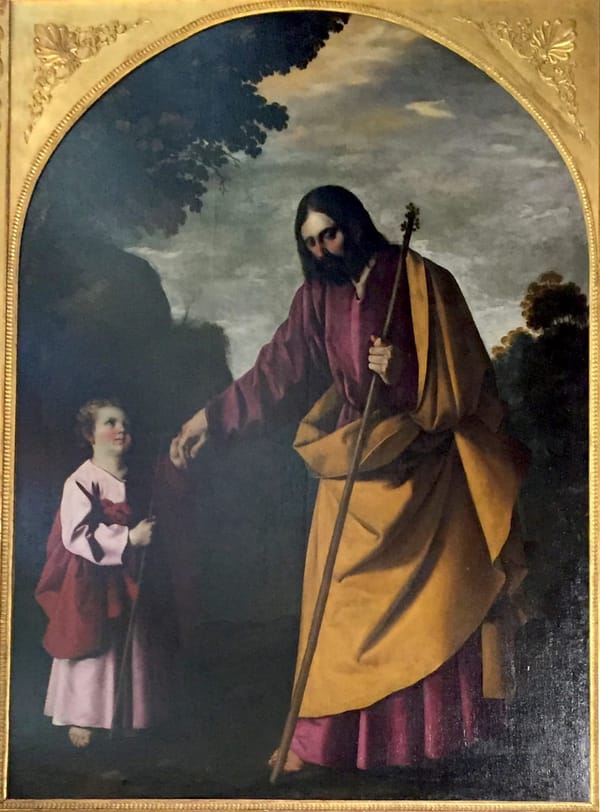
March 19: St. Joseph, Spouse of the Blessed Virgin
To-day, Joseph, the spouse of Mary, the fosterfather of the Son of God, comes to cheer us by his dear presence. In a few days hence, the august mystery of the Incarnation will demand our fervent adoration: who could better prepare us for the grand feast, than he that was both the confidant and thd faithful guardian of the divine secret?
The Son of God, when about to descend upon this earth to assume our human nature, would have a Mother; this Mother could not be other than the purest of Virgins, and her divine maternity was not to impair her incomparable virginity. Until such time as the Son of Mary were recognized as the Son of God, His Mother’s honour had need of a protector: some man, therefore, was to be called to the high dignity of being Mary’s spouse. This privileged mortal was Joseph, the most chaste of men.
Heaven designated him as being the only one worthy of such a treasure: the rod he held in his hand in the temple suddenly produced a flower, as though it were a literal fulfilment of the prophecy of Isaias: ‘There shall come forth a rod from the root of Jesse, and a flower shall rise up out of his root.’1 The rich pretenders to an alliance with Mary were set aside; and Joseph was espoused to the Virgin of the house of David, by a union which surpassed in love and purity everything the angels themselves had ever witnessed.
But he was not only chosen to the glory of having to protect the Mother of the Incarnate Word; he was also called to exercise an adopted paternity over the very Son of God. So long as the mysterious cloud was over the Saint of saints, men called Jesus the Son of Joseph and the carpenter's Son. When our blessed Lady found the Child Jesus in the temple, in the midst of the doctors, she thus addressed Him: ‘Thy father and I have sought Thee sorrowing’;2 and the holy evangelist adds that Jesus was subject to them, that is, that He was subject to Joseph as He was to Mary.
Who can imagine or worthily describe the sentiments which filled the heart of this man, whom the Gospel describes to us in one word, when it calls him the just man?3 Let us try to picture him to ourselves amidst the principal events of his life: his being chosen as the spouse of Mary, the most holy and perfect of God’s creatures; the angel’s appearing to him, and making him the one single human confidant of the mystery of the Incarnation, by telling him that his Virgin bride bore within her the fruit of the world’s salvation: the joys of Bethlehem, when he assisted at the birth of the divine Babe, honoured the Virgin Mother, and heard the angels singing; his seeing first the humble and simple shepherds, and then the rich eastern magi, coming to the stable to adore the new-born Child; the sudden fears which came to him, when he was told to arise, and, midnight as it was, to flee into Egypt with the Child and the Mother; the hardships of that exile, the poverty and the privations which were endured by the hidden God, whose foster-father he was, and by the Virgin, whose sublime dignity was now so evident to him; the return to Nazareth, and the humble and laborious life led in that village, where he so often witnessed the world's Creator sharing in the work of a carpenter; the happiness of such a life, in that cottage where his companions were the Queen of the angels and the eternal Son of God, both of whom honoured, and tenderly loved him as the head of the family—yes, Joseph was beloved and honoured by the uncreated Word, the Wisdom of the Father, and by the Virgin, the masterpiece of God’s power and holiness.
We ask, what mortal can justly appreciate the glories of St. Joseph? To do so, he would have to understand the whole of that mystery, of which God made him the necessary instrument. What wonder, then, if this foster-father of the Son of God was prefigured in the old Testament, and that by one of the most glorious of the patriarchs? Let us listen to St. Bernard, who thus compares the two Josephs: ‘The first was sold by his brethren, out of envy, and was led into Egypt, thus prefiguring our Saviour’s being sold; the second Joseph, that he might avoid Herod’s envy, led Jesus into Egypt. The first was faithful to his master, and treated his wife with honour; the second, too, was the most chaste guardian of his bride, the Virgin Mother of his Lord. To the first was given the understanding and interpretation of dreams; to the second, the knowledge of, and participation in, the heavenly mysteries. The first laid up stores of corn, not for himself, but for all the people; the second received the living Bread that came down from heaven, and kept It both for himself and for the whole world.’4
Such a life could not close save by a death that was worthy of so great a saint. The time came for Jesus to quit the obscurity of Nazareth, and show Himself to the world. His own works were henceforth to bear testimony to His divine origin; the ministry of Joseph, therefore, was no longer needed. It was time for him to leave this world, and await, in Abraham’s bosom, the arrival of that day, when heaven’s gates were to be opened to the just. As Joseph lay on his bed of death, there was watching by his side He that is the master of life, and that had often called this His humble creature, father. His last breath was received by the glorious Virgin-Mother, whom he had, by a just right, called his bride. It was thus, with Jesus and Mary by his side, caring for and caressing him, that Joseph sweetly slept in peace. The spouse of Mary, the fosterfather of Jesus, now reigns in heaven with a glory which, though inferior to that of Mary, is marked with certain prerogatives which no other inhabitant of heaven can have.
From heaven, he exercises a powerful protection over those that invoke him. In a few weeks from this time, the Church will show us the whole magnificence of this protection; a solemn feast will be kept in his honour in the third week after Easter. To-day the Liturgy sets before us his glories and privileges. Let us unite with the faithful throughout the world, and ofier to the spouse of Mary the hymns which are this day sung in his praise.
Hymn I
Te cuncti resonent Christiadum chori,
Qui clams meritis junctus es inclytæ
Casto fœdere Virgini.
Admirans, dubio tangeris anxius,
Afflatu superi Flaminis angelus
Conceptum puerum docet.
Ægypti profugum tu sequeris plagas:
Amissum Solymis quæris, et invenis,
Miscene gaudia fletibus.
Palmamque emeritos gloria suscipit;
Tu vivens, Superis par, frueris Deo,
Mira sorte beatior.
Da Joseph meritis sidera scandere:
Ut tandem liceat nos tibi perpetim
Gratum promere canticum.
May the choirs of Christendom resound with thy name,
for great are thy merits,
who wast united by a chaste alliance to the holy Virgin.
a cruel doubt afflicts thy heart; but an angel visits thee,
telling thee that she had conceived of the Holy Ghost
the Child she bore in her womb.
and go with the little fugitive to Egypt’s distant land.
When he was lost in Jerusalem, thou didst seek after him;
and having found him, thy tears were mingled with joy.
has crowned their life; they receive their glory, when they have won the palm:
but thou, by a strange, happy lot, hadst, even during life,
what the blessed have in heaven—thou hadst the sweet society of thy God.
and may the intercession of Joseph aid us to reach heaven:
that there we may sing to thee
our eternal hymn of grateful love.
Hymn II
Certa spes vitæ, columenque mundi,
Quas tibi læti canimus, benignus
Suscipe laudes.
Virginia sponsum, voluitque Ver bi
Te patrem dici, dedit et ministrum
Esse salutis.
Quem chorus vatum cecinit futurum,
Aspicis gaudens, humilisque natum
Numen adoras.
Cujus ad nutum tremit inferorum
Turba, cui pronus famulatur æther,
Se tibi subdit.
Quæ tibi præbens superos honores,
Det tuis nobis meritis beatæ
Gaudia vitae.
the sure hope of our life, and the pillar of the world!
Receive, in thy kind love,
the praises we now joyfully sing to thee.
the spouse of the holy Virgin;
willed thee to be called the father of the Word;
and gave thee to be an instrument of our salvation.
on the Redeemer lying in the stable,
him that the prophets had foretold was to come;
and seeing him, thou didst humbly adore the new-born King.
at whose bidding hell trembles
and before whom heaven prostrates ready to do his will,
yea, even he makes himself subject to thee.
May he that has conferred such high honours upon thee,
grant us, through the merits of thine intercession,
to come to the joys of heavenly life.
Hymn III
Cujus excelsos canimus triumphos,
Hac die, Joseph meruit perennis
Gaudia vitæ.
Cujus extremam vigiles ad horam
Christus et Virgo simul adstiterunt,
Ore sereno.
Camis, ad sedes placido sopore
Migrat æternas, rutilisque cingit
Tempora sertis.
Adsit ufc nobis, veniamque nostris
Obtinene culpis, tribuat supernæ
Munera pacis.
Trine qui regnas, Deus; et coronas
Aureas servo tribuis fideli,
Omne per ævum.
whose praises we, the faithful,
now gladly tell, and whose high triumph we sing,
deserved to receive the joys of eternal life.
thrice blessed saint,
at whose last hour Jesus and Mary
stood watching in tender love.
and Joseph, sweetly sleeping,
passed to the eternal home,
and received upon his brott the glittering crown.
let us beseech him to help us,
obtain us the pardon of our sins,
and procure us the gift of heavenly peace.
O God, O blessed Trinity,
who art our sovereign Lord!
who givest to thy faithful servant an everlasting crown of gold.
The Greek liturgy, which honours St. Joseph on the Sunday following the feast of Christmas, thus hymns his praise in the Menæa:
Hymn (Dominica post Natale Domini)
We praise and glorify thee, O happy saint! We hail thee as the spouse of the Queen of heaven, and foster-father of our Redeemer. These titles, which would seem too grand for any human being to enjoy, are thine; and they are but the expression of the dignities conferred on thee by God. The Church of heaven admires the sublime favours thou hast received; the Church on earth joyfully celebrates thy glories, and blesses thee for the favours thou art so unceasingly bestowing upon her.
Though born of the kingly race of David, thou wast the humblest of men; thy spirit led thee to seek obscurity, and a hidden life was thine ambition: but God chose thee to be an instrument in the sublimest of all His works. A noble Virgin of the same family of David, the object of heaven’s admiration, and the glory and hope of the world, is to be thy bride. The Holy Ghost is to dwell within her as in a most pure tabernacle; it is to thee, the just and chaste, that He entrusts her as an inestimable treasure. Espouse, then, to thyself her whose beauty the very King of heaven so greatly desires.5
The Son of God comes down to this earth, that He may live the life of man; He comes that He may sanctify the ties and affections of kindred. He calls thee father; He obeys thy orders. What strange emotions must have filled thy heart, O Joseph! when, knowing the prerogatives of thy bride and the divinity of thy adopted Son, thou hadst to be the head of this family, which united heaven and earth into one! What respectful and tender love for Mary, thy blessed bride! What gratitude and profound worship of Jesus, who obeyed thee as thy Child! Oh mysteries of Nazareth! a God dwells among men, and permits Himself to be called the Son of Joseph!
O sublime minister of the greatest of blessings, intercede for us with God made Man. Ask Him to bestow humility upon us, that holy virtue which raised thee to such exalted dignity, and which must be the basis of our conversion. It is pride that led us into sin, and made us prefer our own will to that of God: yet will He pardon us if we offer Him the sacrifice of a contrite and humble heart.6 Get us this virtue, without which there can be no true penance. Pray also for us, O Joseph, that we may be chaste. Without purity of mind and body we cannot come nigh the God of all sanctity, who suffers nothing defiled to approach Him. He wills to make our bodies, by His grace, the temples of His holy Spirit: do thou, great saint, help us to maintain ourselves in so exalted a dignity, or to recover it if we have lost it.
And lastly, O faithful spouse of Mary! recommend us to our Mother. If she cast a look of pity upon us during these days of reconciliation, we shall be saved: for she is the Queen of mercy, and Jesus, her Son, will pardon us and change our hearts, if she intercede for us, O Joseph! Remind her of Bethlehem, Egypt, and Nazareth, in all of which she received from thee such marks of thy devotedness. Tell her that we, also, love and honour thee; and Mary will reward us for our devotion to him who was given her by heaven as her protector and support.
Friday of the Fourth Week of Lent
The Station is in the church of Saint Eusebius, priest of Rome, who suffered for the faith, in the Arian persecution, under the emperor Constantius.
Collect
Epistle
3. Cap. xvii.
Again it is a mother that comes, with tears in her eyes, praying for the resurrection of her child. This mother is the widow of Sarephta, whom we have already had as the type of the Gentile Church. She was once a sinner, and an idolatress, and the remembrance of the past afflicts her soul; but the God that has cleansed her from her sins, and called her to be His bride, comforts her by restoring her child to life. The charity of Elias is a figure of that of the Son of God. Observe how this great prophet stretches himself upon the body of the boy, fitting himself to his littleness, as did also Eliseus. Here again, we recognize the divine mystery of the Incarnation. Elias thrice touches the corpse; thrice, also, will our catechumens be immersed in the baptismal font, whilst the minister of God invokes the three Persons of the adorable Trinity. On the solemn night of Easter, Jesus, too, will say to the Church, His bride: Behold, thy son liveth; and she, transported with joy, will acknowledge the truth of God’s promises. Nay, the very pagans bore witness to this truth; for when they saw the virtuous lives of this new people, which came forth regenerated from the waters of Baptism, they acknowledged that God alone could produce such virtue in man. There suddenly arose from the midst of the Roman empire, demoralized as it was and corrupt beyond imagination, a race of men of angelic purity; and these very men had, but a short time before their Baptism, wallowed in all the abominations of paganism. Whence had they derived this sublime virtue? From the Christian teaching, and from the supernatural remedies it provides for man’s spiritual miseries. Then it was that unbelievers sought for the true faith, though they knew it was at the risk of martyrdom; they ran to the Church, asking her to become their mother, and saying to her: We know that thou art of God, and the word of the Lord in thy mouth is true.
Gospel
Cap. xi.In illo tempore: Erat quidam languens Lazarus a Bethania, de castello Mariae et Marthae eororis ejus. (Maria autem erat, quæ unxit Dominum ungüento, et extersit pedes ejus capillis suis: cujus frater Lazarus infirmabatur.) Miserunt ergo sor ores ejus ad eum, dicentes: Domine, ecce quem amas, infirmatur. Audiens autem Jesus, dixit eis: Infirmitas hæc non est ad mortem, sed pro gloria Dei, ut glorificetur Filius Dei per eam. Diligebat autem Jesus Martham, et sororem ejus Mariam, et Lazarum. Ut ergo audivit quia infirmabatur, tunc quidem mansit in eodem loco duobus diebus. Deinde post hæc dixit discipulie suis: Eamus in Judæam iterum. Dicunt ei discipuli: Rabbi, nunc quærebant te Judæi lapidare, et iterum vadis illuc? Respondit Jesus: Nonne duodecim sunt horæ diei? Si quis ambulaverit in die, non offendit, quia lucem hujus mundi videt: si autem ambulaverit in nocte, offendit, quia lux non est in eo. Hæc ait, et post hæc dixit eis: Lazarus amicus noster dormit: sed vado ut a somno excitem eum. Dixerunt ergo discipuli ejus: Domine, si dormit salvus erit. Dixerat autem Jesus de morteejus: illi autem putaverunt quia de dormitione somni diceret. Tunc ergo Jesus dixit eis manifeste: Lazarus mortuus est; et gaudeo propter vos, ut credatis, quoniam non eram ibi. Sed eamus ad eum. Dixit ergo Thomas, qui dicitur Didymus, ad condiscipulos: Eamus et nos, ut moriamur cum eo. Venit itaque Jesus; et invenit eum quatuor dies jam in monumento habentem. (Erat autem Bethania juxta Jerosolymam quasi stadiis quindecim.) Multi autem ex Judæis vener ant ad Martham et Mariam, ut consolarentur eas de fratre suo. Martha ergo ut audivit quia Jesus venit, occurrit illi: Maria autem domi sedebat. Dixit ergo Martha ad Jesum: Domine, si fuisses hie, frater meus non fuisset mortuus. Sed et nunc scio quia quæcumque poposceris a Deo, dabit tibi Deus. Dicit illi Jesus: Resurget frater tuus. Dicit ei Martha: Scio quia resurget in resurrections in novissimo die. Dixit ei Jesus:’ Ego sum resurrectio et vita: qui credit in me, etiamsi mortuus fuerit, vivet: et omnis qui vivit et credit in me, non morietur in æternum. Credis hoc? Ait illi: Utique, Domine, ego credidi, quia tu es Christus Filius Dei vivi, qui in huno mundum venisti. Et cum hæc dixisset, abiit, et vocavit Mariam sororem suam silentio, dicens: Magister adest, et vocat te. Hla, ut audivit, surgit cito, et venit ad eum; nondum enim venerat Jesus in castellum, sed erat adhuc in illo loco, ubi occurrerat ei Martha. Judaei ergo, qui erant cum ea in domo, et consolabantur eam, cum vidissent Mariam, quia cito surrexit et exiit, Becuti sunt eam, dicentes: Quia vadit ad monumentum, ut ploret ibi. Maria ergo, cum venisset ubi erat Jesus, videns eum, cecidit ad pedes ejus, et dicit ei: Domine, si fuisses hie, non esset mortuus frater meus. Jesus ergo, ut vidit eam ploran tern, et Judaeos qui venerant cum ea plorantes, infremuit spiritu, et turbavit seipsum, et dixit: Ubi posuistis eum? Dicunt ei: Domine, veni et vide. Et lacrymatue est Jesus. Dixerunt ergo Judaei: Ecce quomodo amabat eum! Quidam autem ex ipsis dixerunt: Non poterat hie, qui aperuit oculos cæci nati, facere ut hic non moreretur? Jesus ergo rursum fremens in semetipso, venit ad monumentum. Erat autem spelunca: et lapis superpositus erat ei. Ait Jesus: Tollite lapidem. Dicit ei Martha, soror ejus qui mortuus fuerat: Domine, jam foetet, quatriduanus est enim. Dicit ei Jesus: Nonne dixi tibi, quoniam si credideris, vide bis gloriam Dei? Tulerunt ergo lapidem: Jesus autem, elevatis sursum oculis, dixit: Pater, gratias ago tibi, quoniam audisti me. Ego autem sciebam quia semper me audis, sed propter populum qui circumstat, dixi: ut credant quia tu me misisti. Hæc cum dixisset, voce magna clama vit: Lazare, veni foras. Et statim prodiit, qui fuerat mortuus, ligatus pedes et manus institis, et facies illius sudario erat ligata. Dixit eis Jesus: Solvite eum, et sinite abire. Multi ergo ex Judæis, qui venerant ad Mariam et Martham, et viderant quæ fecit Jesus, crediderunt in eum.
Ch. xi.At that time: There was a certain man sick named Lazarus, of Bethania, of the town of Mary, and of Martha her sister. And Mary was she that anointed the Lord with ointment, and wiped his feet with her hair, whose brother Lazarus was sick. His sisters therefore sent to him, saying: Lord, behold, he whom thou lovest is sick. And Jesus hearing it said to them: This sickness is not unto death, but for the glory of God, that the Son of God may be glorified by it. Now Jesus loved Martha, and her sister Mary, and Lazarus. When he had heard therefore that he was sick, he still remained in the same place two days. Then after that, he said to his disciples: Let us go into Judea again. The disciples say to him: Rabbi, the Jews but now sought to stone thee, and goest thou thither again? Jesus answered: Are there not twelve hours of the day? If a man walk in the day, he stumbleth not, because he seeth the light of this world; but if he walk in the night he stumbleth, because the light is not in him. These things he said, and after that he said to them: Lafcarus our friend sleepeth: but I go that I may awake him out of sleep. His disciples therefore said: Lord, if he sleep, he shall do well. But Jesus spoke of his death; and they thought that he spoke of the repose of sleep. Then therefore Jesus said to them plainly: Lazarus is dead, and I am glad for your sakes, that I was not there, that you may believe; but let us go to him. Thomas therefore, who is called Didymus, said to his fellow disciples: Let us also go, that we may die with him. Jesus therefore came, and found that he had been four days already in the grave. (Now Bethania was near Jerusalem, about fifteen furlongs off.) And many of the Jews were come to Martha and Mary, to comfort them concerning their brother. Martha, therefore, as soon as she heard that Jesus was come, went to meet him; but Mary sat at home. Martha therefore said to Jesus: Lord, if thou hadst been here, my brother had not died; but now also I know, that whatsoever thou wilt ask of God, God will give it thee. Jesus saith to her: Thy brother shall rise again. Martha saith to him: I know that he shall rise again in the resurrection at the last day. Jesus said to her: I am the resurrection and the life; he that believeth in me, although he be dead, shall live; and every one that liveth, and believeth in me, shall not die for ever. Believest thou this? She saith to him: Yea, Lord, I have believed that thou art Christ, the Son of the living God, who art come into this world. And when she had said these things, she went, and called her sister Mary secretly, saying: The Master is come, and calleth for thee. She, as soon as she heard this, riseth quickly, and cometh to him; for Jesus was not yet come into the town, but he was still in that place where Martha had met him. The Jews therefore, who were with her in the house, and comforted her, when they saw Mary that she rose up speedily, and went out, followed her saying: She goeth to the grave, to weep there. When Mary therefore was come where Jesus was, seeing him, she fell down at his feet, and saith to him: Lord, if thou hadst been here, my brother had not died. Jesus therefore, when he saw her weeping, and the Jews, that were come with her, weeping, groaned in the spirit, and troubled himself, and said: Where have you laid him? They say to him: Lord, come and see. And Jesus wept. The Jews therefore said: Behold how he loved him l But some of them said: Could not he, that opened the eyes of the man bom blind, have caused that this man should not die? Jesus therefore again groaning in himself, cometh to the sepulchre: now it was a cave and a stone was laid over it. Jesus saith: Take away the stone. Martha, the sister of him that was dead, saith to him: Lord, by this time he etinketh, for he is now of four days. Jesus saith to her: Did I not say to thee that if thou believe, thou shalt see the glory of God? They took therefore the stone away; and Jesus, lifting up his eyes, said: Father, I give thee thanks that thou hast heard me; and I knew that thou hearest me always, but because of the people who stand about have I said it, that they may believe that thou hast sent me. When he had said these things, he cried with a loud voice: Lazarus, come forth! And presently he that had been dead came forth, bound feet and hands with winding bands, and his face was bound about with a napkin. Jesus said to them: Loose him, and let him go. Many therefore of the Jews, who were come to Mary and Martha, and had seen the things that Jesus did, believed in him.
Let us meditate upon this admirable history; and as we meditate, let us hope; for it not only shows us what Jesus does for the souls of others, but what He has done for ours. Let us, also, renew our prayers for the penitents, who now, throughout the world, are preparing for the great reconciliation. It is not a mother that is here represented as praying for the resurrection of her child; it is two sisters asking this grace for a brother. The example must not be lost on us: we must pray for one another. But let us take our Gospel in the order of its truths.
First, Lazarus was sick; and then, he died. The sinner begins by being tepid and careless; and then he receives the mortal wound. Jesus could have cured Lazarus of his sickness; but He permitted it to be fatal. He intends to work such a miracle, and that within sight of Jerusalem, that His enemies shall have no excuse for refusing to receive Him as the Messias. He would also prove that He is the sovereign Master of life, in order that He might hereby teach His apostles and disciples not to be scandalized at the death He Himself was soon to suffer. In the moral sense, God, in His wisdom, sometimes leaves an ungrateful soul to itself, although He foresees that it will fall into sin. It will rise again; and the confusion it will feel for having sinned will lead it to that great preservative against a future fall—humility.
The two sisters, Martha and Mary, are full of grief, yet full of confidence in Jesus. Let us observe how their two distinct characters are shown on this occasion. Jesus tells Martha that He is the resurrection and the life, and that they who believe in Him shall not die—that is, shall not die the death of sin. But when Mary came to Him, and He saw her weeping, He groaned in the spirit, and troubled Himself, because He knew the greatness of her love. His divine Heart was touched with compassion as He beheld these, who were so dear to Him, smarting under that chastisement of death which sin had brought into the world. Having reached the sepulchre where Lazarus was buried, He wept, for He loved Lazarus. Thus did our Redeemer, by His own weeping, sanctify the tears which Christian affection sheds over the grave of a relative or friend. Lazarus has been in the sepulchre four days; it is the image of the sinner buried in his sins. To see him now makes even his sister shudder: but Jesus rebukes her, and bids them take away the stone. Then with that voice which commands all nature and makes hell tremble, He cries out: Lazarus, come forth! He that had been dead rises up in the sepulchre; but his feet and hands are tied, his face is covered with a napkin; he lives, but he can neither walk nor see. Jesus orders him to be set free; and then, by the hands of the men that are present, he recovers the use of his limbs and eyes. So is it with the sinner that receives pardon. There is no voice but that of Jesus which can call him to conversion, and touch his heart, and bring him to confess his sins; but Jesus has put into the hands of priests the power to loose, enlighten, and give movement. This miracle, which was wrought by our Saviour at this very season of the year, filled up the measure of His enemies’ rage, and set them thinking how they could soonest put Him to death. The few days He has still to live, are all to be spent at Bethania, where the miracle has taken place, and which is but a short distance from Jerusalem. In nine days from this, He will make His triumphant entry into the faithless city, after which He will return to Bethania, and after three or four days, will once more enter Jerusalem, there to consummate the Sacrifice, whose infinite merits are to purchase resurrection for sinners.
The early Christians loved to see this history of our Lord’s raising Lazarus to life painted on the walls of the catacombs. We also find it carved on the sarcophagi of the fourth and fifth centuries; and later on, it was not unfrequently chosen as a subject for the painted windows of our cathedrals. This symbol of spiritual resurrection was formerly honoured by a most solemn ceremony, in the great monastery of holy Trinity, at Vendóme, in France. Every year, on this day, a criminal who had been sentenced to death, was led to the church of the monastery. He had a rope round his neck, and held in his hand a torch weighing thirty-three pounds, in memory of the years spent on earth by our Saviour. The monks made a procession, in which the criminal joined; after which, a sermon was preached, at which he also assisted. He was then taken to the foot of the altar, where the abbot, after exhorting him to repentance, imposed on him, as a penance, the pilgrimage to St. Martin’s church at Tours. The abbot loosened the rope from his neck, and declared him to be free. The origin of this ceremony was, that when Louis of Bourbon, Count of Vendóme, was prisoner in England, in the year 1426, he made a vow that, if God restored him to liberty, he would establish this custom in the church of holy Trinity, as a return of gratitude, and as a homage to Christ, who raised up Lazarus from the tomb. God accepted the vow, and the prince soon recovered his freedom.
Let us pray to-day for the conversion of sinners, using this devout formula given by the Roman pontifical in the reconciliation of penitents:
Prayer
| Previous Thursday of the Fourth Week of Lent | Next Friday of the Fourth Week of Lent |