Daily reading
Passiontide
Double of the I Class · March 25 · Sanctoral
March 25, 2021
From Dom Guéranger’s The Liturgical Year.
A Double of the I Class leads the weekday.Rubric

|
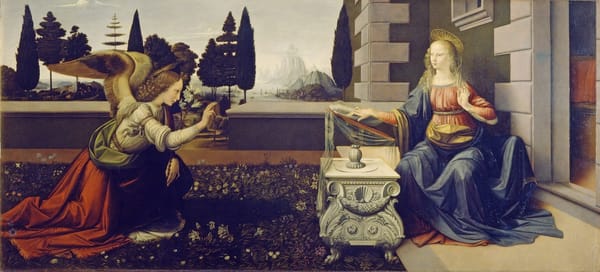
March 25: The Annunciation of the Ever Blessed Virgin
Including:
Feast of the Annunciation during Lent
This is a great day, not only to man, but even to God Himself; for it is the anniversary of the most solemn event that time has ever witnessed. On this day, the divine Word, by whom the Father created the world, was made flesh in the womb of a virgin, and dwelt among us.1 We must spend it in joy. Whilst we adore the Son of God who humbled Himself by thus becoming Man, let us give thanks to the Father, who so loved the world, as to give His only-begotten Son;2 let us give thanks to the Holy Ghost, whose almighty power achieves the great mystery. We are in the very midst of Lent, and yet the ineffable joys of Christmas are upon us: our Emmanuel is conceived on this day, and, nine months hence, will be born in Bethlehem, and the angels will invite us to come and honour the sweet Babe.
During Septuagesima week, we meditated upon the fall of our first parents, and the triple sentence pronounced by God against the serpent, the woman, and Adam. Our hearts were filled with fear as we reflected on the divine malediction, the effects of which are to be felt by all generations, even to the end of the world. But in the midst of the anathemas then pronounced against us, a promise was made us by our God; it was a promise of salvation, and it enkindled hope within us. In pronouncing sentence against the serpent, God said that his head should one day be crushed, and that, too, by a woman.
The time has come for the fulfilment of this promise. The world has been in expectation for four thousand years; and the hope of its deliverance has been kept up, in spite of all its crimes. During this time, God has made use of miracles, prophecies, and types, as a renewal of the engagement He has entered into with mankind. The blood of the Messias has passed from Adam to Noe; from Sem to Abraham, Isaac and Jacob; from David and Solomon to Joachim; and now it flows in the veins of Mary, Joachim’s daughter. Mary is the woman by whom is to be taken from our race the curse that lies upon it. God has decreed that she should be Immaculate; and has thereby set an irreconcilable enmity between her and the serpent. She, a daughter of Eve, is to repair all the injury done by her mother’s fall; she is to raise up her sex from the degradation into which it has been cast; she is to co-operate, directly and really, in the victory which the Son of God is about to gain over His and our enemy.
A tradition, which has come down from the apostolic ages, tells us that the great mystery of the Incarnation was achieved on the twenty-fifth day of March.3 It was at the hour of midnight, when the most holy Virgin was alone and absorbed in prayer, that the Archangel Gabriel appeared before her, and asked her, in the name of the blessed Trinity, to consent to become the Mother of God. Let us assist, in spirit, at this wonderful interview between the angel and the Virgin: and, at the same time, let us think of that other interview which took place between Eve and the serpent. A holy bishop and marytr of the second century, Saint Irenæus, who had received the tradition from the very disciples of the apostles, shows us that Nazareth is the counterpart of Eden.4
In the garden of delights there is a virgin and an angel; and a conversation takes place·between them. At Nazareth a virgin is also addressed by an angel, and she answers him; but the angel of the earthly paradise is a spirit of darkness, and he of Nazareth is a spirit of light. In both instances it is the angel that has the first word. ‘Why,’ said the serpent to Eve, ‘hath God commanded you, that you should not eat of every tree of paradise?’ His question implies impatience and a solicitation to evil; he has contempt for the frail creature to whom he addresses it, but he hates the image of God which is upon her.
See, on the other hand, the angel of light; see with what composure and peacefulness he approaches the Virgin of Nazareth, the new Eve; and how respectfully he bows himself down before her: ‘Hail, full of grace! The Lord is with thee! Blessed art thou among women! Such language is evidently of heaven: none but an angel could speak thus to Mary.
Eve imprudently listens to the tempter’s words; she answers him; she enters into conversation with one that dares to ask her to question the justice of God’s commands. Her curiosity urges her on. She has no mistrust in the serpent; this leads her to mistrust her Creator.
Mary hears what Gabriel has spoken to her; but this most prudent Virgin is silent. She is surprised at the praise given her by the angel. The purest and humblest of virgins has a dread of flattery; and the heavenly messenger receives no reply from her, until he has fully explained his mission by these words: ‘Fear not, Mary, for thou hast found grace with God. Behold, thou shalt conceive in thy womb, and shalt bring forth a Son: and thou shalt call His name Jesus. He shall be great, and shall be called the Son of the Most High, and the Lord God shall give unto Him the throne of David His father: and He shall reign in the house of Jacob for ever, and of His kingdom there shall be no end.’
What magnificent promises are these, which are made to her in the name of God! What higher glory could she, a daughter of Juda, desire, knowing, as she does, that the fortunate Mother of the Messias is to be the object of the greatest veneration? And yet it tempts her not. She has for ever consecrated her virginity to God, in order that she may be the more closely united to Him by love. The grandest possible privilege, if it is to be on the condition of violating this sacred vow, would be less than nothing in her estimation. She thus answers the angel: ‘How shall this be done? because I know not man.’
The first Eve evinces no such prudence or disinterestedness. No sooner has the wicked spirit assured her that she may break the commandment of her divine Benefactor and not die; that the fruit of her disobedience will be a wonderful knowledge, which will put her on an equality with God Himself: than she immediately yields; she is conquered. Her self-love has made her at once forget both duty and gratitude: she is delighted at the thought of being freed from the twofold tie which binds her to her Creator.
Such is the woman that caused our perdition. But how different is she that was to save us! The former cares not for her posterity; she looks but to her own interests: the latter forgets herself to think only of her God, and of the claims He has to her service. The angel, charmed with this sublime fidelity, thus answers the question put to him by Mary, and reveals to her the designs of God: ‘The Holy Ghost shall come upon thee, and the power of the Most High shall overshadow thee. And therefore also the Holy which shall be born of thee shall be called the Son of God. And behold thy cousin Elizabeth, she also hath conceived a son in her old age; and this is the sixth month with her that is called barren; because no word shall be impossible with God.’ This said, he is silent, and reverently awaits the answer of the Virgin of Nazareth.
Let us look once more at the virgin of Eden. Scarcely has the wicked spirit finished speaking than Eve casts a longing look at the forbidden fruit: she is impatient to enjoy the independence it is to bring her. She rashly stretches forth her hand; she plucks the fruit; she eats it, and death takes possession of her: death of the soul, for sin extinguishes the light of life; and death of the body, which, being separated from the source of immortality, becomes an object of shame and horror, and finally crumbles into dust.
But let us turn away our eyes from this sad spectacle, and fix them on Nazareth. Mary has heard the angel’s explanation of the mystery; the will of heaven is made known to her, and how grand an honour it is to bring upon her! She, the humble maid of Nazareth, is to have the ineffable happiness of becoming the Mother of God, and yet the treasure of her virginity is to be left to her! Mary bows down before this sovereign will, and says to the heavenly messenger: ‘Behold the handmaid of the Lord: be it done to me according to thy word.’
Thus, as the great St. Irenæus and so many of the holy fathers remark, the obedience of the second Eve repaired the disobedience of the first: for no sooner does the Virgin of Nazareth speak her fiat, ‘be it done,’ than the eternal Son of God (who, according to the divine decree, awaited this word) is present, by the operation of the Holy Ghost, in the chaste womb of Mary, and there He begins His human life. A Virgin is a Mother, and Mother of God; and it is this Virgin’s consenting to the divine will that has made her conceive by the power of the Holy Ghost. This sublime mystery puts between the eternal Word and a mere woman the relations of Son and Mother; it gives to the almighty God a means whereby He may, in a manner worthy of His majesty, triumph over satan, who hitherto seemed to have prevailed against the divine plan.
Never was there a more entire or humiliating defeat than that which this day befel satan. The frail creature, over whom he had so easily triumphed at the beginning of the world, now rises and crushes his proud head. Eve conquers in Mary. God would not choose man for the instrument of His vengeance; the humiliation of satan would not have been great enough; and therefore she who was the first prey oi hell, the first victim of the tempter, is selected to give battle to the enemy. The result of so glorious a triumph is that Mary is to be superior not only to the rebel angels, but to the whole human race, yea, to all the angels of heaven. Seated on her exalted throne, she, the Mother of God, is to be the Queen of all creation. Satan, in the depths of the abyss, will eternally bewail his having dared to direct his first attack against the woman, for God has now so gloriously avenged her; and in heaven, the very Cherubim and Seraphim reverently look up to Mary, and deem themselves honoured when she smiles upon them, or employs them in the execution of any of her wishes, for she is the Mother of their God.
Therefore is it that we, the children of Adam, who have been snatched by Mary’s obedience from the power of hell, solemnize this day of the Annunciation. Well may we say of Mary those words of Debbora, when she sang her song of victory over the enemies of God’s people: ‘The valiant men ceased, and rested in Israel, until Debbora arose, a mother arose in Israel. The Lord chose new wars, and He Himself overthrew the gates of the enemies.’5 Let us also refer to the holy Mother of Jesus these words of Judith, who by her victory over the enemy was another type of Mary: ‘Praise ye the Lord our God, who hath not forsaken them that hope in Him. And by me, His handmaid, He hath fulfilled His mercy, which He promised to the house of Israel; and He hath killed the enemy of His people by my hand this night . . . . The almighty Lord hath struck him, and hath delivered him into the hands of a woman, and hath slain him.’6
First Vespers
When the Annunciation falls on any other day than Monday, the first Vespers of this feast are sung before midday, according to the rule prescribed for fast-days of Lent: but when it falls on a Monday, this Office is celebrated at the ordinary time of Vespers, and only & commemoration is made of the Sunday by the Magnificat antiphon and the prayer.
The Office of first Vespers is always the commencement of a feast. The antiphons of the Vespers, at which we are going to assist, are taken from the Gospel of St. Luke, where the evangelist reveals to us the sublime interview between the angel and the Virgin. The psalms are those which tradition has consecrated to the celebration of Mary’s glories. We have elsewhere7 shown how each of the five refers to the Mother of God.
Psalm 109
Donec ponam inimicos tuos: * scabellum pedum tuorum.
Virgam virtutis tuæ emittet Dominus ex Sion: * dominare in medio inimicorum tuorum.
Tecum principium in die virtutis tuæ in splendoribus sanctorum: * ex utero ante luciferum genui te.
Juravit Dominus, et non pœnitebit eum: * Tu es Sacerdos in æternum secundum ordinem Melchisedech.
Dominus a dextris tuis: * confregit in die iræ suæ reges.
Judicabit in nationibus, implebit ruinas: * conquassabit capita in terra multorum.
De torrente in via bibet: * propterea exaltabit caput.
Until, on the day of thy last earning, I make thy enemies thy footstool.
O Christ! the Lord thy Father, will send forth the sceptre of thy power out of Sion: from thence rule thou in the midst of thy enemies.
With thee is the principality in the day of thy strength, in the brightness of the Saints: For the Father hath said to thee: From the womb, before the day-star, I begot thee.
The Lord hath sworn, and he will not repent: he hath said, speaking of thee, the God-Man: Thou art a Priest for ever, according to the order of Melchisedech.
Therefore, O Father, the Lord, thy Son, is at thy right hand: he hath broken kings in the day of his wrath.
He shall also judge among nations: he shall fill the ruins of the world: he shall crush the heads in the land of many.
He cometh now in humility: he shall drink, in the way, of the torrent of sufferings: therefore, shall he lift up the head.
Ant. Ave, Maria, gratia plena, Dominus tecum: nenedicta tu in mulieribus.
Ant. Hail, Mary, full of grace, the Lord is with thee: blessed art thou among women.
Psalm 112
Sit nomen Domini benedictum: * ex hoc nunc et usque in sæculum.
A solis ortu usque ad occasum: * laudabile nomen Domini.
Excelsus super omnes gentes Dominus: * et super cælos gloria ejus.
Quis sicut Dominus Deus noster qui in altis habitat: * et humilia respicit in cœlo et in terra?
Suscitans a terra inopem: * et de stercore erigens pauperem.
Ut collocet eum cum principibus: * cum principibus populi sui.
Qui habitare facit sterilem in domo: * matrem filiorum lætantem.
Blessed be the name of the Lord: from henceforth, now and for ever.
From the rising of the sun unto the going down of the same, the name of the Lord is worthy of praise.
The Lord is high above all nations: and his glory above the heavens.
Who is as the Lord our God, who dwelleth on high: and looketh down on the ow things in heaven and in earth, nay, who cometh down amidst us?
Raising up the needy from the earth: and lifting up the poor out of the dunghill.
That he may place him with princes: with the princes of his people.
Who maketh a barren woman to dwell in a house, the joyful mother of children.
Ant. Ne timeas, Maria; invenisti gratiam apud Dominum: ecce concipies, et paries filium.
Ant. Fear not, Mary; thou hast found grace with God: behold thou shalt conceive, and shalt bring forth a Son.
Psalm 121
Stantes erant pedes nostri: * in atriis tuis, Jerusalem.
Jerusalem quæ ædificatur at civitas: * cujus participate ejus in idipsum.
Illuc enim ascenderunt tribus, tribus Domini: * testimonium Israël ad confiten dum nomini Domini.
Quia illic sederunt sedes in judicio: * sedes super domum David.
Rogate quæ ad pacem sunt Jerusalem: * et abundantia diligentibus te.
Fiat pax in virtute tua: * et abundantia in turribus tuis.
Propter fratres meos et proximos meos: * loque bar pacem de te.
Propter domum Domini Dei nostri: * quæsivi bona tibi.
Our feet were standing in thy courts, O Jerusalem! Our heart loves and confides in thees O Mary.
Mary is like to Jerusalem, that is built as a city; which is compact together.
For thither did the tribes go up, the tribes of the Lord: the testimony of Israel, to praise the name of the Lord.
Because seats sat there in judgment; seats upon the house of David, and Mary is of a kingly race.
Pray ye, through Mary, for the things that are for the peace of Jerusalem: and may abundance be on them that love thee, O Church of our God!
The voice of Mary: Let peace be in thy strength, O thou new Sion! and abundance in thy towers.
I, a daughter of Israel, for the sake of my brethren and of my neighbours, spoke peace of thee.
Because of the house of the Lord our God, I have sought good things for thee.
Ant. Dabit ei Dominus sedem David patris ejus, et regnabit in aeternum.
Ant. And the Lord shall give unto him the throne of David his father, and he shall reign for ever.
Psalm 126
Nisi Dominus custodierit civitatem: * frustra vigilat qui custodit eam.
Vanum est vobis ante luoem surgere: * eurgite postquam sederitis, qui manducatis panem doloris.
Cum dederit dilectis suis somnum: * ecce hæreditas Domini filii, merces, fructus ventris.
Sicut sagittae in manu potentis: * ita filii excussorum.
Beatus vir, qui implevit desiderium suum ex ipsis: * non confundetur cum loquetur inimicis suis in porta.
Unless the Lord keep the city, he watcheth in vain that keepeth it.
It is vain for you to rise before light; rise ye after you have sit ten, you that eat of the bread of sorrow.
When he shall give sleep to his beloved: behold the inheritance of the Lord are children; the reward, the fruit of the womb.
As arrows in the hand of the mighty, so the children of them that have been shaken.
Blessed is the man that hath filled his desire with them; he shall not be confounded when he shall speak to his enemies in the gate.
Ant. Ecce ancilla Domini: fiat mihi secundum verbum tuum.
Ant. Behold the handmaid of the Lord: be it done to me according to thy word.
Psalm 147
Quoniam confortavit seras portarum tuarum: * benedixit filiis tuis in te.
Qui posuit fines tuos pacem: * et adipe frumenti satiat te.
Qui emittit eloquium suum terræ: * velociter currit sermo ejus.
Qui dat nivem sicut lanam: * nebulam sicut cinerem spargit.
Mittit crystallum suam sicut buccellas: * ante faciem frigoris ejus quis sustinebit?
Emittet verbum suum, et liquefaciet ea: * flabit spiritus ejus, et fluent aquæ.
Qui annuntiat verbum suum Jacob: * justitias, et judicia sua Israël.
Non fecit taliter omni nationi: * et judicia sua non manifestavit eis.
Because he hath strengthened against sin the bolts of thy gates: he hath blessed thy children within thee.
Who hath placed peace in thy borders, and filleth thee with the fat of com, toith Jesus, who is the Bread of life.
Who sendeth forth, by thee, his Word to the earth: his word runneth swiftly.
Who giveth snow like wool; scattereth mists like ashes.
He sendeth his crystal like morsels; who shall stand before the face of his cold?
He shall send forth his Word by Mary, and shall melt them: his Spirit shall breathe, and the waters shall run.
Who declareth his word to Jacob: his justices and his judgments to Israel.
He hath not done in like manner to every nation: and his judgments he hath not made manifest to them.
Capitulum (Is . vii.)
Hymn8
Dei Mater alma,
Atque semper Virgo,
Felix cœli porta.
Gabrielis ore,
Funda nos in pace,
Mutans Evæ nomen.
Profer lumen cæcis,
Mala nostra pelle,
Bona cuneta posee.
Sumat per te preces,
Qui pro nobis natus,
Tulit esse tuus.
Inter omnes mitis,
Nos culpis solutos
Mites fac et castos.
Iter para tutum;
Ut videntes Jesum,
Semper collætemur.
Summo Christo decus,
Spiritui sancto,
Tribus honor unus.
Blessed Mother of God,
yet ever a Virgin!
O happy gate of heaven!
from Gabriel’s lips,
confirm us in peace,
and so let Eva be changed into an Ave of blessing for us.
bring light to the blind,
drive from us our evils,
and ask all good things for us.
and offer our prayers to him,
who would be born of thee,
when born for us.
and meekest of the meek,
obtain us the forgiveness of our sins,
and make us meek and chaste.
and a safe pilgrimage;
that we may be united with thee
in the blissful vision of Jesus.
and to the Lord Jesus,
and to the Holy Ghost:
to the Three one self-same praise.
Antiphon of the Magnificat
Mass
The Church has taken most of the chants of today’s Mass from the forty-fourth Psalm, wherein the royal prophet celebrates the mystery of the Incarnation. In the Introit, she greets Mary as the Queen of the human race, to whom every creature should pay respectful homage. It is her virginity that fitted Mary to become the Mother of God. This virtue will be imitated in the Church, and each generation will produce thousands of holy virgins, who will walk in the footsteps of her who is their Mother and their model.
Introit
In the Collect, the Church glories in her faith in the divine maternity; she puts it forward as a claim to Mary’s interceding for her with God, who is her Son. This dogma of Mary’s being the Mother of God is founded on the mystery of the Incarnation, which is the basis of our faith, and which was accomplished on this twenty-fifth of March.
Collect
To this is added the Collect for the feria of Lent.
Epistle
Cap. vii.In diebus illis: Locutus est Dominus ad Achaz, dicens: Pete tibi signum a Domino Deo tuo, in profundum infemi, sive in excelsum supra. Et dixit Achaz: Non petam, et non tentabo Dominum. Et dixit: Audite ergo domua David: Numquid parum vobis est, molestos esse hominibus, quia molesti estis et Deo meo? Propter hoc dabit Dominus ipse vobis signum. Ecce Virgo concipiet, et pariet filium: et vocabitur nomen ejus Emmanuel. Butyrum et mel comedet, ut sciat reprobare malum et eligere bonum.
Ch. vii.In those days: the Lord spoke unto Achaz, saying: Ask thee a sign of the Lord thy God, either unto the depth of hell, or unto the height above. And Achaz said: I will not ask, and I will not tempt the Lord. And he (Isaias) said: Hear ye therefore, O house of David: Is it a small thing for you to be grievous to men, that you are grievous to my God also? Therefore the Lord himself shall give you a sign. Behold a Virgin shall conceive and bear a son, and his name shall be called Emmanuel. He shall eat butter and honey, that he may know to refuse the evil and to choose the good.
The prophet is speaking to a wicked king, who refused to accept a miraculous proof of God’s merciful protection over Jerusalem; and he makes this an opportunity for announcing to Juda the great portent which we are celebrating to-day: A Virgin shall conceive, and hear a Son. And when was it, that God fulfilled the prophecy? It was in an age, when mankind seemed to have reached the highest pitch of wickedness, and when idolatry and immorality reigned throughout the whole world. The fulness of time came, and the tradition, which had found its way into every country, that a Virgin should bring forth a Son, was exciting much interest. This is the day on which the mystery was accomplished; let us adore the power of God, and the fidelity wherewith He fulfils His promises. The Author of the laws of nature suspends them; He acts independently of them: virginity and maternity are united in one and the same creature, for the Child that is to be born is God. A Virgin could not bring forth other than God Himself: the Son of Mary is therefore called Emmanuel, that is, God with us.
Let us adore this God, the Creator of all things visible and invisible, who thus humbles Himself. Henceforth, He will have every tongue confess, not only His Divinity, but also His human Nature, which He has assumed in order that He might redeem us. From this day forward He is truly the Son of Man. He will remain nine months in His Mother’s womb, as other children. Like them, He will, after His birth, be fed on milk and honey. He will sanctify all stages of human life, from infancy to perfect manhood, for He is the New Man, who has come down from heaven that He might restore the old. Without losing aught of His Divinity, He shares in our weak finite being, that He may make us partakers of the divine nature.9
In the Gradual, the Church unites with David in praising the beauty of the Emmanuel, His kingdom and His strength; for He comes in humility, that He may rise again in glory; He comes to give battle that He may conquer and triumph.
Gradual
The Church continues the same canticle in the Tract, but it is in praise of Mary, the Virgin and Mother. The Holy Ghost loves her for her incomparable beauty; it is on this day that He overshadows her and she conceives the Word. Where is there a glory like that of Mary, who is an object of complacency to the three Persons of the Trinity? God could create nothing more exalted than the Mother of God. David foretells how this, his daughter, was to receive homage from the great ones of the earth, and how she was to be surrounded by holy virgins, who would follow her as their Queen and model. This day is also the triumph of her virginity, for it is raised to the dignity of divine maternity! Her triumph frees her sex from slavery, and renders it capable of everything that is honourable and great.
Tract
Gospel
Cap. i.In illo tempore: Missus est angelus Gabriel a Deo in civitatem Galilææ, cui nomen Nazareth, ad virginem desponsatam viro, cui nomen erat Joseph, de domo David: et nomen virginis, Maria. Et ingressus angelus ad eam, dixit: Ave, gratia plena; Dominus tecum: benedicta tu in mulieribus. Quæ cum audisset, turbata est in sermone ejus: et cogitabat qualis esset ista salutatio. Et ait angelus ei: Ne timeas, Maria: invenisti enim gratiam aqud Deum. Ecce concipies in utero, et paries filium: et vocabis nomen ejus Jesum. Hic erit magnus: et Filius Altissimi vocabitur. Et dabit illi Dominus Deus sedem David patris ejus: et regnabit in domo Jacob in æternum; et regni ejus non erit finis. Dixit autem Maria ad angelum: Quomodo fiet istud? quoniam virum non cognosco. Et respondens angelus, dixit ei: Spiritus sanctus superveniet in te; et virtue Altissimi obumbrabit tibi. Ideoque et quod nascetur ex te sanctum, vocabitur Filius Dei. Et ecceElisabeth cognata tua: et ipsa concepit filium in senectute sua. Et hic mensis sertufl est illi, quse vocatur sterilis; quia non erit impossibile apud Deum omne verbum. Dixit autem Maria: Ecce ancilla Domini: fiat mihi secundum verbum tuum.
Ch. i.At that time: the angel Gabriel was sent from God into a city of Galilee, called Nazareth, to a Virgin espoused to a man whose name was Joseph, of the house of David; and the Virgin’s name was Mary. And the angel being come in, said unto her: Hail, full of grace, the Lord is with thee: blessed art thou among women. Who having heard, was troubled at his saying, and thought with herself what manner of salutation this should be. And the angel said to her: Fear not, Mary, for thou hast found grace with God. Behold thou shalt conceive in thy womb, and shalt bring forth a son, and thou shalt call his name Jesus. He shall be great, and shall be called the Son of the Most High, and the Lord God shall give unto him the throne of David his father: and he shall reign in the house of Jacob for ever, and of his kingdom there shall be no end. And Mary said to the angel: How shall this be done, because I know not man? And the angel answering, said to her: The Holy Ghost shall come upon thee, and the power of the Most High shall overshadow thee. And therefore also the Holy which shall be born of thee, shall be called the Son of God. And behold thy cousin Elizabeth she also hath conceived a son in her old age; and this is the sixth month with her that is called barren: because no word shall be impossible with God. And Mary said: Behold the handmaid of the Lord, be it done to me according to thy word.
By these last words of thine, O Mary! our happiness is secured. Thou consentest to the desire of heaven, and thy consent brings us our Saviour. O Virgin-Mother! Blessed among women! we unite our thanks with the homage that is paid thee by the angels. By thee is our ruin repaired; in thee is our nature restored; for thou hast wrought the victory of man over satan! St. Bernard, in one of his homilies on this Gospel, thus speaks: ‘Rejoice, O thou our father Adam! but thou, O mother Eve, still more rejoice! You were our parents, but you were also our destroyers; and, what is worse, you had wrought our destruction before you gave us birth. Both of you must be consoled in such a daughter as this: but thou, O Eve, who wast the first cause of our misfortune, and whose humiliation has descended upon all women, thou hast a special reason to rejoice in Mary. For the time has now come, when the humiliation is taken away; neither can man any longer complain against the woman, as of old, when he foolishly sought to excuse himself, and cruelly put all the blame on her, saying: “The woman, whom Thou gavest me, gave me of the tree, and I did eat.” Go, Eve, to Mary; go, mother, to thy daughter; let thy daughter take thy part, and free thee from thy disgrace, and reconcile thee to her father: for, if man fell by a woman, he is raised up by a woman.
‘What is this thou sayest, Adam? “The woman, whom Thou gavest me, gave me of the tree, and I did eat?” These are wicked words; far from effacing thy fault, they aggravate it. But divine Wisdom conquered thy wickedness, by finding in the treasury of His own inexhaustible mercy a motive for pardon, which He had in vain sought to elicit by questioning thee. In place of the woman, of whom thou complainest, He gives thee another: Eve was foolish, Mary is wise; Eve was proud, Mary is humble; Eve gave thee of the tree of death, Mary will give thee of the Tree of life; Eve offered thee a bitter and poisoned fruit, Mary will give thee the sweet Fruit she herself is to bring forth, the Fruit of everlasting life. Change, then, thy wicked excuse into an act of thanksgiving, and say: “ The Woman, whom Thou hast given me, O Lord, hath given me of the Tree of life, and I have eaten thereof; and it is sweeter than honey to my mouth, for by it Thou hast given me life.” ’10
In the Offertory, the Church addresses Mary in the words spoken to her by the Archangel, to which she also adds those used by Elizabeth, when she saluted the Mother of her God.
Offertory
In the Secret, the Church renews her profession of faith in the mystery of the Incarnation; she confesses the reality of the two Natures, divine and human, in Jesus Christ, the Son of God, and Son of Mary.
Secret
To this is added the Secret for the feria of Lent.
The greatness of the solemnity obliges the Church to substitute, for the lenten Preface, the one she uses on our Lady’s feasts.
Preface
The Communion-anthem repeats the prophetic words of the Epistle. It is a Virgin that has conceived and brought forth Him, who, being God and Man, is also the living Bread that came down from heaven, whereby God is with us, and in us.
Communion
In the Postcommunion, the Church gratefully recalls to mind all the mysteries which God has achieved for our salvation, and which are the consequences of the one we honour to-day. After the Incarnation, which unites the Son of God to our human nature, we have had the Passion of this our divine Redeemer; and His Passion was followed by His Resurrection, whereby He triumphed over our enemy death.
Postcommunion
To this is added the Postcommunion of the feria of Lent.
Second Vespers
The antiphons, psalms, hymn, and versicle, are the same as in the first Vespers, pages 449-455.
The Magnificat antiphon alone is changed, and is as follows:
Antiphon of the Magnificat
Let us now bring together the different liturgies, and hear them celebrate the great mystery of this glad feast. First of all, let us listen to the Church of Rome, who, in her Office of Matins, thus proclaims the praises of Mary, the Mother of God:
Hymn
Colunt, adorant, prædicant,
Trinam regentem machinam,
Claustrum Mariæ bajulat.
Deserviunt per tempora,
Perfusa cceli gratia,
Gestant puellæ viscera.
Cujus, supernus artifex
Mundum pugillo contincns,
Ventris sub area clausus est.
Fœcunda eancto Spiritu,
Desideratus gentibus
Cujus per alvum fusus est.
Qui natus es de Virgine;
Cum Patre et almo Spiritu,
In sempiterna sæcula.
worship, adore, and praise;
he, the King of the triple kingdom,
is carried in Mary’s womb.
with heavenly grace, bears him,
whom the moon, and sun, and all creatures
serve in the order marked for them.
He, the sovereign Creator,
who holds the world in the palm of his hand,
is enclosed in the tabernacle of her womb.
proclaims her blessed;
the holy Spirit makes her fruitful;
and the Desired of nations is born of her.
that wast born of the Virgin!
and to the Father, and to the Spirit of love,
for everlasting ages.
Many of the Latin Churches, in the middle ages, used to recite, in the Mass of the Annunciation, the following sequence, which is thought to have been composed by Peter Abailard.
Sequence
Non quemvis Angelum,
Sed Fortitudinem
Suum Archangelum,
Amator hominis.
Pro nobis nuntium,
Naturae faciat
Ut præjudicium
In partu Virginis.
Natus Rex gloriæ:
Regnet et imperet,
Et zyma scoriæ
Tollat de medio.
Terat fastigia:
Colla sublimium
Calcet vi propria,
Potens in prælio.
Mundanum principem:
Secumque faciat
Matrem participem
Patris imperii.
Hæc dona dissere:
Revela veteris
Velamen litteræ
Virtute nuncii.
Dic: Ave, cominus,
Dic: Plena gratia,
Dic: Tecum Dominus,
Et dic: Ne timeas.
Dei depositum,
In quo perficiae
Casta propoeitum,
Et votum teneas.
Puella nuntium:
Credit et concipit,
Et parit Filium,
Sed admirabilem.
Humani generis:
Deum et hominem,
Et Patrem posteris,
In pace stabilem.
Nos reddat stabiles,
Ne nos labilitas
Humana labiles
Secum praecipitet.
Concessa venia,
Per matrem gratiæ
Obtenta gratia,
In nobis habitet.
Peccati veniam:
Reatue deleat,
Donet et patriam
In arce siderum.
sends to the Virgin
no less an angel than him
who is called God's Strength,
the Archangel Gabriel.
be speedily at his work;
may he stay the rights
and laws of nature
in the Virgin’s delivery.
when born, triumph over nature;
may he reign and command;
may he take away from the midst of men
all leaven and rust.
proud heads;
may this God, mighty in war,
trample in his power
on the necks of the haughty.
the prince of this world;
and make his Mother
share with him the empire
which his Father has given him.
announce these gifts;
lift up, by the virtue
of thy Annunciation,
the veil of the ancient Scripture.
say, when thou art in her presence, ‘Hail!’
Say: ‘O full of grace!’
Say: ‘The Lord is with thee!’
And then: ‘Fear not!’
the divine deposit;
by him fulfil
thy chaste purpose,
and keep thy vow.
the announcement;
she believes and conceives,
and brings forth a Son,
but he is the Admirable.
of mankind,
God and Man,
Father of the world to come,
the Prince of peace.
render us firm,
lest human frailty
should make us stumble
into the abyss.
of pardon, granting us pardon
and grace, obtained by
the Mother of grace,
dwell within us.
us pardon of our sins,
wipe away all our guilt,
and give us the country
in the starry heaven.
The Ambrosian liturgy gives us this fine Preface, which is used in its celebration of to-day’s mystery.
Preface
The Mozarabic liturgy (which, as we have already observed, keeps the feast of the Annunciation on December 18) has several admirable prayers touching this mystery: we select the following:—
Prayer
The Greek liturgy, with its wonted abundance, celebrates the glory of Mary in the Incarnation of the Word. We give the following hymn, which comes in the Office of the vigil of the Annunciation. In our opinion, it is finer than the one on the feast itself.
Hymn (Die XXIV. Martii)
O Emmanuel, God with us! who, as Thy Church says in her hymn, ‘being to take upon Thee to deliver man, didst not disdain the Virgin’s womb,’ the whole human race gives thanks to Thee on this day, for Thy merciful coming. O eternal Word of the Father! it was not enough for Thee to have drawn man out of nothing by Thy power; Thine exhaustless love would follow him even to the abyss of misery into which he had fallen. By sin man had forfeited the dignity Thou hadst given him: that he might regain it, Thou didst come in person and assume his nature, so to raise him up again to Thyself. In Thee, from this day forward unto all eternity, God is made man, and man is made God. Thy Incarnation is the fulfilment of the promises made in the canticle; Thou unitest Thyself to human nature, and it is in the virginal womb of a daughtei of David that Thou celebratest these ineffable espousals. O incomprehensible humiliation! O ineffable glory! The humiliation is for the Son of God, the glory is for the Son of man. Thus hast Thou loved us, O divine Word, thus hast Thou removed from us the degradation of our fall! The rebel angels fell, and Thou didst leave them in the abyss; we fell, and Thou hadst mercy on us. A single look of Thy pity would have sufficed to save us; but it would not satisfy Thy love: therefore d dst Thou descend into this world of sin, take upon Thyself the form of a slave,11 and lead a life of humiliation and suffering. O Word made Flesh, who comest not to judge, but to save,12 we adore Thee, we praise Thee, we love Thee. Make us worthy of all that Thy love has led Thee to do for us.
We salute thee, O Mary, full of grace, on this day whereon thou didst receive thy sublime dignity of Mother of God. Thy incomparable purity drew down upon thee the love of the great Creator, and thy humility drew Him into thy womb; His presence within thee increased the holiness of thy spirit and the purity of thy body. What must have been thy happiness in knowing that this Son of God was living by thy life, and was taking from thine own substance the new being, which His love for us induced Him to assume! Between thee and Him is formed that ineffable union which is granted to none else but to thee: He is thy Creator, and thou art His Mother; He is thy Son, and thou art His creature. Every knee bows down before Him, O Mary! for He is the great God of heaven and earth; but every creature reveres thee, also, for thou hast carried Him in thy womb, thou hast fed Him at thy breast; thou alone canst say to Him, as does His heavenly Father: ‘Thou art my Son!’ O Mother of Jesus! thou art the greatest of God’s works: receive the humble homage of mankind, for thou art most dear to us, seeing that thou art of the same flesh and blood as ourselves.
Thou art a daughter of Eve, but without her sin. By thy obedience to the divine decrees, thou savest thy mother and her race; thou restorest Adam and his children to the innocence they had lost. Jesus, whom thou bearest in thy womb, is our pledge that all these blessings are to be ours; and it is by thee that He comes to us. Without Jesus, we should abide in death; without thee, we should not have had Him to redeem us. It is from thy virginal womb that He receives the precious Blood which is to be our ransom, that Blood whose purity He protected in thy Immaculate Conception, and which becomes the Blood of God by the union, that is consummated in thee, of the divine with the human Nature.
To-day, O Mary! is fulfilled in thee the promise made by God after Adam's sin, that He would put enmity between the woman and the serpent. Up to this time, the human race had not the courage to resist the enemy; it was subservient to him, and everywhere were altars raised up in his honour; but, on this day, his head is crushed beneath thy foot. Thy humility, thy purity, thy obedience, have conquered him; his tyranny is checked. By thee we areelivered from his sway; and nothing but our own perversity and ingratitude could again give him the mastery. Let not this be, O Mary! Come to our assistance. During this season of repentance, we humbly acknowledge that we have abused the grace of God; we beseech thee, on this the feast of thy Annunciation, intercede for us with Him, who, on this day, became thy Son. Holy Mother of God! by the salutation addressed to thee by the angel Gabriel, by thy virginal fear, by thy fidelity to God, by thy prudent humility, by thy consent, obtain for us conversion of heart, and sincere repentance; prepare us for the great mysteries we are about to celebrate. These mysteries are so full of sorrow to thy maternal heart; and yet thou wouldst have us rejoice on this day, as we think on the ineffable happiness which filled thy soul at the solemn moment when the Holy Ghost overshadowed thee, and the Son of God became thine. Yes, blessed Mother of Jesus! we will spend the whole of this day near thee, in thy humble dwelling at Nazareth. Nine months hence, we will follow thee to Bethlehem, and there, in company with the shepherds and the angels, we will prostrate ourselves in adoration before the Infant-God, our Saviour: we will join our voices with those of the heavenly host, and we will thus express our gladness: ‘Glory be to God in the highest, and peace on earth to men of good will!’
Feast of the Annunciation during Paschaltide
IT very frequently happens that March 25 falls between Palm Sunday and Low Sunday: on these occasions, the feast of our Lady’s Annunciation, being out of keeping both with the dolorous mysteries of Holy Week and with the splendour of the Resurrection, is deferred to the Monday following Low Sunday. For the convenience of the faithful, we have here repeated the Vespers and Mass of this great feast. As to the instructions we gave upon the mystery of the Annunciation, our readers must refer to our volume on Lent.
First Vespers
The Office of First Vespers is always the commencement of a feast. The Antiphons of the Vespers at which we are going to assist are taken from the Gospel of St Luke, where the Evangelist reveals to us the sublime interview between the angel and the Virgin. The Psalms are those which tradition has consecrated to the celebration of Mary’s glories. We have elsewhere13 shown how each of the five refers to the Mother of God.
Psalm 109
Donec ponam inimicos tuos: * scabellum pedum tuorum.
Virgam virtutis tuæ emittet Dominus ex Sion: * dominare in medio inimicorum tuorum.
Tecum principium in die virtutis tuæ in splendoribus sanctorum: * ex utero ante luciferum genui te.
Juravit Dominus, et non pœnitebit eum: * Tu es Sacerdos in æternum secundum ordinem Melchisedech.
Dominus a dextris tuis: * confregit in die iræ suæ reges.
Judicabit in nationibus, implebit ruinas: * conquassabit capita in terra multorum.
De torrente in via bibet: * propterea exaltabit caput.
Until, on the day of thy last earning, I make thy enemies thy footstool.
O Christ! the Lord thy Father, will send forth the sceptre of thy power out of Sion: from thence rule thou in the midst of thy enemies.
With thee is the principality in the day of thy strength, in the brightness of the Saints: For the Father hath said to thee: From the womb, before the day-star, I begot thee.
The Lord hath sworn, and he will not repent: he hath said, speaking of thee, the God-Man: Thou art a Priest for ever, according to the order of Melchisedech.
Therefore, O Father, the Lord, thy Son, is at thy right hand: he hath broken kings in the day of his wrath.
He shall also judge among nations: he shall fill the ruins of the world: he shall crush the heads in the land of many.
He cometh now in humility: he shall drink, in the way, of the torrent of sufferings: therefore, shall he lift up the head.
Ant. Ave, Maria, gratia plena, Dominus tecum: nenedicta tu in mulieribus.
Ant. Hail, Mary, full of grace, the Lord is with thee: blessed art thou among women.
Psalm 112
Sit nomen Domini benedictum: * ex hoc nunc et usque in sæculum.
A solis ortu usque ad occasum: * laudabile nomen Domini.
Excelsus super omnes gentes Dominus: * et super cælos gloria ejus.
Quis sicut Dominus Deus noster qui in altis habitat: * et humilia respicit in cœlo et in terra?
Suscitans a terra inopem: * et de stercore erigens pauperem.
Ut collocet eum cum principibus: * cum principibus populi sui.
Qui habitare facit sterilem in domo: * matrem filiorum lætantem.
Blessed be the name of the Lord: from henceforth, now and for ever.
From the rising of the sun unto the going down of the same, the name of the Lord is worthy of praise.
The Lord is high above all nations: and his glory above the heavens.
Who is as the Lord our God, who dwelleth on high: and looketh down on the ow things in heaven and in earth, nay, who cometh down amidst us?
Raising up the needy from the earth: and lifting up the poor out of the dunghill.
That he may place him with princes: with the princes of his people.
Who maketh a barren woman to dwell in a house, the joyful mother of children.
Ant. Ne timeas, Maria; invenisti gratiam apud Dominum: ecce concipies, et paries filium.
Ant. Fear not, Mary; thou hast found grace with God: behold thou shalt conceive, and shalt bring forth a Son.
Psalm 121
Stantes erant pedes nostri: * in atriis tuis, Jerusalem.
Jerusalem quæ ædificatur at civitas: * cujus participate ejus in idipsum.
Illuc enim ascenderunt tribus, tribus Domini: * testimonium Israël ad confiten dum nomini Domini.
Quia illic sederunt sedes in judicio: * sedes super domum David.
Rogate quæ ad pacem sunt Jerusalem: * et abundantia diligentibus te.
Fiat pax in virtute tua: * et abundantia in turribus tuis.
Propter fratres meos et proximos meos: * loque bar pacem de te.
Propter domum Domini Dei nostri: * quæsivi bona tibi.
Our feet were standing in thy courts, O Jerusalem! Our heart loves and confides in thees O Mary.
Mary is like to Jerusalem, that is built as a city; which is compact together.
For thither did the tribes go up, the tribes of the Lord: the testimony of Israel, to praise the name of the Lord.
Because seats sat there in judgment; seats upon the house of David, and Mary is of a kingly race.
Pray ye, through Mary, for the things that are for the peace of Jerusalem: and may abundance be on them that love thee, O Church of our God!
The voice of Mary: Let peace be in thy strength, O thou new Sion! and abundance in thy towers.
I, a daughter of Israel, for the sake of my brethren and of my neighbours, spoke peace of thee.
Because of the house of the Lord our God, I have sought good things for thee.
Ant. Dabit ei Dominus sedem David patris ejus, et regnabit in aeternum.
Ant. And the Lord shall give unto him the throne of David his father, and he shall reign for ever.
Psalm 126
Nisi Dominus custodierit civitatem: * frustra vigilat qui custodit eam.
Vanum est vobis ante luoem surgere: * eurgite postquam sederitis, qui manducatis panem doloris.
Cum dederit dilectis suis somnum: * ecce hæreditas Domini filii, merces, fructus ventris.
Sicut sagittae in manu potentis: * ita filii excussorum.
Beatus vir, qui implevit desiderium suum ex ipsis: * non confundetur cum loquetur inimicis suis in porta.
Unless the Lord keep the city, he watcheth in vain that keepeth it.
It is vain for you to rise before light; rise ye after you have sit ten, you that eat of the bread of sorrow.
When he shall give sleep to his beloved: behold the inheritance of the Lord are children; the reward, the fruit of the womb.
As arrows in the hand of the mighty, so the children of them that have been shaken.
Blessed is the man that hath filled his desire with them; he shall not be confounded when he shall speak to his enemies in the gate.
Ant. Ecce ancilla Domini: fiat mihi secundum verbum tuum.
Ant. Behold the handmaid of the Lord: be it done to me according to thy word.
Psalm 147
Quoniam confortavit seras portarum tuarum: * benedixit filiis tuis in te.
Qui posuit fines tuos pacem: * et adipe frumenti satiat te.
Qui emittit eloquium suum terræ: * velociter currit sermo ejus.
Qui dat nivem sicut lanam: * nebulam sicut cinerem spargit.
Mittit crystallum suam siout buccellas: * ante faciem frigoris ejus quis sustinebit?
Emittet verbum suum, et liquefaciet ea: * flabit spiritus ejus, et fluent aquæ.
Qui annuntiat verbum suum Jacob: * justitias, et judicia sua Israël.
Non fecit taliter omni nationi: * et judicia sua non manifestavit eis.
Because he hath strengthened against sin the bolts of thy gates: he hath blessed thy children within thee.
Who hath placed peace in thy borders, and filleth thee with the fat of com, toith Jesus, who is the Bread of life.
Who sendeth forth, by thee, his Word to the earth: his word runneth swiftly.
Who giveth snow like wool; scattereth mists like ashes.
He sendeth his crystal like morsels; who shall stand before the face of his cold?
He shall send forth his Word by Mary, and shall melt them: his Spirit shall breathe, and the waters shall run.
Who declareth his word to Jacob: his justices and his judgments to Israel.
He hath not done in like manner to every nation: and his judgments he hath not made manifest to them.
Capitulum (Isa. vii.)
Hymn14
Dei Mater alma,
Atque semper Virgo,
Felix cœli porta.
Gabrielis ore,
Funda nos in pace,
Mutans Evæ nomen.
Profer lumen cæcis,
Mala nostra pelle,
Bona cuneta posee.
Sumat per te preces,
Qui pro nobis natus,
Tulit esse tuus.
Inter omnes mitis,
Nos culpis solutos
Mites fac et castos.
Iter para tutum;
Ut videntes Jesum,
Semper collætemur.
Summo Christo decus,
Spiritui sancto,
Tribus honor unus.
Blessed Mother of God,
yet ever a Virgin!
O happy gate of heaven!
from Gabriel’s lips,
confirm us in peace,
and so let Eva be changed into an Ave of blessing for us.
bring light to the blind,
drive from us our evils,
and ask all good things for us.
and offer our prayers to him,
who would be born of thee,
when born for us.
and meekest of the meek,
obtain us the forgiveness of our sins,
and make us meek and chaste.
and a safe pilgrimage;
that we may be united with thee
in the blissful vision of Jesus.
and to the Lord Jesus,
and to the Holy Ghost:
to the Three one self-same praise.
Then is made a commemoration of Low Sunday, as on p. 307.
Mass
The Church has taken most of the chants of to-day’s Mass from the forty-fourth Psalm, wherein the royal prophet celebrates the mystery of the Incarnation. In the Introit, she greets Mary as the Queen of the human race, to whom every creature should pay respectful homage. It was her virginity that fitted Mary to become the Mother of God. This virtue will be imitated in the Church, and each generation will produce thousands of holy virgins, who will walk in the footsteps of her that is their Mother and their model.
Introit
Ps. Eructavit cor meum verbum bonum: dico ego opera mea Regi. ℣. Gloria Patri. Vultum tuum.
Ps. My heart hath uttered a good word: I speak my works to the King. ℣. Glory, etc. All the rich.
In the Collect, the Church glories in her faith in the divine maternity; she puts it forward as a claim to Mary’s interceding for her with God, who is her Son. This dogma of Mary’s being the Mother of God is founded on the mystery of the Incarnation, which is the basis of our faith.
Collect
Epistle
Cap. vii.In diebus illis: Locutus est Dominus ad Achaz dicens: Pete tibi signum a Domino Deo tuo, in profundum inferni sive in excelsum supra. Et dixit Achaz: Non petam, et non tentabo Dominum. Et dixit: Audite ergo domus David: Numquid parum vobis est, molestos esse hominibus, quia molestiestis et Deo meo? Propter hoc dabit Dominus ipse vobis signum. Ecce virgo concipiet, et pariet filium: et vocabitur nomen ejus Emmanuel. Butyrum et mel comedet, ut sciat reprobare malum et eligere bonum.
Ch. vii.In those days: The Lord spoke unto Achaz, saying: Ask thee a sign of the Lord thy God, either unto the depth of hell, or unto the height above. And Achaz said: I will not ask, and I will not tempt the Lord. And he (Isaias) said: Hear ye, therefore, O house of David: Is it a small thing for you to be grievous to men, that you are grievous to my God, also? Therefore the Lord himself shall give you a sign. Behold a virgin shall conceive and bear a son, and his name shall be called Emmanuel. He shall eat butter and honey, that he may know to refuse the evil, and to choose the good.
The prophet is speaking to a wicked king, who refused to accept a miraculous proof of God's merciful protection over Jerusalem; and he makes this an opportunity for announcing to Juda the great portent which we are celebrating to-day: A virgin shall conceive and bear a son. And when was it that God fulfilled the prophecy? It was in an age when mankind seemed to have reached the highest pitch of wickedness, and when idolatry and immorality reigned throughout the whole world. 'The fulness of time came,' and the tradition, which had found its way into every country, that a virgin should bring forth a son, was exciting much interest. To-day we are celebrating the sublime mystery; let us adore the power of God, and the fidelity wherewith he fulfils his promises. The author of the laws of nature suspends them; he acts independently of them: virginity and maternity are united in one and the same creature, for the Child that is to be bom is God. A virgin could not bring forth other than God himself: the Son of Mary is, therefore, called Emmanuel, that is, God with us.
Let us adore this God, the Creator of all things visible and invisible, who thus humbles himself. Henceforth, he will have every tongue confess, not only his divinity, but also his human nature, which he has assumed in order that he might redeem us. From this day forward, he is truly the Son of Man. He will remain nine months in his Mother's womb, as other children. Like them, he will, after his birth, be fed on milk and honey. He will sanctify all stages of human life, from infancy to perfect manhood, for he is the New Man, who has come down from heaven that he might restore the old. Without losing aught of his divinity, he shares in our weak finite being, that he may make us ‘partakers of the divine nature.’15
The first Alleluia Versicle repeats the angel's salutation to Mary. Let us, with Gabriel, bow down before this holy Virgin, the masterpiece of nature and grace, predestined from all eternity to be the Mother of God.
The second Versicle celebrates in sublime and enthusiastic words, the effects of the divine mystery of the Incarnation—peace between God and man re-established in the virginal womb of Mary, wherein the divine and human nature are united in the Person of the Child, whom she conceives the very instant she consents to the will of the Most High.
Gospel
Cap. i.In illo tempore: Missus est angelus Gabriel a Deo in civitatem Galilææ, cui nomen Nazareth, ad virginem desponsatam viro cui nomen erat Joseph, de domo David: et nomen virginis Maria. Et ingressus angelus ad eam, dixit: Ave, gratia plena; Dominus tecum: benedicta tu in mulieribus. Quæ cum audisset, turbata est in sermone ejus: et cogitabat qualis esset ista salutatio. Et ait angelus ei: Ne timeas, Maria: invenisti enim gratiam apud Deum. Ecce concipies in utero, et paries filium: et vocabis nomen ejus Jesum. Hic erit magnus: et Filius Altissimi vocabitur. Et dabit illi Dominus Deus sedem David patris ejus: et regnabit in domoJacob in æternam; et regni ejus non erit finis. Dixit autem Maria ad angelum: Quomodo fiet istud? quoniam virum non cognosco. Et respondens angelus, dixit ei: Spiritus Sanctus superveniet in te; et virtus Altissimi obumbrabit tibi. Ideoque et quod nascetur ex te sanctum, vocabitur Filius Dei. Et ecce Elisabeth cognata tua: et ipsa concepit filium in senectute sua. Et hic mensis sextus est illi, quæ vocatur sterilis; quia non erit impossibile apud Deum omne verbum. Dixit autem Maria: Ecce ancilla Domini: fiat mihi secundum verbum tuum.
Ch. i.At that time: The angel Gabriel was sent from God into a city of Galilee, called Nazareth, to a virgin espoused to a man whose name was Joseph, of the house of David; and the virgin's name was Mary. And the angel being come in, said unto her: Hail, Mary, full of grace, the Lord is with thee: blessed art thou among women. Who having heard, was troubled at his saying, and thought with herself what manner of salutation this should be. And the angel said to her: Fear not, Mary, for thou hast found grace with God. Behold thou shalt conceive in thy womb, and shalt bring forth a son, and thou shalt call his name Jesus. He shall be great, and shall be called the Son of the Most High, and the Lord God shall give unto him the throne of David his father: and he shall reign in the house of Jacob for ever, and of his kingdom there shall be no end. And Mary said to the angel: How shall this be done, because I know not man? And the angel answering, said to her: The Holy Ghost shall come upon thee, and the power of the Most High shall overshadow thee. And therefore also the Holy which shall be born of thee shall be called the Son of God. And behold, thy cousin Elizabeth, she also hath conceived a son in her old age; and this is the sixth month with her that is called barren: because no word shall be impossible with God. And Mary said: Behold the handmaid of the Lord; be it done to me according to thy word.
By these last words of thine, O Mary! our happiness is secured. Thou consentest to the desire of heaven, and thy consent brings us our Saviour. O Virgin-Mother! Blessed among women! we unite our thanks with the homage that is paid thee by the angels. By thee is our ruin repaired; in thee is our nature restored; for thou hast wrought the victory of man over Satan! St Bernard, in one of his homilies on this Gospel, thus speaks: 'Rejoice, O thou our father Adam! but thou, O mother Eve, still more rejoice! You were our parents, but you were also our destroyers; and what is worse, you had wrought our destruction before you gave us birth. Both of you must be consoled in such a daughter as this: but thou, O Eve, who wast the first cause of our misfortune, and whose humiliation has descended upon all women, thou hast a special reason to rejoice in Mary. For the time is now come when the humiliation is taken away, neither can man any longer complain against the woman, as of old, when he foolishly sought to excuse himself, and cruelly put all the blame on her, saying: “The woman whom thou gavest me, gave me of the tree, and I did eat.” Go, Eve, to Mary; go, mother, to thy daughter; let thy daughter take thy part, and free thee from thy disgrace, and reconcile thee to her father: for if man fell by a woman, he is raised up by a woman.
'What is this thou sayest, Adam? “The woman whom thou gavest me, gave me of the tree, and I did eat?" These are wicked words; far from effacing thy fault, they aggravate it. But divine Wisdom conquered thy wickedness, by finding in the treasury of his own inexhaustible mercy a motive for pardon, which he had in vain sought to elicit by questioning thee. In place of the woman of whom thou complainest, he gives thee another: Eve was foolish, Mary is wise; Eve was proud, Mary is humble; Eve gave thee of the tree of death, Mary will give thee of the tree of life; Eve offered thee a bitter and poisoned fruit, Mary will give thee the sweet fruit she herself is to bring forth, the fruit of everlasting life. Change, then, thy wicked excuse into an act of thanksgiving, and say: “The woman, whom thou hast given me, O Lord, hath given me of the tree of life, and I have eaten thereof; and it is sweeter than honey to my mouth, for by it thou hast given me life.”‘16
In the Offertory, the Church addresses Mary in the words spoken to her by the archangel, to which she also adds those used by Elizabeth, when she saluted the Mother of her God.
Offertory
In the Secret, the Church renews her profession of faith in the mystery of the Incarnation; she confesses the reality of the two natures, divine and human, in Jesus Christ, the Son of God and Son of Mary.
Secret
The greatness of the solemnity obliges the Church to substitute for the Paschal Preface, the one she uses on our Lady's feasts.
Preface
The Communion Anthem repeats the prophetic words of the Epistle. It is a virgin that has conceived and brought forth him who, being God and man, is also the living Bread that came down from heaven, whereby God is with us, and in us.
Communion
In the Postcommunion the Church gratefully recalls to mind all the mysteries which God has achieved for our salvation, and which were the consequences of the one of to-day. After the Incarnation, which unites the Son of God to our human nature, we have had the Passion of this our divine Redeemer; and his Passion was followed by his Resurrection, whereby he triumphed over our enemy, death.
Postcommunion
Second Vespers
The Antiphons, Psalms, Hymn, and Versicle are the same as in the First Vespers, pp. 310-315.
The Magnificat Antiphon is alone changed, and is as follows:
Antiphon of the Magnificat
- St. John i. 14. ↩︎
- Ibid. iii. 16. ↩︎
- St. Augustine, De Trinitate, Lib. iv. cap. v. ↩︎
- Adv. hæreses. Lib. v. cap. xix. ↩︎
- Judges v. 7, 8. ↩︎
- Judith xiii. 17, 18; xvi. 7. ↩︎
- See our volume for Advent, in the Vespers for December 8. ↩︎
- In monastic churches it is preceded by this responsory:—,℟. breve. Angelus Domini * Nuntiavit Mariæ. Angelus. ℣. Et concepit de Spiritu sancto. * Nuntiavit. Gloria Patri. Angelus, ↩︎
- 2 St. Peter i. 4. ↩︎
- St. Bernard. Homil. II. super Missus est. ↩︎
- Phil, ii, 7. ↩︎
- St. John xii. 47. ↩︎
- See our volume for Advent, in the Vespers for December 8. ↩︎
- In monastic churches it is preceded by this Responsory: ℟. breve. Angelus Domini nuntiavit Mariæ. * Alleluia, alleluia. Angelus ℣. Et concepit de Spiritu Sancto. * Alleluia. Gloria Patri. Angelus. ↩︎
- 2 St Pet. i 4. ↩︎
- St Bernard, Homil. ii super Missus est. ↩︎
Thursday in Passion Week
The Station at Rome is in the church of Saint Apollinaris, who was a disciple of St. Peter, and afterwards bishop of Ravenna and martyr.
Collect
Epistle
Cap. iii.In diebus illis: Oravit Azarias Dominum dicens: Domine Deus noster, ne quæsumus, tradas nos in perpetuum propter nomen tuum, et ne dissipes testamentum tuum: neque auferas misericordiam tuam a nobis, propter Abraham dilectum tuum, et Isaac servum tuum, et Israel sanctum tuum; quibus locutus es, pollicens quod multiplicares semen eorum sicut stellae cœli, et sicut arenam quæ est in littore maris: quia, Domine, imminuti sumus plus quam omnes gentes, sumusque humiles in universa terra hodie propter peccata nostra. Et non est in tempore hoc princeps, et dux, et propheta, neque ho locaustum, neque sacrificium, neque oblatio, neque incensum, neque locus primitiarum coram te, ut possimus invenire misericordiam tuam: sed in animo contrito, et spiritu humilitatis suscipiamur. Sicut in holocausto arietum, et taurorum, et sicut in millibus agnorum pinguium: sic fiat sacrificium nostrum in conspectu tuo hodie, ut placeat tibi: quoniam non est confusio confidentibus in te. Et nunc sequimur te in toto corde, et timemus te, et quærimus faciem tuam. Ne confundas nos, sed fac nobiscum juxta mansuetudinem tuam, et secundum multitudinem misericordiæ tuæ. Et erue nos in mirabilibus tuis, et da gloriam nomini tuo, Domine: et confundantur omnes qui ostendunt servis tuis mala, confundantur in omnipotentia tua, et robur eorum conteratur; et sciant quia tu es Dominus Deus solus, et gloriosus super orbem terrarum, Domine Deus noster.
Ch. iii.In those days, Azarias prayed to the Lord saying: O Lord our God, deliver us not up for ever, we beseech thee, for thy name’s sake, and abolish not thy covenant: and take not away thy mercy from us, for the sake of Abraham thy beloved, and Isaac thy servant, and Israel thy holy one; to whom thou hast spoken, promising that thou wouldst multiply their seed as the stars of heaven, and as the sand that is on the sea shore. For we, O Lord, are diminished more than any nation, and are brought low in all the earth this day for our sins. Neither is there at this time prince, or leader, or prophet, or holocaust, or sacrifice, or oblation, or incense, or place of first-fruits before thee, that we may find thy mercy: nevertheless, in a contrite heart and humble spirit, let us be accepted. As in holocausts of rams, and bullocks, and as in thousands of fat lambs: so let our sacrifice be made in thy sight this day, that it may please thee: for there is no confusion to them that trust in thee. And now we follow thee with all our heart, and we fear thee, and seek thy face. Put us not to confusion, but deal with us according to thy meekness, and according to the multitude of thy mercies. And deliver us according to thy wonderful works, and give glory to thy name, O Lord; and let all them be confounded that show evils to thy servants, let them be confounded in all thy might, and let their strength be broken; and let them know that thou art the Lord, the only God, and glorious over all the world, O Lord our God.
Thus did Juda, when captive in Babylon, pour forth her prayers to God, by the mouth of Azarias. Sion was desolate beyond measure; her people were in exile; her solemnities were hushed. Her children were to continue in a strange land for seventy years; after which God would be mindful of them, and lead them, by the hand of Cyrus, back to Jerusalem, when the building of the second temple would be begun, that temple which was to receive the Messias within its walls. What crime had Juda committed, that she should be thus severely punished? The daughter of Sion had fallen into idolatry; she had broken the sacred engagements which made her the bride of her God. Her crime, however, was expiated by these seventy years of captivity; and when she returned to the land of her fathers, she never relapsed into the worship of false gods. When the Son of God came to dwell in her, He found her innocent of idolatry. But scarcely had forty years elapsed after the Ascension of this divine Redeemer, than Juda was again an exile; not, indeed, led captive into Babylon, but dispersed in every nation under the sun, after having first seen the massacre of thousands of her children. This time it is not merely for seventy years, but for eighteen centuries, that she is without prince, or leader, or prophet, or holocaust, or sacrifice, or temple. Her new crime must be greater than idolatry; for, after all these long ages of suffering and humiliation, the justice of the Father is not appeased! It is, because the Blood that was shed by the Jewish people on Calvary was not the blood of a man—it was the Blood of a God. The very sight of the chastisement inflicted on the murderers proclaims to the world that they were deicides. Their crime was an unparalleled one; its punishment is to be so too; it is to last till the end of time, when God, for the sake of Abraham His beloved, and Isaac His servant, and Jacob His holy one, will visit Juda with an extraordinary grace, and her conversion will console the Church, whose affliction is then to be great by reason of the apostasy of many of her children. This spectacle of a whole people bearing on itself the curse of God for having crucified the Son of God, should make a Christian tremble for himself. It teaches him that divine justice is terrible, and that the Father demands an account of the Blood of His Son, even to the last drop, from those that shed it. Let us lose no time, but go at once, and, in this precious Blood, cleanse ourselves from the share we have had in the sin of the Jews; and, throwing off the chains of iniquity, let us imitate those among them whom we see, from time to time, separating themselves from their people and returning to the Messias: let us, also, be converts, and turn to that Jesus, whose hands are stretched out on the cross, ever ready to receive the humble penitent.
Gospel
Cap. vii.In illo tempore: Rogabat Jesum quidam de pharisæis, ut manducaret cum illo. Et ingressus domum pharisæi, discubuit. Et ecce mulier quæ erat in civitate peccatrix, ut cognovit quod accubuisset in domo pharisæi, attulit alabastrum unguenti; et stans retro secus pedes ejus, lacrymis cœpit rigare pedes ejus, et capillis capitis sui tergebat, et osculabatur pedes ejus, et unguento ungebat. Videns autem pharisæus, qui vocaverat eum, ait intra se dicens: Hic si esset Propheta sciret utique, quæ, et qualis est mulier, quæ tangit eum: quia peccatrix est. Et respondens Jesus, dixit ad illum: Simon, habeo tibi aliquid dicere. At ille ait: Magieter, dic. Duo debitores erant cuidam fœneratori: unus debebat denarios quingentos, et alius quinquaginta. Non habentibus illis unde redderent, donavit utrisque. Quis ergo eum plus diligit? Respondens Simon, dixit: Æstimo quia is, cui plus donavit. At ille dixit ei: Recte judicasti. Et conversus ad mulierem, dixit Simoni: Vides hanc mulierem? Intravi in domum tuam: aquam pedibus meis non dedisti; hæc autem lacrymis rigavit pedes meos, et capillis suis tersit. Osculum mihi non dedisti; hæc autem ex quo intravit, non cessavit osculari pedes meos. Oleo caput meum non unxisti; hæc autem unguento unxit pedes meos. Propter quod dico tibi: Remittuntur ei peccata multa, quoniam dilexit multum. Cui autem minus dimittitur, minus diligit. Dixit autem ad illam: Remittuntur tibi peccata. Et coeperunt qui simul accumbebant, dicere intra se: Quis est hic, qui etiam peccata dimittit? Dixit autem ad mulierem: Fides tua te salvam fecit: vade in pace.
Ch. vii.At that time: one of the pharisees desired him to eat with him. And he went into the house of the pharisee, and sat down to meat. And behold a woman that was in the city, a sinner, when she knew that he sat at meat in the pharisee's house, brought an alabaster box of ointment; and standing behind at his feet, she began to wash his feet with tears, and wiped them with the hairs of her head, and kissed his feet, and anointed them with the ointment. And the pharisee, who had invited him, seeing it, spoke within himself, saying: This man, if he were a prophet, would know surely who and what manner of woman this is that touches him, that she is a sinner. And Jesus answering, said to him: Simon, I have somewhat to say to thee. But he said: Master, say it. A certain creditor had two debtors: the one owed him five hundred pence, and the other fifty. And whereas they had not wherewith to pay, he forgave them both. Which therefore of the two loveth him most? Simon answering, said: I suppose that he to whom he forgave most. And he said to him: Thou hast judged rightly. And turning to the woman, he said unto Simon: Dost thou see this woman? I entered into thy house; thou gavest me no water for my feet, but she with tears hath washed my feet and with her hairs hath wiped them. Thou gavest me no kiss; but she, since she came in, hath not ceased to kiss my feet. My head with oil thou didst not anoint; but she with ointment hath anointed my feet. Wherefore I say to thee: Many sins are forgiven her, because she hath loved much. But to whom less is forgiven, he loveth less. And he said to her: Thy sins are forgiven thee. And they that sat at meat with him began to say within themselves; Who is this that forgiveth sins also? And he said to the woman: Thy faith hath made thee safe: go in peace.
What consolation there is for us in this Gospel, and how different are the reflections it suggests, from those we were just making upon the Epistle! The event here related does not belong to the time of our Saviour’s Passion; but, during these days of mercy, does it not behove us to glorify the meekness of that divine Heart, which is preparing to grant pardon to countless sinners throughout the world? Besides, is not Magdalene the inseparable companion of her dear crucified Master, even to Calvary? Let us, then, study this admirable penitent, this type of love faithful even to death.
Magdalene had led a wicked life: as the Gospel tells us elsewhere,1 seven devils had taken up their abode within her. But, no sooner has she seen and heard Jesus, than immediately she is filled with a horror for sin; divine love is enkindled within her heart; she has but one desire: to make amends for her past life. Her sins have been public: her conversion must be so too. She has lived in vanity and luxury; she is resolved to give all up. Her perfumes are all to be for her God, her Jesus; that hair of hers, of which she has been so proud, shall serve to wipe His sacred feet; her eyes shall henceforth spend themselves in shedding tears of contrite love. The grace of the Holy Ghost urges her to go to Jesus. He is in the house of a pharisee, who is giving an entertainment. To go to Him now would be exposing herself to observation. She cares not. Taking with her an ointment of great worth, she makes her way in to the feast, throws herself at Jesus’ feet, washes them with her tears, wipes them with the hair of her head, kisses them, anoints them with the ointment. Jesus Himself tells us with what interior sentiments she accompanies these outward acts of respect: but even had He not spoken, her tears, her generosity, her position at His feet, tell us enough; she is heartbroken, she is grateful, she is humble: who but a pharisee could have mistaken her?
The pharisee, then is shocked! His heart has within it much of that Jewish pride which is soon to crucify the Messias. He looks disdainfully at Magdalene; he is disappointed with his Guest, and murmurs out his conclusion: This man, if He were a Prophet would surely know who and what manner of woman this is! Poor pharisee! If he had the spirit of God within him, he would recognize Jesus to be the promised Saviour, by this wonderful condescension shown to a penitent. With all his reputation as a pharisee, how contemptible he is compared with this woman! Jesus would give him a useful lesson, and draws the parallel between the two—Magdalene and the pharisee. He passes His own divine judgment on them, and the preference is given to Magdalene. What is it that has thus transformed her, and made her deserve, not only the pardon, but the praise, of Jesus? Her love: She hath loved her Redeemer, she hath loved Him much; and, therefore, she was forgiven much. A few hours ago this Magdalene loved but the world and its pleasures; now, she cares for nothing, sees nothing, loves nothing, but Jesus; she is a convert. Henceforward she keeps close to her divine Master; she is ambitious to supply His wants; but, above all, she longs to see and hear Him. When the hour of trial shall come, and His very apostles dare not be with Him, she will follow Him to Calvary, stand at the foot of the cross, and see Him die who has made her live. What an argument for hope is here, even for the worst of sinners! He to whom most is forgiven, is often the most fervent in love! You, then, whose souls are burdened with sins, think of your sins and confess them; but, most of all, think how you may most love. Let your love be in proportion to your pardon, and doubt it not: Your sins shall be forgiven.
Let us close this Thursday of Passion-week with the following devout hymn, taken from the Mozarabic breviary.
Hymn
Agnus Dei peccata mundi auferens;
Ad te venimus cernui, ut inclytum
Bibamus almæ Passionis sanguinem.
Exsurgat insignis crucis fortissimum
Signum, quod in vigore perpetim manens,
Credentibus salvationem conferat.
Corona spinarum, flagella, lancea,
Impressa sunt damnationis verbera:
Jam nostra pro his cuncta dele crimina.
Lavet cruor malitiæque contagia:
Sit vita præsens absque omni crimine:
Futura detur in beato munere.
Orbique regni claritas illuxerit,
Sequamur ætheris viam quæ nos trahat
In se receptos jam perennes incolas.
Uni Patri, ejusque soli Filio
Cum Spiritu; quæ Trinitas perenniter
Vivit potens in sæculorum sæculis.
to thee do we come, and, in prostrate adoration, beseech thee to give us
to drink of the Blood shed for us in thy sacred Passion.
Let the invincible standard of thy glorious cross be raised on high,
and, by its imperishable power,
bring salvation to them that believe.
the crown of thorns, the whips, the spear
—these were the instruments of thy sufferings:
oh! cleanse us by them from all our sins.
flow on our hearts and purify them from their stains of guilt,
enable us to pass through this world without sin,
and give us, in the next, the reward of bliss.
brightening it with the splendours of the eternal kingdom,
we may ascend by the path that leads above,
and dwell in heaven, citizens eternal.
to the one Father, and to his only Son,
together with the Holy Ghost: the almighty Trinity,
that liveth unceasingly for ever and ever.
Let us again borrow from the Greek Church the expression of our devotion to the holy cross.
Hymn (Feria V. mediæ Septimanæ)
| Previous March 24: St. Gabriel, the Archangel | Next Thursday in Passion Week |