Daily reading
Passiontide
Double · March 27 · Sanctoral
March 27, 2021
From Dom Guéranger’s The Liturgical Year.
A Double leads the weekday.Rubric
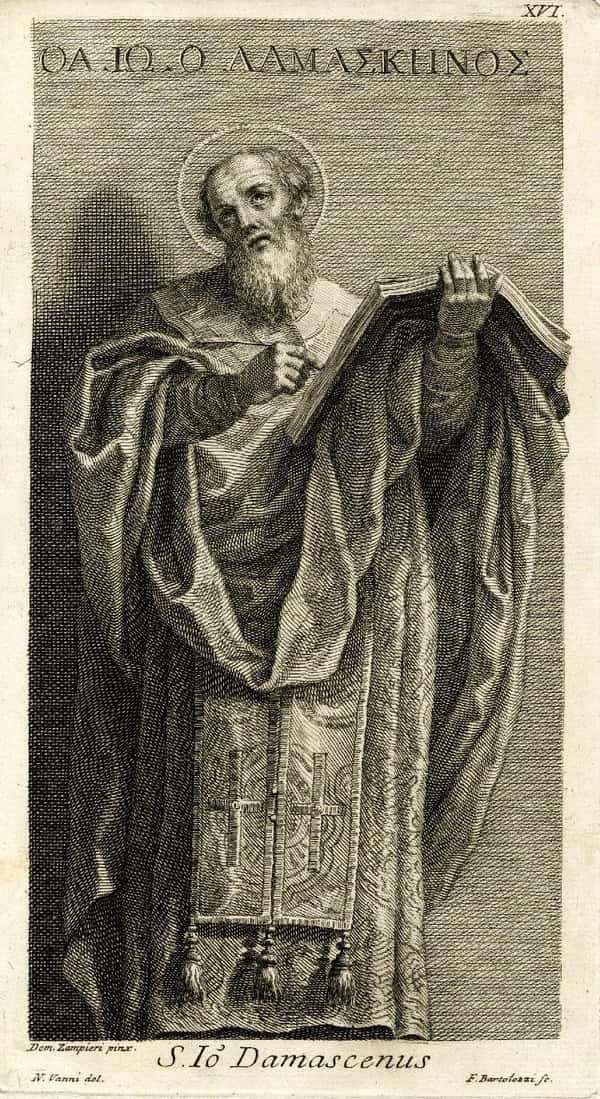 |
March 27: St. John Damascene, Confessor and Doctor of the Church
The faithful have not forgotten that on the first Sunday of Lent the Greeks keep one of their greatest solemnities, that of Orthodoxy. History proves that the Church of Constantinople, the new Rome, did not share the indefectibility of that of the old Rome, for it passed through a cycle of heresies on the dogma of the Incarnation. It rejected successively the consubstantiality of the Word, the unity of Person in Jesus Christ, and the integrity of His two natures. It seemed as though there were nothing left for heretical emperors and patriarchs to deny. Yet there was one more error to proclaim before the measure of false teaching was filled up.
Christ enthroned in heaven could not be belittled, but His images might be proscribed on earth. Heresy was powerless to touch the King even in these pictorial representations, but schism could at least shake off the yoke of His Vicar, and this last denial rolled the stone to the door of a tomb which the Crescent was one day to seal.
The heresy of the Iconoclasts or Image-breakers represents the last phase of Oriental error with regard to the Incarnation of the Son of God. It was right that the feast which commemorates the restoration of the holy Images should receive the glorious name of the Feast of Orthodoxy. It celebrates the last blow struck at Byzantine dogma, and recalls all those delivered by the councils of the Church between the first and second of Nicæa. A peculiar solemnity was given to this feast by the fact that all the anathemas formulated in previous times against the adversaries of revealed truth were renewed in the Church of St. Sophia while the Cross and the holy Images were exalted in triumph and the emperor stood at his throne.
Satan, the sworn foe of the Word, showed clearly that he looked upon the doctrine of the Iconoclasts as his last resource. There is no heresy which has caused more martyrdoms or more destruction. Nero and Diocletian seemed to be reincarnate in the baptized Caesars who defended it: Leo the Isaurian, Constantine Copronymus, Leo the Armenian, Michael the Stammerer and his son Theophilus. The edicts of persecution, published in defence of the idols of former times, were renewed for the destruction of the idolatry which was said to defile the Church.
In the early days of the heresy, St. Germanus of Constantinople reminded the crowned theologian of Isauria that Christians do not adore images but give them a relative honour, which is due to the persons of the saints whom they represent. The imperial pontiff replied by sending the patriarch into exile. The soldiers, whom the emperor charged to carry out his will, gave themselves up to the pillage of churches and private houses. On all sides venerated statues fell under the hammer of the destroyer. Mural paintings were covered with chalk, vestments and sacred vessels mutilated and destroyed on account of images in embroidery or enamel. Masterpieces of art, which had nourished the devotion of the people, were publicly burnt, and the artist who dared to represent Christ, Our Lady, or the saints, was himself subjected to fire and torture together with those of the faithful who had not been able to restrain their sorrow at the sight of such destruction. The shepherds bowed beneath the storm and yielded to re grettable compromises, and the reign of terror was soon supreme over the deserted flock.
But the noble family of St. Basil, both monks and consecrated virgins, rose en masse to withstand the tyrant. They passed through exile, imprisonment, starvation, scourging, death by drowning and the sword, but they saved the tradition of ancient art and the faith of their ancestors. The whole Order seems personified in the holy monk and painter Lazarus, who was first tempted by flattery and threats, then tortured and put in chains. It was impossible to repress him. His hands were burned with red-hot plates, but he still continued to exercise his art for the love of the saints, for the sake of his brethren, and for God, and he outlived his persecutors.
The heresy of the Iconoclasts helped, moreover to establish the temporal independence of the Roman pontiffs, for when the Isaurian threatened to enter Rome and destroy the statue of St. Peter, all Italy rose to repel the invasion of these new barbarians, defend the treasures of her basilicas and withdraw the Vicar of Christ from the yoke of Byzantium.
It was a glorious period, a hundred and twenty years, comprising the reigns of great popes, from St. Gregory II. to St. Paschal I. In the history of the Eastern Church it begins with John Damascene, who saw the opening of the conflict, and ends with Theodore the Studite, whose indomitable firmness secured the final triumph. For many centuries this period, which gave so many saints to the Greek Kalendar, was unrepresented in the Latin Liturgy. The feast of to-day was added by Pope Leo XIII. in 1892, and now John Damascene, the quondam vizier, the protege of Our Lady, the monk, whose excellent doctrine won for him the name of ‘Golden stream,’ commemorates in the Western cycle the heroic struggle in which the East rendered such glorious services to the Church and to the world.
The account given by the Liturgy of the life of this holy Doctor is so complete that we need add nothing further. But it will be well to give a short summary of the definitions by which in the eighth and sixteenth centuries the Church has avenged the holy Images from the attacks made on them by hell. The second Council of Nicæa declares that: ‘It is lawful to place in churches, in frescoes, in pictures, on vestments and the sacred vessels, on the walls of houses and in public streets, images, whether painted or mosaic or of other suitable material, representing Our Lord and Saviour Jesus Christ, our most pure Lady, the holy Mother of God, the angels and the saints; and it is equally lawful to burn incense before them and surround them with lights.’1 ‘Not that we must believe that these images have any divinity or virtue of their own,’ says the Council of Trent against the Protestants, ‘or that we must put our confidence in them as the pagans did in their idols. But the honour which is given to the images is referred to Christ the prototype,2 to whom through them all our adoration is addressed, and to the saints whom we venerate in their portraits.’3
O champion of the holy Images, obtain for us as the Church asks of thee,4 that we may imitate the virtues and experience the aid of those whom we see thus represented. The image directs our veneration and our prayers to those to whom they are due, to Christ the King and to the saints, who are the princes of His army and the most valiant of His soldiers, for it is right that the King should share with His army the honours of His triumph.5 The image is the book of those who cannot read, and even the learned may gain more from an instant’s gazing at an eloquent picture than from the prolonged study of many volumes.6 The work of the Christian artist is not only an act of religion but also an apostolate; thus it is easy to understand the opposition raised by hell in all times of disturbance against Christian art. We unite ourselves with thee, O glorious saint, in thy warfare against the devil, and cry: ‘Get thee behind us, Satan, with that envy which will not suffer us to look upon the image of Our Lord and thus be sanctified. Thou wilt not permit us to contemplate those sufferings which were the source of our salvation, to admire the gracious condescension of our God, to recognize and praise the power displayed in His miracles. Thou art envious of the saints and of the glory they have received from God, and wilt not have us contemplate this glory, lest the sight inspire us to imitate their courage and their faith. Thou canst not endure the thought that our confidence in them will profit us both in soul and in body. We will not follow thee, O jealous demon, thou enemy of mankind.’7
Be thou rather our guide, dear saint, whom sacred science salutes as one of her earliest Doctors.
‘Knowledge is the most precious of all treasures,’8 as thou didst once tell us, and it was thy desire to lead men to the only master who cannot lie, Christ the power and the wisdom of God. If they hear His voice in Holy Scripture, they will gain a true knowledge of all things. If they dispel all darkness of heart and mind, they will not stay on the threshold of the truth, but will pass into the secret of the nuptial chamber.9
Our Blessed Lady herself foretold the teaching and the works of John. She appeared to the master, whose voice he obeyed as that of God, and said to him: ‘Suffer the waters to flow, the clear sweet waters whose abundance will spread throughout the whole world, whose virtue will refresh souls athirst for knowledge and purity, whose power will stay the floods of heresy and transform them into a marvellous sweetness.’
The queen of the heavenly minstrels declared that thou, dear John, hadst received the prophetic harp and psaltery to sing the new canticle of the Lord our God in rivalry with the Cherubim.10 The daughters of Jerusalem, who are the Churches, sing the death and resurrection of Christ,11 and thou art one of the chief cantors. Lead us from the feasts of our exile— the Pasch of time—through the Red Sea and the desert to the eternal feast where all images of earth will vanish before the realities of heaven, where all knowledge will pass into vision, where reigns in glory the queen who inspired thy song, Mary, the mother of us all.
- Concil., Nic. II., sees. vii. ↩︎
- This formula, which gives the true theological basis of the cult of images, is borrowed by the Council of Trent from the second Council of Nicæa, and was originally taken word for word from St. John Damascene, De fide Orthodoxy iv. 16. ↩︎
- Concil., Trident,, sess. xxv. ↩︎
- Collect of the feast. ↩︎
- Damasc., De Imaginibus, i. 19-21. ↩︎
- Damasc., Comment, in Basil. ↩︎
- Ibid., De Imaginibus, iii. 3. ↩︎
- Ibid., Dialectica, i. ↩︎
- Ibid. ↩︎
- Joan. Hierosolymit., Vita J. Dama&ceni, xxxi. ↩︎
- Ibid ↩︎
Saturday in Passion Week
To-day we begin, as does the holy Gospel, to number the days which precede the death, the sacrifice, of the Lamb of God. St. John, in the twelfth chapter of his Gospel, tells us that this is the sixth day before the Pasch.
Jesus is in Bethania, where a feast is being given in His honour. Lazarus, whom Jesus has restored to life, is present at this repast, which is given in the house of Simon the leper. Martha is busy looking after the various arrangements; her sister, Mary Magdalene, has a heavenly presentiment that the death and burial of her beloved Master are soon to be, and she has poured upon Him a precious perfume. The holy Gospel, which ever preserves such a mysterious reserve with regard to the Mother of Jesus, does not tell us that Mary was at Bethania on this occasion, but there can be no doubt of her being present. The apostles were also there, and partook of the repast. Whilst the friends of our Saviour are thus grouped around Him, in this village, which is about two thousand paces from Jerusalem, the aspect of the faithless city becomes more and more threatening; and yet, though His disciples are not aware of it, Jesus is to enter the city to-morrow, and in a most public manner. The heart of Mary is a prey to sadness; Magdalene is absorbed in grief; everything announces that the fatal day is near.
The Church has reserved for Monday next the Gospel which relates the history of this Saturday. The reason is that, formerly, and up to the twelfth century, there was no Station held on this day in Rome: it was left free, in order that the Pope might rest before the great fatigues of Holy Week, whose long and solemn services were to begin on the morrow. But, although he did not preside over the assembly of the faithful, he had to observe two usages, which had been handed down by tradition, and had almost become of liturgical importance in the Church at Rome.
During the whole year, the Pope used, every Sunday, to send a portion of the sacred Species consecrated by him, to each of the priests of the presbyterial titles, or parochial churches of the city. But it was to-day that this distribution was made for the whole of Holy Week, perhaps on account of to-morrow’s long service. We know from the ancient liturgical books of Rome, that it was in the Lateran consistory that to-day’s sacred distribution was made, and it is probable (as the blessed Cardinal Tommasi and Benedict XIV tell us) that the bishops of the suburbicarian churches were of the number of those who received it. We have several instances proving that, formerly, bishops occasionally sent to one another the blessed Sacrament, as a sign of the union that existed between them. With regard to the priests of the city parochial churches, to whom a Particle was sent by the Pope, they put a portion of it in the chalice before receiving the precious Blood.
The other custom, peculiar to this day, consisted in giving alms to all the poor. The Pope presided at this distribution, which was no doubt made ample enough to last the whole of the coming week, when, on account of the long ceremonies, it would scarcely be possible to attend to individual cases of poverty. The liturgists of the middle-ages allude to the beautiful appropriateness of the Roman Pontiff’s distributing alms with his own hand to the poor, on this day, the same on which Mary Magdalene embalmed with her perfumes the feet of Jesus.
Since the twelfth century, a Station has been assigned to this Saturday; it takes place in the Church of St. John before the Latin Gate. This ancient basilica is built near the spot where the beloved disciple was, by Domitian’s order, plunged into the cauldron of boiling oil.
Collect
Epistle
Cap. xviii.In diebus illis: Dixerunt impii Judæi ad invicem: Venite, et cogitemus contra Justum cogitationes: non enim peribit lex a sacerdote, neque consilium a sapiente, nec sermo a propheta: venite, et percutiamus eum lingua, et non attendamus ad universos sermones ejus. Attende, Domine, ad me; et audi vocem adversariorum meorum. Numquid redditur pro bono malum, quia foderunt foveam animæ meæ? Recordare quod steterim in conspectu tuo, ut loquerer pro eis bonum, et averterem indignationem tuam ab eis. Propterea da filios eorum in famem, et deduc eos in manus gladii; fiant uxores eorum absque liberis, et viduæ: et viri earum interficiantur morte: juvenes eorum confodiantur gladio in prælio. Audiatur clamor de domibus eorum: adduces enim super eos latronem repente: quia foderunt foveam ut caperent me, et laqueos absconderunt pedibus meis. Tu autem, Domine, scis omne consilium eorum adversum me in mortem: ne propitieris iniquitati eorum, et peccatum eorum a facie tua non deleatur: fiant comientes in conspectu tuo, in tempore furoris tui abutere eis, Domine Deus noster.
Ch. xviii.In those days, the wicked Jews said to one another: Come, and let us invent devices against the Just: for the law shall not perish from the priest, nor counsel from the wise, nor the word from the prophet. Come, and let us strike him with the tongue, and let us give no heed to all his words. Give heed to me, O Lord, and hear the voice of my adversaries. Shall evil be rendered for good, because they have digged a pit for my soul? Remember that I have stood in thy sight to speak good for them, and to turn away thy indignation from them. Therefore deliver up their children to famine, and bring them into the hands of the sword; let their wives be bereaved of children, and widows; and let their husbands be slain by death; let their young men be stabbed with the sword in battle. Let a cry be heard out of their houses; for thou shalt bring the robber upon them suddenly, because they have digged a pit to take me, and have hid snares for my feet. But thou, O Lord, knowest all their counsel against me unto death; forgive not their iniquity, and let not their sin be blotted out from thy sight: let them be overthrown before thy eyes, in the time of thy wrath do thou destroy them, O Lord our God.
It makes us tremble to read these awful anathemas, which Jeremias, the figure of Christ, speaks against his enemies, the Jews. This prophecy, which was literally fulfilled at the first destruction of Jerusalem by the Assyrians, received a more terrible fulfilment at the second visitation of God’s anger upon this city of malediction. This time, it was not because the Jews had persecuted a prophet; it was because they had rejected and crucified the very Son of God. It was to their long-expected Messias that they had rendered evil for good. It was not a saint, like Jeremias, that had spoken good for them to the Lord, and besought Him to turn away His indignation from them; the Man-God Himself had, without ceasing, made intercession for them, and treated them with the tenderest mercy. But all was in vain; this ungrateful people seemed to hate their divine Benefactor in proportion to His love for them; and at length, in the transport of their fury, they cried out: ‘His Blood be upon us and upon our children!’1 What a frightful chastisement they entailed on themselves by this imprecation! God heard and remembered. Alas! the sinner, who knows Jesus and the worth of His Blood, yet who again sheds this precious Blood, does not he expose himself to the severity of that same justice which fell so heavily on the Jews? Let us tremble and pray: let us implore the divine mercy in favour of those many obstinately blind and hardened sinners, who are hastening to destruction. Oh! that by the fervour of our supplications addressed to the merciful Heart of our common Redeemer, we could obtain a reversion of their sentence, and secure them pardon!
Gospel
Cap. xii.In illo tempore: Cogitaverunt principes sacerdotum, ut et Lazarum interficerent: quia multi propter ilium abibant ex Judæis, et credebant in Jesum. In crastinum autem turba multa, quæ venerat ad diem festum, cum audissent quia venit Jesus Jerosolymam: acceperunt ramos palmarum, et processerunt obviam ei, et clamabant: Hosanna: benedictus qui venit in nomine Domini, Rex Israel. Et invenit Jesus asellum, et sedit super eum, sicut scriptum est: Noli timere, filia Sion: ecce Rex tuus venit sedens super pullum asinæ. Hæc non cognoverunt discipuli ejus primum: sed quando glorificatus est Jesus, tunc recordati sunt quia hæcerant scripta de eo: et hæc fecerunt ei.
Testimonium ergo perhibebat turba, quæ erat cum eo quando Lazarum vocavit de monumento, et suscitavit eum a mortuis. Propterea et obviam venit ei turba: quia audierunt eum fecisse hoc signum. Pharisæi ergo dixerunt ad semetipsos: Videtie quia nihil proficimus? Ecce mundus totus post eum abiit. Erant autem quidam Gentiles ex his, qui ascenderant ut adorarent in die festo. Hi ergo accesserunt ad Philippum, qui erat a Bethsaida Galilææ, et rogabant eum, dicentes: Domine, volumus Jesum videre. Venit Philippus, et dicit Andreæ: Andreas rursum et Philippus dixerunt Jesu.
Ch. xii.At that time: The chief priests thought to kill Lazarus also, because many of the Jews by reason of him went away, and believed in Jesus. And on the next day a great multitude, that was come to the festival day, when they had heard that Jesus was coming to Jerusalem, took branches of palm trees, and went forth to meet him, and cried: Hosanna, blessed is he that cometh in the name of the Lord, the King of Israel! And Jesus found a young ass, and sat upon it, as it is written: Fear not, daughter of Sion; behold thy king cometh sitting on an ass’s colt. These things his disciples did not know at first; but when Jesus was glorified, they then remembered that these things were written of him, and that they had done these things to him.
The multitude therefore gave testimony, which was with him, when he called Lazarus out of the grave, and raised him from the dead. For which reason also the people came to meet him, because they heard that he had done this miracle. The pharisees therefore said among themselves: Do you see that we prevail nothing? behold the whole world is gone after him. Now there were certain Gentiles among them, who came up to adore on the festival day. These therefore came to Philip, who was of Bethsaida of Galilee, and desired him saying: Sir, we would see Jesus. Philip cometh, and telleth Andrew. Again Andrew and Philip told Jesus.
The enemies of Jesus have come to that pitch of hatred, which robs a man of his senses. Lazarus, who has been restored from death to life, is here standing before them; and instead of his resuscitation convincing them of Jesus’ being the Messias, it sets them thinking how best to make away with this irresistible witness. O senseless men! that Jesus who raised him to life when dead, can again bring him to life if you murder him. Jesus’ triumphant entry into Jerusalem, which we are solemnly to commemorate to-morrow, adds to their jealousy and hatred. Behold! say they, 'We prevail nothing: the whole world goes after Him.' Alas! this ovation is to be soon followed by one of those reverses to which a populace is so subject. Meanwhile, however, we have certain Gentiles who desire to see Jesus. It is the beginning of the fulfilment of Jesus’ prophecy: ‘The kingdom of God shall be taken from you, and shall be given to a nation yielding the fruits thereof.’2 Then shall the Son of man be glorified; then shall all nations, by their humble homage to the Crucified, protest against the sinful blindness of the Jews. But, before this comes to pass, it is requisite that the divine Wheat be cast into the ground, and die. Then, the glorious harvest; and the beautiful seed shall yield a hundredfold.
And yet, Jesus feels, in His human nature, a momentary fear at the thought of this death He is to undergo. It is not the agony in the garden; it is a trouble of soul. Let us listen to His words: 'Father! save Me from this hour.' It is our God who foresees all that He is about to suffer for our sake, and it fills Him with fear: He asks to be freed from it, though His will has decreed and accepted it. He immediately adds: 'But for this cause I came unto this hour: Father! glorify Thy name.' His soul is now calm; He once more accepts the hard conditions of our salvation. After this, His words bespeak a triumph; by virtue of the sacrifice about to be offered, satan shall be dethroned: the prince of this world shall be cast out. But the defeat of satan is not the only fruit of our Saviour’s immolation: man, earthly and depraved creature as he is, is to be raised from this earth to heaven. The Son of God is to be the heavenly loadstone, attracting man to Himself: 'And I, if I be lifted up from the earth, will draw all things to Myself.' He forgets His sufferings, and the terrible death which just now troubled Him; He thinks but of the defeat of our implacable enemy, and of our being saved and glorified by His cross. These few words reveal the whole Heart of our Redeemer: if we attentively weigh them, they will suffice to inflame us with devotion as we celebrate the ineffable mysteries of Holy Week.
Let us sue for mercy from the Saviour of our souls, in these words of supplication used in the Gothic liturgy of Spain.
Supplication
(Feria VI Dominicæ V)
The following sequence, in praise of Mary, is most appropriate for this Saturday of Passion-week. It sweetly blends together the homages we owe to the cross of Jesus and to the dolours of Mary. We have taken it from the Horæ of the sixth century.
Sequence
Qui vitam amisimus
Fructu ligni vetiti.
Qui fructum non viderit
Adhærentem stipiti.
Pendet, sicut creditur,
Virginis ad ubera.
Inter viros scelerum,
Passus quinque vulnera.
Hic crux salutifera:
Ambo ligna mystica.
Illa cedrue nobilis:
Utraque vivifica.
Quo me vertam nescio.
Dulcis est collatio.
Modis vagit variis.
Complexurus omnia.
Novit hic tenere.
Nescit hie latere.
Pascitur ab ubere.
Pascit nos ex vulnere.
Fructu nos reficiens.
Fructum nobis nutriens.
Finalis sententia.
Quod nemo consequitur
Unam sine alia.
Nec sic Matrem deserit:
Cuna ad crucem venerit,
Matrem ibi poterit
Stantem invenire.
Crucem prorsus abigit,
Si modum intelligit
Quo per Matrem contigit
Gladium transire.
Matris crucifixæ,
Nos de cruce respice,
Fili crucifixe.
Fructus ligni vitæ,
Nos teipso refice,
Nobis da frui te.
lost our life,
now seek the tree of life.
who sees the branch
whereon is fixed the fruit.
that the fruit, that gives us life,
hangs on Mary’s breast.
between two thieves,
though here he is pierced with five wounds.
and the saving cross,
both are mystic trees;
Mary, noble as the cedar:
both are trees of life.
I know not to which to turn.
O sweet comparison!
a weeping little Babe;
calling all to his embrace.
sweet to a Mother’s love;
too ardent to be hid.
he is fed at her breast;
he feeds us from his wounds.
the food of its refreshing fruit;
feeding the very fruit, feeding him for us.
is my decision:
we cannot have the one
without the other.
must have the Mother;
for when he comes to the cross,
he will find the Mother
standing at the foot.
meets the cross as well,
for it was while standing at the cross,
that the Mother’s heart
was pierced.
of a crucified Mother!
look upon us
from thy cross.
O fruit of the tree of life!
refresh us with thyself,
give us the enjoyment of thine own dear self.
| Previous Friday in Passion Week: The Seven Dolours of the Blessed Virgin | Next Saturday in Passion Week |