Daily reading
Paschal Time
Double · Movable from Easter · Temporal
April 11, 2021
From Dom Guéranger’s The Liturgical Year.

|
Quasimodo or Low Sunday
THE OCTAVE OF THE PASCH
OUR neophytes closed the Octave of the Resurrection yesterday. They were before us in receiving the admirable mystery; their solemnity would finish earlier than ours. This, then, is the eighth day for us who kept the Pasch on the Sunday, and did not anticipate it on the vigil. It reminds us of all the glory and joy of that feast of feasts, which united the whole of Christendom in one common feeling of triumph. It is the day of light, which takes the place of the Jewish Sabbath. Henceforth, the first day of the week is to be kept holy. Twice has the Son of God honoured it with the manifestation of his almighty power. The Pasch, therefore, is always to be celebrated on the Sunday; and thus every Sunday becomes a sort of Paschal feast, as we have already explained in the Mystery of Easter.
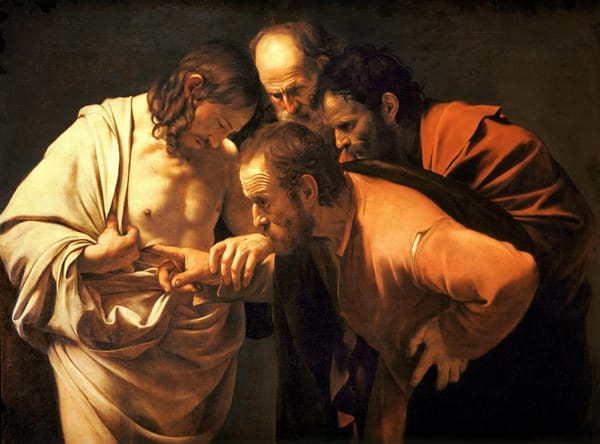
Our risen Jesus gave an additional proof that he wished the Sunday to be, henceforth, the privileged day. He reserved the second visit he intended to pay to all his disciples for this the eighth day since his Resurrection. During the previous days, he has left Thomas a prey to doubt; but to-day he shows himself to this Apostle, as well as to the others, and obliges him, by irresistible evidence, to lay aside his incredulity. Thus does our Saviour again honour the Sunday. The Holy Ghost will come down from heaven upon this same day of the week, making it the commencement of the Christian Church: Pentecost will complete the glory of this favoured day.
Jesus’ apparition to the eleven, and the victory he gains over the incredulous Thomas—these are the special subjects the Church brings before us to-day. By this apparition, which is the seventh since his Resurrection, our Saviour wins the perfect faith of his disciples. It is impossible not to recognize God in the patience, the majesty, and the charity of him who shows himself to them. Here, again, our human thoughts are disconcerted; we should have thought this delay excessive; it would have seemed to us that our Lord ought to have at once either removed the sinful doubt from Thomas's mind, or punished him for his disbelief. But no: Jesus is infinite wisdom, and infinite goodness. In his wisdom, he makes this tardy acknowledgement of Thomas become a new argument of the truth of the Resurrection; in his goodness, he brings the heart of the incredulous disciple to repentance, humility, and love; yea, to a fervent and solemn retractation of all his disbelief. We will not here attempt to describe this admirable scene, which holy Church is about to bring before us. We will select, for our to-day’s instruction, the important lesson given by Jesus to his disciple, and through him to us all. It is the leading instruction of the Sunday, the Octave of the Pasch, and it behoves us not to pass it by, for, more than any other, it tells us the leading characteristic of a Christian, shows us the cause of our being so listless in God’s service, and points out to us the remedy for our spiritual ailments.
Jesus says to Thomas: ‘Because thou hast seen me, thou hast believed: blessed are they that have not seen, and have believed!’ Such is the great truth, spoken by the lips of the God-Man: it is a most important counsel, given, not only to Thomas, but to all who would serve God and secure their salvation. What is it that Jesus asks of his disciple? Has he not heard him make profession that now, at last, he firmly believes? After all, was there any great fault in Thomas’s insisting on having experimental evidence before believing in so extraordinary a miracle as the Resurrection? Was he obliged to trust to the testimony of Peter and the others, under penalty of offending his divine Master? Did he not evince his prudence, by withholding his assent until he had additional proofs of the truth of what his brethren told him? Yes, Thomas was a circumspect and prudent man, and one that was slow to believe what he had heard; he was worthy to be taken as a model by those Christians who reason and sit in judgement upon matters of faith. And yet, listen to the reproach made him by Jesus. It is merciful, and withal so severe! Jesus has so far condescended to the weakness of his disciple as to accept the condition on which alone he declares that he will believe: now that the disciple stands trembling before his risen Lord, and exclaims, in the earnestness of faith,’My Lord and my God!' oh! see how Jesus chides him! This stubbornness, this incredulity, deserves a punishment: the punishment is, to have these words said to him:’Thomas! thou hast believed, because thou hast seen!
Then was Thomas obliged to believe before having seen? Yes, undoubtedly. Not only Thomas, but all the Apostles were in duty bound to believe the Resurrection of Jesus even before he showed himself to them. Had they not lived three years with him? Had they not seen him prove himself to be the Messias and the Son of God by the most undeniable miracles? Had he not foretold them that he would rise again on the third day? As to the humiliations and cruelties of his Passion, had he not told them, a short time previous to it, that he was to be seized by the Jews in Jerusalem, and be delivered to the gentiles? that he was to be scourged, spit upon, and put to death?1
After all this, they ought to have believed in his triumphant Resurrection, the very first moment they heard of his Body having disappeared. As soon as John had entered the sepulchre, and seen the windingsheet, he at once ceased to doubt; he believed. But it is seldom that man is so honest as this; he hesitates, and God must make still further advances, if he would have us give our faith! Jesus condescended even to this: he made further advances. He showed himself to Magdalen and her companions, who were not incredulous, but only carried away by natural feeling, though the feeling was one of love for their Master. When the Apostles heard their account of what had happened, they treated them as women whose imagination had got the better of their judgement. Jesus had to come in person: he showed himself to these obstinate men, whose pride made them forget all that he had said and done, sufficient indeed to make them believe in his Resurrection. Yes, it was pride; for faith has no other obstacle than this. If man were humble, he would have faith enough to move mountains.
To return to our Apostle. Thomas had heard Magdalen, and he despised her testimony; he had heard Peter, and he objected to his authority; he had heard the rest of his fellow-Apostles and the two disciples of Emmaus, and no, he would not give up his own opinion. How many there are among us who are like him in this! We never think of doubting what is told us by a truthful and disinterested witness, unless the subject touch upon the supernatural; and then we have a hundred difficulties. It is one of the sad consequences left in us by original sin. Like Thomas, we would see the thing ourselves: and that alone is enough to keep us from the fulness of the truth. We comfort ourselves with the reflection that, after all, we are disciples of Christ; as did Thomas, who kept in union with his brother-Apostles, only he shared not their happiness. He saw their happiness, but he considered it to be a weakness of mind, and was glad that he was free from it!
How like this is to our modem rationalistic Catholic! He believes, but it is because his reason almost forces him to believe; he believes with his mind, rather than from his heart. His faith is a scientific deduction, and not a generous longing after God and supernatural truth. Hence how cold and powerless is this faith! how cramped and ashamed! how afraid of believing too much! Unlike the generous unstinted faith of the saints, it is satisfied with fragments of truth, with what the Scripture terms diminished truths.2 It seems ashamed of itself. It speaks in a whisper, lest it should be criticized; and when it does venture to make itself heard, it adopts a phraseology which may take off the sound of the divine. As to those miracles which it wishes had never taken place, and which it would have advised God not to work, they are a forbidden subject. The very mention of a miracle, particularly if it have happened in our own times, puts it into a state of nervousness. The lives of the saints, their heroic virtues, their sublime sacrifices—it has a repugnance to the whole thing! It talks gravely about those who are not of the true religion being unjustly dealt with by the Church in Catholic countries; it asserts that the same liberty ought to be granted to error as to truth; it has very serious doubts whether the world has been a great loser by the secularization of society.
Now it was for the instruction of persons of this class that our Lord spoke those words to Thomas:’Blessed are they who have not seen, and have believed.' Thomas sinned in not having the readiness of mind to believe. Like him, we also are in danger of sinning, unless our faith have a certain expansiveness, which makes us see everything with the eye of faith, and gives our faith that progress which God recompenses with a superabundance of light and joy. Yes, having once become members of the Church, it is our duty to look upon all things from a supernatural point of view. There is no danger of going too far, for we have the teachings of an infallible authority to guide us. ‘The just man liveth by faith.’3 Faith is his daily bread. His mere natural life becomes transformed for good and all, if only he be faithful to his Baptism. Could we suppose that the Church, after all her instructions to her neophytes, and after all those sacred rites of their Baptism which are so expressive of the supernatural life, would be satisfied to see them straightway adopt that dangerous system which drives faith into a nook of the heart and understanding and conduct, leaving all the rest to natural principles or instinct? No, it could not be so. Let us therefore imitate St Thomas in his confession, and acknowledge that hitherto our faith has not been perfect. Let us go to our Jesus, and say to him: 'Thou art my Lord and my God! But alas! I have many times thought and acted as though thou wert my Lord and my God in some things, and not in others. Henceforth I will believe without seeing; for I would be of the number of those whom thou callest blessed!’
This Sunday, commonly called with us Low Sunday, has two names assigned to it in the Liturgy: Quasimodo, from the first word of the Introit; and Sunday in albis (or, more explicitly, in albis depositis), because on this day the neophytes assisted at the Church services attired in their ordinary dress. In the Middle Ages it was called Close-Pasch, no doubt in allusion to its being the last day of the Easter Octave. Such is the solemnity of this Sunday that not only is it of Greater Double rite, but no feast, however great, can ever be kept upon it.
At Rome, the Station is in the basilica of St Pancras, on the Aurelian Way. Ancient writers have not mentioned the reason of this Church being chosen for to-day's assembly of the faithful. It may, perhaps, have been on account of the saint's being only fourteen years old when put to death: a circumstance which gave the young martyr a sort of right to have the neophytes round him, now that they were returning to their everyday life.
Mass
The Introit repeats those beautiful words of St Peter, which were addressed, in yesterday's Epistle, to the newly baptized. They are like new-born babes, lovely in their sweet simplicity, and eager to drink from the breasts of their dear mother, the Church, the spiritual milk of faith—that faith which will make them strong and loyal.
Introit
On this the last day of the great Octave, the Church, in her Collect, bids farewell to the glorious solemnities that have so gladdened us, and asks our Lord to grant that our lives and actions may ever reflect the holy influence of our Pasch.
Collect
Epistle
I Cap. v.Charissimi, omne, quod natum est ex Deo, vincit mundum: et hæc est victoria, quæ vincit mundum, fides nostra. Quis est, qui vincit mundum, nisi qui credit quoniam Jesus est Filius Dei? Hic est qui venit per aquam et sanguinem, Jesus Christus: non in aqua solum, sed in aqua et sanguine. Et spiritus est, qui testificatur, quoniam Christus est veritas. Quoniam tres sunt, qui testimonium dant in cœlo: Pater, Verbum et Spiritus Sanctus: et hi tres unum sunt. Et tres sunt, qui testimonium dant in terra: Spiritus et aqua et sanguis: et hi tres unum sunt. Si testimonium hominum accipimus, testimonium Dei majus est: quoniam hoc est testimonium Dei quod majus est, quoniam testificatus est de Filio suo. Qui credit in Filium Dei, habet testimonium Dei in se.
I Ch. v.Dearly beloved: Whatsoever is born of God, overcometh the world: and this is the victory which overcometh the world, our faith. Who is he that overcometh the world, but he that believeth that Jesus is the Son of God? This is he that came by water and blood, Jesus Christ: not by water only, but by water and blood. And it is the spirit which testifieth, that Christ is the truth. And there are three who give testimony in heaven, the Father, the Word, and the Holy Ghost. And these three are one. And there are three that give testimony on earth: the spirit, the water, and the blood, and these three are one. If we receive the testimony of men, the testimony of God is greater. For this is the testimony of God which is greater, because he hath testified of his Son. He that believeth in the Son of God, hath the testimony of God in himself.
The Apostle St John here tells us the merit and power of faith: it is, says he, a victory, which conquers the world, both the world outside, and the world within us. It is not difficult to understand why this passage from St John's Epistles should have been selected for to-day's Liturgy: it is on account of its being so much in keeping with the Gospel appointed for this Sunday, in which our Lord passes such eulogy upon faith. If, as the Apostle here assures us, they Overcome the world who believe in Christ, that is not sterling faith which allows itself to be intimidated by the world. Let us be proud of our faith, esteeming ourselves happy that we are but little children when there is a question of receiving a divine truth; and let us not be ashamed of our eager readiness to admit the testimony of God. This testimony will make itself heard in our hearts, in proportion to our willingness to hear it. The moment John saw the winding-bands which had shrouded the Body of his Master, he made an act of faith; Thomas, who had stronger testimony than John (for he had the word of the Apostles, assuring him that they had seen their risen Lord), refused to believe: he had not overcome the world and its reasonings, because he had not faith.
The two Alleluia Versicles are formed of two texts alluding to the Resurrection. The second speaks of the scene which took place on this day, in the cenacle.
Gospel
Cap. xx.In illo tempore: Quum sero esset die illo, una sabbatorum, et fores essent clausæ, ubi erant discipuli congregati propter metum Judaeorum: venit Jesus, et stetit in medio, et dixit eis: Pax vobis. Et cum hoc dixisset, ostendit eis manus et latus. Gavisi sunt ergo discipuli, viso Domino. Dixit ergo eis iterum: Pax vobis. Sicut misit me Pater, et ego mitto vos. Hæc cum dixisset, insufflavit et dixit eis: Accipite Spiritum Sanctum; quorum remiseritis peccata, remittuntur eis: et quorum retinueritis, retenta sunt. Thomas autem unus ex duodecim, qui dicitur Didymus, non erat cum eis quando venit Jesus. Dixerunt ergo et alii discipuli: Vidimus Dominum. Ille autem dixit eis: Nisi videro in manibus ejus fixuram clavorum, et mittam digitum meum in locum clavorum, et mittam manum meam in latus ejus, non credam. Et post dies octo, iterum erant discipuli ejus intus: et Thomas cum eis. Venit Jesus januis clausis, et stetit in medio, et dixit: Pax vobis. Deinde dicit Thomæ: Infer digitum tuum huc, et vide manus meas, et after manum tuam, et mitte in latus meum: et noli esse incredulus, sed fidelis. Respondit Thomas, et dixit ei: Dominus meus, et Deus meus. Dixit ei Jesus: Quia vidisti me, Thoma, credidisti: beati qui non viderunt et crediderunt. Multa quidem et alia signa fecit Jesus in conspectu discipulorum suorum, quæ non sunt scripta in libro hoc. Hæc autem scripta sunt, ut credatis, quia Jesus est Christus Filius Dei: et ut credentes, vitam habeatis in nomine ejus.
Ch. xx.At that time: When it was late that same day, being the first day of the week, and the doors were shut where the disciples were gathered together for fear of the Jews, Jesus came and stood in the midst, and said to them: Peace be to you. And when he had said this, he showed them his hands and his side. The disciples therefore were glad when they saw the Lord. He said therefore to them again: Peace be to you. As the Father hath sent me, I also send you. When he had said this, he breathed on them; and he said to them: Receive ye the Holy Ghost: whose sins you shall forgive, they are forgiven them; and whose sins you shall retain, they are retained. Now Thomas, one of the twelve, who is called Didymus, was not with them when Jesus came. The other disciples therefore said to him: We have seen the Lord. But he said to them: Except I shall see in his hands the print of the nails, and put my finger into the place of the nails, and put my hand into his side, I will not believe. And after eight days again his disciples were within, and Thomas with them. Jesus cometh, the doors being shut, and stood in the midst, and said: Peace be to you. Then he said to Thomas: Put in thy fingers hither, and see my hands, and bring hither thy hand, and put it into my side; and be not faithless, but believing. Thomas answered and said to him: My Lord and my God! Jesus saith to him: Because thou hast seen me, Thomas, thou hast believed: blessed are they that have not seen, and have believed. Many other signs also did Jesus in the sight of his disciples, which are not written in this book. But these are written, that you may believe that Jesus is the Christ, the Son of God: and that believing you may have life in his name.
We have said enough about St Thomas’ incredulity; let us now admire his faith. His fault has taught us to examine and condemn our own want of faith; let us learn from his repentance how to become true believers. Our Lord, who had chosen him as one of the pillars of his Church, has been obliged to treat him with an exceptional familiarity: Thomas avails himself of Jesus’ permission, puts his finger into the sacred wound, and immediately he sees the sinfulness of his past incredulity. He would make atonement, by a solemn act of faith, for the sin he has committed in priding himself on being wise and discreet: he cries out, and with all the fervour of faith: My Lord and my God! Observe, he not only says that Jesus is his Lord, his Master, the same who chose him as one of his disciples: this would not have been faith, for there is no faith where we can see and touch. Had Thomas believed what his brother-Apostles had told him, he would have had faith in the Resurrection; but now he sees, he has experimental knowledge of the great fact; and yet, as our Lord says of him, he has faith. In what? In this, that his Master is God. He sees but the humanity of Jesus, and he at once confesses him to be God. From what is visible, his soul, now generous and repentant, rises to the invisible:’Thou art my God!' Now, O Thomas! thou art full of faith! The Church proposes thee to us, on thy feast, as an example of faith. The confession thou didst make on this day is worthy to be compared with that which Peter made, when he said:’Thou art Christ, the Son of the living God!’4 By this profession, which neither flesh nor blood had revealed to him, Peter merited to be made the rock whereon Christ built his Church: thine did more than compensate thy former disbelief; it gave thee, for the time, a superiority over the rest of the Apostles, who, so far at least, were more taken up with the visible glory, than with the invisible divinity, of their risen Lord.
The Offertory gives us another text of the Gospel relative to the Resurrection.
Offertory
In the Secret, the Church expresses the holy enthusiasm wherewith the Paschal mystery fills her; she prays that this joy may lead her to the never-ending one of the eternal Easter.
Secret
While giving the Bread of heaven to her neophytes and other children, the Church sings in her Communion Antiphon the words spoken by Jesus to Thomas. This Apostle was permitted to touch our Lord's sacred wounds; we, by the holy Eucharist, are brought into still closer intimacy with this same Jesus: but that we may derive the profit intended by such condescension, we must have a faith lively and generous, like that which he exacted from his Apostles.
Communion
The Church concludes the prayers of her Sacrifice by asking that the divine mystery, instituted to be a support to our weakness, may give us untiring perseverance.
Postcommunion
Vespers
When the feast of the Annunciation is deferred till after Easter, it is kept on the Monday following Low Sunday: its First Vespers are now sung, and a commemoration only is made of the Sunday, at the end of the Office. We have given these below, p. 310. Other years, the Vespers are those of Paschal time, which will be found at p. 81.
Antiphon of the Magnificat
Oremus.
Let us Pray.
As an appropriate prayer wherewith to close the day, we offer to our readers the following beautiful one, wherein the Gothic Church of Spain celebrates the mystery of the eighth day—the Octave of Easter.
Once more let us listen to the devout Adam of St Victor. His sequences were great favourites with our Catholic forefathers of the Middle Ages. The triumph of our Redeemer over death was a subject which this great liturgical poet has often treated in a most masterly way.
Sequence
Nova parit gaudia;
Resurgenti Domino
Conresurgunt omnia.
Elementa serviunt,
Et auctoris sentiunt
Quanta sit potentia.
Et aer volubilis:
Fluit aqua labilis,
Terra manet stabilis:
Alta petunt levia,
Centrum tenent gravia,
Renovantur omnia.
Et mare tranquillius;
Spirat aura levius,
Vallis nostra floruit.
Revirescunt arida,
Recalescunt frigida,
Postquam ver intepuit.
Princeps mundi tollitur,
Et ejus destruitur
In nobis imperium;
Dum tenere voluit
In quo nihil habuit,
Jus amisit proprium.
Homo jam recuperat
Quod prius amiserat,
Paradisi gaudium:
Viam præbet facilem,
Cherubim versatilem
Amovendo gladium.
Et captivos liberat,
Quos culpa ligaverat
Sub mortis interitu.
Pro tanta victoria
Patri, Proli gloria
Sit cum Sancto Spiritu!
creates new joy.
All creatures rise together
with their Lord.
The elements obey him,
and feel their Creator's
mighty power.
air is swift;
water is flowing;
earth is firm;
light things tend aloft,
and those that are heavy seek their centre:
but all are now renewed.
the sea more tranquil,
the winds breathe softer.
Our valley is filled with flowers;
and now that gentle spring is come,
the dry things have put on green again,
and the cold a genial warmth.
The prince of this world
is made captive,
and has no longer power over us:
by striving to take him over
whom he had no claim,
he lost his own.
man now regains
what he had lost
—the joys of heaven;
the angel sheathes
his two-edged sword,
and leaves the passage free.
and liberates them
whom sin had
made captives of death.
For this great victory,
be glory to Father, Son,
and Holy Ghost.
April 11: St. Leo the Great, Pope and Doctor of the Church
 |
ONE of the grandest Saints in the Church’s Calendar is brought before us to-day. Leo, the Pontiff and Doctor, rises on the Paschal horizon, and calls for our admiration and love. As his name implies, he is the Lion of Holy Church; thus representing, in his own person, one of the most glorious of our Lord’s titles. There have been thirteen Popes who have had this name, and five of the number are enrolled in the catalogue of Saints; but not one of them has so honoured the name as he whose feast we keep to-day: hence he is called ‘Leo the Great.’
He deserved the appellation by what he did for maintaining the faith regarding the sublime mystery of the Incarnation. The Church had triumphed over the heresies that had attacked the dogma of the Trinity, when the gates of hell sought to prevail against the dogma of God having been made Man. Nestorius, a bishop of Constantinople, impiously taught that there were two distinct Persons in Christ the Person of the Divine Word, and the Person of Man. The Council of Ephesus condemned this doctrine, which, by denying the unity of Person in Christ, destroyed the true notion of the Redemption. A new heresy, the very opposite of that of Nestorianism, but equally subversive of Christianity, soon followed. The monk Eutyches maintained that in the Incarnation the human nature was absorbed by the Divine. The error was propagated with frightful rapidity. There was needed a clear and authoritative exposition of the great dogma, which is the foundation of all our hopes. Leo arose, and, from the Apostolic Chair, on which the Holy Ghost had placed him, proclaimed with matchless eloquence and precision the formula of the ancient faith—ancient indeed, and ever the same, yet ever acquiring greater and fresher brightness. A cry of admiration was raised at the General Council of Chalcedon, which had been convened for the purpose of condemning the errors of Eutyches. ' Peter,' exclaimed the Fathers, ‘Peter has spoken by the mouth of Leo!’ As we shall see further on, the Eastern Church has kept up the enthusiasm thus excited by the magnificent teachings given by Leo to the whole world.
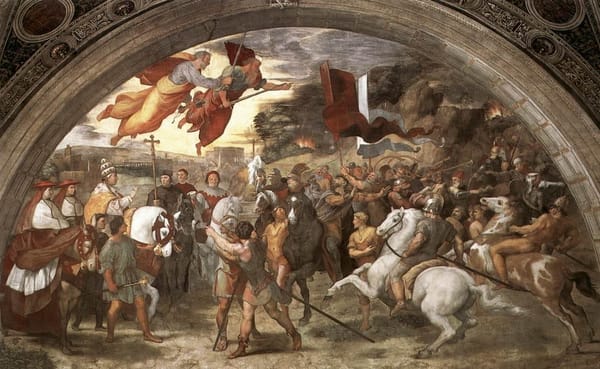
The barbarian hordes were invading the West; the Empire was little more than a ruin: and Attila, ‘the Scourge of God,’ was marching on towards Rome. Leo's majestic bearing repelled the invasion, as his word had checked the ravages of heresy. The haughty king of the Huns, before whose armies the strongest citadels had fallen, granted an audience to the Pontiff on the banks of the Mincio, and promised to spare Rome. The calm and dignity of Leo—who thus unarmed confronted the most formidable enemy of the Empire, and exposed his life for his flock—awed the barbarian, who afterwards told his people that, during the interview, he saw a venerable person standing in an attitude of defence, by the side of Rome’s intercessor: it was the Apostle St Peter. Attila not only admired, he feared the Pontiff. It was truly a sublime spectacle, and one that was full of meaning—a priest, with no arms save those of his character and virtues, forcing a king, such as Attila, to do homage to a devotedness which he could ill understand, and recognize by submission the influence of a power which had heaven on its side. Leo, singlehanded and at once, did what it took the whole of Europe several ages to accomplish in later times.
That the aureole of Leo’s glory might be complete, the Holy Ghost gifted him with an eloquence which, on account of its majesty and richness, might deservedly be called papal. The Latin language had at that time lost its ancient vigour; but we frequently come across passages in the writings of our Saint which remind us of the golden age.
In exposing the dogmas of our holy faith, he uses a style so dignified and so impregnated with the savour of sacred antiquity, that it seems made for the subject. He has several admirable sermons on the Resurrection; and speaking of the present season of the liturgical year, he says: ‘The days that intervened between our Lord's Resurrection and Ascension were not days on which nothing was done: on the contrary, great were the sacraments then confirmed, and great were the mysteries that were revealed.'1
Let us now read the sketch of the Saint’s life given by the Church in the Matins of the feast.
The Greek Church, in her Memea, has an office in honour of St Leo: we take from it the following stanzas. As they were composed before the Schism, they show us that the ancient Church of Constantinople believed the supremacy of the Roman Pontiff, and that it is not the Latins that have changed the faith. The Greeks keep the Feast of St Leo on February 18.
Hymn (Die XVIII Februarii)
Glory be to thee, O Jesus, Lion of the Tribe of Juda! that hast raised up in thy Church a Lion to defend her in those dark times, when holy Faith was most exposed to danger. Thou didst charge Peter to confirm his brethren2 and we have seen Leo, in whom Peter lived, fulfil his office with sovereign authority. We have heard the acclamation of the holy Council, which, in admiration at the heavenly teachings of Leo, proclaimed the signal favour thou didst confer on thy flock, when thou badest Peter feed both sheep and lambs.
O holy Pontiff Leo! thou worthily didst represent Peter in his Chair, whence thy apostolic teaching ceased not to flow, ever beautiful in its truth and majesty. The Church of thine own day honoured thee as the great teacher of faith; and the Church of every succeeding age has recognized thee as one of the most learned Doctors and preachers of the divine word. From thy throne in heaven, where now thou reignest, pour forth upon us the understanding of the great mystery, which thou wast called on to defend. Under thy inspired pen, this mystery grows clear; we see how sublimely it harmonizes with all other mysteries; and faith delights at gaining so close a view of the divine object of its belief. Oh! strengthen this faith within us. The Incarnate Word is blasphemed in our own times; avenge his glory, by sending us men of thy zeal and learning.
Thou didst triumph over barbarian invaders: Attila acknowledged the influence of thy sanctity and eloquence, by withdrawing his troops from the Christian land they infested. In these our days, there have risen up new barbarians—civilized barbarians, who would persuade us that religion should be eliminated from education. and that the State, in its laws and institutions, should simply ignore our Lord Jesus Christ, the King to whom all power has been given, not only in heaven but on earth also.3 Oh! help us by thy powerful intercession, for our danger is very great. Many are seduced, and have fallen into apostasy, whilst flattering themselves that they are still Christians. Pray that the light that is left within us may not be extinguished, and that the public scandals which now exist may be brought to an end. Attila was but a pagan; our modem statesmen and governments are, or at least call themselves, Christians: have pity cn them, and gain for them light to see the precipice to which they are hurrying society.
These days of Paschal Time remind thee, O holy Pontiff! of the Easters thou didst once spend here on earth, when, surrounded by the neophytes, thou gavest them the nourishment of thy magnificent discourses: pray for the faithful, who have this Easter risen to a new life with Christ. What they most need is a fuller and better knowledge of this their Saviour, in order that they may cling more closely to him, and persevere in his holy service. Thy prayers must obtain for them this knowledge; by thy prayers thou must teach them what he is both in his Divine and Human Nature: that as God he is their Last End, and their Judge after death; as Man, their Brother, their Redeemer, their Model. Bless, O Leo! and help the Pontiff who is now thy successor on the Chair of Peter. Show now thy love for that Rome whose sacred and eternal destinies were so frequently the subject of thy glowing and heavenly eloquence.
| Previous Saturday in Easter Week | Next April 11: St. Leo the Great, Pope and Doctor of the Church |