Daily reading
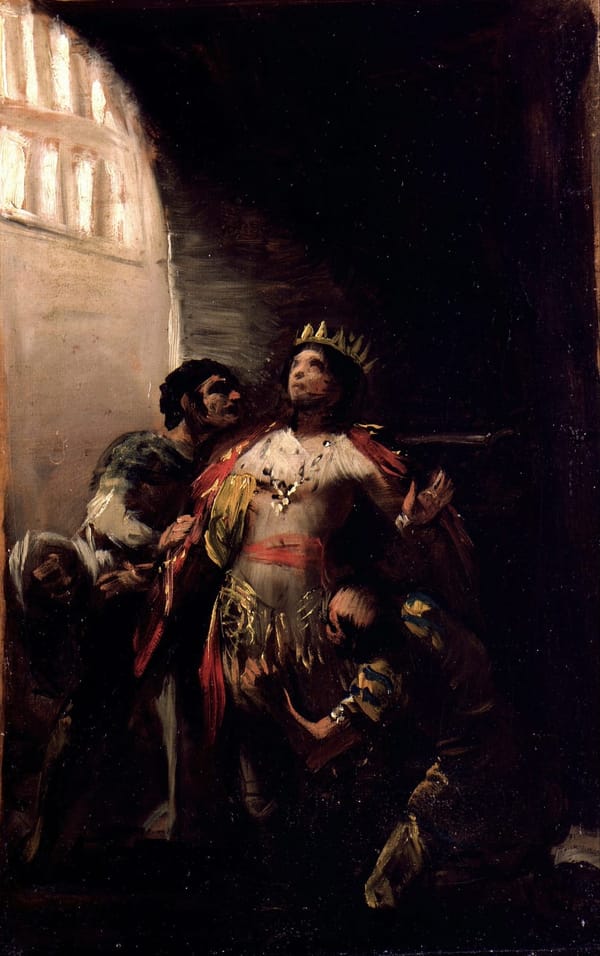
April 13: St. Hermenegild, Martyr
IT is through a martyr's palm-branch that we must to-day see the Paschal Mystery. Hermenegild, a young Visigoth prince, is put to death by his heretical father, because he courageously refused to receive his Easter Communion from an Arian bishop. The martyr knew that the Eucharist is the sacred symbol of Catholic unity; and that we are not allowed to approach the Holy Table in company with those who are not in the true Church. A sacrilegious consecration gives heretics the real possession of the divine Mystery, if the priestly character be in him who dares to offer sacrifice to the God whom he blasphemes; but the Catholic, who knows that he may not so much as pray with heretics, shudders at the sight of the profanation, and would rather die than share by his presence in insulting our Redeemer in that very Sacrifice and Sacrament which were instituted that we might all be made one in God.
The blood of the martyr produced its fruit: Spain threw off the chains of heresy that had enslaved her, and a Council, held at Toledo, completed the work of conversion begun by Hermenegild's sacrifice. There are very few instances recorded in history of a whole nation rising up as one man to abjure heresy; but Spain did it, for she seems to be a country on which heaven lavishes exceptional blessings. Shortly after this she was put through the ordeal of the Saracen invasion; she triumphed here again by the bravery of her children; and ever since then, her faith has been so staunch and so pure as to merit for her the proud title of The Catholic Kingdom.
St Gregory the Great, a contemporary of St Hermenegild, has transmitted to us the following account of the martyrdom. The Church has inserted it in her Lessons of today's Matins.
Pope Urban VIII composed the two following hymns for the feast of the holy martyr: we unite them under one conclusion.
Hymn
Hermenegilde jubar, gloria Martyrum,
Christi quos amor almis
Cœli cœtibus inserit.
Deo Servans obsequium! quo potius tibi
Nil proponis, et arces
Cautus noxia, quæ placent.
Surgentis vitii, non dubios agens
Per vestigia gressus
Quo veri via dirigit!
Non vitæ caperis divitis otio,
Gemmarumve nitore,
Regnandive cupidine.
Nec terret perimens carnificis furor:
Nam mansura caducis
Præfers gaudia cœlitum.
Clemens, atque preces, dum canimus tua
Quæsitam nece palmam,
Pronis auribus excipe.
Et natum celebrent ora precantium,
Divinumque supremis
Flamen laudibus efferant.
Hermenegild, as one of its glories:
so, too, do the martyrs,
whose love of Christ has numbered them among the blessed of heaven.
He was dear to thee above all things else;
and as to the dangerous pleasures of this world,
thou wisely didst reject them.
which excite and foster vice,
and march onwards, with unfaltering step,
whither the path of truth leads.
The luxuries of a life of ease and wealth,
the glitter of diamonds, the prospect of a throne
—they could not allure thee.
nor by the executioner's merciless rage;
for the everlasting joys of heaven
were dearer to thee than those of time.
from thy heavenly throne,
and graciously receive the prayers we present to thee
whilst celebrating the palm made thine by martyrdom.
Let the faithful assembled here in prayer, glorify the Son;
let them sing forth endless praise
to the Holy Ghost.
We offer thee, O brave witness to the truth of our holy faith! our admiration and gratitude. Thy courageous death was proof of the love thou hadst for Christ; and thy contempt of earthly honours teaches us to despise them. Though thou wert heir to a throne, a prison was thy abode here below. It was thence that thou didst ascend to heaven, wearing on thy brow the laurels of martyrdom, a crown far brighter than that which was offered thee on condition of thy apostatizing from the faith. Pray now for us: the Church asks it of thee, by inserting thy name in the Calendar of her Saints. The Pasch was the day of thy triumph; obtain for us that this may be a true Pasch to us, a real resurrection. which may lead us to the heaven above, where we may enjoy with thee the sight of our Risen Jesus. Intercede for us, that we may be firm in the faith, obedient to the teachings of holy Church, and enemies of every error and innovation. Protect Spain, thy fatherland, which owes to thy martyrdom long centuries of loyalty to the true faith. Pray for her, that she may ever continue to merit her glorious title of Catholic Kingdom.
Tuesday of the Second Week after Easter
WHAT are these wounds in the midst of thy hand?1 Such was the exclamation of the Prophet Zacharias, who lived five hundred years before the Birth of our Emmanuel: and we are almost forced to use it, now that we behold the Wounds that shine so brightly in the glorified Body of our Risen Lord. His hands and feet bear the mark of the nails, and his side that of the spear; the Wounds are as visible and as deep as when he was first taken down from the Cross. Put in thy finger hither, said Jesus, holding out his wounded hands to Thomas; put thy hand into my Side!2
We assisted at this wonderful interview on Sunday last—the incredulity of the disciple was made an occasion for the most incontestable proof of the Resurrection: but it also taught us that, when our Lord rose from the tomb, he retained in his glorified Flesh the stigmata of his Passion. Consequently, he will retain them for ever, inasmuch as no change can have further place in his Person. What he was the moment after his Resurrection, that will he be for all eternity. But we are not to suppose that these sacred stigmata, which tell of his humiliation on Calvary, are in the slightest degree a lessening of his glory. He retains them because he wishes to do so; and he wishes it, because these Wounds, far from attesting defeat or weakness, proclaim his irresistible power and triumph. He has conquered death; the Wounds received in the combat are the record of his victory. He will enter heaven on the day of his Ascension, and the rays of light which beam from his Wounds will dazzle the eyes of even the angels. In like manner, as the holy Fathers tell us,3 his martyrs who have imitated him in vanquishing death will also shine with special brightness in those parts of their bodies where they were tortured.
And is not our Risen Jesus to exercise, from his throne in heaven, that sublime mediatorship for which he assumed our human nature? Is he not to be ever disarming the anger of his Father justly irritated by our sins? Is he not to make perpetual intercession for us, and obtain for mankind the graces necessary for salvation? Divine Justice must be satisfied; and what would become of poor sinners, were it not that the Man-God, by showing the precious Wounds on his Body, stays the thunderbolts of heaven, and makes mercy preponderate over judgement?4 O sacred Wounds! the handiwork of our sins, and now our protection! we shed bitter tears when we first beheld you on Calvary; but we now adore you as the five glories of our Emmanuel! Hail most precious Wounds! our hope and our defence!
And yet the day will come when these sacred stigmata, which are now the object of the angels’ admiration, will be again shown to mankind, and many will look upon them with fear; for, as the Prophet says: They shall look upon him whom they have pierced.5 These men, who, during life, heeded neither the sufferings of the Passion, nor the joys of the Resurrection, but rather despised and insulted them, will have treasured up for themselves the most terrible vengeance; for could it be that a God could be crucified, and rise again, and both to no purpose? We can understand how sinners will say, on that last day: Fall upon us, ye mountains! and ye hills, cover us!6—‘hide us from the sight of these Wounds, which now dart upon us the lightnings of angry justice!’
O sacred Wounds of our Risen Jesus! be a source of mercy and joy, on that dread day, to all them that spent the Easters of their earthly pilgrimage in rising to a holy life! Happy the disciples who were privileged to gaze upon you during these forty days! and happy we, if we venerate and love you! Let us here borrow the devout words of St Bernard:7 ‘Where can I that am weak find security and rest, but in the Wounds of Jesus? The greater is his power to. save, the surer am I in my dwelling there. The world howls at me, the body weighs me down, the devil sets snares to take me: but I fall not, for I am on the firm rock. I have sinned a grievous sin; my conscience will throw me into trouble, but not into despair, for I will remember the Wounds of my Lord. Yes, he was wounded for our iniquities!8 What I have not of mine own I take to myself from the Heart of my Jesus, for it is overflowing with mercy. Neither are there wanting outlets, through which it may flow—they have pierced his hands and feet9 and with a spear they have opened his side, enabling me, through these chinks, to suck honey out of the rock, and oil out of the hardest stone,10 that is, to taste and see how sweet is the Lord.11 He thought thoughts of peace,12 and I knew it not, for who hath known the mind of the Lord? or who hath been his counsellor?13 But the nail that wounded is the key that opened to me to see the design of the Lord. I looked through the aperture, and what saw I? The nail and Wound both told me that truly God was in Christ reconciling the world to himself.14 The iron pierced his soul,15 and reached even to his heart, so that henceforth he cannot but know how to compassionate with me in my infirmities. The secret of his heart is revealed by the Wounds of his Body; the great mystery of mercy is revealed—the bowels of the mercy of our God, in which the Orient from on high hath visited us.16 What, O Lord, could more clearly show me than do thy Wounds, that thou art sweet and mild, and plenteous in mercy?’17
Let us express our Paschal joy, to-day, in the words of a charming sequence of the eleventh century. We have taken it from a missal of the Abbey of Murbach:
Sequence
Ecclesia Christi canat,
Ob quam patrem matremque deserens,
Se vestiit natura,
Et synagogam respuit.
Tuo sacro latere
Sacramenta manarunt illius;
Conservatur in salo saeculi.
Sed portas offracturus,
Hanc etiam hostibus Illius Eruiturus,
Tyranno Goliath, Quem lapillo
Prosternis unico.
Amoena, Christe,
Ludit in pace
Omnis Ecclesia tute in horto;
Resurgens, Christe,
Hortum florentis
Paradisi tuis Obstructum
Diu, reseras, Domine,
Rex regum.
a canticle to her Beloved,
who out of love for her, left father and mother,
clad himself with our nature,
and cast off the Synagogue.
O Christ,
flowed from thy sacred Side.
on the wood of thy Cross.
but thou didst break its gates:
and, to deliver her from her enemies,
the tyrant Goliath, and with a single stone
didst lay him low.
under the shade
of the pleasant Vine,
enjoys peace,
and safely lives in the garden.
By thy Resurrection,
O Lord, King of kings,
thou openest the long-closed garden
of thy flowery Paradise.
- Zach. xiii 6. ↩︎
- St John xx 27. ↩︎
- St Augustine De Civitate Dei, Lib. xxii, Cap. xxix. St Ambrose In Lucam, Lib. x. ↩︎
- St James ii 13. ↩︎
- Zach. xii 12. ↩︎
- St Luke xxiii 30. ↩︎
- In Cantica, Serm. lxi ↩︎
- Isa. liii 5. ↩︎
- Ps. xxi 17. ↩︎
- Deut. xxxii 13. ↩︎
- Ps. xxxiii 9. ↩︎
- Jer. xxix 11. ↩︎
- Rom. xi 34. ↩︎
- 2 Cor. v 19. ↩︎
- Ps. civ 18. ↩︎
- St Luke i 78. ↩︎
- Ps. lxxxv 5. ↩︎
| Previous Monday of the Second Week after Easter | Next Tuesday of the Second Week after Easter |