Daily reading
Paschal Time
Double · April 21 · Sanctoral
April 21, 2021
From Dom Guéranger’s The Liturgical Year.
A Double leads the weekday.Rubric
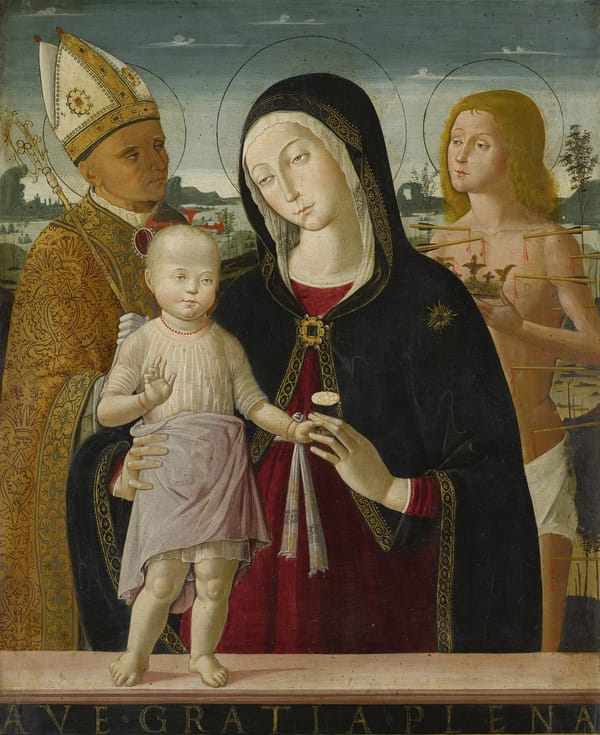 |
April 21: St. Anselm, Bishop, and Doctor of the Church
A MONK, a Bishop, a Doctor of the Church—such was the Saint whose feast comes to gladden us on this twenty-first day of April. He was a martyr, also, at least in desire, and we may add, in merit too—for he did enough to earn the glorious palm. When we think of Anselm, we picture to ourselves a man in whom are combined the humility and meekness of the cloister with the zeal and courage of the episcopal dignity; a man who was both a sage and a saint; a man whom it was impossible not to love and respect.
He left his native country of Piedmont for the Monastery of Bec in France, where he became a Benedictine monk. Being elected Superior, he realized in himself the type of an Abbot, as drawn by St Benedict in his Rule: ‘He that is made Abbot,’ says the holy Patriarch, ‘should study to give help rather than to give commands,’1 We read that the love entertained for Anselm by his brethren was beyond description. His whole time was devoted to them, either in giving them spiritual direction, or in communicating to them his own sublime knowledge of the sacred sciences. After governing them for several years, he was taken from them, and compelled to accept the dignity of Archbishop of Canterbury. He was a worthy successor of Augustine, Dunstan, Elphege, and Lanfranc; and by his own noble example of courage, he prepared the way for the glorious martyr Thomas, who succeeded him in less than a century.
As bishop, his whole life was spent in fighting for the liberty of the Church. Though gentle as a lamb by nature, he was all energy for this great cause. He used to say: ‘Christ would not have his Spouse be a slave; there is nothing in this world that God loves more than the liberty of his Church.’ There was a time when the Son of God allowed himself to be fettered with bonds in order that he might loosen us from the chains of our sins; but now that he has risen in triumph from the dead, he wills that his Spouse should be, like himself, free. She cannot otherwise exercise the ministry of salvation confided to her by her divine Lord; and yet there is scarcely a single hundred years of her existence in which she has not had to fight for this holy liberty. The rulers of this earth, with very few exceptions, have ever been jealous of her influence, and have sought to lessen it by every possible means. In our own times there are numbers of her children who do not even know that she has any rights or privileges; they would be at a loss to understand you, if you told them that she is the Spouse of Christ, and therefore a queen; they think it quite enough for her, if she enjoy the same amount of freedom and toleration as the sects she condemns; and they cannot see how, under such conditions as these, the Church is not the kingdom he wished her to be, but a mere slave. St Anselm would have abominated all such theories as these; so does every true Catholic. He is not driven into disloyalty to the Church by the high-sounding words, progress and modern society; he knows that there is nothing on earth equal to the Church; and when he sees the world convulsed by revolutions, he knows that all comes from the Church having been deprived of her rights. One of these is that she should not only be recognized, in the secret of our conscience, as the one only true Church, but that, as such, she should be publicly confessed and outwardly defended against every opposition or error. Jesus, her divine Founder, promised to give her all nations as her inheritance; he kept his promise, and she was once the Queen and Mother of them all. But nowadays, a new principle has been asserted, to the effect that the Church and all sects must be on an equal footing as far as the protection of the State goes. The principle has been received with acclamation, and hailed as a mighty progress achieved by modern enlightenment: even Catholics, whose previous services to religion had endeared them to our hearts and gained our confidence, have become warm defenders of the impious theory.
Trying as were the times when St Anselm governed the See of Canterbury, they were spared the humiliation of producing and ratifying such doctrine as this. The tyrannical interference of the Norman kings was an evil far less injurious than the modern system, which is subversive of the very idea of a Church. Open persecution would be a boon, compared to the fashionable error of which we are speaking. A winter torrent brings desolation in its track: but in the summer, when the flood is over, nature brings back her verdure and flowers. The errors which now prevail are like a great sea that gradually sweeps over the whole earth: and when the Church can find no spot whereon to rest, she will take her flight to heaven, and men must expect the speedy coming of the judge.
Anselm was not only the zealous and heroic defender of the rights and privileges of the Church; he was also a light to men by his learning. The contemplation of revealed truths was his delight. He studied them in their bearings one upon the other, and his writings occupy a distinguished place in the treatises of Catholic Theology. God had blessed him with extraordinary talent. Amidst all the troubles and anxieties and occupations of his various duties, he found time for study. Even when passing from place to place, as an exile, he was intent on the meditation of the mysteries of religion, thus preparing those sublime reflections which he has left us on the articles of our Faith.
The Church gives us, in her Liturgy, the following sketch of our Saint’s life:
We take the following Responsories and Antiphons from an office approved by the Holy See:
℣. Afflictions await me; but I fear none of them, so that I may consummate my course.* And your joy shall soon be changed into mourning, alleluia.℟. When the Fathers were assembled in Council, Urban, the Pope, cried out: Where art thou, Father and Master Anselm, Archbishop of the English? Come up here to us; fight for thine own and our Mother, and help us, alleluia.℣. Blessed be thy wisdom, and blessed the word of thy mouth!* Come up here to us; fight for thine own and our Mother, and help us, alleluia.
The following hymn is from the same Office:
Hymn
Laurea doctor redimitus astat:
Festus Anselmo chorus æmuletur
Dicere carmen.
Sæculi florem pereuntis horret;
Atque Lanfranci documenta quærens,
Intrat eremum.
Fertur immotæ fidei volatu:
Dogmatum puros latices an ullus
Altius hausit?
Te voves charæ soboli: benignis
Debiles portas humeris, alacres
Prævius hortans.
Quid times luctam? properant triumphi;
Exteras gentes, generosus exsul,
Lumine reples.
Parta, cui Christus nihil ante ponit,
Urget Anselmum: studio quis aequo
Vindicat ipsam?.
Pontifex summus tibi fert honores;
Te fides poscit: siluere Patres:
Dogma tuere.
Sis ad æternam Triadem, precamur,
Cuncta cui dignas resonent per orbem
Sæcula laudes.
a true monk, a doctor with his laurel wreath upon him.
Let our festive choir sing
fervently a hymn in his praise.
so wise, indeed, that he trampled on the flower of this perishable world,
and fled to solitude,
that he might receive instruction from Lanfranc.
he entered into the mysteries of the Word.
Did any mortal drink more fully
than he of the limpid fount of Truth?
thou didst tenderly care for thy flock.
Thou didst carry the weak upon thy shoulders
and encourage the fervent by thine own example.
O fear not the combat! Triumph shall be thine.
When he sends thee into exile, thou wilt shine,
as a generous light, upon lands beyond the sea.
which he won for us by redeeming us,
excited Anselm’s zeal.
Never had it a braver defender than he.
The Supreme Pontiff showed thee great honour,
when, in the presence of the Fathers, he said to thee:
‘Fight for the faith! Defend our dogmas!’
be mindful of the holy flock!
Intercede for us to the Blessed Three,
to whom be worthy praise from all for ever.
O holy Pontiff Anselm! beloved of God and men! the Church, whose cause thou didst so zealously defend on earth, celebrates, this day, thy praise, and honours thee as one of her dearest Saints. Thy meekness, condescension and charity gave thee a resemblance to Jesus, the Good Shepherd. Like him, thou couldst truly say: I know my sheep, and my sheep know me.2 Thou didst watch over them day and night, lest the wolf should come and find them unprotected. Far from fleeing at his approach, thou didst go forth to meet him, and nothing could induce thee to yield to his sacrilegious tyranny. Heroic champion of the Church's liberty! protect it in these our days, when there is not a country left where it is not insulted or ignored. Raise up in every place pastors with a spirit of holy independence such as thou hadst; that thus the faithful may take courage and that every Christian may boldly and proudly confess that he himself is a member of the Church, and that the interests of our spiritual mother are far more deserving of our solicitude than those of the whole world besides.
God had gifted thee, O Anselm, with that Christian philosophy which bows down to the teachings of faith, and which, being thus purified by humility, is elevated to the intelligence of the sublimest truths. The Church, in acknowledgement of the benefits she derived from thy learning, has conferred upon thee the title of Doctor, which for a long time was confined to those great men who lived in the early Christian Ages, and whose writings are the reflex of the preaching of the Apostles. Thy teaching has been deemed worthy of being numbered with that of the ancient Fathers, for it came from the same divine Spirit, and was the result of prayer rather than of study. Obtain for us, O holy Doctor, that ‘our faith,' like thine, ‘may seek understanding,'Nowadays, there are many who blaspheme what they know not;3 but there are many also who know little or nothing of what they believe. Hence arise a deplorable confusion of ideas, compromises are made between truth and error, and the only true doctrines are despised, scouted, or at least undefended. Pray to our heavenly Father, O Anselm, that he would bless the world with holy and learned men, who may teach the path of truth, and dispel the mists of error; that thus the children of the Church may not be led astray.
Look down with affection, O holy Pontiff, on the venerable Order, which, when God called thee from the vanities of the world, received thee, made thee one of her children, gave thy soul its life, and thy mind the light of wisdom. She claims thy protection. Thou art a son of the great Patriarch Benedict: forget not thy brethren. Bless them in France, where thou didst first embrace the Monastic Life; bless them in England, where thou wast Primate, and yet still the humble monk. Pray for the two countries, for both are dear to thee. Faith is weak in one; and heresy reigns supreme in the other. Beseech our Lord to show his mercy to both: he is all-powerful, and he turns not a deaf ear to the prayers of his Saints. If, in his justice, he have decreed not to restore to these two countries their ancient Catholic constitution, pray that, at least, the number of souls saved may be great, that conversions may be frequent, and that the labourers sent at the eleventh hour to the vineyard may emulate the zeal of them that were first called!
Wednesday of the Third Week after Easter
THERE is nothing on earth so grand, nothing so exalted, as the princes of the Church—the pastors, appointed by the Son of God—who are to follow on, in unbroken succession, to the end of time: but let us not suppose that the subjects of this vast empire, called the Church, are devoid of dignity and greatness. The Christian people, in which both prince and beggar are equally subjects, is superior to every other, in intellectual and moral worth. It carries civilization with it, wheresoever it goes, for it carries with it the true notion of God and of the supernatural end of man. Barbarism recedes; pagan institutions, how ancient soever they may be, are forced to give way. Even Greece and Rome laid down their own laws to adopt those of the Christian code—the code which was based on the Gospel. So, too, in our own times, the mere sight of a Christian army, though composed of but a few thousand men, struck terror into the heart of an immense empire of the East: its ruler who counts four hundred million subjects, and calls himself the ‘Son of the Celestial Empire, was so overcome by fear that without offering the slightest resistance he fled from his palaces and capital. Yes, this is the superiority given by baptism to Christian nations; for it would be absurd to attribute this superiority to our civilization, seeing that civilization itself is but a consequence of baptism.
But if the outward bearing of the Christian people be such as to exercise an influence on even infidels, what must not be that dignity which faith teaches us is its inheritance? The Apostle St Peter—the universal shepherd, into whose hands the divine Shepherd placed the keys—thus describes the flock entrusted to his care: You are a chosen generation, a kingly priesthood, a holy nation, a purchased people; that you may declare his virtues, who hath called you out of darkness into his marvellous light.1 So, indeed, it is; divine truth is entrusted to this people, and its light can never be extinguished among them. When the teaching authority has, with its infallibility, to proclaim a solemn definition in doctrinal matters, it first appeals to the faith of the Christian people; and the sentence declares that to be the truth which has been believed ‘everywhere, always, and by all.’2 Amidst the Christian people there exists that strangest phenomenon under heaven, union of mind; whereby there is one common faith amidst nations the most opposite to each other in every other respect. Let them be as hostile to one another as you please; in matters of faith, in submission to their pastors, they are all one and the same great family. The most admirable, at times the most heroic virtues are to be found amidst this people, for Jesus has given it a large share of that element of holiness wherewith his grace has enriched human nature.
Observe, too, how affectionately it is protected and honoured by its pastors! Every pastor, no matter what may be his rank in the Church, is bound, in virtue of his office, to lay down his life for his sheep, if called upon to do it. The sacrifice is not even counted as an act of heroism; it is a strict duty. Shame and curse upon the pastor who flees through cowardice! The Redeemer stigmatizes such a one with the name of hireling. Hence it is, that during these last eighteen hundred years, there have been so many thousands of pastors who have given their lives for their flocks. One or other of their names are to be found in every page of the Church’s history. The list is headed by St Peter, who was crucified like his divine Master; it continues down to the Bishops of Cochin-China, Tonkin, and Corea, whose recent martyrdoms attest that the pastor has not ceased to consider himself as a victim for his flock. Thus, before confiding his lambs and sheep to Peter, Jesus asks him if he have greater love than the rest. If Peter love his Master, he will love his Master’s lambs and sheep; he will love them even to laying down his life for them. For this reason, after entrusting him with the care of the whole flock, our Saviour tells Peter that he is to die a martyr. Happy is that people whose rulers only exercise their authority on condition of being ready to die for these their Master’s sheep!
If one of these should evince in his life the marks which denote sanctity, and this so far as to deserve to be proposed to the faithful as a model and intercessor, you will not only see the priest whose word calls down the Son of God upon the altar, not only the bishop whose sacred hands wield the pastoral staff, but the very Vicar of Christ, humbly kneeling before the tomb or statue of the Servant of God, how poor or despised soever he or she may have been on this earth. This sacred hierarchy testifies the same sentiments of respect for the sheep of Christ on every occasion. Thus in a baptized babe, that knows not how to utter a single word, that is not counted among the citizens of the state, that, like a tender flower, may perhaps have faded before the close of day, yet does the pastor recognize in it a worthy member of the Body of Christ, the Church; he reverences it as a being that is enriched with gifts so sublime as to be an object of heaven’s love, and a source of blessing to all around it. When the Faithful are assembled in the house of God, and the sacred oblations and altar have been thurified, the Celebrant, as the representative of Christ, and any others of the clergy who may be in the sanctuary, are also honoured with the same mysterious tribute of homage: but the incense is to go beyond the sanctuary. The thurifer advances towards the people, and in the name of the Church, gives them the same honour as that just given to the pontiff and the clergy; for the faithful people are also members of Christ. Again: when the corpse of a Christian, even though he may have been the poorest of the poor, is carried into the house of God, observe what honour is paid to his mortal remains! On this occasion, also, the incense is made to express the affectionate homage wherewith the Church honours the Christian character of her children. O Christian people! how truly we may say of thee what Moses said of Israel: There is no other nation so great as thou!3
It is our Risen Jesus that has procured us all this honour: let us express our love and gratitude in this canticle of the ancient Missal of Saint Gall.
Sequence
Unquam præevalet, regum summe,
Typica majestatis tuae Promere?
Qui Parenti supremo
Deitate coaequalis,
Omnia potestate pari disponis;
In Patre callebas Sophia;
Per quam facta sunt omnia,
Quæque profert
Triplex machina.
Qui cernens immersos esse barathro,
Tua quos adornat imago,
Propter nos factus es homo,
Ut nos solveres Sanguine tuo.
Isaac parentis nostri immolatio,
Mactabatur aries
Pro quo Domino.
Joseph prænotavit
Venditus in Ægypto,
Nunc daturus typicos victus populo.
Infernum fracturus,
Cum Samson vir invictus
Leonem suffocavit,
Et portas hostiles Disrupit.
Illius flos virgæ,
Quam fudit radix Jesse
Generosa germine,
Quod sunt præconati Prophetae.
O Redemptor, ceu sub umbra primitus,
Quæ nos verius
Te monstrante cernimus.
Tu cuncta procul fugas nubila,
Terrae reddens tui vultus Lumina.
Quæ morte tua
Fuscabatur tremula.
Cuncta ornantur
Elementa sereno,
Quia redisti victor Barathro.
Hinc et nos, o socii,
Mente Dominum
Sincera et humili
Simul laudemus
Carmine tali:
Criminum nos cœno,
Haud pepercit proprio
Propter nosmet Filio.
Pro nobis qui factus est homo,
Ut solvens nos tartaro
Redderet paradiso.
Ævo omni.
can worthily celebrate
the mysteries wrought by thy majesty?
God co-equal with the Father, Eternal,
thou rulest all things
with the selfsame power as his.
when thou wast,
in the bosom of the Father,
the Wisdom whereby all things were made,
yea all that compose this triple world.
Seeing that they who were adorned with thy image
had fallen into an abyss of misery,
thou wast made man for our sakes,
that by thy Blood thou mightest rescue us.
was the sacrifice of our father Isaac;
in whose stead
a ram was immolated unto the Lord.
was prefigured by Joseph sold into Egypt,
where he fed the people
with mysterytelling food.
was foreshadowed
by the invincible Samson
slaying a lion
and breaking his enemies’ gates.
Flower of the Branch
that nobly grew
from Jesse's root,
as sang the Prophets of old.
were shown, in a shadow, to our Fathers;
thou hast shown them to us in their truth.
Thou dispellest all clouds,
and makest the light of thy countenance
to shine once more on the earth,
that had been thrown into darkness
and fear by thy death.
in beauteous light,
because thou hast returned
in victory from the tomb.
Let us, then, brethren,
with upright
and humble hearts,
unite in praising
thus our God:
who, to raise us from the mire of our sins,
spared not his own Son,
for our sake.
who to ransom us from hell,
and restore us to heaven,
was made Man for our sake.
for ever.
| Previous Tuesday of the Third Week after Easter | Next Wednesday of the Third Week after Easter |