Daily reading
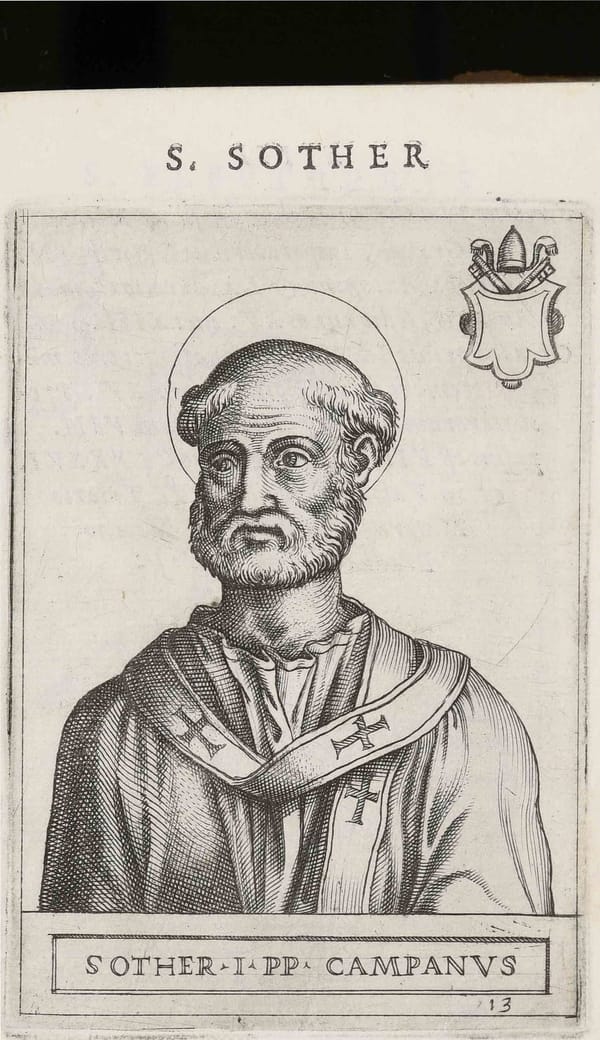
April 22: Sts. Soter and Caius, Popes and Martyrs
THE palms of two martyred Popes are intertwined and grace this day of the Calendar. Soter suffered for Christ in the second, and Caius in the third century; a hundred years separate them; and yet we have the same energy of faith, the same jealous fidelity to keep intact the depositum left by Christ to his Church. What human society ever existed that produced heroes for century after century? The Society, however, which was founded by Christ—in other words, the Church—is based on that traditional devotedness which consists in laying down one's life for the faith. And if so, we may be sure that the spirit of martyrdom would show itself in them that were the Heads and Fathers of this Society. The first thirty successors of St Peter paid dearly for the honour of the Supreme Pontificate; they were martyrs. How grand the throne of our Risen Jesus, surrounded as it is by all these Kings clad in their triumphant scarlet robes!
Soter was the immediate successor of Anicetus, whose feast we kept on the 17th of this month. Time has effaced the details of his life. Eusebius, however, gives us a fragment of a letter written by St Dionysius, bishop of Corinth, wherein thanks are expressed to the Pontiff for the alms he sent to the faithful of that Church, during a famine. An Apostolic Letter was sent with these alms; and St Dionysius tells us that it was read in the assemblies of the faithful, together with the one addressed to the same Church, in the preceding century, by St Clement. The Roman Pontiffs have ever united charity to their fidelity in preserving pure the deposit of our faith. With regard to Caius, he suffered death in the terrible persecution under Diocletian: and little more than a mere mention of his name is given in the annals of Christian Rome. We cannot, therefore, be surprised at the brevity wherewith the Liturgy speaks of these two martyred Popes. We subjoin the Lessons given in the Breviary.
O holy Pontiffs! you are of the number of those who went through the great tribulation,1 and passed, through fire and water,2 to the eternal shores of heaven. The thought of Jesus’ victory over death gave you courage: you remembered how his Passion was followed by a glorious Resurrection. By imitating him in laying down your lives for your sheep, you have taught us how we also should think no sacrifice too great to be made for our faith. Obtain for us this heroic courage. Baptism has numbered us among the soldiers of Christ; confirmation has given us the spirit of fortitude; we must then be ready for battle. It may be that, even in our own times, a persecution may rage against the Church; at all events, we have to fight against ourselves, the spirit of the world, and Satan; support us by your prayers. You were once the Fathers of the Christian people; you are still animated with the pastoral charity which then filled your hearts. Protect us, and make us loyal to the God, whose cause was so dear to you when here on earth.
Thursday of the Third Week after Easter
THIS Church founded and maintained by Christ —is it nothing more than a society of minds that know, and of hearts that love, the truths revealed to it by heaven? Have we adequately defined it, when we call it ‘a spiritual society'? No, most assuredly; for we are told that it was to spread, and actually has been spread, throughout the whole world. Now how could such progress and conquest have taken place, if the spiritual society founded by our Redeemer had not also been exterior and visible? On earth, souls cannot hold intercommunication without bodies. Faith cometh by hearing, says the Apostle: and how shall they hear without a preacher?1 When, therefore, our Risen Jesus says to his Apostles: Go, teach all nations!2 he distinctly implies that the word of God will be heard, that it will resound throughout the world, and that its sound will be heard both by them that obey and by them that reject the teaching of his ministers. Has this word a right to circulate thus freely, independently of any permission from earthly powers? Yes; for the Son of God has said: Go, teach all nations! He must be obeyed; the word of God cannot be fettered.3
The word, then, the exterior word is free; and being free, it obtains numerous disciples. Will these disciples live isolatedly? Will they not rather group around their apostle, the better to profit by his teaching? Will they not look on one another as brethren, and members of the same family? And if so, they must hold their assemblies. Thus the new people is brought before the notice of the world. It was necessary that this should be; for if this people, which is to attract all others to itself, be not visible, how can it do its work?
But the people thus assembled must have their buildings, their temples. Therefore do they erect houses of preaching and prayer. The stranger—that is, he who is not a Christian—seeing these new places of worship, asks: ‘What means all this? Whence come these people who pray aloof from their fellow-citizens? Would not one be inclined to say that we have a nation within the nation?’ The stranger is right; there is a nation within the nation, and it will continue to be so until the whole nation itself have passed into the ranks of this new people.
Every society stands in need of laws; the Church, therefore, will not be long without giving outward proof of her internal government. There are her festivals, her solemnities, which denote a great people; her ritual rules, forming a visible bond of union between the members of her society, and this not merely during the hours of divine service; there are commandments and orders made by the various degrees of the hierarchy, which are promulgated and claim obedience; there are institutions and corporations existing within the great society itself, and they add to her strength and beauty; in a word, there is everything that is needed, even penal laws against offending and refractory members.
But it does not suffice the Church that she have places where her children can assemble together; provision must also be made for the support of her clergy, for the expenses attendant on the divine worship, for the necessities of her indigent members. Aided by the generosity of her children, she enters into possession of certain landed properties, which become sacred by reason of their use, as also because of the superhuman dignity of her who owns them. Nay more; when the princes of this earth, tired of their vain efforts to stay the Church’s progress, shall ask to be admitted as her children, a new necessity will arise from this: the supreme Pontiff can be no longer the subject of any temporal sovereign, and he himself must become king. The Christian world hails with joy this crowning of the work of Christ, to whom all power has been given in heaven and on earth ,4 and who was one day to reign, with temporal power, in the person of his Vicar.
Such is the Church: a spiritual, but at the same time an exterior and visible society; just in the same way as man is spiritual because of his soul and material because of his body, which is an essential part of his being. The Christian, therefore, should love the Church such as God has made her; he should detest that false and hypocritical spiritualism which, with a view to subvert the work of Christ, would confine religion within the exclusively spiritual domain. We never can admit such a limitation. The Divine Word has assumed our fiesh; he permitted his creature man to hear and see and handle him;5 and when he organized his Church on earth, he made it speaking, visible, and so to say palpable. We are a vast state; we have our king, our magistrates, our fellow-citizens; and we should be willing to lay down our lives for this supernatural country, whose excellence is as far superior to that of our earthly country as heaven is better than the whole earth. Satan has an instinctive hatred for this country, which is to bring us to the Paradise whence he has been driven; he has used every means in his power to ruin it. He began by attacking the liberty of the word which is preached to men, and leads them to the Church. Did not his first agents forbid the Apostles to speak at all in the name of Jesus to any man?6 The strategy was shrewd enough; and although it failed to arrest the progress of the Gospel, it has ever been resorted to by the enemy, even to this very day.
The powers of the world have always been jealous of Christian assemblies; the jealousy began early, and has periodically manifested its fury during these eighteen centuries. Frequently during a fit of persecution we have been obliged to flee to caves and forests, and seek the hours of night for our celebrations of the mysteries of light, and for singing the praises of the divine Sun of Justice: Our dearest churches, which had been erected by the piety of our ancestors, and were sacred by innumerable memories—how many times have they not been made ruins! Satan's ambition is to efface every vestige of Christ's kingdom on earth, for that kingdom is his defeat.
The laws promulgated by the Church, and the communications of the pastors with one another and with the sovereign Pontiff—these, also, have excited the most tyrannical jealousy. The right of self-government has been denied to the Church; servile men have aided emperors and kings to fetter the Spouse of Christ. Her temporal possessions, too, have tempted the avarice of sovereigns. These possessions procured her independence; it was, therefore, considered necessary to rob her of them, that she might become the creature of the state. It was a wicked attempt, and has brought the most terrible chastisements upon the countries where it was perpetrated, yet there was one more wicked still, which aimed at depriving of his throne, venerable by its thousand years’ duration, the Pontiff who holds in his sacred hands the keys of the kingdom of God.
Meanwhile, the most detestable errors are being propagated. Among these, we would mention one, which in spite of its impious absurdity, finds favour with thousands: we mean the doctrine that the Church should be purely spiritual, or, if it is to be a visible Church, that it should be an instrument in the hands of government, for political purposes. Let us hold such doctrine in execration; let us think of those countless martyrs, who have shed their blood in order to maintain and secure to the Church of Christ her position as a society, visible, external, independent of every human power, in a word, complete in herself. It may be that we are the last inheritors of the promise; and if so, it would be an additional reason for our proclaiming the rights of the Spouse of Christ, upon whom he has conferred the empire of the world, which only exists because of her, and will be destroyed as soon as it refuses her a resting-place.
Let us close these reflections with a hymn of praise to our divine Head. The ancient Missal of Saint Gall gives us this other Sequence in honour of our paschal mystery.
Sequence
Socii, laudum resonis
Celebremus gaudia
Simul temporis,
Per Christum patet
Reserata spes nobis.
Quos afflixit vernaculos.
Grates regi,
Qui nos redemit Barathro.
More Judaeorum, solvimur pæno,
Mentes pariter praeparemus,
Typicam ut immolemus Victimam,
Insigniti mentis domo,
Non pavemus Angeli ensem
Plectentis reos vindicem.
Mysticis ut ejus
Epulemur carnibus,
Fermenta criminum purgemus,
Sinceriter vivamus.
Eremo vitæ quimus
Per coeleste lumen
De tetris hostibus;
Digne ipsum laudare hymno Moysi,
Qui suos maligno pressos Pharaone alumnos liberat, obstructo
Atris abyssis inimico.
Tantae potestatis Domino, et suae januam
Praecelsae pietatis pulsemus
Moriendo ut qui mortis legem rupit atrocis,
Hic redemptos custodiat,
Ne post tergum decidant,
Sed ut regnum scandant promissum.
in sweetest hymns of praise,
the joys of this
bright spring time,
our hopes
of heaven revive.
he tortured with the scourge of death.
to the divine king,
who delivered us from the abyss.
delivered by Christ from Egyptian tyranny,
let us prepare ourselves
to offer up the mystic Lamb.
shall mark the dwelling of our souls,
and we not fear the avenging sword
of the destroying angel.
partake of his sacred Flesh,
us put away the leaven of and
make our lives
the unleavened bread of sincerity.
we shall be delivered
from the wicked enemies
that fill the desert of this world.
and we will praise him in the canticle which Moses sang
when he rescued his Israelites from Pharaoh’s cruelty,
and saw the dark waves close upon the pursuant foe.
we sing to this almighty Lord;
and knocking at the door of his infinite mercy,
that having by his own dying broken the yoke of death,
he may watch over the people he has redeemed,
preserve them from lagging behind,
and aid them to reach the Promised Land above.
| Previous Wednesday of the Third Week after Easter | Next Thursday of the Third Week after Easter |