Daily reading
Paschal Time
Double · April 28 · Sanctoral
April 28, 2021
From Dom Guéranger’s The Liturgical Year.
A Double leads the weekday; St. Vitalis is commemorated.Rubrics
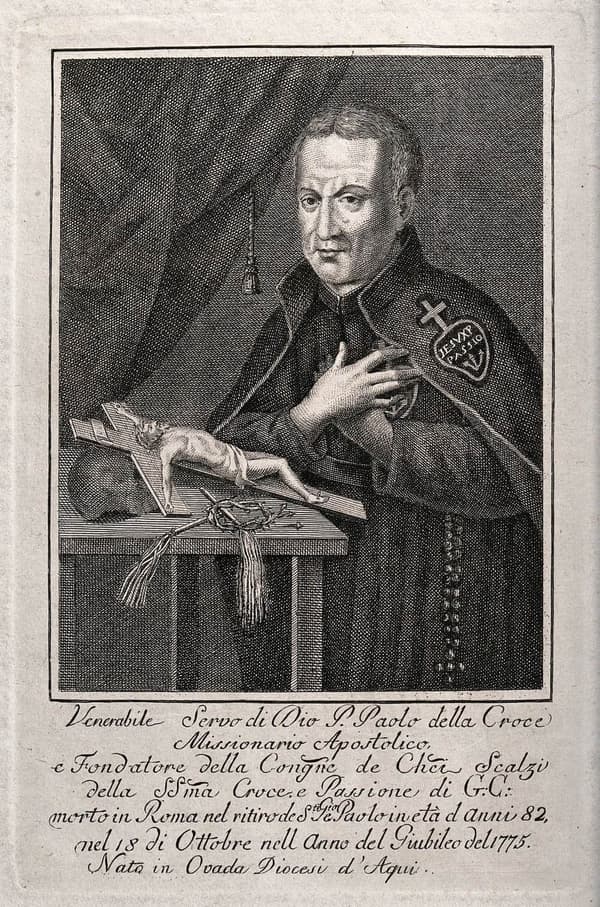 |
April 28: St. Paul of the Cross, Confessor
SPLENDIDLY adorned with the sacred sign of the Passion, Paul of the Cross comes to-day to pay homage to the Conqueror of Death. It behoved Christ to suffer and so enter into his glory. It behoves the Christian, the member of Christ, to follow his Head in suffering that he may share his triumph. Even as a child Paul penetrated deeply into the ineffable mystery of the suffering of a God. He was filled with an ardent love for the cross, and ran with giant strides along this royal road. He passed through the torrent, following his divine Head, he was buried with him in death, and has won a share in his Resurrection.
The diminution of truths among the children of men seemed to have dried up the fount of sanctity, when Italy, ever fruitful in her vivid faith, gave birth to the Christian hero, who stands out in the arid waste of the eighteenth century, like a saint of olden times. God never deserts his Church. He confronts a century of revolt and sensualism veiled under the name of philosophy with the Cross of his Son. A new Paul, recalling both in his name and his works the great Apostle of the Gentiles, rises in the midst of a generation intoxicated with pride and falsehood, to whom the Cross has become once more a folly and a scandal. This apostle was weak, poor, isolated and long misunderstood, but his heart was full of love and self-abnegation, and he sought to put to confusion the wisdom of sages and the prudence of prudent men. Clad in a coarse habit, with bare feet, his head crowned with thorns and a heavy cross on his shoulder, he journeyed through cities, claiming the attention of both the humble and the mighty, and desiring to know nothing but Jesus Crucified. The Cross made his zeal fruitful and showed itself to be indeed the power and the wisdom of God. Those who prided themselves on having banished the miraculous from history and the supernatural from the life of the people, might exult in their triumph, but, unknown to them, wonderful prodigies, countless miracles, were making whole peoples submissive to the voice of this man who, by completely destroying sin in his own person, had regained the power which Adam once had over nature, and seemed to possess in his mortal flesh the qualities of a glorified body.
But the apostolate of the Cross was not to end with Paul’s death. The resources of ancient times were no longer sufficient for a decrepit age. We are far from the days when the exquisite delicacy of Christian sentiment was strongly moved by the sight of the cross amid flowers, as it is seen in the paintings of the catacombs. Man’s senses have been dulled by unhealthy emotions, and there is need of a stimulant in the form of a constant representation of the tears, the Blood, and the gaping wounds of our divine Redeemer. Paul of the Cross received the mission to supply this need. At the cost of unspeakable sufferings he became the father of a new religious family, which adds to the three ordinary vows of religion a fourth vow—to propagate devotion to the sacred Passion of our Lord, the badge of which each Religious wears visibly on his breast.
We must not forget that the Passion of our Lord is for the Christian soul only a preparation for the great mystery of the Pasch, the glorious term of the manifestations of the Word, the supreme end of the elect, whose piety finds therein its completion and its crown. The Holy Spirit, who guides the Church throughout the admirable course of the liturgical cycle, has no other end in view for the souls who abandon themselves unreservedly to his sanctifying power. Paul's desire was to be nailed to the cross on Calvary, but he was often carried thence to the heights of heaven where he heard mysterious words such as it is not granted to man to utter.1 He assisted at the triumph of the Son of Man, who, after having lived on earth a mortal life and passed through death, is living now for ever and ever.2 He saw on the throne of God the Lamb standing as though slain, and giving light to the heavenly city,3 and this sublime vision of the realities of heaven inspired him with that divine enthusiasm, that intoxication of love, which, in spite of his terrifying austerities, gives an incomparable charm to his whole person. ‘Fear not,' he said to his children who were terrified by the furious attacks of the Devil, ' fear not, cry “Alleluia.” The devil is afraid of the Alleluia; it is a word that comes from Paradise.' He could not restrain his feelings when he saw nature born again with her Saviour in these days of spring, the flowers blossoming under the steps of his Risen Lord, the birds celebrating his victory in their harmonious songs. His heart was full to overflowing with love and poetry; he touched the flowers gently with his stick and upbraided them, saying: ‘Hold your peace, hold your peace.’ ‘To whom do these lands belong?’ he said one day to a companion, ‘to whom do these lands belong, I say? You do not understand. They belong to our great God.’ And his biographer relates that he was rapt in an ecstasy of love and carried some distance through the air. ‘Love God, my brethren,' he repeated to all those whom he met, ‘love God, who so well deserves our love. Do you not hear the very leaves on the trees telling you to love God? O love of God, love of God!'
We yield to the charm of a sanctity which is so sweet and yet so strong. It is a divine attraction, such as could never be exercised by the false spirituality, so much in vogue in the eighteenth century, even among the holiest. Under pretext of subduing man's evil nature and avoiding possible excesses, the new teachers allied themselves, though unwittingly, with Jansenism, checked the flight of the soul, disciplined it, remade it according to their own fashion, and confined it within the limits of certain rules which were supposed to lead all souls to perfection at the same rate. But saints are made by the divine Spirit, the spirit of love and holiness, to whose essence liberty belongs. He does not confine himself within the bounds of human methods. Our Lord says: ' The Spirit breatheth where he will . . . but thou knowest not whence he cometh and whither he goeth. So is every one that is bom of the Spirit.'4 The Holy Ghost chose Paul in his earliest infancy. He took possession of this child, so richly endowed by nature, destroyed nothing and sanctified everything. He formed him according to ancient models, always ardent, always attractive, and exceedingly holy. Such a one could never have been produced by a school whose over-correct methods wear the soul out by a barren and self-centred asceticism.
The Liturgy gives the following short account of St Paul of the Cross:
Romam profectus, theologicis disciplinis rite imbutus, a summo Pontifice Benedicto Decimo tertio ex obedientia sacerdotio auctus est. Facta sibi ab eodem potestate aggregandi socios, in solitudinem recessit Argentarii montis, quo eum beata Virgo jampridem invitaverat, veste illi simul ostensa atri coloris, Passionis Filli sui insignibus decorata, ibique fundamenta jecit novæ Congregationis. Quæ brevi, plurimis ab eo toleratis laboribus, præclaris aucta viris, cum Dei benedictione valde succrevit; a Sede Apostolica non semel confirmata una cum regulis, quas orando ipse a Deo acceperat, et quarto addito voto pergratam Dominicæ Passionis memoriam promovendi. Sacras Virgines quoque instituit, quæ excessum caritatis divini Sponsi sedulo meditarentur. Hæc inter, animarum inexhausta aviditate ab Evangelii prsedicatione numquam deficiens, homines pene innumeros etiam perditissimos aut in hæresim lapsos, in salutis tramitem adduxit. Præsertim Christi enarranda Passione, mirifica ejus prationis vis erat, qua una cum adstantibus in fletum effusus quælibet obdurata corda ad poenitentiam scindebat.
Thou hadst but one thought, O Paul. Hidden in those ‘clefts of the rock,’5 which are the sacred Wounds of the Saviour, thou wouldst bring all men to these divine fountains which quench the thirst of the true Israel in the desert of this life. Happy were they who could hear thy victorious word and save themselves by the Cross in the midst of a perverse generation. But in spite of thy apostolic zeal, thy voice could not make itself heard in all lands, and where thou wast absent evil was let loose upon the world. False science and mistaken piety, mistrust of Rome and the corruption of the great had prepared the way for the destruction of the old Christian social order, and the world was given over to teachers of lies. Thy prophetic gaze saw the abyss in which kings and peoples were soon to be engulfed. The successor of St Peter, unable to quell the storm which raged against the Church, sought by his efforts and sacrifices to hold back the floods, even for a time. Thou wert the friend of the Pontiffs and their support in those sad days, the witness of Christ suffering in his Vicar. What sorrows were confided to thee! And what must have been thy thoughts when at thy death thou didst bequeath the venerated image of the Mater Dolorosa to a Pontiff who was destined to drain the cup of bitterness and die a captive in a strange land! Thou didst promise to watch over the Church from thy throne in heaven with that tender compassion which identified thee on earth with her suffering Spouse. Keep this promise to-day, O Paxil! This age of social disintegration has neither made atonement for the sins of the past nor learnt wisdom from misfortune. The Church is the victim of oppression on all sides, the power is in the hands of her persecutors, and the Vicar of Christ is a prisoner in his palace and lives on alms. The Bride has no bed but the Cross of her Spouse, she lives on the memory of his sufferings. The Holy Spirit who guards her and is preparing her for the final summons, has raised thee up to keep her perpetually in mind of those sufferings which are to strengthen her in the trials of the last days.
Thy children all the world over are true to the spirit of their father and continue thy work on earth. They have gained a footing in England where thy prophetic gaze foresaw their labours, and this kingdom, for which thou didst pray so earnestly, is being gradually freed, through their influence, from the bonds of schism and heresy. Bless their apostolate. May they grow and be multiplied to meet the ever-increasing needs of these unhappy times! May their zeal ever continue to minister to the Church, and may the holiness of their lives ever redound to the glory of their father!
Thou, O Paul, wast faithful to thy crucified Master in his humiliation, and he has been faithful to thee in his triumphant Resurrection. In the hour of darkness thou didst live hidden in the clefts of the mysterious Rock. But what must be thy glory, now that Christ victorious ‘enlighteneth wonderfully from the everlasting hills’!6 Enlighten and perfect us, we beseech thee. We give thanks to God for thy triumph. Do thou in return help us to be faithful to the standard of the Cross, so that we, like thee, may be illuminated by its glory, when it appears in the clouds of heaven on the day of judgement.7 O Apostle of the Cross, initiate us into the mystery of the Pasch, which is so closely connected with that of Calvary. Only he who has shared the combat can comprehend the victory and have part in the triumph.
April 28 (the Same Day): St. Vitalis, Martyr
THERE are few martyrs of the West whose names are more celebrated than those of SS Gervasius and Protasius. The veneration in which they aie held by the Roman Church has led her to honour the memory of their father, who also won the palm under the persecution of Nero. She has chosen for his feast the glad season of Easter. The account given by the Liturgy of St Vitalis is short; but we can gather, from the few circumstances related, what fine characters these primitive Christians were who received the crown of martyrdom under the first of all the persecutions—the one that numbers among its choicest victims the two Apostles SS Peter and Paul.
Sin is the enemy of the soul; it throws her back again into that death whence Jesus had drawn her by his Resurrection. To preserve one of thy brethren from this misery, thou, O Vitalis, didst bravely raise a cry of zealous warning to him in the midst of his torments, and thy words awakened him to self-possession and courage. Show this same fraternal charity to us. We are living the life of our Risen Jesus; but the enemy is bent on robbing us of this life. He will seek to intimidate us; he will lay all manner of snares wherewith to deceive us; he will give us battle, and this untiringly. Pray then for us, O holy martyr, that we may be on our guard, and that the mystery of the Pasch may be fully accomplished within us, now and for ever!
Wednesday of the Fourth Week after Easter
THE Son of God is soon to ascend to his Father. He has said to his Apostles: Going, teach all nations: preach the Gospel to every creature. Thus, then, the nations are not to receive the word from the lips of Jesus, but through his ministers. The glory and happiness of being instructed directly by the Man-God were for none but the Israelites, and even for them for only three short years.
The impious may murmur at this, and say, in their pride:’Why should there be men between God and us?' God might justly answer:’And what right have you to expect me to speak to you myself, seeing that you can otherwise be as certain of my word as though you heard it from myself V Was the Son of God to lose his claim to our faith unless he remained on this earth to the end of time? If we reflect on the infinite distance there is between the Creator and creature, we shall detest such a blasphemy. If we receive the testimony of men, the testimony of God is greater:1 and how can we reject it? Can we call that testimony human, which was given by the Apostles, when, in proof of their being sent by God, they showed the power, conferred on them by their divine Master, of working miracles? Of course the pride of reason may rebel; it may protest, and refuse to believe men who speak in God’s name. Did not the very Son of God meet with more unbelievers than believers? And why? Because he affirmed himself to be God, yet showed nothing exteriorly but his human nature. So that there was an act of faith to be made, even when Jesus himself spoke; and pride might rebel, and say:’I will not believe just as it will do when the Apostles speak in his name. The two cases are alike. God demands of us, as long as we are in this world, that we give him our faith; and faith is not possible without humility. God confirms his word by miracles; but man has always the power to resist, and for that very reason faith is a virtue.
If it be asked—why, when God took his Son from this earth, he did not commission his angels to teach us in his name, instead of giving such a sublime office to men, frail and mortal as we ourselves are who receive their teaching—the reason is, that man could not be raised up from the state of degradation into which he had fallen by pride, except by submission and humility; and consequently, it was fitting that the ministry of the divine word should not be entrusted to angels, inasmuch as our pride might have been flattered by our having for our teachers beings so noble and exalted. We believed the serpent when he spoke to us, and we had the pride to think that we might one day become gods: our merciful Creator, in order to save us, has imposed it as a law upon us, that we should yield submission to men, when they speak in his name.
These men, therefore, are to preach the Gospel to every creature; and he that believeth not, shall be condemned. O word of God! thou heavenly seed planted in the field of the Church, how fruitful hast thou not been! Yet one little while, and the harvest will be ripe. Faith will have spread throughout the world; the faithful shall be found in every land. And how came they by the faith? By hearing, answers the great Apostle of the Gentiles.2 They heard the word, and they believed. How honoured above the rest of our senses is our hearing, at least in this present life! Let us listen to St Bernard, speaking on this subject.’One would have thought that the Truth would have entered into our souls by that noblest of our senses, the eye: but no, my soul! that is reserved for the future life, when we shall see face to face. For the present, let the remedy come in by the same door through which crept the malady; let life, and light, and the antidote of truth, come to us in the track previously taken by death and darkness, and the serpent’s poison. Thus the troubled eye will be cured by the ear, and will see, when calm, what she cannot when troubled. The ear was the first door of death; let it be the first to be opened to life. The ear took away our Light; let it now restore our Light; for unless we believe, we shall not understand.3 Hearing, therefore, is the instrument of our merit; sight is to be our reward . . . . Observe, too, how the Holy Ghost follows this order in the spiritual education of the soul: he forms the ear, before he gladdens the eye. He says to her: Hearken, O daughter, and see!4 Forget thine eye for the present: it is thine ear I now ask for. Dost thou wish to see Christ? First hear him; hear what is said of him: that so, when thou dost see him, thou mayest say: As we have heard, so have we seen!5 The brightness is immense; thine eye is weak; and thou canst not bear the splendour. But what thine eye cannot do, thine ear can; . . . only let this ear of thine be fervent, and watchful, and faithful. Faith will give to thine eye the clearness it lost by sin; disobedience shut it, but obedience will open it.”6
To the glory of him who has sent us his word by his ambassadors, and whom we have received as himself, let us recite this ancient sequence of Saint Gall: it expresses the faith of our fathers, and this faith is ours also.
Sequence
Ac Regi Christo Deo
Solvant omnes insularum incolæ,
Quem exspectatum dies jam tenent, et leges ejus
Mentibus captent promptulis.
Quos derelicto populo
Delegit Judæo,
De Abrahæ carne genito,
Quos Abrahæ natos fecit, et cognatos
Suum sanctum per sanguinem.
O Christe,
Consanguinee naturae nostrae, nos fove,
Tuere ab omni incursu inimici, et insidiis.
Quem per carnis edulium
Delusisti hamo tuae majestatis, Fili Dei.
Tu resurgens imperitas,
Non moriturus amplius.
Tu mortalem nostram
Et terream naturam
Resurgens incorruptivam fecisti,
Atque cœlis invexisti.
render thanks to Christ,
our Saviour, King and God,
The Expected One, who is at length come,
and whose Law is now devoutly obeyed by mankind.
He cast off the Jewish people,
who were born
of Abraham according to the flesh;
And he chose, for his own,
them that he made children of Abraham by faith,
them that he had made his brethren by his precious Blood.
O Jesus
who art united to us by the bond of consanguinity! protect us,
And, by thy divine power,
defend us from every attack and snare of the enemy.
Thou, O Son of God! didst show him the Flesh thou hadst assumed,
and he, taking it, was taken by the hook of thy divinity.
Rising again, thou triumphest,
for death shall never more triumph over thee.
By thy Resurrection,
thou gavest incorruptibility
to our mortal and earthly nature,
and didst raise it to heaven.
| Previous Tuesday of the Fourth Week after Easter | Next April 28 (the Same Day): St. Vitalis, Martyr |