Daily reading
Paschal Time
Double · April 29 · Sanctoral
April 29, 2021
From Dom Guéranger’s The Liturgical Year.
A Double leads the weekday.Rubric
 |
April 29: St. Peter, Martyr
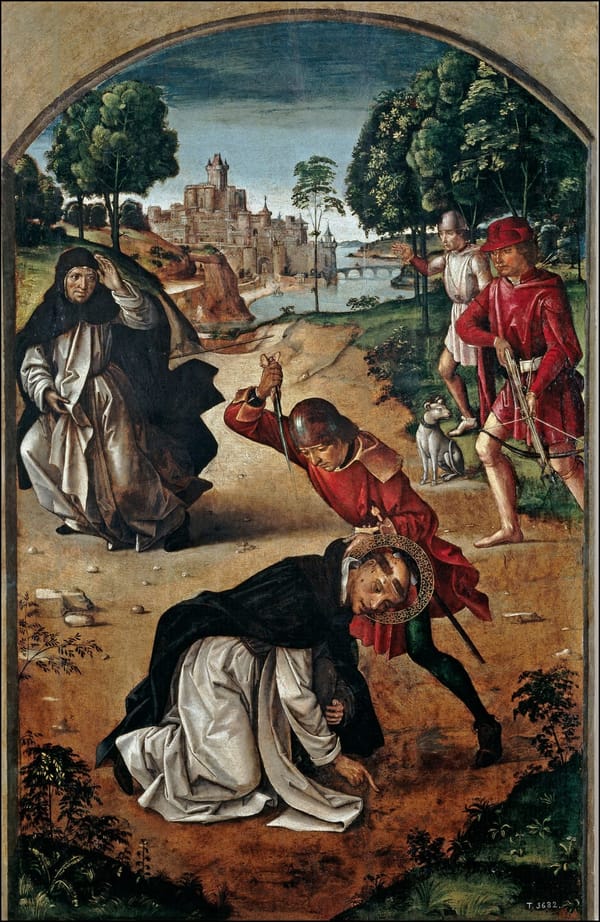
THE hero deputed this day by the Church to greet our Risen Lord was so valiant in the good fight that martyrdom is part of his name. He is known as Peter the Martyr; so that we cannot speak of him without raising the echo of victory. He was put to death by heretics, and is the grand tribute paid to our Redeemer by the thirteenth century. Never was there a triumph hailed with greater enthusiasm than this. The martyrdom of St Thomas of Canterbury excited the admiration of the faithful of the preceding century, for nothing was so dear to our forefathers as the liberty of the Church; the martyrdom of St Peter was celebrated with a like intensity of praise and joy. Let us hearken to the fervid eloquence of the great Pontiff, Innocent IV, who thus begins the Bull of the martyr's canonization: ‘The truth of the Christian faith, manifested, as it has been, by great and frequent miracles, is now beautified by the new merit of a new Saint. Lo! a combatant of these our own times comes, bringing us new and great and triumphant signs. The voice of his blood shed (for Christ) is heard, and the fame of his martyrdom is trumpeted, through the world. The land is not silent that sweateth with his blood; the country that produced so noble a warrior resounds with his praise; yea, the very sword that did the deed of parricide proclaims his glory . . . . Mother Church has great reason to rejoice, and abundant matter for gladness; she has cause to sing a new canticle to the Lord, and a hymn of fervent praise to her God; . . . the Christian people has cause to give forth devout songs to its Creator. A sweet fruit, gathered in the garden of faith, has been set upon the table of the eternal King: a grape-bunch taken from the vineyard of the Church has filled the royal cup with new wine . . . . The flourishing Order of Preachers has produced a red rose, whose sweetness is most grateful to the King; and from the Church here on earth there has been taken a stone, which, after being cut and polished, has deserved a place of honour in the temple of heaven.'1
Such was the language wherewith the supreme Pontiff spoke of the new martyr, and the people responded by celebrating his feast with extraordinary devotion. It was kept as were the ancient festivals, that is, all servile work was forbidden upon it. The churches served by the Fathers of the Dominican Order were crowded on his feast; and the faithful took little branches with them, that they might be blessed in memory of the triumph of Peter the Martyr. This custom is still observed; and the branches blessed by the Dominicans on this day are venerated as being a protection to the houses where they are kept.
How are we to account for all this fervent devotion of the people towards St Peter? It was because he died in defence of the faith; and nothing was so dear to the Christians of those days as faith: Peter had received the charge to seize all the heretics who at that time were causing great disturbance and scandal in the country round about Milan. They were called Cathari, but in reality were Manicheans; their teachings were detestable, and their lives most immoral. Peter fulfilled his duty with a firmness and equity which soon secured him the hatred of the heretics; and when he fell a victim to his holy courage, a cry of admiration and gratitude was heard throughout Christendom. Nothing could be more devoid of truth than the accusations brought by the enemies of the Church and their indiscreet abettors against the measures formerly decreed by the public law of Catholic nations, in order to foil the efforts made by evil-minded men to injure the true faith. In those times, no tribunal was so popular as that whose office it was to protect the faith, and to put down all them that attacked it. It was to the Order of St Dominic that this office was mainly entrusted; and well may they be proud of the honour of having so long held one so beneficial to the salvation of mankind. How many of its members have met with a glorious death in the exercise of their stem duty! St Peter is the first of the martyrs given by the Order for this, holy cause: his name, however, heads a long list of others who were his brethren in religion, his successors in the defence of the faith, and his followers to martyrdom. The coercive measures that were once, and successfully, used to defend the faithful from heretical teachers have long since ceased to be used: but for us Catholics, our judgement of them must surely be that of the Church. She bids us to-day honour as a martyr one of her Saints, who was put to death whilst resisting the wolves that threatened the sheep of Christ’s fold; should we not be guilty of disrespect to our Mother if we dared to condemn what she so highly approves? Far, then, be from us that cowardly truckling to the spirit of the age, which would make us ashamed of the courageous efforts made by our forefathers for the preservation of the faith! Far from us that childish readiness to believe the calumnies of Protestants against an institution which they naturally detest! Far from us that deplorable confusion of ideas which puts truth and error on an equality, and, from the fact that error can have no rights, concludes that truth can claim none!
The following is the account given us by the Church of the virtues and heroism of St Peter the Martyr:
The following Antiphons and Responsory are taken from the Dominican Breviary:
The victory was thine, O Peter! and thy zeal for the defence of our holy faith was rewarded. Thou didst ardently desire to shed thy blood for the holiest of causes, and by such a sacrifice to confirm the faithful of Christ in their religion. Our Lord satisfied thy desire; he would even have thy martyrdom be in the festive season of the Resurrection of our divine Lamb, that his glory might add lustre to the beauty of thy holocaust. When the death-blow fell upon thy venerable head, and thy generous blood was flowing from the wounds, thou didst write on the ground the first words of the creed, for whose holy truth thou wast giving thy life.
Protector of the Christian people! what other motive hadst thou, in all thy labours, but charity? What else but a desire to defend the weak from danger induced thee not only to preach against error, but to drive its teachers from the flock? How many simple souls, who were receiving divine truth from the teaching of the Church, have been deceived by the lying sophistry of heretical doctrine, and have lost the faith? Surely the Church would do her utmost to ward off such dangers from her children; she would do all she could to defend them from enemies, who were bent on destroying the glorious inheritance which had been handed down to them by millions of martyrs! She knew the strange tendency that often exists in the heart of fallen man to love error; whereas truth, though of itself unchanging, is not sure of its remaining firmly in the mind, unless it be defended by learning or by faith. As to learning, there are but few who possess it; and as to faith, error is ever conspiring against it, and, of course, with the appearance of truth. In the Christian ages it would have been deemed not only criminal, but absurd, to grant to error the liberty which is due only to truth; and they that were in authority considered it a duty to keep the weak from danger, by removing from them all occasions of a fall; just as the father of a family keeps his children from coming in contact with wicked companions who could easily impose on their inexperience, and lead them to evil under the name of good.
Obtain for us, O holy martyr, a keen appreciation of the precious gift of faith—that element which keeps us in the way of salvation. May we zealously do everything that lies in our power to preserve it, both in ourselves and in them that are under our care. The love of this holy faith has grown cold in so many hearts; and frequent intercourse with heretics or free-thinkers has made them think and speak of matters of faith in a very loose way. Pray for them, O Peter, that they may recover that fearless love of the truths of religion which should be one of the chief traits of the Christian character. If they be living in a country where the modem system is introduced of treating all religions alike—that is, of giving equal rights to error and to truth—let them be all the more courageous in professing the truth, and detesting the errors opposed to the truth. Pray for us, O holy martyr, that there may be enkindled within us an ardent love of that faith without which it is impossible to please God.2 Pray that we may become all earnestness in this duty, which is of vital importance to salvation; that thus our faith may daily gain strength within us, till at length we shall merit to see in heaven what we have believed unhesitatingly on earth.
Thursday of the Fourth Week after Easter
THE Apostles have received their mission. The Sovereign Master has bade them divide among themselves the nations of the earth, and preach everywhere the Gospel—that is, the Good Tidings—the tidings of man's Redemption wrought by the Son of God, who was made flesh, was crucified, and arose again from the dead. But what is to be the grand support of these humble Jews, who have been suddenly transformed into conquerors, and have to win the whole world to Christ? Their support is the solemn promise made to them by Jesus, when, after saying: Go, teach all nations! he adds: Lo! I am with you all days, even to the consummation of the world! Hereby he promises never to leave them, and ever to direct and guide them. They shall see him no more in this life; and yet he assures them that he will be ever in their midst.
But these men, with whom Christ thus promises that he will abide for ever, and preserve them from every fall and from every error in the teaching of his doctrine—these Apostles are not immortal. We shall find them, one after the other, laying down their lives for the faith and so leaving this world. Are we, then, condemned to uncertainty and darkness, like men who have been abandoned by the light? Is it possible, that the appearance of our Emmanuel upon the earth has been but like that of a meteor, which we sometimes behold in the night, emitting a lurid light, and then suddenly disappearing, leaving us in greater darkness than before? No: the words of our Risen Jesus forbid us to fear such a calamity. He did not say to his Apostles:’Lo! I am with you even to the end of your lives;' but Lo! I am with you all days, even to the consummation of the world. So that those to whom he addressed himself were to live to the end of the world! What means this, but that the Apostles were to have successors, in whom their rights were to be perpetuated? successors whom Jesus would ever assist by his presence and uphold by his power. The work founded by a God, out of his love for man, and at the price of his own precious Blood, must surely be imperishable! Jesus, by his presence amidst his Apostles, preserved their teaching from all error; by his presence he will also, and for ever, guide the teaching of their successors.
O precious and necessary gift of Infallibility in the Church! Gift, without which the mission of the Son of God would have been a failure! Gift whereby faith, that essential element of man’s salvation, is preserved upon the earth! Yes, we have the promise; and the effects of this promise are evident even to them that are not of the Church. Where is there an unprejudiced man, who would not recognize the hand of God in the perpetuity of the Catholic Symbol of Faith, whereas everything else on earth is for ever changing? Can we attribute to natural causes such a result as this—that a society, whose link is unity of belief, should live through so many ages, and yet lose nothing of the truth it possessed at its commencement, nor imbibe anything of the falseness of the world around it; that it should have been attacked by thousands of sects, and yet have triumphed over them all, survived them all, and be as pure in the faith now at this present day, as it was on the day when first formed by its divine Founder? Is it not an unheard-of prodigy, that hundreds of millions of men, differing from each other in country, character, and customs, yea, and frequently enemies to each other, should be united in one like submission to one same authority, which, with a single word, governs their reason in matters of faith?
How great is thy fidelity to thy promises, O Jesus! Who could help feeling that thou art in the midst of thy Church, mastering by thy presence the warring elements, and by irresistible yet sweet power, subjecting our pride and fickleness to thy dear yoke? And they are men, men like ourselves who rule and guide our faith! It is the Pope, the successor of St Peter, whose faith cannot fail,* and whose sovereign word is carried through the whole world, producing unity of mind and heart, dispelling doubt, and putting an end to disputation. It is the venerable body of the bishops united with their Head, and deriving from this union an invincible strength in the proclamation of the one same truth in the several countries of the universe. Oh yes; men are made infallible because Jesus is with and in them! In everything else they are men like ourselves; but the Chair on which they are throned is supported by the arm of God; it is the Chair of Truth upon the earth.
How grand is our faith! Miracles gave it birth; and this continued miracle, of which we have been speaking, and which disconcerts all the calculations of human wisdom, directs it, enlightens it, and upholds it. How stupendous are the wondrous works done by our Risen Jesus during these forty days! So far, he had been preparing his work; now he carries it into effect. May the divine Shepherd be ever praised for the care he takes of his Sheep! If he exacts their faith as the first pledge of their service, we must own that he has made the sacrifice not only meritorious by the submission of our reason, but most attractive to our heart.
Let us honour his glorious Resurrection by a new canticle—one from the ancient Missals of Germany.
Sequence
Voce modulemur supplici.
Omnis in hac die
Rerum natura jubilans,
Personet immensas
Filio Dei gratias.
Jam nostri concives,
Coelestis sanctuarii milites,
In vestra nos adunate gaudia.
Hymnite nunc superi,
Pariter resonate inferi,
Et omnis in Domino
Spiritus gratuletur ænesi;
Deus homo nascitur;
Et fragili carne,
Se deitas occulens,
Probra sustinuit patiens:
Virtutibus, signis ut
Deus emicuit;
Et corporis nostri necessitate fruens,
Verus terrigena claruit.
Ab hoste tentatus,
Non est agnitus neque divinitas patuit:
Ars artem delusit,
Donec veteris nodum piaculi secuit.
In ara crucis hostiam
Se pro nobis Christus obtulit Deo Patri,
Morte sua nostra mortificans crimina.
Jam victor Christus,
Barathro populato,
Mortis principe vinculato,
Ab inferis pompa regreditur nobili.
Hæc est dies quæ illuxit, post turbida
Regni Æthiopum tempora;
Christus in qua resurrexit
Ultra victurus,
Cum carne quam sumpsit de Maria virgine.
Qui ovem
Cum gaudio Patri quam perdiderat,
Humero revexit suo.
sing with suppliant voice our praise to Christ.
On this day let all nature,
in a transport of joy,
Sound forth one universal hymn of thanks
to the Son of God.
And you,
our fellow-citizens,
permit us to share in your joys.
Sing a hymn, ye that are highest!
Intone a loud canticle, ye that are lowest!
Yea, let every spirit be glad in the Lord,
and praise him!
For he, God,
became Man for man's salvation.
Hiding his divinity
with the veil of our frail flesh,
he patiently endured every insult;
But his power and miracles
revealed him as our God.
He subjected himself to all our human wants,
and was verily a wayfarer on our earth.
He was tempted by the enemy;
but he made not known his divinity.
Craft by craft was foiled,
till the hour came for him to cut the knot of Adam's sin.
For our sake, he offered himself to his Father
a victim upon the altar of the Cross: and by his Death,
he put our sins to death.
And now hell is ravaged
and the prince of death enchained,
and Christ returns from Limbo,
in all the pageant of his victory.
This is the day which has shone upon the world,
after the stormy times of the Ethiopian sway.
It is the day whereon,
with the flesh he assumed from the Virgin Mary,
Christ rose again, to live for evermore.
With joy, he carried on his shoulders,
to his Father,
the sheep that had been lost.
* St Luke xxii 32. ↩︎
| Previous Wednesday of the Fourth Week after Easter | Next Thursday of the Fourth Week after Easter |