Daily reading
Paschal Time
Double of the II Class · May 1 · Sanctoral
May 1, 2021
From Dom Guéranger’s The Liturgical Year.
A Double of the II Class leads the weekday.Rubric

|
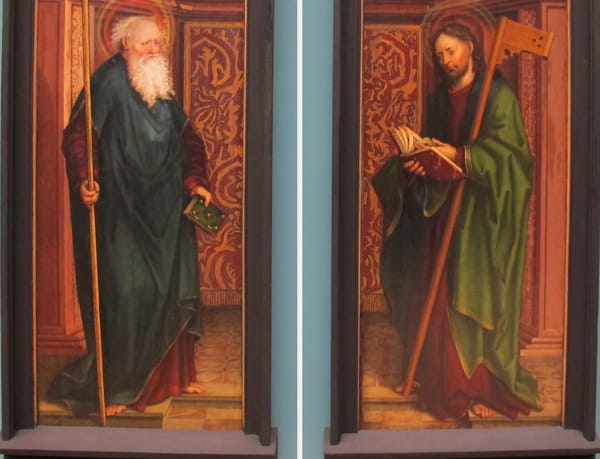
May 11 [May 1]: Sts. Philip and James the Less, Apostles
[This feast day, previously kept on May 1, was moved to May 11 when the feast of St. Joseph the Worker was established on May 1. The Solemnity of St. Joseph, which was replaced by St. Joseph the Work, was originally celebrated on the Third Sunday after Easter, as it was in the time of Dom Guéranger, whose article on that feast can be found here.-Ed.]
From Dom Guéranger's The Liturgical Year.
TWO of the favoured witnesses of our beloved Jesus' Resurrection come before us on this first day of May. Philip and James are here, bearing testimony to us that their Master is truly risen from the dead, that they have seen him, that they have touched him, that they have conversed with him,1 during these forty days. And, that we may have no doubt as to the truth of their testimony, they hold in their hands the instruments of the martyrdom they underwent for asserting that Jesus, after having suffered death, came to life again and rose from the grave. Philip is leaning upon the cross to which he was fastened, as Jesus had been; James is holding the club wherewith he was struck dead.
Philip preached the Gospel in the two Phrygias, and his martyrdom took place at Hierapolis. He was married when he was called by our Saviour; and we learn from writers of the second century that he had three daughters, remarkable for their great piety, one of whom lived at Ephesus, where she was justly revered as one of the glories of that early Church.
James is better known than Philip. He is called, in the sacred Scripture, Brother of the Lord,2 on account of the close relationship that existed between his own mother and the blessed Mother of Jesus. He claims our veneration during Paschal Time, inasmuch as he was favoured with a special visit from our Risen Lord, as we learn from St Paul.3 There can be no doubt but that he had done something to deserve this mark of Jesus’ predilection. St Jerome and St Epiphanius tell us that our Saviour, when ascending into heaven, recommended to St James’s care the Church of Jerusalem, and that he was accordingly appointed the first bishop of that city. The Christians of Jerusalem, in the fourth century, had possession of the chair on which St James used to sit when he assisted at the assemblies of the faithful. St Epiphanius also tells us that the holy Apostle used to wear a lamina of gold upon his forehead as the badge of his dignity. His garment was a tunic made of linen.
He was held in such high repute for virtue that the people of Jerusalem called him ' The Just and when the time of the siege came, instead of attributing the frightful punishment they then endured to the deicide they or their fathers had .committed, they would have it to be a consequence of the murder of James, who, when dying, prayed for his people. The admirable Epistle he has left us bears testimony to the gentleness and uprightness of his character. He there teaches us, with the eloquence of an inspired writer, that works must accompany our faith if we would be just with that justice which makes us like our Risen Lord.
The bodies of SS Philip and James repose in the Basilica of the Holy Apostles at Rome. These relics are counted as one of the richest treasures of the Holy City, and there is reason to believe that this first of May is the real anniversary of their translation. For a long period the Church of Rome kept special feasts in honour of four only of the Apostles: SS Peter and Paul, St John the Evangelist, and St Andrew (Peter’s brother): the rest were united in the solemnity of June 29, and a vestige of this is still to be found in the office of that day, as we shall see later on. The reception of the bodies of SS Philip and James, which were brought from the East somewhere about the sixth century, gave rise to the institution of to-day's feast; and this led gradually to the insertion into the Calendar of special feasts for the other Apostles and Evangelists.
Let us now read the brief account given of St Philip in the Liturgy.
The Breviary then gives the two following Lessons upon St James:
The Greek Church celebrates the memory of these two Apostles on distinct days, which are the anniversaries of their martyrdom. The following stanzas are from the hymn in honour of St Philip:
Hymn (Die XIV Novembris)
Let us now make a selection from the Menæa in honour of St James, whose memory is so affectionately cherished by the Eastern Churches:
Hymn (Die XXIII Octobris)
Holy Apostles! you saw our Risen Jesus in all his glory. He said to you on the evening of that great Sunday: Peace be to you! He appeared to you during the forty days following, that he might make you certain of his Resurrection. Great indeed must have been your joy at seeing once more that dear Master, who had admitted you into the number of his chosen Twelve; and his return made your love of him more than ever fervent. We address ourselves to you as our special patrons during this holy season, and most earnestly do we beseech you to teach us how to know and love the great mystery of our Lord’s Resurrection. May our hearts glow with Paschal joy, and may we never lose the new life that our Jesus has now given unto us.
Thou, O Philip! wast devoted to him, even from the first day of his calling thee. Scarcely hadst thou come to know him as the Messias, than thou didst announce the great tidings to thy friend Nathanael. Jesus treated thee with affectionate familiarity. When about to work the great miracle of the multiplication of the loaves, it was to thee that he addressed himself, and said to thee: Whence shall we buy bread, that these may eat?4 A few days before the Passion of thy divine Master, some of the Gentiles wished to see this great Prophet, of whom they had heard such wonderful things, and it was to thee that they applied. How fervently didst thou not ask him, at the Last Supper, to show thee the Father! Thy soul longed for the divine light; and when the rays of the Holy Ghost had inflamed thy spirit, nothing could daunt thy courage. As a reward of thy labours, Jesus gave thee to share with him the honours of the Cross. O holy Apostle! intercede for us, that we may imitate thy devotedness to Jesus; and that, when he deigns to send us the Cross, we may reverence and love it.
We also honour thy love of Jesus, O thou that art called the brother of the Lord, on whose venerable features was stamped the likeness of our Redeemer. If, like the rest of the Apostles, thou didst abandon him in his Passion, thy repentance was speedy and earnest, for thou wast the first, after Peter, to whom he appeared after his Resurrection. We affectionately congratulate thee, O James, for the honour thus conferred upon thee; do thou, in return, obtain for us that we may taste and see how sweet is our Risen Lord.5 Thy ambition was to give him every possible proof of thy gratitude; and the last testimony thou didst bear, in the faithless city, to the divinity of thy dear Master (when the Jews took thee to the top of the Temple) opened to thee, by martyrdom, the way that was to unite thee to him for eternity. Pray for us, O thou generous Apostle, that we also may confess his holy Name with the firmness which befits his disciples; and that we may ever be brave and loyal in proclaiming his rights as King over all creatures.
O holy Apostles! we beseech you to unite your prayers, and intercede for the Churches of the East, to which you preached the Gospel. Have compassion on Jerusalem, the dupe of schism and heresy; obtain her purification and her liberty; and rid her Holy Places of the sacrileges that have so long polluted them. Lead back the Christians of Asia Minor to union with the fold governed by the one supreme pastor. And lastly, pray for Rome, the city where your bodies repose, awaiting their glorious Resurrection. In return for the long hospitality she has given you, shield her with your protection; and permit not that the city of Peter, your venerable Head, should be deprived of its grandest glory—the presence of the Vicar of Christ.
Saturday of the Fourth Week after Easter
SATURDAY brings us once more to the dear Mother of our Jesus. Last Saturday, when closing our week’s considerations upon the establishment of the Church, we reverently drew a parallel between these two Mothers—Mary and the Church. During the present week, we have been considering how our Saviour confided his doctrine—that is, the object of our faith—to his Apostles; let us devote this last day to a loving remembrance of the dogmas which Jesus revealed to them regarding the dignity and office of her whom he chose for his own and our Mother.
Holy Church teaches us several truths concerning Mary; and these truths are the object of our faith, on the same ground as the other articles contained in the Catholic Creed. Now they could not be the object of our faith, except inasmuch as they were revealed by the lips of our divine Lord himself. The Church of our days has received them from the Church of past ages, just as this last named received them from the Apostles, to whom Jesus first confided them. There has been no new revelation since our Saviour’s Ascension; consequently, the manifestation of all the dogmas transmitted to the Church, and promulgated by her to the world, dates from the teaching given by Jesus to his Apostles. It is on this account that we believe them with theological faith—a faith which can only be given to truths directly revealed by God to man.
How beautiful is the affection here shown by the Son of God to his Mother! He revealed to his Apostles the impenetrable secrets of the divine Essence, the Trinity in Unity, the eternal generation of the Word in the Father's bosom, the eternal procession of the Holy Ghost from the Father and the Son, the union of the two Natures in one Person in the Incarnate Word, the Redemption of the world by the Blood of the Man-God, the restoration of fallen man and his elevation to a supernatural state by grace. But this same Jesus also reveals the prerogatives of his dearest Mother; and we are to believe them with the same faith as we do the dogmas which relate to God himself! Jesus, the Wisdom of the Father, the Conqueror of death, has revealed to us Mary's dignity with the same lips that taught us what he himself is: we believe the two revelations with equal faith because both come from him.
Jesus said to his Apostles, and they, under the guidance of the Holy Ghost, communicated his teaching to the Church:’Mary, my Mother, is a daughter of Adam and Eve; but the stain of original sin was not upon her. The decree that every human being should be conceived in sin was suspended in her regard. She was full of grace from the first moment of her Conception. Jeremiasand John the Baptist were sanctified in their mother’s womb; Mary was Immaculate from the first moment of her existence.’
Jesus also said to his Apostles, and commanded them to repeat his words to the Church:’ Mary is truly Mother of God, and must be honoured as such by all creatures; for she truly conceived me and gave me birth, according to my human nature, which forms but one Person with my divine nature.’
Jesus also said to his Apostles, and commanded them to repeat his words to the Church:’ Mary, my Mother, conceived me in her chaste womb without ceasing to be a Virgin, and she gave me birth without her Virginity suffering any injury.’
Thus, Mary’s Immaculate Conception which prepared her for her sublime office, her divine Maternity and her perpetual Virginity, are three dogmas of our faith, which were revealed to the Apostles directly by our Lord. Holy Church merely repeats them after the Apostles, just as the Apostles repeated them after hearing them from their divine Master.
But did not Jesus reveal other prerogatives of his august Mother—prerogatives which are consequences of the three magnificent gifts just mentioned? Let us ask the Church what she believes on this subject, and what she teaches, both by her doctrinal utterance, and by her equally infallible practice. Every development, which is produced in her by the action of the Holy Ghost, is based upon the word of God, which was spoken at the beginning. Thus it is impossible to doubt but that our Saviour made known to his Apostles his intention of raising his blessed Mother to the dignity of Queen of the universe, of Mediatrix of men, of Mother of grace, of Co-operatrix of our Redemption. Had she not, by the three unparalleled gifts just mentioned, already been raised above all other creatures? Yes, we cannot doubt it; these glories of the Mother of God were known, revered, and loved by the Apostles; and we, who have received from the Church these same sublime and consoling truths, we too prize and love our knowledge. Should we not be offering violence to every noble feeling of our nature, were we to believe that Jesus ascended into heaven, without having made known to the world the glories of his Mother, whom he loved both as her Son and her God!
What must have been thy sentiments, O Mary, thou most humble of creatures, when Jesus unveiled thy glories to the disciples? They already reverenced thee, but they could never have known the grand gifts bestowed on thee by God, unless that God himself had revealed them. What glorious things were said of thee, O City of God!1 If thy humility was troubled when the archangel called thee full of grace, and blessed among women; how must thou not have shrunk from the homage paid thee by the Apostles, when they were first told that thou wast the Mother of God, the ever spotless Virgin, Immaculate from thy very conception! But no, blessed Mother! thou canst not shun the honours that are richly thy due. The prophecy spoken by thyself, in Zachary’s house, must be fulfilled: All generations shall call thee Blessed!2 The time is at hand; a few days hence, the preaching of the Gospel will have commenced. Thy name, thy ministry, thy glories are an essential part of the Creed which is to be carried throughout the world. Up to this time, thou hast been shrouded in a veil of mystery; that veil must now be drawn aside —Jesus will have it so—and thou must be known as Mother of the God, who, when he came to save us, disdained not to assume our human nature in thy chaste womb. Dearest Mother! Queen of angels and men! suffer us to unite our fervent homage with that which the Apostolic College gave thee, when Jesus first revealed to them thy glories!
Let us, in honour of the blessed Mother, recite this sequence of the Cluny Missal of 1523. It is a graceful imitation of the Victimœ Paschali.
Sequence
Intonent Christiani.
Tua per suffragia
Reconcilientur peccatores.
A fermento veteri,
Victimae paschalis perceptores.
Virgo clemens et pia,
Et gloria frui resurgentis.
Christo reconcilia,
Es Genitrix Verbi Dei facta.
Et hominem natum, resurrexisse glorificatum.
A mortuis vere;
Conserva Mater nos et tuere.
their hymns of praise.
let sinners be reconciled to God
by thy prayers.
by thy intercession,
cleansed from the old leaven.
thou merciful and loving Virgin!
and Risen Christ.
by thy holy prayers,
Mother of the Word of God!
who was born of thee hath risen again in glory.
Do thou, O Mother!
preserve and defend us.
| Previous Friday of the Fourth Week after Easter | Next Saturday of the Fourth Week after Easter |