Daily reading
Paschal Time
Double · May 4 · Sanctoral
May 4, 2021
From Dom Guéranger’s The Liturgical Year.
A Double leads the weekday.Rubric
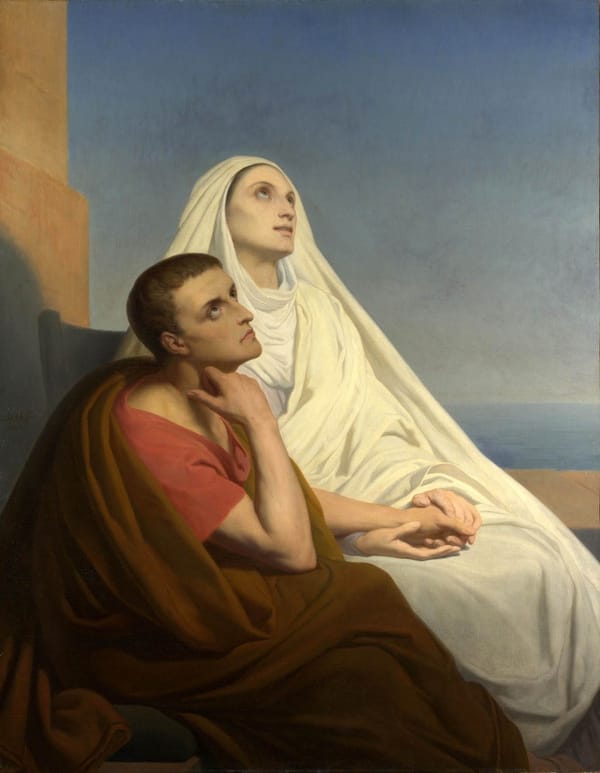 |
May 4: St. Monica, Widow
IN the company of our Risen Lord there are two women, two mothers, of whom we have often had to speak during the last few weeks: they are Mary, mother of James the Less and Thaddeus, and Salome, mother of 'James the Great and John the beloved disciple. They went with Magdalen to the Sepulchre on the Resurrection morning; they carried spices to anoint the Body of Jesus; Angels spoke to them; and, as they returned to Jerusalem, our Lord appeared to them, greeted them, and allowed them to kiss his sacred feet. Since that day, he has repaid their love by frequently appearing to them; and on the day of his Ascension from Mount Olivet, they will be there, together with our blessed Lady and the Apostles, to receive his farewell blessing. Let us honour these faithful companions of Magdalen, these models of the love we should show to our Lord in his Resurrection; let us also venerate them as mothers who gave four Apostles to the Church.
But lo! on this fourth morning of beautiful May, there rises, near to Mary and Salome, another woman, another mother. She, too, is fervent in her love of Jesus. She, too, gives to Holy Church a treasure—the child of her tears, a Doctor, a Bishop, and one of the grandest Saints of the New Law. This woman, this mother, is Monica, doubly mother of Augustine. This masterpiece of God's grace was produced on the desert soil of Africa. Her virtues would have been unknown till the day of judgement, had not the pen of the great bishop of Hippo, prompted by the holy affection of his filial heart, revealed to us the merits of this woman, whose life was humility and love, and who now, immortalized in men’s esteem, is venerated as the model and patroness of Christian mothers.
One of the great charms of the book of Confessions is Augustine’s fervent praise of Monica’s virtues and devotedness. With what affectionate gratitude he speaks, throughout his whole history, of the untiring constancy of this mother who, seeing the errors of her son, 1 wept over him more than other mothers weep over the dead body of their children.’1 Our Lord, who from time to time consoles with a ray of hope the souls he tries, had shown to Monica in a vision the future meeting of the son and mother; she had even heard a holy bishop assure her that the child of so many tears could never be lost: still the sad realities of the present weighed heavily on her heart; and both her maternal love and her faith caused her to grieve over this son, who kept away from her, yea, who kept away from her because he was unfaithful to his God. The anguish of this devoted heart was an expiation which would at a future period be applied to the guilty one; fervent and persevering prayer, joined with suffering, prepared Augustine’s second birth; and, as he himself says, ‘she went through more when she gave me my spiritual than when she gave me my corporal birth.’2
At last, after long years of anxiety, the mother found at Milan this son of hers who had so cruelly deceived her, when he fled from her roof to go and risk his fortune in Rome. She found him still doubting the truth of the Christian religion, but tired of the errors that had misled him. Augustine was not aware of it, but he had really made an advance towards the true faith. ‘She found me,’ says he, ‘in extreme danger, for I despaired of ever finding the truth. But when I told her that I was no longer a Manichean, and yet not a Catholic Christian, the announcement did not take her by surprise. She leaped for joy at being made sure that one half of my misery was gone. As to the other, she wept over me, as dead indeed, but to rise again; she turned to thee, O my God, and wept, and in spirit brought me and laid the bier before thee, that thou mightest say to the widow's son: Young man! I say to thee, arise! Then would he come to life again, and begin to speak, and thou couldst give him back to his mother! . . . Seeing then that although I had not yet found the truth, I was delivered from error, she felt sure that thou wouldst give the other half of the whole thou hadst promised. She told me in a tone of gentlest calm, but with her heart full of hope, that she was confident, in Christ, that before leaving this world, she would see me a faithful Catholic.’3
At Milan, Monica formed acquaintance with the great St Ambrose, who was the instrument chosen by God for the conversion of her son. ‘She had a very great affection for Ambrose,' says Augustine, ' because of what he had done for my soul; and he too loved her, because of her extraordinary piety, which led her to the performance of good works, and to fervent assiduity in frequenting the Church. Hence, when he saw me, he would frequently break out in her praise, and congratulate me on having such a mother.’4 The hour of grace came at last. The light of faith dawned upon Augustine, and he began to think of enrolling himself a member of the Christian Church; but the pleasures of the world, in which he had so long indulged, held him back from receiving the holy sacrament of baptism. Monica's prayers and tears won for him the grace to break this last tie. He yielded and became a Christian.
But God would have this work of his divine mercy a perfect one. Augustine, once converted, was not satisfied with professing the true faith; he aspired to the sublime virtue of continence. A soul favoured as his then was could find no further pleasure in anything that this world had to offer him. Monica, who was anxious to guard her son against the dangers of a relapse into sin, had been preparing an honourable marriage for him; but Augustine came to her one day, accompanied by his friend Alypius, and told her that he was resolved to aim at the most perfect life. Let us listen to the Saint's account of this interview with his mother; it was immediately after he had been admonished by the voice from heaven: ‘We (Augustine and Alypius) go at once to my mother's house. We tell her what has taken place; she is full of joy. We tell her all the particulars; she is overpowered with feelings of delight and exultation. She blessed thee, O my God, who canst do beyond what we ask or understand. She saw that thou hadst done more for me than she had asked of thee, with her many piteous and tearful sighs . . . . Thou hadst changed her mourning into joy even beyond her wishes, yea, into a joy far dearer and chaster than she could ever have had in seeing me a father of children.’5 A few days after this, and in the Church of Milan, a sublime spectacle was witnessed by angels and men: Ambrose baptized Augustine in Monica's presence.
The saintly mother had fulfilled her mission: her son was regenerated to truth and virtue, and she had given to the Church the greatest of her Doctors. The evening of her long and laborious life was approaching and she was soon to find eternal rest in the God for whose love she had suffered so much. The son and mother were at Ostia, waiting for the vessel that was to take them back to Africa. ‘I and she were alone,’ says Augustine, ‘and were standing near a window of our lodging, which commanded a view of the garden. We were having a most charming conversation. Forgetting the past, and stretching forward to the things beyond, we were talking about the future life of the Saints, which eye hath not seen, nor ear heard, nor hath it ascended into man's heart . . . . And whilst thus talking about it and longing for it, our hearts seemed to bound forward and reach it. We sighed, and left the first-fruits of our spirit there, and returned to the sound of our own voice . . . . Then my mother said to me: “ My son! as far as I am concerned, there is nothing now that can give me pleasure in this life. I know not what I can do, or why I should be here, now that I have nothing to hope for in this world. There was one thing for which I desired to live somewhat longer, and it was to see thee a Catholic Christian before my death. My God has granted me this and more, for I see that thou hast despised earthly pleasures and become his servant. What do I here?”’6
She had not long to wait for the divine invitation. She breathed forth her pure soul a few days after this incident, leaving an indelible impression upon the heart of her son, a name most dear and honoured to the Church, and a perfect example of the purest and holiest maternal affection to Christian mothers.
The life and virtues of St Monica are thus briefly portrayed in to-day’s Liturgy:
The Middle Ages have left us several liturgical pieces composed in honour of St Monica; but most of them are poor. The sequence we select is not without merit; it has even been attributed to Adam of Saint-Victor.
Sequence
Atque suæ piæ matris laudes et præconia
Decantemus, venerantes
Et optata celebrantes hodie solemnia.
Vita clara, Christo chara, hæc beata Monica
De profano propagatum,
Jam nunc parit suum natum in fide catholica.
Quo effulsit tam præclarum lumen in Ecclesia!
Multo fletu seminavit,
Germen ubi reportavit metens in lætitia.
O quam miro tunc gestivit Spiritus tripudio,
Cernens natum fide ratum,
Sed et Christo jam sacratum toto mentis studio!
Et in eis Christum pavit, mater dicta pauperum;
Curam gerens infirmorum,
Lavit, stravit, et eorum tersit sordes vuinerum.
Quam transfigunt amorosa crucifixi stigmata!
His accensa sic ploravit,
Lacrymis quod irrigavit pavimenti schemata.
Stat a terris elevata cubiti distantia;
Mente rapta exsultavit:
‘Volitemus,’ exclamavit, ‘Ad cœli fastigia.’
Advocata et patrona sis pro tuis filiis,
Ut dum carne exuemur,
Nato tuo sociemur paradisi gaudiis.
and of his holy mother.
Let us devoutly celebrate
the beloved solemnity of this day.
well instructed in the faith, edifying in her conduct, and dear to Christ.
Her son was born of a pagan father;
but she gave him a second birth—she brought him to the Catholic faith.
through which shone forth so bright a light within the Church!
Monica sowed in much weeping,
but she reaped her fruit in joy.
Oh! how grand was the gladness that filled her soul,
when she saw her son staunch in faith,
yea, and devoted with his whole heart to Christ!
for she ministered to them in their necessities, and gave to Christ the food she gave to them.
She took care of the sick,
washed them, nursed them, and dressed their wounds.
with compassion for the dear Wounds of her crucified Lord!
She wept for love when she thought upon them,
and her tears bedewed the spot on which she prayed.
she was raised from the ground
and in her rapture exclaimed with joy:
‘Let us fly to heaven above!'
be to us thy children an advocate and patroness,
that so, when we quit the flesh, we may be united to Augustine,
thy son, in the joys of paradise.
O thou model of mothers! Christendom honours thee as one of the most perfect types of human nature regenerated by Christ. Previous to the Gospel, during those long ages when woman was kept in a state of abjection, a mother’s influence on her children was feeble and insignificant; her duties were generally limited to looking after their bodily well-being; and if some mothers of those times have handed their names down to posterity, it is only because they taught their sons to covet and win the passing glory of this world. But we have no instance in pagan times of a mother training her son to virtue, following him from city to city that she might help him in the struggle with error and the passions, and encourage him to rise after a fall; we do not meet with one who devoted herself to continual prayer and tears, with a view to obtain her son's return to truth and virtue. Christianity alone has revealed a mother's mission and power.
What forgetfulness of thyself, O Monica, in thine incessant endeavour to secure Augustine's salvation! After God, thou livest for him, and to live for thy son in such a way as this, is it not living for God, who deigns to use thee as the instrument of his grace? What carest thou for Augustine's glory and success in this world when thou thinkest of the eternal dangers and of the eternal separation from God and thee to which he is exposed. There is no sacrifice which thy maternal heart is not ready to make in order to satisfy the divine justice: it has its rights and thou art too generous not to satisfy them. Thou waitest patiently, day and night, for God's good time to come. The delay only makes thy prayer more earnest. Hoping against all hope, thou at length feelest within thy heart the humble but firm conviction that the object of all these tears can never be lost. Moved with mercy towards thee, as he was towards the sorrowing mother of Naim, he speaks with that voice which nothing can withstand: ‘Young man! I say to thee, arise!’ and he gives him to his mother,’7 he gives thee the dear one whose death thou hadst so bitterly bewailed, but from whom thou couldst not tear thyself.
What a recompense of thy maternal love is this! God is not satisfied with restoring thee Augustine full of life; this son of thine rises at once from the very depths of error and sin to the highest virtue. Thou hadst prayed that he might become a Catholic and break certain ties which were both a disgrace and danger to him; when lo! one single stroke of grace has raised him to the sublime state of the Evangelical Counsels. Thy work is more than done, O happy mother! Speed thee to heaven; where till thy Augustine joins thee, thou art to gaze on the saintly life and works of this son, whose salvation is due to thee and whose glory, even while he sojourns here below, sheds a bright halo over thy venerated name.
From the eternal home where thou art now happy with this son who owes to thee his life both of earth and heaven, cast a loving look, O Monica, on the many Christian mothers who are now fulfilling on earth the hard but noble mission which was once thine. Their children are also dead with the death of sin; and they would restore them to true life by the power of their maternal love. After the Mother of Jesus, it is to thee that they turn, O Monica, whose prayers and tears were once so efficacious and so fruitful. Take their cause in hand; thy tender and‘devoted heart cannot fail to compassionate them in the anguish which was once thine own. Maintain their courage; teach them to hope. The conversion of these dear ones is to cost them many a sacrifice; procure them the generosity and fortitude to pay the price thus asked of them by God. Let them remember that the conversion of a soul is a greater miracle than raising a dead man to life; and that divine justice demands a compensation which they, the mothers of these children, must be ready to make. This spirit of sacrifice will destroy that hidden egotism which is but too frequently mingled with what seems to be affection of the purest kind. Let them ask themselves if they would rejoice as thou didst, O Monica, at finding that a vocation to the Religious life was the result of the conversion they have so much at heart. If they are thus disinterested, let them not fear; their prayers and sufferings must be efficacious; sooner or later, the wished-for grace will descend upon the prodigal, and he will return to God and to his mother.
Tuesday of the Fifth Week after Easter
THE third sacrament—the Holy Eucharist—is so intimately connected with our Redeemer's Passion that its institution could not be deferred till the Resurrection had taken place. On Maundy Thursday, we honoured the solemn act whereby our Jesus prepared for the morrow’s sacrifice, by instituting the mystery of his Body and Blood, which are really immolated in the Eucharistic Supper. The Apostles were not only admitted, as all future generations were to be, to partake of the divine Food, which giveth life to the world,1 but they moreover received power from Jesus, the Priest for ever,2 to do what he himself had just done. The great Mystery was inaugurated; the new priesthood was instituted: and now that Jesus is risen from the dead, he makes known to his Apostles the whole importance of the gift bestowed upon mankind at the Last Supper; he bids them begin the exercise of the sublime power conferred on them, as soon as the Holy Ghost, by descending upon the earth, shall give to the Church the signal for her using the prerogatives wherewith she has been endowed; and, finally, he teaches how they are to perform this special function of their Priesthood.
At the Last Supper, the Apostles were still carnal-minded men. They were taken up with the sad event that was about to happen, and overcome with grief at their divine Master telling them that that was the last Pasch he was to keep with them. They were not, therefore, in a fit state to appreciate what it was that Jesus had done for them, when he uttered those words: Take ye and eat; this is my Body. Drink ye all of this; for this is my Blood. Still less did they understand the greatness of the power they received, of doing what their Lord himself had just done in their presence. Now that Jesus is risen from the grave, he unfolds all these mysteries to them. The sacrament of the Eucharist was not instituted during these days, but it was made known, explained, and glorified by its divine institutor: and this circumstance gives a fresh lustre to the sacred season we are now going through.
Of all the sacraments, there is not one that can be compared in dignity to that of the Eucharist. The others give grace; this gives us the very Author of grace. The others are only sacraments; this is both a sacrament and a sacrifice. We will endeavour to explain it in all its magnificence, when we come to the bright feast of Corpus Christi. Let us for the present pay the tribute of our loving adoration to our Jesus, the Living Bread, that giveth life to the world.3 Let us acknowledge his immense love for his sheep. He seems to be on the point of leaving them that he may return to his Father, and yet his love retains him amongst them by means of this august mystery, wherein he is truly though invisibly present.
Be thou blessed, then, O Son of the Eternal Father! who, even in the days of the ancient covenant, didst assure us that thy delights are to be with the children of men.4 Thou provest it now by this wonderful sacrament, which reconciles thy two announcements, apparently so contradictory: thy leaving us, and thy abiding ever in our midst.
Be thou blessed for having provided for the nourishment of our souls as well as for that of our bodies. At Christmas we welcomed thy birth at Bethlehem, which signifies a House of Bread. Thou wast both the Saviour who was born for us, and the Food that came down from heaven to nourish our souls.
Be thou blessed, who, not satisfied with working the greatest of wonders at the Last Supper, by changing bread into thy Body and wine into thy Blood, hast also willed that this same miracle should be renewed, everywhere and to the end of time, for the support and consolation of our souls.
Be thou blessed in that thou hast put no limits to our longing after this Bread of Life. On the contrary, thou biddest us make it our daily Bread, and this in order that we may not faint in the way of this our exile.
Be thou blessed for the generosity wherewith, out of thy desire to communicate thyself unto us, thou hast exposed thyself to the blasphemies of heretics, to the sacrileges of bad Christians, and to the indifference of the tepid.
Be thou blessed, O divine Lamb, who enrichest the new Pasch by the shedding of thy Blood, and invitest the new Israel to a banquet where thy sacred Body is offered as nourishment to thy faithful; there do they receive life at its very source, and share in the ineffable joys of thy Resurrection.
Be thou blessed, O Jesus, for having instituted, in the Holy Eucharist, not only the greatest of the sacraments, but also a sacrifice which surpasses all others; a sacrifice whereby we are enabled to offer to the divine Majesty the only homage that is worthy of him, give him thanks in keeping with his favours to us, make him a superabundant atonement for our sins, and finally beg and obtain from him all the graces of which we stand in need.
Be thou blessed, O Emmanuel, who, having promised to give us this heavenly Food, didst fulfil thy promise on the eve of thy Passion, and gavest us this adorable sacrament as the testament of thy love. In the interval between thy Resurrection and Ascension, thou didst reveal to thine Apostles the excellency of thy gift, that so we might receive it with becoming faith.
We offer thee, dear Jesus, this homage of our faith. We confess that in this august Mystery the bread is changed into thy Body, and the wine into thy Blood: and we believe it, because thou hast said it, and because thou canst do all things.
In praise of our Paschal Lamb, who gives himself to us to be our nourishment, let us recite the following beautiful canticle, composed by Notker for the Church of Saint Gall.
Sequence
Esu potuque dignas,
Praebeant omnes se Christianae animae.
Ipse summus Pontifex.
Ejus illita sacrosancto cruore, tuta a clade Canopica,
In mari rubro sunt obruti.
Pedes tutentur adversus viperas;
Contra canes jugiter manu bajulent;
Quo de barathro victor rediit.
Ornatibus Christo consurgens, fideles admonet,
Cum eo victuros.
to partake of the Paschal Lamb,
by holy lives.
for their sakes, as an oblation to the Father.
of the Lamb; they are protected from the slaughter that fell upon Egypt,
were engulfed in the Red Sea.
let them protect their feet against vipers;
to defend themselves against dogs;
whereby he rose again victorious from the tomb.
rises together with Christ. She teaches us,
are to share in Jesus’ victory.
| Previous Monday of the Fifth Week after Easter | Next Tuesday of the Fifth Week after Easter |