Daily reading
Paschal Time
Greater Double · May 6 · Sanctoral
May 6, 2021
From Dom Guéranger’s The Liturgical Year.
A Greater Double leads the weekday.Rubric

|
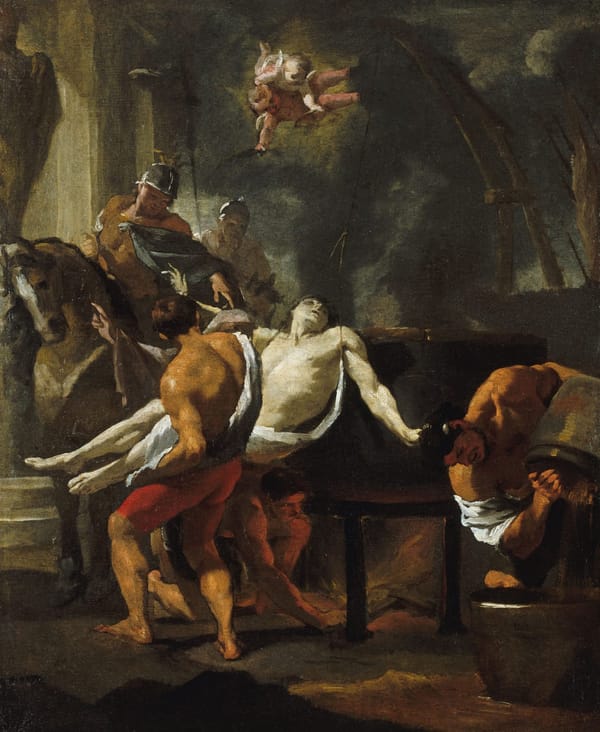
May 6: St. John before the Latin Gate
THE beloved Disciple John, whom we saw standing near the crib of the Babe of Bethlehem, comes before us again to-day; and this time he pays his delighted homage to the glorious Conqueror of death and hell. Like Philip and James, he is clad in the scarlet robe of martyrdom. The month of May, so rich in Saints, was to be graced with the palm of St John.
Salome one day presented her two sons to Jesus, and with a mother’s ambition asked him to grant them the highest places in his kingdom. The Saviour, in his reply, spoke of the chalice which he himself had to drink, and foretold that these two disciples would also drink of it. The elder, James the Great, was the first to give his Master this proof of his love; we shall celebrate his victory when the sun is in Leo: it was to-day that John, the younger brother, offered his life in testimony of Jesus’ divinity.
But the martyrdom of such an Apostle called for a scene worthy the event. Asia Minor, which his zeal had evangelized, was not a sufficiently glorious land for such a combat. Rome, whither Peter had transferred his Chair and where he died on his cross, and where Paul had bowed down his venerable head beneath the sword, Rome alone deserved the honour of seeing the beloved disciple march on to martyrdom, with that dignity and sweetness which are the characteristics of this veteran of the Apostolic College.
Domitian was then Emperor—a tyrant over Rome and the world. Whether it were that John undertook this journey of his own free choice, and from a wish to visit the Mother Church, or that he was led thither bound with chains, in obedience to an imperial edict—John, the august founder of the seven Churches of Asia Minor, appeared before the tribunal of pagan Rome. He was convicted of having propagated, in a vast province of the Empire, the worship of a Jew who had been crucified under Pontius Pilate. He was a superstitious and rebellious old man, and it was time to rid Asia of his presence. He was therefore sentenced to an ignominious and cruel death. He had somehow escaped Nero’s power: but he should not elude the vengeance of Caesar Domitian!
A huge cauldron of boiling oil is prepared in front of the Latin Gate. The sentence orders that the preacher of Christ be plunged into this bath. The hour is come for the second son of Salome to partake of his Master’s chalice. John’s heart leaps with joy at the thought that he—the most dear to Jesus, and yet the only Apostle that has not suffered death for him—is at last permitted to give him this earnest of his love. After cruelly scourging him, the executioners seize the old man, and throw him into the cauldron; but, lo! the boiling liquid has lost all its heat; the Apostle feels no scalding; on the contrary, when they take him out again he feels all the vigour of his youthful years restored to him. The Praetor’s cruelty is foiled, and John, a martyr in desire, is to be left to the Church for some few years longer. An imperial decree banishes him to the niggled Isle of Patmos, where God reveals to him the future of the Church, even to the end of time.
The Church of Rome, which counts among her most glorious memories the abode and martyrdom of St John, has marked with a Basilica the spot where the Apostle bore his noble testimony to the Christian faith. This Basilica stands near the Latin Gate, and gives a title to one of the Cardinals.
In honour of the great Apostle of love, we give the following Sequence, composed by Adam of Saint-Victor:
Sequence
Summum regem gloriæ
Videns mentis acie
Non repulsa,
Angelis parificat,
Spiritu qui indicat
Cœli summa.
Hic est potus recumbentis
Supra pectus Domini;
Hic expugnat vires ignis
Et ferventis olei.
Tormenti sævitia,
Quod martyr quis fiat
Et pœnas non sentiat.
O custos Virginis
Per quam mundo gloria,
Ex quo sunt, in quo sunt,
Per quem sunt omnia,
Per te det suffragia!
Christum, a quo diligeris,
Interpellans et exorans,
Nos ei concilia.
Tu qui collis, due ad montem;
Præsta Sponsum ad videndum,
Virgo totus gratia.
where the King of glory
is seen by the soul's
unfettered gaze,
and equality with the angels, to
John, whose revelations have made known
to men the mysteries of heaven.
that spring up to life eternal,
when he leaned on his Lord's breast.
have made him shine as a bright light in the Church.
He quenched the heat of the boiling oil.
for him are cruel beyond measure;
yet do they wonder within themselves,
how a man can be a martyr and feel no pain.
O guardian of the Virgin
by whom the world received him
who is its glory!
pray for us to Jesus, from whom, and in whom,
and by whom are all things.
by thine intercession and prayers,
render Jesus, by whom thou wast loved,
propitious unto us.
O thou that art a hill, lead us to the mountain!
O thou whom grace made wholly pure,
pray for us that we may see the Beloved.
We are delighted to meet thee again, dear disciple of our Risen Jesus! The first time we saw thee was at Bethlehem, where thou wast standing near the Expected of Nations, the promised Saviour, who was sweetly sleeping in his crib. We then thought of all thy glorious titles: Apostle, Evangelist, Prophet, highsoaring Eagle, Virgin, Doctor of charity, and above all, Jesus' Beloved Disciple. To-day we greet thee as martyr; for if the ardour of thy love quenched the fire prepared for thy torture, thy devotion to Christ had honestly and willingly accepted the chalice of which he spoke to thee in thy younger years. During these days of Paschal Time, which are passing so rapidly, we behold thee ever close to this divine Master, who treats thee with every mark of affection. Who could be surprised at his special love for thee? Wast thou not the only one of all the disciples who stood at the foot of the Cross? Was it not to thee that he gave the care of his Mother, making her thine? Wast thou not present when his Heart was opened on the Cross by a spear? When, on the morning of the great Sunday, thou didst repair with Peter to the Tomb, wast thou not, by thy faith, the first of all the disciples to honour Jesus' Resurrection? Oh, yes! thou hast a right to all the special love wherewith Jesus treats thee; but pray to him for us, O blessed Apostle!
We ought to love him for all the favours he has bestowed upon us; and yet we are tepid in his love—we humbly confess it. Thou hast taught us to know the infant Jesus, thou hast described to us the crucified Jesus; show us now the Risen Jesus, that we may keep close to him during these last few days of his sojourn on earth. And when he has ascended into heaven, procure us brave hearts, that like thee we may be prepared to drink the chalice of trials which he has destined for us.
Rome was the scene of thy glorious confession, O holy Apostle! She is most dear to thee; join, then, with Peter and Paul in protecting her. If the palm of martyrdom be in thy hand as well as the pen of the Evangelist, remember it was at the Latin Gate that thou didst obtain it. It was in the East that thou didst pass the greater part of thy life; but the West claims the honour of counting thee as one of her grandest martyrs. Bless our Churches, reanimate our faith, rekindle our love, and deliver us from the Antichrists against whom thou didst warn the faithful of thine own times, and who are causing such ravages among us. Adopted son of Mary! thou art now enjoying the sight of thy Mother's glory: present to her the prayers we are offering to her during this month, which is consecrated to her, and obtain for us the petitions which we presume to make to her.
Thursday of the Fifth Week after Easter
BY the first four sacraments, our Saviour provided for the several spiritual necessities of man during this mortal life. Baptism gives him spiritual birth, Confirmation arms him for the battle, the Eucharist is his food, Penance is his cure. But the last moment of life—that most important and terrible of all, on which depends eternity—does it not seem to require a special sacramental aid? Could it be that our Redeemer, after so lovingly supplying us with a sacrament to meet our other wants, would leave us unprovided when we are dying, that is, when we are passing from this to another life, and are weighed down with bodily and mental sufferings? No: he has provided a sacrament for the dying; the grace of redemption puts on a new form, that it may visit and fortify us in our last struggle.
Even before his Passion, he gave us some idea of the sacrament he intended to institute for the help of the dying. When he sent his disciples before him, that they might prepare the people for his preaching, he commanded them to anoint the sick with oil: they did so, and the result was the cure of them that were thus anointed.1 But after his Resurrection, when our Redeemer was preparing the dowry of his Church, he gave her a sacrament wherewith this Mother was to administer special grace and consolation to her children when in danger of death.
Oil is the symbol of strength; hence, the wrestlers of old used it as a means for acquiring activity and nerve. Our Saviour chose it as the matter of the sacrament of confirmation, whereby our souls, after being regenerated by baptism, are strengthened for their future combats. The hour of death is a combat, but one so terrible that it stands apart by itself. It is then that Satan, seeing how the long-coveted prey is soon to be beyond his reach, redoubles his efforts to make it his own for ever. The dying Christian, standing as he does on the brink of eternity, is exposed to two temptations: presumption and despair. In a few moments he will be before the Judge, whose sentence is irrevocable. The remnants of sin are still upon him, and clog his soul. How will he comport himself in that last combat, on which depends the final success of all the previous ones of his life? Is not this an occasion for a special sacrament, whereby our Jesus may provide his combatant with the help so urgently needed? Yes; and here again it is oil. The first anointing was that of confirmation, and it gave strength; and the last, or as it is called, extreme unction, is equally rich in power: it is the last application made to mankind of the Redeemer’s blood,’which flows in such abundance with this holy oil.’2
Let us consider the effects of extreme unction, of which the Apostle St James speaks to us in his Epistle. What he there tells us, he had received from Jesus’ own lips. First of all, this sacrament brings forgiveness of sins;3 forgiveness of those sins which the conscience, however diligent it may have been in its examination, had overlooked; but which, nevertheless, injure the soul: and forgiveness of those remnants of sin, which continue after the guilt of sin has been remitted; like wounds which, though cured, are not quite closed, and keep the patient weak. The holy oil anoints each of the senses; each has been the source of sin; each now receives its special purification. These doors, which up to this moment had been open to the world, are now closed; so that the soul can be all intent upon eternal things. Let the enemy come now, if he will; his attacks can do no harm. He expected to find his adversary the poor earthly-minded creature of old, on whom he had inflicted hundreds of wounds; but lo! he finds a soldier of Christ, vigorous and brave. It is extreme unction that has worked the change.
But the effects of this sacrament do not stop here. Though primarily instituted for imparting strength to the soul, yet it has the power of restoring health to the body too. We learn this from the Apostle St James. His words are these: Is any man sick among you? Let him bring in the priests of the Church, and let them pray over him, anointing him with oil in the name of the Lord. And the prayer of faith shall save the sick man, and the Lord shall raise him up.4 The sacred formula, which accompanies each anointing in this sacrament, has therefore the power of restoring bodily health, at the same time that it drives away the remnants of sin, which is the chief cause of all man's miseries, whether of soul or body. Such is the interpretation put by the Church on the words of St James; and we have continual proofs that our divine Master has not forgotten the promise of twofold efficacy which he gave to this sacrament. Hence it is, that after having anointed the several senses of the sick person, the priest addresses God in earnest prayer, that he would restore strength of body to him or her whose soul has received the efficacy of the heavenly remedy. Nay, the Church looks upon the restoration to bodily health as so truly a sacramental effect of extreme unction, that she does not consider as miracles, properly so called, the cures produced by its administration.
Let us, then, offer to the conqueror of death the homage of our thanks for this fresh proof of his compassionate love. He would himself experience all our miseries, not excepting even death or the agony that precedes it. When on his Cross, and enduring every anguish, as though he were a poor dying sinner, and not the Saint of saints, he thought of our deaths, and mercifully blessed our last agony with an outpouring of his precious Blood. This was the origin of the beautiful sacrament of extreme unction, which he gave to his Church, after his Resurrection, and for which we offer him to-day our humble thanks.
The following hymn—composed by St Ambrose, and used during Paschal Time in the Church of Milan—celebrates with the Saint's characteristic vigour of style the thoroughness of the salvation wrought by the Death of Christ, as was made evident in the conversion of the Good Thief.
Hymn
Sanctus sereno lumine,
Quo diluit sanguis sacer
Probrosa mundi crimina.
Cæcosque visu illuminans:
Quem non gravi solvet metu
Latronis absolutio?
Jesum brevi acquirit fide,
Justusque praevio gradu
Pervenit in regnum Dei.
Pænam videntes corporis,
Christoque adhaerentem reum
Vitam beatam carpere.
Ut abluat mundi luem,
Peccata tollit omnium,
Camis vitia mundans caro.
Ut culpa quærat gratiam,
Metumque solvat charitas,
Reddatque mors vitam novam?
Suisque se nodis liget:
Moriatur vita omnium,
Resurgat ut vita omnium.
Omnes resurgunt mortui:
Consumpta mors ictu suo
Perisse se solam gemit.
Qui surrexisti a mortuis,
Cum Patre et Sancto Spiritu,
In sempiterna sæcula.
holy with its unclouded light,
whereon the sacred Blood washed away
the world’s infamous crimes.
it gives sight to the blind.
Oh! who would not cease to despair at the thought
of the pardon granted to the Thief?
he gained Jesus by a brief act of faith;
and, being justified, was the first
to enter into the kingdom of God.
they behold the criminal suffering bodily tortures,
yet united with Christ, and culling
the flower of life everlasting.
Jesus takes upon himself the sins of the world,
that he may cleanse it from its filth:
Flesh washes away the sins of flesh.
—sin seeking for grace,
love expelling fear,
and death giving a new life.
let him be caught in his own net!
Let him but die, who is the Life of all,
and all will rise to life.
and all the dead rise again to life:
death’s blow falls on himself,
and none die but he.
who didst rise again from the dead!
and to the Father, and to the Holy Ghost,
for everlasting ages.
| Previous Wednesday of the Fifth Week after Easter | Next Thursday of the Fifth Week after Easter |