Daily reading
Paschal Time
Double · May 7 · Sanctoral
May 7, 2021
From Dom Guéranger’s The Liturgical Year.
A Double leads the weekday.Rubric
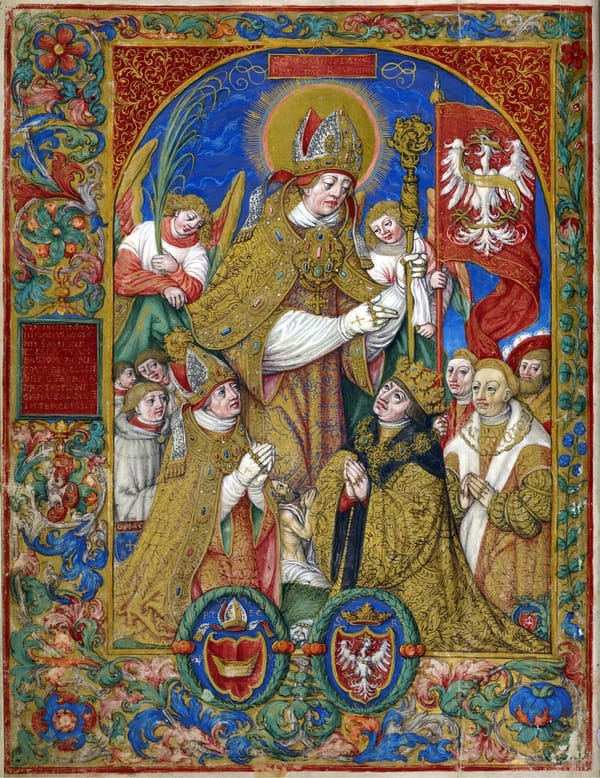 |
May 7: St. Stanislaus, Bishop and Martyr
THE eleventh century, the century of contest between the priests of the Church and Barbarism, gives to-day another martyr to our Risen Jesus. It is Stanislaus, beloved by noble Poland as one of her chief protectors. He was slain at the altar by a Christian prince whom he had reproved for his crimes. The blood of the courageous Pontiff was mingled with that of our Redeemer in the same sacrifice. What an invincible energy there is in these lambs whom Jesus has sent amidst the wolves!1 They seem to be straightway changed into lions, as Jesus himself was at his Resurrection. There is not a century that has not had its martyrs: some for the faith, others for the unity of the Church, others for her liberty, others for justice, others for charity, and others, like our great Saint of to-day, for the maintenance of morals. The nineteenth century, too, has had its martyrs; scarcely a year elapses without our hearing of some who have been added to the bright list in the far East. At the commencement of the eighteenth century there was little probability of its providing such an abundant harvest of martyrdom as it did. Of one thing we are quite sure: whatever persecutions may arise in the future, the Spirit of fortitude will not be wanting to the champions of truth. Martyrdom is one of the Church's characteristics and it has never failed her. The Apostles who are very close to Jesus during these days preceding his Ascension drank the chalice which he drank; and only yesterday we were honouring the martyrdom of the favourite disciple—yes, even he had to tread the path prepared for all.
Holy Church tells us, in the account we now subjoin, how the saintly bishop of Cracow was offered the glorious chalice, and how courageously he accepted it.
Thou wast powerful in word and work, O Stanislaus! and our Lord rewarded thee with a martyr’s crown. From thy throne of glory, cast a look of pity upon us; obtain for us from God that gift of fortitude which was so prominent in thee, and which we so much need in order to surmount the obstacles which impede our progress. Our Risen Lord must have no cowards among his soldiers. He took by assault the kingdom into which he is about to enter; and he tells us plainly that if we would follow him thither, we must prepare to use violence.2 Brave soldier of the living God! obtain for us brave hearts. We need them for our combat—whether that be one of open violence for the faith or unity of the Church, or one which is to be fought with the invisible enemies of our salvation. Thou wast indeed a good shepherd, for the presence of the world neither made thee flee nor fear; ask our heavenly Father to send us shepherds like thee. Succour Holy Church, for she has to contend with enemies in every part of the world. Convert her persecutors, as thou didst convert Boleslaus; he was thy murderer, but thy martyrdom won mercy for him. Remember thy dear Poland, which honours thee with such fervent devotion. Be with her now that she has regained her rank among nations. During the severe triads which her sins drew down upon her, she maintained the sacred link of Catholic Faith and unity; she was patient and faithful; our Risen Jesus has had pity on her, and rewarded her patience and fidelity by granting her a share in his own Resurrection.
Friday of the Fifth Week after Easter
WE have reverently followed our Redeemer in his institution of the sacramental helps, whereby man is placed and kept in the state of sanctifying grace, from his first entrance into this life to his leaving it for the eternal enjoyment of the beatific vision. We must now speak of that sublime sacrament, which was instituted by Jesus as the source whence mankind is to receive the other sacraments.
This sacrament is Holy Orders, and it is so called because of its being conferred in several distinct degrees upon those who receive it. As in heaven the angels are arranged in different ranks according as they have been endowed with a greater or less degree of light and power, in such wise that they who are higher act upon those that are lower; so it is in the sacrament of Holy Orders; there is order in the several ranks, and the higher act upon the lower by the communication of light and power. It is this that constitutes the hierarchy of the Church. Hierarchy means Sacred Government. It comprises three degrees: the episcopate, priesthood, and diaconate, in which last are included the Orders below it. This is called the hierarchy of Order, to distinguish it from the hierarchy of Jurisdiction. This second, which is entrusted with the government of the Church, is composed of the Pope, of the bishops, and of the inferior clergy to whom the Pope and bishops delegate a part of their power of government. We have already seen how this hierarchy takes its origin from that sovereign act whereby our Lord Jesus, the shepherd of men, gave to Peter the keys of the kingdom of God. The hierarchy of Order is intimately connected with the second, and its object is the sanctification of men by the administration of the treasures of grace confided to its keeping.
As we have already said, Jesus appeared to his Apostles on the day of his Resurrection, and said to them: As the Father hath sent me, I also send you.1 Now the Father sent his Son that he might be the Shepherd of men; and we have heard Jesus bidding Peter to feed his lambs and his sheep. The Father sent his Son that he might be the Teacher of men; and we have seen Jesus entrusting to his Apostles the truths which were to be proposed to us as the object of our faith. But the Father sent the Son that he might also be the High Priest of men; Jesus must, therefore, leave this same priesthood on earth, that it may be continued among us to the end of time. Now what is a priest? He is the mediator between heaven and earth; he reconciles man to his God, by offering a sacrifice that gives infinite honour to God and atones for man's sin; he cleanses the sinner's conscience, and makes him a just man; he, in a word, unites man to his God by the mysteries of which he is the dispenser.
Jesus exercised all these functions of a priest agreeably to the mission given him by the Father; but the Father would have them to be continued, even after his Son should have ascended into heaven. For this it was necessary that Jesus should communicate his priestly character, by a special sacrament, to a few chosen men, just as by baptism he conferred upon all his faithful the dignity of being his members. Here again, it will be the Holy Ghost that will act, in each stage or degree of the sacrament. It was by his divine operation that the Incarnate Word entered into Mary's womb; it is his action that will imprint on the souls of them that are presented the priestly character of this same Jesus our Lord. Hence, after using the words just cited, Jesus breathed on his Apostles, and said to them: Receive ye the Holy Ghost! hereby showing that it is by a special infusion of him who is the Spirit of the Father and the Son, that men are fitted for being sent by the Son, as the Son was sent by the Father.
And yet the Apostles and their successors are to confer this sacrament, not by a breath—that is the prerogative of the Word, the author of life—but by the imposition of hands. It is at the solemn moment of the imposition of the bishop's hands over them who are to be ordained, that the Holy Ghost comes down upon them. Thus will be transmitted the heavenly gift from generation to generation. It will be conferred in its several degrees, according to the will of the hierarch, by and with whom the Holy Ghost acts. So that when Jesus comes on the last day to judge the world, he will find on earth the sacred character which he conferred upon his Apostles when he gave them the Holy Ghost.
Let us attentively and devoutly contemplate the mystic ladder of the hierarchy, established by our Jesus, whereby we might ascend to heaven. At the very summit is the bishop, having in himself the plenitude of Holy Orders and the power to produce other pontiffs, and priests, and deacons. He has the power of offering up the Holy Sacrifice; he holds the keys whereof our Lord speaks, when he says: Whatsoever ye shall bind upon earth, shall be bound also in heaven; and whatsoever ye shall loose upon earth, shall be loosed also in heaven;2 he can administer all the sacraments; the consecration of the Chrism and Holy Oils belongs to his office; he can not only bless, he can also consecrate.
Next comes the priest, who truly looks upon the bishop as his spiritual father, seeing that it was by the imposition of the bishop’s hands that he received the dignity and character of priesthood. The priest, however, does not possess the plenitude of Jesus’ priesthood. His hands, though most holy, have not the power to produce other priests; he blesses, but he does not consecrate;3 he must look to the bishop for holy Chrism, for he himself cannot make it. Notwithstanding this, his dignity is great, for he has power to offer the Holy Sacrifice, and his offering is the same as that of the bishop. He forgives the sins of those whom the bishop has put under his care. The solemn administration of baptism is entrusted to him, when the bishop himself does not perform it: and as to extreme unction, it is essentially a priest’s function.
The next lower order is that of deacon, who is, as the Greek name implies, the servant of the priest. Not having the priesthood, he cannot offer sacrifice, nor remit sins, nor give extreme unction to the dying: but he assists and serves the priest at the Altar, and stands by his side during the solemn moment of consecration. He reads the holy Gospel, from the ambo, to the people. The Blessed Sacrament is entrusted to his care, and, failing a priest, he is allowed to distribute it to the faithful. In similar circumstances, he could solemnly administer baptism. He has also the power of preaching the word of God to the people.
These are the three degrees of the hierarchy of Order. They correspond, as the great St Denis teaches, with the three degrees whereby man attains to union with God: namely, purification, illumination, and perfection. The deacon prepares the catechumen and the sinner, by instructing them in the word of God, which will purify their minds from error, and incite them to the repentance of their sins and to a desire of being freed from them. The priest enlightens these same by the illumination of holy baptism, by the remission of their sins, and by admitting them to partake of the Body and Blood of Christ. The bishop pours out upon them the gifts of the Holy Ghost, and raises them, by their seeing his own supereminent prerogatives, to union with Christ. Such is the sacrament of Holy Orders. It is the essential means established for the salvation of mankind, the channel through which God has ordained that the infinite graces of the Incarnation should flow upon the earth, and the medium whereby is perpetuated among us the presence and action of our Redeemer.
Let us give thanks to our Jesus for this unspeakable blessing. Let us honour the priesthood of the New Law; it is Jesus who inaugurated it in his own person, and who afterwards entrusted it to men, chosen by him for continuing the mission given to him by his Father. The sacraments are the true life of the world; but who are the ministers of these sacraments? The priests of the Church. Let us pray for those who are in Holy Orders; for their responsibilities are great, their dignity is divine, and yet they themselves are but men. They are not a tribe or a caste, as were the priests in the Old Law; but they are taken from every race and family. Finally, a priest, though inferior to the angels by nature, is, by the office he holds, superior to these blessed spirits.
Let us celebrate, to-day, the Resurrection of our eternal High Priest, by this joyous canticle of the ancient Missal of Liége:
Sequence
Quibus e terris
Nuncias gaudia,
Visitans patriam.
Dulci voce dixit: Alleluia.
Pia miracula.
Cecinit voce laudanda.
Volucris vacuas
Redii famulis,
Et novam regnare gratiam.
Christus hodie redemit nos a morte dira.
Ut interimerent pro salute nostra.
Ut nos redimeret morte ab aeterna.
Et frui vita perpetua.
Celebri laude sanctum Pascha.
from what land comest thou,
to the whole world.
more our country?
and sweet voice, saying: ‘Alleluia!
dear prodigies wrought by Christ:
that the Lord hath risen from the tomb.
and joyfully sped my way through the thin air:
servants of God!
and the New Law of grace hath begun its reign.’
‘This day hath Christ delivered us from cruel death.
that they might slay him for the sake of our salvation.
that he might redeem us from eternal death.’
and enjoy never-ending life.
the praise of this holy Pasch.
| Previous Thursday of the Fifth Week after Easter | Next Friday of the Fifth Week after Easter |