Daily reading
Paschal Time
Greater Double · May 8 · Sanctoral
May 8, 2021
From Dom Guéranger’s The Liturgical Year.
A Greater Double leads the weekday.Rubric

|
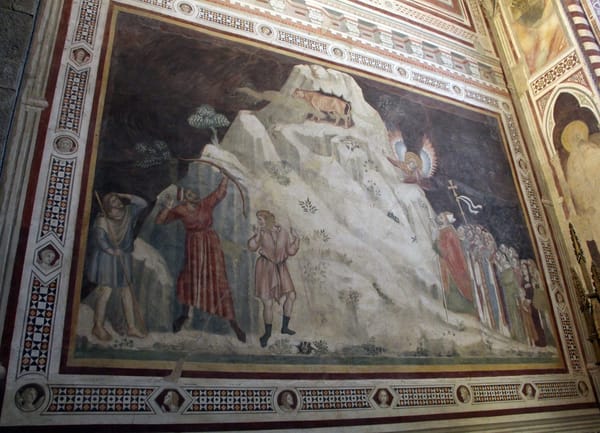
May 8: The Apparition of St. Michael the Archangel
DAVID foretold that Emmanuel's entrance into this world would be greeted by the angels and that they would humbly adore him on his first appearance among us.1 We saw this prophecy fulfilled on the ever blessed night when Mary brought forth the Fruit of her womb. The angelic choir sang one of their heavenly hymns, which led the shepherds to the stable; we blended our songs with theirs in homage to our infant God. The Resurrection of our Emmanuel was sure to be honoured by the presence of these blessed spirits, who had witnessed with amazement and trembling the humiliations and cruelties of his Passion. The moment he passed through the barrier that imprisoned him in his sepulchre, an angel, with a face bright as the sun, and garments white as snow, came and rolled back the stone, and proclaimed to the holy women that he whom they were seeking had risen. When they entered the cave of the sepulchre, two other angels, clad in white robes, appeared to them, and repeated the tidings of Jesus' triumph.
Let us reverently honour these princely heralds of our deliverance, and consider with what respect they cluster round Jesus their King and God during the forty days after his Resurrection. They adore this glorified humanity, which they are soon to see raised up to the highest heavens and enthroned at the Father's right hand. They rejoice with us in the happiness given by this Paschal feast, which restores immortality to us in the person of our Risen Saviour; and thus, as St Gregory told us a few days back, ‘it is the feast of the angels, because, by recalling us to heaven, it fills up their number,’2 It was but right, therefore, that one day in Paschal Time should be devoted to honouring the angelic spirits. On the day previous to the Annunciation we kept the Feast of St Gabriel, our Lady's honoured messenger; to-day it is St Michael, the Archangel and prince of the heavenly host, who is to receive our love and praise. He himself selected this day, by appearing on it and leaving us a pledge of his presence and protection.
The very name of Michael urges us to honour this glorious spirit; it is a cry of enthusiasm and fidelity, for it signifies: ‘Who is like unto God?’ Satan trembles at hearing this name, for it reminds him of the noble protest wherewith the bright Archangel answered the call of the rebel angels. Michael proved his strength and prowess when he fought the great battle in heaven. On that account, he was made the guardian and protector of God's people; first of the Jews, and afterwards of the Christian Church, for the Synagogue has forfeited all her honours. Michael now watches over Jesus' Spouse, our mother; he supports her in her trials and she wins no triumph in which he has not had some part.
But we are not to suppose that the holy Archangel is so engaged in attending to the general interests of Christ's kingdom on earth that he cannot listen to the prayers of each individual member of the Church. God has given him a compassionate love for men; and there is not a single soul that escapes his notice. He wields the sword in defence of the Spouse of Christ; he wars with the dragon, who is ever lying in wait for the Woman and her Child;3 but, at the same time, he is attentive to each one of us; for fter having confessed our sins to Almighty God, and to the Blessed Mary ever a Virgin, we acknowledge them likewise to Blessed Michael the Archangel and beseech him to pray for us to the Lord our God.
He assists at every death-bed, for his special office is to receive the souls of the elect on their quitting the flesh. With loving solicitude and princely bearing, he presents them to the Light Eternal and introduces them into the House of God’s glory. It is Holy Church herself that tells us, in the words of her Liturgy, of these prerogatives of the great Archangel. She teaches us that he has been set over Paradise, and that God has given him the charge of leading to heaven the souls of them that are to be received there. On the last day, when our Risen Jesus is to appear on the clouds of heaven to judge mankind, all of whom will then have resumed their bodies in the general resurrection, Michael with the rest of the angels will have to fulfil a ministry of awful import—that of separating the good from the bad. Our Catholic forefathers, in the Middle Ages, were fond of representing the holy Archangel engaged in this dread function, standing at the foot of Jesus’ judgement-seat, and holding a scale, in which he is weighing the souls of men and their works.
Devotion to St Michael was sure to spread through the Church, especially after the worship of idols had been banished from the various countries, and men were no longer tempted to give divine honour to creatures. Constantine built a celebrated Church called Michaelion in honour of the great Archangel, and at the time when Constantinople fell under the power of the Turks, there were no fewer than fifteen churches bearing the name of Saint Michael, either in the city or the suburbs. In other parts of Christendom this devotion took root only by degrees; and it was through apparitions of the holy Archangel that the faithful were prompted to have recourse to him. These apparitions were local and for reasons which to us might seem of secondary importance: but God, who from little causes produces great effects, made use of them whereby to excite Christians to have confidence in their heavenly protector. The Greeks celebrate the apparition that took place at Chone, the ancient Colosse in Phrygia. There was in that city a Church dedicated to St Michael, and it was frequently visited by a holy man named Archippus, who was violently persecuted by the pagans. One day, when Archippus was at his devotions in his favourite St Michael's, his enemies resolved to destroy both him and the Church. Hard by ran a brook which flowed into the river Lycus; they turned it aside and flooded the ground on which the church stood. Suddenly there appeared the Archangel St Michael holding a rod in his hand: the water immediately receded, and flowed into a deep gulf near Colosse, where the Lycus empties itself and disappears. The date of this apparition is not certain, but it occurred at the period when the pagans were numerous enough in Colosse to harass the Christians.
Another apparition, which encouraged devotion to St Michael in Italy, took place on Mount Gargano, in Apulia; it is the one honoured by to-day's feast. A third happened on Mount Tomba, on the coast of Normandy: we shall commemorate it on October 16.
The feast we are keeping to-day is not so solemn as the one of September 29; it is, however, more exclusively in honour of St Michael, inasmuch as the autumn feast includes all the choirs of the angelic hierarchy. The Roman Breviary gives us the following account of the apparition on Mount Gargano:
Holy Church tells us of the glories of St Michael in several portions of the Liturgy; but particularly in the following Responsory and Antiphons, taken from to-day's Office:
The first of the following hymns is used by the Church in the Vespers of the Feasts of St Michael. The second is taken from the Lauds. They speak the praises, not only of our great Archangel, but likewise of St Gabriel, St Raphael, and of all the blessed spirits in general. The Church has not instituted a feast for the collective celebration of the nine choirs of Blessed Spirits, but she includes all the members of the angelic host in her tribute of honour on the Feasts of St Michael.
First Hymn
Te vita, Jesu, cordium,
Ab ore qui pendent tuo
Laudamus inter Angelos.
Ducum corona militat:
Sed explicat victor crucem
Michael salutis signifer.
In ima pellit tartara,
Ducemque cum rebellibus
Coelesti ab arce fulminat.
Sequamur hunc nos principem,
Ut detur ex Agni throno
Nobis corona gloriæ.
Qui, quos redemit Filius,
Et sanctus unxit Spiritus,
Per Angelos custodiat.
who obey thee, we praise thee,
O Jesus, thou brightness and power of the Father,
thou life of our hearts!
this army of a thousand thousand princes,
at whose head is Michael, the Conqueror,
the standardbearer of salvation, who unfurls the Cross.
the cruel dragon into the depths of hell,
and drove the rebels, with their chief,
from the heavenly city.
that we may deserve to receive,
from the throne of the Lamb,
a crown of glory.
who, by means of the angels,
guards those whom the Son hath redeemed
and the Holy Spirit anointed.
Second Hymn
Gentis humanæ sator et redemptor,
Cœlitum nobis tribuas beatas
Scandere sedes.
Cœlitus nostras veniat; serenæ
Auctor ut pacis lacrymosa in orcum
Bella releget.
Pellat antiquos, et amica cœlo
Quæ triumphator statuit per orbem,
Templa revisat.
Adsit e cœlo Raphael, utomnes
Sanet ægrotos, dubiosque vitæ
Dirigat actus.
Et sacer nobis chorus Angelorum
Semper assistat, simul et micantis
Regia cœli.
Patris, ac Nati, pariterque Sancti
Spiritus, cujus resonat per omnem
Gloria mundum.
the Creator and Redeemer of mankind!
grant that we may ascend to the happy thrones
of the heavenly citizens.
come from heaven into this our temple,
bring us sweet peace,
and drive dismal war back again to hell.
come and rout our ancient foe;
may he often visit the heaven-loved temples
which the triumphant Jesus has placed throughout the world.
descend and visit us,
that he may heal all that are infirm
and direct our faltering steps in the path of life.
may the holy choir of angels;
may the bright court of heaven
ever assist and protect us.
Father, Son, and Holy
Ghost, whose glory is proclaimed through the whole world,
grant us this our prayer.
The following sequence is from the collection of the Monastery of Saint-Gall, and was composed by the monk Notker in the eleventh century:
Sequence
Rex cœlice, laudes Cuncta
Pangat jam canora
Caterva symphonia
Odas, atque solvat
Concio tibi nostra.
Michaelis inclyta valde festa,
Per quæ lætabunda
Perornatur machina Mundi tota.
Spirituum sunt agmina
Per te facta.
Facis hæc flammea
Per angelicas Officinas.
Sed cum simus nos ultima Factura,
Sed imago tua.
Nobis hæc ter tripartita
Per privata officia.
Phalanx et archangelica,
Principans turma.
Ac Potestas almiphona,
Dominantia numina,
Divinaque subsellia,
Cherubim ætherea,
Ac Seraphim ignicoma.
Vera dans Verbi nuntia, Atque Raphael,
Vitæ vernula, Transferte nos inter Paradisicolas.
Complentur mandata,
Quæ dat ejusdem Sophia,
Compar quoque Pneuma,
Una permanens in usia,
Cui estis administrantia Deo millia
Millium sacra.
Bis atque quingenta vestra
Centena millena
Assistunt in aula,
Ad quam Rex ovem centesimam verbigena,
Drachmamque decimam Vestra
Duxit ad agalmata.
Nos per rura terrea, pars electa,
Harmonica vota damus hinc
Per lyricas citharas.
Nostra Deo sint accepta auream super aram
Thymiamata, quo in coeva jam gloria
Condecantemus Alleluia.
may our whole assembly and choir
now sound forth
its instruments of sweet music
and sing hymns
in thy praise.
of Michael's most glorious feast,
which fills the whole earth
with great joy.
created by thee,
into nine choirs;
when thou wiliest
to seek their ministry.
whereas we are thy last,
but made after thine image.
according to their special offices,
reveals to us the mysterious design of God.
then the phalanx of Archangels;
then the host of the Principalities.
the sweet-sounding Powers,
The spiritual Dominations,
the divine Thrones,
the ethereal Cherubim,
the burning Seraphim.
messenger of the Incarnate Word! Raphael,
our guide through life! lead us to the company of the citizens of Paradise.
all the commands of the Father,
the Son who is his Wisdom,
and the co-equal Spirit,
the Three, One in essence,
the God before whom ye stand thousands
of thousands in number, as ministering spirits.
times a hundred thousand;
and hither did the King,
the Father of the Word,
bring the hundredth sheep,
and the tenth groat,
that they might share in your bliss.
and we the elect flock on earth,
give forth our tuneful praise
on sweetsounding harps.
when set on the golden altar, be acceptable to God;
Thus, when united in the same eternal glory,
may we sing together our Alleluia!
How beautiful art thou, O Michael. in thy heavenly armour, giving glory to the God whose enemy thou hadst overcome! Thine humble and fervent gaze is fixed on the throne of Jehovah, whose rights thou didst defend, and who gave thee the victory. Thy sublime cry: ‘Who is like unto God?’ roused the faithful legions and became thy name and thy crown. It will remind us for all eternity of thy fidelity to our Creator and thy triumph over the dragon. Meanwhile, we enjoy thy loving protection; we are thy happy clients.
Guardian angel of Holy·Church! now is the time for thee to exert all the might of thine arm. Satan is furious in his efforts against the noble Spouse of thy Master; brandish thy bright sword, and give battle to this implacable enemy. The kingdom of Christ is shaken to its very foundations. Is it that the reign of the Man of Sin is about to be proclaimed on the earth? Are we near that last day when, this guilty world is to be destroyed by fire, and thou art to exercise, in the name of the Sovereign Judge, the terrible office of separating the goats from the sheep? If this earth is still to exist; if the mission of the Church is not yet completed; is it not time for thee, O Michael! to show the dragon of hell that he may not, with impunity, insult on this earth the God who created it, who redeemed it, and whose name is King of kings and Lord of lords? The forces of error and crime are unceasingly dragging the world to the brink of the precipice; save it, O glorious Archangel, by confounding the dark plots which are laid for its destruction!
Thou, O Michael, art the protector of our souls in their passage from time to eternity. During this present life thine eye is upon our wants, and thine ear open to our prayers. Though awed by the brightness of thy glory, we love thee, dear prince of heaven! and we live happy and contented beneath the shadow of thy wings. In a few days, or at most years, our holy Mother the Church will be performing her last sacred rites over our lifeless remains; she will pray for us to our heavenly Father, that we may be delivered from the lion's mouth, and that the standard-bearer, St Michael, may bring us into the holy light.4 Watch over us now, O holy Archangel, lest we should then not deserve thy protection. The dragon is ever threatening us; he makes no secret of his wish to devour us. Teach us, O Michael, to repeat thy beautiful words: ' Who is like unto God?’ God’s honour, the rights he has over us, our obligation to be faithful to him, and serve him, and confess him as our Lord in all times and places—yes! these thoughts must be our shield in danger, and the armour wherewith we must fight, like thee, and win the battle. But we need the sturdy courage which resulted from the love thou hadst within thee. Oh! pray for us, that we, too, may love our common Lord and Master; then shall we be invincible. Satan cannot make head against a creature that is filled with the love of the great God.
God created thee, O Michael! and thou lovest him as thy Creator; but he has not only created us, he has redeemed us, yea, and at the price of his own Blood! What, then, should be the intensity of our love for him! Strengthen this love in our hearts; and since we are fighting under thy leadership, guide us, inspirit us; let thy look give us courage; ward off from us the blows of the enemy’s sword. We venture to hope that thou wilt be present at our last moments, O standard-bearer of our salvation! In return for our tender devotion towards thee, deign to keep guard round our deathbed, cover it with thy shield. If the dragon see the flash of thy sword, he will not dare to come near us. May our soul, on leaving the body, throw herself with affection into thine arms! Cast her not from thee, O holy Archangel, when she seeks to cling to thee; carry her to the judgement-seat, cover her beneath thy wings, calm her fears; and may the Lord, thy Master, bid thee bear her speedily to the kingdom of eternal bliss!
Saturday of the Fifth Week after Easter
ON this day, which is sacred to Mary, let us open the holy Gospel according to St John. There, in the second chapter, we find these words: There was a marriage in Cana of Galilee, and the Mother of Jesus was there.1 The sacred text goes on to say that Jesus also and his disciples were among the guests; but the Holy Spirit, who guided the Evangelist's hand, would have him first make mention of Mary. It was to teach us that this our blessed Mother extends her protection to those who enter upon the married life with worthy dispositions, that is, with such dispositions as to draw down upon themselves the blessing of her divine Son.
Marriage is a sacred state, for it was instituted by God. The first marriage was celebrated in the earthly Paradise between Adam and Eve, when yet they were innocent. It was God himself who dictated the conditions of marriage. Unity was to be its very basis; in other words, the wife was to have but one husband, the husband was to have but one wife. It was the type of a still more glorious unity, which was not to be revealed till a later period. The mystery of unity typified by marriage being part of the Christian revelation, we deem it a duty to put it before our readers by the following considerations.
The angels were all created at one and the same time: but the members of the human race were to be bom, each indeed from their respective parents, but yet so as that Adam and Eve were to be the common parents to whom all were to owe their origin. Such was our Creator’s design, and marriage was the means he selected for its fulfilment. An immense multitude of the angels having fallen, the places destined for them in heaven were to be filled up by the elect of earth; again, it was marriage that was to provide these citizens for heaven. Hence, God blessed marriage at the very commencement of the world, and with a blessing which was to be permanent, for, as the Church teaches us in the Liturgy,’it was not recalled, either by the punishment inflicted on original sin, or by the sentence which destroyed the world by the deluge.’2
Even before this second great chastisement came upon the earth, all flesh hud corrupted its way,3 and marriage had fallen from the elevated dignity given to it by the Creator. The end for which he instituted it was forgotten; it was debased into a mere sensual gratification; it lost the sacred unity, which was its glory. Polygamy and divorce destroyed its primitive character, and two frightful evils ensued: family ties were at an end, and woman’s position was degraded into that of a being which must minister to man’s passions. The lesson intended to be conveyed by the Deluge was soon lost sight of; the world again became depraved, so much so indeed, that when the Mosaic Law came with its reforms, it had not power to restore to marriage the dignity of its first institution.
To effect this, it was requisite that God himself should descend upon the earth. When the miseries of humanity had reached their height, the Word, the second Person of the blessed Trinity, assumed our human nature, and dwelt amongst us. He called himself the Bridegroom.4 The prophets and the Canticle of Canticles had foretold that he would take to himself a Spouse from among mortals. This Spouse is the Church—that is, the human race purified by baptism and enriched with supernatural gifts. As a dowry, he gave her his own precious Blood and merits; and then united her to himself for ever. This Spouse is One: he affectionately calls her his Only One.5 On her part, she has no other but him. Here we have revealed to us the divine type on which marriage was formed, which, as the Apostle teaches us, derives its holiness and dignity from its resemblance to the union existing between Christ and his Church.6 The two unions are for the same end, and bear a mutual relation to each other. Jesus loves his Church with the tenderest affection; but his Church is the issue of human marriage, for it is marriage that provides the Church with her children, and thus perpetuates her existence upon the earth. Let us not be surprised, therefore, that Jesus restored marriage to its primitive condition, and that he honours it as being his powerful aid in the accomplishment of his designs.
We have already seen, on the second Sunday after the Epiphany, how he selected the nuptial feast at Cana as the occasion of his working his first public miracle. By his accepting the invitation to assist, in company with his blessed Mother, at the marriage, it is evident that he wished to honour, by his divine presence, the sacred engagement which was to unite the two spouses; it is evident that he intended to renew, in their persons, the ancient blessing given in Paradise. Having, by his miracle at Cana, proved himself to be truly the Son of God, he began his public life and preaching. His object being to reform fallen man to the noble end for which he had been created, he frequently made marriage the subject of his instructions. He spoke of its being divinely instituted on the basis of unity. He authoritatively repeated the command given at its first institution: They shall be two in one flesh:7 two, and only two. Speaking of the indissolubility of the marriage tie, he told his hearers that no power on earth, not even the unfaithfulness, however criminal, of the husband or wife, could sever the bond. These were his words: What God hath joined together, let no man put asunder.8 Thus did he restore marriage to its normal state; thus did he abrogate the degrading liberty, or more correctly, the libertinism, of polygamy and divorce—those sad proofs of the hardness of man’s heart,9 and of the need he had of a Redeemer. Thus did the New Law bring back to marriage its primal blessing, and make it once more a holy state, which, so far from being an obstacle, is a means to virtue, and peoples both earth and heaven with the elect.
But our Risen Jesus would do more than repair the injuries brought upon marriage by human frailty. He raised to the dignity of a sacrament the solemn and irrevocable contract whereby a man and woman take each other for husband and wife. The moment that two Christians are thus irrevocably united, a sacramental grace descends upon them, and cements their union, which there and then becomes a sacred thing. The Apostle, speaking of Christian marriage, says: It is a great sacrament; but I speak in Christ, and in the Church.10 The meaning of these words is that marriage is the type of the union which exists between Christ and his Spouse the Church. There is one and the same object and end in the two unions—in that of Christ with the Church, and in that of the husband with his wife: this object, this end, is to people heaven with the elect. Hence it is that the Holy Ghost puts his divine seal upon both these unions.
But the grace of the seventh sacrament does more than cement the indissoluble union of husband and wife. It gives them every help they stand in need of for the fulfilment of their sacred mission. First of all, it infuses into their hearts a mutual love, which is strong as death, and which many waters cannot quench,11 so long as they make religion the ruling principle of their lives. This love is mingled with a sentiment of chaste respect, which serves as a check upon evil concupiscence. It is a love which time, far from impairing, makes purer and stauncher. It is a love calm like that which is found in heaven. When sacrifices are to be made, it makes them almost without an effort, and is intensified by the making. The sacramental grace also fits the husband and wife for the great duty of educating their children. It gives them an untiring devotedness for their welfare; an affectionate patience with their faults; a supernatural discernment for treating them according to their age and dispositions; a ceaseless remembrance of the fact that these dear ones were created for heaven; and, finally, a deep-rooted sentiment that they belong to God more truly than to the parents, through whom he gave them life.
Thus was the married state transformed by the grace of the sacrament of matrimony. The Christian Law restored to it the dignity of which the vile egotism of pagan passion had deprived it. After so long a period of degradation, mankind was again brought to the knowledge of what marriage really is—namely, love surrounded by sacrifice, and sacrifice prompted and aided by love. Truly a sacrament was needed for bringing about such a change as this! The change came, and admirable indeed it was. Two centuries had not elapsed since the promulgation of the Gospel, and paganism was still powerful; and yet we find a writer of those days giving the following description of a Christian husband and wife.’How shall I find words to describe the happiness of a marriage, whose tie is formed by the hands of the Church, which is confirmed by the sacred oblation, sealed by the blessing, proclaimed by the angels, and ratified by the heavenly Father? How wonderful a yoke is that which is taken up by two of the faithful united together in the same hope, in the same law, in the same duty! They have the same God for their Father, they serve the same Master, they are two in one flesh, they are one heart and soul. They pray together, they prostrate together, they fast together; they instruct each other, they exhort each other, they encourage each other. You see them together in the Church, and at the holy Table. They share in each other's trials, persecutions, and joys. There are no secrets between them; no such thing as shunning each other, or being wearied of each other's company. They have not to hide from each other, in order to visit the sick or the needy. Their alms excite no disputes; they approve of each other’s sacrifices; they interfere not with each other’s practices of piety. They have no need to make the sign of the Cross stealthily; neither are they afraid to give way, in each other’s presence, to feelings of love and gratitude for their God. They sing together the psalms and canticles: and if there be any rivalry between them, it is which of them shall best sing the praises of God. Oh! these are the marriages which gladden the eyes and ears of Christ. These are the marriages to which he imparts his blessing of peace. He has said, that he would be where two are united together; therefore, he is in such a house as the one we are describing; and the enemy of man is not there.’12
What a picture! and how great must be the sacrament which can bring about such results as this! Here is the secret of the world’s regeneration: it was our Lord Jesus Christ himself who created the beautiful existence of a Christian family, and implanted it on our earth. Long ages passed, and this was the type which, in spite of human frailty, was the only one acknowledged either by the conscience of individuals or by the public laws of nations. But the pagan element, which may be repressed, but which never dies, strove to regain what it had lost; and at length the time came when it succeeded in falsifying, in the majority of Christian countries, the notion of marriage. Faith teaches us, that this contract, now become a sacrament, comes under the jurisdiction of the Church, in what regards the bond, which constitutes its very essence: but the modem world looks on the Church as a power incompatible with the progress of liberty and enlightenment; and therefore the State takes the Church’s place, as often as it is deemed good for society! and marriage has been debased into a civil act. The immediate consequence of this has been, that the State can legalize divorce, and therefore paganize Society. The influence exercised over the world by the long predominance of the Christian spirit has not been entirely removed by this iniquitous secularization of marriage; still, from the principles laid down by our modem Governments we have this logical and practical result: that a marriage may be indissoluble and sacramental in the eyes of the Church, and null in the eyes of the civil power; and again, a marriage held to be legal by the State may be counted as invalid by the Church, and therefore not binding on the conscience. The rupture between Church and State is, therefore, consummated.
And yet that which Christ has appointed cannot be effaced by man. What Jesus has instituted is to last to the end of time. Therefore let Christians fear not: let them continue to receive from their mother, the Church, the doctrine of the sacraments; let them continue to look upon marriage as a divine institution, such as we have been describing it to be; and thus, they may save Society and re-Christianize it, or, if that cannot be, they will save their own and their children's souls.
The close of this week, and these reflections upon the divine sacrament of matrimony, lead us to think of thee, dear Mother of Jesus! The marriage feast at Cana, which was honoured by thy presence and blessing, is one of the great facts of the holy Gospel. Why, O thou purest of Virgins, who wouldst have refused the dignity of being Mother of God had it called for the sacrifice of the treasure already conferred on thee—why wast thou present at these nuptials, if not to teach a sublime lesson? This lesson is that holy and perfect continency is a state far superior to that of marriage. It is a lesson which exercises an immense influence upon the married life, inasmuch as it secures to it its Christian dignity and happiness. Who, then, could have been more appropriately chosen by God than thou, to bless a union which is so holy in itself, and instituted for so sublime an end? Shield it with thy protection now more than ever, for the world's laws have legislated for its ruin, and sensualism has destroyed in thousands of Christians the sense of right and wrong. There are exceptions: there are some who receive this sacrament with the holiest of dispositions: upon these, O Mary, lavish thy blessing. They are the inheritance of thy divine Son; they are the salt of the earth, to keep it from universal corruption; they are the pledge of a better future. They are thy children, sweet Mother! then watch over them, add to their number, that so the world may not perish.
To Mary, the Virgin of virgins, and Protectress of Christian Marriage: to Mary, who was the Spouse of the Eternal Word before she became his Mother by the Incarnation: let us, to-day, offer this beautiful sequence of the Catholic Germany of the Middle Ages; let us devoutly present it to her as the ring of her chaste nuptials.
Sequence
Desponsari habilis
Summo Regi, annulum,
Arrhabonis titulum, Suscipe, Maria.
Paranympho credula,
Concipis, quam Jaspidis
Color monstrat viridis plenam fide pia.
Numquam in te labilis
Fuit neque veritas,
Signat ut serenitas cœlica Sapphiri.
Sed sub divo pulchrius,
Pandit te eximio
Charitatis radio fervide igniri.
Monstrat et viriditas,
Mente cunctis purior
Es, et elegantior actu virtuali.
Ruber, niger, candidus,
Te designat limpide
Conversatam placide gestu virginali.
Indicat apertius,
Mortis Christi gladium
Sauciasse nimium spiritum Mariae.
Præ fulgore inclytus,
Flammeis scintillulis,
Claram te miraculis ac dono sophiæ.
Sed nitenti fulgido,
Humilis in animo,
Et benigna proximo rite comprobaris.
Cunctis gemmis gratior,
Asserit Topazius,
Cunctis quod limpidius Deum contemplaris.
Guttas jacit aureas
Chrysoprasus, nimii
Æstu desiderii refert te fervere.
Se conformat aetheri,
Sic fers opem anxiis,
Tuis quos auxiliis cernis indigere.
Deo et hominibus,
Prædilectam, roseus
Color et purpureus probat Amethysti.
Margarita cœlica
Es mercantum omnium;
Felix qui commercium consequitur Christi!
Venis albis cingitur.
Qui te vere humilem
Hinc et acceptabilem reseret Achates.
Mixtus fert, quod
Dominus Piis te virtutibus
Adornavit omnibus, quam optarunt vates.
Adamas, qui firmiter
Cunctis obstat ictibus,
In adversis omnibus fortem, patientem.
Te Crystallus frigida
Mente, carne virginem,
Nostræque originem spei existentem.
Ac timoris gratia
Ornant, ut egregius
Aperit Ligurius similis Electro.
Attrahit celerius:
Virgo pœnitentium
Chordas tangit mentium pietatis plectro.
Lucens nocte oculus,
Longe, late, largiter
Laudis tuae jugiter famam dilatari.
Ornata virtutibus,
Munda nos a vitiis,
Et de tuis nuptiis facias laetari.
Exsultat Arabia,
Ophir, Saba pariter,
Tharsis dat similiter aurum affluenter.
Sit gemmatus annulus,
Quem oblatum hodie
Per nos, sponsa gloriae suscipe clementer.
called to be the Spouse of the great King!
Receive, O Mary, this ring
as the expression of our loving congratulation.
the angel’s word and conceive
Jesus, the fresh Flower.
The green-coloured Jasper shows thy fervent faith.
was changeless and unwavering.
Its emblem is the Sapphire,
with its heavenly blue.
whose beauty doubles in the light of day,
signifies the burning flame of charity
that glowed within thy heart.
tells us that thou surpassest all creatures
in the purity of thy soul
and in the loveliness of thy holy deeds.
with its veins of red and black and white,
bespeaks thy innocent
and peaceful and modest bearing.
plainly tells us that thy soul, O Mary,
was wounded through and through
by the sword of the death of Christ.
with its sparkling golden rays,
denotes thy admirable miracles,
and the wisdom wherewith thou wast gifted.
Beryl reminds us
aptly of thy humility,
and of thy love of thy neighbour.
that richest and loveliest of gems,
tells us that no creature enjoyed so clearly as thou
the contemplation of our God.
What say its red golden drops,
but that thy soul burned
with exceeding love?
which adapts its colour to the air around it,
thou helpest them
that are in trouble and need thy aid.
with its ruddy and purple colour,
symbolizes thy being beloved
by God and Man.
after which all are in search.
Oh! happy they that find
the merchandise of Christ!
a large black stone with white veins,
speaks to us of thy humility, which
makes thee so dear to God.
tells us that God enriched
thee with every virtue,
O thou whom the prophets longed to behold!
which is proof against every blow,
loudly proclaims thy courage
and patience in all adversities.
makes us think of thee,
who wast a Virgin in mind and body,
and the commencement of our hope.
reminds us of the grace
of temperance and fear
that beautified thy soul.
attracts iron to itself;
so thou, O Virgin! touchest with the wand of devotion
the heart-strings of them that repent.
like a bright eye glistening in the gloom,
tells us that, far and wide,
thy praise is loudly and ever proclaimed.
O rich in every virtue!
cleanse us from vice,
and give us to rejoice in thy nuptials.
Saba and Tharsis,
yield an abundance
of gold.
this jewelled ring.
O glorious Spouse of Jesus!
deign to accept the offering we this day present unto thee.
| Previous Friday of the Fifth Week after Easter | Next Saturday of the Fifth Week after Easter |