Daily reading
Semidouble · Movable from Easter · Temporal
May 12, 2021
From Dom Guéranger’s The Liturgical Year.
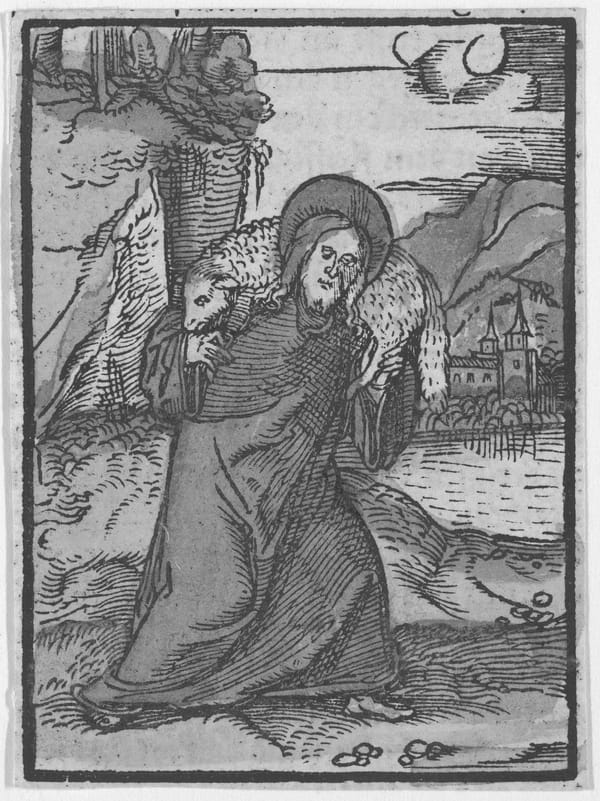
Rogation Days: Wednesday
For the third time, holy Church marshals her children in procession, and makes a solemn appeal to the divine mercy. Let us follow her sacred standard, and join her in invoking the intercession of the saints. The Litany, in which we pray to all the choirs of the heavenly Jerusalem, is both a magnificent and a powerful prayer: it is the Church triumphant uniting with the Church militant in praying for the salvation of the world.
O Mary! Mother of God, Virgin of virgins, miracle of divine power, exercise in our favour thy maternal mediation with Him, who, though God, is thy Son!
Michael the invincible, Gabriel, welcome messenger of our salvation, Raphael, affectionate physician of them that are suffering; Angels and Archangels, who watch over us, and co-operate in the work of our salvation; all ye choirs of blessed spirits, who are waiting for your ranks to be filled up by the elect of earth: intercede for your brethren, your clients!
John the Baptist, precursor of the Lamb of God; Joseph, spouse of Mary Immaculate, and foster-father of the Son of God; patriarchs, the glorious forefathers of the human race, and ancestors of the Messias; prophets, who foretold His coming, and described the events of His life, that so the earth might recognize Him as its promised Redeemer: remember us who are living in this exile, through which you also passed!
Peter, universal pastor, that holdest the keys of the kingdom of heaven; Paul, apostle of the Gentiles, armed with the sword of the word, and immolated by the sword of martyrdom; Andrew, crucified like thy master; James the Greater, son of thunder, founder of the Catholic kingdom; John, the beloved disciple, the adopted son and guardian of Mary, evangelist and prophet; Thomas, apostle of the Indies, pierced to death by a spear; James the Less, surnamed the 'brother of the Lord ’; Philip, who didst preach the Gospel to the Scythians, and wast crucified at Hierapolis; Bartholomew, the teacher and martyr of Armenia; Matthew, the evangelist, who didst carry the faith into the scorching regions of Ethiopia; Simon, by whose zeal Mesopotamia was led to the knowledge of Christ; Thaddeus, the courageous destroyer of the idols of Egypt; Mathias, chosen to fill up the place of the traitor Judas, and well worthy of the honour; Barnabas, Paul’s companion, and the light of the isle of Cyprus; Luke, disciple of the apostle of the Gentiles, and historian of the Incarnate Word; Mark, disciple of Peter, under whose direction thou wrotest the Gospel of salvation: we devoutly honour you as our fathers in the faith; pray for and with us!
Disciples of our Lord, who, though not raised to the rank of apostles, were chosen by Him to be their fellow-labourers, and who, on the day of Pentecost, were filled with the Holy Ghost; dear Innocents of Bethlehem, first-fruits of the martyrs: deign to join us in our supplications!
Stephen the crowned, Laurence the brave and cheerful winner of immortal laurels, Vincent the victorious,—the glorious triumvirate of deacons; Fabian, pontiff designated by a dove sent from heaven; Sebastian, dauntless soldier of holy Church; John and Paul, Cosmas and Damian, Gervasius and Protasius, brothers by nature and by martyrdom; oh! all ye holy martyrs, protect us under the shadow of your palms!
Sylvester, pontiff of peace; Gregory, vicar both of the meekness and of the authority of Christ; Ambrose, whose eloquence was sweet as honey, and whose courage was as that of a lion; Augustine, doctor of doctors, and apostle of divine charity; Jerome inspired interpreter of the Scriptures; Martin thaumaturgus of the west, and Nicholas, wonder-worker in the east; holy pontiffs, holy doctors of the Church, lead back to Christ all His sheep that have gone astray.
Antony, the glory of the desert, and the conqueror of satan; Benedict, the Abraham of the new Testament, whose children are countless as the stars of heaven; Bernard, pillar of the Church, and favourite of the Mother of God; Dominic, preacher of divine truth, and scourge of heresy; Francis friend and spouse of poverty, crucified together with Christ; we honour you all; enkindle within our souls the desire of Christian perfection!
Priests of the Lord; holy monks, and hermits, and confessors: pray for us who implore your aid!
Mary Magdalene, once a sinner, but afterwards a saint, whose devotedness to Jesus was so generous and fervent: obtain for us that compunction of heart, which makes amends for sin by love!
Agatha and Lucy, beautiful flowers of fair Sicily; Agnes, who followest the Lamb whithersoever He goeth; Cecily, wreathed with thy roses and lilies, and queen of sweet melody; Catharine the wise virgin that confoundest the false wisdom of philosophers; Anastasia, the valiant woman that didst triumph over the trials of life and the severity of tortures; oh! all ye holy virgins, spouses of Jesus, look with compassion on us who are dwelling in this land of exile!
All ye holy men and women, saints of God, who now reign in heaven above, think of us your brethren, who mourn in this vale of tears. We, too, are created for eternal happiness; and yet the vanities of time engross our thoughts and affections. Make intercession for us, that, henceforth, we may walk worthy of God, who hath called us unto His kingdom and glory.1
The Litany is finished; and for the third time, the holy Sacrifice is about to work reconciliation between our God and us His guilty children. Let us hope that He will make this a year of peace and plenty; and next year, when the Church invites us to join her in this public supplication for pardon, may the number of those who respond to her call, be such as to merit an increase of every blessing!
The Mass is given above, page 144. Let us assist at it with a deep conviction of our own insufficiency to make atonement for our sins, and yet with a firm confidence in the infinite merits of the Paschal Lamb, our risen Jesus.
The ancient Church of Gaul used to recite the following prayer on this third of the Rogation days. It will aid us to a spirit of penance.
Prayer (Immolatio)
The third morning of the Rogation days is over; the hour of noon has come, and from it we begin to count the hours of the last day which the Son of God is to spend upon earth in His visible presence. During these three days, we seem to have forgotten that the time of separation is close upon us; but no: the thought of our coming trial has often presented itself, and the humble supplications we have been presenting to heaven, in union with holy Church, have prepared us to celebrate the last mystery achieved by our Emmanuel on earth.
The disciples are all assembled in Jerusalem. They are grouped around the blessed Mother, in the cenacle, awaiting the hour when their divine Master is to appear to them for the last time. Recollected and silent, they are reflecting upon all the kindness and condescension He has been lavishing upon them during the last forty days; they are ruminating upon the instructions they have received from His sacred lips. They know Him so well now! They know in very deed that He came out from the Father.2 As to what regards themselves, they have learned from Him what their mission is: they have to go, ignorant men as they are, and teach all nations;3 but (Oh sad thought!) He is about to leave them; yet a little while, and they shall not see Him!4
What a contrast between their sorrow and the smiling face of nature, which is decked out in her best, for she is going to celebrate the triumphant departure of her Creator! The earth is blooming with the freshness of her first-fruits, the meadows have put on their richest emerald, the air is perfumed with blossom and flower; and all this loveliness of spring is due to the bright sun that shines upon the earth to give her gladness and life, and is privileged to be, both by its kingly splendour and the successive phases of its influence upon our globe, the grand symbol of our Emmanuel’s passage through this world.
Let us go back in thought to the dismal days of the winter solstice. The sun looked then so pallid; his triumph over night was slow and short; he rose, and sank again, often without our seeing him; his light had a certain timid reserve about it, and his heat was, for weeks, too feeble to rescue nature from the grasp of frost. Such was our divine Sun of justice, when first He came on earth; His rays made but little way in the world’s thick gloom; He kept His splendour in, lest men should be dazzled by too sudden a change from darkness to light. Like the material sun, He gained upon the world by slow advances; and even so, His progress was shrouded by many a cloud. His sojourn in the land of Egypt, His hidden life at Nazareth, were long periods during which He was wholly lost sight of. But when the time came for Him to show Himself, His glory shone forth, with all its magnificence, upon Galilee and Judea; He spoke as one having power,5 His works bore testimony to His being God,6 and the people hailed Him with the cry of 'Hosanna to the Son of David!'
He was almost at the zenith of His glory, when suddenly came the eclipse of His Passion and Death. For some hours, His enemies flattered themselves that they had for ever put out His light. Vain hope! On the third day, our divine Sun triumphed over this final obstruction, and now stands in the firmament, pouring out His light upon all creation, but warning us that His course is run. For He can never descend; there is no setting for Him; and here finishes the comparison between Himself and the orb of day. It is from heaven itself that He, our beautiful Orient, is henceforth to enlighten and direct us, as Zachary foretold at the birth of the Baptist.7 The royal prophet, too, thus exultingly sang of Him: 'He hath rejoiced, as a giant, to run the way: His going out is from the highest heaven, and His circuit even to the summit thereof: and there is no one that can hide himself from His heat.’8
This Ascension, which enthroned our Emmanuel as the eternal centre of light, was, by His own decree, to take place on one of the days of the month which men call May, and which clothes in its richest beauty the creation of this same God, who, when He had made it, was pleased with it, and found it very good.9 Sweet month of May! Not gloomy and cold like December, which brought us the humble joys of Bethlehem; not lowering and clouded like March, when the Lamb was sacrificed on Calvary; but buoyant with sunshine, and flowers, and life, and truly worthy to be offered, each year, to Mary, the Mother of God, for it is the month of her Jesus’ triumph.
O Jesus! our Creator and our Brother! our eyes and heart have followed Thee from Thy first rising upon our world. We have celebrated, in the holy liturgy, each of Thy giant steps. But Thy very growth in beauty and brightness told us that Thou must one day leave us, to go and take possession of the place that was alone worthy of Thee, the throne at the right hand of Thine eternal Father. The splendour that has been on Thee since Thy Resurrection, is not of this world; Thou canst no longer abide among us. Thou hast remained here below, for these forty days, only for the sake of consolidating Thy work; and tomorrow the earth that has been blessed with Thy presence for three and thirty years, will be deprived of its privilege and joy. We rejoice at Thy approaching triumph, as did Thy blessed Mother, Thy disciples, Mary Magdalene and her companions; but we are sad at the thought of losing Thee, and Thou wilt forgive us. Thou wast our Emmanuel, our ‘God with us'; henceforth, Thou art to be our Sun, our King, reigning from the throne of heaven, and we shall no longer be able to hear Thee, nor see Thee, nor touch Thee, O Word of life!10 Still, dearest Jesus, we say to Thee with all our hearts: Glory and love be to Thee, for Thou hast treated us with infinite mercy! Thou owedst nothing to us; we were unworthy of a single look from Thee; and yet Thou camest down to this sinful earth, Thou hast dwelt among us, Thou hast paid our ransom by Thy Blood, Thou hast re-established peace between God and man. Oh, yes! it is most just that Thou shouldst now return to Him that sent Thee.11 The Church, Thy bride, consents to her exile; she thinks only of what is most glorious to her Jesus; and she thus addresses Thee, in the words of the Canticle: 'Flee away, O my Beloved! and be swift as the roe and as the young hart, and ascend to the mountains, where the flowers of heaven exhale their sweet fragrance!’12 Can we, poor sinners as we are, refuse to imitate this loving resignation of her, who is Thy bride, and our mother?
May 12: Sts. Nereus and Achilleus, Martyrs, and St. Flavia Domitilla, Virgin and Martyr
|
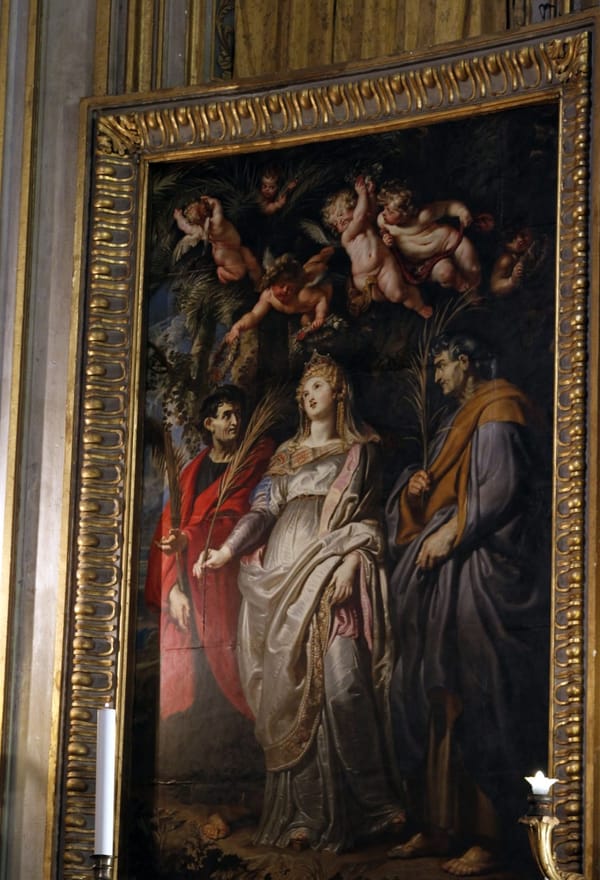
SO far in our Paschal season, the choir of Virgin martyrs has not yet offered to Jesus its crown of roses and lilies. It does so to-day, by presenting to him the noble Flavia Domitilla, the fairest flower of Rome, that was cut down by the sword of martyrdom in the first age of the Christian faith. It was under the persecution of Domitian—during which John the Evangelist was condemned to be burned alive in the cauldron of boiling oil—that Flavia Domitilla was honoured with banishment and death for the sake of our Redeemer, whom she had chosen for her Spouse. She was of the imperial family, being a niece of Flavius Clemens, who adorned the consular dignity by martyrdom. She was one of the Christians belonging to the court of the Emperor Domitian, who show us how rapidly the religion of the poor and humble made its way to the highest classes of Roman life. A few years previous to this, St Paul sent to the Christians of Philippi the greetings of the Christians of Nero's palace.1 There is still extant, not far from Rome, on the Ardeatine Way, the magnificent subterranean cemetery which Flavia Domitilla ordered to be dug on her prædium, and in which were buried the two martyrs, Nereus and Achilleus, whom the Church honours to-day together with the noble virgin who owes her crown to them.
Nereus and Achilleus were in Domitilla’s service.2 Hearing them one day speaking of the merit of virginity, she there and then bade farewell to all worldly pleasures, and aspired to the honour of being the Spouse of Christ. She received the veil of consecrated virgins from the hands of Pope St Clement: Nereus and Achilleus had been baptized by St Peter himself. What glorious reminiscences for one day!
The bodies of these three Saints reposed, for several centuries, in the Basilica, called the Fasciola, on the Appian Way; and we have a Homily which St Gregory the Great preached in this Church on their feast. The holy Pontiff dwelt on the vanity of the earth’s goods; he encouraged his audience to despise them by the example of the three martyrs whose relics lay under the very altar around which they were that day assembled.
These Saints, [said he] before whose tomb we are now standing, trampled with contempt of soul on the world and its flowers. Life was then long, health was uninterrupted, riches were abundant, parents were blessed with many children; and yet, though the world was so flourishing in itself, it had long been a withered thing in their hearts.3
Later on, in the thirteenth century, the Fasciola having been almost reduced to ruins by the disasters that had befallen Rome, the bodies of the three Saints were translated to the Church of St Adrian, in the Forum. There they remained till the close of the sixteenth century, when the great Baronius, who had been raised to the Cardinalate, with the title of Saints Nereus and Achilleus, resolved to repair the Church that was thus entrusted to his care. Through his munificence, the naves were restored; the history of the three martyrs was painted on the walls; the marble pulpit, from which St Gregory preached the Homily, was brought back, and the Homily itself was graven, from beginning to end, on the back; and the Confession was enriched with mosaics and precious marbles, preparatory to its receiving the sacred relics, of which it had been deprived for three hundred years.
Baronius felt that it was high time to put an end to the long exile of the holy martyrs, whose honour was now so specially dear to him. He organized a formal triumph for their return. Christian Rome excels in the art of blending together the forms of classic antiquity and the sentiments inspired by faith. The chariot, bearing a superb canopy, under which lay the relics of the three martyrs, was first led to the Capitol. On reaching the top of the clivus Capitolinus, the eye met two inscriptions, placed parallel with each other. On one were these words: ' To Saint Fla via Domitilla, Virgin and Martyr of Rome, the Capitol, purified from the wicked worship of demons, and restored more perfectly than by Flavius Vespasian and Domitian, Emperors, kinsmen of the Christian Virgin.' On the other: ‘The Senate and People of Rome to Saint Flavia Domitilla, Virgin and Martyr of Rome, who, by allowing herself to be put to death by fire for the faith of Christ, brought greater glory to Rome than did her kinsmen, the Emperors Flavius Vespasian and Domitian, when, at their own expense, they restored the Capitol, that had twice suffered from fire.'
The reliquaries of the martyrs were then placed on an altar that had been erected near the equestrian statue of Marcus Aurelius. After being venerated by the faithful, they were replaced on the chariot, which descended by the opposite side of the Capitol. The procession soon reached the triumphal arch of Septimius Severus, on which were hung these two inscriptions:
To the holy Martyrs Flavia Domitilla, Nereus and Achilleus, the best of citizens, the Senate and People of Rome, for their having honoured the Roman name by their glorious death, and won peace for the Roman commonwealth by shedding their blood.
To Flavia Domitilla, Nereus and Achilleus, the invincible Martyrs of Christ Jesus, the Senate and People of Rome, for their having honoured the City by the noble testimony they bore to the Christian Faith.
Following the Via Sacra, the procession was soon in front of the triumphal arch of Titus, the monument of God’s victory over the deicide nation. On one side were inscribed these words: 'This triumphal arch, formerly dedicated and raised to the Emperor Titus Flavius Vespasian, for having brought the rebellious Judea under the yoke of the Roman people, is now, by the Senate and People of Rome, more auspiciously dedicated and consecrated to Flavia Domitilla, kinswoman of the same Titus, for having, by her death, increased and furthered the Christian Religion.'
On the other side of the arch was the following inscription: ‘To Flavia Domitilla, Virgin and Martyr of Rome, kinswoman of the Emperor Titus Flavius Vespasian, the Senate and People of Rome, for her having, by shedding her blood and laying down her life for the Faith, rendered a more glorious homage to the death of Christ than did the said Titus, when by divine inspiration he destroyed Jerusalem, to avenge that same death.'
Leaving on the left the Coliseum, the hallowed ground whereon so many martyrs had fought the battle of faith, they passed under the triumphal arch of Constantine, which so eloquently speaks of the victory of Christianity, both in Rome and the Empire, and which still bears on it the name of the Gens Flavia, of which the first Christian Emperor was a member. The two following inscriptions were attached to the arch:
To Flavia Domitilla, Nereus and Achilleus, the Senate and People of Rome. On this sacred way, whereon so many Roman Emperors received triumphal honours for having brought various provinces into subjection to the Roman People, these martyrs receive to-day a more glorious triumph, for that they con quered, by a greater courage, the conquerors themselves.
To Flavia Domitilla, the Senate and People of Rome. Twelve Emperors, her kinsmen, conferred honour on the Gens Flavia and on Rome herself by their deeds of fame; but she, by sacrificing all human honours and life itself for Christ's sake, rendered greater service to both family and City than they.
The procession then continued its route along the Appian Way, and at length reached the Basilica. Baronius, assisted by a great number of Cardinals, received the precious relics, and took them with great respect to the Confession of the High Altar. Meanwhile the choir sang this Antiphon of the Pontifical: * Enter, ye Saints of God! for a dwelling hath been prepared for you by the Lord. The faithful people have followed you on your way, that ye may intercede for them with the majesty of the Lord. Alleluia!'
The following is the account of our three martyrs as given in the Liturgy:
How grand was the triumph which Rome gave to you, O holy martyrs, so many centuries after your glorious deaths! How true it is that there is no glory here on earth which can bear comparison with that of the saints! Where are now those twelve Emperors, thy kinsmen, O Domitilla? Who cares for their remains? Who even cherishes their memory? One of them was sur~ named ‘the delight of mankind '; and now how many there are who have never heard of his existence! Another, the last of the twelve, had the glory of proclaiming the victory won by the Cross over the Roman Empire; Christian Rome honours and loves his name; but the homage of religious devotion is not given to him, but to thee, O Domitilla, and to the two martyrs whose names are now associated with thine.
Who does not recognize the power of Jesus' Resurrection in the love and enthusiasm wherewith a whole people welcome your holy relics, O martyrs of the living God? Fifteen hundred years had elapsed; and yet your lifeless remains were greeted with a transport of joy, as though you yourselves were there, and living. It was because we Christians know that Jesus, who is the first-born of the dead,4 has risen from the grave; and that you, like him, are one day to rise in glory. Therefore do the faithful honour by anticipation the immortality which, at a future period, is to be given to your bodies, once slain for Jesus' sake; they already see by faith the future brightness which is to be imparted to your flesh; and thus they proclaim the dignity which the Redemption has given to man, to whom death is now but a transition to true life, and the tomb but a resting-place where the body is consigned, as seed to the earth, to be restored in a hundredfold of richer beauty.
Happy they who, as the prophecy says, have washed their robes and have made them white in the Blood of the Lamb!5 But happier they, says Holy Church, who, after being thus purified, have mingled their own blood with that of the divine Victim! for by so doing they have filled up in their flesh those things that are wanting of the sufferings of Christ.6 Hence, their intercession is powerful, and we should address our prayers to them with love and confidence. Befriend us, then, O holy martyrs Nereus, Achilleus, and Domitilla! Obtain for us an ardent love for our Risen Jesus; perseverance in the new life which he has conferred upon us; detachment from the things of this world, and a determined resolution to trample them beneath our feet, should they become a danger to our eternal salvation. Pray for us, that we may be courageous in resisting our spiritual enemies, ever ready to defend our holy faith, and earnest in our endeavours to gain that kingdom which is to be borne away by violence.7 Be the defenders of the holy Roman Church, which fervently celebrates your memory each year. You, Nereus and Achilleus, were converts of Peter; and thou, Domitilla, wast the spiritual daughter of Clement, Peter's successor; protect the Pontiff who now governs the Church—the Pontiff, in whom Peter still lives—the Pontiff, the successor of Clement. Dispel the storms which are threatening the Cross on the Capitol, and pray for the inhabitants of Rome, that they may be staunch to the faith.
- Phil, iv 22. ↩︎
- The Acts of these two Saints—which were drawn up long after their martyrdom, and on which were formed the Lessons of to-day’s Office—call them “eunuchs”: but it is a mistake of the compiler, who belongs to the fifth or sixth century. The introduction of eunuchs into the Imperial Court, and into the Roman families, is of a later date than the reign of Domitian. ↩︎
- Homil. xxviii in Evang. ↩︎
- Apoc. i 5. ↩︎
- Ibid. vii 14. ↩︎
- Coloss. i 24. ↩︎
- St Matt. xi 12. ↩︎
May 12 (the Same Day): St. Pancras, Martyr
A FOURTH martyr claims our veneration on this twelfth day of May. Like the three others, he culled his palm at Rome. But whilst they died for the faith at the very commencement of the Christian era, Pancras was not called to the glorious combat till the persecution under Diocletian—the last and greatest effort of pagan Rome against the Church. Our young hero was only fourteen years of age; but he was old enough to be a brave martyr, and he has been honoured by a commemoration in Paschal Time. The venerable Church in the Holy City which is dedicated to him, and which gives a title to one of the Cardinals, was built on the site of the cemetery where his body was buried. The following commemoration is made of him in the Matins of this feast:
Divine grace, which called thee to the crown of martyrdom, selected thee, O Pancras, from the distant land of Phrygia, and led thee to the capital of the empire—the centre of every vice and every error of paganism. Thy name, like those of millions of others who were better known to the world, had else been quite forgotten. But now, though thy earthly career was soon ended, the name of Pancras is loved and venerated throughout the whole earth: it is breathed at the altar, in the prayers which accompany the sacrifice of the Lamb. How camest thou, dear youthful martyr, by this celebrity, which will last to the end of the world? It was because, having imitated Jesus' Death by suffering and shedding thy blood for his name, thou hast been made a sharer in the glory of his immortality. In return for the honour we pay thee, deign to aid us by thy protection. Speak of us to Jesus, who is our divine Master, as he was thine. In this vale of our exile, we sing our Alleluia for his Resurrection, which has filled us with hope; obtain for us, by thy prayers, that we may sing Alleluia with thee in heaven, where it will be eternal, and be prompted, not by the gladness of hope, but by the bliss of possession.
| Previous Rogation Days: Tuesday | Next May 12: Sts. Nereus and Achilleus, Martyrs, and St. Flavia Domitilla, Virgin and Martyr |