lyp.network

Daily reading

Semidouble · Movable from Easter · Temporal

May 15, 2021

From Dom Guéranger’s The Liturgical Year.
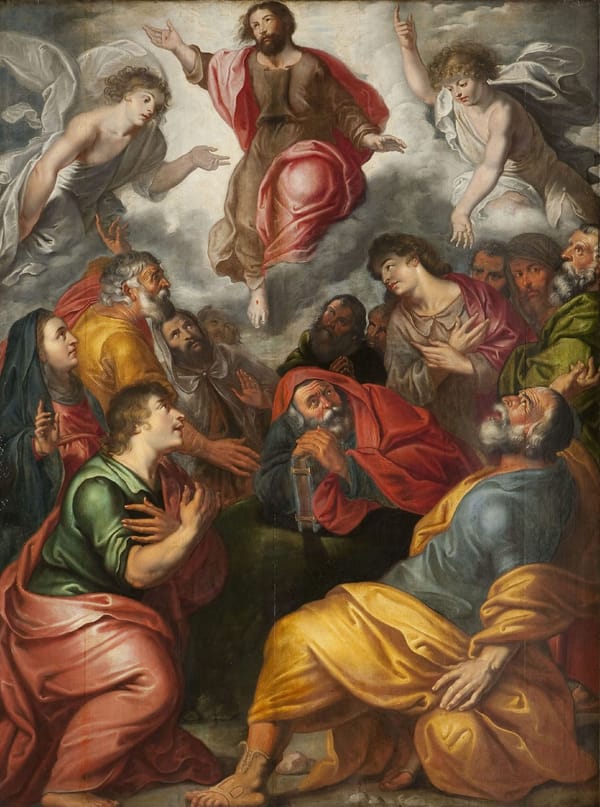
Saturday within the Octave of the Ascension

O Rex gloriæ, Domine virtutum, qui triumphator hodie super omnes cœlos ascendisti, ne derelinquas nos orphanos; sed mitte promissum Patris in nos Spiritum veritatis, alleluia.
O King of glory, Lord of hosts, who didst this day ascend in triumph above all the heavens! leave us not orphans, but send upon us the Spirit of truth, promised by the Father, alleluia.

Jesus, then, the Man who dwelt on the earth and was perfect in all holiness, has ascended into heaven. This earth, accursed of God as it was, has produced the fairest fruit of heaven; and heaven with its gates shut against our race, has had to open them for the entrance of a Son of Adam. It is the mystery of the Ascension; but it is only a part, and it behoves us to know the mystery in its fulness. Let us give ear to the apostle of the Gentiles: ‘God who is rich in mercy, through His exceeding charity wherewith He loved us even when we were dead in sins, hath quickened us together with Christ: and hath raised us up together with Him, and hath made us sit in the heavenly places together with Him.’1 We have celebrated the Pasch of our Saviour’s Resurrection as our own resurrection; we must, agreeably to the apostle’s teaching, celebrate also His Ascension as our own. Let us weigh well the expression: ‘God hath made us sit in the heavenly places together with Christ.’ So then in the Ascension, it is not Jesus alone who ascends into heaven; we ascend thither with Him. It is not He alone that is enthroned there in glory; we are enthroned through and together with Him.

That we may the better understand this truth, let us remember that the Son of God did not assume our human nature with a view to the exclusive glorification of the Flesh which He united to His own divine Person. He came to be our Head. We, consequently, are His members; and where He is, we also are to be; at least, such is His intention, as He implied at the last Supper, when He said: ‘Father! I will that where I am, they also whom Thou hast given Me may be with Me, that they may see My glory which Thou hast given Me.’2 And what is the glory given to Him by His Father? Let us hearken to the royal prophet, who, speaking of the future Ascension, says: ‘The Lord said to my Lord: Sit Thou at My right hand!’3

It is, then, on the very throne of the eternal Father, it is at His right hand, that we shall see Him whom the apostle calls our forerunner.4 We shall be united with Jesus, as members to our Head; so that His glory will be ours; we shall be kings, with His kingship; He will make us partake of all that He Himself has, for He tells us that we are His joint-heirs.5

From this it follows that the august mystery of the Ascension, which began on the day of Jesus’ entrance into heaven, will continue, until His mystical body has received its completion by the ascension of the last of the elect. Look at that countless host of holy souls who were the earliest companions of His triumph: foremost are our first parents; then the patriarchs, the prophets, and the just of every generation of the preceding four thousand years! They had been imprisoned in limbo, but He liberated them, gave them of His own brightness, and made them His partners in the glory of His Ascension. They were His trophy; they formed His court, as He passed from earth to heaven. Well did we exclaim in the words of holy David: ‘Sing to God, ye kingdoms of the earth! Sing ye to the Lord. Sing ye to God, who mounteth above the heaven of heavens, towards the east.’6

The angels were ready to receive our Emmanuel; and then began that sublime dialogue, which the royal psalmist was permitted to hear and prophesy. The glad countless legion of the holy souls, who escorted the divine conqueror, cried out to the guardians of the heavenly Jerusalem: ‘Lift up your gates, O ye princes! Be ye lifted up, O eternal gates! and the King of glory shall enter in.’ The faithful angels replied: ‘Who is this King of glory?’ ‘It is the Lord,’ responded the elect of earth: ‘It is the Lord who is strong and mighty; the Lord mighty in battle.’ Well might they say this of our Jesus, who had vanquished satan, death and hell, and brought themselves to the city’s gate as a sample of His stupendous conquest. The angels repeated their question; the saints re-echoed their reply; the eternal gates were thrown open, and the King and His courtiers entered into heaven.7

The gates, then, are opened to receive our Redeemer, and opened He would have them remain for us to follow Him. Admirable Ascension! oh, let us linger in its contemplation! Jesus inaugurates the grand mystery by His own entrance into heaven, and then perpetuates it by the ascension of His elect of each successive generation. There is a ceaseless procession up to heaven; for some happy souls are ever finishing their purification in purgatory, while some still happier ones are winging their rapid flight direct from this earthly vale of sorrows. Hail, then, O glorious mystery! fruit of the flowers of so many mysteries; term, fulfilment, perfection of our Creator’s decree! Alas! thou hadst a long interruption by Adam’s sin; but Jesus’ triumph restored thy reign on earth, and this earth shall live in thy beauty and grace till that word shall be uttered by the angel: ‘Time shall be no more!’8 O mystery of joy and hope, be thou accomplished in me!

Permit us, then, O Jesus, to apply to ourselves what Thou saidst to Thine apostles: ‘I go to prepare a place for you!’9 This has been Thy aim in all Thou hast done for us: Thou camest into this world to open heaven for us. Thy holy bride, the Church, bids us fix our eyes on heaven; she points to its opened gates, and shows us the bright track through which is passing up from earth an unbroken line of souls. We are still in exile; but the eye of our faith sees Thee in that land above, Thee the Son of Man throned at the right hand of the Ancient of days.10 How are we to reach Thee, dear Jesus? We cannot, as Thou didst, ascend by our own power: Thou must needs fulfil Thy promise, and our desire, of drawing us to Thyself.11 It was the object after which Thy blessed Mother also sighed, when Thou didst leave her on earth; she longed for the blissful hour of Thy taking her to Thyself, and awaited Thy call with faith, labouring meanwhile for Thy glory, and living with Thee, though not seeing Thee. Give us to imitate the faith and love of this Thy Mother, that so we may apply to ourselves those words of Thine apostle: ‘We are already saved, by hope.’12 Yes, we shall be so, if Thou send us, according to Thy promise, the holy Spirit whom we so ardently desire to receive; for He is to confirm within us all that Thy mysteries have produced in our souls; He is to be to us a pledge of our future glorious ascension.

In presenting our petitions this day to heaven, let us take, as addressed to ourselves, the sublime instructions given by the Gothic Church of Spain, on the Ascension feast, to her children.

Missa

Placeat, dilectissimi fratres, saecularium cogitationum fasce deposito, erectis in sublime mentibus subvolare: et impositam aetheris fastigio assumpti hominis communionem, sequacibus cordis oculis contueri. Ad incomparabilem nobis claritatem attonitus vocandus aspectus, est Jesus Dominus noster: humilitatem nobis terrarum cœlorum dignitate commutat: acutus necesse est visus esse respicere quo sequimur. Hodie salvator noster post assumptionem carnis, sedem repetit deitatis. Hodie hominem suum intulit Patri, quem obtulit passioni. Hunc exaltans in cœlis, quem humiliaverat in infernis. Hic visurus gloriam, qui viderat sepulturam. Et qui adversus mortem mortis suæ dedit beneficium, ad spem vitae donavit resurrectionis exemplum. Hodie rediit ad Patrem, cum tamen sine Patris, qui sibi aequalis est, potestate non venerit. Hodie ascendit in cœlum qui obsequia cœlestium cum descenderet, non amisit. Ita in Patris natura unitate consistens, ut cum homo cœlum novus intraret, novum tamen Deus hominem non haberet. Petamus igitur ab omnipotentia Patris, per nomen Filii salvatoris, gratiæ spiritalis ingressum, aeternæ beatitu- dinis donum, beatae mansionis ascensum, catholicae credulitatis augmentum, haereticae infidelitatis, excidium. Audiet profecto in confessione, quos in perditione quaesivit. Adstitit suis, qui non destitit alienis. Aderit agnitus, qui non defuit agnoscendus. Non patietur orphanos esse devotos, qui filios facere dignatus est inimicos. Dabit effectum supplicationis, qui promisit Spiritum sanctitatis. Amen.
We beseech you, dearly beloved brethren, that, laying aside the weight of worldly thoughts, you would raise up your minds, and soar to heavenly things, and see, with the attentive eye of the heart, how Christ placed your own human nature, which he had assumed, in the highest heavens. The incomparable brightness on which we are invited to fix our astonished gaze, is Jesus our Lord. He exchanges the lowliness of this earthly dwelling for the glory of heaven. How quick must our sight be, that it may see the land, whither we are to follow him! To-day our Saviour, after assuming our human nature, returned to the throne of the Godhead. Today, he offered to his Father that same human nature, which he had previously offered to the endurance of his Passion. He exalted in heaven the Humanity that he had humbled in limbo. He well deserved to see glory, who had seen the tomb. He who conferred on us his own death, that he might put ours to death, gave us the example of his Resurrection, that he might gladden us with the hope of life. To-day, he returned to the Father, though he had not been here on earth without possessing all the power of the Father, who is co-equal with him. To-day, he ascended into heaven, though he had not lost the adoration of the angels when he descended upon our earth. One with the Father in unity of substance, he so entered into heaven as the new Man, that he was not new to God. Let us, therefore, ask the almighty Father, through the name of his Son, our Saviour, that he grant us admission into a spiritual life of grace, the gift of eternal happiness, an ascension into the mansion of bliss, an increase of Catholic faith, and the destruction of heretical disbelief. He, surely, will hear us, now that we praise him who went in search of us when we were lost. He will assist us that are now his people, who abandoned us not when we were aliens. He will be with us now that we know him, for he was not absent from us even when we knew him not. He will not suffer us to be orphans now that we are devoted to him, for he vouchsafed to make us his children when we were his enemies. He will grant us what we ask, for he has promised to send us the Holy Ghost. Amen.
  1. Eph. ii. 4,6. ↩︎
  2. St. John, xvii. 24. ↩︎
  3. Ps. cix. 1. ↩︎
  4. Heb. vi. 20. ↩︎
  5. Rom. viii. 17. ↩︎
  6. Ps. lxvii. 33, 34. ↩︎
  7. Ibid xxiii. ↩︎
  8.  Apoc. x, 6. ↩︎
  9.  St. John, xiv. 2. ↩︎
  10.  Dan. vii. 13. ↩︎
  11.  St. John, xii. 32. ↩︎
  12.  Rom. viii. 24. ↩︎

May 15: St. John Baptist de la Salle, Confessor

JOHN Baptist de la Salle, the teacher of the humble, takes his place to-day beside Leo the Great, Athanasius, and Gregory of Nazianzum. He has no fear. The victor of Paschal Time is the same Jesus who said during his mortal life: ‘Suffer the little children to come unto me,'1 and ‘unless you be converted and become as little children, you shall not enter into the kingdom of heaven,'2 that kingdom of heaven which, after entering into his glory, he manifests so fully upon earth. On the other hand, the Lion of Juda is never more terrible in his anger than when he beholds evil men conspiring to keep from him the little ones of whom he forms his court.3

The promise made in Holy Scripture that ' they that instruct many to justice shall shine as stars for all eternity'4 is addressed not only to the great doctors of the science of salvation, but also to the humblest Christian teacher, and the supreme Pontiff, when inscribing the name of the saint of to-day among those of the blessed, declared that the inspired words ' apply in an especial manner to those who, like him, have left all things and devoted themselves to the instruction of the baptized from earliest infancy in the teaching of the Gospel and the precepts which lead to life eternal.’5

John Baptist de la Salle was a true disciple of our blessed Lord, and entered so fully into the thought of his Master that no sacrifice was too great for him if only he might carry it out, and no suffering, humiliation, or persecution could hinder him from persevering in the accomplishment of his works of love. He suffered from misunderstanding and lack of support all through his life, but is he less great in heaven to-day on that account?

The following account of him is given in the Breviary:

Joannes Baptista de la Salle, Rhemis claro genere ortus, puer adhuc moribus et factis in sortem Domini se vocandum et sanctimoniae laude honestandum portendit. Adolescens in Rhemensi Academia litteras ac philosophicas disciplinas didicit; quo tempore etsi ob animi virtutes et alacre ingenium ac suave omnibus carus esset, ab aequalium tamen societate abhorrebat, ut solitudini addictus facilius Deo vacaret. In clericalem militiam jampridem cooptatus, sextodecimo aetatis anno inter Rhemenses Canonicos adscriptus est. Lutetiam Parisiorum, theologiae in Sorbonica universitate daturus operam, contendit atque in Sulpitianum seminarium adscitus est. At brevi parentibus orbatus, domum regredi coactus, fratres educandos suscepit: quod scientiarum interim sacrarum studia non intermittens, optimo cum fructu praestitit, uti exitus comprobavit.
Sacerdotio demum auctus, qua praestanti fide animique ardore primum ad aram fecit, eisdem toto vitæ tempore sacris est operatus. Interea salutis animarum studio incensus, totum in earumdem utilitatem sese impendit. Sororum a Jesu Infante, puellis educandis institutarum regimen suscepit, easque non modo prudentissime est moderatus, sed ab excidio vindicavit. Hinc porro animum advertit ad pueros de plebe religione bonisque moribus informandos. Atque in hoc quidem illum suscitaverat Deus, ut scilicet nova in Ecclesia sua religiosorum hominum familia condita puerorum, praesertim pauperum, scholis perenni efficacique ratione consuleret. Demandatum vero a Dei providentia munus, per contradictiones plurimas magnasque aerumnas feliciter implevit, fundata Fratrum sodalitate, quam a scholis Christianis nuncupavit.
Adjunctos igitur sibi homines in gravi opere et arduo, apud se primum suscepit; tum aptiori in sede constitutos disciplina sua optime imbuit iis legibus sapientibusque institutis, quæ postea a Benedicto decimo tertio sunt confirmata. Ex demissione animi ac paupertatis amore primum canonicatu se abdicavit, omniaque sua bona in pauperes erogavit; quin etiam serius, quod frustra saepius tentaverat, fundati a se instituti regimen sponte deposuit. Nihil tamen interim de Fratrum sollicitudine remittens, deque scholis ab eo, pluribus jam locis, apertis, impensius Deo vacare cœpit. Assidue jejuniis, flagellis, aliisque asperitatibus in se ipsum saeviens, noctes orando ducebat. Donec virtutibus omnibus conspicuus, praesertim obedientia, studio divinae voluntatis implendae, amore ac devotione in Apostolicam Sedem, meritis onustus, sacramentis rite susceptis, obdormivit in Domino, annos natus duo de septuaginta. Eum Leo decimus tertius Pontifex Maximus Beatorum catalogo inseruit; novisque fulgentem signis, anno jubilaei millesimo nongentesimo Sanctorum honoribus decoravit
John Baptist de la Salle was born of a noble family at Rheims. When quite a child he showed by his ways and actions that he would be called to follow our Lord and attain great sanctity. He studied literature and philosophy at Rheims, and though his virtues and quick intelligence endeared him to all, he avoided the company of his fellows that he might be free to contemplate God in solitude. He was made a cleric when very young, and was only sixteen when given the rank of a Canon at Rheims. He went to Paris to study theology at the Sorbonne, and was received at the Seminary of St Sulpice. He was soon forced to return home by the death of his parents, whereupon he undertook the education of his brothers, which he carried on, without interrupting his own studies, to the great advantage of his pupils, as soon became evident.
He was ordained priest, and said his first Mass with the intense faith and love which, throughout his life, he brought to the holy Mysteries; but his zeal for the salvation of souls made him devote himself wholly to the service of his neighbour. He was made superior of the Sisters of the Holy Child, founded for the education of girls, and by his prudent government saved their institute from dissolution. From this he turned his attention to the education of poor boys. God had raised him up for this very end, namely that he should found in the Church a new family of religious men devoted to the training of children, particularly the poor. This work, which had been entrusted to him by divine Providence, was successfully accomplished in spite of many trials and contradictions by the establishment of the Institute of the Brothers of the Christian Schools.
His first helpers in this great and arduous work he received into his own house, and then, establishing them in a more suitable dwelling, gave them a careful training in those wise laws and regulations which were afterwards confirmed by Pope Benedict XIII. His humility and love of poverty caused him first of all to resign his canonry and to distribute all his property among the poor; and. finally, after many unsuccessful attempts to do so, he spontaneously resigned the government of the Institute which he had founded. His solicitude for the Brethren and for the schools which he had opened in various places suffered no diminution, though he began to give himself more assiduously to the direct service of God in fasting, watching, and other austerities. He spent his nights in prayer. His virtues were conspicuous, especi ally his obedience, conformity to the will of God, and love of the Holy See. At length, full of merits, and fortified with the Sacraments of the Church, he fell asleep in the Lord in the sixty-eighth year of his age. Pope Leo XIII beatified him and, after fresh miracles had been worked through his intercession, proceeded to his canonization in the year of Jubilee, 1900.

O God, who hast raised up the holy Confessor John Baptist to promote the Christian education of the poor and to confirm the young in the way of truth, and, through him, hast gathered together a new family within thy Church: mercifully grant through his intercession and example that we may bum with zeal for thy glory in saving souls, and may share his crown in heaven. Through Christ our Lord.

Thus, O father of Christian schools, does Holy Church pray to-day in thy honour. She is as full of confidence as though the trials of thy mortal life had been sufficient to guard thy sons against similar sufferings; as serene as though the future of thy work were assured. And yet, might we not say that the culminating point of thy glorification on earth seems to have given the signal for the triumph of hell over thy labours? But the Church is strong in her experience of twenty centuries, and she fears no persecution. She knows that if the tree be planted by God, the hurricane will but strengthen its roots, and that a house built upon a rock can brave the wind and the floods. We too, like the Church, are full of hope, trusting in thy merits and thy intercession. Even if min seem complete, the divine Head of all who suffer persecution assures us that the tomb itself, though sealed by the powers of this world, cannot guarantee to Death the secure possession of his victim.

  1. St Mark x 14. ↩︎
  2. St Matt. xviii 3. ↩︎
  3. Ibid. xviii 6. ↩︎
  4. Dan. xii 3. ↩︎
  5. Decree of Beatification. ↩︎
Previous
May 14: St. Boniface, Martyr
Next
May 15: St. John Baptist de la Salle, Confessor