Daily reading
Paschal Time
Semidouble · Movable from Easter · Temporal
May 16, 2021
From Dom Guéranger’s The Liturgical Year.

|
Sunday within the Octave of the Ascension
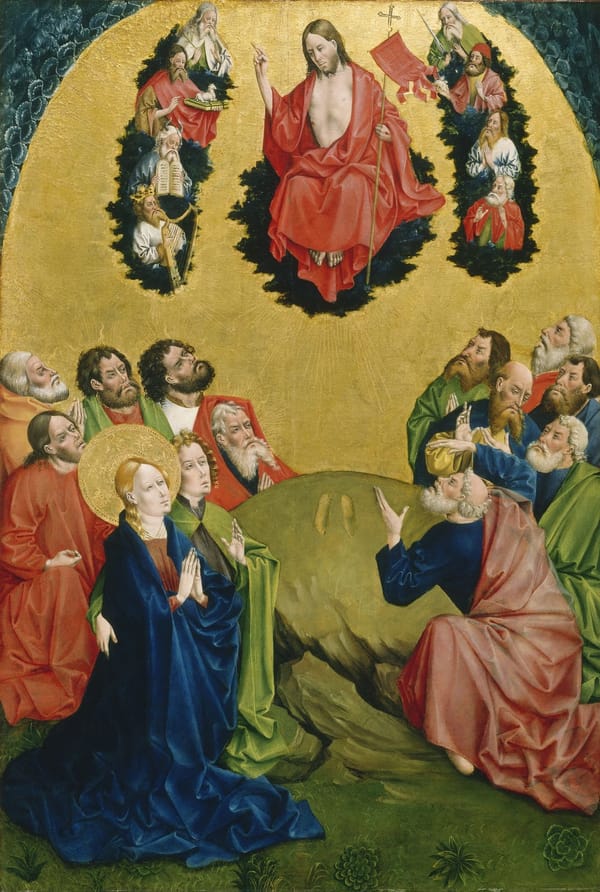
Jesus has ascended into heaven. His Divinity had never been absent; hut, by the Ascension, His Humanity was also enthroned there, and crowned with the brightest diadem of glory. This is another phase of the mystery we are now solemnizing. Besides a triumph, the Ascension gave to the sacred Humanity a place on the very throne of the eternal Word, to whom it was united in unity of Person. From this throne, it is to receive the adoration of men and of angels. At the name of Jesus, Son of Man, and Son of God,—of Jesus who is seated at the right hand of the Father almighty,—'Every knee shall bend, in heaven, on earth and in hell.’1
Give ear, O ye inhabitants of earth! This is the Man Jesus, who heretofore was a little Babe wrapped in swaddling clothes; who went through Judea and Galilee, not having where to lay His head; who was bound by the sacrilegious hands of his enemies, was scourged, crowned with thorns, nailed to a cross; who, whilst men thus trampled Him, as a worm, beneath their feet, submitted His will to that of His Father, accepted the chalice of suffering, and, that He might make amends to the divine glory, shed His Blood for the redemption of you sinners. This Man Jesus, child of Adam through Mary the immaculate, is the master-piece of God’s omnipotence. He is the most beautiful of the sons of men’;2 the angels love to fix their gaze upon Him;3 the blessed Trinity is well-pleased with Him; the gifts of grace bestowed on Him surpass all that men and angels together have ever received. But He came to suffer, and suffer for you; and though He might have redeemed you at a much lower price, yet would He generously overpay your debts by a superabundance of humiliation and suffering. What reward shall be given to Him? The apostle tells us in these words: 'He humbled Himself, becoming obedient unto death, even to the death of the cross; for which cause God also hath exalted Him, and hath given Him a name, which is above all names.’4
You, then, who compassionate with Him in the suffering whereby He wrought your redemption; you who devoutly follow Him in the stages of His sacred Passion; now raise up your heads, and look up to the highest heaven! Behold this Jesus ‘crowned with glory and honour because He suffered death’!5 See how the Father has magnified Him in return for His having 'emptied Himself, taking the form of a servant,’ though in His other nature, He was equal with God.6 His crown of thorns is replaced by a crown of precious stones.7 The cross that was laid on His shoulders is now the ensign of His power.8 The wounds made by the nails and the spear are now like five bright suns that light up all heaven. Glory, then, he to the justice of the Father, who has dealt thus with His Son! Let us rejoice at seeing the Man of sorrows9 become now the King of glory; and let us, with all the transport of our souls, repeat the hosanna wherewith the angels welcomed Him into heaven.
Nor must we suppose that the Son of Man now that He is seated on the throne of His Divinity, is inactive in His glorious rest. No; the sovereignty bestowed upon Him by the Father, is an active one. First of all, He is appointed Judge of the living and of the dead,10 before whose judgement-seat we must all stand.11 No sooner shall our soul have quitted the body, than she shall be presented before this tribunal, and receive from the lips of the Son of Man the sentence she will have deserved. O Jesus! by the glory Thou didst receive on the day of Thine Ascension, have mercy on us at that moment whereon depends eternity.
But the judgeship of our Lord Jesus Christ is not to be confined to this silent exercise of His sovereign power. The angels, who appeared to the apostles after His Ascension, told us that He is to come again upon the earth; that He is to descend through the clouds, as He ascended; and that then shall be the last judgement, at which the whole human race is to be present! Throned on a cloud, and surrounded by the angelic host, the Son of Man will show Himself to mankind, and this time with all majesty. Men shall see Him whom they pierced;12 the imprints of those wounds, which will give additional beauty to His sacred Body, will be an object of terror to the wicked, while to the good they will be a source of unspeakable consolation. The shepherd, seated on His ethereal throne, will separate the goats from the sheep. His voice, after so many ages of silence, will make itself once more heard upon this earth: He will speak to impenitent sinners, condemning them to eternal torments; He will speak to the just, calling them to approach Him, and ascend, body and soul, into the region of everlasting bliss.
Meanwhile, He exercises over all nations the royal power, which He received, as Man, on the day of His Ascension. He redeemed us all by His Blood; we are therefore His people, and He is our King. He is, and He calls Himself, 'King of kings and Lord of lords.’13 The kings of the earth reign not either by their own prowess, or by the boasted social compact; they lawfully reign by Christ alone. Peoples and nations are not their own masters; they belong to Christ and are His subjects. His law requires no sanction from man; it is above all human laws, and should be their guide and controller. ‘Why have the nations raged, and the people devised vain things? The kings of the earth stood up and the princes met together, against the Lord and against His Christ. They said: Let us break their bonds asunder, and let us cast away their yoke from us,’14 How vain all these efforts! For, as the apostle says, ‘He must reign, until He hath put all His enemies under His feet.’15 that is, until His second coming, when the pride of man and satan’s power shall both be at an end.
Thus, then, the Son of Man, crowned at His Ascension, must reign over the world to the end of time. But it will be objected: 'How can He be said to reign in these our times, when kings and emperors and presidents acknowledge that their authority comes from the people; and when the people themselves, carried away with the ideas of self-government and liberty and independence, have lost all idea of authority?’ And yet, He reigns; He reigns in His justice, since men refused to be guided by His clemency . They expunged His law from their statutes; they gave the rights of citizenship to error and blasphemy: then did He deliver them up, both people and rulers, to their own follies and lies. Authority and power have become ephemeral: and as they scorn to receive the consecration of the Church, the hand that holds them to-day, may be empty to-morrow. Then anarchy, then a new ruler, and then a fresh revolution. This will be the future, as it is the present, history of nations, until they once more acknowledge Jesus as their King, and resume the constitution of the ages of faith: ‘It is Christ that conquers! it is Christ that reigns! it is Christ that commands! May Christ preserve His people from all evil!'
On this Thy coronation-day, receive our devoted homage, O Jesus, our King, our Lord, our Judge! By our sins, we were the cause of Thy humiliations and sufferings; so much the more fervently, then, do we nite with the acclamations made to Thee by the angels when the royal diadem was placed on Thy head by the eternal Father. As yet, we but faintly see Thy grandeur; but the holy Spirit, whom Thou art about to send upon us, will teach us more and more of Thy sovereign power, for we are, and wish to be eternally, Thy humble and faithful subjects!
In the middle-ages, the Sunday within the octave of the Ascension was called the Sunday of roses, because it was the custom to strew the pavement of the churches with roses, as a homage to Christ who ascended to heaven when earth was in the season of flowers. How well the Christians of those times appreciated the harmony that God has set between the world of grace and that of nature! The feast of the Ascension, when considered in its chief characteristic, is one of gladness and jubilation, and spring’s loveliest days are made for its celebration. Our forefathers had the spirit of the Church; they forgot, for a moment, the sadness of poor earth at losing her Emmanuel, and they remembered how He said to His apostles: 'If ye loved Me, ye would be glad, because I go to the Father!’16 Let us do in like manner; let us offer to Jesus the roses wherewith He has beautified our earth: their beauty and fragrance should make us think of Him who made them, of Him who calls Himself the flower of the field and the lily of the valleys.17 He loved to be called Jesus of Nazareth; for Nazareth meaus a flower; and the symbol would tell us what a charm and sweetness there is in Him whom we serve and love as our God.
Mass
The Introit, which is taken from the Book of Psalms, expresses the longings of the Church to behold her Spouse, who has fled far from her. The faithful soul is possessed with the same desire; she unites in the prayer of our holy mother, and says to Jesus: ‘Oh! hearken to the wish of my heart, and show me Thy divine face!’
Introit
Ps. Dominus illuminatio mea, et salus mea: quem timebo? ℣. Gloria Patri. Exaudi.
Ps. The Lord is my light, and my salvation: whom shall I fear? Glory &c. Hear, &c.
The Church, in the Collect, teaches us to ask of God that good will, which will render us worthy of seeing our Jesus, by making us zealous in the service of His divine Majesty.
Collect
A commemoration of the Ascension is added, by the Collect, page 176.
Epistle
I Cap. iv.Charissimi, estote prudentes, et vigilate in orationibus. Ante omnia autem, mutuam in vobismetipsis caritatem continuam habentes: quia caritas operit multitudinem peccatorum. Hospitales invicem sine murmuratione. Unusquisque, sicut accepit gratiam, in alterutrum illam administrantes, sicut boni dispensatores multiformis gratiae Dei. Si quis loquitur, quasi sermones Dei: si quis ministrat, tamquam ex virtute, quam administrat Deus: ut in omnibus honorificetur Deus per Jesum Christum Dominum nostrum.
I Ch. iv.Dearly beloved: Be prudent, and watch in prayers. But before all things have a constant mutual charity among yourselves: for charity covereth a multitude of sins. Using hospitality one towards another, without murmuring. As every man hath received grace, ministering the same one to another: as good stewards of the manifold grace of God. If any man speak, let him speak as the words of God. If any man minister, let him do it as of the power which God administereth; that in all things God may be honoured through Jesus Christ our Lord.
The prince of the apostles, who presided over the holy assembly that awaited in the cenacle the descent of the divine Spirit, here addresses us, who are in expectation of the same great gift, and recommends us to practise fraternal charity. This virtue, says he, covereth a multitude of sins; could we make any better preparation for receiving the Holy Ghost? This Paraclete is coming that He may unite all men into one family; let us, then, put an end to all our dissensions, and prove ourselves to be members of the brotherhood established by the preaching of the Gospel. During these days of our preparing to receive the promised Comforter, the apostle bids us be prudent and watch in prayers. Let us follow his instruction; we must show our prudence by excluding everything that might be an obstacle to the Holy Ghost’s entering our hearts; and as to prayer, it is the means which will open our hearts to Him, that He may make them His own for ever.
The first of the two Alleluia-versicles is taken from the Psalms, and celebrates the majesty of Jesus upon His royal throne; the second is formed of the words of this same Saviour, promising us that He will return at the end of the world, when He comes to gather together His elect.
Gospel
Cap. xv., xvi.In illo tempore: dixit Jesus discipulis suis: cum venerit Paraclitus, quem ego mittam vobis a Patre, Spiritum veritatis, qui a Patre procedit, ille testimonium perhibebit de me: et vos testimonium perhibebitis, quia ab initio mecum estis. Hæc locutus sum vobis, ut non scandalizemini. Absque synagogis facient vos: sed venit hora ut omnis, qui interficit vos, arbitretur obsequium se præstare Deo. Et hæc facient vobis, quia non noverunt Patrem, neque me. Sed hæc locutus sum vobis: ut, cum venerit hora eorum, reminiscamini quia ego dixi vobis.
Ch. xv., xvi.At that time: Jesus said to his disciples: when the Paraclete cometh, whom I will send you from the Father, the Spirit of truth, who proceedeth from the Father, he shall give testimony of me; and you shall give testimony, because you are with me from the beginning. These things have I spoken to you, that you may not be scandalized. They will put you out of the synagogues; yea the hour cometh, that whosoever killeth you will think that he doth a service to God. And these things will they do to you, because they have not known the Father, nor me. But these things I have told you; that when the hour shall come, you may remember that I told you of them.
Here we have our Jesus telling us the effects, which the coming of the Holy Ghost will produce in our souls. These words were first addressed to the apostles, at the last Supper. He told them that the Paraclete would give testimony of Him, that is, would instruct them upon His Divinity, and teach them to be faithful to Him, even so as to lay down their lives for Him. A few moments before His Ascension, Jesus again spoke to them concerning the Paraclete, and called Him’the power from on high.’18 Severe trials were awaiting these apostles; they would have to resist unto blood.19 Who would be their support P For, of themselves, they were but weak men. The Holy Ghost, who was to abide with them. By Him they would conquer, and the Gospel would be preached to all nations. Now, this Spirit of the Father and of the Son is about to descend upon us; and what is the object of His visit, but that of arming us for the combat, and strengthening us against the attacks of our enemies? As soon as this holy season of Easter is over, and we no longer have the celebration of its mysteries to enlighten and cheer us, we shall find ourselves at the old work of battling with the three enemies: the devil, who is angered by the graces we have received; the world, to which we must unfortunately return; and our passions, which, after this calm, will again awaken, and molest us. If we be’endued with the power from on high’, we shall have nothing to fear. Let us, therefore, ardently desire to receive Him; let us prepare Him a worthy reception; let us use every endeavour to make Him abide with us; and we shall gain the victory, as did the apostles.
The Offertory gives us the words of the psalmist, describing the glories of Jesus’ Ascension. Holy Church wishes to impress the thought of this triumph well upon us, that our hearts may be fixed on the dear country, where our Jesus awaits us.
Offertory
While offering to God the bread and wine, which are soon to be changed into the Body and Blood of Christ, the Church, in the Secret, prays that we may not only be made pure by our contact with these divine mysteries, but may also receive the vigour and energy which are so indispensably needed by every Christian.
Secret
A commemoration is then made of the Ascension, by the Secret of the feast, given on page 182.
The Preface is that of the Ascension, page 182.
The Communion-anthem is formed of the words addressed by Jesus to His eternal Father, after having instituted the sacrament of the Eucharist, at the last Supper. They show us what His wishes are in our regard.
Communion
Thanksgiving is the Christian’s first duty after receiving, in holy Communion, the Body and Blood of Christ. The Church, which appreciates so much more perfectly than we can ever do the greatness of the favour thus bestowed on us, prays, in her Postcommunion, that we may ever be giving thanks to our divine benefactor.
Postcommunion
Vespers
Antiphon of the Magnificat
OREMUS
Omnipotens sempiterne Deus, fac nos tibi semper et devotam gerere voluntatem, et majestati tuæ sincero corde servire. Per Dominum.
LET US PRAY
O almighty and eternal God, inspire thy servants with true devotion, and grant that we may serve thy divine Majesty with sincere hearts. Through, &c.
Let us offer to our triumphant Jesus the following beautiful hymn, which is used by the Church at the Matins of the feast of the Ascension, and during the octave. It forcibly expresses the mystery, and shows us how fervently we ought to celebrate it.
Hymn
Redemptor et fidelium,
Cui mors perempta detulit
Summae triumphum gloriae.
Quo te vocabat cœlitus
Collata, non humanitus,
Rerum potestas omnium.
Cœlestium, terrestrium
Et inferorum condita,
Flectat genu jam subdita.
Versam vicem mortalium:
Peccat caro, mandat caro,
Regnat Deus Dei caro.
Manens Olympo præmium,
Mundi regis qui fabricam,
Mundana vincens gaudia.
Ignosce culpis omnibus,
Et corda sursum subleva
Ad te superna gratia.
Clarere nube judicis,
Poenas repellas debitas,
Reddas coronas perditas.
Qui victor in cœlum redis,
Cum Patre et almo Spiritu,
In sempiterna sæcula.
and Redeemer of the faithful!
thy victory over death won for thee
a triumph of highest glory.
there to exercise thy supreme
power over all creatures,
—a power conferred by heaven, not by man.
of heaven, earth, and hell,
is subject to thee; and all things in them
bow the knee in homage to thy power.
it was flesh that sinned,
and now Flesh taketh all sin away,
and the God that reigns is the God made Flesh.
to be our reward in heaven.
Thou art the ruler of this world;
our joy that surpasses all earthly joys.
that thou pardon all our sins,
and, by thy heavenly grace,
lift up our hearts to the things that are above.
suddenly on a bright cloud as our judge,
thou mayst forgive us the punishment we deserve,
and restore to us the crown we had lost.
who ascendest in triumph to heaven!
and to the Father, and to the Spirit of love,
for everlasting ages.
We may close the day with this prayer, taken from the Mozarabic breviary.
Prayer
- Philipp. ii. 10. ↩︎
- Ps. xliv. 3. ↩︎
- 1 St. Pet. i 21. ↩︎
- Philipp ii. 8, 9. ↩︎
- Heb. ii. 9. ↩︎
- Philipp. ii. 6,7. ↩︎
- Ps. xx. 4. ↩︎
- Is. ix. 6. ↩︎
- Is. liii. 3. ↩︎
- Acts, x. 42. ↩︎
- Rom. xiv. 10. ↩︎
- Zach. xii. 10. ↩︎
- Apoc. xix. 16. ↩︎
- Ps. ii. 1-3. ↩︎
- 1 Cor. xv, 25. ↩︎
- St. John, xiv. 28. ↩︎
- Cant. ii, 1. ↩︎
- St. Luke, xxiv. 49. ↩︎
- Heb. xii. 4. ↩︎
May 16: St. Ubaldus, Bishop and Confessor
IN order to honour her eternal High Priest, the Church presents to him this day the merits of a pontiff who, after his mortal career, was admitted into a happy immortality. Ubaldus, here on earth, was the image of our Lord Jesus Christ. Like his divine Master, he received the holy anointing of priesthood; he was a mediator between God and man; he was the shepherd of a flock; and now he is united with our Risen Jesus, the great Anointed, the Mediator, the Shepherd. In proof of his influence in heaven, Ubaldus has had given to him a special power against the wicked spirits who lay snares for our perdition. It has frequently happened that the simple invocation of his name has sufficed to foil their machinations. The Church has fixed this day as his feast with the view of encouraging the faithful to have recourse to his protection.
Let us now read the account she gives of the virtues of the saintly bishop:
O blessed Pontiff! be thou our protector against the spirits of hell. They are devoured by envy at seeing how man, that lowly and feeble creature, has become the object of God’s predilection. The incarnation of the Son of God, his death on the cross, his glorious resurrection, the sacraments which give us the life of Grace—all these sublime means, whereby the infinite goodness of God has restored us to our lost dignity,have excited the rage of the old enemy, and he seeks revenge by insulting, in us, the image of our Creator. At times he attacks man with all the frenzy of angry jealousy. To mimic the operations of sanctifying grace, which, so to speak, makes us the instruments of God’s good pleasure, Satan sometimes takes possession of our fellow-creatures, and makes them his slaves. Thy power, O Ubaldus, has often manifested itself by rescuing these unhappy victims of the devil’s jealousy; and Holy Church, on this day, celebrates the special prerogative conferred on thee by our heavenly Father. Relent not in the exercise of thy charitable office. And yet, O holy Pontiff, thou knowest that the snares of the wicked spirits are more inj urious to the souls than to the bodies of men. Have pity, then, on the unhappy slaves of sin, who, though the divine Sun of the Pasch has risen upon them, are still in the darkness of guilt. Pray for them, that they may become once more children of the light, and share in the Easter Resurrection which Jesus offers to all.
May 16 (the Same Day): St. John Nepomucen, Martyr
TO the martyrs who were slain because they refused to adore false gods—to the martyrs whose blood was shed by heretics—there is added to-day another brave soldier of Christ, who won his crown in a very different sort of combat. The sacrament of Penance whereby sinners regain the heaven they had lost claims John Nepomucen as its glorious defender.
A holy secrecy shrouds the reconciliation made between God and the penitent. This sacramental secrecy deserved to have its martyr. When Jesus instituted the sacrament of Penance—that second baptism, wherein the Blood of our Redeemer washes away the sins of the Christian soul—he willed that man should not be deterred from confessing his humiliations to his spiritual physician by the fear of their ever being revealed. How many hidden martyrdoms have there not been, during these eighteen hundred years, for the maintenance of this secret, which, whilst it gives security to the penitent, exposes the confessor to obloquy, injustice, and even death! But the martyr we honour to-day was not one of these hidden sufferers. His testimony to the inviolability of the sacramental seal was public; he gave it amidst cruel tortures; it cost him his life.
All praise, then, to the brave and faithful priest! Right worthy was he to hold in his hands the keys that open or shut the gate of heaven! In this great fact of the observance of the seal of confession, on which depends the salvation of millions of souls, we have a permanent miracle. But there was one thing wanting to it—the glory of martyrdom. The holy priest of Prague gave it that glory; and he offers the fair palm to our Risen Jesus, whom we have seen, during these days between his Resurrection and Ascension, mercifully instituting the sacrament of Penance, wherein he communicates to men his own power of forgiving sin.
We subjoin the Lessons approved by the Holy See for the feast of this great martyr:
How great, O glorious martyr, was the honour reserved for thee by the Son of God, when he chose thee to be the one who was to attest, by laying down his life, the sacredness of the secret which protects the sacrament of Penance! Other priests, as well as thyself, have bravely suffered persecution for the sake of the secrecy of the mystery of reconciliation: but thou wast the one chosen by heaven to give a solemn testimony of priestly discretion. Thy sufferings were known to more than angels: thy martyrdom was a public one, and the faithful honour thy courage as an eloquent proof of how truly our good Shepherd, Jesus, removes every difficulty that could deter the strayed sheep from returning to the fold.
We address ourselves to thee, O holy martyr, on this day of thy triumph and beseech thee to intercede for sinners. Admirable minister of the sacrament of Penance! thou seest how many Christians there are who neglect to avail themselves of the means of salvation prepared for them by our risen Saviour. Instead of laying hold of this ‘second plank after shipwreck,’ they let themselves be carried on to the deep abyss by the tide of their sinful habits. There are thousands who have turned a deaf ear, even this Easter, to the call of Holy Church, who invited them, as an affectionate Mother, to approach the tribunal of mercy and reconciliation. We beseech thee, intercede for these blind, unwary, ungrateful men. Procure for them the grace which will lead them to the feet of the God of mercy, who is ever ready to grant pardon.
There are others, again, who go to Confession, but who have not the dispositions requisite for receiving the grace of the Sacrament—the justification of their souls. Pray also for these, that they may see the danger they thus incur of profaning the Blood of Christ. Obtain for all them who approach the holy tribunal an honest avowal of their sins, and contrition of heart; that thus the life of our Risen Jesus may be imparted to them and that they may never again lose it. By thy powerful intercession, raise up zealous and faithful ministers of this great sacrament of which thou wast the martyr. Draw down the blessing of heaven on their arduous labour: then will the number of the children of God be increased, and the grace of the Holy Ghost triumph in souls that have long been dead in sin.
Cast, too, an eye of compassion on thy fatherland of Bohemia, where there are so many faithful hearts that love and honour thee. Alas! there are tares which disfigure that portion of the Church. The enemy came, not many years after thy glorious martyrdom, and sowed the baneful weeds of heresy in thy native land. The good seed claims thy protection; but take pity also on the cockle, for even it may be turned, by the true faith, into wheat, and be garnered into the house of our heavenly Father. Secure peace to thy Bohemia and save her from the snares that are laid for her.
| Previous May 15: St. John Baptist de la Salle, Confessor | Next May 16: St. Ubaldus, Bishop and Confessor |