Daily reading
Paschal Time
Double · Movable from Easter · Temporal
May 17, 2021
From Dom Guéranger’s The Liturgical Year.
 |
Monday within the Octave of the Ascension
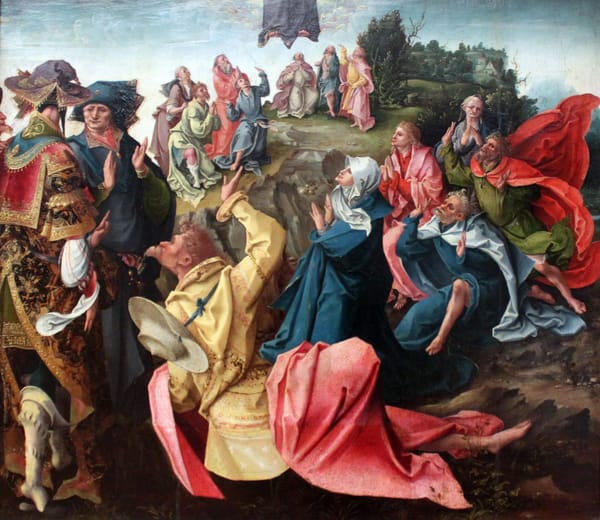
The kingship over men is not the only diadem given to our Emmanuel at His Ascension. The apostle expressly tells us that He is, moreover, ‘the Head of all principality and power.’1 Noble indeed is man; hut nobler far are the glorious choirs of the angelic hierarchy. We have already seen that in the great trial, whereby God tested the love of His angels, many rebelled and were oast into hell; the rest, who were faithful, entered at once into the possession of their sovereign good, and began round the throne of God their ceaseless hymns of adoration, love, and thanksgiving.
But a portion of their happiness was reserved till the fulfilment of one of God’s decrees. Laden as they are with the most magnificent gifts, they await another; it is to be the completion of their joy and glory. God revealed to them, at the first instant of their coming into existence, that He intended to create other beings, of a nature inferior to their own; and that of these beings, who were to be composed of body and soul, there should be one, whom the eternal Word would unite to Himself in unity of Person. It was also revealed to them, that this human Nature, (for whose glory and for God’s, all things were made), was to be the first-born of every creature;2 that all angels and men would have to bend the knee before Him; that after suffering countless humiliations on earth, He would be exalted in heaven; and finally that the time would be, when the whole hierarchy of heaven, the Principalities and Powers, yea, even the Cherubim and Seraphim, would have Him placed over them as their King.
The angels, then, as well as men, looked forward to the coming of Jesus. The angels awaited Him that was to confer upon them their final perfection, give them unity under Himself as their head, and bring them into closer union with God by the union of the divine and created Natures in His own Person. As to us men, we awaited Him as our Redeemer and our mediator: as our Redeemer, because sin had closed heaven against us, and we needed one that would restore us to our inheritance; as our mediator, because it was the eternal decree of God to communicate His own glory to the human race by union with Himself. Whilst, therefore, the just ones on earth, who lived before the Incarnation, were pleasing to God by their faith in this future Redeemer and mediator, the angels in heaven were offering to the divine Majesty the homage of their proffered service of this Man-God, their future King, who, in virtue of the eternal decree, was ever present to the Ancient of days.3
At length the fulness of time came,4 and God, as the apostle expresses it, ‘brought into the world His first-begotten’,5 the prototype of creation. The first to adore the new-born King were not men, but the angels, as the same apostle assures us.6 The royal prophet hed foretold that it would be so.7 And was it not just? These blessed spirits had preceded us in their longings, not indeed for a Redeemer,—for they had never sinned,—but for a mediator, who was to be the link of their closer union with infinite beauty, the object of their eternal delight; in a word, who was to fill up the void there seemed to be even in heaven, by taking the place destined for Him.
Then was accomplished that act of adoration of the Man-God, which was demanded of the angels at the first moment of their creation, and which, according to its being complied with or refused, decided the eternal lot of these noble creatures. With what love did the faithful angels adore Jesus, the Word made Flesh, when they beheld Him in His Mother’s arms at Bethlehem! With what transports of joy did they announce to the shepherds, and to us through them, the glad tidings of the birth of our common King!
As long as He lived upon this earth and submitted to every humiliation and suffering in order to redeem us from sin and make us worthy to become His members, the blessed spirits ceased not to contemplate and adore Him. The Ascension came; and from that day forward, it is on the throne prepared at the Father’s right hand that they behold and adore their Lord and King. At the solemn moment of Jesus’ Ascension, a strange joy was felt in each choir of the heavenly hierarchy, from the burning Seraphim to the Angels who are nearest to our own human nature. The actual possession of a good, whose very expectation had filled them with delight, produced an additional happiness in those already infinitely happy spirits. They fixed their enraptured gaze on Jesus’ beauty, and were lost in astonishment at seeing how Flesh could so reflect the plenitude of grace that dwelt in that human Nature as to outshine their own brightness. And now, by looking on this Nature (which, though inferior to their own, is divinized by its union with the eternal Word), they see into further depths of the uncreated sea of light. Their love is more burning, their zeal is more impetuous, their hymns are more angelic; for, as the Church says of them, the Angels and Archangels, the Powers and Dominations, the Cherubim and Seraphim, praise the majesty of the Father through His Son Jesus Christ: per quem majestatem tuam laudant angeli.
Add to this the joy these heavenly spirits must have experienced at seeing the immense multitude that accompanied Jesus from earth to heaven. These, according to their respective merits, were divided among the various choirs, and placed on thrones left vacant by the fallen angels. Their bodies, are not yet united to their souls; but is not their flesh already glorified in that of Jesus? When the time fixed for the general resurrection comes, the trumpet of the great archangel will be heard,8 and then these happy souls will again put on their ancient vesture, the mortal made immortal. Then will the holy angels, with fraternal enthusiasm, recognize in Adam’s features a likeness of Jesus, and in those of Eve a likeness of Mary, and the resemblance will even be greater than it was when our first parents were innocent and happy in the garden of Eden. Come quickly, O thou glorious day, whereon the bright mystery of the Ascension is to receive its final completion, and the two choirs of angels and men are to be made one in love and praise under the one Head, Christ Jesus!
It is St. Ambrose who is to help us to-day, by the following beautiful hymn, to celebrate the mystery of the triumph of our human nature in Jesus. The hymn is inserted in the breviary of Milan.
Hymn
Sacratus illuxit dies
Quo Christus, mundi spes, Deus,
Conscendit cœlos arduos.
Propriam ad sedem remeans,
Gavisa sunt cœli regna,
Reditu Unigeniti.
Mundi perempto principe,
Patris præsentat vultibus
Victricis carnis gloriam.
Et spem fecit credentibus,
Aperiens paradisum,
Quem protoplastus clauserat.
Quod partus nostræ Virginis,
Post sputa, flagra, post crucem,
Paternæ sedi jungitur.
Nostræ salutis vindici,
Nostrum quod corpus vexerit
Sublimem ad cœli regiam.
Commune manens gaudium,
Illis quod se præsentavit,
Nobis quod se non abstulit.
Christum exspectare nos decet,
Vitaque tali vivere,
Quae possit cœlos scandere.
Qui scandis super sidera,
Cum Patre et sancto Spiritu
In sempiterna saecula.
hath shone upon us: the day whereon Christ our God,
the hope of the world,
ascended to the highest heavens.
returning to his rightful throne,
the kingdom of heaven rejoiced,
for it was the return of the Only-begotten of the Father.
Having defeated the prince of this world,
Jesus presents to his Father the Flesh
that had won the glorious victory.
and opening the gate of heaven,
which our first parent had closed against us,
he inspired believers with hope.
that the Son of our Virgin-Mother,
after being spit upon, and scourged, and crucified,
was placed upon his Father’s throne!
and wrought our salvation,
for that he took our flesh
and made it dwell in the heavenly courts above.
between the angels and us;
they rejoice because he offered himself to their delighted gaze;
we, because he ceased not to be our Brother.
by the practice of virtues of which he has set us the example,
to await our union with Christ,
and so to live as to merit our ascension into heaven.
who ascendest above the stars!
and to the Father, and to the Holy Ghost,
for everlasting ages.
We may use this prayer of the Mozarabic breviary wherewith to close the day.
May 17: St. Paschal Baylon, Confessor
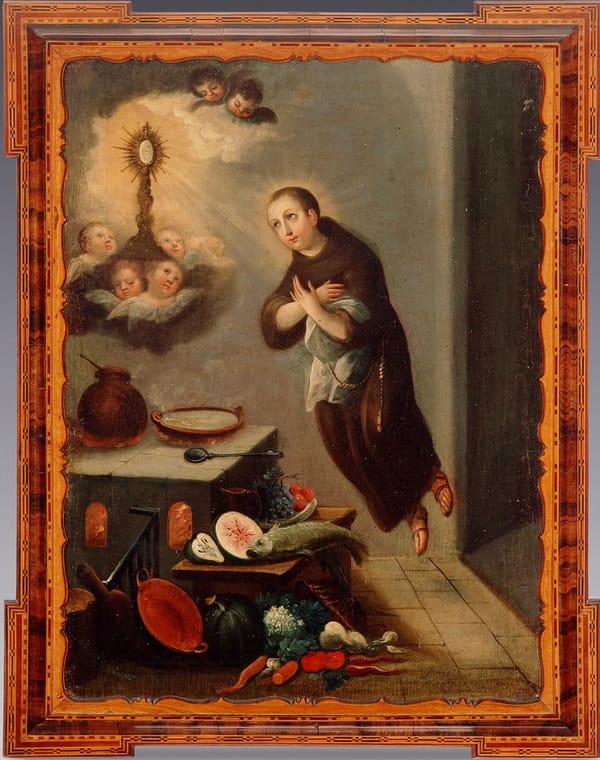 |
THE Seraph of Assisi was sure to depute some of his children to pay their court to his Risen Master. The one he sends to-day is the humblest and most obscure of men; another will follow, three days hence, powerful in word and work, and holding a palm in his hands, as a most devoted preacher of the Gospel. Paschal Baylon was a simple peasant. He was a shepherd-boy; and it was in tending his flock that he found the Lord Jesus. He had a great love for contemplation. Forests and fields spoke to him of their great Creator; and, in order that he might be the more closely united with him, he resolved to seek him in the highest paths of perfection. He was ambitious to imitate the humble, poor and suffering life of the Man-God; the Franciscan Cloister offered him the opportunity of satisfying this desire and he flew to it. On that blessed soil, he grew to be one of heaven's choicest plants, and the whole earth has now heard the name of the humble lay-brother of a little convent in Spain. Holy Church brings him before us to-day enraptured in the contemplation of Jesus' Resurrection. He had trod the path of humiliation and the cross; it was but just that he should share in his Master's triumph. It was of him, and of such as he, that this divine Saviour spoke, when he said: Ye are they that have continued with me in my temptations; and I dispose to you, as my Father hath disposed to me, a kingdom; that ye may eat and drink at my table in my kingdom, and may sit upon thrones, judging the twelve tribes of Israel.1
The account given by the Liturgy of the angelic life of this illustrious son of St Francis is as follows:
Heaven opened to receive thee, O Paschal! Even when here below, the fervour of thy contemplation often gave thee a foretaste of the delights of eternal bliss; but now every veil is drawn aside, and thou art face to face with him whom thou didst so ardently desire to possess. Thou hast no further need to unite thyself with him by humiliation and suffering; thou enjoyest his own glory, his own happiness, his own triumph, and he will have thee enjoy it for all eternity. Deign to cast an eye of pity on us, who have not thy eagerness to walk in our Redeemer’s footsteps, and who, as yet, have but the hope of being united to him for eternity. Gain for us courage. Gain for us that love which leads straight to Jesus, which surmounts every obstacle of flesh and blood, and gives to man an admirable resemblance to his divine Model. The pledge of this happy transformation has been given to us by our being permitted to partake of the Paschal Mystery; may it be perfected by our fidelity in keeping close to our divine conqueror and Lord! Though he leave us some time further in this vale of tears, his eye is ever upon us, he longs to see us persevere in our loyalty to him. Yet a little while, and we shall see him! Behold! says he, I come quickly; hold fast that which thou hast. Behold! I stand at the gate and knock. If any man shall hear my voice, and open to me the door, I will come in to him, and will sup with him, and he with me.2 Thus will the Pasch of time be changed into the Pasch of eternity. Pray for us, O Paschal, that like thee, we may hold fast that which, by the grace of our Risen Jesus, we already possess.
| Previous May 16 (the Same Day): St. John Nepomucen, Martyr | Next May 17: St. Paschal Baylon, Confessor |