Daily reading
Semidouble · Movable from Easter · Temporal
May 20, 2021
From Dom Guéranger’s The Liturgical Year.
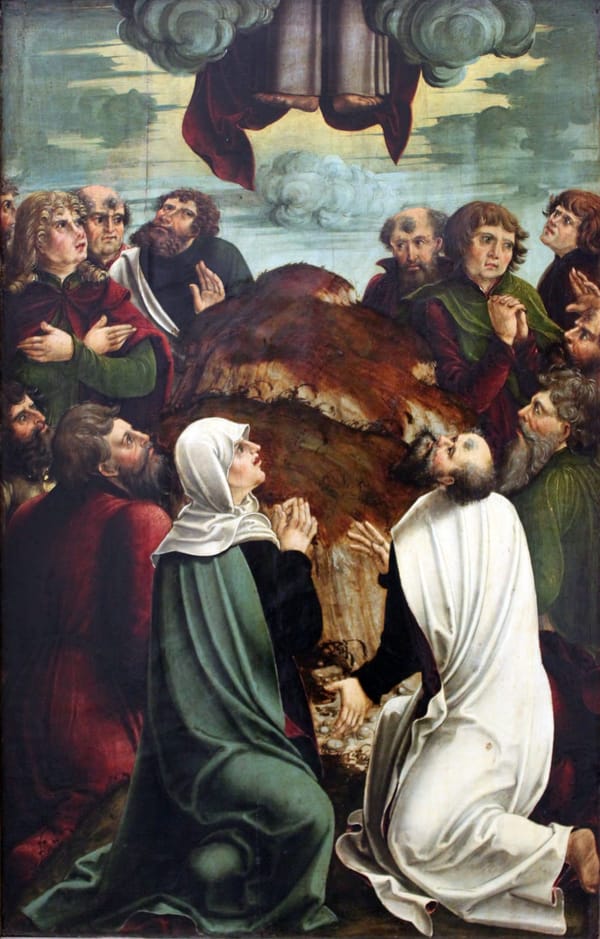
Thursday within the Octave of the Ascension
We have already seen how the Ascension of our Emmanuel won Him the empire over our understanding: it was the triumph of faith. The same mystery gave Him a second victory: the victory of love, which makes Him reign in our hearts. For eighteen hundred years, in whom have men believed, firmly and universally, except Jesus? In what have men agreed, except the dogmas of faith? What countless errors has this divine torch dispelled! What light has it given to the nations that received it! And in what darkness has it left those which rejected it after having once received it!
In like manner, no one has been loved as our Jesus has been, ever since the day of His Ascension; no one is so loved now or ever will be, as He. But that He might thus win our love He had to leave us, just as He had to do in order to secure our faith. Let us return to our text, that we may get deeper into the beautiful mystery.’It is expedient for you that I go!’1 Before the Ascension, the disciples were as inconstant in their love as they were in their faith. Jesus could not trust them. But no sooner had He left them, than they became warmly devoted to Him. Instead of complaining of their bereavement, they returned full of joy to Jerusalem. The thought of their master’s triumph made them forget their own loss, and they hastened, as He bade them, to the cenacle, where they were to be endued with power from on high. Watch these men during the subsequent years; examine what their conduct was from that time to the day of their death; count, if you can, their acts of devotedness in the arduous labour of preaching the Gospel; and say, if any other motive than love for their master could have enabled them to do what they did. With what cheerfulness did they drink His chalice!2 With what raptures did they hail His cross, when they saw it being prepared for themselves!
But let us not stop at these first witnesses; they had seen Jesus, and heard Him, and touched Him.3 Let us turn to those who came after them, and knew Him by faith only; let us see if the love, which burned in the hearts of the apostles, has been kept up by the Christians of the past eighteen centuries. First of all, there is the contest of martyrdom, which has never been altogether interrupted since the Gospel began to be preached. The opening campaign lasted three hundred years. What was it that induced so many millions to suffer, not only patiently but gladly, every torture that cruelty could devise? Was it not their ambition to testify how much they loved their Jesus? Let us not forget how these frightful ordeals were cheerfully gone through, not only by men hardened to suffering, but also by delicate women, by young girls, yea even by little children. Let us call to mind the sublime answers they gave to their persecutors, whereby they evinced their generous ardour to repay the death of Jesus by their own. The martyrs of our own times, in China, Japan, the Corea, and elsewhere, have repeated, without knowing it, the very same words to their judges and executioners as were addressed to the proconsuls of the third and fourth centuries by the martyrs of those days.
Yes, our divine King who has ascended into heaven, is loved as no other ever was or could be. Think of those millions of generous souls, who, that they might be exclusively His, have despised all earthly affections, and would know no other love than His. Every age,—even our own, in spite of all its miseries,—has produced souls of this stamp, and God alone knows how many.
Our Emmanuel has been, and to the end of time will ever be, loved on this earth. Have we not reason to say so, when we consider how many there have always been, even among the wealthiest ones of the world, who, in order that they might bear a resemblance to the Babe of Bethlehem, have given up everything they possessed? What an irresistible proof of the same truth we have in the countless sacrifices of self-love and pride, made with a view to imitate the obedience of the God-Man on earth! And what else but an ardent love of Jesus could have prompted those heroic acts of mortification and penance, whereby the sufferings of His Passion have been emulated, and, as the apostle says, filled up?4
But grand as all this is, it was not enough to satisfy man’s devoted love of His absent Lord. Jesus had said: ‘Whatsoever you do to the least of your brethren, you do it to Me.’5 Love is ever quick at catching the meaning of our Redeemer’s words. It took advantage of these, and saw in them another means for reaching Jesus,—reaching Him through the poor. And as the worst of poverties is the ignorance of divine truths, because it would make a man poor and miserable for eternity, therefore have there risen up in every age zealous apostles, who, bidding farewell to home and fatherland, have carried the light of the Gospel to them that sat in darkness and in the shadow of death. They heeded not the fatigues or the perils of such a mission: what cared they for all these things, if they could but make Jesus known and honoured and loved by one poor savage or Hindoo?
But what of those other poor ones, the sick, in whom Jesus suffers? Fear not: He is too much loved to be forgotten there. Once let the Church be free enough to develop her plans of charity, and there will be an institute of relief for every class of sufferers. The poor, the sick, all will be cared for and comforted. There will be vocations to charity, to meet every want; and women, too, urged by the love of their divine Lord, will deem it an honour to be the nurses and attendants of a suffering or dying Lazarus. The world itself is in admiration at their heroism; and though it knows not the divine principle which originates these charitable institutions, yet is it obliged to acknowledge the extraordinary good they effect.
But man’s observation can only reach the exterior; the interior is the far grander reality, and it is beyond his notice. What we have said so far is, therefore, but a very feeble description of the ardour wherewith our Lord Jesus Christ has been, and still is, loved on this earth. Let us picture to ourselves the millions of Christians who have lived since the first foundation of the Church. Many, it is true, have had the misfortune to be unfaithful to the object of their existence; but what an immense number have loved Jesus with all their heart and soul and strength!
Some have never flagged in their love; others have needed a conversion from vice or tepidity, returned to Him, and slept in the kiss of peace. Count, if you can, the virtuous actions, the heroic sacrifices, of those countless devoted servants of His, who are to be arrayed before Him in the valley of Josaphat. His memory alone can hold and tell the stupendous total of what has been done. This well-nigh infinite aggregate of holy deeds and thoughts, from the seraphic ardour of the greatest saint down to the cup of cold water given in the name of the Redeemer, what is it all but the ceaseless hymn of our earth to its beloved absent One, its never-forgotten Jesus? Who is the man, how dear soever his memory may be, for whom we would be devoted, or sacrifice our interests, or lay down our lives, especially if he had been ten or twenty ages gone from us? Who is that great Dead, the sound of whose name can make the hearts of men vibrate with love, in every country, and in every generation? It is Jesus, who died, who rose again, who ascended into heaven.
But we humbly confess, O Jesus, that it was necessary for us that Thou shouldst go from us, in order that our faith might soar up to Thee in heaven, and that our hearts, being thus enlightened, might burn with Thy love. Enjoy thine Ascension, O Thou King of angels and of men! We, in our exile, will feast on the fruits of the great mystery, waiting for it to be fulfilled in ourselves. Enlighten those poor blind infidels, whose pride will not permit them to recognize Thee, notwithstanding these most evident proofs. They continue in their errors concerning Thee, though they have such superabundant testimony of Thy Divinity in the faith and love Thou hast received in every age. The homage offered Thee by the universe, represented, as it has ever been, by the chief nations of the earth and by the most virtuous and learned men of each generation, is as nought in the eyes of these unbelievers. Who are they, to be compared with such a cloud of faithful witnesses? Have mercy on them, O Lord! save them from their pride; then will they unite with us in saying:’It was indeed expedient for this world to lose Thy visible presence, O Jesus! for never were Thy greatness, Thy power, and Thy Divinity, so recognized and loved, as when Thou didst depart from us. Glory, then, be to the mystery of Thine Ascension, whereby, as the psalmist prophesied, Thou receivedst gifts, that Thou mightest bestow them upon men!’6
We will take a hymn to-day from the Greek Church: it is the one she sings in honour of our Redeemer’s triumph, at her evening Office of Ascension day.
Hymn (In Assumptione Domini, ad magnum Vespertinum.)
As a close to this glorious octave, we offer the eighth and last of the beautiful prayers given by the Mozarabic breviary in honour of our Lord’s Ascension.
Prayer
May 20: St. Bernardine of Siena, Confessor
|
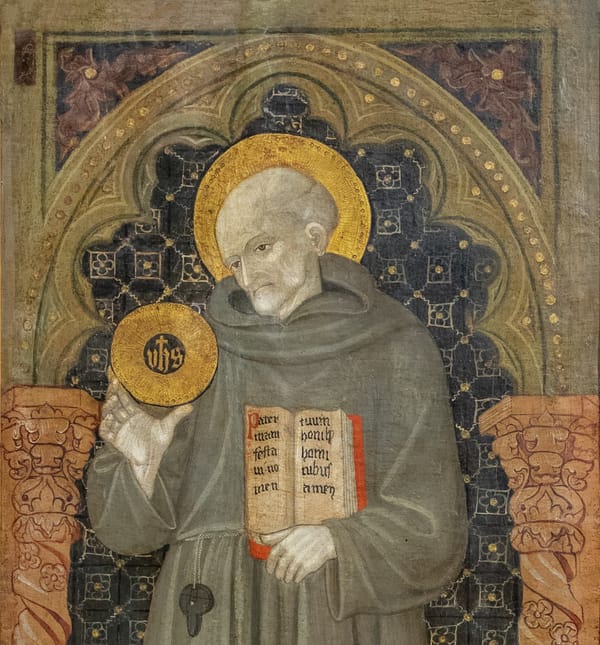
IN that season of the liturgical year when we were kneeling in love and prayer around the crib of the Infant Jesus, one day was devoted to the celebration of the glory and sweetness of his Name. Holy Church was full of joy when she pronounced the dear Name chosen from all eternity by her heavenly Spouse; and mankind found consolation in the thought that the great God who might so justly have bid us call him the Just and the Avenger, willed us henceforth to call him the Saviour. The devout Bemardine of Siena, whose feast we keep to-day, stood then before us, holding in his hands this ever blessed Name, surrounded with rays. He urged the whole earth to venerate with love and confidence the sacred name which expresses the whole economy of our salvation. The Church, ever attentive to what is for the good of her children, adopted the beautiful device. She encouraged them to receive it from the Saint, as a shield that would protect them against the darts of the evil spirit, and as an additional means of reminding ourselves of the exceeding charity wherewith God has loved this world of ours. And finally, when the loveliness of the holy Name of Jesus had won all Christian hearts, she instituted in its honour one of the most beautiful solemnities of Christmastide.
Bemardine, the worthy son of St Francis of Assisi, returns to us on this twentieth day of May, and the sweet flower of the holy Name is, of course, in his hand. But it is not now the prophetic appellation of the newborn Babe; it is not the endearing Name, respectfully and lovingly whispered by the Virgin-Mother over the crib; it is the Name whose sound has gone through the whole creation, it is the trophy of the grandest of victories, it is the fulfilment of all that was prophesied. The Name of Jesus was a promise to mankind of a Saviour; Jesus has saved mankind, by dying and rising again; he is now Jesus in the full sense of the word. Go where you will, and you hear this Name—the Name that has united men into the one great family of the Church.
The chief priests of the Synagogue strove to stifle the Name of Jesus, for it was even then winning men’s hearts. They forbade the Apostles to teach in this Name; and it was on this occasion that Peter uttered the words which embody the whole energy of the Church: We ought to obey God rather than men.1 The Synagogue might as well have tried to stay the course of the sun. So too, when the mighty power of the Roman Empire set itself against the triumphant progress of this Name, and would annul the decree that every knee should bow at its sound,2 its attempt was a complete failure, and at the end of three centuries the Name of Jesus was heard and loved in every city and hamlet of the Empire.
Armed with this sacred motto, Bernardine traversed the towns of Italy, which at that period (the fifteenth century) were at enmity with each other, and not unfrequently torn with domestic strifes. The Name of Jesus, which he carried in his hand, became as a rainbow of reconciliation; and wheresoever he set it up, there every knee bowed down, every vindictive heart was appeased, and sinners hastened to the sacrament of pardon. The three letters (I H S) which represent this Name, became familiar to the faithful; they were everywhere to be seen carved, or engraven, or painted; and the Catholic world thus gained a new form whereby to express its adoration and love of its Saviour.
Bernardine was a preacher of inspired eloquence. He was also a distinguished master in the science of sacred things, as is proved by the writings he has left us. We regret not being able, from want of space, to give our readers his words on the greatness of the Paschal mystery; but we cannot withhold from them what he says regarding the apparition of Jesus to his Blessed Mother after the Resurrection. They will be rejoiced at finding unity of doctrine on this interesting subject existing between the Franciscan school, represented by St Bemardine, and the school of St Dominic, whose testimony we have already given on the Feast of St Vincent Ferrer.
'From the fact of there being no mention made in the Gospel of the visit wherewith Christ consoled his Mother after his Resurrection, we are not to conclude that this most merciful Jesus, the source of all grace and consolation, who was so anxious to gladden his disciples by his presence, forgot his Mother, who he knew had drunk so deeply of the bitterness of his Passion. But it has pleased divine Providence that the Gospel should be silent on this subject; and this for three reasons.
‘In the first place, because of the firmness of Mary's faith. The confidence which the Virgin-Mother had of her Son's rising again had never faltered, not even by the slightest doubt. This we can readily believe, if we reflect on the special grace wherewith she was filled, she the Mother of the Man-God, the Queen of angels, and the Mistress of the world. To a truly enlightened mind, the silence of the Scripture on this subject says more than any affirmation could have done. We have learned to know something of Mary by the visit she received from the angel, when the Holy Ghost overshadowed her. We met her again at the foot of the Cross, where she, the Mother of Sorrows, stood nigh her dying Son. If then the Apostle could say: As ye are partakers of the sufferings, so shall ye he also of the consolation:3 what share must not the Virgin-Mother have had in the joys of the Resurrection? We should hold it as a certain truth that her most sweet Jesus, after his Resurrection, consoled her first of all. The holy Roman Church would seem to express this, by celebrating at Saint Mary Major's the Station of Easter Sunday. Moreover, if from the silence of the Evan-gelists you would conclude that our Risen Lord did not appear to her first, you must go farther, and say that he did not appear to her at all, inasmuch as these same Evangelists, when relating the several apparitions, do not mention a single one as made to her. Now, such a conclusion as this would savour of impiety.
'In the second place, the silence of the Gospel is explained by the incredulity of men. The object of the Holy Spirit, when dictating the Gospels, was to describe such apparitions as would remove all doubt from carnalminded men with regard to the Resurrection of Christ. The fact of Mary's being his Mother would have weakened her testimony, at least in their eyes. For this reason she was not brought forward as a witness, though most assuredly there never was or will be any creature (the humanity of her Son alone excepted) whose assertion better deserved the confidence of every truly pious soul. But the text of the Gospel was not to adduce any testimonies, save such as might be offered to the whole world. As to Jesus' apparition to his Mother, the Holy Ghost has left it to be believed by those that are enlightened by his light.
'In the third place, this silence is explained by the sublime nature of the apparition itself. The Gospel says nothing regarding the Mother of Christ after the Resurrection; and the reason is, that her interviews with her Son were so sublime and ineffable that no words could have described them. There are two sorts of visions: one is merely corporal, and feeble in proportion; the other is mainly in the soul, and is granted only to such as have been transformed. Say, if you will, that Magdalen was the first to have the merely corporal vision, provided that you admit that the Blessed Virgin saw, previously to Magdalen, and in a far sublimer way, her Risen Jesus, that she recognized him, and enjoyed his sweet embraces in her soul, more even than in her body.'4
Let us now read the Life of our Saint, as given, though too briefly, in the Lessons of to-day's Office:
How beautiful, O Bernardine, are the rays that form the aureole round the Name of Jesus! How soft their light on that eighth day after his birth, when he received this Name! But how dazzling, now that this Jesus achieves our salvation, not only by humiliation and suffering, but by the triumph of his Resurrection! Thou comest to us, O Bernardine, in the midst of the Paschal glory of the Name of Jesus. This Name, for which thou didst so lovingly and zealously labour, gives thee to share in its immortal victory. Now therefore, pour forth upon us, even more abundantly than when thou wast here on earth, the treasures of love, admiration and hope, of which this divine Name is the source, and cleanse the eyes of our soul, that we may one day be enabled to join thee in contemplating its beauty and magnificence.
Apostle of peace! Italy, whose factions were so often quelled by thee, may well number thee among her protectors. Behold her now a prey to the enemies of Jesus, rebellious against the Church of God, and abandoned to her fate. Oh! forget not that she is thy native land, that she was obedient to thy preaching, and that thy memory was long most dear to her. Intercede in her favour; deliver her from her oppressors; and show that when earthly armies fail, the host of heaven can always save both cities and countries.
Illustrious son of the great patriarch of Assisi! the seraphic Order venerates thee as one of its main supports. Thou didst reanimate it to its primitive observance; continue now from heaven to protect the work thou didst commence here on earth. The Order of St Francis is one of the grandest consolations of holy Mother Church; make this Order for ever flourish, protect it in its trials, give it increase in proportion to the necessities of the faithful; for thou art the second Father of this venerable family, and thy prayers are powerful with the Redeemer, whose glorious Name thou didst confess upon earth.
| Previous May 19 (the Same Day): St. Pudentiana, Virgin | Next May 20: St. Bernardine of Siena, Confessor |