Daily reading
Paschal Time
Double of the I Class · Movable from Easter · Temporal
May 25, 2021
From Dom Guéranger’s The Liturgical Year.

|
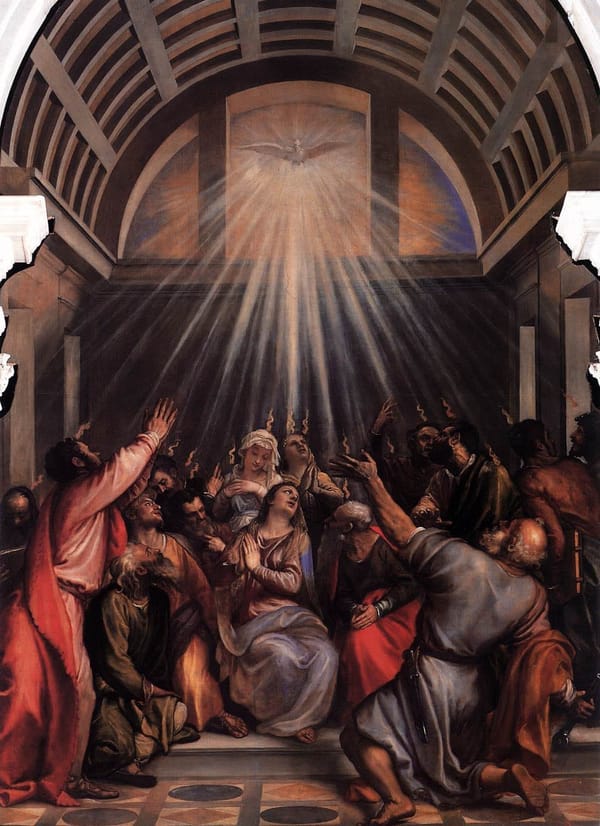
Tuesday in Whitsun Week
Yesterday, we were admiring the work of the Holy Ghost, whereby He drew mankind to the faith and the name of Jesus, to whom ‘all power was given in heaven and in earth.’1 The instruments used for this conquest were the apostles and their immediate successors. The tongue of fire was victorious, and the prince of this world was defeated, Let us continue our reflections, and see the further workings of the holy Spirit for the glory of the Son of God, who had sent Him into this world.
Our Emmanuel came down from heaven, that He might effect the union He had desired from all eternity. He began it by uniting our human nature to His own divine Person; but this personal union did not satisfy His love. He mercifully deigned to invite the whole human race to a spiritual union with Himself, by giving her to become His Church, His own dearest one,2 as He calls her; His ‘glorious Church, not having spot or wrinkle, but holy and without blemish.’3 But how could mankind, deformed as it was by sin, be worthy of such an honour? His love would make it worthy. He tells us that this Church is His bride.4 Having chosen her, He beautified her in the laver of His own precious Blood, and gave her, in dowry, the infinite merits He had acquired.
Thus prepared, her union with Him was to be of the closest. Jesus and His Church are one body; He is the Head, she is the aggregate of the members united together under this one Head. Such is the teaching of the apostle: ‘Christ is the Head of the Church; we are members of His body, of His flesh, and of His bones’.5 This body is to be formed of all who shall, in each successive age, be faithful to the call of divine grace, and enroll themselves as children of the Church. The world we inhabit is to be preserved, till the last elect required to complete the mystic body of Jesus, be added to the Church triumphant: then all will be consummated; the divine mystery of the Incarnation will have achieved its whole work.
But as in the Incarnate Word there was the invisible Soul and the visible Body, so also the Church was to have a soul and a body: a soul, whose hidden beauty no eye but God’s can fully see, at least during her earthly sojourn; and a body, which is to be visible to men: an ever-living proof of God’s power, and of His love for the human race. Up to the day of Pentecost, the just, who had been united under Jesus, their Head, had belonged only to the soul of the Church, for the body was not then in existence. The heavenly Father had adopted them as His children; the Son of God had accepted them as His members; and the Holy Ghost, who is now about to work exteriorly, had interiorly wrought their election and sanctification. The new order of things is to begin in Mary’s person. As we have already explained, the Church in its entirety, that is both soul and body, resided first in her. It was but fitting that she who was as truly the Mother of the Son of God, according to His human Nature, as the heavenly Father was His Father according to the divine Nature, should be superior to all other members of the Church, and this not only in the high degree of grace, but also in the precedence of time.
When our Saviour gave His Church an existence outside the loved sanctuary of His Mother’s heart, He, with His own hands, set the foundation stone, Peter, the rock; He raised up the pillars, and we have seen how He spent the forty days before His Ascension in organizing this Church, which was then so small, but which was afterwards to cover the whole earth. He told His apostles that He would be with them all days even to the consummation of the world;6 it was the same as telling them that, even after His Ascension into heaven, His Church was to continue on earth, even to the end of time.
He left the plan, thus begun by Himself, to be perfected by the Holy Ghost. It was necessary that this holy Spirit should come down from heaven, in order to strengthen those whom Jesus had chosen as His apostles. He was to be their Paraclete; their comforter, in the absence of their Master; He was to be the power from on high, who was to serve them as armour in their future combats; He was to remind them of all the words spoken to them by Christ; He was to give fruitfulness, by His own action, to the Sacraments, which Jesus had instituted, and over which the apostles had power because of the character impressed upon them by this holy Spirit. It is on this account that Jesus said to His apostles: ‘It is expedient to you that I go; for if I go not, the Paraclete will not come to you’.7 We have seen this divine Spirit, on the day of Pentecost, producing His effects on the apostles and disciples; let us now see His action in the creation, maintenance, and perfecting of this Church, which Jesus has promised to assist, by His mysterious presence, even to the consummation of the world.
The first operation of the Holy Ghost in the Church is the election of its members. This right of election is so especially Hisprerogative, that, as we learn from the Scriptures, it was by the Holy Ghost8 that Jesus chose the apostles, who were to be the pillars of His Church. We have seen how this holy Spirit began His mission on the day of Pentecost, by the election of three thousand Jews. A few days after, five thousand were added to the number, being converted by the preaching of Peter and John.9 The Gentiles, also, were called to the Church; and the Holy Ghost, having led Peter to Cornelius the centurion, descended upon this Roman and his household, thus declaring them to be elected as candidates for holy Baptism. The liturgy put this history before us, in the Mass of yesterday.
We seem able to keep pace with these first workings of the holy Spirit; but the sequel is all impetuosity, divine rapidity of action, irresistible conquest. He sends forth His messengers: their sound goeth forth into all the earth, and their words unto the ends of the world.10 He goes before them; He goes with them; He works the victory, while they speak. We come to the commencement of the third century, and we find a Christian writer addressing the magistrates of the Roman empire in these words: ‘We are but of yesterday, and we abound everywhere; in your cities, in your towns, in your camps; in the palace, the senate, the forum.’11 Nothing can withstand the Spirit of God; and in less than three hundred years from the day of His first manifestation, He calls the very emperors of Rome to be members of the Church.
Thus does the bride of Jesus advance in her beauty and strength; He looks upon her from His throne in heaven, and tenderly loves her. In the early part of the fourth century, she exceeds the limits of the Roman empire. Here and there, within this vast empire, there are men who still cling to paganism; but they all know what the Church is, and the very hatred they bear her is a proof that they are aware of her progress.
But let us not suppose that the mission of the Holy Ghost is limited to founding the Church on the ruins of the great pagan empire. No; the bride of Jesus is to be immortal; she is to exist in every place and age; she is to be superior, both by the extent of her dominions and the number of her subjects, to every other human power.
The divine Spirit could not, therefore, suspend His mission. The Roman empire has merited, by her crimes, to be swept away by the inundation of barbarous nations: it is the preparation of a new triumph for the Spirit. He comes and works, invisibly and silently, amidst this huge mass: He has His elect there, and by millions. He has renewed the face of the pagan world; He renews the face of the World, now that the barbarians rule it. He chooses His co-operators, and right faithful are they. He creates new apostles, and He selects them from all classes, for He is Master to do as He wills. Queens such as Clotilda, Bertha, Theodolind, or Hedwiges, are ready to do His biddings; they deck the bride of Jesus with their royal hands, and she comes forth to the world once more, younger and lovelier than ever.
There are, indeed, immense tracts of country in Europe not yet in the Church; it was necessary first to give stability to the work in those that had pre viously been Christian, and had been well-nigh submerged beneath the deluge of invasion. But, at the close of the sixth century, the holy Spirit visits Britain, Germany, Scandinavia and Sclavonia; He sends them apostles, such as Augustine, Boniface, Anscharius, Adalbert, Cyril, Methodius, Otho. By the labours of missioners like these, the bride is compensated for the losses she has sustained in the east, where schism and heresy have encroached upon her primitive inheritance. That holy Spirit, who is God together with the Father and the Son, and has been sent by Them to defend the honour of the bride, is ever faithful to His trust.
Thus, when the so-called Reformation was preparing for Europe the great apostasy of the sixteenth century, the Paraclete was extending the glories of the Church in other continents. The East Indies became the conquest of the most faithful nation; and, in the west, a new world was discovered by and made subject to the Catholic kingdom. The divine Spirit, who is ever jealous to maintain the honour and entirety of the deposit entrusted to Him by the Incarnate Word, then raised up new apostles to go and carry the name of Jesus to these immense tracts of country, which were to be added to the kingdom of His bride. St. Francis Xavier was sent to the East Indies; his brethren, together with the sons of St. Dominio and St. Francis of Assisi, laboured most perseveringly in preaching the Gospel to the people of the West Indies.
If, later on again, our Europe be misled by false theories and break with the Church; if this beloved bride of Jesus be betrayed and pillaged, calumniated and deprived of her rights, by those very nations which she had protected for so many ages, as the most loving of mothers—fear not; the Holy Ghost will add to her glories in some other way. Look at His present workings in the Church. Whence, if not from Him, are those ever increasing vocations to the apostolic ministry? Moreover, whilst conversions from heresy are more numerous than at any previous period, there is not an infidel country where the Gospel is not being preached. Our century has had its martyrs for the faith; it has heard the authorities of China and Cochin China, like the proconsuls of old, putting the Christians through an examination; it has heard the sublime answers, suggested by the Holy Ghost to these brave confessors, as Christ had promised.12 The farthest east produces its elect; the negroes of Africa are evangelized; and the most recently discovered portion of the world already counts its faithful by thousands, flourishing under a hierarchy of lawfully appointed pastors.
Be Thou blessed, then, O holy Spirit! who thus watchest over the dear bride of Jesus! Thanks to Thy ceaseless and untiring action, she has never once failed. In every age, Thou hast raised up apostles to enrich her by their conquests: Thy grace has been uninterruptedly inviting men to give themselves to her; in every nation and period, Thou Thyself hast chosen the members of her happy and countless family. She is our mother and we are her children; she is the bride of our divine Master, to whom we hope to be united through her: so that, by working for the glory of the Son of God who sent Thee, O holy Spirit! Thou hast deigned to work for us poor sinful creatures. We offer Thee our feeble tribute of thanks for all these Thy benefits to us.
Our Emmanuel has revealed to us that Thou art to abide with us to the end of the world; and we now understand how necessary is Thy presence. It is Thou that presidest over the formation of the bride; that maintainest her; that renderest her victorious over her enemies; that carriest her from one country to another, when a people becomes unworthy to possess her; that avengest her when she is insulted; and all this Thou wilt continue to do to the end of time.
But this noble bride of our God is not to remain for ever an exile from her Lord. As Mary was left for several years upon the earth, in order that she might labour for the glory of her Son, and was then taken up to heaven, there to reign eternally with Him; so likewise the Church is to remain militant here below as long as God sees her to be needed for completing the number of His elect. But the time will come of which it is written: ‘The marriage of the Lamb is come, and His wife hath prepared herself. And it is granted to her that she should clothe herself with fine linen glittering and white; for the fine linen are the justifications of the saints.’13 that is, the virtues of the saints she has formed. In those days, the bride ever comely and worthy of her Jesus, will grow no more, nay, she will decrease on earth in proportion as her triumphant glory is perfect in heaven. The revolt, spoken of by St. Paul,14 will show itself; men will abandon her, side with the prince of this world, who is to be let loose for a little while,15 and serve the beast, to whom it shall be given to make war with the saints, yea, and to overcome them.16 The bride herself will not be degenerate, during these her last days on earth, for Thou O holy Spirit! wilt still be with her, supporting her. But as soon as the last of the elect shall have been born, the Spirit and the bride will say ‘Come!’17 Then will Jesus appear upon the clouds of heaven; the mission of the Spirit will be accomplished; and the bride leaning upon her Beloved,18 will ascend from this ungrateful barren earth to heaven, where the eternal nuptials with the Lamb await her.
Mass
The station for to-day is in the church of Saint Anastasia, where we assisted at the Mass of the Aurora on the birthday of our Emmanuel. We revisit it now that we have celebrated all the grand mysteries of our Redemption. Let us bless our God for having so magnificently completed what He began so humbly and so sweetly. The neophytes, clothed in their white garments, are present, bearing testimony both to the love of the Son of God who has cleansed them by His Blood, and to the power of the Holy Ghost who has rescued them from the tyranny of satan, the prince of this world.
The Introit is addressed to the neophytes, inviting them to appreciate the glory they have received, and to give thanks to the God who has called them to a heavenly kingdom. The words of this Introit, which has been used almost from the very commencement of the Church, are taken from the fourth Book of Esdras, which, although not received by the Church as part of the sacred Scriptures, was frequently read by the early Christians on account of the admirable instructions it contains.
Introit
Ps. Attendite, popule meus, legem meam: inclinate aurem vestram in verba oris mei. ℣. Gloria Patri. Accipite.
Ps. Attend, O my people, to my law: incline your ears to the words of my mouth. ℣. Glory, &c. Receive, &c.
In the Collect, the Church teaches us that the action of the Holy Ghost in our souls is one of mercy and power combined. This divine action purifies our souls from all their stains, and defends them from the attacks of the crafty and jealous enemy, who is ever lying in wait for us.
Collect
Epistle
Cap. viii.In diebus illis: Quum au- dissent apostoli, qui erant Jerosolymis, quod recepisset Samaria verbum Dei, miserunt ad eos Petrum et Joannem, qui quum venissent, oraverunt pro ipsis ut acciperent Spiritum sanctum; nondum enim in quemquam illorum venerat, sed baptizati tantum erant in nomine Domini Jesu. Tunc imponebant manus super illos, et accipiebant Spiritum sanctum.
Ch. viii.In those days: When the apostles, who were in Jerusalem, had heard that Samaria had received the word of God, they sent unto them Peter and John. Who when they were come, prayed for them, that they might receive the Holy Ghost. For he was not as yet come upon any of them; but they were only baptized in the name of the Lord Jesus. Then they laid their hands upon them, and they received the Holy Ghost.
The inhabitants of Samaria had received the word of God through the preaching of Philip the deacon. They had received, at his hands, the Sacrament of Baptism, which made them Christians. This reminds us of the dialogue between Jesus and the woman at Jacob’s well, and of the three days that He spent in the city. Their faith is rewarded: Baptism has made them children of God and members of Christ their Redeemer. But they must also receive the Holy Ghost, in the Sacrament that gives perfection to the Christian character. The deacon Philip has not power to confer it upon them: Peter and John, who are invested with episcopal authority, visit them, and complete their happiness. This event makes us think of the grace bestowed on us by the Holy Ghost, when He strengthened our souls by the Sarcrament of Confirmation. Let us thank Him for this favour, which brought us into closer union with Himself, and gave us the courage needed for confessing our faith before heretics or tyrants.
Here all kneel.
Then follows the Sequence, Veni, sancte Spiritus; page 305.
Gospel
Cap. x.In illo tempore: Dixit Jesus Pharisæis: Amen, amen dico vobis, qui non intrat per ostium in ovile ovium, sed ascendit aliunde, ille fur est, et latro. Qui autem intrat per ostium, pastor est ovium. Huic ostiarius aperit, et oves vocem ejus audiunt, et proprias oves vocat nominatim, et educit eas. Et quum proprias oves emiserit, ante eas vadit: et oves illum sequuntur, quia sciunt vocem ejus. Alienum autem non sequuntur, sed fugiunt ab eo: quia non noverunt vocem alienorum. Hoc proverbium dixit eis Jesus. Illi autem non cognoverunt quid loqueretur eis. Dixit ergo eis iterum Jesus: Amen, amen dico vobis, quia ego sum ostium ovium. Omnes quotquot venerunt, fures sunt et latrones, et non audierunt eos oves. Ego sum ostium. Per me si quis introierit, salvabitur: et ingredietur, et egredietur, et pascua inveniet. Fur non venit nisi ut furetur, et mactet et perdat. Ego veni ut vitam habeant, et abundantius habeant.
Ch. x.At that time: Jesus said to the Pharisees: Amen, amen, I say to you: he that entereth not by the door into the sheepfold, but climbeth up another way, the same is a thief and a robber. But he that entereth in by the door, is the shepherd of the sheep. To him the porter openeth; and the sheep hear his voice: and he calleth his own. sheep by name, and leadeth them out. And when he hath let out his own sheep, he goeth before them: and the sheep follow him, because they know his voice. But a stranger they follow not, but fly from him, because they know not the voice of strangers. This proverb Jesus spoke to them. But they understood not what he spoke to them. Jesus therefore said to them again: Amen, amen, I say to you, I am the door of the sheep. All others, as many as have come, are thieves and robbers: and the sheep heard them not. I am the door. By me if any man enter in, he shall be saved; and he shall go in, and go out, and shall find pastures. The thief cometh not, but for to steal, and to kill, and to destroy. I am come that they may have life, and may have it more abundantly.
The Church’s motive for putting this passage of the Gospel before the neophytes of Pentecost was, to put them on their guard against a danger which might probably occur in after years. At present, they are the favoured sheep of the good Shepherd Jesus, represented by men to whom He Himself has given the charge to feed His lambs. These men have received their mission from Peter; and he who is with Peter, is with Jesus. But it has not unfrequently happened that false shepherds have got into the fold; our Saviour calls them thieves and robbers. He tells us that He Himself is the door, through which they must pass who can claim the right to feed His sheep. Every shepherd, if he would avoid the imputation of being a robber, must have received his mission from Jesus; and this mission cannot be given save by him whom Jesus has appointed to be His vicar and representative until He Himself return.
The Holy Ghost has poured forth His divine gifts upon these new Christians; but the virtues that are in them cannot be meritorious of eternal life, unless they continue to be members of the true Church. If, instead of following the lawful pastor, they were to be so unhappy as to go after false pastors, all these virtues would become barren. They should, therefore, flee, as they would from a stranger, from any guide who has not received his mission from the Master, who alone can lead them to the pastures of life. During the past centuries, schismatical pastors have risen up from time to time: the faithful were bound to shun them. We, who are living now, should take seriously to heart the admonition here given us by our Redeemer. The Church He has founded, and which He guides by His holy Spirit, is apostolic. The mission of those pastors alone is lawful who are sent by apostolic authority; and whereas Peter lives in his successors, the successor of Peter is the source whence alone can come pastoral power. He who is with Peter, is with Christ.
In the Offertory, the Church excites our devotion to the holy Sacrifice at which we are assisting, by speaking to us, in the words of the psalmist, the praises of the sacred nourishment which is to be given to us; it is a manna from heaven, it is the very Bread of the angels.
Offertory
The Victim that is about to be offered, has the power to purify, by His immolation, those who are to feed upon His sacred Flesh. The Church prays in the Secret, that it may be thus with them that are assisting at this holy sacrifice.
Secret
The Preface is given page 310.
In the Communion-anthem, the Church puts before us the words wherein Jesus told His disciples that the Holy Ghost would glorify Him. We, who have seen the workings of this holy Spirit throughout the whole earth, can testify to the most perfect fulfilment of the prophecy.
Communion
The faithful people have partaken of the sacred mysteries; and the Church comes immediately after, telling them that the Holy Ghost has actively co-operated in what has taken place. It is He that achieved the change of the bread and wine into the Body and Blood of our Redeemer; it is He also that prepared our souls for their union with the Son of God, by purifying them from their sins.
Postcommunion
Vespers
They are the same as on Sunday page 311, with the exception of the Magnificat antiphon and the Prayer.
Antiphon of the Magnificat
The Prayer is the Collect of the Mass, given above, page 368.
Again let us give ear to the Armenian Church celebrating the coming of the Holy Ghost, and that with all the dignity of sentiment and diction which characterizes its hymnarium.
Hymn (Canon tertiæ diei)
Sequence
Veri splendor auxilii,
Totius spes solatii.
Et præmium justorum:
Sublevator perditorum.
Ac omnis sanctitudinis
Ac beatitudinis Donator,
Omnis rectitudinis amator.
Omnitenens, innoxius.
Justius, carius
Quo nihil est potentius,
Quo nihil est vel melius.
Per quem ad Patrem omnium
Venitur, et ad Filium.
Dator gaudii:
Medicina vitii,
Spiritus consilii.
Et invariabilis;
Habilis, nobilis,
Et insuperabilis,
Promptus et amabilis.
Dans intellectum,
Dans et affectum,
Diligens rectum.
Vivificans Paraclitus:
Divinæ dextræ digitus.
Pietas et bonitas,
Benignitas et largitas:
Quando vult,
Et ubi vult,
Quousque vult,
Et quantum vult,
Spirat et erudit,
Replet et erigit,
Ditat et instruit.
Ad consolandum hodie
Apostolis donatur:
Et eis plenarie
Fons verae sapientiae
Per hunc administratur.
thou art our true and brightest aid,
in whom alone we hope for solace.
the reward of the just,
the resuscitator of sinners!
and holiness,
and blessing!
Lover of all righteousness.
All-governing,
and so merciful!
and strong, and spiritual!
No, nothing is so mighty, nothing so good!
by whom we come to the Father of all,
and to the Son.
giver of joy;
remedy for sin;
Spirit of counsel!
and unchangeable;
prudent, noble,
and invincible;
prompt and endearing!
‘tis thou that givest us understanding
and love,
and that lovest what is right.
the lifegiving Paraclete;
the Finger of God’s right hand!
mercy and goodness,
benignity and munificence;
and when he wills,
and where he wills,
and as long as he wills,
and as much as he wills,
inspires and teaches,
fills and exalts,
enriches and guides.
is given to the apostles,
on this day,
that he may console them.
By him is opened to them, in all its fullness,
the fount of true wisdom.
- St. Matth. xxviii. 18. ↩︎
- Cant. vi. 8. ↩︎
- Eph. v. 27. ↩︎
- St. Matth, ix. 15; xxv. 6. St. Mark, ii. 19. St. Luke, v. 34. St. John, iii. 29. ↩︎
- Eph. v. 23, 30. ↩︎
- St. Matth, xxviii. 20. ↩︎
- St. John, xvi. 7. ↩︎
- Acts, i. 2. ↩︎
- Ibid. iii. & iv. 4 ↩︎
- Ps. xviii. 5. ↩︎
- Tertullian, Apologet. xxxvii. ↩︎
- St. Matth. x. 20. ↩︎
- Apoc. xix.7, 8. ↩︎
- II Thess. ii. 3. ↩︎
- Apoc. xx. 3. ↩︎
- Ibid. xiii. 7. ↩︎
- Ibid. xxii. 17. ↩︎
- Cant. viii. 5. ↩︎
Tuesday in Whitsun Week: The Gift of Knowledge
Detached from evil by the fear of the Lord, and ennobled with holy love by the gift of godliness, the soul feels the want of knowing how she is to avoid what she must fear, and how to find what she must love. The Holy Ghost comes to her assistance, and brings her what she needs, by infusing into her the gift of knowledge. By means of this precious gift, truth is made evident to her; she knows what God asks of her and what He condemns, she knows what to seek and what to shun. Without this holy knowledge, we are in danger of going astray, because of the frequent darkness which, more or less, clouds our understanding. This darkness arises, in the first place, from our own nature, which bears upon itself the hut too visible proofs of the fall. It is added to by the false maxims and judgments of the world, which so often warp even those whose upright minds seemed to make them safe. And lastly, the action of satan, who is the prince of darkness, has this for one of its chief aims: to obscure our mind, or to mislead it by false lights.
The light of our soul is faith, which was infused into us at our Baptism. By the gift of knowledge, the Holy Ghost empowers our faith to elicit rays of light strong enough to dispel all darkness. Doubts are then cleared up, error is exposed and put to flight, truth beams upon us in all its beauty. Everything is viewed in its true light, the light of faith. We see how false are the principles which sway the world, which ruin so many souls, and of which we ourselves were once, perhaps, victims.
The gift of knowledge reveals to us the end which God had in creation, and out of which creatures can never find either happiness or rest. It teaches us what use we are to make of creatures, for they were not given us to be a hindrance, but a help whereby to reach our God. The secret of life thus possessed, we walk on in safety, we halt not, and we are resolved to shun every path which would not lead us to our end.
The apostle had this gift in view, when, speaking to the converts of Ephesus, he said: ‘Ye were heretofore darkness, but now light in the Lord: walk then as children of the light.’1 Hence comes that unhesitatingness, that confidence of the Christian life. There may be a want of experience now and then; so much so, indeed, that the little world around talks feelingly about the indiscretions and scandals which are almost sure to arise; but they forget that there is the gift of knowledge, of which the sacred Scripture thus speaks: ‘She conducted the just through the right ways, and gave him the knowledge of holy things,’ or, as some render it, ‘the science of the saints.’2 We have daily proofs of this truth: a Christian, by means of supernatural light, is found to escape every danger; he has no experience of his own, but he has the experience of God.
We give thee thanks, O holy Paraclete! for this Thy gift of light, which Thou so lovingly maintainest within us! Oh! never permit us to seek any other. It alone is sufficient; without it, there is nought but darkness. Preserve us from those sad inconsistencies, of which so many are guilty, who follow Thy guidance to-day, and the maxims of the world to-morrow; wretched double-dealing, which displeases Thee, and does not please the world! Make us love that knowledge, which Thou gavest us in order to our salvation. The enemy of our souls is jealous of our having such a gift, and is ever studying to make us exchange it for his lying principles. O divine Spirit! suffer not his treachery to triumph. Be Thou ever within us, aiding us to distinguish truth from falsity, and right from wrong. May our eye be single and simple, as our Jesus bids it be; that so our body, that is, our actions, desires, and thoughts, may be lightsome; and preserve us from that evil eye, which makes the whole body to be darkness.3
May 25: St. Gregory VII, Pope and Confessor
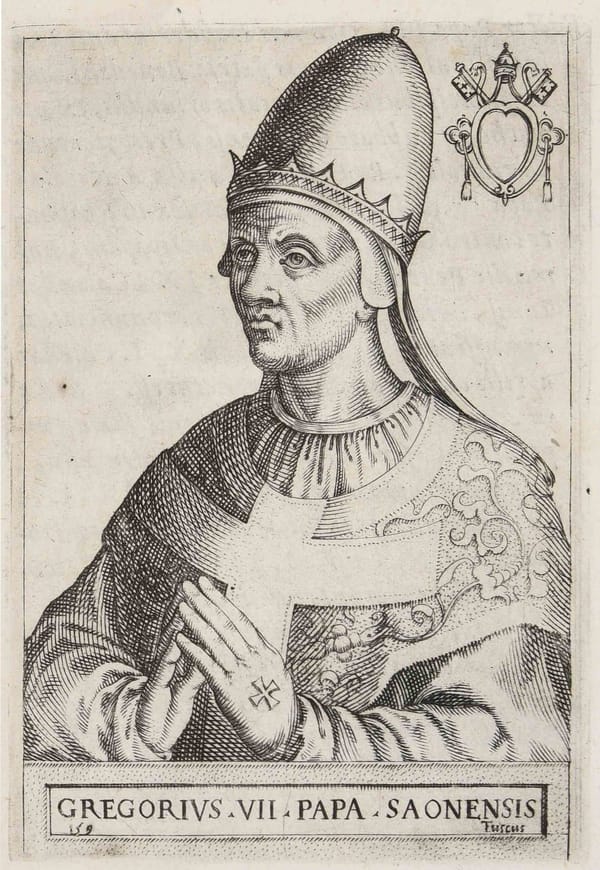 |
OUR Easter Calendar has already given us the two great Popes, Leo the Great and Pius V; it bids us, to-day, pay honour to the glorious memory of Gregory VII. These three names represent the action of the papacy, dating from the period of the persecutions. The mission divinely put upon the successors of St Peter is this: to maintain intact the truths of faith, and to defend the liberty of the Church. St Leo courageously and eloquently asserted the ancient faith, which was called in question by the heretics of those days; St Pius V stemmed the torrent of the so-called Reformation, and delivered Christendom from the yoke of Mahometanism; St Gregory VII came between these two, and saved society from the greatest danger it had so far incurred, and restored the purity of Christian morads by restoring the liberty of the Church.
The end of the tenth and the commencement of the eleventh century was a period that brought upon the Church of Christ one of the severest trials she has ever endured. The two great scourges of persecution and heresy had subsided; they were followed by that of barbarism. The impulse given to civilization by Charlemagne was checked early in the ninth century; the barbarian element had been but suppressed, and broke out again with renewed violence; faith was still vigorous among the people, but of itself it could not triumph over the depravity of morals. The feudal system had produced anarchy throughout the whole of Europe; anarchy created social disorder, and this, in its turn, occasioned the triumph of might and licentiousness over right. Kings and princes were no longer kept in check by the power of the Church; for Rome herself being a prey to factions, unworthy or unfit men were but too frequently raised to the Papal Throne.
The eleventh century came; its years were rapidly advancing; and there seemed no remedy for the disorders it had inherited. Bishoprics had fallen a prey to the secular power, which set them up for sale, and the first requisite for a candidate to a prelacy was that he should be a vassal subservient to the ruler of the nation, ready to supply him with means for prosecuting war. The bishops being thus, for the most part, simoniacal, as St Peter Damian tells us they were, what could be expected from the inferior clergy but scandals? The climax of these miseries was that ignorance increased with each generation, and threatened to obliterate the very notion of duty. There was an end to both Church and society, had it not been for the promise of Christ that he would never abandon his own work.
In order to remedy these evils, in order to dispel all this mist of ignorance, Rome was to be raised from her state of degradation. She needed a holy and energetic Pontiff, whose consciousness of having God on his side would make him heedless of opposition and difficulties; a Pontiff whose reign should be long enough to make his influence felt, and encourage his successors to continue the work of reform. This was the mission of St Gregory VII.
This mission was prepared for by holiness of life; it is always so with those whom God destines to be the instruments of his greatest works. Gregory, or, as he was then called, Hildebrand, left the world, and became a monk of the celebrated monastery of Cluny, in France. It was there, and in the two thousand abbeys which were affiliated with it, that were alone to be found in those days zeal for the liberty of the Church, and the genuine traditions of the monastic life. It was there that for upwards of a hundred years, and under the four great Abbots, Odo, Maiolus, Odilo and Hugh, God had been secretly providing for the regeneration of Christian morals. Yes, we may well say secretly, for no one would have thought that the instruments of the holiest of reforms were to be found in those monasteries, which existed in almost every part of Europe, and had affiliated with Cluny for no other motive than because Cluny was the sanctuary of every monastic virtue. It was to Cluny itself that Hildebrand fled, when he left the world; he felt sure that he would find there a shelter from the scandals that then prevailed.
The illustrious Abbot Hugh was not long in discovering the merits of his new disciple, and the young Italian was made Prior of the great French abbey. A stranger came one day to the gate of the monastery, and sought hospitality. It was Bruno, bishop of Toul, who had been nominated Pope by the Emperor Henry III. Hildebrand could not restrain himself on seeing this new candidate for the Apostolic See—this Pope whom Rome, which alone has the right to choose its own Bishop, had neither chosen nor heard of. He plainly told Bruno that he must not accept the keys of heaven from the hand of an Emperor who was bound in conscience to submit to the canonical election of the holy City. Bruno, who was afterwards St Leo IX, humbly acquiesced in the advice given him by the Prior of Cluny, and both set out for Rome. The elect of the Emperor became the elect of the Roman Church, and Hildebrand prepared to return to Cluny; but the new Pontiff would not hear of his departure, and obliged him to accept the title and duties of Archdeacon of the Roman Church.
This high post would soon have raised him to the Papal Throne, had he wished it; but Hildebrand’s only ambition was to break the fetters that kept the Church from being free, and prepare the reform of Christendom. He used his influence in procuring the election, canonical and independent of imperial favour, of Pontiffs who were willing and determined to exercise their authority for the extirpation of scandals. After St Leo IX came Victor II, Stephen IX, Nicholas II, and Alexander II—all of whom were worthy of their exalted position. But he who had thus been the very soul of the Pontificate under five Popes was at length obliged to accept the Tiara himself. His noble heart was afflicted at the presentiment of the terrible contests that awaited him; but his refusals, his endeavours to evade the heavy burthen of solicitude for all the Churches, were unavailing; and the new Vicar of Christ was made known to the world under the name of Gregory VII. “Gregory” means vigilance; and never did man better realize the name.
He had to contend with brute force personified in a daring and crafty Emperor, whose life was stained with every sort of crime, and who held the Church in his grasp, as a vulture does its prey. In no part of the Empire would a bishop be allowed to hold his see, unless he had received investiture from the Emperor, by the ring and crosier. Such was Henry IV of Germany; and his example encouraged the other Princes of the Empire to infringe on the liberty of canonical elections by the same iniquitous measures. The twofold scandal of simony and incontinence was still frequent among the clergy. Gregory's immediate predecessors had, by courageous zeal, checked the evil; but not one of them had ventured to confront the fomenter of all these abuses, the Emperor himself. The great contest, with its perils and anxieties, was left to Gregory; and history tells us how fearlessly he accepted it.
The first three years of his pontificate were, however, comparatively tranquil. Gregory treated the youthful Emperor with great kindness, out of regard for his father, who had deserved well of the Church. He wrote him several letters, in which he gave him good advice, or affectionately expressed his confidence in the future. Henry did not allow that confidence to last long. Aware that he had to deal with a Pope whom no intimidation could induce to swerve from duty, he thought it prudent to wait a while and watch the course of events. But the restraint was unbearable; the selfimposed check had but swelled the torrent; the enemy of the spiritual power gave full vent to his passion. Bishoprics and abbeys were again sold for the benefit of the imperial revenue. Gregory excommunicated the simoniacal prelates; and Henry, imprudently defying the censures of the Church, persisted in keeping in their posts men who were resolved to follow him in all his crimes. Gregory addressed a solemn warning to the Emperor, enjoining him to withdraw his support from the excommunicated prelates, under penalty of himself incurring the ban of the Church. Henry, who had thrown off the mask, and thought he might afford to despise the Pontiff, was unexpectedly made to tremble for the security of his throne by the revolt of Saxony, in which several of the Electors of the Empire joined. He felt that a rupture with the Church at such a critical time might be fatal. He turned suppliant, besought Gregory to absolve him, and made an abjuration of his past conduct in the presence of two Legates, sent by the Pontiff into Germany. But scarcely had the perjured monarch gained a temporary triumph over the Saxons than he recommenced hostilities with the Church. In an assembly of bishops, worthy of their imperial master, he presumed to pronounce sentence of deposition against Gregory. Shortly afterwards he entered Italy with his army; and this gave to scores of prelates an opportunity for openly declaring rebellion against the Pope, who would not tolerate their scandalous lives.
Then did Gregory, in whose hands were placed those keys which signify the power of loosing and binding in heaven and on earth, pronounce against Henry the terrible sentence which declared him to be deprived of his crown and to have forfeited the allegiance of his subjects. To this the Pontiff added the still heavier anathema; he declared him to be cut off from the communion of the Church. By thus setting himself as a rampart of defence to Christendom, which was threatened on all sides with tyranny and persecution, Gregory drew down upon himself the vengeance of every wicked passion; and even Italy was far from being as loyal to him as he had a right to expect her to be. More than one of the princes of the peninsula sided with Henry; and as to the simoniacal prelates, they looked on him as their defender against the sword of Peter. It seemed as though Gregory would soon not have a spot in Italy whereon he could set his foot in safety; but God, who never abandons his Church, raised up an avenger of his cause. Tuscany, and part of Lombardy, were, at that time, governed by the young and brave countess Matilda. This noble-hearted woman stood up in defence of the Vicar of Christ. She offered her wealth and her army to the Pope, that he might make use of them as he thought best, as long as she lived; and as to her possessions, she willed them to St Peter and his successors.
Matilda, then, became a check to the Emperor's prosperity in crime. Her influence in Italy was still strong enough to procure for the heroic Pontiff a refuge where he could be safe from the Emperor's power. He was enabled by her management to reach Canossa, a strong fortress near Reggio. At the same time, Henry was alarmed by news of a fresh revolt in Saxony, in which more than one feudal lord of the Empire took part, with a view to dethrone the haughty and excommunicated tyrant. Fear again took possession of his mind, and prompted him to recur to perjury. The spiritual power marred his sacrilegious plans; and he flattered himself that by offering a temporary atonement he could soon renew the attack. He went barefooted and unattended to Canossa, garbed as a penitent, shedding hypocrite tears, and suing for pardon. Gregory had compassion on his enemy, and readily yielded to the intercession made for him by Hugh of Cluny and Matilda. He took off the excommunication, and restored Henry to the pale of Holy Church; but thought it would be premature to revoke the sentence whereby he had deprived him of his rights as Emperor. The Pontiff contented himself with announcing his intention of assisting at the Diet which was to be held in Germany; there he would take cognizance of the grievances brought against Henry by the Princes of the Empire, and then decide what was just.
Henry accepted every condition, took his oath on the Gospel, and returned to his army. He felt his hopes rekindle within him at every step he took from the dreaded fortress, within whose walls he had been compelled to sacrifice his pride to his ambition. He reckoned on finding support from the bad passions of others, and to a certain extent his calculation was verified. Such a man was sure to come to a miserable end; but Satan was too deeply interested in his success to refuse him his support.
Meanwhile, Henry met with a rival in Germany: it was Rodolph, duke of Suabia, who, in a Diet of the Electors of the Empire, was proclaimed Henry's successor. Faithful to his principles of justice, Gregory refused, at first, to recognize the newly elected, although his devotedness to the Church and his personal qualifications were such as to make him most worthy of the throne. The Pontiff persisted on hearing both sides, that is, the princes and representatives of the Empire, and Henry himself; this done, he would put an end to the dispute by an equitable judgement. Rodolph strongly urged his claims, and importuned the Pontiff to recognize them; but Gregory, though he loved the duke, courageously refused his demand, assuring him that his cause should be tried at the Diet by which Henry had bound himself, by his oath at Canossa, to stand, though he had good reasons to fear its results. Three years passed on, during which the Pontiff's patience and forbearance were continually and severely tried by Henry's systematic subterfuges, and refusal to give guarantees against his further molesting the Church. At length, after using every means in his power to put an end to the wars that ravaged Italy and Germany, and after Henry had given unmistakable proofs of impenitence and perjury, the Pontiff renewed the excommunication, and in a Council held at Rome, confirmed the sentence whereby he had declared him deposed of his crown. At the same time, Gregory ratified Rodolph’s election, and granted the Apostolic benediction to his adherents.
Henry’s rage was at its height, and his vengeful temper threw off all restraint. Among the Italian prelates who had sided with the tyrant, the foremost in subserviency and ambition was Gilbert, Archbishop of Ravenna, and, of course, there was no bitterer enemy to the holy See. Henry made an anti-pope of this traitor, under the name of Clement III. He had his party; and thus schism was added to the other trials that afflicted the Church. It was one of those terrible periods when, according to the expression of the Apocalypse, it was given unto the Beast to make war with the Saints, and to overcome them.1 The Emperor suddenly became victorious: Rodolph was slain fighting in Germany, and Matilda’s army was defeated in Italy. Henry had then but one wish, and he determined to realize it: to enter Rome, banish Gregory, and set his anti-pope on the Chair of St Peter.
What were the feelings of our Saint in the midst of this deluge of iniquity, from which, however, the Church was to rise purified and free? Let us listen to him, describing them in a letter written to his former Abbot, St Hugh of Cluny: ‘The troubles which have come upon us are such, that even they that are living with us not only cannot endure them, but cannot even bear to look at them. The holy king David said: According to the multitude of my sorrows in my heart, thy consolations have given joy to my soul:2 whereas to us, life is often a burthen, and death a happiness for which we sigh. When Jesus, that loving Consoler, true God and true Man, deigns to stretch out his hand to me, his goodness brings back joy to my afflicted heart; but when he leaves me, immediately my trouble is extreme. Of myself, I am for ever dying; but in so far as he is with me, there are times when I live. When my strength wholly leaves me, I cry out to him, saying with a mournful voice: “If thou hadst put a burthen as heavy as this on Moses or Peter, they would, methinks, have sunk beneath it. What then can be expected of me, who, compared to them, am nothing? Thou hast then, O Lord, but one thing to do: thou thyself, with thine Apostle Peter, must govern the pontificate thou hast imposed on me; else thou wilt find me sink beneath the load, and the pontificate, in my person, be disgraced.” '3
These words of heartfelt grief depict the whole character of the sainted Pontiff. The one great object of his life was the reformation of society by the liberty of the Church. It was nothing but his zeal in such a cause that could have made him face this terrible situation, from which he had nothing to look for in this life but heart-rending vexations. And yet, Gregory was that Father of the Christian world who, from the very commencement of his pontificate, was full of the thought of driving the Mahometans out of Europe, and of delivering the Christians from the yoke of the Saracens. It was the inspiration taken up by his successors, and carried out under the name of the Crusades. In a letter addressed to all the faithful, our Saint thus speaks of the enemy of the Christian name, whom he describes as being at the very gates of Constantinople, committing every kind of outrage and cruelty:
‘If we love God, if we call ourselves Christians, we must grieve over such evils; but we should do more than grieve over them. Our Saviour’s example and the duty of fraternal charity impose upon us the obligation of giving our lives for the deliverance of our fellow-Christians. Know, then, that trusting in the mercy of God and in the might of his arm, we are doing and preparing everything in our power in order to give immediate help to the Christian Empire.’4 He shortly afterwards wrote to Henry, who at that time had not shown his hostile intentions against the Church: ‘My admonition to the Christians of Italy and the countries beyond the Alps has been favourably received. At this moment, fifty thousand men are preparing; and, if they can have me to head the expedition as leader and Pontiff, they are willing to march to battle against the enemies of God, and, with the divine assistance, to go even to our Lord's Sepulchre.’ Thus, despite his advanced age, the noble-minded Pontiff was willing to put himself at the head of the Christian army. ‘There is,’ says he, ‘one thing which urges me to do this: it is the state of the Church of Constantinople, which is separated from us in what regards the dogma of the Holy Ghost, and which must be brought back to union with the Apostolic See. . Almost the whole of Armenia has abandoned the Catholic faith. In a word, the greater portion of the Orientals require to know what is the faith of Peter, on the various questions which are being mooted among them. The time is come for using the grace bestowed, by our merciful Redeemer, on Peter, when he thus spoke to him: I have prayed for thee, Peter, that thy faith may not fail: do thou confirm thy brethren.5 Our Fathers in whose footsteps we would walk, though we be unworthy to be their successors, have more than once visited those countries, that they might confirm the Catholic faith. We, then, also feel urged, if Christ open to us a way, to undertake this expedition for the interests of the faith, and in order to give aid to the Christians.’
With his characteristic good faith, Gregory went so far as to reckon on Henry's protecting the Church during his absence. ‘This design,' says he, in the same letter to the Emperor, ‘requires much counsel and powerful co-operation, in case God permits us to attempt it: I therefore come to you, asking you for this counsel and co-operation, and hope you will grant me them. If, by divine favour, I go, it is to you, after God, that I leave the Roman Church, that you may watch over her as a holy mother, and protect her from insult. Let me know, as soon as may be, what in your prudence, aided by God's counsel, you decide. If I had not greater confidence in you than people suppose, I should not have written this to you; but as you may not fully believe that I have the affection for you that I profess, I appeal to the Holy Spirit who can do all things. I beseech him to make you understand, in his own way, how attached I am to you; and so to guide your soul as to disappoint the desires of the wicked and strengthen the hopes of the good.’6
The interview at Canossa took place in less than three years from the date of the above letter; but at the time he wrote it, Gregory’s hopes for carrying out the expedition were so well grounded, that he acquainted the Countess Matilda with his intention. He wrote to her as follows: ' The matter which engrossed my thoughts, and the desire I have to cross the seas in order to give succour to the Christians, who are being slain as brute beasts by the pagans, makes me seem strange to many people, and fear they think me guilty of a sort of levity. But it costs me nothing to confide it to you, my dearly beloved daughter, whose prudence I esteem more than words could express. After you have perused the letters which I am sending to the countries beyond the Alps, if you have any advice to offer, or, what is better, any aid to give to the cause of God your Creator, exert yourself to the utmost; for if, as men say, it be a grand thing to die for one's country, it is grander and nobler to sacrifice this mortal flesh of ours for Christ, who is Eternal Life. I feel convinced that many soldiers will aid us in this expedition. I have grounds for believing that our Empress (Agnes, the saintly mother of Henry) intends going with us, and would fain take you with her. Your mother (the Countess Beatrice) will remain here in Italy, to protect our common interests; and all things thus arranged, we shall, with Christ's help, be enabled to set out. By coming hither to satisfy her devotion, the Empress, especially if she have you to help her, will doubtless encourage many to join in this enterprise. As for me, honoured with the company of such noble sisters, I will willingly cross the seas, ready to lay down my life for Christ with you, from whom I would not be separated in our eternal country. Send me a speedy answer upon this project, as also regarding your coming to Rome. And may the Almighty God bless you, and give you to advance from virtue to virtue, that thus the common Mother may rejoice in you for many long years to come!’7
The project on which Gregory set his heart with so much earnestness was not a mere scheme suggested by his own greatness of soul; it was a presentiment infused into his mind by God. The troubles he had nearer home, and which he so heroically combated, left him no time for a long expedition; he had to engage with an enemy who was not a Turk, but a Christian. Still, the Crusade so dear to his heart was not far off. Urban II—his second successor, and, like himself, a monk of Cluny—was soon to arouse Christian Europe and give battle to the infidels. But as this subject has led us to mention Matilda's name, we take the opportunity thus afforded us of entering more fully into the character of our great Pontiff. We shall find that this illustrious champion of the Church's liberty, with all his elevation of purpose, and all his untiring zeal in what concerned the interests of Christendom, was as solicitous about the spiritual advancement of a single soul as any director could be. Writing to the Countess Matilda, he says: ' He who fathoms the secrets of the human heart, he alone knows, and knows better than I do myself, how interested I am in what concerns your salvation. I think you understand that I feel myself bound to take care of you for the sake of so many people, in whose interest I have been compelled by charity to deter you, when you were thinking of leaving them in order to provide for the salvation of your own soul. As I have often told you, and will keep on telling you in the words of heaven’s herald, Charity seeketh not her own.8 But as the principal armour wherewith I have provided you in your battle against the prince of this world is the frequent receiving of our Lord’s Body, and a firm confidence in the protection of his blessed Mother, I will now add what St Ambrose says on the subject of holy Communion.’
The Pontiff then gives her two quotations from the writings of this holy Father, to which he also adds others from St Gregory the Great and St John Chrysostom on the blessings we derive from receiving the sacrament of the Eucharist. He then continues: ‘Therefore, my daughter, we should have recourse to this greatest of the sacraments, this greatest of all remedies. I have written all this to you, beloved daughter of blessed Peter, with a view to increase your faith and confidence when you approach to Communion. This is the treasure, and this the gift, more precious than gold and gems, which your soul, out of love for the King of heaven, your Father, expects from me, although you would have received the same in a far better way, and one more worthy of your acceptance, had you applied to some other of God’s ministers. With regard to the Mother of God, to whose care I have confided you, for the past, the present, and the future, until we are permitted to see her in heaven, as we desire—what can I say? How can I say anything worthy of her whom heaven and earth are ever praising, and yet never so much as she deserves? Yes, hold this as a most certain truth: that as she is grander and better and holier than all mothers, so is she more merciful and loving to all sinners who are sorry for their sins. Be, then, determined never to commit sin; prostrate yourself and weep before her, with a contrite and humble heart; and I unhesitatingly promise you this—you will find her more ready to assist you, and more affectionate, than any mother on earth ever was to her child.'9
A Pontiff like this, who amidst all his occupations could devote himself with such paternal zeal to the advancement of one single soul, was sure to be on the watch for men whose piety and learning promised well for the interests of the Church. It is true, there were very few such men in those times; but Gregory would find them out, wheresoever they might be. The great St Anselm, who was living in the peaceful retirement of his monastery at Bec, had not escaped the watchful eye of the Pontiff, who wrote him these touching words amidst the troubles of the year 1079: 'The good odour of your fruits has spread even to us. We give thanks to God, and we embrace you with affection in the love of Christ; for we are well assured of the benefits which the Church of God will derive from your studies and of the succour which, through God’s mercy, she will receive from your prayers, united as they are with those who are of a like spirit. You know, my Brother, of how much avail with God is the prayer of one just man; how much more then must not avail the prayer of many just ones? No, we cannot doubt it; it obtains what it asks. The authority of Truth himself obliges us to believe it. It is he who said: Knock, and it shall be opened to you! Knock with simplicity of heart—ask with simplicity of heart—for those things which are pleasing to him; then shall it be opened to you, then shall you receive; and it is thus that the prayer of the just is graciously heard. We therefore beg of you, Brother, of you and your monks, that you beseech God in assiduous prayer, that he may vouchsafe to deliver from the tyranny of heretics his Church and us, who, though unworthy, are placed over it; and that, dispelling the error which blinds our enemies, he may lead them back to the path of truth.’10
But Gregory’s attention was not confined to persons of such eminence and learning as a Matilda or an Anselm. His quick eye discerned every Christian, how humble soever his station, who had suffered persecution for the cause of Holy Church; he honoured and loved him far more than he would the bravest soldier who fought for earthly glory, and won it at the risk of his life. Let us read the following letter, which he wrote to a poor priest of Milan, named Liprand, who had been cruelly maimed by the simoniacs: ' If we venerate the memory of those Saints who died after their limbs had been severed by the sword; if we celebrate the sufferings of those whom neither the sword nor torture could separate from the faith of Christ; you, who have had your nose and ears cut off for his Name, you deserve still greater praise, for that you have merited a grace which, if it be accompanied by your perseverance, gives you a perfect resemblance to the Saints. Your body is no longer perfect in all its parts; but the interior man, who is renewed from day to day, is now grander than ever. Your outward face is maimed, and therefore disfigured; but the image of God, which consists in the brightness of virtue, has become more graceful by your wounds, and its beauty heightened by the deformity which men have brought on your features. Does not the Church, speaking of herself, say: I am black, O ye daughters of Jerusalem?11 If, then, your interior beauty has not been impaired by these cruel mutilations, neither has your priestly character, which manifests itself rather by the perfection of virtue than by that of the body. Did not the Emperor Constantine show his veneration for a bishop who had had one of his eyes pulled out? was he not seen to kiss the wound? Have we not the examples of the Fathers, and the early history of the Church, telling us that the martyrs were allowed to continue the exercise of the sacred ministry, even after their limbs had been mutilated? You, then, martyr of Christ! must confide in the Lord without reserve. You must congratulate yourself on having made an advance in your priesthood. It was conferred upon you by the holy oil; but now you have sealed it with your own blood. The more your body has lost, the more must you preach what is good, and sow that word which produces a hundredfold. We know that the enemies of holy Church are your enemies and persecutors; fear them not, and tremble not in their presence; for we lovingly hold both yourself and everything that belongs to you under our own protection and that of the Apostolic See. And if you should at any time find it necessary to have recourse to us, we now at once admit your appeal, and will receive you with joy and every mark of honour, when you visit us and this Holy See.’12
Such was Gregory, who preserved the simplicity of the monk amidst all his occupations as Pope; and what engrossing occupations were these, even apart from that fearful contest with tyranny and crime which cost him his life! We have already mentioned his project of the Crusade, which, at a later period, was enough to immortalize the name of Urban II. As to his other labours for the good of religion in every part of Christendom, we may truly say that at no period of the Church's existence did the papacy exercise a wider, more active, or more telling influence, than during the twelve years of his pontificate. By his immense correspondence, he furthered the interests of the Church in Germany, Italy, France, England and Spain; he aided the rising Churches of Denmark, Sweden and Norway; he testified his vigilant and tender solicitude for the welfare of Hungary, Bohemia, Poland, Serbia, yea, even for Russia. Despite the rupture between Rome and Byzantium, the Pontiff withheld not his paternal intervention with a view to remove the schism which kept the Greek Church out of the centre of unity. On the coast of Africa, he, by great vigilance, succeeded in maintaining three bishoprics which had survived the Mussulman invasion. In order to knit the Latin Church into closer unity by greater uniformity in prayer, he abolished the Gothic Liturgy that was used in Spain, and forbade the introduction of the Greek Liturgy into Bohemia. What work was this for one man! And what a martyrdom he had to suffer! Let us resume our history of his trials. He was to save the Church and society; but like his divine Master, he had to drink of the torrent in the way,13 as the condition of his mission being a successful one.
We have seen how its defenders were defeated in battle; how he was menaced by the conqueror, who had once stood trembling in his presence; and how there was set up in opposition an anti-pope, whose side was taken by unworthy prelates. Henry marched on towards Rome, taking with him the false vicar of Christ. He set fire to that part of the City which would expose the Vatican to danger; Gregory sent his blessing to his terrified people, and immediately the fire took the contrary direction and died out. Enthusiasm filled, for a while, the hearts of the Romans, who have so often been ungrateful to their Pontiff, without whom their Rome, with all its glory, sinks into a poor contemptible town. Henry was afraid to consummate the sacrilege. He therefore sent word to the Romans that he only asked one condition; it was that they should induce Gregory to consecrate him Emperor of Germany, and that he would for ever be a devoted son of the Church: as to the ignoble phantom he had set up in opposition to the true Pope, he (Henry) would see that he was soon forgotten, This petition was presented to Gregory by the whole City. The Pontiff made them this reply: ‘Too well do I know the king’s treachery. Let him first make atonement to God and to the Church which he tramples beneath his feet. Then will I absolve him, if penitent, and crown the convert with the imperial diadem.’ The Romans were earnest in their entreaties, but this was the only answer they could elicit from the inflexible guardian of Christian justice. Henry was about to withdraw his troops, when the fickle Romans, bribed by money from Byzantium (for then, as ever, all schisms were in fellowship against the Papacy), abandoned their King and Father, and delivered up the keys of the City to him who enslaved their souls. Gregory was thus obliged to seek refuge in the Castle of Sant’ Angelo, taking with him into that fortress-prison the liberty of Holy Church. Thence, or perhaps a few days previously to his retiring thither, he wrote this admirable letter, in the year 1084. It is addressed to all the faithful, and may be considered as the last Will and Testament of this glorious Pontiff.
‘The kings of the earth and the Princes of the priests have met together against Christ,14 the Son of the Almighty God, and against his Apostle Peter, to the end that they may destroy the Christian religion and propagate the wickedness of heresy in every land. But by the mercy of God they have not been able with all their threats and cruelties and proffers of worldly glory to seduce those that put their confidence in the Lord. Wicked conspirators have raised up their hands against us, for no other reason than because we would not pass over in silence the perils of holy Church, nor tolerate them that blush not to make a slave of the very Spouse of God. In every country the poorest woman is allowed, yea, she is assisted by the law of the land, to choose her own husband; and yet nowadays Holy Church, the Spouse of God and our Mother, is not allowed to be united to her Spouse as the Divine Law commands, and as she herself wishes. It cannot be that we should suffer the children of this Church to be slaves to heretics, adulterers, and tyrants, as though these were their parents. Hence we have had to endure all manner of evil treatment, perils, and unheard-of cruelties, as you will learn from our Legates.
‘You know, Brethren, that it was said to the prophet: Cry from the top of the mountain, cry, cease not! I, then, urged irresistibly, laying human respect aside, and raising my mind above every earthly consideration, I preach the Gospel, I cry out, yea, I cry out unceasingly, and I make known to you that the Christian religion, the true faith which the Son of God, who came down on the earth, taught us by our Fathers, is in danger of being corrupted by the violence of secular power; that it is on the way to destruction, and to the loss of its primitive character, being thus exposed to be scoffed at, not only by Satan, but by Jews, and Turks, and pagans. The very pagans are observers of their laws, though these cannot profit the soul’s salvation, neither have they been guaranteed by miracles, as ours have been, to which our Eternal King has borne testimony; they keep their laws, and believe them. We Christians, intoxicated with the love of the world, and led astray by vain ambition, make every principle of religion and justice give way to covetousness and pride; we seem as though we had neither law nor sense, for we have not the earnestness our Fathers had for our salvation, and for the glory of both the present and future life; we do not make even them the object of our hopes. If there be some still left who fear God, they only care for their own salvation, and the common good seems not to concern them. Where do we now find persons who labour and toil, or expose their lives by fatigue, out of the motive of the fear or love of the Omnipotent God? whereas we see soldiers of this world’s armies braving all manner of dangers for their masters, their friends, and even their subjects! There are thousands of men to be found who face death for the sake of their liege lord; but when the King of heaven, our Redeemer, is in question, so far from being lavish of their lives, Christians dare not even incur the displeasure of a few scoffers. If there be some (and thanks to the mercy of God there are still a few such left among us)—if, we repeat, there be some who, for the love of the Christian Law, dare to resist the wicked to their face, not only are they unsupported by their brethren, but they are accused of imprudence and indiscretion, and are treated as fools.
‘We, therefore, who are bound, by our position, to destroy vice and implant virtue in the hearts of our brethren, we pray and beseech you, in the Lord Jesus who redeemed us, that you would consider within yourselves, and understand why it is that we have to suffer such anguish and tribulation from the enemies of the Christian religion. From the day when, by the Divine will, the Mother-Church, despite my great unworthiness, and (as God is my witness) despite my own wish, placed me on the Apostolic Throne, the one object of all my labours has been that the Spouse of God, our Mistress and Mother, should recover her just rights, in order that she may be free, chaste and Catholic. But such a line of conduct must have caused extreme displeasure to the old enemy; and therefore has he marshalled against us them that are his members, and has stirred up against us a world-wide opposition. Hence it is that there have been used against us, and against the Apostolic See, efforts of a more violent character than any that have ever been attempted since the days of Constantine the Great. But there is nothing surprising in all this: it is but natural that the nearer we approach to the time of Antichrist, the more furious will be the attempts to annihilate the Christian religion.’15
These words vividly describe to us the holy indignation and grief of the great Pontiff, who, at this terrible crisis, stood almost alone against the enemies of God. He was weighed down, he was crushed, by adversity; but conquered, no! From the fortress, within whose walls he had withdrawn the majesty of the Vicar of Christ, he could hear the impious cheers of his people as they followed Henry to the Vatican Basilica, where, at St Peter’s Confession, the mock pope was awaiting his arrival. It was the Palm Sunday of 1085. The sacrilege was committed. On the previous day, Gilbert had dared to ascend the Papal Throne in the Basilica of Saint John Lateran; and on the Sunday, whilst the people held in their hands the palms that glorify the Christ, whose Vicar was Gregory, the anti-pope took the crown of the Christian Empire and put it on the head of the excommunicated Henry. But God was preparing an avenger of his Church. The Pontiff was kept a close prisoner in the fort, and it seemed as though his enemy would soon make him a victim of his rage; when the report suddenly spread through Rome that Robert Guiscard, the valiant Norman chieftain, was marching on towards the City. He had come to fight for the captive Pontiff, and deliver Rome from the tyranny of the Germans. The false Cæsar and his false pope were panic-stricken; they fled, leaving the perjured City to expiate its odious treason in the horrors of a ruthless pillage.
Gregory's heart bled at seeing his people thus treated. It was not in his power to prevent the depredations of the barbarian troops; they had done their work of delivering him from his enemies, but they were not satisfied; they had come to Rome to chastise her, but now they wanted booty, and they were determined to have it. Not only was the Saint powerless to repress these marauders; he was in danger of again falling into Henry's hands, who was meditating a return to Rome, for he made sure that the people's angry humour would secure him a welcome back, and that the Normans would withdraw from the City as soon as it had no more to give them. Gregory therefore, overwhelmed with grief, left the capital; and, shaking off the dust from his feet, he repaired to Monte Cassino, where he sought shelter, and a few hours' repose, with the sons of the great Patriarch St Benedict. The contrast of the peaceful years he spent when a young monk at Cluny, with the storms that had so thickly beset his pontificate, was sure to present itself to his mind. A wanderer and fugitive, and abandoned by all save a few faithful and devoted souls, he was passing through the several stations of his Passion; but his Calvary was not far off, and God was soon to admit him into rest eternal. Before descending the holy mount, he was honoured with the miraculous manifestation which had been witnessed on several previous occasions. Gregory was at the Altar, offering up the Holy Sacrifice; when suddenly a white dove was seen resting on his shoulder, with its beak turned towards his ear, as though it were speaking to him. It was not difficult to recognize, under this expressive symbol, the guidance which the saintly Pontiff received from the Holy Ghost.
It was the early part of the year 1085. Gregory repaired to Salerno, where his troubles and life were to be brought to a close. His bodily strength was gradually failing. He insisted, however, on going through the ceremony of the dedication of the Church of St Matthew the Evangelist, whose body was kept at Salerno He addressed a few words in a feeble voice to the assembled people. He then received the Body and Blood of Christ. Fortified with this lifegiving Viaticum, he returned to the house where he was staying, and threw himself upon the couch, whence he was never to rise again. There he lay, like Jesus on his Cross, robbed of everything, and abandoned by almost the whole world. His last thoughts were for Holy Church. He mentioned to the few Cardinals and Bishops who were with him, three from whom he would recommend his successor to be chosen: Desiderius, Abbot of Monte Cassino, who succeeded him under the title of Victor III; Otho of Chatillon, a monk of Cluny, who was afterwards Urban II, Victor's successor; and the faithful legate, Hugh of Die, whom Gregory had made Archbishop of Lyons.
The bystanders asked the dying Pontiff what were his wishes regarding those whom he had excommunicated. Here again he imitated our Saviour on his Cross—he exercised both mercy and justice. ‘Excepting,’ said he, ‘Henry, and Gilbert the usurper of the Apostolic See, and them that connive at their injustice and impiety, I absolve and bless all those who have faith in my power, as being that of the holy Apostles Peter and Paul.' The thought of the pious and heroic Matilda coming to his mind, he entrusted this devoted daughter of the Roman Church to the care of the courageous Anselm of Lucca; hereby imitating, as the biographer of this holy bishop remarks, our dying Jesus, who consigned Mary to his beloved disciple John. Gregory's last blessing to Matilda drew down upon her thirty years of success and victory.
Though so near his end, Gregory was yet as full of paternal solicitude for the Church as ever he had been. Calling to him, one by one, the faithful few who stood round his couch, he made them promise on oath that they would never acknowledge Henry as Emperor until he had made satisfaction to the Church. Summing up all his energy, he solemnly forbade them to recognize anyone as Pope unless he were elected canonically and in accordance with the rules laid down by the holy Fathers. Then, after a moment of devout recollectedness, he expressed his conformity to the divine Will, which had ordained that his pontificate should be one long martyrdom, and said: ‘I have loved justice and hated iniquity: for which cause, I die in exile!’ One of the bishops who were present, respectfully made him this reply: ‘No, my lord, you cannot die in exile; for, holding the place of Christ and the holy Apostles, you have had given to you the nations for your inheritance, and the utmost parts of the earth for your possession.'Sublime words! but Gregory heard them not: his soul had winged its flight to heaven, and had received a martyr’s immortal crown.
So that Gregory was conquered by death, as Christ himself had been; but as the Master triumphed over death, so too would he have his disciple triumph. Christianity, which had been insulted in so many forms, rose again in all its grandeur. Nay, on the very day that Gregory breathed his last at Salerno, heaven seemed to give a pledge of this Resurrection; for on that day—May 25, 1085—Alphonsus VI entered, with his victorious troops, into the city of Toledo, and there, after four centuries of slavery under the Saracen yoke, he replanted the Cross of Christ.
But the Church had need of someone who would take Gregory’s place in defending her against oppression. The need was supplied. The martyrdom of our saint was like a seed that produced Pontiffs imbued with his spirit. As he had prepared his own predecessors, he also prepared worthy successors. There are few names on the list of the Popes more glorious than those that begin with Victor III, Gregory's immediate successor, and continue to Boniface VIII inclusively, in whom was recommenced the struggle for which our great Pontiff so heroically lived and died. Scarcely had death put an end to his trials in this vale of tears, than victory came to the Church; for her enemies were defeated, her sacred law of celibacy was everywhere re-enforced, and the canonical election of her bishops was secured by the suppression of investitures and simony.
Gregory had been the instrument used by God for the reformation of the Christian world; and although his memory be held in benediction by all true children of the Church, yet his mission was too grand, and too grandly fulfilled, not to draw down upon him the hatred of Satan. The prince of this world,16 then, took his revenge. Gregory was of course detested by heretics; but that could scarcely be called an insult; he must be rendered odious to Catholics; Catholics must be made ashamed of him. The devil succeeded, and it may be beyond his expectations. The Church had passed her judgement; but her judgement, her canonization, had no weight with these cowardly, temporizing, half Catholics; and they persisted in calling the Saint, simply and reproachfully, ‘Gregory VII.’ Governments, styling themselves Catholic, forbade his being honoured as a Saint. There were even bishops who issued Pastorals to the same effect. The most eloquent of French preachers declared his pontificate and conduct to be unchristian. There was a time, and that not so very long ago, when these lines would have exposed the writer to a heavy penalty, as being contrary to the law of the land. The lessons of to-day’s feast, which we give on the next page, were suppressed by the Parliament of Paris in the year 1729; and those who dared to recite them were to be punished by the forfeiture of their property. Thank God! all this is now passed; and the name of St Gregory VII is honoured in every country where the Roman Liturgy is in use. Yes, this glorious name will remain now to the end of the world, on the universal Calendar of Holy Church, as one of the brightest glories of Paschal time. May it produce the same enthusiastic admiration, and bring the same blessings, upon the faithful of these our times, as it did on our Catholic forefathers of the Middle Ages!
We will now read the lessons of to-day’s feast wherein the Church speaks to us of the life and actions of our admirable Pontiff: we will read them with all the greater reverence, because they have been scoffed at by men who knew not what they did.17
The following Responsories, which we select from an Office for his feast, celebrate the struggles and triumphs of the holy Pontiff:
*Thou therefore, my son, if so it please thee, do what thou hast seen me do. ℣. But the king dared not to stretch out his hand, and take the Holy of holies.* Thou therefore, my son, if so it please thee, do what thou hast seen me do.
We unite in one three hymns that celebrate the virtues and services of St Gregory VII:
Hymn
Inclytum Romæ jubar, o Gregori;
Corde qui magno superans procellas,
Littora tangis.
Qui tot et tantos generavit orbi
Filios: nullus simili refulsit
Laude verendus.
Dextra ludentis pueri, dolantem
Dum secus fabrum, Domino regente,
Segmine scribit.
Sol novus mundum radiis serenans:
Pontifex Petri sedeas cathedra,
Arbiter orbis.
Quotquot hostili rabie furentes,
In gregem Christi satagunt nefanda
Tela vibrare.
Spiritu plenus: giadioque verbi
Conteret tetros zabuli minantis
Fortiter astus.
Gestit Henricus, monitis supremi
Patris abscedens, veterum furorum
Flare favillas.
E sacra fulmen jaculatus arce:
Et potestatis tumidos caducae
Despicis ausus.
Sceptra regnantis regimenque transfers,
A fide cives relevans tyranno
Jure negata.
Sub columbina specie, loquentis
Spiritus Sancti documenta sensit,
Actibus implet.
Quæ, patri summo tribuens juvamen,
Inclytae Sedis, studio fideli,
Jura tuetur.
Præsul, et messem manibus profanis
Objici; zelo rapiente, sævit,
Alter Elias.
Libero gressu populi fideles,
Anteit pastor, propriam paratus
Tradere vitam.
Criminum vindex, columenque Romæ,
Inter aerumnas placida, Gregori,
Morte potiris.
Firmus et constans, fidei tenacem,
O Pater, praebes animum: triumphi
Gaudia sumas.
Sis ad aeternam Triadem, precamur:
Cuncta cui dignas resonent per orbem
Saecula laudes.
O Gregory, thou bright ray of Rome’s glory!
With a brave heart thou didst master
the storm and reach the shore.
that has given so many and such noble children to the world
—yes, let it rejoice in this son,
than whom there never lived one worthier of praise.
foretold his future sway;
he wrote it with the fragments that lay beneath a carpenter's feet,
and God guided his hand.
and gladden it with thy beams.
Thy throne, O Pontiff, judge of the world,
is to be the Chair of Peter.
were rushing ’gainst the flock of Christ,
and had their sacrilegious weapons
raised to dart them at his Church.
he has the sword of the Word;
and with its power he will crush the dark plots
wherewith Satan threatens our peace.
heedless of the counsels of the holy Father,
strives to fan the flame
of ancient persecution.
cast against the disobedient prince
the thunderbolt that checked his pride.
What was the haughty daring of mortal power to thee!
thou didst take the royal sceptre and command,
and absolve his subjects
from the fealty forfeited by the tyrant’s crimes.
to receive from the Holy Ghost,
who appeared under the shape of a dove,
the inspirations that guided his acts.
came to the assistance of the Sovereign Pontiff,
and, with faithful zeal,
defended the rights of the Holy See.
and that the harvest was in the hands of worthless men,
Gregory, like another Elias,
was impelled by zeal to holy indignation.
tread the path to their heavenly country,
the shepherd led the way,
ready to give his life for his sheep.
the avenger of crime and the pillar of Rome!
But, after all thy trials,
thy death, O Gregory, was peaceful.
Thy soul, O Father, was firm and true
and unflinching in the faith:
well dost thou deserve a conqueror's triumphant joy.
and intercede for us to the Eternal Three
to whom may every age give worthy praise
throughout the world's wide range.
Our Paschal joy is increased by thy triumph, O Gregory! for in thee we recognize an image of him who by the announcement of his glorious Resurrection, raised the world from its fallen state. Divine Providence had prepared thy pontificate, and made it an era of regeneration for society, which was then oppressed by the tyranny of barbarism. Thy courage was founded on confidence in Jesus' word; and nothing could daunt thee. Thy reign on the Apostolic See was one long combat; and because thou hatedst iniquity and lovedst justice, thou hadst to die an exile. But in thee was fulfilled the prophecy which had been spoken of thy divine Master: If he shall lay down his life for sin, he shall see a long-lived seed.18 A glorious succession of six and thirty Popes continued the work which thy heroism had begun: the Church had regained her liberty, and might was made subservient to right. It was a period of triumph: it passed, war was again declared, and has never. since ceased. Kings and Emperors and Governments have rebelled against the spiritual power; they have thrown off obedience to the Vicar of Christ; they have refused to acknowledge the control of any authority on earth. The people, on their part, have revolted against their Governments, that is, against a power which has ceased to have any visible and sacred connection with God; and this twofold revolt is now hurrying society on to destruction.
This world belongs to Christ, for he is the King of kings, and Lord of lords,19 and to him hath been given all power in heaven and in earth.20 It matters not who they may be that rebel against him—be they kings or be they people, they must inevitably be chastised, just as were the Jewish people who said in their pride: We will not have this Man to reign over us!21 Pray, O Gregory, for this world which thou didst rescue from barbarism, and which is now striving to relapse into degradation. The men of this generation are ever talking of liberty; it is in the name of this pretended liberty that they have unchristianized society; and the only means now left for maintaining order is outward violence and force. Thou didst triumph over brute force by making the laws of right acknowledged and loved; thou gavest the world what it had lost—the liberty of the sons of God, the liberty of doing one’s duty—and it lasted for ages. O come, noble-hearted Pontiff! aid this Europe of ours a second time. Beseech our Lord Jesus Christ to forgive the wickedness of them that have driven him from the world, and scoff at his threat of returning on the day of his triumph and his justice. Yes, pray him to have mercy on the thousands among us who call themselves Christians, and perhaps are so, yet who are led astray by the absurd sophistry of the times, by blind prejudice, by a godless education, by high-sounding and vague words, and who call by the name of progress the system of keeping men as far as possible from the end for which God created them.
From the abode of peace, where thou art now resting after thy labours, look with an eye of affectionate pity on Holy Church, whose path is beset by countless difficulties. Everything conspires against her: remnants of bygone laws that were made in times of persecution; the frenzy of pride, which chafes at everything that favours subordination of rank or authority; and the determination to secularize society by scouting every element of the supernatural. In the midst of this storm of irreligion, the Rock on which thou, O Gregory, didst once hold the place of Peter, is furiously beaten by the waves of persecution. Pray for our holy Father, the Vicar of Christ. Pray that the threatening scourge may be turned aside from Rome. The followers of Satan, as St John prophesies in the Apocalypse, are come upon the breadth of the earth, and have encompassed the camp of the saints, and the beloved City.22 This Holy City was thy Spouse, when thou wast Pontiff here on earth; watch over her now. Disconcert the plots that are laid for her ruin. Rouse the zeal of the children of the Church, that by their courage and generous offerings they may labour for the noblest cause on earth.
Pray, too, for the episcopal Order, of which the Apostolic See is the source. The anointed of the Lord have never had greater need of thine intercession than now, when they have to contend with a world that has openly divorced itself from the laws of God and his Church. May they be endued with strength from on high; courageous in the confession of truth; and zealous in warning the faithful against the errors that are now so rife against faith and morals. The power of the Church in these our days is confined to the sanctuary of the souls of her devoted children; external support is everywhere denied her. The Holy Ghost, whose mission is to maintain the Church of Christ, will indeed assist her even to the consummation of the world; but he does his work by instruments, and these must be men who are detached from the world, men who are not afraid to be unpopular, and men who are resolved at every risk to proclaim the teachings of the Sovereign Pontiff. Great, by the mercy of God, is now the number of pastors of the Church, who are all that he would have them be, who is the Prince of Pastors,23 as St Peter calls him. Pray for all, that all may, like thee, love justice and hate iniquity, love truth and hate error; and fear neither exile, nor persecution, nor death: for the disciple is not above the Master!24
- Apoc. xiii 7. ↩︎
- Ps. xciii 19. ↩︎
- Data Romœ, nonis Maii, Indictione 1 (1078). ↩︎
- Ibid., Kalendis Martii, Indictione 12 (1074). ↩︎
- St Luke xxii 32. ↩︎
- Data Romœ, 7 Idus Decembris, Indictione 13 (1074). ↩︎
- December 16, 1074, Jaffe, Monumenta Gregoriana, p. 532. ↩︎
- 1 Cor. xiii 5. ↩︎
- Data Romæ, 14 Kalendas Martii (1074). ↩︎
- St Anselmus, Epist., lib. ii 31. ↩︎
- Cant. i 4. ↩︎
- 1075, Jaffe, p.533. ↩︎
- Ps. cix 7. ↩︎
- Ps. ii 2. ↩︎
- 1084, Jaffe, p. 572. ↩︎
- St John xii 31. ↩︎
- St Luke xxiii 34. ↩︎
- Isa. liii 10. ↩︎
- 1 Tim. vi 15. ↩︎
- St Matt. xxviii 18. ↩︎
- St Luke xix 14. ↩︎
- Apoc. xx 8. ↩︎
- 1 St Pet. v 4. ↩︎
- St Matt. x 24. ↩︎
May 25 (the Same Day): St. Urban, Pope and Martyr
THIS day is honoured by the triumph of two sainted Popes; and Gregory VII, when he quitted this earth, was introduced into the court of Heaven by one of his predecessors. Urban was a martyr by the shedding of his blood; Gregory was a martyr by the sufferings he had to endure during his whole pontificate. Both fought for the same glorious cause. Urban laid down his life rather than obey an earthly potentate, who bade him degrade himself by adoring an idol; Gregory preferred to endure every temporal suffering rather than allow the Church to be the slave of Cæsar. Both of them adorn the Paschal season with their beautiful palms. Our Risen Jesus said to Peter: Follow me!1—and Peter followed him, even to the cross. Urban and Gregory were Peter’s successors, and like him, they were the devoted disciples of the same divine Master. We honour them both on this day; and, in their triumph, we have a proof of the invincible power which, in every age, the Conqueror of death has communicated to them whom he appointed to bear testimony to the truth of his Resurrection.
The labours and merits of the holy Pope Urban are thus commemorated in the Liturgy:
Holy Pontiff! the joy of this day of thy triumph is enhanced by its being the anniversary of the entrance into heaven of thy illustrious successor Gregory. Thou hadst watched his combats here on earth, and his courage delighted thee, as being equal to that of the martyrs. He, when dying at Salerno, thought of thy martyrdom, and the thought inspired him with energy for his last trial. How admirable is the union that exists between the Church triumphant and militant! How sublime the brotherhood that exists between the Saints! What a joy it is for us to know that we may share in it! Our Risen Jesus invites us to be united with him for all eternity. Each generation is sending him its elect, and they cluster around him, for he is their Head, and they are the members that complete his mystical body. He is the first-born of the dead;2 and he will give us to share in his life, in proportion to our having imitated him in his sufferings and death. Pray, O Urban, that we may become more and more inflamed with the desire of being with him who is the way, the truth, and the life;3 that we may be detached from earthly things, and comport ourselves here below as men who believe themselves to be exiles, absent from the Lord.4
| Previous Monday in Whitsun Week | Next Tuesday in Whitsun Week: The Gift of Knowledge |