Daily reading
Paschal Time
Double · May 27 · Sanctoral
May 27, 2021
From Dom Guéranger’s The Liturgical Year.
A Double leads the weekday; St. John I is commemorated.Rubrics
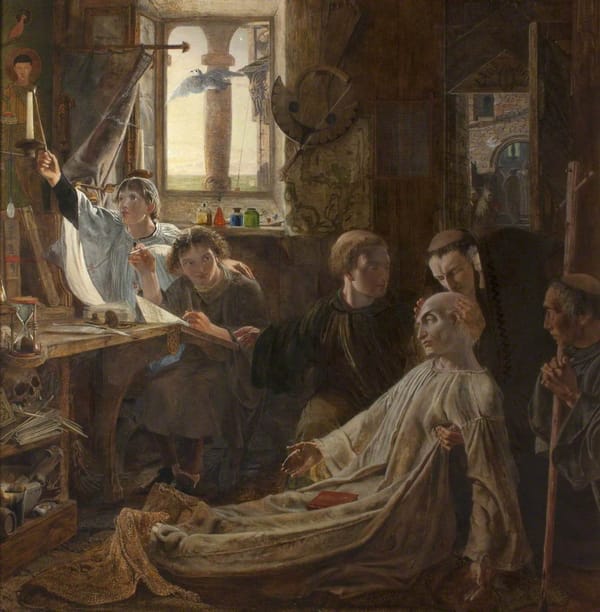 |
May 27: St. Bede the Venerable, Confessor and Doctor of the Church
THE blessing given by our Lord as he ascended into heaven has revealed its power in the most distant pagan lands, and during these days the liturgical cycle bears witness to a concentration of graces upon the west of Europe.
The band of missionaries begged of Pope Eleutherius by the British king Lucius has been followed by the apostolate of Augustine, the envoy of Gregory the Great, and to-day, as though impatient to justify the lavish generosity of heaven, England brings forward her illustrious son, the Venerable Bede. This humble monk, whose whole life was spent in the praise of God, sought his divine Master in nature and in history, but above all in holy Scripture, which he studied with a loving attention and fidelity to tradition. He who was ever a disciple of the ancients, takes his place to-day among his masters as a Father and Doctor of the Church.
He thus sums up his own life: 'I am a priest of the monastery of the blessed Apostles Peter and Paul. I was bom on their land, and ever since my seventh year I have always lived in their house, obserying the Rule, singing day by day in their church, and making it my delight to learn, to teach or to write. Since I was made a priest, I have written commentaries on the holy Scripture for myself and my brethren, using the words of our venerated Fathers and following their method of interpretation. And now, good Jesus, I beseech thee, thou who hast given me in thy mercy to drink of the sweetness of thy word, grant me now to attain to the source, the fount of wisdom, and to gaze upon thee for ever and ever.’*
The holy death of the servant of God was one of the most precious lessons he left to his disciples. His last sickness lasted fifty days, and he spent them, like the rest of his life, in singing the psalms and in teaching. As the Feast of the Ascension drew near, he repeated over and over again with tears of joy the Antiphon: ‘O king of glory, who hast ascended triumphantly above the heavens, leave us not orphans, but send us the promise of the Father, the Spirit of truth.’ He said to his disciples in the words of St Ambrose: ‘I have not lived in such a sort as to be ashamed to live with you, but I am not afraid to die, for we have a good Master.’ Then, returning to his translation of the Gospel of St John and a work, which he had begun, on St Isidore, he would say: ‘I do not wish my disciples to be hindered after my death by error nor to lose the fruit of their studies.’
On the Tuesday before the Ascension he grew worse, and it was evident that the end was near. He was full of joy and spent the day in dictating and the night in prayers of thanksgiving. The dawn of Wednesday morning found him urging his disciples to hurry on their work. At the hour of Terce they left him to take part in the procession made on that day with the relics of the saints. One of them, a child, who stayed with him, said: 'Dear master, there is but one chapter left; hast thou strength for it?’ ‘It is easy,' he answered with a smile; ‘take thy pen, cut it and write—but make haste.' At the hour of None, he sent for the priests of the monastery and gave them little presents, begging them to remember him at the altar. All wept. But he was full of joy, saying: ‘It is time for me, if it so please my Creator, to return to him who made me out of nothing, when as yet I was not. My sweet Judge has well ordered my life, and now the time of dissolution is at hand. I desire to be dissolved and to be with Christ. Yea, my soul longs to see Christ my king in his beauty.’
So did he pass this last day. Then came the touching dialogue with Wibert, the child mentioned above. ‘Dear master, there is yet one sentence more.' 'Write quickly.' After a moment: ‘It is finished,’ said the child. 'Thou sayest well,' replied the blessed man. ‘It is finished. Take my head in thy hands and support me over against the Oratory, for it is a great joy to me to see myself over against that holy place where I have so often prayed.’ They had laid him on the floor of his cell. He said: ‘Glory be to the Father, and to the Son, and to the Holy Ghost,’ and when he had named the Holy Ghost, he yielded up his soul.
The following account of this holy monk is given in the Breviary:
‘Glory be to the Father, and to the Son, and to the Holy Ghost’ is the hymn of eternity. Before the creation of the angels and of man, God, in the concert of the three divine Persons, sufficed for his own praise, and this praise was adequate, infinite and perfect, like the divinity. This was the only praise worthy of God. However magnificently the world may hymn its Creator in the thousand voices of nature, its praise is always below the divine Object. But, in the designs of God, creation was one day to send up to heaven an echo of that melody which is threefold and yet one, for the Word was to take flesh, through the operation of the Holy Ghost, in the womb of Mary, and was to be Son of Man as truly as he is Son of God. Then the canticle of creation fully and perfectly re-echoed the adorable harmonies once known only to the blessed Trinity. Since that day a man who has understanding finds his perfection in such conformity to the Son of Mary, that he may be one with the Son of God in the divine concert wherein God is glorified.
This, O Bede, was thy life, for understanding was given thee. It was fitting that thy last breath should be spent in that song of love which had filled thy mortal life, and that thus thou shouldst enter at once into a glorious and blessed eternity. May we profit by that supreme lesson, which sums up all the teaching of thy grand and simple life!
Glory be to the almighty and merciful Trinity! These words form the close of the cycle of the mysteries which terminate at this time in the glorification of the Father, our sovereign Lord, by the triumph of the Son our Redeemer, and the inauguration of the reign of the Holy Ghost, our sanctifier. How splendid were the triumph of the Son and the reign of the Holy Ghost in the Isle of Saints in the days when Albion, twice given by Rome to Christ, shone like a priceless jewel in the diadem of the Spouse! O thou who wast the teacher of the English in the days of their fidelity, do not disappoint the hopes of the supreme Pontiff who has in our days extended thy cult to the Universal Church; but rekindle in the hearts of thy countrymen their former love for the Mother of all mankind.
* Bede, Hist, Eccl. cap. ult. ↩︎
May 27 (the Same Day): St. John I, Pope and Martyr
THE palm of martyrdom was won by this holy Pope, not in a victory over a pagan persecutor, but in battling for the Church’s liberty against a Christian king. But this king was a heretic, and therefore an enemy of every Pontiff that was zealous for the triumph of the true faith. The state of Christ’s Vicar here on earth is a state of combat; and it frequently happens that a Pope is veritably a martyr, without having shed his blood. St John I, whom we honour to-day, was not slain by the sword; a loathsome dungeon was the instrument of his martyrdom; but there are many Popes who are now in heaven with him, martyrs like himself, who never even passed a day in prison or in chains: the Vatican was their Calvary. They conquered, yet fell in the struggle with so little appearance of victory, that heaven had to take up the defence of their reputation, as was the case with that angelic Pontiff of the eighteenth century, Clement XIII.
The Saint of to-day teaches us, by his conduct, what should be the sentiment of every worthy member of the Church. He teaches us that we should never make a compromise with heresy, nor approve the measures taken by worldly policy for securing what it calls the rights of heresy. If the past ages, aided by the religious indifference of Governments, have introduced the toleration of all religions, or even the principle that ‘all religions are to be treated alike by the state,’ let us, if we will, put up with this latitudinarianism, and be glad to see that the Church, in virtue of it, is guaranteed from legal persecution; but as Catholics, we can never look upon it as an absolute good. Whatever may be the circumstances in which Providence has placed us, we are bound to conform our views to the principles of our holy faith, and to the infallible teaching and practice of the Church—out of which, there is but contradiction, danger and infidelity.
The holy Liturgy thus extols the virtues and courage of our Saint:
Thy fair palm, O holy Pontiff, was the reward of proclaiming the spotless holiness of the Church of Christ. She is the glorious Church, as St Paul calls her, having neither spot nor wrinkle;1 and, for that very reason she can never consent to yield to heresy any of the inheritance given her by her divine Lord. Nowadays, men form their calculations on the interests of this passing world, and are resolved to regulate society independently of the rights of the Son of God, from whom proceeds all social order, as well as all truth. They have deprived the Church of her external constitution and influence; and at the same time, they give encouragement to the sects that have rebelled against her. O holy Pontiff, teach us to realize what divine truth is, and how error can never create prescription against her rights. Then shall we submit to the unhappy necessities handed down to us by the fatal triumph of heresy, without accepting, as a sign of progress, the principle and law that ‘all religions are on an equality.’ In thy prison, brave martyr, thou didst proclaim the rights of the one only Church; preserve us, who are living during that revolt which was foretold by the Apostle,2 from those cowardly compromises, dangerous prejudices, and culpable want of solid instruction, which are the ruin of so many souls; and may our last words, on leaving this world, be those that were taught us by our Jesus himself: Heavenly Father! Hallowed be thy Name! May thy Kingdom come!
Thursday in Whitsun Week
|
The divine Spirit has been sent to secure unity to the bride of Christ; and we have seen how faithfully He fulfils His mission, by giving to the members of the Church to be one, as He Himself is one. But the bride of a God, who is, as He calls Himself, the truth,1 must be in the truth, and can have no fellowship with error. Jesus entrusted His teachings to her care, and has instructed her in the person of the apostles. He said to them: ‘All things whatsoever I have heard of My Father, I have made known to you.’2 And yet, if left unaided, how can the Church preserve free from all change, during the long ages of her existence, that word which Jesus has not written, that truth which He came from heaven to teach her? Experience proves that everything changes here below; that written documents are open to false interpretations; and that unwritten traditions are frequently so altered in the course of time, as to defy recognition.
Here again we have a proof of our Lord’s watchful love. In order to realize the wish He had to see us one, as He and His Father are one,3 He sent us His Spirit; and in order to keep us in the truth, He sent us this same Spirit who is called the Spirit of truth. ‘When the Spirit of truth is come,’ said He, ‘He will teach you all truth.’4 And what is the truth which this Spirit will teach us? ‘He will teach you all things, and bring all things to your mind, whatsoever I shall have said to you.’5
So that nothing of what the divine Word spoke to men is to be lost. The beauty of His bride is to be based on truth, for ‘beauty is the splendour of truth.’ Her fidelity to her Jesus shall be of the most perfect kind; for if He be the truth, how could she ever be out of the truth? Jesus had said:’I will ask the Father, and He shall give you another Paraclete, that He may abide with you for ever; and He shall be in you.’6 It is by the Holy Ghost, then, that the Church is ever to possess the truth, and that nothing can rob her of it; for this Spirit, who is sent by the Father and the Son, will abide unceasingly with and in her.
The magnificent theory of St. Augustine comes most appropriately here. According to his teaching—which, after all, is but the explanation of the texts just cited—the Holy Ghost is the principle of the Church’s life; and He, being the Spirit of truth, preserves and directs her in the truth, so that both her teaching and her practice cannot be other than expressions of the truth. He makes Himself responsible for her words. jnst as our spirit is responsible for what our tongue utters. Hence it is that the Church, by her union with the Holy Ghost, is so identified with truth, that the apostle did not hesitate to call her ‘the pillar and ground of the truth’.7 The Christian, therefore, may well rest on the Church in all that regards faith. He knows that the Church is never alone; that she is always with the holy Spirit who lives within her; that her word is not her own, hut the word of the Spirit, which is the word of Jesus.
Now, this word of Jesus is preserved in the Church by the Holy Ghost, and in two ways. He guards it as contained in the four Gospels, which the evangelists wrote under His inspiration. It is by His watchful care that these holy writings have been kept free from all change during the past ages. The same is to be said of the other books of the new Testament, which were also written under the guidance of the same Spirit. Those of the old Testament are equally the result of the inspiration of the Holy Ghost: and, although they do not give us the words spoken by our Saviour during His mortal life, yet do they speak of Him, and foretell His coming, and contain, moreover, the primitive revelations made by God to mankind. The Books of sacred Writ are replete with mysteries, the interpretation of which is communicated to the Church by the Holy Ghost.
The other channel of Jesus’ word is tradition. It was impossible for everything to be written; and even before the Gospels were composed, the Church was in existence. Tradition, like the written word itself, is from God; but unless the Spirit of truth watch over and protect it, how can it remain pure and intact? He therefore fixes it in the memory of the Church, He preserves it from change: it is His mission; and thanks to the fidelity wherewith He fulfils His mission, the Church remains in possession of the whole treasure left her by her Spouse.
But it is not enough that the Church possesses the word, written and traditional: she must also have the understanding of that word, in order that she may explain it to her children. Truth came down from heaven that it might be communicated to men; for it is their light, and without it they would be in darkness, knowing not whither they are going.8 The Spirit of truth could not, therefore, be satisfied if the word of Jesus were kept as a hidden treasure; no, He will have it thrown open to men, that they may thence draw life to their souls. Consequently, the Church will have to be infallible in her teaching; for how can she be deceived herself, or deceive others, seeing it is the Spirit of truth who guides her in all things and speaks by her mouth? He is her soul; and we have already had St. Augustine telling us that when the tongue speaks, the soul is responsible.
The infallibility of our holy mother the Church is the direct and immediate result of her having the Spirit of truth abiding within her. It is the promise made to her by Jesus; it is the necessary consequence of the presence of the holy Spirit. The man who does not acknowledge the Church to be infallible, should, if he be consistent, admit that the Son of God has not been able to fulfil His promise, and that the Spirit of truth is a Spirit of error. But he that reasons thus, has strayed from the path of life; he thought he was but denying a prerogative to the Church, whereas, in reality, he has refused to believe God Himself. It is this that constitutes the sin of heresy. Want of due reflection may hide the awful conclusion; but the conclusion is strictly implied in his principle. The heretic is at variance with the Holy Ghost, because he is at variance with the Church; he may become once more a living member, by humbly returning to the bride of Christ; but at present he is dead, for the soul is not animating him. Let us again give ear to the great St. Augustine: ‘It sometimes happens,’ he says, ‘that a member—say a hand, or finger, or foot—is cut from the human body; tell me, does the soul follow the member that is thus severed? As long as it was in the body, it lived; now that it is cut off, it is dead. In the same manner, a Christian is a Catholic so long as he lives in the body (of the Church); cut off, he is a heretic; the Spirit follows not a member that is cut off.’9 Glory, then, be to the holy Spirit, who has conferred upon the bride the ‘splendour of truth!’ With regard to ourselves: could we, without incurring the greatest of dangers, put limits to the docility wherewith we receive teachings which come to us simultaneously from ‘the Spirit and the bride,’ who are so indissolubly united?10 Whether the Church intimates what we are to believe, by showing us her own practice, or by simply expressing her sentiments, or by solemnly pronouncing a definition on the subject, we must receive her word with submission of heart. Her practice is ever in harmony with the truth, and it is the Holy Ghost, her life-giving principle, that keeps it so; the utterance of her sentiments is but an aspiration of that same Spirit, who never leaves her; and as to the definitions she decrees, it is not she alone that decrees them, but the Holy Ghost who decrees them in and by her. If it be the visible head of the Church who utters the definition, we know that Jesus prayed that Peter’s faith might never fail,11 that He obtained it from the Father, and that He gave the Holy Ghost the mission of perpetuating this precious prerogative granted to Peter. If it be the sovereign Pontiff and bishops, assembled in council, who proclaim what is the faith on any given subject, it is the Holy Ghost who speaks by this collective judgement, makes truth triumph, and puts error to flight. It is this divine Spirit that has given to the bride to crush all heresies beneath her feet; it is He that, in all ages, has raised up within her learned men, who have confuted error whensoever or wheresoever it was broached.
So that our beloved mother the Church is gifted with infallibility; she is true, always and in all things; and she is indebted for this to Him who proceeds eternally from the Father and the Son. But there is auother glory which she owes to Him. The bride of the thrice holy God could not but be holy. She is so; and it is from the Spirit of holiness that she receives her holiness. Truth and holiness are inseparably united in God. Hence it is that our Saviour, who willed us to be perfect as our heavenly Father is perfect,12 and, creatures as we are, would have us take the infinite good as our model, prayed that we might be sanctified in the truth.13
Jesus, therefore, consgined His bride to the direction of the Spirit, that He might make her holy. Holiness is so inherent in this divine Spirit, that it is His very name. Jesus Himself calls Him the Holy Ghost;14 so that it is on the authority of the Son of God that we call Him by this beautiful name. The Father is power; the Son is truth; the Spirit is holiness: and it is for this reason that the Spirit has, here below, the office of Sanctifier; although the Father and the Son are holy, just as truth is in the Father and the Spirit, and power is in the Spirit and the Sou. The three Persons of the blessed Trinity have each His special property, but They are all one in essence or nature. Now, the special property of the Holy Ghost is love, and love produces holiness; for it unites the sovereign Good with the soul that loves Him, and this union is holiness, which is the splendour of goodness, as beauty is the splendour of truth.
That she might be worthy, then, of the Emmanuel, her Spouse, the Church was to be holy. He gave her truth, and the divine Paraclete has preserved it within her: the Spirit is to endow her with holiness; and the Father, seeing her true and holy, will adopt her as His daughter:—this is her glorious destiny. Let us now see what proofs she gives of her being holy. The first is her fidelity to her Spouse. History is one long testimony of this her fidelity. Every possible snare has been laid, every sort of violence has been used, to make her unfaithful: she has bravely withstood them all: she has sacrificed everything, her blood, her peace, the very countries where she reigned, rather than allow what Jesus had entrusted to her to be corrupted or changed. Count, if you can, her martyrs, from the apostles down to our own times, who have died for the faith. Call to mind the offers made to her by the potentates of the earth, soliciting her to dissemble the truth. Think of the threats and persecutions whereby the world sought to make her withdraw one or other dogma of her Creed. Who that knows aught of past or present history, can forget the great battle she fought against the emperors of Germany in defence of the liberty wherewith her Jesus had made her free, and of which He is so jealous; or the noble love of justice she evinced, when her refusal to sanction by an unlawful dispensation the adultery of a king, was to be followed by the apostasy of England; or the high-minded love of principle she showed in the person of Pius IX, when she braved the clamours of modern infidelity, yea, and the cowardly remonstrances of temporizing Catholics, rather than allow a Jewish boy who had been baptized when in danger of death, to be exposed to the temptation of denying his faith and blaspheming the Saviour who had made him His child?
Such has been, and such ever will be, the conduct of the Church, because she is holy in her fidelity, and because the divine Spirit inspires her with a love which overleaps everything when duty is at stake. She can show the code of her laws to her enemies as well as to her faithful children, and defy them to point out a single enactment that has not been made with a view to procure the glory of her Jesus and lead mankind to virtue. The observance of these her laws has given to God millions of saints, whom she has produced through the influence of the Holy Ghost. The Church claims each one of those myriads of the elect as the fruit of her maternal care. Even those whom Providence has permitted to be born of heretical parents—if they have lived in the disposition of mind of entering the true Church as soon as they should find it, and have faithfully corresponded, by a virtuous life, to the grace given to them through the merits of the Redeemer—they, too, are children of the Church.
She is the school of devoted ness and heroism. Virtues, of which men knew not so much as the name before she was founded, are now being practised in every country of the world. There are extraordinary actions of saintliness, which she rewards with the honour of canonization; there are the more humble and hidden virtues, which are to be published only on the day of judgement. The precepts of Jesus are observed by all His disciples; they obey Him as their dear Master. This Master has also His counsels, which all cannot follow, but which afford the Church a new scope for the development of her gift of holiness. Not only are there individual and generous souls who fervently practise these counsels; there are the religious Orders, whose aim is perfection, and whose first law is the obligation, under vow, of observing the evangelical counsels, unitedly with the precepts; and these Orders are produced in the Church by the action of the Spirit of holiness.
After this, we cannot wonder at her having the gift of miracles, which is the outward mark of holiness. It is a supernatural gift, which our Lord told her she should always possess.15 Now, the apostle assures us, that the working of miracles comes directly from the Holy Ghost.16
It may be objected that all the members of the Church are not holy: to this we reply, that she offers to all the means of becoming so, but that their freewill may, and frequently does, reject such means. Free-will has been granted to man that he might thereby merit; and it is a contradiction in terms to say that he who has free-will is, at the same time, necessitated to choose good. Moreover, an immense number of those who are now in a state of sin, but who are members of the Church by faith and respectful submission to her lawful pastors, and particularly to the sovereign Pontiff, will sooner or later be reconciled to God and die in holy dispositions. It is the mercy of the Holy Ghost that works this wonderful change, and He works it through the Church, who, imitating her divine Spouse, breaketh not the bruised reed, nor quencheth the smoking flax.17
How could she be otherwise than holy, who has received, in order to administer them to her children, the seven sacraments, of which we have spoken in one of the preceding weeks? What more holy than these divine rites, some of which give life to sinners, and others an increase of grace to the just? These sacraments, which were instituted by Christ and given in heritage to His Church, all bear some relation to the Holy Ghost. In Baptism, Confirmation, and Holy Orders, His operation is direct; in the eucharistic sacrifice, it is by His action that the Man-God lives and is immolated on our altars; it is He that restores baptismal grace by Penance; He is the Spirit of fortitude, who strengthens the dying by Extreme Unction; He is the sacred link which inseparably unites husband and wife together in the sacrament of Matrimony. Our Jesus gave us these seven sacraments as a pledge of His love, when He left us to return to His Father; but the treasure remained sealed up until the descent of the Holy Ghost. It was for Him to prepare the bride, by sanctifying her, to receive these precious gifts into her royal hands, and to administer them faithfully to her children; it was for Him, therefore, to put her in possession of them.
Lastly, the Church is holy because of her ceaseless prayer. He who is the Spirit of grace and of prayers,18 is ever producing, in the children of the Church, those varied acts of adoration, thanksgiving, petition, repentance, and love, which constitute the sublime concert of prayer. To these He adds, for many of the faithful, the gifts of contemplation, whereby either the creature is raised up to his God, or God comes down to him, with favours which seem only fit for such as are already in heaven. Who could enumerate the aspirations, we mean the effusions of love, which the holy bride sends up to her Jesus in those millions of prayers, which are day and night ascending from earth to heaven, and seem to unite the two in the embrace of closest intimacy? How could she be otherwise than holy, who, as the apostle so forcibly expresses it, has her conversation in heaven?19
But if the individual prayer offered up by her children is thus admirable by its multiplicity and its ardour, how beautiful and grand must be the united prayer of the Church herself in her liturgy, wherein the Holy Ghost acts with all the plenitude of His inspiration, and puts upon her lips those thrilling and sublime words, which we have undertaken to explain in our Liturgical Year! We would ask those who have followed us thus far, if the liturgy is not the best of all prayers, and the guide and soul of their own individual prayer? Let them, therefore, love the holy mother who gives them to partake of her own abundance. Let them glorify the Spirit of grace and of prayers for all that He so mercifully deigns to do both for her and for them!
O Church of our God! thou art sanctified in truth! By thee we are taught the whole doctrine of our Jesus! By thee we are put in the path of that holiness, which is thy very life. What would we have more, having truth and holiness? They that seek them out of thee, seek in vain. Happy we, who have nothing to seek, because we have thee for our mother, who art ever lavishing upon us all thy grand gifts and lights! Oh! how beautiful art thou on this solemnity of Pentecost, which gave thee the riches thou givest to us! We gaze with delighted wonder at the magnificent prerogatives prepared for thee by thy Jesus, and communicated to thee by the Holy Ghost. And now that we know thee better, we will love thee with warmer hearts!
The Station for the Thursday of Whitsuntide is in the basilica of St. Laurence outside the walls. This venerable church, where lie the relics of the intrepid archdeacon of Rome, is one of the grandest trophies of the victory gained by the Holy Ghost over the prince of this world. This annual assembly of the faithful in so holy a place, and for all these long ages, is an eloquent testimony to the completeness of that victory, which made Rome and her power subject to Christ.
The Armenian Church comes, for the fourth time, to aid us in our homage to the Holy Ghost. The richest fragrance of antiquity is in the stanzas we select for to-day.
Hymn (Canon quintæ diei.)
We subjoin a sequence from Germany; in which her illustrious prophetess, the holy abbess Hildegarde, gives expression to her love of the divine Spirit, whose inspiration she almost uninterruptedly enjoyed and obeyed.
Sequence
Vita vitae omnis creaturae.
Sanctus es ungendo Periculose fractos.
Sanctus es tergendo Foetida vulnera.
O ignis charitatis,
O dulcis gustus
In pectoribus, et infusio cordium
In bono odore virtutum!
Quod Deus alienos Colligit, et perditos requirit.
Et spes compaginis
Membrorum omnium!
Salva beatos!
Et solve ligatos, quos divina vis salvare vult.
In altissimis, e in terrenis, et in omnibus abyssis,
Et colligis.
Lapides humorem habent,
Aquæ rivulos educunt Et terra viriditatem sudat.
Per inspirationem sapientiae Laetificatos.
Qui es sonus laudis Et gaudium vitæ,
Spes et honor fortissimus,
Dans praemia lucis.
thou art the life of every creature’s life.
Thou art the Holy One, healing with thine unction them that are dangerously bruised!
Thou art the Holy One, cleansing our festered wounds!
O fire of charity!
O thou sweet Saviour
of the soul, and the heart’s infusion
of the pleasing odour of virtues!
who adopts aliens for his children, and goes in search of them that are lost.
that givest all the members hope
of compact strength!
save us thy happy people!
Loose the bonds of them whom God’s power would save!
that penetratest heaven and earth, and every deep abyss,
and unity!
that rocks yield springs,
that waters flow, and earth gives forth her verdure.
gladdening them with the inspiration of wisdom.
O thou praise-yielding Spirit, thou joy of life,
our hope, our highest honour,
the giver of the reward of light!
- St. John, xiv. 6. ↩︎
- Ibid. xv. 15. ↩︎
- Ibid. xvii. 11. ↩︎
- St. John, xvi. 13. ↩︎
- Ibid. xiv. 26. ↩︎
- Ibid. 16, 17. ↩︎
- 1 Tim. iii. 15. ↩︎
- St. John, xii. 35. ↩︎
- Serm. cclxvii. In die Pentecostes. ↩︎
- Apoc. xxii. 17. ↩︎
- St. Luke, xxii. 32. ↩︎
- St. Matth. v. 48. ↩︎
- St. John, xvii. 19. ↩︎
- Ibid. xiv. 26. xx. 22, et alibi. ↩︎
- St. John, xiv. 12. ↩︎
- 1 Cor. xii. 11. ↩︎
- Is. xlii. 3. ↩︎
- Zach. xii. 10. ↩︎
- Philipp. iii. 20. ↩︎
Thursday in Whitsun Week: The Gift of Counsel
We have seen how necessary for the sanctification of a Christian is the gift of fortitude; but it is not sufficient; there is need of another gift, which completes it. This other gift is Counsel. Fortitude needs direction. The gift of knowledge is not the guide of fortitude, and for this reason: knowledge teaches the soul her last end, and gives her general rules for her conduct; hut it does not bring her light sufficient for the special application of God’s law to particular cases, and for the practical doing of her duty. In those varied circumstances in which we are to be placed, and in the decisions we must then form, we shall have to hearken to the voice of the Holy Ghost, and this voice speaks to us through the gift of counsel. It will tell us, if we are attentive to its speaking, what we must do and what we must not do, what we must say and what we must not say, what we may keep and what we must give up. The Holy Ghost acts upon our understanding by the gift of counsel, as He acts upon our will by the gift of fortitude.
This precious gift bears upon our whole life; for we are continually obliged to be deciding on one of two sides or questions. How grateful, then, should we be to the Holy Ghost, who is ever ready to be our counsellor, if we will but permit Him! And if we follow His direction, what snares He will teach us to avoid! how many illusions He will dispel! bow grand the truths He will show us! But, in order that His inspirations may not be lost upon us, we must be on our guard against such miseries of our nature as the following: natural impulse, which is but too often the sole motive of our acts; rashness, which makes us follow whatever feeling happens to be uppermost in our mind; precipitation, which urges us to judge or act, before we have seen both sides of the case; and lastly, indifference, which makes us decide at haphazard, out of a repugnance we have to take the trouble of examining what is the best course to pursue.
By the gift of counsel, the Holy Ghost saves us from all these evils. He corrects the impetuosity, or, it may be, the apathy, of our temperament. He keeps the soul alive to what is true, and good, and conducive to her real interests. He introduces into the soul that virtue which completes and seasons every other—we mean discretion whereby the other virtues are harmonized and kept from extremes. Under the direction of the gift of counsel, the Christian has nothing to fear; the Holy Ghost takes the whole responsibility. What matters it, therefore, if the world find fault, or criticize, or express surprise, or be scandalized? The world thinks itself wise; but it has not the gift of counsel. Hence it often happens that what is undertaken by its advice, results in the very opposite to what was intended. Was it not of the world that God spoke, when He said:’My thoughts are not your thoughts, nor your ways my ways’?1
Let us, then, with all the ardour of our hearts, desire this divine gift, that will preserve us from the danger of being our own guides; but let us remember, it will only dwell in us on the condition of our allowing it to be master. If the Holy Ghost sees that we are not led by worldly principles, and that we acknowledge our own weakness, He will be our counsel; if He find that we are wise in our own eyes, He will withdraw His light, and leave us to ourselves.
O holy Spirit! we would not that Thou shouldst ever abandon us. Sad experience has taught us how fraught with danger is all human prudence. Most cheerfully do we promise Thee to mistrust our own ideas, which are so apt to blind and mislead us. Keep up within us the magnificent gift Thou gavest us at Baptism: be Thou our counsel, yea, unreservedly and for ever! Show me, O Lord, Thy ways, and teach me Thy paths. Direct me in Thy truth, and teach me: for Thou art the God who canst save me; therefore have I waited on Thee, all the day long.2 We know that we are to be judged for all our works and intentions; but we know, too, that we have nothing to fear so long as we are faithful to Thy guidance. Therefore will we attentively hear what the Lord God will speak in us;3 we will listen to Thee, O holy Spirit of counsel, whether Thou speakest to us directly Thyself, or whether Thou sendest us to those whom Thou shalt appoint as our guides. Blessed, then, be Jesus, who has sent us such a Counsellor! And blessed be Thou, O holy Spirit, who deignest to give us Thine aid, in spite of all our past resistance!
| Previous Wednesday in Whitsun Week: The Gift of Fortitude | Next May 27 (the Same Day): St. John I, Pope and Martyr |