Daily reading
May 29: St. Mary Magdalen de Pazzi, Virgin
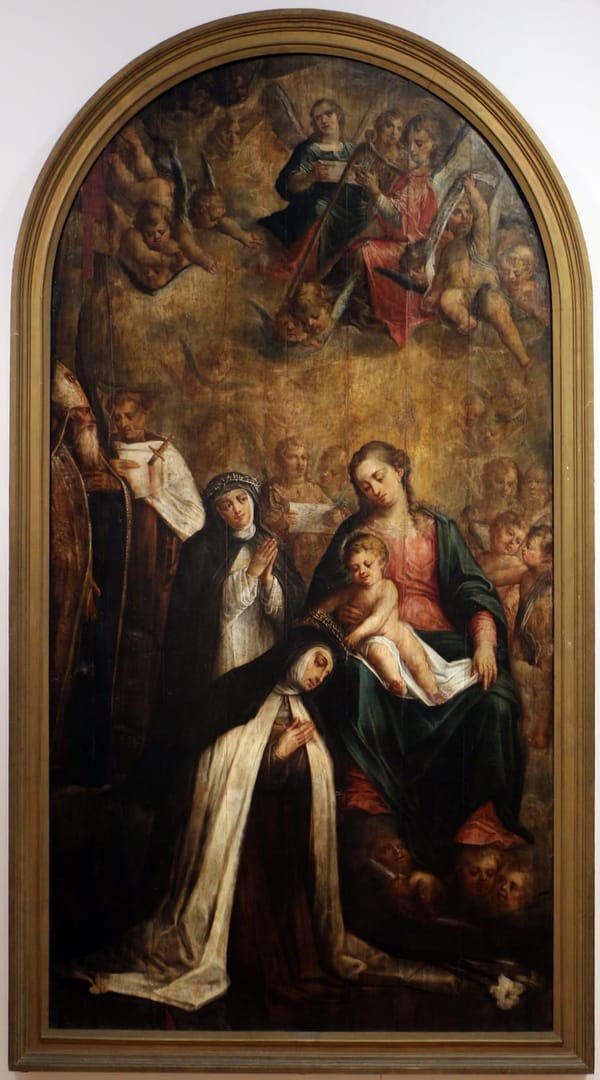
OUR Paschal Calendar gives us three illustrious virgins of beautiful Italy. We have already kept the feast of the valiant Catharine of Siena; in a few days we shall be honouring the memory of Angela dei Merici, surrounded by her school-children; to-day it is the fair lily of Florence, Magdalen de Pazzi, who embalms the whole Church with the fragrance of her name and intercession. She devoted herself to the loving imitation of our crucified Jesus; was it not just that she should have some share in the joy of his Resurrection?
Magdalen de Pazzi was one of the brightest ornaments of the Order of Carmel, by her angelic purity, and by the ardour of her love for God. Like St Philip Neri, she was one of the grandest manifestations of the divine charity that is found in the true Church. Magdalen in her peaceful cloister, and Philip in his active labours for the salvation of souls—both made it their ambition to satisfy that desire expressed by our Jesus when he said: I am come to cast fire on the earth; and what will I, hut that it he kindled?1 The life of this Spouse of Christ was one continued miracle. Her ecstasies and raptures were almost of daily occurrence. The lights given to her regarding the mysteries were extraordinary; and in order to prepare her for those sublime communications, God would have her go through the severest trials of the spiritual life. She triumphed over them all; and her love having found its nourishment in them, she could not be happy without suffering; for nothing else seemed to satisfy the longings of the love that burned within her. At the same time, her heart was filled to overflowing with charity for her neighbour: she would have saved all mankind, and her charity to all, even for their temporal well-being, was something heroic. God blessed Florence on her account; and she so endeared herself to its people by her admirable virtues, that devotion to her, even to this day, which is more than three hundred years since her death, is as fervent as ever it was.
One of the most striking proofs of the divine origin and holiness of the Church is to be found in such privileged souls as Magdalen de Pazzi, on whom we see the mysteries of our salvation acting with such direct influence. God so loved the world as to give it his Only Begotten Son;2 and this Son of God deigns to love some of his creatures with such special affection, and to lavish upon them such extraordinary favours, that all men may have some idea of the love wherewith his Sacred Heart is inflamed for this world, which he redeemed at the price of his Blood. Happy those Christians that appreciate and relish these instances of Jesus' special love! Happy they that can give him thanks for bestowing such grits on some of our fellowcreatures! They have the true light; whereas they that have an unpleasant feeling at hearing of such things, and are angry at the thought that there can be between God and any soul an intimacy of which they are not worthy, prove that there is a great deal of darkness in their faith.
We regret extremely that we have not space for a fuller development of the character and life of our Saint. We therefore proceed at once to the Lessons given in her Office. Even they are too short, and give us but an imperfect idea of this admirable spouse of Christ.
Charitate erga proximum singulariter enituit; nam sæpe noctes ducebat insomnes, vel obeundis sororum ministeriis, vel inserviendo infirmis occupata, quarum aliquando ulcera lambens sanavit. Infidelium et peccatorum perditionem amare deflens, se ad quælibet pro illorum salute tormenta paratam offerebat. Multis ante obitum annis, universis cœli deliciis, quibus copiose affluebat, heroica virtute renuntians, illud frequenter in ore habebat: Pati, non mori. Tandem longa et gravissima infirmitate exhausta, transivit ad Sponsum die vigesima quinta Maji anno millesimo sexcentesimo septimo, expleto anno quadragesimo primo ætatis suæ. Eam multis in vita et post mortem miraculis claram Clemens Nonus sanctarum Virginum numero adscripsit: cujus corpus in præsentem diem incorruptum conservatur.
She was remarkable for her charity towards others. She would frequently sit up the whole night, either doing the work of the sisters, or waiting upon the sick, whose sores she sometimes healed by sucking the wounds. She wept bitterly over the perdition of infidels and sinners, and offered to suffer every sort of torment so that they might be saved. Several years before her death she heroically besought our Lord to take from her the heavenly delights wherewith he favoured her; and was frequently heard saying these words: ‘To suffer; not to die.' At length, worn out by a long and most painful illness, she passed hence to her Spouse, on the twenty-fifth of May, in the year 1607, having completed the forty-first year of her age. Many miracles having been wrought by her merits, both before and after death, she was canonized by Pope Clement the Ninth. Her body is, even to this day, preserved from corruption.
Thy life here below, O Magdalen, resembled that of an angel sent by God to assume our weak and fallen nature and be subject to its laws. Thy soul ceaselessly aspired to a life which was all heavenly, and thy Jesus was ever giving thee that thirst of love which can only be quenched by the waters of life everlasting.3 A heavenly light revealed to thee such admirable mysteries, such treasures of truth and beauty, that thy heart, unequal to the sweetness thus given to it by the Holy Ghost, sought relief in sacrifice and suffering. It seemed to thee as though there was but one way of making God a return for his favours—the annihilation of self.
Seraphic lover of our God! how are we to imitate thee? what is our love, when we compare it to thine? And yet we can imitate thee. The year of the Church's Liturgy was thy very life. Each of its seasons did its work in thee, and brought thee new light and love. The divine Babe of Bethlehem, the bleeding Victim of the Cross, the glorious Conqueror of Death, the Holy Ghost radiant with his seven gifts—each of these great realities enraptured thee; and thy soul, renewed by the annual succession of the mysteries, was transformed into him who, that he might win our hearts, gives these sublime celebrations to his Church. Thy love of souls was great during thy sojourn here; it is more ardent now that thou art in possession of the Sovereign Good; obtain for us, O Magdalen, light to see the riches which enraptured thee, and love to love the treasures which enamoured thee. O riches! O treasures! is it possible that they are ours too?
Saturday in Whitsun Week
|
We have been contemplating, with grateful hearts, the inexpressible devotedness, the divine untiredness, wherewith the Holy Ghost fulfils His mission in the souls of men; we have something still to add to our considerations, in order to have anything like a true idea of the wonders wrought by the divine Guest when the heart raises no obstacles. And first of all we deem it necessary to say a word to those Christians, who, after hearing what we have said regarding the prodigies of power and love of the divine Spirit, and the sublime mystery of His presence among us, might be tempted to fear lest all this may, in some degree, tend to make us forget our dearest Jesus, who being in the form of God, and equal to God, emptied Himself, being made in the likeness of man, and in habit found as man.1
The superficial knowledge of their religion is the reason why so many Christians have very vague notions about the Holy Ghost and His special workings in the Church and the souls of men. You will find these same individuals well instructed upon the mysteries of the Incarnation and Redemption; you will find them really devout in honouring the Son of God; but, judging from their conduct, you would say that they have put off knowing and honouring the Holy Ghost until they get to heaven.
We would, therefore, tell them, that the mission of this divine Spirit, far from being likely to make us forget what we owe to our Saviour, is the grandest gift bestowed upon us by this our Redeemer. Who is it that produces and keeps up within us the loving and meritorious remembrance of our Jesus’ mysteries? It is the Holy Ghost, who dwells in our hearts for the sole purpose of forming Christ, the new Man, within us, to the end that we may be united with Him, for ever, as His members. Consequently, the love we bear to our Jesus is inseparable from that we bear to the Holy Ghost; and the love we have for this divine Spirit, closely unites us with the Son of God, from whom He (the Spirit) proceeds and is given to us. When we meditate on the sufferings of Jesus, we are excited to feelings of affectionate compassion, and it ought to be so; but how comes it that we never think of, or, if we think of, never grieve over, the resistances, the slights, the disloyalties, which the Holy Ghost is every day receiving from ourselves and others? It is, indeed, most true that we are children of our heavenly Father: but, why should we forget the immense debt we owe to the other two divine Persons, who have come down from heaven to serve us, and at the risk of receiving nought but ingratitude!
After this short, but almost necessary, digression, we will continue our reflections upon the workings of the Holy Ghost in the soul of man. As we were just saying, His aim is to form Christ within us by the imitation of this our Redeemer’s sentiments and actions. Who, better than this divine Spirit, knows Jesus, whose Humanity He formed in Mary’s womb? Jesus, in whom He dwelt so unreservedly? Whom He aided and directed in all things, with a fullness of grace becoming the dignity of the human Nature which was personally united with the Divinity? We repeat—His object is to reproduce, in our humble persons, a faithful copy of Jesus, as far as our fallen nature will permit so grand a work to be realized.
The holy Spirit produces the most noble results in this His work, which is one truly worthy of a God. We have already seen how He wins from sin and Satan the creatures purchased by Christ; now let us consider Him achieving His victories in what the apostle so magnificently calls the consummation of the saints.2 He takes them as He finds them, that is, fallen children of Adam; He first applies to them the ordinary means of sanctification, though He intends to carry them to extraordinary virtue. The courage wherewith He carries on His work is truly divine. He has to deal with nature, fallen indeed and tainted with a poison which is mortal, but a nature which retains some resemblance to its Creator; it is a ruin, but still it is an image. The Spirit, then, has to destroy what there is of corruption and defilement; at the same time, He has to purify and foster what has not been irremediably affected by the poison. The case requires an infinite care. He knows where and when to out or burn; and, what is very wonderful, He makes the invalid himself help Him to apply the saving remedies. Just as He does not save the sinner, without the sinner’s sharing in the work; so neither does He sanctify the saint, without the saint’s co-operation. But He inspirits and encourages him by countless touches of grace; so that, while corrupt nature keeps gradually losing ground in the soul, the healthy parts are being transformed into Christ, and finally the whole man is under the perfect mastery of grace.
The virtues are neither inactive nor half formed in such a Christian as this; and each day they grow more vigorous. The holy Spirit suffers none of them to lag behind, for He is unceasingly showing His disciple the great original whom he is to copy, namely Jesus, in whom are all the virtues in all perfection. There are times when He makes the soul feel her own weakness, in order that she may humble herself; He permits her to feel certain repugnances and temptations; but these are precisely the seasons wherein He evinces the most watchful solicitude. The soul must act, and she must suffer; the Holy Ghost loves her with extreme tenderness, and will never permit her to be tried above her strength. Oh! what a wonderful work is this, to enable a fallen creature to be a saint! Of course, there will be moments of discouragement, there may be defects now and then; but the work goes on in spite of all, for the divine Spirit keeps up within the soul an unchanging love, which is ever burning out the dross, whilst its own bright flame is every day gaining new intensity and beauty.
The human element at last disappears; it is Christ who lives in this new man, and this man lives in Christ.3 His life is one of prayer, for it is in prayer that he finds union with his Jesus; the more he prays, the closer is the bond. The Holy Ghost is continually opening out new charms of truth to him, in order to encourage him to seek his sovereign good in prayer. He has made it the mystic ladder; it rests on earth, but its summit reaches to high heaven. Who could tell the favours bestowed by God on a soul that has broken every tie of self-love and interest, in order that, with oneness of purpose and energy, she may see and enjoy her Lord, and lose herself eternally in His infinite beauty! The whole blessed Trinity is devoted to such a soul: the Father embraces her in His paternal affection, the Son has no reserves of His love towards her, the Holy Ghost is ever working within her, enlightening and consoling her.
The citizens of heaven, with their wonted interest in us, which makes them keep a feast of joy at the conversion of one poor sinner,4 are enraptured at the lovely sight of a saint; they yearn over him with an indescribable love; they sing a loud hymn of praise to the Holy Ghost who has produced such a masterpiece of perfection out of such materials as fallen nature yields. At times, the blessed Mother evinces her joy by appearing to this her new-born child; the angels show themselves to this brother upon whom they look as worthy to be throned among them; the saints treat him with an intimacy which tells him that they expect him to be soon their companion in the home of everlasting glory. Is it to be wondered at, that this dear child of the Holy Ghost should sometimes be allowed to stay the laws of nature, and work miracles in favour of his suffering or necessitous fellow mortals? Does he not love them with an affection which springs from the love which he has for God, and which is not shackled by the egotism of a heart divided between the world and its Creator?
Nor must we forget to speak of the grandest feature in the soul thus perfected by the Holy Ghost. Men of the world may scoff, and frivolous spirits may feel sceptical, at what we are going to say; it is not the less true, and, thank God, it is not so rare as some among us pretend. It evinces the power of the merits won for us by our Redeemer; it testifies the greatness of His love for mankind; it manifests the divine energy of the Holy Ghost in the souls that put no obstacles to His working within them. The soul, then, that we have been describing, is called to an espousal with Jesus, not only in heaven, but now and on this earth of exile. Jesus loves, as only a God can, the bride He has redeemed with His Blood; and this bride is not only the beloved Church; it is this soul of whom we are speaking, who was once mere nothingness, whose present existence is not known by the world, and yet whose beauty is such that her Creator deigns to say that He, the King, greatly desireth it.5 He, together with the Holy Ghost, has wrought this beauty within her; and He wishes her to be all His. Then is achieved by the holy Spirit, in favour of an individual soul, the same mystery that we have seen accomplished in the Church herself; He prepares her, He establishes her in unity, He fixes her in truth, He perfects her in sanctity. This done, the Spirit and the bride say: ‘Come’!6
It would take a volume to describe the workings of the Holy Ghost in the saints, and we are obliged to be satisfied with this hurried and imperfect sketch. The little we have said was a necessity, in order that we might give a general idea of the mission of the Holy Ghost upon earth, such as we are taught it is by the words of sacred Scripture, and by the principles of dogmatic and mystical theology. What we have said to-day will, moreover, assist our readers in their study and appreciation of the saints. In the course of the liturgical year, during which the names and actions of the saints have been so frequently proclaimed and celebrated by the Church herself, it was important to find an occasion for honouring the sanctifying Spirit: and surely, Pentecost was the most fitting season for doing so.
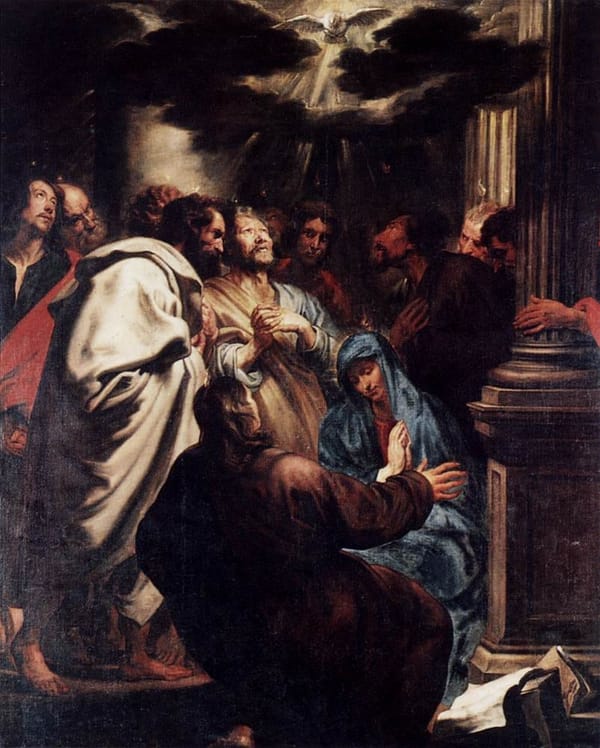
This is the last day of Paschal Time; it is the last of the Pentecost octave; we must not allow it to pass without offering to the Queen of saints the homage which is so justly her due, and without presenting our adoration and praise to the Holy Ghost for all the glorious things He has achieved in her. After the sacred Humanity of our Redeemer, which received from this holy Spirit every gift that could make it worthy, as far as a creature can be, of the divine Nature to which the Incarnation united it, Mary’s soul, and whole being, were adorned with grace above all other creatures together. It could not but be so, as must be evident to us if we reflect for a moment upon the meaning of a Mother of God. Mary, in her single self, forms a world apart in the order of grace; she alone was, for a short time, the Church of Jesus. The holy Spirit was at first sent for her alone, and He filled her with grace from the instant of her Immaculate Conception. That grace developed itself in her, by the continuous action of the Holy Ghost, until at length she became worthy, as far as a creature could be, of conceiving and giving birth to the very Son of God, who became thus the Son of Mary. During these days of Pentecost, we have seen the new gifts wherewith the divine Spirit prepared her for her new office. Is it possible for us her children to think of all these things, and not be ardent in our admiration of her? or not be overflowing with gratitude for the august Paraclete, who has deigned to show such munificence to this our own matchless Mother?
At the same time, we cannot help being overpowered with delight at the thought of the perfection, wherewith this favourite of the holy Spirit corresponded with the graces she received from Him. Not one was lost, not one was fruitless, as is sometimes the case with even the holiest souls. At her very commencement, she was as the rising morn;7 from that time, her sanctity gradually mounted to the midday of its perfection, and that midday was to have no setting. Even before the Archangel announced to her that she was to conceive the Son of God in her chaste womb, she had already conceived Him in her soul, as the holy fathers teach us. The eternal Word loved her as His bride, even before He conferred upon her the honour of being His Mother. If Jesus could say of a soul that had needed regeneration:’They that seek Me, will find Me in the heart of Gertrude,’ what must have been the harmony of soul existing between Him and His blessed Mother! how close must have been their union! Trials of the severest kind awaited her in this world; she bore them all with heroic fortitude; and when the hour came for her to unite her own sacrifice with that made by her Son, she was ready. After Jesus’ Ascension, the Holy Ghost descended upon her; He opened out to her a new career, which would require her being an exile, for many long years, from the heaven where her Son was reigning: —she did not hesitate to accept the bitter chalice thus offered to her; she proved herself to be indeed the handmaid of the Lord, desirous, above all other things, to do His will in every tittle.
So that the triumph of the Holy Ghost in Mary’s person was of the most perfect kind: how grand soever might be His gifts, she worthily corresponded with them all. The sublime office of Mother of God, to which she was called, entitled her to graces in keeping with such a dignity; she received them, and turned them to the richest account. In return for her fidelity, as also in consideration of her incomparable dignity, the Holy Ghost allotted to Mary the place she well merited in the great work He had come to do, namely, the consummation of the saints and the formation of the Church, the body of Christ.8 Her divine Son is the Head of the immense body of the faithful; He gives it unity; but she herself represents the neck, whereby life and motion are communicated from the head to the rest of the body. Jesus is the chief agent; but He acts upon each member through Mary. Her union with the Incarnate Word is immediate, on account of her being to Him what no other creature could be; but with regard to us, the graces and favours, the light and consolation, which we receive from our divine Head, come to us through Mary.
Hence the influence of this blessed Mother upon the Church in general, and upon each individual in particular. She unites us to her Son, and He unites us to the Divinity. The Father gave us His Son; the Son chose a Mother from among His creatures; and the Holy Ghost, by giving fruitfulness to this Virgin-Mother, perfected the union of creatures with their Creator. The end God proposed in creation, was to effect this union; and now that the Son is glorified, and the Holy Ghost has come, we understand the whole divine plan. More favoured than those who lived before the descent of the divine Spirit, we have, not only in promise, but in reality, a Brother who is crowned with the diadem of the divinity; a Paraclete who is to abide with us for ever, to enlighten our path and strengthen us; a mother, whose intercession is all-powerful; a Church, a second mother, by and from whom we receive all these blessings.
The Station at Rome is in St. Peter’s. It was in this noble basilica that the neophytes of Pentecost appeared in their white robes for the last time, and were presented to the Pontiff as the last lambs of the Pasch, which closes to-day.
This Saturday is now kept as the day for ordinations. The three days’ fasting and prayer prescribed by holy Church have rendered heaven propitious; we may confidently hope that the Holy Ghost, who is about to seal the new priests and sacred ministers with the sacramental character, will vouchsafe to act with all the plenitude of His goodness as well as with all the might of His power; for, upon this day, there is question not only of an immense privilege granted to those who are ordained, but likewise of the salvation of the flocks who are hereafter to be entrusted to their care.
We will praise the divine Spirit with these concluding stanzas of the hymn used by the Armenian liturgy during the feast of Pentecost.
Hymn (Canon septimæ diei.)
Sequence
Spes salutis, vitæ dator,
Adsit tua gratia!
Dulcis ardor, ros divine,
Bonitatis germine
Eadem substantia.
Et a neutro separatus,
Ad utrumque colligatus
Sempiterno foedere;
Ros et vapor utriusque,
Donet Pater Filiusque
Quod effluas ad nos usque
Largifluo munere.
Crede simul et odorem
Quo Deus discernitur.
Rorem istum quem emittit
Qui plus gustat, magis sitit,
Nec ardor reprimitur.
Per hunc unda consecratur,
Cui super ferebatur
In rerum exordium;
Fons, origo pietatis,
Fons emundans a peccatis,
Fons de fonte deitatis,
Fons sacrator fontium!
Munda sinus et fecunda,
Subministra gratiam;
Charitatis tactos igne,
Nosmet tibi fac benigne
Sanctitatis hostiam.
Vitiorum medicamen,
Fessis esto sublevamen,
Mœstis consolatio.
Æstus ardens, sed modestus,
Quos urit ardor incestus
Tua sanet unctio.
Vox subtilis, vox privata,
Vox beatis inspirata,
O vox dulcis,
O vox grata,
Sona nostris mentibus!
Lux inducens veritatem,
Vitam atque sanitatem
Et æternam claritatem
Nobis confer omnibus.
hope of our salvation, giver of life!
aid us with thy grace.
O sweet fire, O divine dew!
thou art, with Father and Son,
the germ of infinite goodness.
from neither ever separate,
but united to both
with an everlasting link.
O thou their dew and Spirit!
may the Father and Son
grant thee to flow in copious gift,
even unto us.
believe, too, that he is the fragrance
that tells thee he is God.
The more we drink of this heaven-sent dew,
the more we thirst to drink,
and pant the more to have.
he gives water its mystic power,
he that moved over the waters
when this world began.
He is the fount of holiness,
the fount that cleanses us from sin,
the fount that springs from the fountain Godhead,
the fount that consecrates the font.
cleanse and fructify our hearts,
and give them grace.
Inflame us with the fire of charity,
and then, in mercy,
make us a holy offering to thyself.
thou remedy of sin!
be to the wearied help,
and to the sorrowing consolation!
O burning, yet purest love!
may thine unction
heal the wound of seething lust.
Voice mysterious and still!
Voice whispered in the faithful ear!
O voice most sweet
and dear!
speak to our souls!
O truth-bearing light!
grant to each and all of us
thy servants life, and health,
and brightness everlasting.
Saturday in Whitsun Week: The Gift of Wisdom
The second favour destined by the Holy Ghost for the soul that is faithful to Him in action, is the gift of wisdom, which is superior to that of understanding. The two are, however, connected together, inasmuch as the object shown by the gift of understanding, is held and relished by the gift of wisdom. When the psalmist invites us to draw nigh to God, he bids us relish our sovereign good:’Taste’, says he,’and see that the Lord is sweet!’1 Holy Church prays for us, on the day of Pentecost, that we may relish what is right and just (recta sapere), because the union of the soul with God is rather an experience or tasting, than a sight, for such sight would be incompatible with our present state. The light given by the gift of understanding is not intuitive; it gladdens the soul, and gives her an instinctive tendency to the truth; but its own final perfection depends upon its union with wisdom, which is, as it were, its end.
Understanding, therefore, is light; wisdom is union. Now, union with the sovereign good is attained by the will, that is, by love, which is in the will. Thus, in the angelic hierarchy, the Cherubim, with their sublime intellect, are below the Seraphim, who are inflamed with love. It is quite true that the Cherubim have ardent love and the Seraphim profound intelligence; but they differ from each other by their predominating quality; and that choir is the higher of the two which approaches the nearer to the Divinity by its love and relish of the sovereign good.
The seventh gift is called by the beautiful name of wisdom, which is taken from its uniting the soul, by love, to the eternal Wisdom. This eternal Wisdom, who mercifully puts Himself within our reach even in this vale of tears, is the divine Word, whom the apostle calls the brightness of the Father’s glory, and the figure of His substance.2 It is He who sent us the Holy Ghost, that He might sanctify us and lead us to Himself; so that the sublimest of the workings of this holy Spirit is His procuring our union with Him, who, being God, became Flesh, and for our sake made Himself obedient unto death, even to the death of the cross.3 By the mysteries wrought in His Humanity, Jesus enabled us to enter within the veil of His Divinity; by faith, enlightened by supernatural understanding, we see the glory of the Only-Begotten of the Father;4 and just as He made Himself a partaker of our lowly human nature, so does He give Himself, the uncreated Wisdom, to be loved and relished by that created wisdom, the noblest of the gifts which the Holy Ghost forms within us.
Happy, then, they who possess this precious wisdom, which makes the soul relish God and the things that are of God!’The sensual man,’ says the apostle,’perceiveth not the things that are of the Spirit of God;’5 and in order that he may enjoy this gift, he must become spiritual, and docile to the teachings of the holy Spirit; and then there will happen to him, what has happened to thousands of others, namely, that after being a slave to a carnal life, he will recover his Christian freedom and dignity. The man who is less depraved than the former, but still imbued with the spirit of the world, is also incapable of receiving or even comprehending the gifts of understanding and wisdom. He is ever ridiculing those who, he cannot help knowing, possess these gifts; he never leaves them in peace, but is ever carping at their conduct, setting himself in opposition to them, and, at times, seeking to satiate his jealousy by bitter persecution. Jesus assures us that the world cannot receive the Spirit of truth, because it seeth Him not, nor knoweth Him.6 They, therefore, who would possess the supreme good, must first divorce themselves from the spirit of the world, which is the personal enemy of the Spirit of God. If they break asunder the chain that now fetters them, they may hope to be gifted with wisdom.
The special result of this gift is great vigour in the soul, and energy in all her powers. Her whole life is, so to speak, seasoned with it; the effect may be likened to that produced in the body by wholesome diet. There is no disagreement between such a soul and her God; and hence, her union with Him is almost inevitable. ‘Where the Spirit of the Lord is,’ Bays the apostle, ‘there is liberty.’7 Everything is easy to the soul that is under the influence of the Spirit of wisdom. Things that are hard to nature, are sweet to such a soul; and suffering does not appal her, as once it did. To say that God is near to her is saying too little: she is united with Him. And yet, she must keep herself in an attitude of profound humility, for pride may reach her even in that exalted state, and oh, how terrible would be her fall!
Let us with all the earnestness of our hearts, beseech the Holy Ghost to give us this wisdom, which will lead us to our Jesus, the infinite Wisdom. One who was wise under the old Law aspired to this gift, when he wrote these words, of which we Christians alone can appreciate the full meaning: ‘I wished and understanding was given to me; and I called upon God and the Spirit of wisdom came upon me.’8 So that we are to ask for this gift, and with great fervour. In the new Covenant, we have the apostle Saint James thus urging us to pray for it:’If any of you want wisdom, let him ask of God who giveth to all men abundantly, and upbraideth not; and it shall be given him; but let him ask in faith, nothing wavering.’9 O holy Spirit! we presume to follow this injunction of the apostle, and say to Thee: O Thou who proceedest from Power and Wisdom, give us wisdom! He that is Wisdom has sent Thee unto us, that Thou mayst unite us to Him. Take us from ourselves, and unite us to Him who united Himself to our weak nature. O sacred source of unity! be Thou the link uniting us for ever to Jesus; then will the Father adopt us as His heirs, and joint-heirs with Christ!10
The series of the mysteries is now completed, and the movable cycle of the liturgy has come to its close. We first passed, during Advent, the four weeks, which represented the four thousand years spent by mankind in entreating the eternal Father to send His Son. Our Emmanuel at length came down; we shared in the joys of His Birth, in the dolours of His Passion, in the glory of His Resurrection, in the triumph of His Ascension. Lastly, we have witnessed the descent of the Holy Ghost upon us, and we know that He is to abide with us to the last. Holy Church has assisted us throughout the whole of this sublime drama, which contains the work of our salvation. Her heavenly canticles, her magnificent ceremonies, have instructed us day by day, enabling us to follow and understand each feast and season. Blessed be this mother for the care wherewith she has placed all these great mysteries before us, thus giving us light and love! Blessed be the sacred liturgy, which has brought us so much consolation and encouragement! We have now to pass through the immovable portion of the cycle: we shall find sublime spiritual episodes, worthy of all our attention. Let us, then, prepare to resume our journey: let us take fresh courage in the thought that the Holy Ghost will direct our steps, and, by the sacred liturgy, of which He is the inspirer, will continue to throw open to us treasures of precept and example.
| Previous Friday in Whitsun Week: The Gift of Understanding | Next Saturday in Whitsun Week |