Daily reading
Simple · June 2 · Sanctoral
June 2, 2021
From Dom Guéranger’s The Liturgical Year.
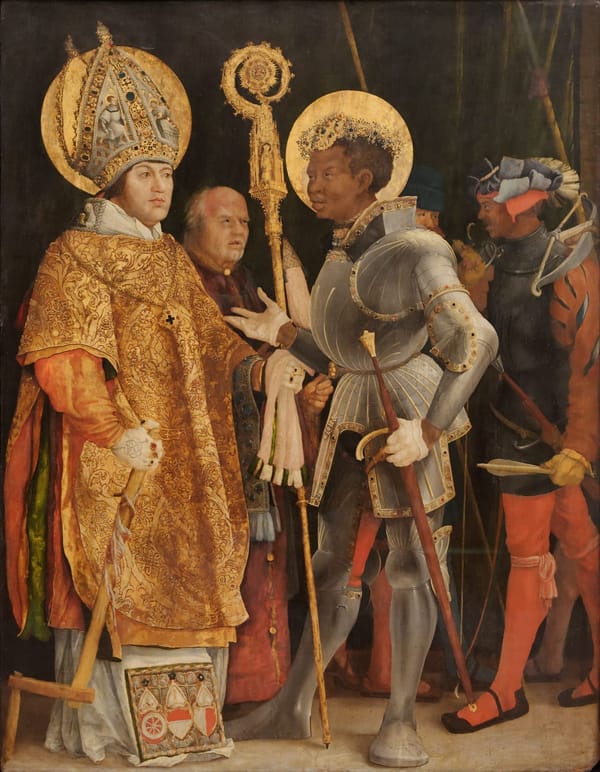
June 2: Sts. Marcellinus, Peter, and Erasmus, Martyrs
THE glory of martyrdom illumines this day with a profusion rarely met with in the cycle; and already we seem to descry the rosy dawn of that brightest day of this month, on which Peter and Paul will consummate in their blood their own splendid confession. Italy and Gaul, Rome and Lyons concur in forming a legion of heroes in the service of heaven. For to-day Lyons, the illustrious daughter of Rome, is keeping the special festival of a whole phalanx of warriors, headed by the veteran chief, St Pothinus, disciple of St Polycarp, who, in the second century, levied the brave recruits of his battalion on the banks of the Rhone.1 But to the mother Church are due the first honours. Let us, then, hail Marcellinus, together with the numerous progeny begotten by his fruitful priesthood, and rendered worthy by the Holy Ghost to share in his triumph. Let us hail, likewise, the exorcist, Peter, leading to the sacred font a long line of pagans whom he won over to Christ by proving to them the weakness of the demons.
When Christianity appeared on earth, Satan was visibly the prince of this world. To him was every altar reared; to his empire were all laws and customs subservient. From the depths of their famous temples, the demon chiefs directed the political affairs of the cities that came to consult their oracles; under divers names the lowest of the fallen angels found honour and influence at the domestic hearth; others had functions assigned to them, in forests, on mountains, at fountains, or on sea, occupying, in opposition to God, this world that had been created by him for his glory, but which Satan, through man’s connivance, had conquered. Four thousand years of abandonment on the part of heaven permitted the usurper to consolidate his conquest; and a strong defence had been planned in preparation for the day on which the lawful King should offer to re-enter on his rights.
The coming of the Word made Flesh was the signal for the assertion of the divine claim. The prince of this world, personally vanquished by the Son of God, understood well enough that he must needs return to the depths of hell. But the countless powers of darkness constituted by him would maintain the struggle through the length of ages, and dispute their position inch by inch. Driven from towns by the abjurations of holy Church and the triumph of martyrs, the infernal legions would fain marshal their ranks in the wilderness; there, under the leadership of an Anthony or a Pachomius, the soldiers of Christ must wage against them ceaseless and terrific battle. In the west, Benedict, the patriarch of monks, finds altars to the demons, and even demons themselves, on the heights of Cassino as late as the sixth century. Even in the seventh, they are found contending against St Gall for possession of the woods, lakes and rocks of what we now call Switzerland; and at last they are heard uttering mournful complaint, because, driven from the haunts of men, even such desolate spots as these are denied them. Verily, in the divine mind, the vocation of a monk to the desert has for itsend, not only flight from the world and its concerns, but likewise the pursuit of demons into their last entrenchments.
We have dwelt upon these considerations because their importance is extreme, and because this subject is now systematically ignored. True Christians firmly believe, now as formerly, in the spiritual combat which the soul has to sustain against hell, in the secrecy of conscience; but too many have no scruple in rejecting, as if belonging to the domain of the imagination, whatever is related of the public combats maintained by our fathers against the demons. The excuse for such Christians is, no doubt, the fact that they live in a land where this external war was ended centuries ago by the social victory of Christendom. But the Holy Ghost has declared that the old serpent, bound up for a thousand years, is at last to be again unchained for a while.2 If we be nearing this fatal epoch, it is high time to look about us; we shall be ill prepared for waging the old battles, if we persist in our ignorance, and in branding with the name of legend the best attested facts in the history of our ancestors. After all, what is history, since the revolt of Lucifer, but a picture of the war that is being waged between God and Satan? Now if Satan has, by divine permission, invaded the exterior world as well as that of souls, must not the struggle to cast him out3 be a hand to hand fight, an exterior and visible encounter?
‘The Word,’ says St Justin, ‘was made Flesh for two ends: to save believers, and to drive away demons.’4 So also, the expulsion of demons from the places they occupy in this material world, and specially in the noblest part thereof, the bodies of men, appears in the Gospel to have been one of the chief characteristics of our Saviour’s power. Again, when on quitting the earth he sent his apostles to continue his work amidst the nations, this is the very thing he singled out as a primary sign of the mission they were to fulfil.5 The world of that day made no mistake about it. Soon enough had the pagans to witness the cessation of the ancient oracles in every place;6 and the cause of a phenomenon of such import to the ancient religion was evident to all: the very demons themselves were not backward in ascribing to the Christians their enforced silence. As regards this power of Christianity against hell, the apologists of the second and third centuries appeal on the subject to public testimony, without fear of contradiction. ‘Before the eyes of everyone,’ says St Justin to the emperors, ‘ the Christians drive out demons in the name of Jesus Christ, not only in Rome, but in the whole universe.᾽7 The gods of Olympus beheld themselves shamefully unmasked, in the presence of their confused adorers, and Tertullian might well challenge the magistrates of the empire thus: ‘Let one of those men who declare themselves to be under the power of the gods, be brought before your tribunals: at the command of the first comer amongst us, the spirit whereby they are possessed will be constrained to confess what he is; if he avow not himself a demon and no god, fearing to lie to a Christian, at once shed the blood of this Christian blasphemer. But no; it is the terror they have of Christ that forces them to take flight at the mere touch or even the breath of one of his servants.᾽8
Baptism sufficed to give man such power as this; and this was the real meaning of our Lord’s promise, when speaking not only of the heads of the Church, but of all who would believe in him, he said: ‘In my name they shall cast out devils.᾽9 At an early date, however, the Church, organizing the holy war, constituted among her sons one special Order having for its direct mission the pursuit of Satan on every point of this visible world. The exorcists were, by this delegation, invested with a power that accelerates the downfall of the prince of this world; and to render this defeat more odious and humiliating the Church raised no higher than to the rank of inferior clergy an Order so terrible to hell. Lucifer had aimed at being equal to the Most High;10 hurled down from heaven, he flattered himself in his folly that he would be able to supplant God upon the earth: and lo! the charge of defeating him here is confided not to angels, his equals by nature, but to men, and even to the least of this credulous race which for long ages he had seen prostrate before him! Their hand of flesh constrains him, spirit though he be, to come off his throne; at their word he must needs cast away his vain adornments, he must unmask himself; the water they bless rekindles within him his eternal tortures; of the prince of this world and his pomps nought remains but mere Satan, the ugly-faced apostate, the condemned criminal wincing in the dust at the feet of the sons of men, or fleeing like a dry leaf before the breath of their mouth.
The archangel Michael recognizes, in these sons of Adam, the worthy allies of the faithful angels he led forward to victory. But amid those who continue the mighty battle begun on the heights of heaven,11 the exorcist Peter comes before us to-day radiant with matchless splendour. The triumph of martyrdom has been added to his victories won over Satan's cohorts. None better than he drove hell back; for, chasing the demons out of men’s bodies, he moreover made conquest of their souls. The priest Marcellinus, the companion of his victories and martyrdom, is likewise his associate in glory. The Church wishes that these two names, so formidable to the spirits of darkness, should shine in one same aureole here below as in heaven. Daily does she render them the most solemn homage in her power by naming them both, on the diptych of the holy Sacrifice, together with the apostles and her first sons. Such was the importance of the mission they fulfilled and the renown of their final combat, that their bodies, translated to the Via Latina, became the nucleus of an illustrious cemetery. In the age of peace, that came soon after their glorious confession, the Christians vied with one another in obtaining sepulture near these soldiers of Christ, whose protection they craved. Constantine the Great, the vanquisher of idolatry, deposited at their sacred feet the remains of his mother, St Helena, who had herself become a terror to the demons by her discovery of the true Cross. A celebrated inscription was composed in their honour by St Damasus, who in childhood had learned the details of their martyrdom from their executioner himself after his conversion; this inscription, near their tomb, completed the monuments of that catacomb wherein Christian art had multiplied its richest teachings.
To the memory of Saints Marcellinus and Peter is joined, in the liturgy of to-day, the name of a holy bishop and martyr, formerly well known to the faithful. If the acts of his life which have reached us are not free from all reproach from a critical point of view, the favours obtained by the intercession of St Erasmus or Elmo wafted his name over the whole of Christendom, as is attested by the numberless forms this name assumed in various countries of the west during the middle ages. He holds a place in the group of saints styled auxiliatores or helpers, whose cultus is widespread particularly in Germany and Italy. Mariners look upon him as their patron, because of a certain miraculous voyage related in his life; one of the tortures to which he was subjected during his martyrdom has caused him to be invoked for colic. Nor should we forget to mention here how great a veneration St Benedict, the patriarch of western monks, had for St Erasmus; when he quitted the Campagna for his solitude on the banks of the Anio, he marked his principal station between Subiaco and Monte Cassino, by building a church and monastery at Veroli under the invocation of this holy martyr; he dedicated another in Rome itself to St Erasmus.
Let us now read the few lines devoted by the Church to the memory of our three Saints.
Holy martyrs, you all confessed Jesus Christ, in the midst of the most terrific storm ever raised by the demon against the Church. Though all three in different grades of the hierarchy, you were alike guides of the Christian people, drawing them by thousands in your train, into the arena of martyrdom, and, by still more numerous conversions, filling up the void made in earth's chosen band by the departure of your victorious companions to heaven. Wherefore the Church this day joins her grateful homage here below, with the congratulation that rings through the Church triumphant. Be propitious, as of yore, in alleviating the ills that overwhelm mankind in this vale of tears. The excess of man's misery is that he seems to have forgotten how to call on such powerful protectors in his hour of need. Revive your memory, in our midst, by new benefits to our race.
As thou, O Erasmus, wast formerly protected by heaven, do thou now, in thy turn, succour those who are a prey to the tempest-tossed sea. In thy last hour of bitter anguish, thou didst suffer thine executioners to tear thy very bowels; lend a kindly aid to such as call upon thy name when racked by pains which bear some resemblance, though but faint, to what thou didst endure for Christ.
Peter and Marcellinus, linked one to another both in toil and in glory, cast gentle eyes upon us: one glance of yours would make all hell to tremble, and would drive far from us its cohorts. But how much is your aid needed in society at large, in the whole visible world! The foe you so mightily thrust backwards into the fiery pit is once more master. Alas! have we come to the time in which, again taking up war against the saints, it shall be granted him to overcome them?12 Scarce does he even hide himself nowadays. Societies which formerly worked in secret have now openly surrendered to him a thousand sources of evil; he may be seen trying to push his way into gatherings of all sorts, into the very bosom of homes, as a family guest, as a comrade in diversion or in business, with table-turning and all those processes for divination, such as Tertullian denounced in your early day.13 The expulsion of demons by Christianity had been so absolute that, up to more recent times, such fatal practices had fallen into utter oblivion amongst us. If at first, in Christian families, the warning voice of the pastors of God's Church has prevailed over the incitements of an unhealthy curiosity, a sect has since been formed, in which Satan is sole guide and oracle. The spiritists, as they are called, in concert with freemasonry, are preparing the way for the final invasion of the exterior world by infernal bands. Antichrist, with his usurped power and vain prestige, will be but the common product of political lodges and of this sect which proposes to bring back, under a new form, the ancient mysteries of paganism. Valiant soldiers of the Church, make us, we beseech you, worthy of our forefathers. If the Christian army must needs decrease in numbers, let its faith wax all the stronger; let its courage neither fail nor go astray; may its ranks be seen facing the foe, at that last hour in which the Lord Jesus will slay, with the breath of his mouth, the man of sin,14 and plunge once again and for ever the whole of Satan's crew down into the lowest depths of the bottomless pit.
- Note of the Translator. Ss. Pothinus, Blandina, and companions, martyrs of Lyons, are marked on this day in the Roman Martyrology, but as the feast is kept only in France, we have omitted in our translation the pages devoted to their memory in this place. ↩︎
- Apoc. xx 2, 3. ↩︎
- St John xii 31. ↩︎
- 2 Apol. vi. ↩︎
- St Mark xvi 17. ↩︎
- Plutarch, De oraculor. defectu. ↩︎
- 2 Apol. vi. ↩︎
- Apol. xxiii. ↩︎
- St Mark xvi 17. ↩︎
- Is. xiv 12-15. ↩︎
- Apoc. xii 7-9. ↩︎
- Apoc. xiii 7. ↩︎
- Apolog. xxiii. ↩︎
- 2 Thess. ii 8. ↩︎
Wednesday after Trinity Sunday
Including descriptions of:
- Wednesday after Trinity Sunday
- First Vespers of Corpus Christi
We have not, as yet, reached the feast of the divine Memorial; not until the morrow, shall we have it in all its splendour. But this evening, at first Vespers, the Church will begin her acclamations to the eternal Priest; and, although the sovereign Pontiffs have not ordained that a vigil, properly so called, shall precede the feast of Corpus Christi, yet have they granted indulgences1 to a voluntary fast practised on this its eve. Let us now resume the history of the Church’s worship of the great mystery.
We have already seen how the unity of the Church is based upon the Eucharist. Our Lord Jesus Christ, in that Sacrament, is the corner-stone, upon which rises, in the harmony of its several parts, the temple of living stones, built to the glory of God.2 Jesus is the High Priest, ordained for men, Himself being Man,3 that He may present to God the homage of His brethren, by offering, to His and their Father, a Sacrifice in the name of all. And although this homage of regenerate mankind—this Sacrifice which is the highest expression of that homage—owes its whole worth to the infinite dignity of Him who is the Head of the Church, yet the Sacrifice is completed only by the union of the members with the Head. The Head must have the body. The Church is, as the apostle tells us, the fullness, the completion, of Him who is filled in all;4 the Church perfects the Sacrifice, as being herself an integral portion of the Victim who is offered upon the altar. What is true of the Church, is true, likewise, of each one of us, who are members of Christ; and we are really His members, provided we be united, in the great Action of the Sacrifice, by that intimate union which makes one body of many members.
Herein consists the social influence of the Eucharist. The human family had been broken up by sin; it regains its lost unity by the Blood of the Lamb; and the original intention, which God had in creating the world, is fulfilled. After all other beings, the creature man came forth out of nothing. He was to give a voice of praise to the whole of creation; for his own twofold nature, material and spiritual, made him the compendium of all other creatures. When he was restored by redemption, he regained his position in the glorious choir of beings. The Eucharist, the thanksgiving, the praise by excellence, is the sweet produce of the human race. The Eucharist, that grand hymn of divine Wisdom sung to the King of ages, ascends from this earth of ours, blending two harmonies into one: the ineffable harmony of the eternal Canticle, that is, the Word in the Father’s bosom, and the harmony of the new canticle, which is repeated by the choir of creatures to the glory of their Creator.
The ages of faith lived on this grand truth; they thoroughly understood the priceless worth of the gift bestowed by the Man-God upon His Church. Appreciating the honour thence accruing to our earth, they felt themselves bound to respond to it, in the name of all creatures, by giving to the celebration of the sacred mystery everything that ritual could impart of grandeur and solemnity. The liturgy, for the Christians of those times, was exactly what is implied by the word: it was the public function, the social act by excellence; and, as such, it claimed every sort of external pomp; and the presence of the whole people round the altar was looked upon as a matter of course. As to the lawfulness of what are called private Masses, it would be easy to prove, by most authentic facts of history, that what the Catholic Church teaches regarding them, was her teaching from the very commencement; and yet, practically, and as a general rule, the richness of ceremonial, the enthusiasm of sacred chant, the magnificence of sacred rites, were, for a long period, regarded as inseparable from the offering up of the holy Sacrifice.
The solemnity of divine service, as celebrated in any Catholic cathedral on the grandest feast of the year, is but a feeble image of the magnificent forms of the ancient liturgies, such as we described them yesterday. The Church herself, whose desires for what is most perfect never vary, ever evinces a marked predilection for the remnants she has been able to keep up of her ancient forms of worship; but, as far as the generality of her people is concerned, there can be no doubt of the existence of a growing feeling of indifference for the external pomp wherewith the holy Sacrifice is so deservedly accompanied; whatever demonstrations of Christian piety still exist, are directed elsewhere. The cultus of the divine Presence in the Eucharist, as developed in these our own times, is certainly a blow to the heresy which denies that Presence; it is, too, a joy to every Catholic who loves God; but care must be taken lest a movement which is so profitable to individual souls and so redounding to the glory of the holy Sacrament, should be turned, by the craft of the enemy, against the Eucharist itself. Now, this might easily be the case, if, in consequence of such devotion being illregulated, the very primary object of the eucharistic dogma, which is Sacrifice, were permitted to lose its place either in the appreciation, or in the practical religion, of the faithful.
In the admirable connexion existing throughout the whole body of Christian revelation, there can be no such thing as one dogma becoming a danger to another. Every new truth, or every truth presented under a new aspect, is a progress in the Church, and an acquisition for her children. But the progress is only then a true one, when, in its application, the new truth, or its new aspect, is not treated with such prominence as to throw a more important truth into the shade. Surely no family would ever count that gain of new property to be a boon, which would jeopardise or lessen the rich patrimony which past ages had secured. The principle is a self-evident one; and must be borne in mind, when studying the different phases of the history of any human society, and especially when the history of the Church is in question. Although the holy Spirit, who is ever urging the Church to what is highest, is incessantly adorning her for the eternal nuptials and decking her brow with a gradual increase of light, yet is it but too often the case, that the human element of which she partakes through her members makes its weight tell upon the bride of Christ. When that happens, she redoubles her maternal solicitude for these her children; they are too delicate to live on the summits, and bear the bracing atmosphere to which their forefathers were accustomed. She herself continues her aspirations after what is most perfect, and approaches gradually nearer to heaven; but for the sake of her weakly children, she quits the mountain paths she loved to tread in better times, for those paths kept her closer to her divine Spouse; she comes lower down, she is content to lose something of her external charms, she stoops, that she may the better reach the children she has to save. This her condescension is admirable; but it certainly gives no right to the children, who live in these less healthy times, to think themselves better than their forefathers. Is a sick man better than the one who is in health, because the food, which is indispensable for keeping up the little strength he has, is given to him under new forms, and such as will suit his debilitated frame?
Because, in these our days, a certain increase of devotion towards the divine Host, who dwells in our tabernacles, has been observed in some souls, and the external demonstration of this devotion is under a new form, it has been asserted, that ‘no age ever equalled our own in the cultus of the most holy Sacrament!’ And because of this holy enthusiasm, the nineteenth century, which with its restless activity has opened out so many new methods of devotion, has been called by a certain writer ‘the great age of the Eucharist!' Would to God these assertions were correct! For it is quite true, and history is rich in bearing testimony to the fact, ‘that an age is more or less glorious, according to its devotion towards the adorable Eucharist.’ But it is no less true that, if the different centuries be compared with each other for devotion towards the Sacrament of love, which, at all times, ib the very life of the Church, there can be no doubt that that ought to be counted as the golden age, in which our Lord's intentions in instituting the divine mystery were the best understood and carried out, and not that wherein individual devotion was busiest.
Now, leaving aside, for the present, all principles connected with dogma, which will find their place more appropriately a few days later, we have history to bear witness to this fact, that, so long as the western nations kept up their faith and fervour, the Church, who is the faithful and sure interpreter of her Jesus' intentions, maintained the discipline observed in the worship practised towards the Eucharist during the early ages. After her twofold victory over the pagan persecutions and the obstinate dogmatism of the emperors of Byzantium, the Church, the noble depositary of the new Testament, was in possession of a freedom greater than she has had at any other period; her children, too, made it their perfection to follow her every wish. Thus free to act as she knew was best, and sure to be obeyed, she kept to the way of eucharistic worship which her martyrs had followed, and her doctors had so enthusiastically developed in their writings: that is, she took the energies of the new children she had received by the conversion of barbarian nations, and centred them in the Sacrifice, that is, in the holy fatigues of solemn Mass, and the Canonical Hours, which are but a natural irradiation of the Sacrifice.
Nothing in those times was more Catholic, nothing less individual and private, than the eucharistic worship thus based on the social character which pertains to the Sacrifice. It was the uppermost idea even in such of the faithful as, through sickness or other personal reasons, were obliged to communicate of the universal Victim separately from the rest of the people. It was the one leading thought which made them turn their hearts and their adorations towards the gilded dove, or the ivory tower, in which were preserved, under the mysterious integrity of the Sacrament, the precious remnants of the Sacrifice.
Faith in the real presence, a faith quite as animated and deep as any that can be witnessed in our own times, was the soul of the whole liturgy; it was the basis of the entire system of the Church’s rites and ceremonies, all of which are unmeaning if you take away the Catholic dogma of the Eucharist. This dogma was admitted by all the children of the Church as a principle beyond discussion; it was their dearest treasure; it was both foundation-stone and roofing of the house built amongst men by eternal Wisdom. To a superficial observer it might seem as though the faithful of those early ages were less intent upon it than we now are: but is it not always the case, that the rock which supports the edifice, and the timber which roofs it, call for less solicitude when the building is under no risk, either from the indifference of its inmates, or from the attacks of enemies outside?
The Church herself cannot grow decrepit; but it is a law in history, that, even within her fold, and in spite of the vitality she imparts to nations, no society ever maintains itself long at its highest pitch of perfection. Men are like stars in this, that their apogee marks the period of their decline; they seem to mount on high only that they may speedily descend: and, after the fullest vigour of age, we gradually approach the impotency of the old man. So it was to be with Christendom itself, with that grand confederation which had been established, by the Church, in the strong unity of unfeigned charity, and of faith unalloyed by error. The Crusades were, for a second time, rousing the world to holy enterprise; the preaching of St. Bernard was stirring mankind to zeal for the cause of God. The impulse was so immense, that it seemed as though the event marked the culminating point of Christ’s reign upon earth, and secured perpetuity to the power of the Church. And yet, that was the very period when old signs of decay returned, and with fresh intensity. The heroic Pontiff, St. Gregory VII., had stemmed the evil for a considerable time; but, at the period we speak of, a relapse set in, and advanced with its work of ravage, till it brought about the great revolt of the fifteenth century, and the general apostasy of nations.
The celebrated prophetess of the middle ages, Saint Hildegard, was then scanning, with her eagle eye, the miseries of her own day, and the still more sombre threatenings of the future. She that was used to write the messages of God to Pontiffs and kings, penned these words in a letter to Werner and his brother priests of Kircheim, who had written to Hildegard, and solicited her reply: ‘It was while lying for a long time on a bed of sickness, in the year of the Lord’s Incarnation one thousand one hundred and seventy, that I saw, wakeful both in body and mind, a most beautiful image, having a woman’s appearance: she was all perfect in her suavity, and most dear in the charms of her beauty, which was such, as that the human mind could in no wise comprehend it. Her stature was so great, that it reached from earth even up to heaven. Her face, too, beamed with exceeding brightness, and her eye was fixed on heaven. She was clad in a spotless garment, made of white silk. The mantle which covered her, was adorned with most precious stones, of emerald, sapphire, and likewise of beads and pearls. The shoes on her feet were of onyx. But her face was covered with dust, and her garment was rent on the right side, and her mantle had lost its elegant beauty, and her shoes were dimmed. And she with a loud and plaintive voice, cried out towards the high heavens: “Hearken, O heaven, that my face is defiled! And wail, O earth, that my garment is rent! And thou, O abyss, tremble, because my shoes are dimmed! Foxes have holes, and birds of the air nests;5 but I have not helper or comforter, nor staff whereon to lean, and whereby to have support. . . . They that should have adorned me in every way, have, in all these things, abandoned me. For it is they that besmear my face, by dragging the Body and Blood of my Spouse into the great uncleanness of the impurity of their living, and the great filth of their fornications and adulteries; and by buying and selling holy things, defiling them, as a child would be defiled were he put down in mire before swine. . . The wounds of Christ my Spouse are contaminated. . . . Princes and a headlong people will rush upon you, O priests! They will cast you forth, and put you to flight, and will take your riches away from you. . . They will say: Let us cast out from the Church these adulterers, and extortioners, and men that are full of all wickedness! And in doing this they will have it that they do a service unto God, because they say that it is by you that the Church is defiled. . . By God’s permission, many nations will begin to rage against you in their judgments, and many people will devise vain things concerning you, for they will count as nought your priestly office and your consecration. Kings of the earth will assist these in your overthrow, and they will thirst after the earthly things (you possess); and the princes in whose dominions you live, shall make a convention in this one plan, that they may drive you out of their territories, because you, by your most wicked deeds, have driven away the innocent Lamb from your midst.” And I heard a voice from heaven, saying: “This image is the Church!”’6
What a fearful description of the evils brought upon the Church in the twelfth century! What a prophecy of its far off results! These miseries were in keeping with the way in which the august mystery of the altar was treated. It has always been so. The disorders of the sanctuary necessarily brought about relaxation in the people. They grew wearied of receiving the heavenly food from hands that were, but too often, unworthy ones. The guests at the banquet of divine Wisdom became rare, so rare indeed that, in the year 1215 a General Council, the fourth of Lateran, passed the well-known law which obligee, under the severest penalties, the faithful of both sexes to receive Communion at least once in the year. The evil became so great, that the legislation of Councils and the genius of Innocent III, the last of the great Popes of the middle ages, would not have sufficed to arrest it, had not God given to His Church the two Saints, Dominio and Francis; they reclaimed the priesthood, and, for a time, brought back the people to the practice of Christian piety. But the ancient forms of the liturgy had perished during the interval of the crisis.
The oblation in common, which supposed that all communicated in the divine Victim, had given place to private foundations, and to honoraries or stipendium; in themselves, they were quite lawful, but they had been so considerably increased by the introduction of the mendicant Orders, that a change in the liturgy was the consequence. Private Masses, for special intentions, were multiplied, in order to satisfy obligations which had been contracted with individual donors; and, by a necessary consequence, the imposing rite of concelebration, maintained in Rome till the thirteenth century, entirely disappeared in the western Church. The Sacrifice of the Mass was no longer brought before the faithful with the majestic ceremonial which, in former times, had secured to it a preponderance over the whole religion and life of the Christian people. The holy Eucharist soon began to be given out of the time of Mass, and for reasons which were not always serious ones. More than one scholastic theologian encouraged the practice, if not with true learning, at least with sharp definitions and categorical divisions; so that Communion became, in the minds of some men, quite a distinct section in the institution of the Eucharist. This was the forerunner of what we so often find practised in our own times: Communions made isolatedly and furtively on principle, that is, in accordance with an ideal of spirituality, which has a dread of a crowd, and a repugnance to the excitement of the Church’s ceremonies!
The notion, then, of the Sacrifice, which includes the chief motive of the Presence of the Incarnate Word in the Eucharist, was no longer brought before the people with the emphatic pre-eminence of former ages. As a counter result of this, the truth of this Presence of our God under the eucharistic Species gained an ascendancy over the soul in a more exclusive, and therefore in a more impressive and direct, way. It was at this period that, out of a spirit of holy fear and from a feeling of respect—a feeling which can never be too great—several ancient usages began to be discontinued. Usages which had been established in order to express more fully the application of the Sacrifice, were now suppressed as exposing the sacred Species to involuntary irreverence. It is thus that the custom of giving the chalice to the laity, and communion to infants, fell into disuse.
An immense ritual change, then, was brought about. The Church accepted it, although she was aware of its being, in more than one point, a degeneracy as compared with former ages. The time had come, when the grand social forms of the liturgy, requiring as they did the strong union of Christian nations for their basis, would be but unrealities. The jealous mistrust of States against the Church—that is, against the power which was the sole bond of mutual union between the several nations—was ever on the increase, and only waited for an occasion to break out into open hostility. Diplomacy became a system of rupture between one country and another, whereas the Church had been the framer and maintainer of their union.
If the evil from within was thus great, still greater were the dangers to which the faithful were exposed by the onslaughts of heresy. And yet, it is precisely in such a time as this, that the superhuman prudence of the Church is most manifested. In defence of the faith, which is the essential element of her existence here below, she formed a rampart out of the very ruins caused by the liturgical revolution she had been compelled to accept; she sanctioned with her authority what was worthy of sanction, and thereby controlled the movement. She took advantage of the increase of devotion to the real Presence, which the movement had excited; she gave a fresh direction to her liturgy, by substituting a ceaseless expression of the dogma, for the less precise, though not less complete and far grander, forms of the earlier period. It was a reply to heresy, all the stronger because of its being more direct. We have already seen how, in consequence of the covert attacks of false doctrine, there was an evident reason felt in the thirteenth century for instituting a special feast in honour of the Eucharist, as the mystery of faith. That reason became sheer necessity at the approach, foreseen by God alone, of the bold triumph of the sacramentarian heresy. It was necessary to forestall the attack; and, by so doing, to render the coming assault less hurtful to the Christian world, and less injurious to our Lord present in the Sacrament of His love. The means for efficaciously realizing these two ends was the development of exterior devotion to the real Presence. The Church would thus proclaim her unshaken faith in the dogma, and the adorable Sacrament would receive, by the renewed fervour of faithful souls, a compensation for the indifference and insults of others.
Established throughout the world by the authority of the Roman Pontiffs, the feast of Corpus Christi was, therefore, both in itself and in its developments, as we were observing yesterday, the commencement of a new phase in the Catholic worship of the holy Eucharist. Once the feast was instituted, there followed processions, benediction, Forty-Hours, expositions, watchings in adoration; each of which was an additional affirmation of the Church’s belief in the real Presence; the piety of her children was re-enkindled; and the tribute of homage, which is so justly His due, was offered to our Lord under the sacramental Species.
O holy Church, our mother, thou bride of the Son of God, those times are past when thou couldst produce on this earth a likeness to the heavenly eruealem. Free to follow the inspirations of thy heart as bride, thou didst surround the great Sacrifice with the gorgeous ceremonial, which gave our ancestors an insight into the grandeurs of the mystery they saw thus celebrated. That royal magnificence of ritual would be too much for such times as these we live in. The nations of the earth have allowed themselves to be misled: for the glory they once enjoyed, when thou gavest them unity with each other through the unity of the sacred mysteries, is now exchanged for the dishonour and misery of alliance with the old enemy. Whilst thou, with nothing to fear, and strong in the consciousness of thy rights and thy influence for good, wast beautifying, in peace, the garden of thy Spouse; whilst thou wast rejoicing in the sweet fragrance of that garden, and in the fruits of the mystic vine: a strange noise was heard, the noise of ‘the chariots of Aminadab’, driven by the hands of thine own children turned traitors.7 It would have been but a just punishment, hadst thou then left this ungrateful earth, and gone to thy divine Spouse in heaven above. But, O loving 'Sulamitess', with all this increase of the evils of thine exile, thou gavest ear to the cries of them who willed to be ever thy faithful children; and thou remainedst for us, dear mother, that we might receive thy teachings, and thence derive light and life.
We know it: instead of the peaceful grandeurs which thou, beautiful queen, didst once display when thy sovereignty was undisputed; instead of choirs of exultation and triumph resounding in thy courts, we are to see thee, henceforth, as a warrior, and thy hymns are to be the songs of the camp; but how beautiful are thy steps8 in the armour of thy pilgrimage, O thou daughter of the King! Thou art terrible as an army set in array; but thou art, too, all sweet and comely, when, laying aside the robe of gold and all the richly varied clothing which decked thee standing at the right hand of the King’s throne, thou girdest thyself, like Him, with the sword, and piercest the hearts of His enemies with the arrows of thy truth and zeal.9
Turning our thoughts, for a moment, to the Greek Church, how different is the spectacle! She is motionless and sterile as a branch severed from the trunk. She retains, like so many withered leaves, the ancient forms of her liturgy, which has indeed an imposing unity, but it is the unity of schism. The very heresy, which here, in our own country, celebrates its unmeaning Supper in the cathedrals built by our forefathers, is it more out of place than the lifeless schism of the east, so scrupulously keeping up the ancient forms which are its condemnation, and making a parade of vestments which sit so awkwardly on rebels? What life can the members of such a Church derive from these dead forms of worship?
She alone is mother who knows how to meet the wants of her children, for her affection tells her not to give to delicate ones the food that suits the strong. She alone is the bride of the Lamb, who has the instinctive talent of making, in each period of time, the most of the treasure of her Spouse, the priceless Pearl He has committed to her care; and to this end she hesitates not to modify, if need be, her dearest practices, her most cherished schemes for good; yea, and changes the delights and grandeurs of her queenly supremacy for the hard work of battling with the enemy of her Lord.
We recognize thee, O bride of Christ, by this mark, that thou now lispest with us who are weak, thou who heretofore, didst sing so divinely with the strong; and that thou, who so long enjoyedst the peace and company of thy Spouse, art as ready and as powerful to meet and vanquish His enemies, now that they are filling His world. Thus struggling, thus labouring, and yet misunderstood and blamed by an ever-increasing number of ungrateful children, thou wilt not abandon them; thou remainest, that thou mayst carry to the last of the elect the sacred Host which is to unite him with the great Sacrifice. Affectionate and generous mother! we will follow thee in thy militant career; through the laborious passes of the steep road which leads thee to thy eternal rest; we will follow thee because thou bearest with thee the treasure of the world. The bolder the attacks of heresy, and the more insulting the neglect or blasphemies of ungrateful children, the louder shall be the profession of our faith, the humbler our adorations, the warmer and truer the demonstrations of our love towards the sacred Host.
FIRST VESPERS
OF THE FEAST OF CORPUS CHRISTI
We have, at last, reached the great feast which, since Monday, has kept our minds attentive. Our earth is preparing to acknowledge, by the homage of a solemn triumph, the presence of Christ, its Priest and King, in the sacred Host. Everywhere are the faithful busy preparing the triumph which is to be given to it to-morrow. These preparations are inspired by faith and love; and whilst they are progressing, the Church is ushering in the great feast by the celebration of first Vespers. Tuning her harp to the sublime antiphons of the angelic Doctor, St. Thomas, she proclaims, in a chant which is worthy of the words, that her Jesus is the eternal Priest according to the order of Melchisedech, and that the divine banquet He has prepared brings the children of the Church around the table of the Lord, like so many young olive plants.
The limits we have been obliged to observe in this work, would require us to exclude all those portions of the Office for the present feast, at which the faithful generally do not assist. But as this Office, which was composed by St. Thomas of Aquin, is one of exceptional beauty, we have resolved to give it in its entirety. The magnificence of these hymns, and psalms, and antiphons, and responsories—all of which are teeming with genuine Catholic spirit—will furnish the faithful with the best materials for contemplation, whereby to enlighten their minds and inflame their hearts during the whole octave. On each of the days of this week, they will be eager to adore that beautiful King of glory, who is going to hold His court in the midst of His people, with no other veil between Himself and them than the light cloud of the sacramental Species. During these happy hours, which love is ingenious enough to steal from one’s ordinary occupations, let the faithful prefer to take, wherewith to give utterance to their sentiments, the formulas which the Church herself uses when singing to her Spouse in the sacred banquet of His love. Not only will they there find the poetry, doctrine, and gracefulness of diction, which the bride ever has at her command when she addresses her beloved Jesus, but they will soon learn by experience that, like the divine food itself, those approved and sanctified formulas suit every soul; for these formulas of the Church adapt themselves to the several dispositions and degrees of spiritual advancement, and thus become, to each one of her children, the fittest and warmest expression of every want and desire.
The first Vespers of the feast of Corpus Christi are exactly the same as the second, with the single exception of the Magnificat antiphon. By this antiphon, O quam suavis, the Church declares to us, her children, how great is the sweetness of our Lord, and that it is manifested to us by the sweetness of the eucharistic Bread; but she also tells us who they are that taste this sweetness, and derive from it the fruits of salvation: they are the souls that are led to the divine banquet by the spiritual hunger of an humble and ardent desire. With such sentiments, let us, with the immaculate Mary, magnify the Lord, who exalteth the humble and putteth down the mighty, the proud. It is to the humblest of the daughters of Adam that we are indebted for the Bread of heaven: it was formed, in her chaste womb, by the Holy Ghost, as we shall explain further on; but let us, thus early, rejoice in the thought that the feast of Corpus Christi leads us to Mary, and bids us give her the tribute of our gratitude.
Antiphon of the Magnificat
Collect
The octave of Corpus Christi has the same privileges as that of the Epiphany. It admits of no feasts, except those of first class; and even on these a commemoration must be made of the octave at Mass, Lauds, and Vespers. Feasts of double and semidouble rite are merely commemorated. Our solemnity also tells upon all the hymns of the several feasts which may be kept during this octave; for, if the metre admit it, they conclude with the following doxology, which is the one used at Compline and the Little Hours of to-morrow’s Office:10
This continually repeated mention of virginal fecundity, during the feast in honour of the Eucharist, is an affectionate homage paid to the Virgin-Mother. The Church is mindful that the ‘first blasphemy against the dogma of the Sacrament of the altar, consisted in denying that the eucharistic Body of Christ was the one born of Mary.’11 Seeing, too, that the later heretics, who denied the real Presence, have constantly insulted the Mother of Jesus who resides in the holy Sacrament, the Church united them together in one and the same formula of confession and praise, when standing before the sacred Host. Those early and brave witnesses of the faith, Saints Ignatius and Irenæus, did the like; for, as St. Augustine says: 'Christ took flesh from Mary’s flesh; and it is that very flesh that He gave us to eat for our salvation; and we adore it as the foot-stool of His feet.’12
At this evening hour, when holy Church is proclaiming the adorable Sacrament, let us be imbued with these same sentiments, and offer our love to the sacred Host, which, in a few hours, is to be receiving our joyous adorations. We may, for this purpose, make use of the following formula, which has been such a favourite in so many of our Churches, ever since the fourteenth century. It used formerly to be sung, in Germany and France, during the Elevation, as an appropriate termination to the trisagion; for, as we find in the best manuscripts, this piece concluded with the same words as the Sanctus, namely, in excelsis. Liturgical compositions of this kind went under the name of tropes, and were much loved by the faithful of the middle ages; it is from them that our proses or sequences are derived.
Vere passum, immolatum in cruce pro homine,
Cujus latus perforatum fluxit aqua et sanguine:
Esto nobis prægustatum mortis in examine.
O Jesu dulcis!
O Jesu pie!
O Jesu, Fili Mariæ!
Which truly suffered, and was immolated on the cross, for man.
Whose side was pierced, and streamed with Water and Blood.
Be thou our foretaste (of heaven) when we are struggling with death!
O sweet Jesus!
O good Jesus!
O Jesus, Son of Mary!
- Two hundred days, for the fast, or for any other good work substituted for the same, at the discretion of the confessor. ↩︎
- Eph. ii. 21. ↩︎
- Heb. v. 1. ↩︎
- Eph. i. 22, 23. ↩︎
- St. Matt. viii. 20. ↩︎
- Ep. lii. ↩︎
- Cant. vi. 11, 12. ↩︎
- Ibid. vii. 1, 2. ↩︎
- Ps. xliv. 6. ↩︎
- In the monastic rite, it is as follows:
Gloria tibi Domine,
Qui natus es de Virgine,
Cum Patre et sancto Spiritu,
In sempiterna sæcula. Amen. ↩︎ - Mgr. Pie, Bishop of Poitiers. Homily given at Issoudun, Sept. 8, 1869. ↩︎
- Enarrat. in Psalm, xcviii. 9. ↩︎
| Previous Tuesday after Trinity Sunday | Next Wednesday after Trinity Sunday |