Daily reading
After Pentecost
Double · Movable from Easter · Temporal
June 5, 2021
From Dom Guéranger’s The Liturgical Year.
 |
Saturday within the Octave of Corpus Christi
Man has been cast forth from Eden, and has gone into the dreary land of his exile. He has nothing left him of the tree of life, but the recollection that it was once his. It remains in the happy land where it was first planted; how could it go after the sinner man, now that he is banished into the vale of tears? No! it remains in paradise; far from the abode of suffering, and out of mortals' sight, it continues in all its loveliness, bearing testimony to the primitive intentions of God, which were peace, innocence, and love. The day will come when we shall see it again, for it is to be one of the charms of the new earth, into which our Lord will lead His chosen people on the day of the great Pasch, and of the restoration of all things.1 Happy day! after which, as the apostle tells us, every creature longeth, bowed down as it now is, and made subject, by reason of a fault which was not its own, to the inconstancy of ceaseless change. Man, who, against the creature’s will, subjected it to the servitude of corruption, keeps up within it the hope that, the time of deliverance being come, it, too, will partake, in its own way, of the glorious liberty of the children of God.2 The glory of the new paradise will be greater than that of the one of old; for, it is not under the veil of symbols, or in a passing way, that the deifying union is to be fulfilled, but divine Wisdom will give Himself, and for ever, and without veil, to man, in an eternal embrace.
And yet this union, whose permanent enjoyment is to make the eternal bliss of heaven, is to be contracted even now, and on this very earth of ours; for it is the economy of the divine plan, that, in all things, the future life should have its roots in the present one, and should be but the revelation, in the light of glory, of the ineffable realities formed here by grace. What, then, after the fall, will be the conditions of the alliance, from which eternal Wisdom has not been turned by the sin committed by His creature man?
Oh the depth of the riches of this Wisdom ef God!3 His love is strong as death,4 and, even after man’s disloyalty, will be infinitely admirable in its delicate ways of gaining its object. There is to be nothing unbecoming in the alliance He is bent on! He will admit no compromise with the depravity which has befallen our now sinful race! His mercy is infinite; and, through that, He has pardoned the offence, the moment the offender expressed his sorrow; but the pardon is not one which was to mean no compensation, no expiation on man’s side; that would have ill-suited the dignity of such a Spouse as He. And since sinful man cannot offer an adequate expiation, He, Wisdom, undertakes to pay the culprit’s whole debt, and give him back the holiness he has forfeited; this done, He will take our human nature, and espouse her to Himself as His much-loved bride. ‘I will espouse thee unto Me, in justice and judgment,’ says this God to man, by His prophet Osee.5
And He adds: ‘I will espouse thee unto Me in faith.’6 For, just as the entrance of divine Wisdom into this world, which He conies to save from pride by humility, is to be without exterior parade or glory, so, likewise, the divine union is to be accomplished in the mystery of the sacred Species of the nuptial banquet, and these Species will offer nought to view but the appearance of bread and wine, such as one could find on any table. But faith will see through that veil; and the unspeakable dignity conferred on the children of men by this heavenly food, will reflect its brightness on the whole creation.
The whole world of creatures, each in its own way, was in expectation of this marvellous manifestation, which was to be made upon the sons of God,7 by the union to be contracted between Wisdom and man. The prophet thus speaks of this universal expectation: ‘And it shall come to pass in that day, I will hear, saith the Lord, I will hear the heavens; and they shall hear the earth; and the earth shall hear the corn, and the wine, and the oil; and these shall hear Jezrahel.’8 Jezrahel means the seed or race of God. God will give to man, through corn and wine, the substance to be offered in the mysteries; and, through oil, the priesthood, which is to transform them into the marriage-dowry, in the very action of the Sacrifice. It is to be by the Sacrifice, and by Blood, that this alliance of justice and love is to be contracted.
We read in Scripture that Moses was one day traversing the desert; he had on him a legal transgression; the angel of the Lord met him, and was about to slay him, when Sephora, the wife of this future leader of Israel, averted the divine vengeance by the rough and speedy circumcision of her son, Eliezer: then marking with his blood the feet of the guilty one, she said to him: ‘A spouse of blood art thou to me.’9 Thus, and with far greater truth, could divine Wisdom say to the human race; for He is not to save, He is not to be united with man, except by the Blood of this Son of Man, who is one in person with that same Wisdom.
Nay, far from lessening, this very sight of man’s misery has increased the ardour of His love. Later on this Man-God will say: ‘I have a baptism, wherewith I am to be baptized: and how am I straitened until it be accomplished!’10 It was the same from the very first: no sooner has expiation been shown as the royal way, whereby humanity is to be restored to Him, and again made worthy of Him, by the shedding of divine Blood—Wisdom has ever had that thought before Him. He is impatient for the great immolation of Calvary; and until its time comes, He will suggest to His people rites and sacrifices figurative of that one Sacrifice, and of the banquet of the adorable Victim, the marriage-feast.
His garden, the place of His delight, is no longer paradise; it is this parched earth of ours, where man has now, more than ever, need of being loved of God. Ye Cherubim, whom God has stationed to guard the tree of life,’tis well that sinful man be kept from approaching it. But the flaming sword ye hold in your hands, will not prevent divine Wisdom from leaving paradise, and joining our human race here in its banishment. He was not only the tree, but He is, likewise, the river of life. Speaking of Himself, He says, in the Book of Ecclesiasticus: ‘Like a brook out of a river of a mighty water, as though I were but a mere channel of a river, I came out of paradise. I said: “I will water My garden of plants, and I will water abundantly the fruits of My meadow.” And behold! My brook became a great river, and My river became like a sea; for I make doctrine to shine forth unto all, as the morning light, and I will declare it afar off, yea, even to the most distant ages. I will penetrate to all the lower parts of the earth, and will visit all that sleep, and will enlighten all that hope in the Lord.’11
This living light, which from early morning enlightens the whole earth with divine Wisdom, is the varied teaching of prophecies and figures, which were given by God through the course of ages, and, from the very moment of man’s creation, put the shadow of the Messias upon the whole universe. By means of this manifold teaching, Wisdom conveyeth Himself, through nations, into holy souls;12 rouses man up, when discouragement makes him slumber;13 cherishes his hopes, and bids him hope, by looking at the future. Those bloody sacrifices, which were prescribed immediately after man’s departure from Eden, as the ritual expression of his early worship of God, will be offered up by all after generations; and even when idolatry shall have led mankind into the abyss of every crime, those sacrifices will raise up their voice, and keep up the prophecy which they are intended to proclaim—the prophecy of a Victim, who will be one of infinite worth. The stream of primitive traditions will, as it flows through time and space, become impregnated with foreign elements, and transmit many a worthless or even dangerous material; still, it is through the rite of sacrifice, observed by the whole world, that the desire and expectation of Christ will be maintained among all nations.14 Satan, that old serpent thief, may succeed in inducing men to build altars to himself, and on those altars offer him sacrifice, which is due to God alone; but he cannot stifle the voice of truth which accompanies every sacrifice, the voice which teaches that an innocent and pure victim may be substituted in place of guilty man, and work his expiation. This will arouse the notion of the promised Mediator in many a soul bewildered by the orgies of this satanic worship; and here, again, the very sight of the serpent was made to be the cure of them he had stung, and became the sign and ensign of the son of Jesse.15 O root of Jesse! root of the Wisdom of the Most High! who is there that can understand the depth of Thy counsels, or penetrate the devices of Thy immense love?16 Verily, Thou art more beautiful than any light of day; for that light yields when night comes on; whereas Thou, O Wisdom, art overcome by no evil, be it as black as sin!17
All those ancient sacrifices were powerless to produce grace; their very multiplicity proved their inability to do so;18 but what they could and did effect was the keeping alive in mankind the remembrance of the fall, and the expectation of a Redeemer; they were, likewise, the basis of those supernatural acts, which are requisite for man’s justification and salvation. But, besides their representing the redemptive element, which the fall of man has introduced into the plan of God, these bloody sacrifices express, also, the union of God with His creature, which was the primary and chief object of creation. That union was to be effected in the banquet prepared by Wisdom, the eucharistie banquet, wherein He, Wisdom, the Son of God, was to be received by man, and thus united with him. This sublime mystery was also expressed by those figurative sacrifices, wherein the people partook of the viotims offered: for, in the Eucharist, the Victim is the Man-God, offered to God, and eaten of by man; the Deity is appeased by the Blood of the divine Lamb, and mankind is restored, because nourished by His Flesh, which thus feeds him to a new and divine life. Such was the general law observed by all nations, when offering sacrifice: the portion intended for God was consumed by fire, and thus transmitted to heaven; but another portion of the same victim was taken and eaten by the people: and all this signified that there was communion between heaven and earth, and that the receivers were all made one, because they all partook of the same sacred food. How admirably are thus grouped together all the mysteries of God’s goodness towards His creature man! And what a prophecy this was! It was unceasing, for it was proclaimed each time a sacrifice was offered up, and there were thousands every day. It was thus that the divine Lamb, whom they foretold, was slain from the very beginning of the world;19 His Blood, in all these early ages, was applied, through hope and faith, to the souls of men, and cleansed them from their sins; and the mysterious ritual, with its inspired code of prescriptions, was keeping man on the alert, and preparing him for the banquet of the nuptials of the Lamb.20 Then, let Wisdom extol His own triumph! It is He who caused that in the heavens there should rise a light which never fails, and covers the whole earth as with a cloud; He alone has compassed the circuit of heaven, has penetrated into the bottom of the deep, has traversed the waves of the sea, and has stood in all the earth, and in every people, as the King of all, holding the chief rule, and vanquishing, strongly and sweetly, the hearts of all, both high and low.21
Meanwhile, the time of banishment is running on; the long period of expectation is more than half over. The nearer the realization of the promised alliance comes, the more ardent are the longings of chosen souls. As to our Jesus Himself, He seems to desire a preparation of a more telling kind than any of these others that have preceded. He will turn His attention to the very spot where He is to dwell on this earth. And where is that? His Father, the Creator of all things, whose every word is fulfilled by His Son, has a chosen people; and among these He would have His Son be nationalized, if we may reverently use such a word. He said to Him: ‘Let thy dwelling be in Jacob, and thine inheritance in Israel!’22 In obedience to this His Father’s will, He establishes Himself in Sion, He takes His rest in the holy city, and fixes His power in Jerusalem.23 Jerusalem! It is the city of peace, and is to be the scene of such stupendous mysteries! It is here that Isaac, the child of promise, had come carrying on his shoulders the wood for his self-sacrifice; here his father was about to slay him, when a ram was mysteriously substituted; and the mount of the one true Sacrifice was thus selected. It is here, also, that there then lived a king-priest, who bore the likeness of the Son of God;24 it was Melchisedech; and when Abraham, the father of believers, came to him, this Melchisedech offered what was to be the sacrifice of the alliance to come, a sacrifice of bread and wine; and thereby showed to Abraham, who saw into the future, the day of Christ, his Son.25
It is at the very period, when the world at large has fallen into idolatry, and offered to false gods the homage of its sacrifices, that divine Wisdom leads into this chosen dwelling-place the people of whom He is to be born as Man; it is the fulfilment of the command: Let thy dwelling be in Jacob! let thine inheritance be in Israel! In this one people Wisdom will maintain His Father’s claims, and keep alive and pure the light of the expectation of nations. He delivers it, at the cost of countless prodigies, from the Egyptian bondage.26 The feast of the Paschal Lamb—slain the same day on which, at a future time, is to be celebrated the Supper of the Lord, and the immolation of the true Lamb—is the signal of deliverance, and of a triumphant march, through the waters of a sea, to the mount of the alliance: the chosen people becomes the bride of God,27 the priestly kingdom, and the holy nation.28 Figure, in all things, of God’s true people traversing the desert of this world, Israel drinks of the waters which come from the rock, and the Rock is Christ;29 a bread rained down daily from heaven, strengthens him amidst the fatigues of journey and battle; and this bread of angels, as the Scripture terms it, took any taste the eater wished it to have.30 God Himself dwells with Israel under his tents. He has had a tabernacle made for him, on the plan of one shown by God on the mount; and in front of this tabernacle there is an altar, on which a chosen family, consecrated by oil of unction, may alone offer, under the direction of a high-priest, the manifold legal sacrifices, each of which points to some excellency or other of the one great Sacrifice of the future. From this altar, on which burns a fire that is never quenched, there goes up to heaven without interruption the smoke of the flesh and blood of the victims slain. They are a supplication for the coming of that saving Host, which is to put an end to these hecatombs. There are also offerings of flour and wine, the necessary accompaniment of holocausts and peace-offerings; these prefigure the august Memorial which is to keep up and perfect the divine Sacrifice of the cross, by an unbloody application of it. There is, in these early days, a sacrifice which goes under the name of a memorial; it is an offering by itself, consisting of fine flour, and unleavened loaves and wafers.31 Then, there are the proposition loaves; they are kept within the veil, as the most holy of the sacrifices, as being a perpetual memorial of sacrifice and covenant;32 and what a mysterious, yet unmistakable, figure is all this of the future eucharistic Presence, kept up in the Church under the sacred Species, even when the celebration of the mysteries is over!
As there is but one altar in Jacob, which, by its oneness, points towards Him who, at a future time, is to be both victim and altar; so there is but one place, the tabernacle and its surroundings, and later on the temple and the holy city, where it is lawful to celebrate those sacred banquets of communion, which, according to universal custom, close the sacrifice in which they are offered. The last time that Moses had his people assembled around him, in the plains of the Jordan, he thus spoke to them: ‘Beware lest thou offer thy holocaust in every place that thou shalt see. In the place which the Lord your God shall choose, that His name may be therein, thither shall ye bring your holocausts, and victims, and tithes, and the firstfruits of your hands. There shall ye feast before the Lord your God, ye and your sons and your daughters, your men-servants and maid-servants, and the levite that dwelleth in your cities; and thou shalt rejoice, and be refreshed, before the Lord thy God, in all things, whereunto thou shalt put thy hand.’33
The material prosperity promised to the Jewish people, as a reward of his faithfully observing the numerous figurative prescriptions of the law of Sinaï, was itself but a figure of the spiritual blessings which were to transform the soul, and prepare it for the coming of divine Wisdom in the flesh. But Israel is slow to raise himself above material things. He easily falls a prey to all the scandals he witnesses among the Gentiles. Severe punishments teach him that he is not safe, except in keeping the law given to him. He keeps the letter of the ritual precepts with scrupulous exactitude, but sees nothing of their chief meaning, which is the Redeemer to come, and the spiritual dispositions which those outward observances were intended to prompt. God is continually warning him by the prophets, and seeking to reclaim him to the spirit of His divine institutions. Thus, in the psalms, He remonstrates with him, but with such paternal affection that one can scarcely suspect a complaint, though there is a most bitter one: 'Hear, O My people! and I will speak: O Israel! and I will testify unto thee. I am God, thy God. I will not reprove thee for thy sacrifices; and thy burnt-offerings are always in My sight. I will not take calves out of thy house, nor he-goats out of thy flocks; for all the beasts of the wood are Mine, the cattle on the hills, and the oxen. I know all the fowls of the air, and with Me is the beauty of the field. If I should be hungry, I would not tell thee; for the world is Mine, and the fullness thereof. Shall I eat the flesh of bullocks? or shall I drink the blood of goats? Offer unto God the sacrifice of praise, and pay thy vows unto the Most High! . . . The sacrifice of praise shall glorify Me; and there is the way by which I will show him the salvation of God,' that is, my Christ, who is the Saviour signified by all these sacrifices!34 Later on, however, to this people, stiff-necked and uncircumcised in heart and ears,35 which has gone deeper and deeper into outward formalism, and knows no other virtue or perfection, God speaks in strong language, expressing His disgust for sacrifices, which they have robbed of the only worth they possessed in His eight, that is, their prophetic sense. ‘To what purpose do ye offer Me the multitude of your victims?’ says He by the prophet Isaias, ‘I am full; I desire not holocausts of rams, and fat of fatlings, and blood of calves, and lambs, and buck-goats. When ye came to appear before Me, who required these things at your hands, that ye should walk, (defiling) My courts? Offer sacrifice no more in vain: your incense is an abomination unto Me!’36 But these warnings are not heeded; pride increases in the carnal Jew, in proportion to his narrow heart and views. He dreams of a Messias who is to be an earthly conqueror. As to the true Messias, whose divine characteristics are foretold by the victims offered in sacrifice, this Jew will deny Him, for he finds Jesus too closely resembling these poor victims, by His sufferings and meekness.
Then comes the last of the prophets, Malachias. He turns to the Gentiles: they have been less favoured than Israel, but they have kept up the expectation of a Saviour, and, when He comes, they will lovingly receive Him. Malachias announces the final abrogation of a worship which had been so perverted, and the substitution of a divine memorial, which shall be the same in all places, and shall make all people one, by their ail partaking of the great Sacrifice to come: I have no pleasure in you, saith the Lord of hosts, to the priests of Israel; I will not receive a gift of your hand; for, from the rising of the sun, even to the going down, My name is great among the Gentiles, and in every place there is sacrifice, and there is offered unto My name a clean oblation.37
The fullness of time has come; then, bless God, O ye Gentiles! Make the voice of His praise to be heard!38 Too long, life has been to you but the empty dream of night. You hungered after the fruit of life; you thirsted for living water. But, like the hungry man who dreams of a sumptuous repast, yet never satisfies the hunger which gnaws him; like the thirsty man who dreams that he drinks, yet, on waking, is tormented with the same burning thirst, and finds his soul still empty; so was the multitude of your erring people.39 Yet, now, behold! The standard of Jesse appears on the mountain, and rallies you around it. Ye Gentiles, that once were strangers, feed now to your hearts content, in the deserts turned into fruitfulness!40 The water from the rock flows plentifully through your once parched lands. The glory of Libanus, the beauty of Carmel and Saron, adorn your hills, and refresh your lonely plains; your wilderness shall rejoice, and flourish like the lily.41 Rain shall be given to your seed; and the bread of the corn of your land shall be delicious.42 ’Tis just it should be so; for, shall the labourer plough all day long? Shall he be ever opening and harrowing his ground? No; the time comes when, having made smooth the surface of his field, he sows and scatters his seeds, and puts wheat in the rows he has marked. Such is the providence shown to the Gentiles by the Lord God of hosts; and thereby He evinces both the sureness of His divine counsels, and the magnificence of His justice.43
Eternal Wisdom had not given up the mysterious designs of His love. He kept close to the fallen human race, even when He severely chastised it. He owed it to Himself to put guilty man to the test, so to make him feel, before raising him up, how deep had been his fall. It was on this account that He permitted him to be overtaken by night, and fear, and anguish; He Himself sends him sufferings, in order that, having thus brought him to sound the frightful depth of his misery, He might trust Himself to the safe welcome and keeping of His creature’s humility. This done, He would raise him up by repentance, and strengthen him with hope, and, joyously meeting him, disclose to him again His divine charms, and enrich him with the treasures which are in the keeping of His love.44
This is Saturday; let us turn to Mary, who was made for us Gentiles the seat of Wisdom. In her chaste womb was wrought the mystery of mercy, which had been the expectation of all the long ages past. Her most pure blood provided the substance of that spotless Body wherewith the most beautiful of the sons of men contracted the indissoluble alliance of our nature with eternal Wisdom. Mary’s soul is enraptured at seeing the ineffable mystery of these divine nuptials effected in her chaste womb. She is that enclosed garden, where, more delightedly than in the early days of the universe, Wisdom enjoys light and love; the flowery couch of the Canticle,45 perfumed, by the holy Spirit, with the sweetest fragrance; the glorious tabernacle, incomparably more holy than that of Moses. It is within her, under the immaculate veil of her flesh, that, by the unspeakable embrace of the two natures in the unity of God’s only-begotten Son, the Holy Ghost pours forth the unction, which makes Him Spouse, and, at the same time, Priest for ever according to the order of Melchisedech.
Let man, then, be of good courage; the Bread of heaven, the Bread of the covenant, has at last come down upon our earth; and although nine months must pass before the great night comes, when He is to be made visible to us all in Bethlehem, yet, even now, the High Priest is at His work in this His holy temple. ‘Sacrifice and oblation Thou wouldest not,’ He says to His eternal Father; ‘but a Body Thou hast fitted unto Me. Holocausts for sin did not please Thee. Then said I: “Behold I come;” in head of the book it is written of Me, that I should do Thy will, O God!’46
We will close, to-day, our selections from the Office of the Blessed Juliana, by the following hymn; it is assigned to Compline in the ancient books of the Church of St. Martin-au-Mont.
Hymn for Compline
Christus noster vere potus,
Caro Christi vere cibus,
Sanguis Christi vere potus.
Quam assumpsit de Virgine:
Verus sanguis quem bibimus,
Quem effudit pro homine.
Verbum caro comeditur;
Per quod viget religio,
Per quod coelum ingredimur.
Totus plenus, et gratiæe,
Alvo gestatus Virginis,
Rex est aeternae gloriae.
Saginemur pinguedine;
Ut tam pii viatici
Delectemur dulcedine.
O redemptorum gloria!
O requies humilium!
Æterna confer gaudia.
Praesta per almum Spiritum;
Quibus hoc das edulium,
Prosperum serves exitum.
Christ is truly our drink;
the Flesh of Christ is truly our meat,
the Blood of Christ is truly our drink.
from the Virgin, is what we eat;
the true Blood, which he shed for man,
is what we drink.
is truly eaten; it is on him
that our worship rests,
and by him that we enter heaven.
of sweetness and grace,
is the King of eternal glory,
that was carried in the Virgin’s womb.
that we may find delight
in the sweetness of a viaticum
so full of mercy.
O glory of the redeemed!
O repose of the humble!
grant us eternal joys.
grant, through the Spirit of love,
that we, to whom thou givest such nourishment as this,
may be brought by tbee to a prosperous end.
We will continue our selections from the magnificent Preface given in the liturgy of the eighth book of the. Apostolic Constitutions.
Constitutio Jacobi
Tu es qui Abrahamum liberasti avita impietate, et mundi haeredem constituisti, ipsique Christum tuum apparere fecisti. Qui Melchisedecum pontificem divini cultus designasti. Qui Isaacum effecisti filium promissionis. Qui Jacobum ad Ægyptum introduxisti.
’Twas thou deliveredst Abraham from the impiety of his forefathers, and madest him the heir of the world, and showedst him thy Christ. ’Twas thou appointedst Melchisedech to be high-priest of thy divine worship; thou that madest Isaac the son of the promise; thou that broughtest Jacob into Egypt.
- Apoc. xxii. 2. ↩︎
- Rom. viii. 19-22. ↩︎
- Rom. xi. 33. ↩︎
- Cant. viii. 6. ↩︎
- Osee ii. 19. ↩︎
- Ibid. 20. ↩︎
- Rom. viii. 19. ↩︎
- Osee ii. 21-22. ↩︎
- Exod. iv. 24-26. ↩︎
- St. Luke xii. 50. ↩︎
- Ecclus. xxiv. 41-45. ↩︎
- Wisd. vii. 27. ↩︎
- Ps. cxviii. 28. ↩︎
- Gen. xlix. 10; Agg. ii. 8. ↩︎
- Num. xxi. 6-9; Is. xi. 10. ↩︎
- Ecclus. i. 6. ↩︎
- Wisd. vii. 29, 30. ↩︎
- Heb. x. 1-4. ↩︎
- Apoc. xiii. 8. ↩︎
- Apoc. xix. 7-9. ↩︎
- Ecclus. xxiv. 6-11. ↩︎
- Ecclus. xxiv. 12, 13. ↩︎
- Ibid. 15. ↩︎
- Heb. vii. 3. ↩︎
- St. John viii. 56. ↩︎
- Wisd. x. 15. ↩︎
- Exeh. xvi; Osee ii, etc. ↩︎
- Exod. xix. 6. ↩︎
- 1 Cor. x. 4, 11. ↩︎
- Wisd. xvi. 20-29. ↩︎
- Levit. ii. 2, 9. ↩︎
- Ibid, xxiv. 7-9. ↩︎
- Deut. xii. 7, 11-13. ↩︎
- Ps. xlix. 7-14, 23. ↩︎
- Acts vii. 51. ↩︎
- Is. i. 11-13. ↩︎
- Malach. i. 10, 11. ↩︎
- Ps. lxv. 8. ↩︎
- Is. xxix. 7, 8. ↩︎
- Ibid. v. 17. ↩︎
- Is. xxxv. 1, 2, 7. ↩︎
- Ibid. xxx. 23. ↩︎
- Ibid, xxviii. 24-29 ↩︎
- Ecclus. iv. 18-21. ↩︎
- Cant. i. 15. ↩︎
- Heb. x. 5-7. ↩︎
June 5: St. Boniface, Apostle of Germany, Bishop and Martyr
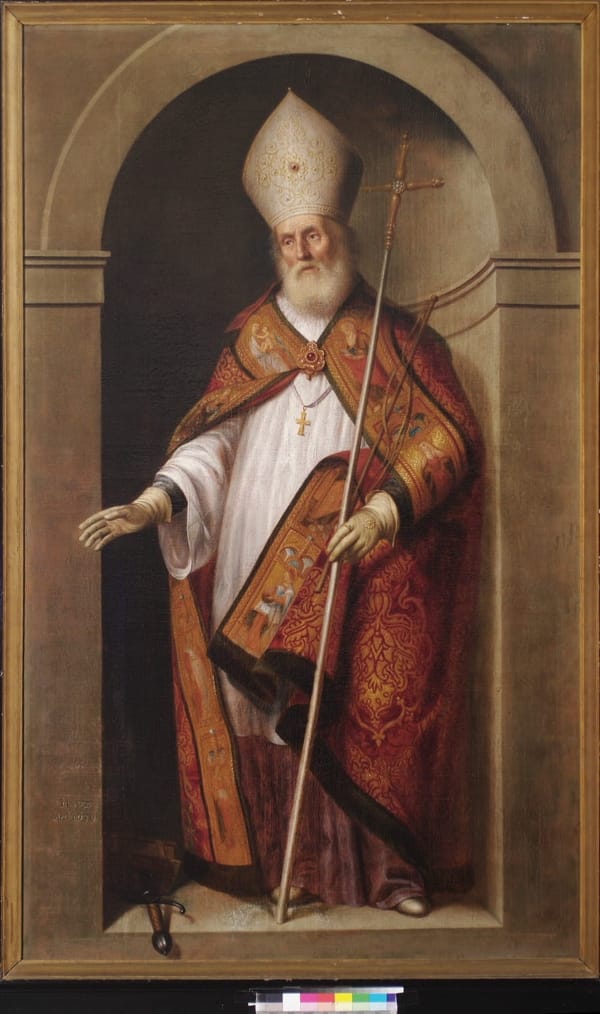 |
THE Son of Man, proclaimed King in the highest heavens on his triumphant Ascension day, leaves to his bride on earth the task of making his sovereign dominion recognized here below: this is her glory. Pentecost gives the signal for the Church's work of conquest; now does she awake, aroused by the breath of the Holy Ghost; replenished with this Spirit of love, she is all eagerness, as he is, to be possessed at once of the whole earth. We have already seen the Franks and the Anglo-Saxons pledging in her hands their oath of fealty to Christ, ‘to whom is given all power on earth and in heaven.’1 To-day we see how Winfrid realizes the fair name of Boniface, or well-doer, given him by Pope Gregory II. He presents himself before us, surrounded by the multitudes he has snatched at one blow from paganism and barbarism. Thanks to the Apostle of Germany, the hour is nigh when the Church may constitute in this world, apart from the spiritual dominion of souls, an empire more powerful than any that has ever been or is to be.
The eternal Father draws to his Son2 not men only but nations; these are his inheritance on earth no less than heaven is in eternity. The good pleasure that God takes in the Word made Flesh could never be content with merely seeing nations come, one here, another there, offering an isolated homage of recognition to Christ, as their Lord and Master. It was the whole world that was promised as his possession, without distinction of nations, without limits, save those of the earth itself:3 recognized or not, his power is universal. In the case of many, no doubt, the contempt or the ignorance of this regal claim of the Man-God is to last on throughout ages; for revolt, alas! is always possible to all. But it was the duty of the Church to exercise her influence over baptized nations, so as to gather them together in one public acknowledgement of the royalty of Christ, which is the source of every kingly power. At the Pontiff’s side there seemed to be a fitting place for a mailed chieftain of Christendom to be the lieutenant of Christ, who alone is Lord of lords and King of kings. Thus would be realized, in all its plenitude, the magnificent principality announced by the prophets for the Son of David.4
Such an institution was indeed worthy of the name it was to receive, that of the Holy Empire: in it we have the final result of our glorious Pentecost, the consummation of the testimony rendered by the Holy Ghost to Jesus, both as Pontiff and as King.5 In a few days, Leo III, the illustrious Pope called by the Holy Spirit to crown this his divine work, will proclaim, to the joy of the whole world, the establishment of this new empire beneath the sceptre-sway of the Man-God, in the person of Charlemagne, the representative of the King of kings. This marvellous work was not prepared all at once. Vast regions, destined to form the very nucleus of this future empire, for long centuries knew not so much as the very name of the Lord Jesus; or, at best, preserved but confused notions of truth, derived from some earlier evangelization that had been stifled in its birth by the turmoil of invasions—a mere mixture of Christian practices and idolatrous superstitions. At length we behold Boniface arise, endued with power from on high,6 the worthy precursor of St Leo III. Bom of those angelfaced Angles, by whom ancient Britain was transformed into the Island of Saints, he bums to carry into the heart of Germany, whence his ancestors had sprung, the light which first shone upon them in the land of their conquest.
Thirty years of monastic life, begun in childhood despite the tears and caresses of a tender father, had braced his soul. Prepared by this long period of retreat and silence, filled with divine science, and accompanied by the prayers of his cloistered brethren, he could now in all security set forth to follow the attraction of a divine call. But, first and foremost, Rome beholds him at the feet of the Sovereign Pontiff, submitting his plans and prospects to him who is the only source of all mission in the Church. Gregory II, in every way worthy of the great Popes that have borne that name, was at that time watching with apostolic vigilance over the Christian world, and preparing for the glorious sovereignty that awaited the Church in the coming eighth century. In the humble monk prostrate at his feet, the immortal Pontiff recognizes a powerful auxiliary sent to him by heaven; and so, armed with the apostolic benediction, Winfrid, now become Boniface, feels the powerful attraction of the Holy Spirit drawing him irresistibly to conquests of which ancient Rome had never dreamed.
Beyond the Rhine, farther than Roman legions ever penetrated, the Church now advances into this barbarous land, along pathways tracked for her by Boniface; overturning in her victorious march the last idols of the false gods, civilizing and sanctifying those savage hordes, the scourge of the old world. This Anglo-Saxon, a true son of St Benedict, gives to his work a stability that will defy the lapse of ages. Everywhere monasteries arise, taking root in the very soil, for God's sake; and, by force of example and beneficence, fixing around them its various nomad tribes. From the river banks, from the forest depths, instead of cries of war and of vengeance, is wafted the accent of prayer and of praise to the Most High. Sturm, the beloved disciple of St Boniface, presides over these peaceful colonies far superior to those of pagan Rome, planted though they were by her noblest veterans and manned by the best forces of her empire.
Here, too, where violence has hitherto reigned supreme, in these savage wilds, a novel kind of army is organized, formed of the gentle brides of Christ. The Spirit of Pentecost, like a mighty wind, has blown over the land of the Angles; and, even as in the cenacle holy women had a share in its influence, consecrated virgins, obedient to the heavenly impulse, have quitted the land of their birth, even the monastery that has sheltered them from childhood. Having for a while administered only at a distance to Winfrid's needs, and copied out for him the sacred books in letters of gold, they at length come to join the apostle. Fearlessly have they crossed the sea, and, guided by their divine Spouse, have come to share the labours undertaken for his glory. Lioba is at their head; she whose gentle majesty, whose heavenly aspect, uplifts the mind from earthly thoughts, and who by her knowledge of the scriptures, of the fathers, and of the sacred canons, is equal to any of the most celebrated doctors. But the Holy Ghost has still more richly gifted the soul of Lioba with humility and Christian heroism. Behold the chosen mother of the German nation! Germany's proud daughters, athirst for blood, who on their wedding-day disdained all other gift save a steed, a buckler, and a lance,7 are to learn from her the true qualities of the valiant woman. No more shall they be seen, intoxicated with slaughter, leading back to the field of battle their vanquished husbands; but the virtues of the wife and of the mother shall replace in them the fury of the camp; family life is to be founded on German soil, and through it the fatherland.
This was Boniface's intention when he called to his aid Lioba, Walburga, and their companions. Worn out with toil, but still more with the incessant wear and fret of petty jealousies (never spared to men of God by such as would cover their paltry complaints under the cloak of false zeal), our athlete of Christ was not ashamed to come to Lioba, his well-beloved daughter, humbly seeking from her that enlightened counsel and comfort which was never denied. Estimating at its true worth the share she had borne in his work, he was desirous that she should be laid to rest in the same tomb prepared for him in his abbey of Fulda.
But not yet was his labour ended, nor was the evening of life at hand. The spiritual welfare of his numberless converts must be secured, and at their head must be placed such as the Holy Ghost designated for the government of God's Church.8 By his means the hierarchy was constituted and developed; the land was covered with churches; and, beneath the rule of holy bishops chosen by God, these once wandering tribes now began to live a life to the glory of the most blessed Trinity, in a country but recently pagan, wherein Satan had hoped to perpetuate his own domination.
Nor was this our saint’s only work in Germany; in certain isolated parts, the seeds of Arianism and Manichæism had been silently taking root, by means of an intruded clergy, half pagan and half Christian in their rites; and these would inevitably prove a serious scandal to his recent converts that came within reach of their influence. Even as Christ, armed with a whip of cords, drove the buyers and sellers from the temple, so did Boniface, by vigorous measures, rid the land of these sectarian priests, who, with hands polluted by heathenish sacrifices to the vanquished deities of Valhalla, dared to offer also the spotless victim to the Most High.
The powerful action of Boniface, as the precursor of the Holy Empire, was not confined to preparing the German race alone for its share in so high a destiny. His beneficent influence was now to be exercised, at a most critical moment, upon France, the eldest daughter of the Church; for she was chosen, in the person of her princes, to be the first to bear the emblem of Christ’s universal kingship. The descendants of Clovis had preserved nought of his royal inheritance, save the vain title of a power that had now passed into the hands of a new family, a more vigorous branch of his stock. Charles Martel, the head of this race, measuring his strength with the Moors, had crushed their entire army near Poitiers: but, in the flush of victory, the hero of the day had wellnigh brought the Church of France to the brink of ruin, by distributing to his comrades in arms the episcopal sees and abbeys of the land. Unless a situation no less disastrous than would have been the triumph of Abderahman was to be accepted, these usurped croziers must at once be wrested from the hands of such strange titularies. To effect this, as much gentleness as firmness was needed, together with an ascendancy belonging only to virtue, if the hero of Poitiers and his noble race were to be gained over to respect the rights of holy Church. This victory, more glorious than had been the defeat of the Moors, was won by Boniface, a veritable triumph of unarmed holiness, as profitable to the vanquished as to the Church herself. Of this fierce warrior he was to make the worthy father of a second dynasty, the glory whereof should far surpass the brilliant hopes of the first race of the Frankish kings.
Boniface, now legate of Pope St Zachary as he had formerly been of Gregory III, fixed his episcopal see at Mainz, the better to keep within the fold both Germany the conquest of his earlier apostolate, and France more recently rescued by his labours. Like another Samuel, he himself, with his own hands, consecrated this new regal dynasty, by conferring the sacred unction on Pepin le Bref, son of Charles Martel. This was in the year 752. Another Charles, as yet a child, who was one day to inherit that throne thus firmly established, attracted the notice of the aged saint, and received his benediction; it was the future Charlemagne. But to the hand of a Sovereign Pontiff would be reserved the anointing of that royal brow; and a diadem more glorious still than that of a king of the Franks was one day to be his, exhibiting in his person the head of the new Roman Empire, the lieutenant of the King of kings.
The personal work of Boniface was now accomplished; like the old man Simeon, his eyes had seen the object of all his ambition, of his life-long toil, the salvation prepared by God for this new Israel. He too had now no desire left save that of departing in peace to our Lord; but could such an apostle enter into peace by any other gate than that of martyrdom? He understands this well: his hour has sounded: the old warrior has chosen his last battlefield. Friesland is still pagan: half a century ago, at the opening of his apostolic career, he had avoided this country, in order to escape the bishopric which St Willibrord, at that early date, was anxious to bestow upon him: but now that it has nought save death to offer him, he will enter this land. In a letter of sublime humility, prostrate at the feet of Pope Stephen III, he submits to the correction of the Apostolic See, the 'awkward mistakes,' as he terms them, and the many faults of his long life;9 to Lullus, his dearest son, he leaves the Church of Mainz; he recommends to the care of the Frankish king the several priests scattered all through Germany, the monks and virgins, who from distant homes have followed him hither. Then ordering to be placed amongst the few books which he is taking with him the winding sheet that is to enwrap his body, he designates the companions chosen by him for the journey, and sets out to win the martyr's palm.
Let us now read the liturgical record of this grand life.
Thou wast, O great apostle, the faithful servant of him who chose thee as the minister of his word and the propagator of his kingdom. When the Son of Man quitted earth to receive the delighted homage of the heavenly hosts in recognition of his kingship over them, he none the less remained King of this lower world which he has left but for a little while.10 He counted on his Church to guard his principality here below. Small indeed was the number of those who recognized him, on the day of his glorious Ascension, as their Master and Lord. But that faith deposited in those first chosen souls was a treasure which they, like skilful bankers, knew how to work with, and how to multiply by apostolic commerce. Transmitted from generation to generation, up to the day of the Lord's return, this precious capital was to go on yielding to the absent Lord more and more accumulated interest. Thus was it with thee, O Winfrid, in that age wherein thou didst bring into the Church that tribute of labour which she requires, though in very different proportion, from each of her sons. In her gratitude, for thy works which appeared to her well done and profitable above those of others, forestalling the Spouse himself, she would, even in this world, call thee by that new name11 whereby thou art known in heaven.
Indeed, when did riches, such as thou didst bring, come pouring at once into the hands of the bride? When did the Spouse appear to be so fully and truly head of the whole world, as in the eighth century, in which the Frankish princes, formed by thee to their noble destinies, constituted the temporal sovereignty of the Church, and gloried in being the lieutenants of Christ standing at the side of his Vicar on earth? To thee, O Boniface, is the Holy Empire indebted for its very existence. But for thee, France would have perished, debased by a simoniacal clergy, even before a Charlemagne had appeared; but for thee, Germany would have remained a prey to pagan barbarians, enemies of all civilization and progress. O thou that didst rescue both Germans and Franks, receive our grateful homage.
At the sight of thy works, and remembering the great popes and magnificent princes, whose glory is indeed derived from thee, our admiration equals our gratitude. But pardon us, dear saint, if the thought of those grand centuries of yore, so far removed, alas, from these our days, should mingle sadness with our joy. Viewed in the light of thy holy policy and its results, O glorious precursor of the confederation of Christian nations, how we must bewail the fatal errors of those princes and statesmen, so renowned in the seventeenth century, and so foolishly admired by a world whose ruin they were hastening! For, by the isolation of Catholic nations from one another, the ties that bound them to the Vicar of Christ became loosened: princes, forgetful of their true position as representatives of the divine King, made friends with heresy, in order to assert their independence of Rome, or to lower one another’s power. Therefore Christendom is no more. Upon its ruins, like a woful mimicry of the Holy Empire, Protestantism has raised its false evangelical empire, formed of nought but encroachments, and tracing its recognized origin to the apostasy of that felon knight Albert of Brandenburg.
The complicities that rendered such a thing possible have received their chastisement. May God’s justice be satisfied at last! O Boniface, cry out with us unto the God of armies for mercy. Raise up in the Church servants of Christ, powerful in word and work, as thou wast. Save France from anarchy; and restore to Germany a right appreciation of true greatness, together with the faith of her ancient days.
| Previous June 4: St. Francis Caracciolo, Confessor | Next June 5: St. Boniface, Apostle of Germany, Bishop and Martyr |