Daily reading
After Pentecost
Double · June 21 · Sanctoral
June 21: St. Aloysius Gonzaga, Confessor
From Dom Guéranger’s The Liturgical Year.
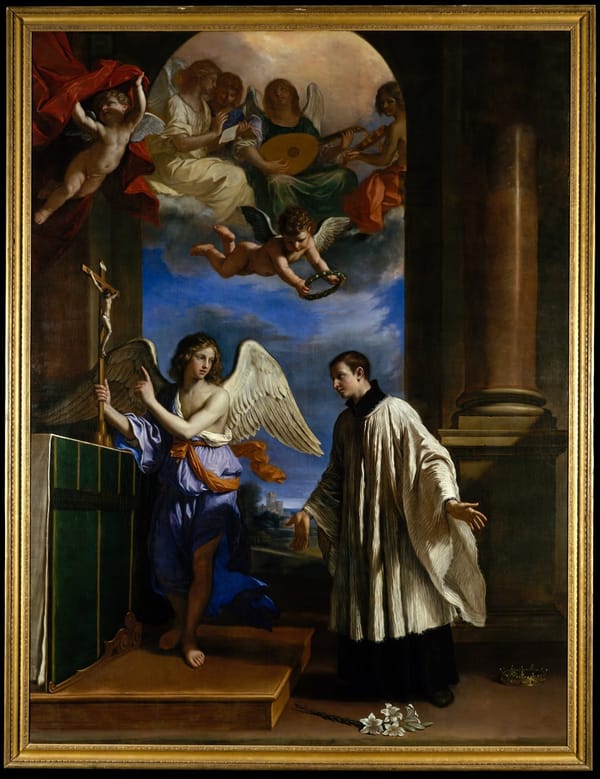 |
OH! how exceeding great is the glory of Aloysius, son of Ignatius! Never could I have believed it, had not my Jesus shown it to me. Never could I have believed that such glory was to be seen in heaven!’ Thus cries out St Mary Magdalene de Pazzi, whose memory we were celebrating a month ago: she is speaking in ecstasy. From the heights of Carmel, whence her ken may reach beyond the heavens, she reveals to earth the splendour wherewith the youthful hero of this day shines amidst the celestial phalanxes.
Yet short was the life of Aloysius, and it had offered nothing to the superficial gaze of a vast majority, save the preliminaries, so to say, of a career broken off in its flower before bearing fruit of any kind. Ah! God does not take account of things as men do; of very slight weight are their appreciations in his judgement! Even in the case of saints themselves, the mere fractional number of years, or brilliant deeds, goes far less to the filling up of a lifetime, in his view, than does love. The usefulness of a human existence ought surely to be measured by the amount produced in it of what is lasting. Now beyond this present time charity remains alone, fixed for ever at the precise degree of growth attained during this life of passage. Little matters it, therefore, if ithout any long duration or any apparent works, one of God’s elect has developed in himself a love as great as, or greater than, some others have done, in the midst of many toils, be they never so holy, and throughout a long career admired of men.
The illustrious Society that gave Aloysius Gonzaga to holy Church owes the sanctity of her members and the benedictions poured upon their works to the fidelity she has ever professed to this important truth, which throws so much light on the Christian life. From the very first age of her history, it would seem that our Lord Jesus, not content with allowing her to assume his own blessed name, has been lovingly determined so to arrange circumstances in her regard that she may never forget wherein her real strength lies, in the midst of the actively militant career which he has especially opened before her. The brilliant works of St Ignatius her founder; of St Francis Xavier, the apostle of the Indies; of St Francis Borgia, the noble conquest of Christ’s humility; manifested truly wondrous holiness in them, and to the eyes of all; but these works had no other spring or basis than the hidden virtues of that other glorious triumvirate, in which, under the eye of God alone, by the sole strength of contemplative prayer, SS Stanislaus Kostka, Aloysius Gonzaga, and John Berchmans rose to such a degree of love, and consequently to the sanctity of their heroic fathers.
Again, it is by Mary Magdalene de Pazzi, the depositary of the secrets of the Spouse, that this mystery is revealed to us. In the rapture during which the glory of Aloysius was displayed before her eyes, she thus continues, while still under the influence of the Holy Ghost: 'Who could ever explain the value and the power of interior acts? The glory of Aloysius is so great simply because he acted thus interiorly. Between an interior act and that which is seen, there is no comparison possible. Aloysius, as long as he dwelt on earth, kept his eye attentively fixed on the Word; and this is just why he is so splendid. Aloysius was a hidden martyr; whosoever loveth thee, my God, knoweth thee to be so great, so infinitely lovable, that keen indeed is the martyrdom of such a one, to see clearly that he loves thee not so much as he desireth to love thee, and that thou art not loved by thy creatures, but art offended! . . . Thus he became a martyrdom unto himself. Oh! he did love while on earth! Wherefore now in heaven he possesses God in a sovereign plenitude of love. While still mortal, he discharged his bow at the heart of the Word; and now that he is in heaven, his arrows are all lodged in his own heart. For this communication of the Divinity, which he merited by the arrows of his acts of love and of union with God, he now verily and indeed possesses and clasps for ever.’
To love God, to allow his grace to turn our heart towards infinite Beauty, which alone can fill it, such is then the true secret of highest perfection. Who can fail to see how this teaching of to-day’s feast answers to the end pursued by the Holy Ghost ever since his coming down at our glorious Pentecost? This sweet and silent teaching was given by Aloysius, wheresoever he turned his steps, during his short career. Bom to heaven, in holy Baptism, almost before he was born to earth, he was a very angel from his cradle; grace seemed to gush from him into those who bore him in their arms, filling them with heavenly sentiments. At four years of age he followed the marquis his father into the camps; and thus some unconscious faults, which had not so much as tarnished his innocence, became for the rest of his life the object of a penitence that one would have thought beseemed some grievous sinner. He was but nine years old when, being taken to Florence, there to be perfected in the Italian language, he became the edification of the court of duke Francis:1 but though the most brilliant in Italy, it failed to have any attraction for him, and rather served to detach him more decisively than ever from the world. During this period, likewise, at the feet of the miraculous picture of the Annunziata, he consecrated his virginity to our Lady.
The Church herself, in the Breviary Lessons, will relate the other details of that sweet life, in which, as is ever the case with souls fully docile to the Holy Ghost, heavenly piety never marred what was of duty in earthly things. It is because he was a true model for all youth engaged in study, that Aloysius has been proclaimed their protector. Of a singularly quick intelligence, as faithful to work as to prayer in the gay turmoil of city life, he mastered all the sciences then exacted of one of his rank. Very intricate negotiations of worldly interest were more than once confided to his management: and thus was opportunity afforded of realizing to what a high degree he might have excelled in government affairs. Here, again, he comes forward as an example to such as have friends and relatives who would fain hold them back, when on the threshold of the religious state, under pretence of the great good they may do in the world, and how much evil they may prevent. Just as though the Most High must be contented with useless nonentities in that select portion of men He reserves to himself amidst nations; or, as though the aptitudes of the richest and most gifted natures may not be turned all the better and all the more completely to God, their very principle, precisely because they are the most perfect. On the other hand, neither State nor Church ever really loses anything by this fleeing to God, this apparent throwing away of the best subjects! If, in the old law, Jehovah showed himself jealous in having the very best of all kinds of goods offered at his altar, his intention was not to impoverish his people. Whether admitted or not, it is a certain fact that the chief strength of society, the fountain-head of benediction and protection to the world, is always to be found in holocausts well pleasing to the Lord.
‘Venerable old age is not that of long time, nor counted by the number of years: but the understanding of man is grey hairs; and a spotless life is old age.’2 And therefore, Aloysius, thou dost hold a place of honour amidst the ancients of thy people! Glory be to the holy Society in the midst whereof thou didst, in so short a space, fulfil a long course; obtain that she may ever continue to treasure, both for herself and others, the teaching that flows from thy life of innocency and love. Holiness is the one only thing, when life is ended, that can be called a true gain; and holiness is acquired from within. External works count with God, only in as far as the interior breath that inspires them is pure; if occasion for exercising works be wanting, man can always supply that deficiency by drawing nigh unto the Lord, in the secrecy of his soul, as much as, and even more than, he could have done by their means. Thus didst thou see and understand the question; and therefore prayer, which held thee absorbed in its ineffable delights, succeeded in making thee equal to the very martyrs. What a priceless treasure was prayer in thine eyes, what a heaven-lent boon, and one that is indeed in our reach too, just as it was in thine! But in order to find therein, as thou didst express it, 'the short cut to perfection,' perseverance is needed and a careful elimination from the soul, by a generous selfrepression, of every emotion which is not of God. For how could muddy or troubled waters mirror forth the image of him who stands on their brink? Even so, a soul that is sullied, or a soul that without being quite a slave of passion is not yet mistress of every earthly perturbation, can never reach the object of prayer, which is to reproduce within her the tranquil image of her God.
The reproduction of the one great model was perfect in thee; and hence it can be seen how nature (as regards what she has of good), far from losing or suffering aught, rather gains by this process of recasting in the divine crucible. Even in what touches the most legitimate affections, thou didst look at things no longer from the earthly point of view; but beholding all in God, far were the things of sense transcended, with all their deceptive feebleness, and wondrously did thy love grow in consequence! For instance, what could be more touching than thy sweet attentions, not only upon earth, but even from thy throne in heaven, for that admirable woman given thee by our Lord to be thine earthly mother? Where may tenderness be found equal to the affectionate effusions written to her by thee in that letter of a saint to the mother of a saint, which thou didst address to her shortly before quitting thine earthly pilgrimage? And still more, what exquisite delicacy thou didst evince, in making her the recipient of thy first miracle, worked after thine entrance into glory! Furthermore, the Holy Ghost, by setting thee on fire with the flame of divine charity, developed also within thee immense love for thy neighbour: necessarily so, because charity is essentially one; and well was this proved when thou wast seen sacrificing thy life so blithely for the sick and the plague-stricken.
Cease not, O dearest saint, to aid us in the midst of so many miseries; lend a kindly hand to each and all. Christian youth has a special claim upon thy patronage, for it is by the Sovereign Pontiff himself that this precious portion of the flock is gathered around thy throne. Direct their feeble steps along the right path, so often enticed to turn into dangerous by-roads; may prayer and earnest toil, for God's dear sake, be their stay and safeguard; may they be enlightened in the serious matter before them of choosing a state of life. We beseech thee, dearest saint, exert strong influence over them during this most critical period of their opening years, so that they may truly experience all the potency of that fair privilege which is ever thine, of preserving in thy devout clients the angelical virtue! Yea, furthermore, Aloysius, look compassionately on those who have not imitated thine innocence, and obtain that they may yet follow thee in the example of thy penance; such is the petition of holy Church this day!
| Previous June 20: St. Silverius, Pope and Martyr | Next June 22: St. Alban, Proto-Martyr of England |