Daily reading
After Pentecost
Double · Movable from Easter · Temporal
July 18, 2021
From Dom Guéranger’s The Liturgical Year.

|
The Eighth Sunday after Pentecost
In the middle ages this Sunday was called the sixth and last Sunday after the Natalis of the apostles (that is, the feast of St. Peter); it was, indeed, the last for the years when Easter had been kept as late in April as was possible; but it was only the first after that feast of St. Peter when Easter immediately followed the spring equinox.
We have already noticed the variable character of this last portion of the liturgical cycle, which is the result of Easter being kept on a different day each year; and that in consequence of this variation this week may be the second in which the Sapiential Books are read, or, what is of more frequent occurrence, the Books of Kings may still be providing the lessons for the Divine Office. In this latter case it is the ancient temple raised by Solomon, the king of peace, to the glory of Jehovah, that engages the Church's attention to-day. We shall find that the portions of the Mass which are chanted on this Sunday are closely connected with the lessons read in last night’s Office.
Let us, then, turn our reverential thought's once more to this splendid monument of the ancient Covenant. The Church is now going through that month which immediately preceded the events so momentous to Jerusalem; she would do honour to-day to the glorious and divine past which prepared her own present. Let us, like her, enter into the feelings of the first Christians, who were Juda’s own children; they had been told of the impending destruction foretold by the prophets, and an order from God bade them depart from Jerusalem. What a solemn moment that was, when the little flock of the elect,—the only ones in whom was kept up the faith of Abraham and the knowledge of the destinies of the Hebrew people—had just begun their emigration, and looked back on the city of their fathers, to take a last farewell! They took the road to the east; it led towards the Jordan, beyond which God had provided a refuge for the remnant of Israel.1 They halted on the incline of Mount Olivet, whence they had a full view of Jerusalem; in a few moments that hill would be between them and the city. Not quite forty years before the Man-God had sat down on that same spot,2 taking His own last look at the city and her temple. Jerusalem was seen in all her magnificence from this portion of the mount, which afterwards would be visited and venerated by our Christian pilgrims. The city had long since recovered from its ruins, and had, at the time we are speaking of, been enlarged by the princes of the Herodian family, so favourably looked on by the Romans. Never in any previous period of her history had Jerusalem been so perfect and so beautiful as she then was, when our fugitives were gazing upon her. There was not, as yet, the slightest outward indication that she was the city accursed of God. There, as a queen in her strength and power, she was throned amidst the mountains of which the psalmist had sung;3 her towers4 and palaces seemed as though they were her crown. Within the triple enclosure of the walls built by her latest kings, she embraced those three hills, the grandest, not only of Judea, but of the whole world: first, there was Sion, with its unparalleled memories; then, Golgotha, which had not yet been honoured on account of the holy sepulchre, and which, nevertheless, was even then attracting to itself the Roman legions, who were to wreak vengeance on this guilty land; and, lastly, Moriah, the sacred mount of the old world, on whose summit was raised that unrivalled temple, which gave Jerusalem to be the queen of all the cities of the east, for as such even the Gentiles acknowledged her.5
‘At sunrise, when in the distance there appeared the sanctuary, towering upwards of a hundred cubits above the two rows of porticoes which formed its double enclosure; when the sun cast his morning rays on that façade of gold and white marble; when there glittered the thousand gilded spires which mounted from its roof, it seemed, says Josephus, that it was a hill capped with snow, which gradually shone, and reddened, with the morning beams. The eye was dazzled, the soul was amazed, religion was roused within the beholder, and even the pagans fell down prostrate.'6 Yes, when the pagan came hither either for conquest or for curiosity, if he ever returned, it was as a pilgrim. Full of holy sentiments, he ascended the hill; and, having reached the summit, he entered by the golden gate into the gorgeous galleries which formed the outward enclosure of the temple. In the court of the Gentiles he met with men from every country. His soul was struck by the holiness of a place where he felt that there were preserved in all purity the ancient religious traditions of the human race; and he, being profane, stood afar off, assisting at the celebrations of the Hebrew worship, such as God had commanded it to be, that is, with all the magnificence of a divine vritual. The white column of smoke from the burning victims rose up before him as earth’s homage to God, its Creator and Saviour; from the inner courts there fell on his ear the harmony of the sacred chants, carrying as they did to heaven both the ardent prayer of those ages of expectation and the inspired expression of the world’s hope; and when, from the midst of the levite choirs and the countless priests who were busy in their ministry of sacrifice and praise, the high priest, with his golden crown on his head, came forth holding the censer in his hand, and entering himself alone within the mysterious veil which curtained off the Holy of holies, the stranger, though he had but a glimpse of all those splendid symbols of religion, yet confessed himself overpowered, and acknowledged the incomparable greatness of that invisible Deity, whose majesty made all the vain idols of the Gentiles seem to him paltry and foolish pretences. The princes of Asia and the greatest kings considered it an honour to be permitted to contribute, both by personal gifts of their own making and by sums taken from the national treasuries, towards defraying the expenses of the holy place.7 The Roman generals and the Cæsar themselves kept up the traditions of Cyrus8 and Alexander9 in this respect. Augustus ordered that every day a bull and two lambs should be presented in his name to the Jewish priests, and be immolated on Jehovah's altar for the well-being of the empire;10 his successors insisted on the practice being continued; and Josephus tells us that the beginning of the war was attributable to the sacrificers refusing any longer to accept the imperial offerings.11
But, if the majesty of the temple thus impressed the very pagans right up to its last days, there were reasons for an intensity of veneration and love on the part of a faithful Jew, which he alone could realize. He was the inheritor of the submissive faith of the patriarchs; as such, he was well aware that the prophetic privileges of his fatherland were but an announcement to the whole world, that it was one day to be blessed with the more real and lasting benefits of which he, the Jew, possessed but a figure; he quite understood that the hour had come when the children of God would not confine their worship within the narrow limits of one mountain or one city;12 he knew that God's true temple was then actually being built up on every hill of the Gentile world;13 and that, in its immensity, it took in all those countries of the earth into which the Blood that flowed first from Calvary had won its way. And yet, we can easily understand what a sharp pang of anguish thrilled through his patriot heart, now that God was about to consummate, before the astonished universe, the terrible consumption14 of the ungrateful people, whom He had chosen for His portion, His inheritance.15 Who is there that would not share in the grief of these holy ones of Jacob, few in number as the ears of corn gathered by the gleaner,16 and now bidding an eternal farewell to that holy, but now accursed, city? These true Israelites might well weep; they were leaving for ever, leaving to devastation and ruin, their homes, their country, and, dearest of all, that temple, which, for ages, had sanctified the glory of Israel, and given Juda the right and title to be the noblest of the nations of the earth.17
There was something even beyond all this : it was that their dear Jerusalem had been the scene of the grandest mysteries of the law of grace. Was it not in yonder temple that, as the prophets expressed it, God had manifested the Angel of the Testament,18 and given peace? The honour of that temple is no longer the exclusive right of an isolated people; for the Desired of all nations, by His going into it, has brought it a grander glory than all the ages of expectation and prophecy have imparted.19 It was under the shadow of those walls that Mary—she that was to be the future seat of Wisdom eternal—prepared within her soul and body a more august sanctuary for the divine Word than was that whose cedared and golden wainscoting made it so exquisite a shelter for the infant maiden. Yes, it was there that, when but three years old, Mary joyously mounted up the fifteen steps which separated the court of women from the eastern gate, offering to God the pure homage of her immaculate heart. Here, then, on the summit of Moriah, began, in the person of their Queen, the long line of consecrated virgins, who, to the end of time, will come offering, after her, their love to the King.20 There, also, the new priesthood found its type and model in the blessed Mother, presenting in that holy temple the world’s victim, Jesus, the new-born Child of her chaste womb. In that same dwelling, made by the hands of men; in those halls where sat the doctors, eternal Wisdom, too, seated Himself under the form of a child of twelve, instructing the very teachers of the Law by His sublime questions and divine answers.21 Every one of those courts had seen the Word Incarnate giving forth treasures of goodness, power, and heavenly doctrine. One of those porticoes was the favourite one where Jesus used to walk,22 and the infant Church made it the place of its early assemblies.23
Truly, then, this temple is holy with a holiness possessed by no other spot on earth; it is holy for the Jew of Sinai; it is holy for the Christian, be he Jew or Gentile, for here he finds that the Law ends, because here are verified all its figures.24 With good reason did our mother the Church, in her Office for this night, repeat the words which were spoken by God to Solomon : ‘I have sanctified this house which thou hast built, to put my name there for ever; and mine eyes and my heart shall be always there.'25
How, then, is it that dark forebodings are come terrifying the watchmen of the holy mount? Strange apparitions, fearful noises, have deprived the sacred edifice of that calm and peace which become the house of the Lord. At the Feast of Pentecost the priests, who were fulfilling their ministry, have heard in the holy place a commotion like that of a mighty multitude, and many voices crying out together: 'Let us go hence!' On another occasion, at midnight, the heavy brazen gate which closed the sanctuary on the eastern side, and which took twenty men to move it, has opened of itself.26 O temple, O temple, let us say it, with them that witnessed these threatening prodigies,27 why art thou troubled? why workest thou thine own destruction? Alas! we know what awaits thee! The prophet Zacharias foretold it when he said: ‘Open thy gates, O Libanus, and let fire devour thy cedars!'28
Has God forgotten His promises of infinite goodness? No : but let us think upon the terrible and just warning, which He added to the promise He made to Solomon, when he had finished building the temple : ‘But if ye and your children, revolting, shall turn away from following Me, and will not keep My commandments and My ceremonies which I have set before you, I will take away Israel from the face of the land, which I have given them; and the temple which I have sanctified to My name, I will cast out of My sight; and Israel shall be a proverb, and a by-word among all people. And this house shall be made an example of; every one that shall pass by it shall be astonished, and shall hiss, and say : "Why hath the Lord done thus to this land, and to this house?'"29
O Christian soul! thou that, by the grace of God, art become a temple30 more magnificent, more beloved in His eyes, than that of Jerusalem, take a lesson from these divine chastisements; and reflect on the words of the Most High, as recorded by Ezechiel: ‘The justice of the just shall not deliver him, in what day soever he shall sin.... Yea, if I shall say to the just, that he shall surely live, and he, trusting in his justice, commit iniquity —all his justices shall be forgotten, and, in his iniquity, which he hath committed, in the same shall he die.'31
With the Greeks, the multiplication of the five loaves and two fishes is the subject of the Gospel for this Sunday; they count it the eighth of St. Matthew.
Mass
The Introit speaks of the glory of the ancient temple, and of the holy mount. But greater far is the splendour of the Church, which is now carrying the name and praise of the Most High even to the end of the earth, far more efficiently than had done that temple which was but a figure of our mother the Church.
Introit
Not only are we incapable, of ourselves, of doing any good work, but, without the help of grace, we cannot even have a thought of supernatural good. Now, the surest means for obtaining the help that is so needed by us is to acknowledge humbly before God that we depend entirely upon Him; it is what the Church does in the Collect.
Collect
The other Collects, as on page 120.
Epistle
Cap. viii.Fratres, Debitores sumus non carni, ut secundum carnem vivamus. Si enim secundum carnem vixeritis, moriemini : si autem spiritu facta carnis mortificaveritis, vivetis. Quicumque enim Spiritu Dei aguntur, ii sunt filii Dei. Non enim accepistis spiritum servitutis iterum in timore, sed accepistis spiritum adoptionis filiorum, in quo clamamus : Abba (Pater). Ipse enim Spiritus testimonium redditi spiritui nostro, quod sumus filii Dei. Si autem filii, et hæredes : hæredes quidem Dei, cohæredes autem Christi.
Ch. viii.Brethren : We are debtors, not to the flesh, to live according to the flesh. For if you live according to the flesh, you shall die : but if by the spirit you mortify the deeds of the flesh, you shall live. For whosoever are led by the Spirit of God, they are the sons of God. For you have not received the spirit of bondage again in fear : but you have received the spirit of adoption of sons, whereby we cry : Abba (Father). For the Spirit himself giveth testimony to our spirit, that we are the sons of God. And if sons, heirs also : heirs indeed of God, and joint heirs with Christ.
The apostle and doctor of the Gentiles here goes on, forming to the Christian life the new recruits, whom his own voice and that of his fellow apostles, dispersed as they are throughout the world, are every day leading, by hundreds, to the fount of salvation. Although the Church is all attention to the events which are preparing for Judea, yet is she full of maternal solicitude for the great work of training those children whom she has given to her divine Spouse. Whilst Israel is obstinate in his fatal refusal to accept the Messiah, another family is growing up in his place; and, by its docility, richly repays our Lord for all the rebellion and slights offered Him by the children He had first made His chosen ones. They were the ancient people, and are jealous of others being now called to the same privilege. The contradictions of which Christ complains in the Psalm are anything but over; and yet, thanks to the Church, the Man-God is already the Head of the Gentiles.32
Admirable is the fruitfulness of the bride; for wonderful is the power of sanctification which she is using all through the world of various nations. Scarcely has she sprung into her beauteous existence, than she offers to her Lord and her King a new empire, consolidated in unity of love; she presents Him with a generation that is all pure in the intelligence and practice of every virtue. It is quite true, that the Holy Ghost acts directly on the souls of the newly baptized; but there is something else to be considered in the divine plan. It is this : the Word, having been made flesh, and having taken to Himself a bride (which is the visible Church on earth), whom He has made His associate in the work of man's salvation, has willed that the invisible operation of the divine Spirit, who proceeds from Him (the Word), shall not be in its normal state, unless there be added to it the extrinsic cooperation and intervention of this His bride. Not only is the Church the depository of those allpotent formulas and mysterious rites which change man’s heart into a new soil, cleansing it from thorns and weeds, making it able to produce a hundredfold, but she also sows the seed of the divine husbandman into that same soil,33 by her countless modes of teaching the truth. To the Holy Ghost, indeed, a magnificent share is due of that fecundity and that social life of the Church; still, her portion of work is exquisite; it deals with the elect taken as individuals, and consists especially in bringing them to profit by the divine energies of the sacraments which she administers, and in developing the germs of salvation which her teaching plants in their souls.
How important, then, and sublime will ever be that mission, winch is confided to those men who are set over particular churches, as teachers or directors of souls; they represent, to these isolated congregations, the common mother of all the faithful, for, in her name, they really provide for the holy Spirit those elements upon which He is to make His all-powerful action felt. For that very same reason, woe to those times when the dispensers of the divine word, having themselves nought but halved or false principles, give but weak, shrivelled seed to the souls entrusted to them! The Holy Ghost; is not bound to supply their insuffciency; ordinarily speaking, He does not supply it, for such is not the way established by Christ for the sanctification of the members of His Church.
The common mother, however, has a supplementary aid for such of her children as may be thus treated; it is her liturgy. There they will find, not only the holy sacrifice which will support them, and the graces of the Sacrament of love which will nourish spiritual life within them, but, moreover, the surest rule of conduct, and the sublimest teachings of every virtue. Such souls as these have perhaps the idea that the poor subjective system they have made for themselves is the royal road to perfection; but, if they be of an earnest good will, desirous to find the best way, God will, some happy day, lead them to find, and, finding, to appreciate, the inexhaustible and divinely given treasures of the Church's liturgy; possessing and enriching themselves with these, they will soon put aside what the prophet Isaias terms bread without strength, and water without power.34 The same prophet would thus urge them, in the Church's name, to what is best: 'All ye that thirst, come to the waters! And ye that have no money, make haste, buy, and eat. Come ye! buy wine and milk, without money, and without any price. Why spend ye money for that which is not bread, and your labour for that which doth not satisfy you? Hearken diligently to me, and eat that which is good, and your soul shall be delighted in fatness!'35 And truly there is a fact which should rouse, both to attention and gratitude, any Christian who longs to be enlightened as to the best way of getting to heaven : this fact is, that the Church herself has made a selection, for our reading, from the treasury of the Scriptures, and, in her missal, which she puts into our hands, she has inserted practical teachings from the same divine Books, which she knew were best suited to the wants of her children. A Christian, who is humbly and devoutly assiduous in the study of this admirable book of the liturgy, will abound in spiritual knowledge. His guide will say to him, and with a well-grounded assurance : 'This is the way; walk in it! And go not aside, neither to the right, nor to the left!'36 We have no need to wonder at all this; for, in the guidance of souls, the Church is far superior to the most learned doctors and to the greatest saints, all of whom were humble disciples in her school.
Let us put together the few lines which have been read to us as the Epistles of the last three Sundays, taken from that written by St. Paul to the Romans. To say nothing of their infallible truth as being inspired by the Holy Ghost, could we have had any exposition of the principles of revealed morality which could be compared to it? Clearness, simplicity of diction, earnest vehemence of exhortation–all are perfect in these few words; and yet, they are but the outward expression of the sublimest truths of Christian dogma. Let us make the barest possible summary of what these three Epistles have taught us; and we shall see how grand they are. Christ Jesus, foundation of man's salvation; His death and burial made, in Baptism, the regeneration of man; His life in God, the model of our own; the disgrace of our enslaved bodies and its removal; the sanctifying fruitfulness of every virtue substituted in our members for the poisonous roots of all vices; and, on this very Sunday, the pre-eminence of the spirit over the flesh; the duties incumbent on our spirit, if she is to maintain her superiority; what man must do, if he would preserve the liberty bestowed on him by the Spirit of love, and prove himself to be, what he really is, a son of God and joint-heir of Christ. Yes, these are the splendid realities, which are henceforth to light up in us the law of the spirit of life (that is, the law of the life we are to live by the Spirit) in Christ Jesus;37 these are the axioms of the science of salvation now taught to the whole world, which are to be substituted for both the weaknesses of the Jewish law and the empty ethics of philosophers.
For, the leading idea which pervades the whole of this sublime Epistle to the Romans is this : man, unaided by grace, is incapable of producing perfect justice and absolute good. Experience has proved it, St. Paul teaches it, the fathers will, later on, unanimously assert it, and the Church, in her Councils, will define it. True, by the mere powers of his fallen nature, man may come to the knowledge of some truths, and to the practice of some virtues; but, without grace, he can never know, and still less observe, the precepts of even the natural law, if they are taken as a whole.
From Jesus, then, from Jesus alone, comes all justice. Not only is supernatural justice, which supposes the infusion of sanctifying grace in the sinner's soul, wholly from Him; but even that natural justice, of which men are so proud, and which they say is quite enough without anything else, soon leaves one who does not cling to Christ by faith and love. Our modern world has a pompous phrase about 'the independence of the human mind let those who pretend to acknowledge no other goodness but that, go on with their boasting of being moral and honest men; but, as to us Christians, we believe what our mother the Church teaches us; and, agreeably to such teaching, we believe that 'a moral and honest man,' that is to say, a man who lives up to all the duties which nature puts upon him, can only be such here below by a special aid of our Redeemer and Saviour Christ Jesus. With St. Paul, therefore, let us be proud of the Gospel; for, as he calls it, it is the power of God,38 not only to justify the ungodly,39 but also to enrich souls, that thirst after what is right, with an active and perfect justice. 'The just man,' says the same apostle, 'liveth by faith'; and according to the growth of his faith, so is his growth in justice. Without faith in Christ, the pretension to reach perfection in good, by one’s own power and works, produces nothing but the stagnation of pride and the wrath of God.40
The Jews are a proof of it. Proud of their Law, which gave them light greater than that enjoyed by the Gentiles,41 and wishing to make their whole virtue consist in the possession of that Law, they have rejected Him who was the end of the Law, and the source of all holiness;42 they have refused to accept the Christ, who not only delivered them from tneir previous misery,43 but also brought them the knowledge of what would save them, and the strength to fulfil it;44 they have continued in their iniquity, adding sin upon sin to that contracted from their first parents, and thus 'treasuring up wrath against the day of wrath.'45 Now is being fulfilled the prediction of Isaias, whose words might very appropriately have been used by the faithful few of Israel, as they fled from Jerusalem : 'Except the Lord of hosts had left us seed, we should have been as Sodom, and we should have been like to Gomorrha.'46
‘What, then, shall we say?’ asks the apostle; and he answers his own question thus : 'That the Gentiles, who followed not after justice, have attained to justice, even the justice that is of faith. But Israel, by following after the law of justice, is not come unto the law of justice. Why so? Because they sought it, not by faith, but as it were of works; for they stumbled at the stumbling-stone, as it is written : 'behold! I lay in Sion a stumblingstone and a rock of scandal; and whosoever believeth in Him, shall not be confounded.’47
The Gradual seems to express the sentiments of the Jewish converts, who had to depart from their cities; they might thus have besought God to be henceforth their protector and a place of refuge where they might be safe. The Alleluia-versicle again sings of the glory that was once given to the Lord in Jerusalem, especially on the holy mountain where His temple was built.
Gradual
Gospel
Cap. xvi.In illo tempore : Dixit Jesus discipulis suis parabolani hanc : Homo quidam erat dives, qui habebat villicum : et hic diffamatus est apud illum quasi dissipasset bona ipsius. Et vocavit ilium, et ait illi: Quid hoc audio de te? Redde rationem villicationis tuæ : jam enim non poteria villicare. Ait autem villicus intra se : Quid faciam, quia dominus meus aufert a me villicationem? Fodere non valeo, mendicare erubesco. Scio quid faciam, ut, cura amotus fuero a villicatione, recipiant me in domos suas. Convocatis itaque singulis debitoribua domini sui, dicebat primo : Quantum debes domino meo? At ille dixit : Centum cados olei. Dixitque illi : Accipe cautionem tuam : et sede cito, scribe quinquaginta. Deinde alii dixit : Tu vero quantum debes? Qui ait : Centum coros tritici. Ait illi : Accipe litteras tuas, et scribe octoginta. Et laudavit dominus villicum iniquitatis, quia prudenter fecisset : quia filii hujus sæculi prudentiores filiis lucis in generatione sua sunt. Et ego vobis dico : Facite vobis amicos de mammona iniquitatis : ut, cum defeceritis, recipiant vos in æterna tabemacula.
Ch. xvi.At that time : Jesus spoke to his disciples this parable: There was a certain rich man who had a steward : and the same was accused unto him, that he had wasted his goods. And he called him, and said to him : How is it that I hear this of thee? give an account of thy stewardship : for now thou canst be steward no longer. And the steward said within himself : What shall I do, because my lord taketh away from me the stewardship? To dig I am not able; to beg I am ashamed. I know what I will do, that when I shall be removed from the stewardship, they may receive me into their houses. Therefore, calling together every one of his lord's debtors, he said to the first : How much dost thou owe my lord? But he said : A hundred barrels of oil. And he said to him : Take thy bill and sit down quickly, and write fifty. Then he said to another : And how much dost thou owe? Who said : A hundred quarters of wheat. He said to him : Take thy bill and write eighty. And the lord commended the unjust steward, forasmuch as he had done wisely : for the children of this world are wiser in their generation than the children of light. And I say to you : Make unto you friends of the mammon of iniquity, that when you shall fail, they may receive you into everlasting dwellings.
The several parts of the parable here proposed to us are easy to be understood, and convey a deep teaching. God alone is rich by nature, for to Him alone belongs the direct and absolute dominion over all things : they are His, because He made them.48 But, by sending His Son into the world under a created form, He, by this temporal mission, appointed Him heir to all the works of His hands,49 just as truly as He already was owner of the riches of the divine Nature because of His eternal generation. The rich man, then, of our Gospel is Jesus, who, in His sacred Humanity, united to the Word, is heir of all things,50 and, as such, all things of the most high God, created or uncreated, finite or infinite, belong to Him. To Him belong the heavens which proclaim His glory,51 and which, as long as they last,52 clothe Him with their garment of light;53 to Him the ocean, whose surges are but a voice that speaks His praise,54 and hushes the fury of its tempests when He bids it be still;55 to Him the earth, which gladly offers Him the homage of all its fullness.56 The grass and flowers of the meadows, the varied fruits, the fertile loveliness of the fields;57 the birds of the air and the fishes that inhabit the rivers, or that sport in the paths of the sea;58 the huge oxen as well as the tiniest insect that lives; the wild beasts of forest or mountain;59 all are His, all are subject to His rule. Silver, too, is His, and gold is His;60 and man, too, is His, and would have been eternally His servant, had not Jesus mercifully vouchsafed to divinize him, and make him a partaker of His own eternal happiness and riches.
Instead of our being His slaves or servants, He would have us be His brothers; and, when He returned from this world to His Father, whom He had also made to be ours by the grace He had infused into us,61 He sent us the Holy Ghost, who should bear testimony to us that we are the sons of God,62 and be to us the pledge of our sacred inheritance, heaven.63 O ineffable riches of the world to come! O inheritance the fullest that ever was! Our Jesus Himself is all joy at the sight of it, and, in the psalm of His Resurrection, He gives expression to that joy. We, His members and jointheirs, have a right to repeat those words after Him, and say : 'The lines are fallen unto me in goodly places; for my inheritance is goodly to me! for the Lord Himself is my portion! I will bless Him for having given me to understand my happiness!'64
But, in order that we may attain to those eternal riches, there is a condition imposed on us : we must turn to profit the visible domain of Christ; we must see that it is used in His service. The future rewards we are to have in heaven depend upon the greater or less fidelity wherewith we have employed our share of these inferior good things, for they are entrusted to us, to each of us in the measure which seemed good in God's eyes. What a divine agreement has been drawn up for us! What perfect adjustment between justice and love! Our Lord Jesus Christ has divided His property into two portions; He gives the eternal portion unreservedly to us; it is the only one that is truly great, the only one that is capable of contenting our infinite longings. As to the other portion, which, in itself, would not be worthy of the attention of beings that are made for the contemplation of the divine essence, He could not think of allowing us to set our hearts on it, neither will He permit us to have absolute dominion over it. The real possession of temporal goods belongs, therefore, to Him alone; the ownership of earthly riches, which He permits to the future joint-heirs of His own blissful eternity, is subject to numberless restrictions during their life-time, and, at their death, exhibits its essentially precarious tenure, by not being able to follow its owner beyond the grave.
For the fool, as well as for the wise man, the day will come when his soul will be required of him;65 and when the rich man, as well as the poor, will be brought before his Maker, exactly as he was on the day of his first entrance into the world,66 and it will be said to him : Give an account of thy stewardship! At that dread hour, the rule observed for the judgment will be that which our Lord revealed to us during His mortal life : ‘Unto whomsoever much is given, of him much shall be required; and to whom they have committed much, of him they will demand the more.’67 Woe, at that hour, to the servant who has comported himself as though he were the absolute master! Woe to the steward who, disregarding the trust assigned to him, has done just what his own whim suggested with the goods of which he was only the dispenser!68 When the light of eternity shall be upon him, he will understand the error of his foolish pride. He will see the shameful injustice of a life which the world perhaps thought a very decent one, but which was spent without the slightest regard to God's intentions in giving him the riches of which he boasted. He will then be entirely deprived of them all; neither will it be then in his power to make a better use of them for the future—that is, a use more in accordance with the designs of God. If he might, at least, make some restitution for the goods he has abused! if he might sue for aid from those with whom he lived upon earth! But, no! when time is over, labour is over too. He has nothing to show for all his riches; he is powerless; and when he goes before that dread tribunal, where every man is afraid that he cannot put his own accounts right, whom can he get to help him?69
Happy, therefore, if, now that time is still granted him, he would allow the thousand calls of God70 to awaken him from his false conscience. Happy if, like the steward mentioned in our Gospel, he would profit by the days he has still to live, and would say to himself those words of Job: 'What shall I do, when God shall rise to judge? And, when He shall examine, what shall I answer Him?'71
This very Judge, whom he so rightly fears, now most mercifully points out to him how he may escape the punishment due to his past mal-administration. Let him imitate the prudence of the unjust steward, and he will have praise for it from his Lord; not only because of his prudence, but because by thus spreading over God's servants the riches that were entrusted to his care, far from robbing his divine Master, he acts in strict accordance with His wishes. ‘Who thinkest thou,’ asks our Lord, ‘is the faithful and wise steward, whom his Lord setteth over His family, to give them, in due time, their measure of wheat72 and oil?'73 Alms, whether corporal or spiritual, secure us powerful friends for that awful day of our death and judgment. It is to the poor that the kingdom of heaven belongs;74 so that if we spend the riches of this present life in solacing the sufferings of the poor now that they are living here below, afterwards they will not fail to make us a return by receiving us into their future homes, the everlasting dwellings of heaven.
Such is the immediate and obvious meaning of the parable given to us to-day. But if we would go further—if we would understand the whole intention of the Church in her choice of the present Gospel—we must listen to St. Jerome, whose homily for last night’s Office is put before us as the official interpretation of the sacred text. Let us first listen to the words of Scripture which the saint quotes (they immediately follow those of our Gospel): 'He that is faithful in that which is least, is faithful also in that which is greater; and he that is unjust in that which is little, is unjust also in that which is greater. If, then, ye have not been faithful in the unjust mammon, who will trust you with that which is the true?'75 These words, says St. Jerome, were said in the presence of the scribes and pharisees; they felt that the parable was intended for them; and they derided the divine preacher. The one that was 'unjust in that which is little' is the jealous Jew, who, in the limited possession of the present life, refuses to his fellow-men the use of those goods which were created for all. If, then, you avaricious scribes are convicted of mal-administration in the management of temporal riches, how can you expect to have confided to you the true, the eternal, riches of the divine word, and the teaching of the Gentiles?76 Terrible question, which our Lord leaves thus unanswered; let these unjust stewards, the depositaries of the figurative law, deride Jesus as much as they please, and pretend that His question does not refer to them; they will soon receive the true answer, the ruin of Jerusalem.
Meanwhile, the little humble flock of the elect of Juda, leaving these hard-hearted men to the vengeance which their proud madness is hurrying on, is continuing its journey, knowing that the promises of Sion belong to it. The Offertory-anthem is the expression of their faith and their hope.
Offertory
It is from God that we receive the gifts, which He deigns to accept at our hands; and yet, the sacred mysteries, which are about to transform our oblation, do, none the less, obtain for us, by His grace, the sanctification of our present life, and the joys of eternity.
Secret
The other Secrets, as on page 130.
The hope which man has in his God could never disappoint him; what, stronger pledge could he wish for than the sweetness of the divine banquet which he is now enjoying?
Communion
The heavenly nourishment we have now received has power to renew both our souls and bodies: let us make ourselves worthy of experiencing the fullness of its effects.
Postcommunion
The other Postcommunions, as on page 131.
Vespers
The psalms, capitulum, hymn, and versicle as above, pages 71-81.
Antiphon of the Magnificat
- Isa. x. 20-23. ↩︎
- St. Mark xiii. 1-3. ↩︎
- Ps. cxxiv. 2. ↩︎
- Ps. cxxi. 7. ↩︎
- Pliny, 'Nat. Hist.,' v.15. ↩︎
- Josephus, De Bell., v. 5, translated by Champagny. ↩︎
- 2 Mach. iii. 2, 3. ↩︎
- 1 Esdras vi 7. ↩︎
- Jos., 'Antiq.,’ xi. 5. ↩︎
- Philo., Legat. ↩︎
- Jos. De bell. ii.17. ↩︎
- St. John iv. 21, 28. ↩︎
- Isa. ii. 2. ↩︎
- Ibid. x. 23. ↩︎
- Deut xxxii. 9. ↩︎
- Isa. xvii. 5. ↩︎
- Deut. iv. 6-8. ↩︎
- Mal. iii.1. ↩︎
- Agg. ii. 8, 10. ↩︎
- Ps. xliv.15, 16. ↩︎
- St. Luke ii. 46, 47. ↩︎
- St. John X. 23. ↩︎
- Acts iii. 11, v. 12. ↩︎
- Rom. x. 4. ↩︎
- 3 Kings ix. 3. ↩︎
- Jos. De Bell., vi. 5. ↩︎
- Talmud, as quoted by Sepp, 2nd part, vi. 62. ↩︎
- Zach. xi. 1. ↩︎
- 3 Kings ix. 6-8. ↩︎
- 1 Cor. in. 16, 17. ↩︎
- Ezech. xxxiii.12,13. ↩︎
- Ps. xvii. 44-46. ↩︎
- St. Luke viii. 11. ↩︎
- Isa. iii 1, xxx 20. ↩︎
- Ibid. lv. 1, 2. ↩︎
- Isa. xxx. 21. ↩︎
- Rom. viii. 2. ↩︎
- Rom. i. 16. ↩︎
- Ibid. iv. 5. ↩︎
- Ibid. i. 17, 18. ↩︎
- Ibid. ii. 17-20. ↩︎
- Ibid. x. 3, 4. ↩︎
- Ibid. iii. 25. ↩︎
- Ibid. viii. 3, 4. ↩︎
- Ibid. ii. 5. ↩︎
- Isa. i 9. ↩︎
- Rom. ix. 30-33. ↩︎
- Ps. xxiii. 2, lxxxviii.12. ↩︎
- Ps. viii. 6-8. ↩︎
- Heb. i. 2, ii. 8. ↩︎
- Ps. xviii. 2, 6. ↩︎
- Ibid. ci. 27 ↩︎
- Ibid. ciii. 2. ↩︎
- Ibid. xcii. 3, 4. ↩︎
- St. Mark iv. 39, 40. ↩︎
- Ps. xxiii. 1. ↩︎
- Ibid. xlix.11. ↩︎
- Ibid. viii. 9. ↩︎
- Ibid. xlix. 9, 10. ↩︎
- Agg. ii. 9. ↩︎
- St. John xx. 17. ↩︎
- Rom. viii. 16. ↩︎
- Eph. i. 14. ↩︎
- Ps. xv. 5-7. ↩︎
- St. Luke xii. 20. ↩︎
- Job i. 21. ↩︎
- St. Luke xii. 48. ↩︎
- Ibid. 45-47. ↩︎
- St. Matt. xxv. 9. ↩︎
- Ps. xciv. 8. ↩︎
- Job. xxxi. 14. ↩︎
- St. Luke xii. 42. ↩︎
- 2 Esdras v. 11. ↩︎
- St. Matt. v. 3. ↩︎
- St. Luke xvi. 10. 14. ↩︎
- S. Hieron., Ep. ad Algasiam, cap, vi. ↩︎
July 18: St. Camillus of Lellis, Confessor
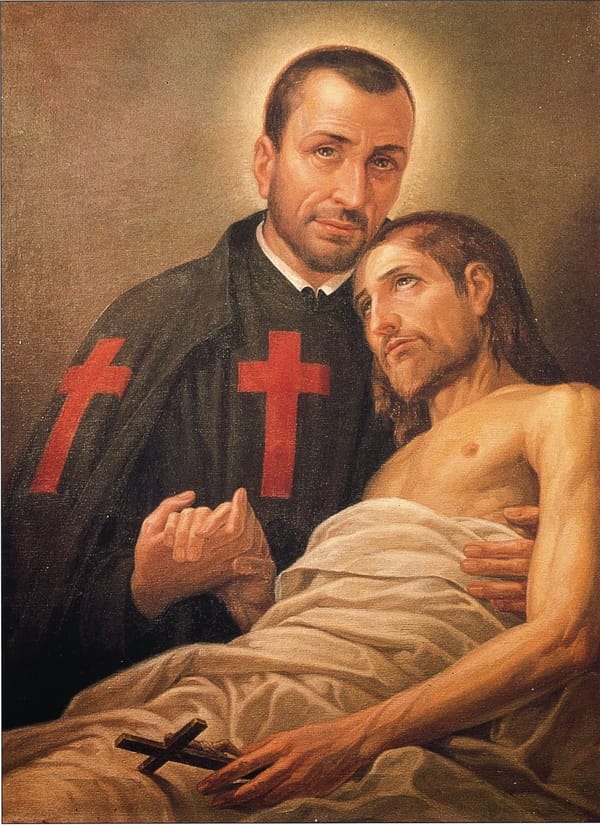 |
THE Holy Spirit, who desires to raise our souls above this earth, does not therefore despise our bodies. The whole man is His creature and His temple, and it is the whole man He must lead to eternal happiness. The Body of the Man-God was His masterpiece in material creation; the divine delight He takes in that perfect Body He extends in a measure to ours; for that same Body, framed by Him in the womb of the most pure Virgin, was from the very beginning the model on which ours are formed. In the re-creation which followed the Fall, the Body of the Man-God was the means of the world’s redemption; and the economy of our salvation requires that the virtue of His saving Blood should not reach the soul except through the body, the divine sacraments being all applied to the soul through the medium of the senses. Admirable is the harmony of nature and grace; the latter so honours the material part of our being that she will not draw the soul without it to the light and to heaven. For in the unfathomable mystery of sanctification, the senses do not merely serve as a passage; they themselves experience the power of the sacraments, like the higher faculities of which they are the channels; and the sanctified soul finds the humble companion of her pilgrimage already associated with her in the dignity of divine adoption, which will cause the glorification of our bodies after the resurrection. Hence the care given to the very body of our neighbour is raised to the nobleness of holy charity; for being inspired by this charity, such acts partake of the love wherewith our heavenly Father surrounds even the members of His beloved children. I was sick, and ye visited Me,1 our Lord will say on the last day, showing that even the infirmities of our fallen state in this land of exile, the bodies of those whom He deigns to call His brethren, share in the dignity belonging by right to the eternal. only-begotten Son of the Father. The Holy Spirit, too, whose office it is to recall to the Church all the words of our Saviour, has certainly not forgotten this one; the seed, falling into the good earth of chosen souls, has produced a hundredfold the fruits of grace and heroic self-devotion. Camillus of Lellis received it lovingly, and the mustard-seed became a great tree offering its shade to the birds of the air. The Order of Regular Clerks, Servants of the Sick, or of Happy Death, deserves the gratitude of mankind; as a sign of heaven's approbation, angels have more than once been seen assisting its members at the bedside of the dying.
The liturgical account of St. Camillus' life is so full that we need add nothing to it.
Angel of charity, by what wonderful paths did the Divine Spirit lead thee! The vision of thy pious mother remained long unrealized; before taking on thee the holy Cross and enlisting comrades under that sacred sign, thou didst serve the odious tyrant, who will have none but slaves under his standard, and the passion of gambling was wellnigh thy ruin. O Camillus, remembering the danger thou didst incur, have pity on the unhappy slaves of passion; free them from the madness wherewith they risk, to the caprice of chance, their goods, their honour, and their peace in this world and in the next. Thy history proves the power of grace to break the strongest ties and alter the most inveterate habits: may these men, like thee, turn their bent towards God, and change their rashness into love of the dangers to which holy charity may expose them! For charity, too, has its risks, even the peril of life, as the Lord of charity laid down His life for us: a heavenly game of chance, which thou didst play so well that the very angels applauded thee. But what is the hazarding of earthly life compared with the prize reserved for the winner?
According to the commandment of the Gospel read by the Church in thy honour, may we all, like thee, love our brethren as Christ has loved us! Few, says St. Augustine, love one another to this end, that God may be all in all.2 Thou, O Camillus, having this love, didst exercise it by preference towards those suffering members of Christ's mystic Body, in whom our Lord revealed Himself more clearly to thee, and in whom His kingdom was nearer at hand. Therefore has the Church in gratitude chosen thee, together with John of God, to be guardian of those homes for the suffering which she has founded with a mother’s thoughtful care. Do honour to that Mother’s confidence. Protect the hospitals against the attempts of an odious and incapable secularization, which, in its eagerness to lose the souls, sacrifices even the corporal well-being of the unhappy mortals committed to the care of its evil philanthropy. In order to meet our increasing miseries, multiply thy sons, and make them worthy to be assisted by angels. Wherever we may be in this valley of exile when the hour of our last struggle sounds, make use of thy precious prerogative which the holy liturgy honours to-day; help us, by the spirit of holy love, to vanquish the enemy and attain unto the heavenly crown!
July 18 (the Same Day): St. Symphorosa and her Seven Sons, Martyrs
FOR the second time in July a constellation of seven stars shines in the heavens. More fortunate than Felicitas, Symphorosa preceded in the arena the seven sons she was offering to God. From the throne where he was already reigning crowned with the martyr’s diadem, Getulius the tribune, father of this illustrious family, applauded the combat whereby his race earned a far greater nobility than that of patrician blood, and gave to Rome a grander glory than was ever dreamed of by her heroes and poets. The Emperor Adrian, corrupt yet brilliant, sceptical yet superstitious, like the society around him, presided in person at the defeat of his gods. Threatening to bum the valiant woman in sacrifice to the idols, he received this courageous answer: ‘Thy gods cannot receive me in sacrifice; but if thou bum me and my sons for the name of Christ, my God, I shall cause thy demons to bum with more cruel flames!’ The execution of the mother and her sons was, indeed, the signal for a period of peace, during which the Kingdom of our Lord was considerably extended. Jerusalem, having under the leadership of a last false Messias revolted against Rome, was punished by being deprived of her very name; but the Church received the glory which the Synagogue once possessed when she produced the mother of the Machabees.
Another glory was reserved for this eighteenth day of July, in the year 1870: the (Ecumenical Council of the Vatican, presided over by the immortal Pius IX, defined in its constitution, Pastor Æternus, the full, supreme, and immediate power of the Roman Pontiff over all the Churches, and pronounced anathema against all who should refuse to recognize the personal infallibility of the same Roman Pontiff, speaking ex cathedra—i.e., defining, as universal pastor, any doctrine concerning faith or morals. We may also remark that during these same days—viz., on a Sunday in the middle of July—the Greeks make a commemoration of the first six general councils: Nicea, Constantinople, Ephesus, Chalcedon, and the second and third of Constantinople. Thus, during these midsummer days, we are in the midst of feasts of heavenly light; and let us not forget that it is martyrdom, the supreme act of faith, that merits and produces light. Doubtless, Divine Wisdom, who plays in the world with number, weight, and measure, planned the beautiful coincidence which unites these two days, July 18, 136, and July 18, 1870. If in these latter days the word of God has been set free, it is owing to the bloodshed by our fathers in its defence. The liturgy gives but a very short account of the immortal combat which glorifies this day:
O Symphorosa, thou wife, sister, and mother of martyrs, thy desires are amply fulfilled; followed by thy seven children, thou rejoinest in the court of the Eternal King thy husband Getulius and his brother Amantius, brave combatants in the imperial army, but far more valiant soldiers of Christ. The words of our Lord: A man's enemies shall be they of his own household,1 are abrogated in heaven; nor can this other sentence be there applied: He that loveth father and mother more than Me, is not worthy of Me; he that loveth son or daughter more than Me, is not worthy of Me.2 There, the love of Christ our King predominates over all other loves; yet, far from extinguishing them, it makes them ten times stronger by putting its own energy into them; and, far from having to set a man at variance against his father, and the daughter against her mother,3 it sets a divine seal upon the family and rivets its bonds for all eternity.
What nobility, O heroes, have ye conferred upon the world! Men may look up with more confidence towards heaven, for the angels will not despise a race that can produce such valiant combatants. The perfume of your holocaust accompanied your souls to the throne of God, and an effusion of grace was poured down in return. From the luminous track left by your martyrdom have sprung forth new splendours in our own days. With joyful gratitude we hail the providential reappearance, immediately after the Vatican Council, of the tomb which first received your sacred relics on the morrow of your triumph. Soldiers of Christ! preserve in us the gifts ye have bestowed on us; convince the many Christians who have forgotten it, that faith is the most precious possession of the just.
| Previous July 17: St. Alexius, Confessor | Next July 18: St. Camillus of Lellis, Confessor |