Daily reading
After Pentecost
Double of the I Class · Movable from Easter · Temporal
August 15, 2021
From Dom Guéranger’s The Liturgical Year.

|
The Twelfth Sunday after Pentecost
On this Sunday, which is their twelfth of Saint Matthew, the Greeks read in the Mass the episode of the young rich man who questions Jesus, given in the nineteenth chapter of the Saint’s Gospel. In the west, it is the Gospel of the Good Samaritan which gives its name to this twelfth Sunday after Pentecost.
The Introit begins with that beautiful verse of Psalm lxix. : 'Come to mine assistance, O God! O Lord, make haste to help me!’ Cassian, in his tenth Conference, has admirably drawn out the beauty of these words, and shows how they are appropriate for every circumstance of life, and how fully they respond to every sentiment of the Christian soul.1 Durandus applies this Introit to Job, because the lessons for the Divine Office, which are taken from that Book of Scripture, sometimes, though not often, coincide with this Sunday.2 Rupert looks on this Introit as the fitting prayer of the deaf and dumb man, whose cure was the subject of our reflexions this day last week. He says : 'The human race, in the person of our first parents, had become deaf to the commandments of God, and dumb in His praise; the first use he makes of his untied tongue, is to call upon the God who has healed him.'3 The same words are the Church’s first address, each morning, to her Creator, and her opening of each of the canonical hours, both day and night.
Introit
It frequently happens (and we have already explained the reason), that the Collect of the Masses for the Time after Pentecost contains an allusion to the Gospel of the foregoing Sunday. The one for to-day evidently does so. Eight days back, we were taught how man, who had rendered himself incapable of serving his Creator, finds by divine mercy, that his supernatural faculties are restored to him; and then, he gives forth the voice of praise, and that, too, rightly (loquebatur recte). The Church, taking up the idea here suggested, prays thus:
Collect
The other Collects, as on page 120.
Epistle
2 Cap. iii.
Fratres, Fiduciam talem habemus per Christum ad Deum : non quod sufficientes simus cogitare aliquid a nobis, quasi ex nobis : sed sufficientia nostra ex Deo est : qui et idoneos nos fecit ministros novi testamenti, non littera, sed spiritu : litter a enim occidit, spiritus autem vivificat. Quod si ministratio mortis litteris deformata in lapidibus, fuit in gloria, ita ut non possent intendere filii Israel in faciem Moysi, propter gloriam vultus ejus, quæ evacuatur : quomodo non magis ministratio spiritus erit in gloria? Nam si ministratio damnationis gloria est: multo magis abundat ministerium justitiæ in gloria.
2 Ch. iii.
The glorious promises mentioned in the concluding words of our Collect are described to us in the Epistle, which seems, at first sight, to be entirely in praise of the apostolic ministry; but the glory of the apostles is the glory of Him whom they announce; and this one glory, which is His, Christ, the Head, communicates to all His members, making it also their one glory. This divine glory flows, together with the divine life, from that sacred Head; and they both flow copiously through all the channels of holy Church.4 If they do not come to all Christians in the same proportions, such difference in no wise denotes that the glory and the life themselves are of a different kind for some from what they are for others. Each member of Christ's mystical Body is called upon to form his own degree of capacity for glory; not, of course, as the apostle says, that we are, of ourselves, sufficient even to think anything as of ourselves— but, what diversity there is in the way in which men turn to profit the divine capital allotted to each by grace!
Oh! if we did but know the gift of God!5 if we did but understand the supereminent dignity reserved, under the law of love, to every man of good will!6 Then, perhaps, our cowardice and sluggishness would, at last, go; then, perhaps, our souls would get fired with the noble ambition which turns men into saints. At all events, we should then come to realize that Christian humility, of which we were speaking on the last two Sundays, is not the vulgar grovelling of a low-minded man, but the glorious entrance upon the way which leads, by divine union, to the only true greatness. Are not those men inconsistent and senseless who, longing by the very law of their nature for glory, go seeking it in the phantoms of pride, and allow themselves to be diverted, by the baubles of vanity, from the pursuit of those real honours which eternal Wisdom7 had destined for them! And those grand honours were to have been heaped upon them, not only in their future heaven, but even here in their earthly habitation; and God and His saints were to have been admiring and applauding spectators!
In the name, then, of our dearest and truest interests, let us give ear to our apostle, and share his heavenly enthusiasm. We shall understand his exquisite teaching all the better, if we read the sequel to the few lines assigned for to-day’s Epistle. It is but fully carrying out the wishes of the Church, when her children, after or before assisting at her liturgical services, take the sacred Scriptures, and read for themselves the continuation of passages, which are necessarily abridged during the public celebrations. It were well, if they did this all through the year. What a fund of instruction they would thus acquire! To-day, however, there is an additional motive for the suggestion, inasmuch as this second Epistle to the Corinthians is brought before us for the first and only time during this season of the liturgy.
But let us examine what is this glory of the new Testament, which so fills the apostle with ecstasy, and, in his mind, almost entirely eclipses the splendour of the old. Splendour there undoubtedly was in the covenant of Sinai. Never had there been such a manifestation of God’s majesty, and omnipotence, and holiness, as on that day, when, gathering together, at the foot of the mount, the descendants of the twelve sons of Jacob, He mercifully renewed, with this immense family, the covenant formerly made with their fathers,8 and gave them His Law in the extraordinarily solemn manner described in the Book of Exodus. And yet, that Law, engraven as it was on stone by God’s own hand, was not, for all that, in the hearts of the receivers; neither did its holiness prevent, though it condemned, sin—sin which reigns in man’s heart.19 Moses, who carried the divine writing, came down from the mount, having the rays of God’s glory glittering on his face;10 but this glory was not to be shared in by the people of whom he was the head; it was for himself alone, as was likewise the privilege he had enjoyed of speaking with God face to face;11 it ceased with him, thus signifying, by its short duration, the character of that ministration, which was to cease on the coming of the Messiah, just as the night’s borrowed light vanishes when the day appears. And, as it were, the better to show that the time was not as yet come, when God would manifest His glory—the children of Israel were not able to gaze steadfastly on the face of Moses; so that, when he had to speak to the people, he had need to put on a veil. Though a mere borrowed light, the brightness of Moses’ face represented the glory of the future Covenant, whose splendour was to shine, not, of course, externally, but in the hearts of us all, by giving us 'the light of the knowledge of the glory of God, in the face of Christ Jesus.'12 Light, living and life-giving, which is none other than the divine Word,13 the Wisdom of the Father,14 and which the energy of the sacraments, seconded by contemplation and love, makes to pass from the Humanity of our divine Head to the very recesses of our souls.
We shall find our Sunday giving us a second reminder of Moses; but the true and enduring greatness of the Hebrew leader lies in what we have been stating. In the same way that Abraham was grander by the spiritual progeny which was the issue of his faith, than he was by the posterity that was his in the flesh—so the glory of Moses consisted not so much in his having been at the head of the ancient Israelites for forty long years, as in his having represented, in his own person, both the office of the Messiah King, and the prerogatives of the new people. The Gentile is set free from the law of fear and sin15 by the law of grace, which not only declares justice, but gives it; the Gentile, having been made a son of God,16 communes with Him in that liberty which comes of the Spirit of love.17 But, this privileged Gentile has no type which so perfectly represents him, in the first Covenant, as this the very lawgiver of Israel, this Moses who finds such favour with the Most High as to be admitted to behold His glory,18 and converse with Him with all the intimacy of friend to friend.19 Whereas God showed Himself to this His servant —as far, that is, as mortal man is capable of such sight20—and as He was seen by him without the intermediation of figures or images,21 so, when he approached thus to God, Moses took from his face the veil he wore at other times. The Jew persists, even to this very day, in keeping this veil between himself and Christ.22 The Christian, on the contrary, with the holy daring of which the apostle speaks,23 removes all intermediaries between God and himself, and draws aside the veil of all figures. ‘Beholding the glory of the Lord with face uncovered, we are transformed into the same image from glory to glory, as by the Spirit of the Lord,’24 for we become other christs, and are made like to God the Father, as is His Son Christ Jesus.
Thus is fulfilled the will of the almighty Father for the sanctification of the elect. God sees Himself reflected in these predestinated, who are become, in the beautiful light divine, conformable to the image of His Son.25 He could say of each one of them what He spoke at the Jordan and on Thabor: ‘This is my beloved son, in whom I am well pleased.’26 He makes them His true temple,27 verifying the word He spoke of old : ‘I will set my tabernacle in the midst of you: I will walk among you, and will be your God;28 I will bring thy seed from the east, and gather thee from the west; I will say to the north : “Give up!” and to the south: “Keep not back!” Bring my sons from afar, and my daughters from the ends of the earth!’29
Such are the promises, for whose realization we should, as the apostle says, be all earnestness in working out our sanctification, by cleansing ourselves from all defilement of the flesh and of the spirit, in the fear of God,30 and in His love. Such is that glory of the new Testament, that glory of the Church and of every Christian soul, which so immensely surpasses the glory of the old, and the brightness which lit up the face of Moses. As to our carrying this treasure in frail vessels, we must not, on that account, lose heart, but rather rejoice in this weakness, which makes God's power all the more evident; we must take our miseries, and even death itself, and turn them into profit, by giving the stronger manifestation of our Lord Jesus’ life in this our mortal flesh. What matters it to our faith and our hope, if our outward man is gradually falling to decay, when the inner is being renewed day by day? The light and transitory suffering of the present is producing within us an eternal weight of glory. Let us, then, fix our gaze, not on what is seen, but on what is unseen; the visible passes, the invisible is eternal.31
The human race, delivered from its long ages of dumbness, and blessed at the same time with God’s gifts, sings, in the Gradual, the hymn of its warmest gratitude.
Gradual
Gospel
Cap. x.In illo tempore : Dixit Jesus discipulis suis : Beati oculi, qui vident quæ vos videtis. Dico enim vobis, quod multi prophetæ, et reges voluerunt videre quæ vos videtis, et non viderunt : et audire quæ auditis, et non audierunt. Et ecce quidam legisperitus surrexit tentans illuni, et dicens: Magister, quid faciendo vitam æternam possidebo? At ille dixit ad eum : In lege quid scriptum est? quomodo legis? Ille respondens dixit : Diliges Domimim Deum tuum ex toto corde tuo, et ex tota anima tua, et ex omnibus viribus tuis, et ex omni mente tua : et proximum tuum sicut teipsum. Dixitque illi : Recte respondisti : hoc fac, et vives. Ille autem volens justificare seipsum, dixit ad Jesum: Et quis est meus proximus? Suscipiens autem Jesus, dixit: Homo quidam descendebat ab Jerusalem in Jericho, et incidit in latrones, qui etiam despoliaverunt eum : et plagis impositis abierunt, semivivo relicto. Accidit autem ut sacerdos quidam descenderet eadem via : et viso illo, præterivit. Similiter et Levita, cum esset secus locum, et videret eum, pertransiit. Samaritanus autem quidam iter faciens, venit secus eum : et videns eum, misericordia motus est. Et appropians, alligavit vulnera ejus, infundens oleum, et vinum : et imponens illum in jumentum suum, duxit in stabulum, et curam ejus egit. Et altera die protulit duos denarios, et dedit stabulario, et ait : Curam illius habe : et quodeumque supererogaveris, ego cum rediero, reddam tibi. Quia horum trium videtur tibi proximus fuisse illi, qui incidit in latrones? At ille dixit: Qui fecit misericordiam in ilium. Et ait illi Jesus: Vade, et tu fac similiter.
Ch. x.At that time : Jesus said to his disciples : Blessed are the eyes that see the things which you see. For I say to you, that many prophets and kings have desired to see the things that you see, and have not seen them : and to hear the things that you hear, and have not heard them. And behold, a certain lawyer stood up, tempting him, and saying: Master, what must I do to possess eternal life? But he said to him : What is written in the law? how readest thou? He answering said: Thou shalt love the Lord thy God with thy whole heart, and with thy whole soul, and with all thy strength, and with all thy mind : and thy neighbour as thyself. And he said to him : Thou hast answered right: this do and thou shalt live. But he willing to justify himself, said to Jesus : And who is my neighbour? And Jesus answering said: A certain man went down from Jerusalem to Jericho, and fell among robbers, who also stripped him, and having wounded him, went away, leaving him half dead. And it chanced that a certain priest went down the same way: and seeing him, passed by. In like manner also a levite, when he was near the place, and saw him, passed by. But a certain Samaritan, being on his journey, came near him; and seeing him, was moved with compassion. And going up to him, bound up his wounds, pouring in oil and wine; and setting him upon his own beast, brought him to an inn, and took care of him. And the next day, he took out two pence, and gave to the host, and said: Take care of him; and whatsoever thou shalt spend over and above, I at my return will repay thee. Which of these three in thy opinion was neighbour to him that fell among the robbers? But he said: He that showed mercy to him. And Jesus said to him: Go, and do thou in like manner.
The doctor and apostle of the Gentiles was speaking to us, in the Epistle, of the glory of the new Testament: Jesus, the Man-God, of whom Paul was but the servant, reveals to us, in the Gospel, the perfection of that Law, which He came to give to the world. And as though He would, in a certain way, unite His own divine teachings with those of His apostle, and justify that apostle’s enthusiasm, it is from the very depth of His own most holy soul, and in the Holy Ghost,32 that, having thanked His eternal Father for these great things, He cries out, turning to His disciples: Blessed are the eyes that see the things which ye see!
The same idea was expressed by the prince of the apostolic college, alluding to the unspeakable and glorious joy,33 which resulted from the new Alliance, wherein figures were to be replaced by realities. In his first Epistle to the elect of the holy Spirit,34 Peter speaks, in the same strain as his divine Master35 had done, of the unfulfilled aspirations of the saints of the old Testament,— those admirable men, whom St. Paul describes36 as being so grand in faith, as to be both heroic in combat and sublime in virtue. St. Peter then expresses, in inspired language, how the elect of the Church of expectation were continually looking forward to the grace of the time that was to come; how they were ever counting the years which were to intervene; how they were carefully searching (scrutinizing, as our Vulgate words it) the long ages, to find out when that happy time would be realized; although they were well aware, that the longed-for sight of the mysteries of salvation was never to be theirs, and that their mission was limited to prophesying those grandeurs to future generations.37
But, who are those kings spoken of in our Gospel, as uniting with the prophets in the desire to see the things we see? To say nothing of those holy ones who thought less of the throne they sat on, than of the divine Object of the world’s expectation,—may we not say, with the holy fathers,38 that those well deserved to be called kings, whom St. Paul describes as, by their faith, conquering kingdoms, vanquishing armies, stopping the mouths of lions, masters of the very elements, yea, what is more, masters of themselves? Heedless of the mockeries, as well as of the persecutions, of the world that was not worthy to possess such men, these champions of the faith were seen wandering in the deserts, sheltering in dens and caves, and yet happy in the love of One whom they knew they were not to see until long ages after their death.39
Do we, then, who are their descendants,—we for whom they were obliged to wait, in order to enjoy a share of those blessings which their sighs and vehement desires did so much to hasten,—appreciate the immense favour bestowed on us by our Lord? Our virtue scarcely bears comparison with that of the fathers of our faith; and nevertheless, by the descent of the holy Spirit of love, we have been more enlightened than ever were the prophets, for, by that holy Spirit, we have been put in possession of the mysteries which they only foretold. How is it, then, that we are so sadly slow to feel the obligation we are under of responding, by holiness of life,40 and by an ardent and generous love, to the liberality of that God, who has gratuitously called us from darkness to His admirable light?41 Having so great a cloud of witnesses over our heads, let us lay aside the burden of sin which impedes us, and run, by patience, in the fight proposed to us. Let us fix our eyes on Jesus, the author and finisher of faith, who, having joy set before Him, preferred to endure the cross, despising the shame, and now sitteth on the right hand of the throne of God.42 We know Him with greater certainty than we do the events which are happening under our eyes, for He Himself, by His holy Spirit, is ever within us, incorporating His mysteries into us.
The illumination of holy Baptism has produced within our souls that revelation of Christ Jesus which constitutes the basis of the Christian life, and on which the Man-God congratulated His disciples. It was of that revelation or knowledge that He spoke, rather than of the exterior sight of His human Nature, a sight which was common not only to His devoted followers, but to every enemy that chose to stare at Him. The apostle of the Gentiles makes this very clear, when, after the change produced in the disciples by the Holy Ghost’s coming upon them, he thus spoke : ‘If we once knew Christ according to the flesh, now we know Him so no longer.’43 It is literally in us, and no longer in the cities of Judea, that the kingdom of God is to be found.44 It is faith that shows us the Christ, who is dwelling in our hearts, that He may establish us in charity, and grow in us, by transforming us into Himself, and fill us with all the fullness of God.45 It is by fixing his eye on the divine image which silently lights up the soul that has been purified by Baptism that, as we were just now saying, the inner man is renewed from day to day, by incessant contemplation, and growing love, and persevering and, at last, perfect imitation, of his Creator and Saviour.46
How important it is, then, to let the supernatural light have such free scope and expansion within us, that not one of our acts or thoughts, not even the deepest recess of our hearts, may escape its sovereign influence and guidance! It is on this point, that the Holy Ghost works prodigies in faithful souls: the unrestrained development of His highest gifts, understanding and wisdom, gives such a predominance to the divine light, that the brightness of the sun’s rays pales before it. Breathing, in His omnipotent freedom, when and as He willeth, this holy Spirit does not always wait for the regular development of those gifts which He bestows upon all: the soul, drawn up to heights unreached by the ordinary paths of the Christian life, finds herself plunged in the deepest abyss of Wisdom;47 there she delightedly imbibes the rays which come to her from the eternal summits, and, in their tranquil and radiant simplicity which holds all in itself, she feels that she has the secret of all things. There are moments, when, raised up still higher,— above the region of the senses and the domain of human reasoning, or, as St. Denis the Areopagite words it, above all the intelligible,48—she is permitted to rest her wings on the summit, where dwells the uncreated light in its essence, and whence it streams down even to the furthest limits of creation, lending something of its divine splendour to every creature. Then it is, that mercifully acting on the soul, which cannot yet bear the direct infinite glory, the blessed Trinity shrouds her in that mysterious darkness, of which the saints speak as belonging to these highest degrees of mystical ascension. The darkness, beyond which is the very God of Majesty,49 is an obscurity which penetrates the soul with higher bliss than does light itself; it is a sacred night, whose silence is more eloquent than any sound that this earth could hear; it is a holy of holies, where adoration absorbs the soul; vision is not there, still less is science, and yet, it is in this sanctuary, that understanding and love, acting together in ineffable unison, take hold of the sublimest mysteries of theology.
It is quite true that such favours as these are imparted to but few; and no man can lay the slightest claim to them, be his virtue ever so great, or his fidelity ever so tried. Neither does perfection depend upon them. Faith, which guides the just man, is enough to make him estimate the life of the senses for what it really is,—miserable and grovelling. With the aid of ordinary grace, he easily lives in that intimate retirement of the soul, wherein he knows that the holy Trinity resides; he knows it, because he has it from the teaching of the Scripture.50 His heart is a kind of heaven, where his life is hidden in God, together with that Jesus upon whom are fixed all his thoughts:51 there he gives to his beloved Lord the only proof of love which is to be trusted, the only one that this Lord asks at our hands,—the keeping of the commandments.52 In spite of the ardent longings of his hope, he waits patiently and calmly for that final revelation of Christ, which, on the last day, will give him to appear together with Him in glory :53 for, as without seeing Him he believes in Him, so without seeing Him he knows that he loves Him.54 The ever-advancing growth in virtue, which men observe in such a man, is a more unmistakable proof of the power of faith, than can be those extraordinary manifestations of which we were just speaking, and in which the soul is so irresistibly subdued, that she has scarcely the power to refuse her love.
Hence, it is not without a reason and a connexion that the Gospel chosen for to-day passes at once, after the opening verses which we have been commenting, to the new promulgation of the great commandment, which includes the whole Law and the Prophets.55 Faith assures man that he may and must love the Lord his God with his whole heart, and with his whole soul, and his whole strength, and his whole mind, and his neighbour as himself. In the homily on the sacred text,56 the Church gives us the interpretation as far only as the question proposed by the Jewish lawyer: by this she insinuates that the latter portion of the Gospel, though by far the longer, is but the practical conclusion of the former, according to the saying of the apostle, that faith worketh by charity.57 The parable of the good Samaritan, though containing materials for the sublimest symbolic teaching, is spoken here in its literal sense by our Lord, for the one purpose of removing the restrictions put by the Jews on the great precept of love.
If all perfection be included in love,—if, without love, no virtue produces fruit for heaven,—it is important for us to remember, that love is not of the right kind unless it include our neighbour; and it is only after stating this particular, that St. Paul affirms that love fulfilleth the whole law,58 and that love is the plenitude of the law.59 Thus we find that the greater number of the precepts of the Decalogue concern our duties to our neighbour;60 and we are told, that the love we have for God is only then what it ought to be, when we love not only Him, but also what He loves, that is, when we love man whom He made to His own likeness.61 Hence, the apostle St. Paul does not explicitly distinguish, as the Gospel does, between the two precepts of love. He says:' All the law is fulfilled in one sentence: Thou shalt love thy neighbour as thyself.'62
Such being the importance of this love, it is necessary to have a clear understanding as to the meaning and extent of the word neighbour. In the mind of the Jews, it comprised only their own race; and in this they were following the custom of the pagan nations, to whom every stranger was an enemy. But, here in our Gospel, we have a representative of this Jewish diminished law63 eliciting, from Him who is the author of the law, an answer which declares the precept in all its fullness. This time, He does not make His voice heard amidst thunder and fire, as on Mount Sinaï. He, as Man living and conversing with men,64 reveals to them, and in the most intelligible way possible, the whole import of the eternal commandment which leads to life.65 In a parable (wherein, as many think, He is relating a fact which has really happened, and is known to those to whom He is addressing it), our Jesus describes how there was a man who went forth from the holy city, and how he fell in with a Samaritan, that is, with a stranger the most despised and the most disliked of all those whom an inhabitant of Jerusalem looked on as his enemies.66 And yet, the shrewd lawyer who questions Jesus, and, no doubt, all those who have been listening to the answer, are obliged to own that the neighbour, for the poor fellow who had fallen into the hands of robbers, was not so truly the priest, or the levite (though both of them were of his own race), as this stranger, this Samaritan, who forgets all national grudges as soon as he sees a suffering creature, and cannot look on him in any other light than as a fellow-man. Our Jesus made Himself thoroughly understood; and everyone present must have well learnt the lesson, that the greatest of all laws, the law of love, admits of no exception, either here or in heaven.
The Offertory is taken from the Book of Exodus, where Moses is described as striving with God, striving, that is, to induce Him to spare His people, after their crime of worshipping the golden calf. Moses was permitted to triumph, and God’s anger was appeased. It may sometimes happen that this Sunday falls close upon, or even on, the very day when the Church, in her Martyrology (September 4), makes a commemoration of the Jewish leader; and Honorius of Autun67 tells us, that this is the reason for such frequent mention being made in to-day’s liturgy of this glorious lawgiver of Israel.
Offertory
The Secret prays our Lord to accept graciously the offerings of the Sacrifice— offerings which are made for the purpose of winning pardon for us, and giving honour to His divine majesty.
Secret
The other Secrets, as on page 130.
As on last Sunday, so again to-day, the Communion-anthem evidently alludes to harvest-time and vintage. Bread, wine, and oil, are not only the supports of our material life; they are, also, the matter of the most august of our Sacraments. No moment is so suitable for speaking their praise as that of our having been made sharers in the sacred banquet.
Communion
The life imparted to us by the sacred mysteries, finds in them its perfection, and also its protection; for they are continually removing from us, gradually more and more, those remnants of the evil which had first brought death upon us. Such is the teaching expressed in the Postcommunion.
Postcommunion
The other Postcommunions, as on page 181.
Vespers
The psalms, capitulum, hymn, and versicle, as above, pages 71-81.
Antiphon of the Magnificat
- Cass., Collat., x. 10. ↩︎
- Dur., Rat., vi. 126. ↩︎
- Rup., De div. off., xii. 12. ↩︎
- Eph. iv. 15, 16. ↩︎
- St. John iv. 10. ↩︎
- St. Luke ii. 14. ↩︎
- Ecclus vi. 29-32. ↩︎
- Gen. xv. 18. ↩︎
- Rom. vii 12, 13. ↩︎
- Exod. xxxiv. 29-35. ↩︎
- Ibid. xxxiii. 11. ↩︎
- 2 Cor. iv. 6. ↩︎
- St. John i. 4-9. ↩︎
- Wisd. vii. 25, 26 ↩︎
- Rom. vii. 2. ↩︎
- Ibid. 15. ↩︎
- 2 Cor. iii. 17. ↩︎
- Exod xxxiii. 17-19. ↩︎
- Ibid. 11. ↩︎
- Ibid. 20. ↩︎
- Num. xii. 8. ↩︎
- 2 Cor. iii. 14. ↩︎
- Ibid. 12. ↩︎
- 2 Cor. iii. 18. ↩︎
- Rom. viii. 29. ↩︎
- St. Matt. iii. 17, xvii. 5. ↩︎
- 2 Cor. vi. 16. ↩︎
- Lev. xxvi. 12. ↩︎
- Isa. xliii. 5-7. ↩︎
- 2. Cor. vii. 1. ↩︎
- 2 Cor. iv. 7-18, etc. ↩︎
- St. Luke x. 21-23. ↩︎
- 1 St. Pet. i. 8. ↩︎
- Ibid. 1, 2. ↩︎
- St. Amb., in Luc., x. ↩︎
- Heb. xi. ↩︎
- 1 St. Pet. i. 10-12. ↩︎
- ℣. Beda, in Luc., iii. Homily for the day. ↩︎
- Heb. xi. 33-39. ↩︎
- 11 St. Pet. i. 13-16. ↩︎
- Ibid. ii. 9. ↩︎
- Heb. xii. 1, 2. ↩︎
- 2 Cor. v. 16. ↩︎
- St. Luke xvii. 21. ↩︎
- Eph. iii. 16-19. ↩︎
- Col. iii. 10. ↩︎
- St. Denis Areop., De div. nom., vii. 3. ↩︎
- De myst. theol., i. 1. ↩︎
- Ps. xvii. 12. ↩︎
- St. John xiv. 23. ↩︎
- Col. iii. 3. ↩︎
- St. John. xiv. 21. ↩︎
- Col. iii. 4. ↩︎
- 1 St. Pet. i. 8. ↩︎
- St. Matt. xxii. 36-40. ↩︎
- The Office of Matins. ↩︎
- Gal. v. 6. ↩︎
- Rom. xiii. 8. ↩︎
- Ibid. 10. ↩︎
- Ibid. 9 ↩︎
- 1 St. John iv. 20. ↩︎
- Gal. v. 14. ↩︎
- Ps. xi. 2. ↩︎
- Baruch iii. 38. ↩︎
- Ibid. iv. 1. ↩︎
- St. John iv. 9. ↩︎
- Gemm. anim., iv. 69. ↩︎
August 15: Assumption of the Most Blessed Virgin
|
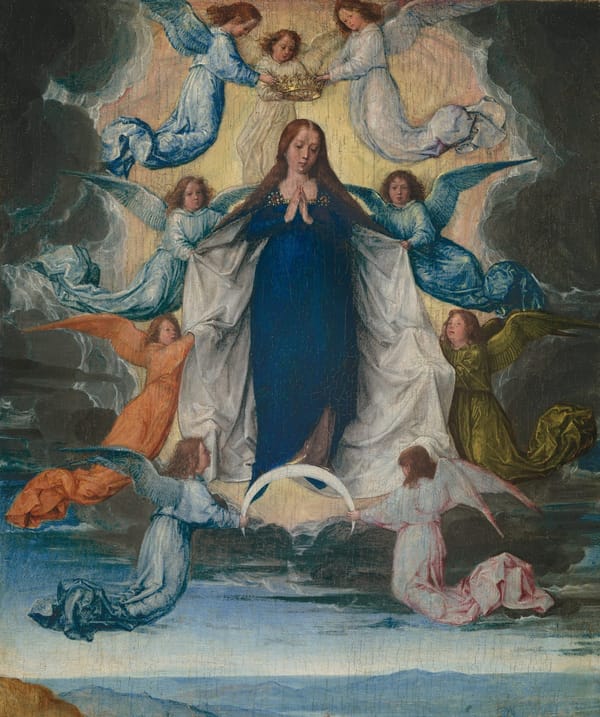
TO-DAY the Virgin Mary ascended to heaven; rejoice, for she reigns with Christ for ever.'1 The Church will close her chants on this glorious day with this sweet antiphon, which resumes the object of the feast and the spirit in which it should be celebrated.
No other solemnity breathes, like this one, at once triumph and peace; none better answers to the enthusiasm of the many and the serenity of souls consummated in love. Assuredly that was as great a triumph when our Lord, rising by His own power from the tomb, cast hell into dismay; but to our souls, so abruptly drawn from the abyss of sorrows on Golgotha, the suddenness of the victory caused a sort of stupor to mingle with the joy of that greatest of days. In presence of the prostrate angels, the hesitating apostles, the women seized with fear and trembling, one felt that the divine isolation of the Conqueror of death was perceptible even to His most intimate friends, and kept them, like Magdalen, at a distance.
Mary's death, however, leaves no impression but peace; that death had no other cause than love. Being a mere creature, she could not deliver herself from that claim of the old enemy; but leaving her tomb filled with flowers, she mounts up to heaven, flowing with delights, leaning upon her Beloved.2 Amid the acclamations of the daughters of Sion, who will henceforth never cease to call her blessed, she ascends surrounded by choirs of heavenly spirits joyfully praising the Son of God. Never more will shadows veil, as they did on earth, the glory of the most beautiful daughter of Eve. Beyond the immovable Thrones, beyond the dazzling Cherubim, beyond the flaming Seraphim, onward she passes, delighting the heavenly city with her sweet perfumes. She stays not till she reaches the very confines of the Divinity; close to the throne of honour where her Son, the King of ages, reigns in justice and in power; there she is proclaimed Queen, there she will reign for evermore in mercy and in goodness.
Here on earth Libanus and Amana, Sanir and Hermon dispute the honour of having seen her rise to heaven from their summits; and truly the whole world is but the pedestal of her glory, as the moon is her footstool, the sun her vesture, the stars of heaven her glittering crown. ‘Daughter of Sion, thou art all fair and sweet,’3 cries the Church, as in her rapture she mingles her own tender accents with the songs of triumph: 'I saw the beautiful one as a dove rising up from the brooks of waters; in her garments was the most exquisite odour; and as in the days of spring, flowers of roses surrounded her and lilies of the valley.’4
The same freshness breathes from the facts of Bible history wherein the interpreters of the sacred Books see the figure of Mary’s triumph. As long as this world lasts a severe law protects the entrance to the eternal palace; no one, without having first laid aside the garb of flesh, is admitted to contemplate the King of heaven. There is one, however, of our lowly race, whom the terrible decree does not touch; the true Esther, in her incredible beauty, advances without hindrance through all the doors. Full of grace, she is worthy of the love of the true Assuerus; but on the way which leads to the awful throne of the King of kings, she walks not alone: two handmaids, one supporting her steps, the other holding up the long folds of her royal robe, accompany her; they are the angelic nature and the human, both equally proud to hail her as their mistress and lady, and both sharing in her glory.
If we go back from the time of captivity, when Esther saved her people, to the days of Israel's greatness, we find our Lady's entrance into the city of endless peace represented by the Queen of Saba coming to the earthly Jerusalem. While she contemplates with rapture the magnificence of the mighty prince of Sion, the pomp of her own retinue, the incalculable riches of the treasure she brings, her precious stones and her spices, plunge the whole city into admiration. There was brought no more, says the Scripture, such abundance of spices as these which the Queen of Saba gave to King Solomon.5
The reception given by David's son to Bethsabee, his mother, in the third Book of Kings, no less happily expresses the mystery of to-day, so replete with the filial love of the true Solomon. Then Bethsabee came to King Solomon. . . and the king arose to meet her, and bowed to her, and sat down upon his throne, and a throne was set for the king's mother: and she sat on his right hand.6 O Lady, how exceedingly dost thou surpass all the servants and ministers and friends of God! ‘On the day when Gabriel came to my lowliness,' are the words St. Ephrem puts into thy mouth, ' from handmaid I became Queen; and I, the slave of Thy Divinity, found myself suddenly the mother of Thy humanity, my Lord and my Son! O Son of the King who hast made me His daughter, O Thou heavenly One, who thus bringest into heaven His daughter of earth, by what name shall I call Thee?'7 The Lord Christ Himself answered; the God made Man revealed to us the only name which fully expresses Him in His twofold nature; He is called The Son. Son of Man as He is Son of God, on earth He has only a Mother, as in heaven He has only a Father. In the august Trinity He proceeds from the Father, remaining consubstantial with Him; only distinguished from Him in that He is Son; producing together with Him, as one Principle, the Holy Ghost. In the external mission He fulfils by the Incarnation to the glory of the Blessed Trinity—communicating to His humanity the manners, so to say, of His Divinity, as far as the diversity of the two natures permits—He is in no way separated from His Mother, and would have her participate even in the giving of the Holy Ghost to every soul. This ineffable union is the foundation of all Mary’s greatnesses, which are crowned by to-day’s triumph. The days within the Octave will give us an opportunity of showing some of the consequences of this principle; to-day let it suffice to have laid it down.
'As Christ is the Lord,' says Arnold of Bonneval, the friend of St. Bernard, 'Mary is Lady and sovereign. He who bends the knee before the Son kneels before the Mother. At the sound of her name the devils tremble, men rejoice, the angels glorify God. Mary and Christ are one flesh, one mind, and one love. From the day when it was said, The Lord is with thee, the grace was irrevocable, the unity inseparable; and in speaking of the glory of Son and Mother, we must call it not so much a common glory as the selfsame glory.’8 ‘O Thou, the beauty and the honour of Thy Mother,’ adds the great deacon of Edessa, ‘ thus hast Thou adorned her in every way; together with others she is Thy sister and Thy bride, but she alone conceived Thee.”9
Rupert in his turn cries out: 'Come then, O most beautiful one, thou shalt be crowned in heaven Queen of saints, on earth Queen of every kingdom. Wherever it shall be said of the Beloved that He is crowned with glory and honour, and set over the works of His Father’s hands, everywhere also shall they proclaim of thee, O well beloved, that thou art His Mother, and as such Queen over every domain where His power extends; and, therefore, emperors and kings shall crown thee with their crowns and consecrate their palaces to thee.'10
First Vespers
Among the feasts of the saints this is the solemnity of solemnities. 'Let the mind of man,’ says St. Peter Damian, ‘ be occupied in declaring her magnificence; let his speech reflect her majesty. May the sovereign of the world deign to accept the goodwill of our lips, to aid our insufficiency, to illumine with her own light the sublimity of this day.’11
It is no new thing, then, that Mary’s triumph fills the hearts of Christians with enthusiasm. Before our times the Church showed by the prescriptions kept in the Corpus juris the pre-eminence she assigned to this glorious anniversary. Thus, under Boniface VIII, she granted to it, as to no other feast, except Christmas, Easter, and Pentecost, the privilege of being celebrated with ringing of bells and the customary splendour in countries laid under interdict.12
In his instructions to the newly-converted Bulgarians, St. Nicholas I, who occupied the Apostolic See from 858 to 867, had already united these four solemnities when recommending the fasts of Lent, of the Ember days, and of the Vigils of these feasts—'Fasts,' he says, 'which the Holy Roman Church has long since received and observed.’13
We must refer to the preceding century the composition of the celebrated discourse which, until the time of St. Pius V, furnished the Lessons for the Matins of the feast; while its thoughts, and even its text, are still found in several parts of the Office.14 The author, worthy of the greatest ages for style and science, but screening himself under a false name, began thus: ' You wish me, O Paula and Eustochium, to lay aside my usual form of treatises, and strive (a new thing to me) to celebrate in oratorical style the Assumption of the Blessed Mary ever Virgin.' And the supposed St. Jerome eloquently declared the grandeur of this feast: 'Incomparable as is she who thereon ascended glorious and happy to the sanctuary of heaven: a solemnity, the admiration of the heavenly hosts, the happiness of the citizens of our true country, who, not content with giving it one day as we do, celebrate it unceasingly in the eternal continuity of their veneration, of their love, and of their triumphant joy.’15 Unfortunately a just aversion for the excesses of certain apocryphal writers led the author of this beautiful exposition of the greatness of Mary to hesitate in his belief as to the glorious privilege of her corporal Assumption. This over-discreet prudence was soon exaggerated in the martyrologies of Usuard and of Odo of Vienne.
That such a misconception of the ever-growing tradition should be found in Gaul is truly astonishing, since it was the ancient Gallican liturgy which gave to the West the explicit formula of that complete Assumption, the consequence of a divine and virginal maternity: ‘No pain in childbirth, no suffering in death, no dissolution in the grave, for no tomb could retain her whom earth had never sullied.’16
When the first Carlovingians abandoned the Gallican liturgy, they bowed to the authority of the false St. Jerome.17 But the faith of the people could not be suppressed. In the thirteenth century the two princes of theology, St. Thomas and St. Bonaventure, subscribed to the general belief in our Lady’s anticipated resurrection. Soon this belief, by reason of its universality, claimed to be the doctrine of the Church herself. In 1497 the Sorbonne severely censured all contrary propositions.18 In 1870 an earnest desire was expressed to have the doctrine defined; but the Vatican Council was unfortunately suspended too soon to complete our Lady’s glorious crown. Yet the proclamation of the Immaculate Conception, of which our times can boast, gives us hope for the future. The corporal Assumption of our Lady follows naturally from that dogma as its necessary result. Mary, having known nothing of original sin, contracted no debt with death, the punishment of that sin; she freely chose to die in order to be conformable to her Divine Son; and, as the Holy One of God, so the holy one of His Christ could not suffer the corruption of the tomb.
If certain ancient calendars give to this feast the title of Sleep or Repose, Dormitio or Pausatio, of the Blessed Virgin, we cannot thence conclude that at the time they were composed the feast had no other object than Mary’s holy death; the Greeks, from whom we have the expression, have always included in the solemnity the glorious triumph that followed her death. The same is to be said of the Syrians, Chaldeans, Copts, and Armenians.
Among the last named, according to the custom of arranging their feasts by the day of the week rather than the date of the month, the Assumption is fixed for the Sunday which occurs between August 12 and 18. It is preceded by a week of fasting, and gives its name to the series of Sundays following it, up to the Exaltation of the Holy Cross in September.
At Rome the Assumption or Dormitio of the holy Mother of God appears in the seventh century to have already been celebrated for an indefinite length of time;19 nor does it seem to have had any other day than August 15. According to Nicephorus Callistus,20 the same date was assigned to it for Constantinople by the Emperor Maurice at the end of the sixth century. The historian notes, at the same time, the origin of several other solemnities, while of the Dormitio alone, he does not say that it was established by Maurice on such a day; hence learned authors have concluded that the feast itself already existed before the imperial decree was issued, which was thus only intended to put an end to its being celebrated on various days.21
At that very time, far away from Byzantium, the Merovingian Franks celebrated the glorification of our Lady on January 18, with all the plenitude of doctrine we have mentioned above. However the choice of this day may be accounted for, it is remarkable that to this very time the Copts on the borders of the Nile announce in their synaxaria on the 21st of the month of Tobi, our January 28, the repose of the Virgin Mary, Mother of God, and the Assumption of her body into heaven; they, however, repeat the announcement on Mesori 16, or August 21, and on the 1st of this same month of Mesori they begin their Lent of the Mother of God, lasting a fortnight like that of the Greeks.22
Some authors think that the Assumption has been kept from apostolic times; but the silence of the primitive liturgical documents is not in favour of the opinion. The hesitation as to the date of its celebration, and the liberty so long allowed with regard to it, point rather to the spontaneous initiative of divers Churches, owing to some fact attracting attention to the mystery or throwing some light upon it. Of this nature we may reckon the account everywhere spread abroad about the year 451 in which Juvenal of Jerusalem related to the Empress St. Pulcheria and her husband Marcian the history of the tomb which was empty of its precious deposit, and which the apostles had prepared for our Lady at the foot of Mount Olivet. The following words of St. Andrew of Crete in the seventh century show how the new solemnity gained ground in consequence of such circumstances. The saint was born at Damascus, became a monk at Jerusalem, was afterwards deacon at Constantinople, and lastly bishop of the celebrated island from which he takes his name; no one then could speak for the East with better authority. 'The present solemnity,' he says, 'is full of mystery, having for its object to celebrate the day whereon the Mother of God fell asleep; this solemnity is too elevated for any discourse to reach; by some this mystery has not always been celebrated, but now all love and honour it. Silence long preceded speech, but now love divulges the secret. The gift of God must be manifested, not buried; we must show it forth, not as recently discovered, but as having recovered its splendour. Some of those who lived before us knew it but imperfectly: that is no reason for always keeping silence about it; it has not become altogether obscured; let us proclaim it and keep a feast. To-day let the inhabitants of heaven and of earth be united, let the joy of angels and men be one, let every tongue exult and sing Hail to the Mother of God.'23
Let us, too, do honour to the gift of God; let us be grateful to the Church for having given us this feast whereon to sing with the angels the glory of Mary.
The Psalms and Hymn of Vespers are the same as for the other feasts of our Lady. The Antiphons, Capitulum, and Versicle gracefully express the mystery of the day.
Ps. Dixit Dominus, page 35
Ps. Laudate pueri, page 39
Psalm 121
Stantes erant pedes nostri: * in atriis tuis, Jerusalem.
Jerusalem quæ ædificatur ut civitas: * cujus participatio ejus in idipsum.
Illuc enim ascenderunt tribus, tribus Domini: * testimonium Israel ad confitendum Nomini Domini.
Quia illic sederunt sedes in judicio: * sedes super domum David.
Rogate quæ ad pacem sunt Jerusalem: * et abundantia diligentibus te.
Fiat pax in virtute tua: * et abundantia in turribus tuis.
Propter fratres meos et proximos meos: * loquebar pacem de te.
Propter domum Domini Dei nostri: * quæsivi bona tibi.
Our feet were standing in thy courts, O Jerusalem! our heart loves and confides in thee, O Mary.
Mary is like to Jerusalem, that is built as a city, which is compact together.
For thither did the tribes go up, the tribes of the Lord: the testimony of Israel, to praise the name of the Lord.
Because seats sat there in judgment: seats upon the house of David; and Mary is of a kingly race.
Pray ye, through Mary, for the things that are for the peace of Jerusalem: and may abundance be on them that love thee, O Church of our God.
The voice of Mary: let peace be in thy strength, O thou new Sion, and abundance in thy towers.
I, a daughter of Israel, for the sake of my brethren and of my neighbours, spoke peace of thee.
Because of the house of the Lord our God, I have sought good things for thee.
Psalm 126
Nisi Dominus custodierit civitatem: * frustra vigilat qui custodit eam.
Vanum est vobis ante lucem surgere: * surgite postquam sederitis, qui manducatis pa nem doloris.
Sicut sagittæ in manu potentis: * ita filii excussorum.
Beatus vir qui implevit desiderium suum ex ipsis: * non confundetur cum loquetur inimicis suis in porta.
Unless the Lord keep the city, he watcheth in vain that keepeth it.
It is vain for you to rise before light; rise ye after you have sitten, you that eat of the bread of sorrow.
As arrows in the hand of the mighty, so the children of them that have been shaken.
Blessed is the man that hath filled his desire with them: he shall not be confounded when he shall speak to his enemies at the gate.
Psalm 147
Quoniam confortavit seras portarum tuarum: * benedixit filiis tuis in te.
Qui posuit fines tuos pacem: * et adipe frumenti satiat te.
Qui emittit eloquium suum terræ: * velociter currit sermo ejus.
Qui dat nivem sicut lanam: * nebulam sicut cinerem spargit.
Mittit crystallum suam sicut buccellas: * ante faciem frigoris ejus quis sustinebit?
Emittet Verbum suum, et liquefaciet ea: * flabit Spiritus ejus, et fluent aquæ.
Qui annuntiat Verbum suum Jacob: * justitias, et judicia sua Israel.
Non fecit taliter omni nationi: * et judicia sua non manifestavit eis.
Because he hath strengthened against sin the bolts of thy gates: he hath blessed thy children within thee.
Who hath placed peace in thy borders, and filleth thee with the fat of corn, with Jesus, who is the Bread of life.
Who sendeth forth by thee His Word to the earth; His Word runneth swiftly.
Who giveth snow like wool; scattereth mists like ashes.
He sendeth His crystal like morsels: who shall stand before the face of His cold?
He shall send forth His Word by Mary, and shall melt them: His Spirit shall breathe, and the waters shall run.
Who declareth His Word to Jacob: His justices and His judgments to Israel.
He hath not done in like manner to every nation; and His judgments He hath not made manifest to them.
Capitulum
Hymn
Dei Mater alma,
Atque semper Virgo,
Felix cœli porta.
Gabrielis ore,
Funda nos in pace,
Mutans Evæ nomen.
Profer lumen cæcis,
Mala nostra pelle,
Bona cuncta posce.
Sumat per te preces,
Qui, pro nobis natus,
Tulit esse tuus.
Inter omnes mitis,
Nos culpis solutos,
Mites fac et castos.
Iter para tutum,
Ut videntes Jesum,
Semper collætemur.
Summo Christo decus,
Spiritui Sancto,
Tribus honor unus.
Blessed Mother of God,
yet ever a Virgin!
O happy gate of heaven!
the Ave from Gabriel’s lips,
confirm us in peace,
and so let Eva be changed into an Ave of blessing for us.
bring light to the blind,
drive from us our evils,
and ask all good things for us.
and offer our prayers to Him
who would be born of thee
when born for us.
and meekest of the meek,
obtain us the forgiveness of our sins,
and make us meek and chaste.
and a safe pilgrimage;
that we may be united
with thee in the blissful vision of Jesus.
and to the Lord Jesus,
and to the Holy Ghost:
to the Three one self-same praise.
Antiphon of the Magnificat
Prayer
'When the time came for the Blessed Mary to leave this earth, the apostles were gathered together from all lands; and, having learnt that the hour was at hand, they watched with her. Now the Lord Jesus came with His angels and received her soul. In the morning the apostles took up her body and placed it in the tomb. And again the Lord came, and the holy body was taken up in a cloud.'24
To this testimony of Gregory of Tours the whole West and East respond, extolling 'the solemnity of the blessed night whereon the venerated Virgin made her entry into heaven.'25 ' What a brilliant light pierces the darkness' of this night, says St. John Damascene;26 and he goes on to describe the assembly of the faithful, eagerly pressing during the sacred night to hear the praises of the Mother of God.27
How could Rome, so devout to Mary, allow herself to be outdone? On the testimony of St. Peter Damian, the whole people spent the glorious night in prayer, singing and visiting the different churches; and, according to several privileged persons enlightened from above, still greater, at that blessed hour, was the number of souls delivered from Purgatory by the Queen of the universe, and all visiting likewise the sanctuaries consecrated to her name.28 But the most imposing of all demonstrations in the city was the memorable litany or procession, which dates back to the Pontificate of St. Sergius (687-701);29 up to the second half of the sixteenth century it continued to express, as Rome alone knows how, the august visit our Lady received from her Son at the solemn moment of her departure from this world.
Two principal sanctuaries in the Eternal City represent, as it were, the residences or palaces of Mother and Son: the basilica of our Saviour on the Lateran and that of St. Mary on the Esquilme. As the latter rejoices in possessing the picture of the Blessed Virgin painted by St. Luke, the Lateran preserves in a special oratory, holy of holies, the picture not made by hand of man representing the form of our Saviour upon cedar-wood.30 On the morning of the Vigil the Sovereign Pontiff, accompanied by the Cardinals, went barefoot, and, after seven genuflections, uncovered the picture of the Virgin’s Son. In the evening, while the bell of Ara cali gave from the Capitol the signal for the preparations prescribed by the city magistrates, the Lord Pope went to St. Mary Major, where, surrounded by his court, he celebrated First Vespers. At the beginning of the night the Matins with nine lessons were chanted in the same church.
Meanwhile an ever-growing crowd gathers on the piazza of the Lateran, awaiting the Pontiff's return. From all sides appear the various guilds of the arts and crafts, each led by its own head and taking up its appointed position. Around the picture of the Saviour, within the sanctuary, stand the twelve bearers who form its perpetual guard, all members of the most illustrious families, and near them are the representatives of the senate and of the Roman people.
But the signal is given that the papal retinue is redescending the Esquilme. Instantly lighted torches glitter on all sides, either held in the hand, or carried on the brancards of the corporations. Assisted by the deacons, the Cardinals raise on their shoulders the holy image, which advances under a canopy, escorted in perfect order by the immense multitude. Along the illuminated and decorated streets,31 amid the singing of psalms and the sound of instruments, the procession reaches the ancient Triumphal Way, winds round the Coliseum, and, passing through the arches of Constantine and Titus, halts for a first Station on the Via Sacra, before the church called St. Mary Minor or Nnova.32 In this church, while the second Matins with three lessons are being chanted in honour of the Mother, some priests wash, with scented water in a silver basin, the feet of her Son, our Lord, and then sprinkle the people with the water thus sanctified. Then the venerable picture sets out once more, crosses the Forum amidst acclamations, and reaches the church of St. Adrian; thence returning to mount the slopes of the Esquiline by the streets where lie the churches of that part—St. Peterad-Vincula, St. Lucy, St. Martin-on-the-hill, St. Praxedes—it at last enters the piazza of St. Mary Major. Then the delight and the applause of the crowd are redoubled; all, men and women, great and little, as we read in a document of 1462,33 forgetting the fatigue of a whole night spent without sleep, cease not till morning to visit and venerate our Lord and Mary. In this glorious basilica, adorned as a bride, the glorious Office of Lauds celebrates the meeting of the Son and the Mother and their union for all eternity.
Striking miracles often showed the divine pleasure in this manifestation of the people's faith and love. Peter the Venerable34 and other reliable witnesses35 mention the prodigy, annually renewed, of the torches burning throughout the whole night, and being found on the morrow to be of the same weight as on the eve. In the year 847, as the procession headed by St. Leo IV passed by the Church of St. Lucy, a monstrous serpent, which had lived in a cavern hard by to the continual terror of the inhabitants, took to flight and was never seen again. In gratitude for this deliverance an octave was added to the feast.36 Four centuries later, in the pontificate of the heroic Gregory IX, when the sacred cortège stopped according to custom before the church of St. Mary Nuova, the partisans of the excommunicated Frederick II, occupying the tower of the Frangipani not far off, began to cry out: 'Here is the Saviour, let the Emperor come!' when suddenly the tower fell to the ground, crushing them under its ruins.37
But let us return to the great basilica where other recollections invite us. On another night we joyfully celebrated within its walls the birth of our Emmanuel. How ineffable are the divine harmonies! At the same hour, when for the first time Mary had pressed to her heart the Infant God in the stable, she herself now awakes in the arms of her Well-Beloved at the very height of heaven. The Church, who reads during this month the Books of Divine Wisdom, did well to select for to-night the Canticle of Canticles.
The Bishop of Meaux thus describes this death: ‘The Most Holy Virgin gave up her soul without pain and without violence into the hands of her Son. It was not necessary for her love to exert itself by any extraordinary emotions. As the slightest shock causes the fully ripe fruit to drop down from the tree, so was this blessed soul culled, to be suddenly transported to heaven; thus the holy Virgin died by a movement of divine love: her soul was carried to heaven on a cloud of sacred desires. Therefore the holy angels said: Who is she that goeth up. . . as a pillar of smoke of aromatical spices, of myrrh, and frankincense?38—a beautiful and excellent comparison admirably explaining the manner of her happy, tranquil death. The fragrant smoke that we see rising up from a composition of perfumes is not extracted by force nor propelled by violence: a gentle, tempered heat delicately detaches it and turns it into a subtle vapour which rises of its own accord. Thus was the soul of the holy Virgin separated from her body: the foundations were not shaken by a violent concussion; a divine heat detached it gently from the body and raised it up to its Beloved.39
For a few hours that sacred body remained in our world, 'the treasure of the earth, soon to become the wonder of the heavens.'40 Who could tell the sentiments of the august persons gathered by our Lord around His Mother, to render her in His name the last duties? An illustrious witness, Denis of Athens, reminded Timothy, who had been there present with him, of the discourses which, coming from hearts filled with the Holy Ghost, rose up as so many hymns to the Almighty Goodness, whereby our littleness had been divinized. There was James, the brother of the Lord, and Peter, the leader of the choir, and the Pontiffs of the Sacred College, and all the brethren who had come to contemplate the body which had given us life and had borne God; above them all, after the apostles, did Hierotheus distinguish himself; for being ravished far from earth and from himself, he seemed to all like a divine cantor.41
But this assembly of men, in whom reigned the light of God, understood that they must carry out to the end the desires of her who even in death was still the humblest of creatures. Carried by the apostles, escorted by the angels of heaven and the saints of earth, the virginal body was borne from Sion to the valley of Gethsemani, where so often since that bleeding Agony our Lady had returned either in body or in heart. For a last time ' Peter, joining his venerable hands, gazed attentively at the almost divine features of the Mother of our Saviour; his glance, full of faith, sought to discover through the shades of death some rays of the glory wherewith the Queen of heaven was already shining’42 John, her adopted son, cast one long, last, sorrowful look upon the Virgin's countenance, so calm and so sweet. The tomb was closed; earth was deprived for ever of the sight of which it was unworthy.
More fortunate than men, the angels, whose gaze could penetrate the marble monument, watched beside the tomb. They continued their songs until, after three days, the most holy soul of the Mother of God came down to take up her sacred body; then leaving the grave, they accompanied her to heaven. Let us too, then, have our hearts on high! Let us to-day forget our exile to rejoice in Mary’s triumph; and let us learn to follow her by the odour of her sweet perfumes.
Let us make our own this ancient formula which was said at Rome over the assembled people, when about to start on the solemn litany we have described above.
Prayer
Mass
Who is this King of glory? asked the keepers of the eternal gates on the day of Emmanuel’s triumphant Ascension. Their question is twice repeated in the Psalm,43 and a third time in Isaias, who cries out in the name of the heavenly citizens: Who is this that cometh from Edom, with dyed garments from Bosra, this beautiful one in His robe, walking in the greatness of His strength?44 In like manner do the angelic princes thrice express their admiration of the Virgin Mother. It is the sacred Canticle that tells us so. Who is she that cometh forth as the morning rising?45 This first question, as St. Peter Damian says, refers to Mary’s birth, which put an end to the night of sin.
Who is she that goeth up by the desert, as a pillar of smoke of aromatical spices?46 This is the expression of the angel’s astonishment at the Virgin’s incomparable life, with its uninterrupted progress in all the virtues, like the sweet smoke rising from the incense.
Who is this that cometh up from the desert, flowing with delights, leaning upon her beloved?47 Such, in the sight of the angels, was Mary rising from her tomb.
She had fulfilled her mission, accomplished the prophecy, crushed the head of the serpent. The blessed spirits who accompanied her cried out to the guardians of the heavenly ramparts, in the words of the triumphant Psalm: 'Open your gates!’ So Judith, a type of Mary returning victorious, had cried: Open the gates, for God is with us, who hath shown His power in Israel.48 The eternal gates were lifted up, and all the inhabitants of heaven, from the least to the greatest, went forth to meet the second Judith coming up from earth’s lowly valley; and they rejoiced with far greater exultation than did Israel when David brought the figurative ark into the holy city.
Let us echo heaven's joy, and with our solemn Introit as a triumphal march, usher Mary into the true Jerusalem. The verse is taken from the forty-fourth Psalm, the Epithalantium, thus linking the chants of the holy Sacrifice with last night's lessons from the sacred Canticle.
Introit
The following prayer asks for pardon and salvation through the intercession of the Mother of God. Its apparent want of harmony with the mystery of the feast might surprise us, did we not remember that it is only the second Collect for the day, in the Sacramentary; the first, which we have given above, said over the faithful at the beginning of the assembly, expressly declares that Mary could not be held by the bonds of death.
Collect
Epistle
Eccli. xxiv.
The Epistle we have just read is closely connected with the Gospel that is to follow. The rest that Mary sought is the better part, the repose of the soul in the presence of the King of Peace; and when a soul is thus full of peace, she forms the choicest part of her Lord’s inheritance. No creature has attained so nearly as our Lady to the eternal, unchangeable peace of the evertranquil Trinity; hence no other has merited to become, in the same degree, the resting-place of God.
A soul occupied by active works cannot attain the perfection or the fruitfulness of one in whom our Lord takes His rest, because she is at rest in Him; for this is the nuptial rest. As the Psalm says: ‘ When the Lord shall give sleep to His beloved, then shall their fruit be seen.’
Let us, then, who became Mary's children on the day the Lord first rested in her tabernacle, understand these magnificent expressions of eternal Wisdom; for they reveal to us the glory of her triumph. The branch that sprang from the stock of Jesse bears the divine Flower on which rests the fulness of the Holy Ghost; but it has taken root also in the elect, into whose branches it passes the heavenly sap which transforms them and divinizes their fruit. These fruits of Jacob and of Israel—i.e., the works of the ordinary Christian life or of the life of perfection—belong therefore to our Blessed Mother. Rightly, then, does Mary enter to-day upon her unending rest in the eternal Sion—the true holy city and glorified people—the Lord’s inheritance. Her power will be established in Jerusalem, and the saints will for ever acknowledge that they owe to her the fulness of their perfection.
But the plenitude of Mary’s personal merits far surpasses that of all the saints together. As the cedar of Libanus towers above the flowers of the field, far more does our Lady’s sanctity, next to that of her divine Son, surpass the sanctity of every other creature. The Angelic Doctor says: 'The trees to which the Blessed Virgin is compared in this Epistle may be taken to represent the different orders of the blessed. This passage therefore means that Mary has been exalted above the angels, patriarchs, prophets, apostles, martyrs, confessors, virgins, and all the saints, because she possesses all their merits united in her single person.’49
The Gradual is taken, as was the verse of the Introit, from the 44th Psalm. In it we sing those perfections of the Bride that have caused the King of kings to call her to Himself. The Alleluia verse tells us how the angelic army hailed the entrance of its Queen.
Gradual
Gospel
Cap. x.In illo tempore; Intravit Jesus in quoddam castellum: et mulier quædam Martha nomine excepit illum in domum suam, et huic erat soror nomine Maria, quæ etiam sedens secus pedes Domini audiebat verbum illius. Martha autem satagebat circa frequens ministerium: quæ stetit, et ait: Domine, non est tibi curæ quod soror mea reliquit me solam ministrare? die ergo illi ut me adjuvet. Et respondens dixit illi Dominus: Martha, Martha, sollicita es, et turbaris erga plurima. Porro unum est necessarium. Maria optimam partem elegit, quæ non auferetur ab ea.
Ch.x.At that time, Jesus entered into a certain town; and a certain woman named Martha received Him into her house: and she had a sister called Mary, who, sitting also at the Lord’s feet, heard His word. But Martha was busy about much serving: who stood and said, Lord, hast Thou no care that my sister hath left me alone to serve? Speak to her therefore, that she help me. And the Lord answering said to her, Martha, Martha, thou art careful, and art troubled about many things: but one thing is necessary. Mary hath chosen the best part, which shall not be taken away from her.
To this Gospel the Roman Liturgy50 formerly added, as the Greek and the Mozarabic still add, the following verses from another chapter of St. Luke: As He spoke these things a certain woman from the crowd lifting up her voice said to Him: Blessed is the womb that bore Thee, and the paps that gave Thee suck. But He said: Yea rather, blessed are they who hear the word of God, and keep it.51
The words thus added turned the people’s thoughts towards our Lady; still the episode of Martha and Mary in the Gospel of the day remained unexplained. We will use the words of St. Bruno of Asti to express the reason tradition gives for the choice of this Gospel. 'These two women,’ he says, ' are the leaders of the army of the Church, and all the faithful follow them. Some walk in Martha's footsteps, others in Mary's; but no one can reach our heavenly fatherland unless he follows one or the other. Rightly, then, have our fathers ordained that this Gospel should be read on the principal feast of our Lady, for she is signified by these two sisters. For no other creature combined the privileges of both lives, active and contemplative, as did the Blessed Virgin. Like Martha she received Christ—yea, she did more than Martha, for she received Him not only into her house, but into her womb. She conceived Him, gave Him birth, carried Him in her arms, and ministered to Him more frequently than did Martha. On the other hand, she listened, like Mary, to His words, and kept them for our sake, pondering them in her heart. She contemplated His humanity, and penetrated more deeply than all others into His Divinity. She chose the better part, which shall not be taken away from her.’52
‘He,’ continues St. Bernard, ' whom she received at His entrance into this poor world, receives her to-day at the gate of the Holy City. No spot on earth so worthy of the Son of God as the Virgin’s womb: no throne in heaven so lofty as that whereon the Son of Mary places her in return. What a reception each gave to the other! It is beyond the power of expression, because beyond the reach of our thought. Who shall declare the generation of the Son and the Assumption of the Mother?’53
In honour of both Mother and Son, let us put this lesson of the Gospel into practice in our lives. When our soul is troubled, like Martha, or distracted with many anxieties, let us always remember, as Mary did, that there is but one thing necessary. Our Lord alone, either in Himself or in His members, should be the one object of our thoughts.
Every human thing is of more or less importance in proportion to its relation to God's glory; we should value everything in this proportion, and then the grace of God which surpasseth all understanding will keep our hearts and minds in Christ Jesus.
To-day the Church on earth, represented by Martha, complains that she has been left alone to struggle and labour; but our Lord defends Mary, and confirms her in her choice of the better part. The angels are keeping a great feast in heaven; the offertory once more tells of their joy.
Offertory
We must not allow anything like regret or envy to cast a shadow over our hearts. Mary has finished her pilgrimage and left our earth; but now that she has entered into her glory, she still prays for us. So says the Secret.
Secret
Preface
If you loved Me, said our Lord to His disciples when about to leave them, you would indeed be glad because I go to the Father. Let us who love our Lady be glad because she goes to her Son, and as we sing in the Communion anthem, the better part is hers for ever.
Communion
The sacred Bread, for which we are indebted to Mary, remains always with us. May it, through her intercession, preserve us from all evils!
Postcommunion
Second Vespers
The antiphons, psalms, capitulum, hymn, and versicle are the same as at First Vespers, page 360.
Antiphon of the Magnificat
In all the churches of France there takes place to-day the solemn procession which was instituted in memory of the vow whereby Louis XIII dedicated the most Christian Kingdom to the Blessed Virgin.
By letters given at Saint-Germain-en-Laye, February 10, 1638, the pious king consecrated to Mary his person, his kingdom, his crown, and his people. Then he continued: ‘We command the Archbishop of Paris to make a commemoration every year, on the Feast of the Assumption, of this decree at the High Mass in his cathedral; and after Vespers on the said day let there be a procession in the said church, at which the royal associations and the corporation shall assist, with the same ceremonies as in the most solemn processions. We wish the same to be done also in all churches, whether parochial or monastic, in the said town and its suburbs, and in all the towns, hamlets, and villages of the said diocese of Paris. Moreover, we exhort and command all the archbishops and bishops of our kingdom to have Mass solemnly celebrated in their cathedrals and in all churches in their dioceses; and we wish the Parliaments and other royal associations and the principal municipal officers to be present at the ceremony. We exhort the said archbishops and bishops to admonish all our people to have a special devotion to the holy Virgin, and on this day to implore her protection, so that our Kingdom may be guarded by so powerful a patroness from all attacks of its enemies, and may enjoy good and lasting peace; and that God may be so well served and honoured therein, that both we and our subjects may be enabled happily to attain the end for which we were created; for such is our pleasure!’
Thus was France again proclaimed Mary’s kingdom. Within a month after the first celebration of the feast, according to the royal prescriptions, the Queen, after twenty years’ barrenness, gave birth on September 5, 1638, to Louis XIV. This prince also consecrated his crown and sceptre to Mary. The Assumption, then, will always be the national feast of France, except for those of her sons who celebrate the anniversaries of revolutions and assassinations.
The following are the special prayers said every year, until the fall of the monarchy, in fulfilment of the vow of Louis XIII. We give the original text of the Collect:
Antiphon
Prayer
We must not forget that Hungary was similarly consecrated to the holy Mother of God by its first king, St. Stephen. From that time the Hungarians called the Feast of the Assumption the ' Day of the great Queen,' Dies magnœ Dominœ. Our Lady recompensed the piety of the apostolic king by calling him, on August 15, 1038, to exchange his earthly for a heavenly crown; we shall find his feast in the cycle on September 2.
In the sixteenth century the Lutherans in several places continued to celebrate the Assumption of our Lady, even after they had apostatized, because the people would not give up the feast. Many of the churches of Germany, as we learn from their breviaries and missals, were accustomed to celebrate Mary's triumph for thirty days by canticles and assemblies.
Let us offer to Mary a garland of liturgical pieces on this day of her triumph. We could find nothing better to commence with than these beautiful and fragrant flowers produced by Gaul in early times. They are taken from the Mass of January 16, in which our forefathers celebrated both the Maternity and the triumph of our Lady.
Missa In Adsumptione S. M. M. D. N.
Collectio Post Nomina
Contestatio
In the Ambrosian Liturgy the preface for the Mass of the Vigil is composed of the very same words as the Roman Collect said in the great procession described above. We will borrow the two following antiphons from the Mass of the day:
Confractorium
Transitorium
The Mozarabic Liturgy gives us these pieces from the Vespers of the feast:
Lauda
Sono
Antiphona
Propter hoc non discedet iaus tua ab ore hominum usque in sæculum. ℣. Non det in commotionem pedem tuum: neque dormiet qui custodit te.℟. Propter.℣. Gloria et honor Patri, et Filio, et Spiritui Sancto in sæcula sæculorum. Amen.℟. Propter.
Lauda
Oratio
The Greeks offer us this graceful composition, the first eight stanzas of which are set to the eight musical tones, while the ninth returns to the first, thus making all the modes sing the triumph of Mary.54
In Officio Vespertino
Ad metam ubi pervenerunt, immaculatum vas tuum, vitæ principium, summa veneratione salutarunt.
At illæ sublimissimæ cœlorum potestates, cum suo Domino accedentes, Dei capax et illibatum corpus occursu honorabant, tremore corripiebantur, tum ad supernas sedes procedebant.
Et arcana voce clamabant superioribus agminum ducibus: Ecce universi mundi regina, mater Dei accedit.
Tollite portas, inque superna recipite eam, lucis uti perpetuæ matrem.
Per ipsam enim mortalium omnium salus facta est, in quam dirigere oculos non possumus.
Ipsi namque dari dignum præmium nequit; ejus enim præstantia omnem superat cogitatum.
Idciro intemerata Deipara, semper cum vivifico rege et filio vivens, intercede continuo, ut circummunias et salves ab omni inimico impetu juventutem tuam. In te enim tutelam possidemus.
Te per sæcula in splendoribus, beatam dicentes.
Having reached their destination, they salute with deepest veneration thy immaculate body.
But the most high powers of heaven, coming with their Lord, honoured with their company the spotless body which had held God; they were seized with trembling as they returned to the heavenly mansions.
With mysterious voice they cried to the chiefs of the heavenly hosts: Behold the Queen of the universe, the Mother of God approaches.
Lift up your gates and receive her into the highest places, as the Mother of eternal light.
The salvation of all mankind was wrought through her, upon whom we cannot fix our gaze.
No condign honour can be given to her, for her excellence surpasses all thought.
Wherefore, O Immaculate Mother of God, ever living with the King of life, thy Son, intercede for us unceasingly, so as to protect and save from every attack of the enemy the youth who are thine, for in thee we have our defence.
Thee we proclaim blessed in the eternal splendours.
Let us now gather from the Chaldean chants:
In Assumptione V. Mariæ
Ralph of Tongres, who wrote in the fourteenth century of the observance of the canons in the Offices of the Church, points out the following hymn as used in his time for to-day's feast:55
Hymn
Stirpis Davidicæ regia proles:
Sublimis residens Virgo Maria,
Supra cœligenas ætheris omnes.
Angelorum Domino pectoris aulam
Sacris visceribus casta parasti;
Natus hinc Deus est corpore Christus.
Cui nunc rite genuflectitur omne:
A quo te, petimus, subveniente,
Abjectis tenebris, gaudia lucis.
Natum per proprium,
Flamine sacro: Qui tecum nitida vivit in æthra,
Regnans, ac moderans sæcula cuncta.
royal daughter of David’s race:
seated on high, O Virgin Mary,
above all the dwellers in heaven.
a home in thy heart for the Lord of the angels,
thou, pure one, didst prepare in thy sacred womb;
the Christ born of thee is God in the flesh.
He before whom each knee rightly bends;
from Him we implore, by thy intercession,
the dispelling of darkness, the joys of light.
through Thine own Son, in the Holy Spirit:
who liveth with Thee in the glittering heavens,
reigning and governing all the ages.
Let us conclude with this sweet Sequence:
Sequence
David regis filia,
Sponsi fertur brachiis
Ad cœli sedilia:
Et amica properat
Sponsum, quo abierat,
Quærens inter lilia.
Regis Hester suscipit,
Sedare periculum,
Quod hostilis efficit
Aman instans fraudibus,
Peccati rudentibus
Mundo mortem conficit.
Cuncta transit ostia
Intra regis atria,
Ubi sceptrum aureum,
Christum, os virgineum
Osculatur hodie,
Ut sit pax Ecclesiæ.
Hic auditur: sed drama
Tibi dulce canitur,
Ubi te amplectitur
Sponsus, et alloquitur,
Quo beata frueris
Plusquam cunctis superis.
Tellus cœli curiæ,
David regis Thecuitem,
Helisæi Sunamitem,
Ut fugati revocemur,
Et prostrati suscitemur
Ad æterna gaudia,
Ubi es in gloria.
the daughter of King David
is borne in the Bridegroom’s arms
to the heavenly thrones;
the beloved hastens,
seeking the Spouse among the lilies
whither He had gone.
of the King opens to Esther
seeking to avert the danger
brought about by her enemy Aman,
eager with his deceits,
who prepares death for the world
with the ropes of sin.
passing through all the doors,
into the court of the King:
there to-day her virginal mouth
kisses the golden sceptre Christ,
that peace may be
given to the Church.
is heard: there sweet music
is sung to thee,
where the Spouse embraces thee and converses with thee;
the Spouse whom thou, O blessed one,
enjoyest more than all the heavenly citizens.
to the heavenly court,
as the wise woman of Thecua to King David,
as the Sunamitess to Eliseus,
that we exiles may be called home,
we who are cast down may be raised up
even to the eternal joys,
where thou art in glory.
Thou didst taste death, O Mary! But that death, like the sleep of Adam at the world’s beginning, was but an ecstasy leading the Bride into the Bridegroom’s presence. As the sleep of the new Adam on the great day of salvation, it called for the awakening of resurrection. In Jesus Christ our entire nature, soul and body, was already reigning in heaven; but as in the first paradise, so in the presence of the Holy Trinity, it was not good for man to be alone.56 To-day at the right hand of Jesus appears the new Eve, in all things like to her Divine Head, in His vesture of glorified flesh: henceforth nothing is wanting in the eternal paradise.
O Mary, who, according to the expression of thy devout servant John Damascene, hast made death blessed and happy,57 detach us from this world, where nothing ought now to have a hold on us. We have accompanied thee in desire; we have followed thee with the eyes of our soul, as far as the limits of our mortality allowed; and now, can we ever again turn our eyes upon this world of darkness? O Blessed Virgin, in order to sanctify our exile and help us to rejoin thee, bring to our aid the virtues whereby, as on wings, thou didst soar to so sublime a height. In us, too, they must reign; in us they must crush the head of the wicked serpent, that one day they may triumph in us. O day of days, when we shall behold not only our Redeemer, but also the Queen who stands so close to the Sun of Justice as even to be clothed therewith, eclipsing with her brightness all the splendours of the saints!
The Church, it is true, remains to us, O Mary, the Church who is also our Mother, and who continues thy struggle against the dragon with its seven hateful heads. But she, too, sighs for the time when the wings of an eagle will be given her, and she will be permitted to rise like thee from the desert and to reach her Spouse. Look upon her passing, like the moon, at thy feet, through her laborious phases; hear the supplications she addresses to thee as Mediatrix with the divine Sun; through thee may she receive light; through thee may she find favour with Him who loved thee, and clothed thee with glory and crowned thee with beauty.
- Magnificat Ant. for 2nd Vesp. ↩︎
- Cant. viii. 5. ↩︎
- Mag. Ant. of 1st Vesp. ↩︎
- 1st Resp. of Matins fr. Cant. v. 12 and Eccli. l. 8. ↩︎
- 3 Kings x. 10. ↩︎
- 2 Ibid. ii. 19. ↩︎
- Ephrem in Natal. Dom., Sermo iv. ↩︎
- Arnold. Carnotsnsis, De laudibus Mariæ. ↩︎
- Ephrem in Natal. Dom., Sermo viii. ↩︎
- Rupert in Cant., lib. iii, c. iv. ↩︎
- Petr. Dam. Sermo in Assumpt. B.M.V. ↩︎
- Cap. Alma Mater, De sent, ezcommunicat in vi°. ↩︎
- Mansi, xv. 403. ↩︎
- Especially the Mag. Ant. for and Vesp., already quoted. ↩︎
- Pseudo-Hieronymus. De Assumpt. B.M.V., 1., VIII., XIV. ↩︎
- Missale Gothicum. ↩︎
- Hæ sunt festivitates in anno quæ per omnia servari debent . . . . De Assumptione Sanctæ Mariæ interrogandum reliquimus. Capitulare Caroli Magni, i. 158; cui pro festo admittendo responsum a Ludovico Pio, capit. 11., 33, ex can. xxxvi concilii Mogunt. anni 813. ↩︎
- Propositio J. Morcelli: Non lenemur credere sub poena Peccati mortalis quod Virgo fuit assumpta in corpore et anima, quia non est articulus fidei; qualifica tur: Utjacet, temeraria, scandalosa, imftia, devotionis populi ad Virginem dimmutiva, falsa et hœetica ; ideo revocanda publice. ↩︎
- Liber pontific.: in Sergio I. ↩︎
- Niceph. Call. Hist. Eccli., Liber xvii., cap. 28. ↩︎
- Benedict XIV de festis B.M.V., c. viii. ↩︎
- Nilles, Kalendarom utriusque Eccl. orientalis ct occidentalis. ↩︎
- Andr. Cret. Oratio xiii. in Dormitionem Deiparæ, ii. ↩︎
- Greg. Turon. De gloria Martyr., iv. ↩︎
- Inter opera Hildefonsi Tolet. De Assumptione Sermo iv. ↩︎
- Joan. Damasc. in Dormitionem B.M.V., Homilia i. ↩︎
- Ibid., Homilia iii. ↩︎
- Petr. Dam. Opusc xxxiv. Disputat De variis apparit. et miraculis, Cap. 3. ↩︎
- Liber Pontific. in Sergio I. ↩︎
- Imago Ss. Salvatoris achcropita, quæ servatur in oratorio dicto Sancta Sanctorum. ↩︎
- Hittorp. Ordo Rom. ↩︎
- Now St. Frances of Rome. ↩︎
- Archivio della Compagnia di Sancta Sanctorum. ↩︎
- Petr. Venbrab. De miraculis, 11. xxx. ↩︎
- Marangoni, Istoria dell' Oratorio di Sancta Sanctorum, p. 127. ↩︎
- Liber Pontific in. Leone IV ↩︎
- Raynald. ad an. 1239. ↩︎
- Cant. iii. 6. ↩︎
- Bossuet, First Sermon on the Assumption. ↩︎
- Dom Guéranger, Essai historique sur l’abbaye de Solesmes, suivi de la description de l'eglise abbatiale, avec l'explication des monuments qu'elle renferme, p. 113. ↩︎
- Dionys. Areopagit. De divinis nominibus, cap. iii., § ii. ↩︎
- Dom Gurranger, ubi supra. ↩︎
- Ps. xxiii. 8, 10. ↩︎
- Isa. lxiii. 1. ↩︎
- Cant. vi. 9. ↩︎
- Ibid. iii. 6. ↩︎
- Ibid. viii. 5. ↩︎
- Judith xiii. 13. ↩︎
- Thom. Aquin. Sermo in Assumpt. B.M.V. ↩︎
- Thomasii Capitulare Evangeliorum. ↩︎
- St. Luke xi. 27, 28. ↩︎
- Bruno Ast. Homil. cxvii. in Assumpt. S.M.V. ↩︎
- Bern, in Assumpt. B.M.V., Senno i. ↩︎
- J. B. Pitra, Analecta Spicilegio Solesmensi, parata I. lxx. ex Anthologio. ↩︎
- Radulph. De canon, observ., Prop. xiii. ↩︎
- Gen ii. 18. ↩︎
- Joan. Damasc. in Dormit. B.M.V., Homil. i. ↩︎
| Previous August 14 (the Same Day): St. Eusebius, Confessor | Next August 15: Assumption of the Most Blessed Virgin |