Daily reading
After Pentecost
Double · Movable from Easter · Temporal
August 22, 2021
From Dom Guéranger’s The Liturgical Year.

|
The Thirteenth Sunday after Pentecost
The dominical series—which formerly counted from the feast of Saint Peter, or of the apostles—never went beyond this Sunday. The feast of Saint Laurence gave its name to those which follow; though that name began with even the ninth Sunday, for the years when Easter was further from the Spring equinox. And when that solemnity was kept at its latest date, the weeks began from to-day to be counted as the weeks of the seventh month (September).
The Ember-days of the autumn quarter sometimes occur even this week; whilst, other years, they may be as late as the eighteenth. We will speak of them when we come to the seventeenth Sunday, for it is in the week following that, that the Roman missal inserts them.
In the western Church, the thirteenth Sunday takes its name from the Gospel of the ten lepers, which is read in the Mass; the Greeks, who count it as the thirteenth of Saint Matthew, read on it the parable of the vineyard, whose labourers, though called at different hours of the day, all receive the same pay.;1
Mass
Now that she is in possession of the promises so long waited for by the world, the Church loves to repeat the words wherewith the just men of the old law used to express their sentiments. Those just men were living during the gloomy period, when the human race was seated in the shadow of death. We are under incomparably happier circumstances; we are blessed with graces in abundance : eternal Wisdom has spared us the trials our forefathers had to contend with, by giving us to live in the period which has been enriched by all the mysteries of salvation. There is a danger, however, and our mother the Church does her utmost to avert us from falling into it; it is the danger of forgetting all these blessings. Ingratitude is the necessary outcome of forgetfulness, and to-day’s Gospel justly condemns it. On this account, the Epistle, and here our Introit, remind us of the time when man had nothing to cheer him but hope: a promise had, indeed, been made to him of a sublime covenant which was, at some distant future, to be realized; but, meanwhile, he was very poor, was a prey to the wiles of satan, his cause was to be tried by divine justice, and yet he prayed for loving mercy.
Introit
This day last week we were considering how important are faith and charity to a Christian who is living under the Law of grace. There is another virtue of equal necessity: it is hope; for, although he already have the substantial possession of the good things which will constitute his future happiness, the Christian is prevented by the gloom of this land of exile from seeing them. Moreover, this mortal life being essentially a period of trial, wherein each one is to win his crown,2 the struggle makes even the very best feel, and that right to the end, the weight of incertitude and anguish. Let us, therefore, pray with the Church, in her Collect, for an increase of the three fundamental virtues of faith, hope, and charity; and, that we may deserve to reach the perfection of the good which is promised us in heaven, let us sue for the grace of devotedness to the commandments of God, which lead us to our eternal home. Let us remember how the Gospel of Sunday last included them all in love.
Collect
The other Collects, as on page 120.
Epistle
Cap. iii.Fratres, Abrahæ dictæ sunt promissiones, et semini ejus. Non dicit : Et seminibus, quasi in multis, sed quasi in uno : Et semini tuo, qui est Christus. Hoc autem dico, testamentum confirmatum a Deo : quæ post quadringentos et triginta annos facta est lex, non irritum facit ad evacuandam promissionem. Nam si ex lege hæreditas, jam non ex promissione. Abrahæ autem per repromissionem donavit Deus. Quid igitur lex? Propter transgressiones posita est, donec veniret semen, cui promiserat, ordinata per angelos in manu mediatoris. Mediator autem unius non est : Deus autem unus est. Lex ergo adversus promissa Dei? Absit. Si enim data esset lex, quæ posset vivificare, vere ex lege esset justitia. Sed conclusit Scriptura omnia sub peccato, ut promissio ex fide Jesu Christi daretur credentibus.
Ch. iii.Brethren: To Abraham were the promises made and to his seed. He saith not, and to his seeds as of many: but as of one, and to thy seed which is Christ. Now this I say, that the testament which was confirmed by God, the law which was made after four hundred and thirty years, doth not disannul, or make the promise of no effect. For if the inheritance be of the law, it is no more of promise, But God gave it to Abraham by promise. Why then was the law? It was set because of transgressions, until the seed should come, to whom he made the promise, being ordained by angels in the hand of a mediator. Now a mediator is not of one : but God is one. Was the law then against the promises of God? God forbid! For if there had been a law given which could give life, verily justice should have been by the law. But the Scripture hath concluded all under sin, that the promise by the faith of Jesus Christ might be given to them that believe.
‘Look up to heaven, and number the stars, if thou canst! So shall thy seed be!’3 Abraham was almost a hundred years old,4 and Sara’s barrenness deprived him of all natural hope of posterity, when these words were spoken to him by God, Abraham, nevertheless, believed God, says the Scripture, and it was reputed to him unto justice.5 And when, later on, that same faith6 would have led him to sacrifice, on the mount, that son of the promise, his one only hope, God renewed His promise, and added: ‘In thy seed shall all the nations of the earth be blessed.’7
It is now that the promise is fulfilled; the event justifies Abraham’s faith. He believed against all hope, trusting to that God who quickeneth the dead, and calleth those things that are not, as those that are;8 and, according to the expression of John the Baptist, from the very stones of the gentile world there rise up, in all places, children to Abraham.9
His faith, firm and, at the same time, so simple, gave to God the glory10 which He looks for from His creatures. Man can add nothing to the divine perfections; but—agreeably to God’s own words— though he sees them not directly here below, he acknowledges those perfections by adoring and loving them; he makes his faith tell upon his whole life; and this use which he freely makes of his faculties—this voluntary devotedness of an intelligent being—magnifies God, by adding to His extrinsic glory.
Following in Abraham’s steps,11 there have come those multitudes, born for heaven, the children of his faith. They live by faith;12 and thereby in all their acts they give to God the homage of confession and praise, through His Son Christ Jesus; and, like Abraham, they receive in return the blessing of an ever-increasing justice.13 The magnificent development of the Church, which gives this new posterity to Abraham, is greater and more visible since the fall of Israel. In countries the remotest, in the midst of cities that once were all pagan, we see crowds of men, women, and children imitating Abraham,14 that is, leaving at heaven’s call, if not their country, at least everything that once made earth dear to them; and like him, trusting in the fidelity and power of God to fulfil His promises,15 they live as strangers amidst their neighbours, yea, and in their very homes, using this world as though they did not use it. In the tumult of cities as in the desert, in the midst of the vain pleasures of the world, whose fashion and figure passeth away,16 they have no other thought than that of the unseen realities,17 no other care than that of pleasing God.18 They take to themselves the word that was spoken to their father: ‘Walk before me, and be perfect!’19 In truth, it was spoken to all of them; it was the condition in the alliance, concluded by God with those His faithful servants of all ages, in the person of the grand patriarch, who was not only their progenitor, but their model too. And God responds also to their faith, either by private manifestations, or by the still surer voice of His Scriptures,20 saying: ‘Fear not! I am thy protector, and thy reward exceeding great!'21
Truly, then, the benediction of Abraham has been poured forth on the Gentiles.22 Christ Jesus, the true Son of the promise, the only seed of salvation, has, by faith in His Rsurrection,23 assembled from every nation24 them that are of a good will,25 making them all one in Him, making them, like Himself, children of Abraham,26 and, what is better still, children of God.27 For the benediction that was promised, at the beginning of the alliance, was the Holy Ghost Himself,28 the Spirit of adoption of children that came down into our hearts, to make us all heirs of God and joint-heirs of Christ.29 O mighty power of faith, which breaks down the former walls of division, unites nations together,30 and substitutes the love and freedom of children of the Most High for the law of bondage and fear!31
And yet, grand as was this spectacle of the Gentiles becoming incorporated into the chosen race, and being made sharers, in Christ, of the holy promises,32 it did not please all people. The carnal Jew, who boasts of having Abraham for his father, though he cares little about imitating his works33—the circumcised who vaunts the bearing in his flesh the sign of a faith which dwells not in his heart34— these men who have rejected Christ now reject His members, and would fain destroy His Church, or, at least, trammel it. They are enraged at seeing crowding in, from every portion of the globe,35 that immense concourse, which their vile jealousy has vainly sought to keep back. Whilst their wounded pride kept them from going in,36 the Gentiles were sitting down with Abraham, Isaac, Jacob, and all the prophets, at the banquet of God’s kingdom;37 the last became the first.38 Even to the end of time, Israel—who, by his own obstinacy, has forfeited his ancient glory—will continue to be the enemy of this spiritual posterity of Abraham, which has supplanted him39 but his persecutions against the children of the promise and of the lawful Bride will but result in showing that he is, as St. Paul says, the son of Agar, the son of the bondwoman, who, together with her child, is excluded from the inheritance and from the kingdom.40
He prefers to refuse the liberty offered him by the Lord, rather than acknowledge the definitive abrogation of his now dead Law. Be it so! His hatred will not induce the children of the Church (who are prefigured by Sara, the freewoman) to reject the grace of their God, for the sake of pleasing their enemy; it will not induce them to abandon the justice of faith, and the riches of the Spirit, and the life in Christ, in order to go back again to the yoke of slavery,41 which, let the Jew do what he will, was broken into pieces by the cross he himself set up on Calvary.42 Up to the last, the true Jerusalem, the free city, our mother—she that was once the barren woman, but now is so glad a bride with her children around her—will meet the superannuated, yet ever busy, pretensions of the Synagogue by reading to her assembled sons and daughters the Epistle we are having to-day. Up to the last St. Paul, in her name—speaking of the law of Sinai, which was made known to its subjects through the mediation of Moses and the angels—will prove its inferiority as compared to the covenant made by Abraham directly with God; each year, as emphatically as on the day he wrote his Epistle, Paul will declare the transient character of that legislation, which came four hundred and thirty years after a promise which could not be changed; neither was such legislation to continue, when the time should come for that Son of Abraham to appear, from whom the world was waiting to receive the promised benediction.
But what is to be said of the incapability of the Mosaic ministration to give man strength, and enable him to rise up from his fall? The Gospel on which we were meditating eight days back, and which formerly was assigned to this present Sunday, gave a symbolical and striking commentary on the uselessness of the old Law in regard to this; at the same time, it showed us the remedial power which resided in Christ, and was by Him transmitted to the ministers of the new Law. ‘Every portion of the Office of the thirteenth Sunday,' says Abbot Rupert, 'bears on the history of that Samaritan, whose name signifies keeper; it is our Lord Jesus Christ who, by His Incarnation, comes to the rescue of man, whom the old Law was not able to keep from harm; and when Jesus leaves the world, He consigns the poor sufferer to the care of the apostles and apostolic men, in the house of the Church. The intentional selection of this Gospel for to-day throws a great light on our Epistle, as also on the whole letter to the Galatians, from which it is taken. Thus, the priest and the levite of the parable are a figure of the Law; and their passing by the half-dead man, seeing him, indeed, but without making an attempt to heal him, is expressive of what that Law did. True, it did not go counter to God’s promises; but, of itself, it could justify no man. A physician who does not himself intend to visit a patient will sometimes send a servant who is expert in the knowledge of the causes of the malady, yet who has not the skill needed for mixing the remedy required, but can merely tell the sick man what diet and what drinks he must avoid, if he would prevent his ailment from causing death. Such was the law, set, as the Epistle tells us, because of transgressions, as a simple safeguard, until such time as there should come the good Samaritan, the heavenly physician. Having, from his very first coming into this world, fallen among robbers, man is stripped of his supernatural goods, and is covered with the wounds inflicted on him by original sin; if he did not abstain from actual sins, from those transgressions against which the law was set as a monitor, he runs the risk of dying altogether.’43
It is on this account that the Gradual repeats the supplication of the Introit: Respice Domine, in testamentum tuum; for, as Rupert observes, it was the cry of the ancient people, who, sighing at the weakness of the powerless Law of Sinaï, besought God to fulfil the covenant He had promised to Abraham's faith. They cried out to Christ, as the poor creature might have done to the good Samaritan, after he had seen the priest and the levite pass him by, without an effort made to save him.
Gradual
Gospel
Cap. xvii.In illo tempore : Dum iret Jesus in Jerusalem, transibat per mediam Samariam et Galilæam. Et cum ingrederetur quoddam castellum, occurrerunt ei decem viri leprosi, qui steterunt a longe : et levaverunt vocem, dicentes : Jesu præceptor, miserere nostri. Quos ut vidit, dixit : Ite, ostendite vos sacerdotibus. Et factum est dum irent, mundati sunt. Unus autem ex illis, ut vidit quia mundatus est, regressus est, cum magna voce magnificans Deum, et cecidit in faciem ante pedes ejus, gratias agens : et hic erat Samaritanus. Respondens autem Jesus, dixit : Nonne decem mundati sunt? et novem ubi sunt? Non est inventus qui redir et, et daret gloriam Deo, nisi hic alienigena. Et ait illi : Surge, vade : quia fides tua te salvum fecit.
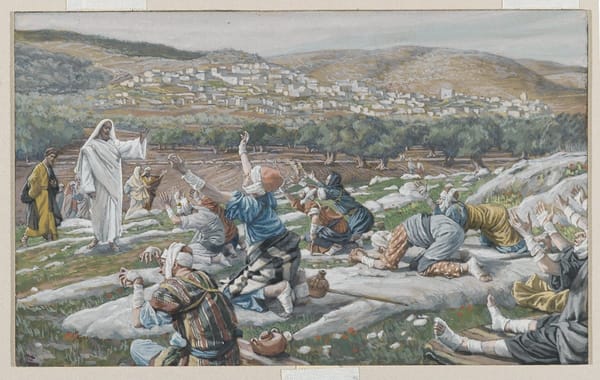
Ch. xvii.At that time: As Jesus was going to Jerusalem, he passed through the midst of Samaria and Galilee. And as he entered into a certain town, there met him ten men that were lepers, who stood afar off; and lifted up their voice, saying: Jesus, Master, have mercy on us. Whom when he saw, he said; Go, show yourselves to the priests. And it came to pass, that as they went they were made clean. And one of them, when he saw that he was made clean, went back, with a loud voice glorifying God. And he fell on his face, before his feet, giving thanks: and this was a Samaritan. And Jesus answering, said: Were not ten made clean, and where are the nine? There is no one found to return and give glory to God, but this stranger. And he said to him: Arise, go thy way; for thy faith hath made thee whole.
The Samaritan leper, cured of that hideous malady which is an apt figure of sin, in company with nine lepers of Jewish nationality, represents the despised race of Gentiles, who were at first admitted, by stealth, so to say, and by extraordinary privilege, into a share of the graces belonging to the lost sheep of the house of Israel.44 The conduct of these ten men, on occasion of their miraculous cure, is in keeping with the attitude assumed by the two peoples they typify, regarding the salvation offered to the world by the Son of God. It is a fresh demonstration of what the apostle says: ‘All are not Israelites that are of Israel; neither are all they who are the seed of Abraham, children; “but,” says the Scripture,45 “ in Isaac shall thy seed be called ”; that is to say, not they who are the children of the flesh are the children of God : but they that are the children of the promise are counted for the seed;'46 they are born of the faith of Abraham, and are, in the eyes of the Lord, His true progeny.
Our holy mother the Church is never tired of this subject, the comparison of the two Testaments, and the contrast there is between the two peoples. We deem it our duty, before proceeding further, to explain how this is; for there are many persons who cannot understand what benefit can come to us Christians from hearing this subject preached to us. The kind of spirituality which, with many of us, has nowadays been substituted for the liturgical life so thoroughly lived by, and so precious to, our Catholic ancestors, gives a certain disrelish for the ideas which the Church perseveringly brings before them during so many of her Sundays. They have become habituated to live in an atmosphere of very limited truth; it is all subjective, as well as little; and they consider it a very excellent thing, to forget all other teaching, except what they happen to possess, and beyond which it is a trouble to go. It is not surprising that Christians of this class feel puzzled at finding the Church continually urging them to take an interest in a long past, which they consider of ho practical utility to them! But the interior life, truly worthy of the name, is not what these good people imagine. No school of spirituality either now makes, or ever made, the ideal of virtue consist in indifference for those great historic facts which are evidently so precious in the eyes of the Church, and of God Himself. And what is the usual result of thus isolating themselves from their mother’s most cherished appreciations? It is, that by thus determinedly shutting themselves up in their own private prayers, they, by a just punishment, lose sight of the true end of prayer, which is union with, and love of, God. Their meditation is deprived of that element of intimate and fruitful converse with God, which is assigned it by all the masters of the spiritual life; it soon becomes an unproductive exercise of analysis and reasoning, in which there is nothing but abstract conclusions.
Now, when God mercifully invited men to the divine nuptials by manifesting to them His Word, it was not by abstraction that He gave to our earth this the Son of His own eternal Substance. As to His Divinity, men could not, in their present state, see it in a direct way. Had God shown us, in this pretended abstract way, that eternal Son of His, in whom are found all beauty, and warmth, and life, the revelation would have been imperfect and cold. This He did not do; but, as St. Paul tells us, He manifested the great mystery of godliness in the flesh;47 the Word became a living soul;48 eternal Truth assumed to Himself a Body, that so He might converse with men,49 and grow up like one of themselves.50 And when that Body, which eternal Truth was to hold as His own for ever, was taken up in glory,51 the Church, the bride of this Man-God, continued in the world this manifestation of God, by the members of Christ; she continued that historic development52 of the Word, which is only to cease when time is no more. This manifestation, this development, surpasses all human calculations, and reveals fresh aspects of the Wisdom of God even to the angels themselves.53 Let due respect be paid to the axioms of learned men, who have arranged the principles of science in logical order, independently of history and of facts: but this lifeless reasoning has nothing in common with substantial truth which is ever fruitful and necessarily active. In the Church, as in God, truth is life and light,54 not a mere collection of formulæ. If our Credo rings out so triumphantly through the aisles of our churches, and seems to force the very gates of heaven, it is because each of its articles is presented before God steeped in the blood of martyrs; from age to age it has gathered ever fresh lustre from the labours and struggles of so many holy confessors, chosen out of the human race to complete the body of Christ on earth.55
The subject is too full to be treated of here; but this we must say: after the master-fact of the Incarnation of the Word, who came upon our earth to manifest God, through the ages of time, by Christ and His members,56 there is not one which is more important, not one which has been and still is so dear to God, as the vocation of the two peoples whom He successively called to the blessing of an alliance with Him. The gifts and vocations of God are, as the apostle expresses it, without repentance or regret on His part. Those Jews, who are now His enemies because they reject the Gospel, are still called charissimi; they are still the beloved and dearly beloved, because of their fathers.57 For the same reason, a time will come —and the whole world is waiting for it—when the denial of Juda being revoked and his iniquities blotted out, the promises made to Abraham, Isaac, and Jacob, will be literally fulfilled.58 Then the divine unity of the two Testaments will be made evident; and the two peoples themselves will be made one, under their one Head, Christ Jesus.59 The covenant of God with man being then fully realized, such as He had designed it in His eternal wisdom—the earth having yielded its fruit,60 the world having done its work, the sepulchres will give back their dead,61 and history will cease here on earth, leaving glorified human nature to bloom in unreserved fullness of life, under God's complacent eye.
The truths, then, which are again brought before our notice by to-day’s Gospel, are anything but dry or old-fashioned; nothing is so grand; and, we must add—though superficial minds will wonder at it—there is nothing more practical in this season of the year, for it is the season consecrated to the mysteries of the unitive life. After all, in what, primarily, does union between God and man consist, but in unanimity of the divine and the human minds? Now, we know that the divine mind has manifested all its designs in the respective histories of the two Testaments and the two peoples; and that the final result which is to bring these two histories to their close, is the one only end which infinite love was in the beginning, and is now, and will for ever be, proposing to fulfil. The Church, therefore, far from showing herself to be behind the age by recurring continually to truths such as these, is but clearly proving herself to be the most intelligent bride of Jesus, and evincing the changeless lovely youthfulness of a heart, which ever beats in unison with that of her Spouse.
Let us now resume the literal explanation of our Gospel. As we were observing on a previous Sunday, our Jesus here, again, wishes rather to give us a useful teaching, than to manifest His divine power. It is for this purpose that He does not cure at once these ten lepers who beseech Him to have mercy on them, as, on another occasion, He cured one who was suffering from the same misery. To this latter, who besought Him, He restored cleanliness by a few words. He said: 'Be thou made clean!' and forthwith the leprosy was cleansed.62 This was at the beginning of His public life. But the event of our Gospel took place in the latter portion of our Lord’s sojourn amongst men. The lepers are made clean only while on their way to show themselves to the priests. Jesus sends them to the priests, just as He had done in the previous case; and thus, from the beginning to the close of His mortal life, He gave an example of the respect which was to be paid to the old Law, so long as it was not abrogated. That Law gave to the sons of Aaron the power, not of curing, but of discerning leprosy, and passing judgment on its being cured or not.63
The time, however, has now come for a Law far above that of Sinai. It has a priesthood, whose judgments are not to concern the state of the body, but, by pronouncing the sentence of absolution, are to effectually remove the leprosy of souls. The cure which the ten lepers felt coming upon them before they had reached the priests, ought to have sufficed to show them, in Jesus, the power of the new priesthood, which had been foretold by the prophets;64 the power which thus forestalls and surpasses the authority of the ancient ministration is sufficient evidence of the superior dignity of Him who exercises it. If only they were in suitable dispositions for the sacred rites, which are going to be used in the ceremony of their purification,65 the Holy Ghost, who heretofore had inspired the prophetic details of the mysterious function, would enable them to understand the signification of the expiatory sparrow, whose blood, being sprinkled upon the living water, sets free, by the wood, its fellow sparrow. That first bird typifies our Lord Jesus Christ, who likens Himself, in the psalm, to the lonely sparrow;66 His immolation on the cross, which gives to water the power of cleansing souls, communicates to the other sparrows, His brethren,67 the purity of the divine Blood.
But the Jew is far from being ready to understand these great mysteries. And yet the Law had. been given to him that it might serve him as a hand leading him to Christ, and without exposing him to err.68 It was a signal favour granted him, not from any merits of his own, but because of his fathers.69 The favour was all the more precious, inasmuch as it was bestowed at a time when the tradition regarding a future Redeemer was almost entirely lost by the bulk of mankind. Gratitude should have been uppermost in the heart of Juda; but pride took its place. He was so taken up with the honour that had been put on him, that it made him lose all desire for the Messiah. He could not endure the thought that a time would come, when the Sun of justice having risen for the whole earth, the limited advantage which was given to a few during the hours of night was to be eclipsed by the bright noon of a light which all might enjoy. He, therefore, proclaimed that the old Law was definitive, though the Law declared itself to be but transitory; he, therefore, insisted on the perpetuity of the reign of types and shadows. He laid it down as a dogma that no divine intervention can ever equal that made on Sinai; that every future prophet, everyone sent by God, must be inferior to Moses; that all possible salvation is in the Law, and that from it alone flows every grace.
This explains to us how it was, that of the ten men cured of leprosy by Jesus, nine have not even the remotest thought of coming to their Deliverer to thank Him: these nine are Jews. Jesus, to their minds, is a mere disciple of Moses, a bare instrument of favours, holding His commission from Sinaï, and as soon as they have gone through the legal formality of their purification they take it that all their obligations to God are paid. The Samaritan, the despised Gentile, whose sufferings have given him that humility which makes the sinner clear-sighted, is the only one who recognizes God by His divine works, and gives Him thanks for His favours. How many ages of apparent abandonment, of humiliation and suffering, must pass over Juda too, before he will recognize and adore His God, and confess to Him his sins, and give Him his devoted love, and, like this stranger, hear Jesus pronounce his pardon, and say: Arise! Go thy way! thy faith hath made thee whole and saved thee!
Let us, by our fervent prayers, hasten the time which will be so glorious for the two peoples, when, united in the same faith by the consciousness of the same hopes then realized, they will cry out to our Redeemer these words of our Offertory:
Offertory
It is the oblation now on the altar that is to obtain for us from God the pardon of our past offences, and the graces we hope for, for the time to come. Let us, in the Secret, beseech Him to accept for the sacrifice these gifts which the Church, in the name of us all, has presented to Him.
Secret
The other Secrets, as on page 180.
Oh! when will the children of Juda come and experience for themselves the superiority of the Bread of the new Testament over the manna of the old? Let us Gentiles, the last-comers, but who have preceded our elder brethren at the banquet of love, sing all the more fervently in our Communion-anthem the divine sweetness of this true Bread of heaven.
Communion
As the Postcommunion expresses it, the work of our redemption by Jesus our Lord is confirmed and grows within us as often as we assist at these sacred mysteries. The Church prays that her children may be blessed with the grace of this fruitful frequentation of the mysteries of salvation.
Postcommunion
The other Postcommunions, as on page 131.
Vespers
The psalms, capitulum, hymn, and versicle, as above, pages 71-81.
Antiphon of the Magnificat
O almighty and eternal God, grant unto us an increase of faith, hope, and charity: and, that we may deserve what thou promisest, make us to love what thou commandest. Through, etc.
- Matt. xx. ↩︎
- 1 Cor. ix. 25. ↩︎
- Gen. xv. 5. ↩︎
- Rom. iv. 19. ↩︎
- Gen. xv. 6. ↩︎
- Heb. xi. 17-19. ↩︎
- Gen. xxii. 18. ↩︎
- Rom. iv. 17, 18. ↩︎
- S. Matt. iii. 9. ↩︎
- Rom. iv. 20. ↩︎
- Rom. iv. 12. ↩︎
- Ibid. i. 17. ↩︎
- Ibid. iv. 23, 24; Gal. iii. 9. ↩︎
- Gen. xii. 1. ↩︎
- Rom. iv. 20, 21. ↩︎
- 1 Cor. vii. 31. ↩︎
- Heb. xi. 1. ↩︎
- 1 Cor. vii. 32. ↩︎
- Gen. xvii. 1. ↩︎
- 2 St. Pet. i. 19. ↩︎
- Gen. xv. 1. ↩︎
- Gal. iii. 14. ↩︎
- Rom. iv. 24. ↩︎
- Gal. iii. 28. ↩︎
- St. Luke ii. 14. ↩︎
- Gal. iii. 29. ↩︎
- Ibid. iv. 5-7. ↩︎
- Ibid. iii. 14. ↩︎
- Rom. viii. 15-17. ↩︎
- Eph. ii. 14-18. ↩︎
- Rom. viii. 2. ↩︎
- Eph. iii. 6. ↩︎
- St. John viii. 39. ↩︎
- Rom. iv. 11. ↩︎
- St. Luke xiii. 29. ↩︎
- St. Luke xv. 28. ↩︎
- Ibid. xiii. 28. ↩︎
- Ibid. 30. ↩︎
- Gen. xxvii. 36. ↩︎
- Gal. iv. 22-31. ↩︎
- Ibid. v. 1. ↩︎
- Ibid. ii. 19-21. ↩︎
- Rup., De Div. Off., xii. 13. ↩︎
- St. Matt. xv. 24. ↩︎
- Gen. xxi. 12. ↩︎
- Rom. ix. 6-8. ↩︎
- 1 Tim. iii. 16. ↩︎
- Gen. ii. 7. ↩︎
- Baruch iii. 38. ↩︎
- St Luke ii. 52. ↩︎
- 1 Tim. iii 16. ↩︎
- Eph. i. 23. ↩︎
- Ibid. iii. 10. ↩︎
- St. John i. 4. ↩︎
- Col. i. 24, ii. 19. ↩︎
- 2 Cor. iv. 10, 11. ↩︎
- Rom. xi. 28, 20. ↩︎
- Ibid. 25-27. ↩︎
- Eph. ii. 14. ↩︎
- Ps. lxvi. 7. ↩︎
- Rom. xi. 15. ↩︎
- St Matt. viii. 3. ↩︎
- Lev. xiii. ↩︎
- Isa. lxvi. 21-23. ↩︎
- Lev. xiv. 1-32. ↩︎
- Ps. ci. 8. ↩︎
- Ps. lxxxiii. 4. ↩︎
- Gal. iii. 24. ↩︎
- Deut. iv. 37, ix. 4-6. ↩︎
August 22: The Octave of the Assumption
HE alone who could understand Mary’s holiness could appreciate her glory. But Wisdom, who presided over the formation of the abyss, has not revealed to us the depth of that ocean, beside which all the virtues of the just and all the graces lavished upon them are but streamlets. Nevertheless, the immensity of grace and merit, whereby the Blessed Virgin’s supernatural perfection stands quite apart from all others, gives us a right to conclude that she has an equal supereminence in glory, which is always proportioned to the sanctity of the elect. Whereas all the other predestined of our race are placed among the various ranks of the celestial hierarchy, the holy Mother of God is exalted above all the choirs, forming by herself a distinct order, a new heaven, where the harmonies of angels and saints are far surpassed. In Mary God is more glorified, better known, more loved than in all the rest of the universe. On this ground alone, according to the order of creative Providence, which subordinates the less to the more perfect, Mary is entitled to be Queen of earth and heaven. In this sense, it is for her, next to the Man-God, that the world exists. The great theologian, Cardinal de Lugo, explaining the words of the saints on this subject, dares to say: 'Just as, creating all things in His complacency for His Christ, God made Him the end of creatures; so, with due proportion we may say He drew the rest of the world out of nothing, through the love of the Virgin Mother, so that she, too, might thus be justly called the end of all things.’1
As Mother of God, and at the same time His firstborn, she had a right and title over His goods; as Bride she ought to share His crown. 'The glorious Virgin,' says St. Bernardine of Siena, 'has as many subjects as the Blessed Trinity has. Every creature, whatever be its rank in creation, spiritual as the angels, rational as man, material as the heavenly bodies or the elements, heaven and earth, the reprobate and the blessed, all that springs from the power of God, is subject to the Virgin. For He who is the Son of God and of the Blessed Virgin, wishing, so to say, to make His Mother's principality in some sort equal to His Father's, became, God as He is, the servant of Mary. If, then, it be true to say that everyone, even the Virgin, obeys God, we may also convert the proposition, and affirm that everyone, even God, obeys the Virgin.'2
The empire of Eternal Wisdom comprises, so the Holy Spirit tells us, the heavens, the earth, and the abyss: the same, then, is the appanage of Mary on this her coronation day. Like the divine Wisdom to whom she gave Flesh, she may glory in God. He whose magnificence she once chanted to-day exalts her humility. She who is blessed above all others has become the honour of her people, the admiration of the saints, the glory of the armies of the Most High. Together with the Spouse, let her, in her beauty, march to victory; let her triumph over the hearts of the mighty and the lowly. The giving of the world's sceptre into her hands is no mere honour void of reality: from this day forward she commands and fights, protects the Church, defends its head, upholds the ranks of the sacred militia, raises up saints, directs apostles, enlightens doctors, exterminates heresy, crushes hell.
Let us hail our Queen, let us sing her mighty deeds; let us be docile to her; above all, let us love her and trust in her love. Let us not fear that, amidst the great interests of the spreading of God’s kingdom, she will forget our littleness or our miseries. She knows all that takes place in the obscurest comers, in the furthest limits of her immense domain. From her title of universal cause under the Lord is rightly deduced the universality of her providence; and the masters of doctrine show us Mary in glory sharing in the science called of vision, whereby all that is, has been, or is to be is present before God. On the other hand, we must believe that her charity could not possibly be defective: as her love of God surpasses the love of all the elect, so the tenderness of all mothers united, centred upon an only child, is nothing to the love wherewith Mary surrounds the least, the most forgotten, the most neglected of all the children of God, who are her children too. She forestalls them in her solicitude, listens at all times to their humble prayers, pursues them in their guilty flights, sustains their weakness, compassionates their ills, whether of body or of soul, sheds upon all men the heavenly favours whereof she is the treasury. Let us, then, say to her, in the words of one of her great servants: ' O most holy Mother of God, who hast beautified heaven and earth, in leaving this world thou hast not abandoned man. Here below thou didst live in heaven; from heaven thou conversest with us. Thrice happy those who contemplated thee and lived with the Mother of life! But in the same way as thou didst dwell in the flesh with them of the first age, thou now dwellest with us spiritually. We hear thy voice; and all our voices reach thine ear; and thy continual protection over us makes thy presence evident. Thou dost visit us; thine eye is upon us all; and although our eyes cannot see thee, O most holy one, yet thou art in the midst of us, showing thyself in various ways to whomsoever is worthy. Thy immaculate body, come forth from the tomb, hinders not the immaterial power, the most pure activity of that spirit of thine, which being inseparable from the Holy Ghost, breathes also where it wills. O Mother of God, receive the grateful homage of our joy, and speak for thy children to Him who has glorified thee: whatsoever thou askest of Him, He will accomplish it by His divine power; may He be blessed for ever!'3
The inexhaustible Adam of St. Victor gives us another sequence for the Assumption; it was sung at Saint Victor on the octave day.
Sequence
In qua sanctæ fit Mariæ celebris Assumptio;
Dies ista, dies grata
Qua de terris est translata in cœlum cum gaudio.
Angelorum, est prælata cunctis cœli civibus.
In decore contemplatur
Natum suum, ut precatur pro cunctis fidelibus.
Ut illius, mundicordes, assistamus laudibus;
Si concordent linguis mentes,
Aures ejus intendentes erunt nostris vocibus.
Et in laude proclamemus: Ave, plena gratia!
Ave, Virgo Mater Christi,
Quæ de Sancti concepisti Spiritus præsentia!
Tibi nostræ sit jocunda vocis modulatio.
Nobis opem fer desursum,
Et, post hujus vitæ cursum, tuo junge Filio.
Litterali diu tecta fuisti sub cortice;
De te, Christum genitura,
Prædixerunt in Scriptura prophetæ, sed typice.
Est, dum Verbum, caro factum, ex te nasci voluit,
Quod nos sua pietate
A maligni potestate potenter eripuit.
Te per vellus Gedeonis præsignatam credimus;
Et per rubum incombustum,
Testamentum si vetustum mystice perpendimus.
Et in rubo flamma splendens (neutram tamen læditur),
Fuit Christus carnem sumens,
In te tamen non consumens pudorem, dum gignitur.
Florem mundo profuturum Isaias cecinit,
Flore Christum præfigurans
Cujus virtus semper durans nec cœpit, nec desinit.
Ardens, lucens es lucerna;
Per te nobis lux superna suum fudit radium:
Ardens igne caritatis,
Luce lucens castitatis,
Lucem summæ claritatis mundo gignens Filium.
Nos exaudi, nos conforta,
Et a via nos distorta revocare propera:
Te vocantes de profundo,
Navigantes in hoc mundo,
Nos ab hoste furibundo tua prece libera.
Ob meritum singulare
Tuæ Matris, visitare
In hac valle nos dignare tuæ dono gratiæ.
Qui neminem vis damnari,
Sic directe conversari
Nos concedas in hoc mari,
Ut post mortem munerari digni simus requie.
whereon is celebrated the Assumption of holy Mary;
this day, this happy day
when from earth she was translated into heaven with joy.
she is set over all the citizens of heaven.
She contemplates her Son in His beauty,
and prays for all the faithful.
that clean of heart we may take part in her praises;
if our minds be in accord with our tongues,
her ears will be attentive to our voices.
and in her praise cry out: Hail, full of grace!
hail, Virgin Mother of Christ,
who didst conceive Him by the presence of the Holy Spirit!
may the music of our voice be pleasing to thee.
Bring us help from on high,
and after this life’s course, unite us to thy Son.
long wast thou hidden in the shell of the letter;
of thee as future Mother of Christ,
the Prophets foretold in the Scripture, but in types.
when the Word made Flesh willed to be born of thee,
who in His love did powerfully
snatch us from the power of the wicked one.
thee by the fleece of Gedeon, we believe to be foreshown,
and by the bush unburnt,
if the ancient Testament we mystically ponder.
in the bush the flame resplendent (yet neither hurt thereby),
was Christ assuming flesh in thee,
yet not destroying thy purity by His birth.
the stem, and benefit the world, Isaias sang;
by the flower prefiguring Christ,
whose power everlasting neither began nor endeth.
thou art a lamp burning and shining:
through thee the light supernal on us hath shed its ray;
burning with fire of charity,
shining with light of chastity,
bringing into the world thy Son, the light of supreme brightness.
hear us and comfort us,
and from our crooked ways hasten to call us back:
we are calling on thee from the abyss,
sailing on the sea of the world;
from the furious enemy deliver us by thy prayer.
by the incomparable merit
of Thy Mother, deign to visit
us in this valley with the gift of Thy grace.
Thou who willest that no one be condemned,
grant us to steer our course so straightly
through this sea that after death
we may be worthy to be rewarded in Thy rest.
The following prayer is remarkable for the symbolism wherewith it is inspired. It is used at the blessing of medicinal herbs and fruits, given from time immemorial, in certain places, on the day of the Assumption.
Prayer
But let us close the radiant octave by hearing Mary herself speak in this beautiful antiphon, appointed amongst others in certain manuscripts to accompany the Magnificat on the feast. Our Lady there appears, not in her own name alone, but as representing the Church, which begins in her its entrance in body and soul into heaven. The present happiness of the Blessed Virgin is the pledge for us all of the eternal felicity promised us; the triumph of the Mother of God will not be complete until the last of her children has followed her into glory. Let us, then, join in this prayer so full of sweet love: it is truly worthy to express the feelings of Mary as she crossed the threshold of her heavenly home.
Antiphon
August 22 (the Same Day): St. Timothy and Companions, Martyrs
Let us honour the group of martyrs which forms the rearguard of our triumphant Queen. Timothy, who came from Antioch to Rome, Hippolytus, Bishop of Porto, and Symphorian, the glory of Autun, suffered for God at different periods and at different places; but they gathered their palms on the same day of the year, and the same heaven is now their abode. ' My son, my son,' said his valiant mother to Symphorian, 'remember life eternal; look up, and see Him who reigns in heaven; they are not taking thy life away, but changing it into a better.' Let us admire these heroes of our faith; and let us learn to walk like them, though by less painful paths, in the footsteps of our Lord, and so to rejoice Mary.
Prayer
| Previous August 21: St. Jane Frances de Fremiot de Chantal, Widow | Next August 22: The Octave of the Assumption |