Daily reading
After Pentecost
Semidouble · Movable from Easter · Temporal
September 5, 2021
From Dom Guéranger’s The Liturgical Year.

|
The Fifteenth Sunday after Pentecost
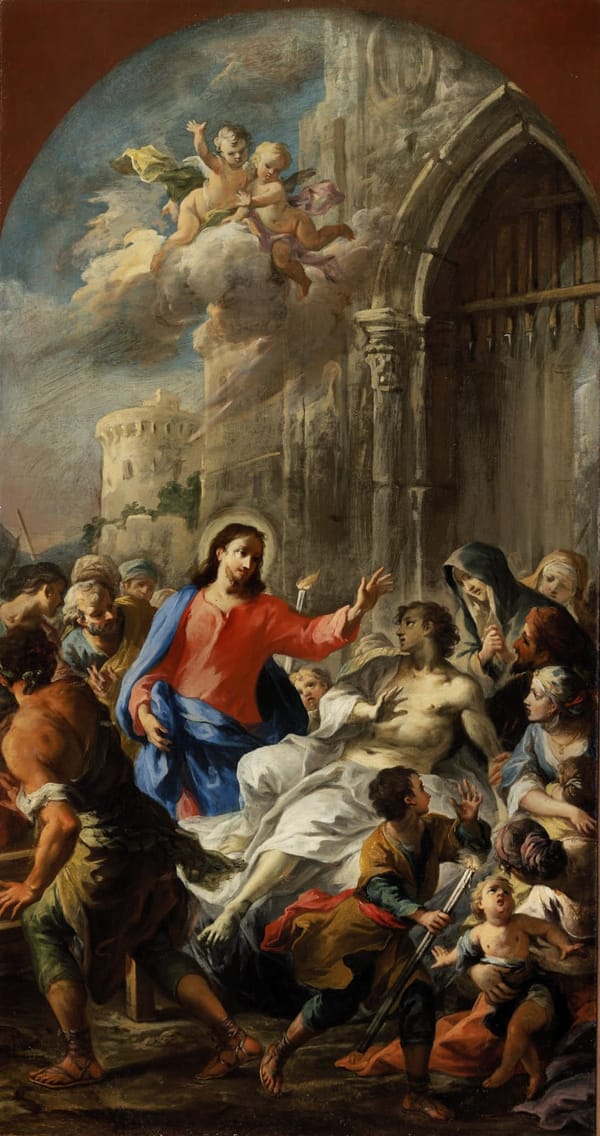
The Introit for this Sunday, which now goes under the name of the Sunday of the widow of Naim, because of the Gospel read on it, gives us a sample of the prayers we should address to our Lord in our necessities. Last Sunday we heard our Jesus promising to provide for all our wants, on the condition that we would serve Him faithfully, by seeking His kingdom. When we present our petitions to Him, let us show Him the confidence He so well deserves from us; and we shall be graciously heard.
Introit
The humility wherewith our holy mother the Church presents her supplications to God should serve as a model to us. If the bride herself thus treats with God, what ought not to be our sentiments of lowliness, when we appear in the presence of sovereign Majesty? We may well say to this tender mother of ours what the disciples said to Jesus: ‘Teach us how to pray!’;1 Let us unite with her in this Collect.
Collect
The other Collects, as on page 120.
Epistle
Cap. v. et vi.Fratres, Si spiritu vivimus, spiritu et ambulemus. Non efficiamur inanis gloriæ cupidi, invicem provocantes, invicem invidentes. Fratres, et si præoccupatus fuerit homo in aliquo delicto, vos, qui spirituales estis, hujusmodi instruite in spiritu lenitatis, considerans teipsum, ne et tu tenteris. Alter alterius onera portate, et sic adimplebitis legem Christi. Nam si quis existimat se aliquid esse, cum nihil sit, ipse se seducit. Opus autem suum probet unusquisque, et sic in semetipso tantum gloriam habebit, et non in altero. Unusquisque enim onus suum portabit. Communicet autem is, qui catechizatur verbo, ei, qui se catechizat, in omnibus bonis. Nolite errare : Deus non irridetur. Quæ enim seminaverit homo, hæc et metet. Quoniam qui seminat in carne sua, de carne et metet corruptionem : qui autem seminat in spiritu, de spiritu metet vitam æternam. Bonum autem facientes, non deficiamus: tempore enim suo metemus, non deficientes. Ergo dum tempus habemus, operemur bonum ad omnes, maxime autem ad domesticos fidei.
Ch. v. and vi.Brethren: If we live in the Spirit, let us also walk in the Spirit. Let us not be made desirous of vain-glory, provoking one another, envying one another. Brethren, if a man be overtaken in any fault, you who are spiritual, instruct such a one in the spirit of meekness, considering thyself, lest thou also be tempted. Bear ye one another’s burdens: and so you shall fulfil the law of Christ; For if any man think himself to be something, whereas he is nothing, he deceiveth himself. But let every one prove his own work, and so he shall have glory in himself only, and not in another. For every one shall bear his own burden. And let him that is instructed in the word, communicate to him, that instructeth him, in all good things. Be not deceived, God is not mocked. For what things a man shall sow, those also shall he reap. For he that soweth in the flesh, of the flesh also shall reap corruption. But he that soweth in the spirit, of the spirit shall reap life everlasting. And in doing good, let us not fail. For in due time we shall reap not failing. Therefore, whilst we have time, let us work good to all men, but especially to those who are of the household of the faith.
Holy Church resumes the lesson of St. Paul, where she left it last Sunday. The spiritual life— the life produced in our souls by the holy Spirit, in place of the former life of the flesh—is still the subject of the apostle’s teaching. When the flesh has been subdued, we must beware of supposing that the structure of our perfection is completed. Not only must the combat be kept up after the victory, under penalty of losing all we have won, but we must also be on the watch, lest one or other of the heads of the triple concupiscence take advantage of the soul's efforts being elsewhere directed, to raise itself against us, and sting us all the more terribly, because it is left to do just as it pleases. The apostle warns us here of vain-glory, and well he may; for vain-glory is, more than other enemies, always in a menacing attitude, ready to infuse its subtle poison even into acts of humility and penance; hence the Christian, who is desirous to serve God, and not his own gratification, by the virtues he practises, must keep up a specially active vigilance over this passion.
Let us think for a moment of the madness that culprit would be guilty of, who having his sentence of death commuted for a severe flogging, should take pride in the stripes left on his body by the whip! May this madness never be ours! It would seem, however, as though it were far from being impossible, seeing how the apostle, immediately after telling us to mortify our flesh, bids us take heed of vain-glory. In fact, we are not safe on this subject, excepting inasmuch as the outward humiliation, inflicted by us on our body, has this for its principle, that our soul should voluntarily humble herself at the sight of her miseries. The ancient philosophers, too, had their maxims about the restraint of the senses; but those among them who practised those admirably worded maxims found them a stepping-stone for their pride to mount up mountains high in self-conceit. It could not be otherwise; for they were totally devoid of anything like the sentiments which actuated our fathers in the faith, who, when they clad themselves in sackcloth and prostrated on the ground,2 cried out from the heartfelt conviction of the miseries of human nature: 'Have mercy on me, O God, according to Thy great mercy! for I was conceived in iniquities, and my sin is ever before me!’3
To practise bodily mortification, with a view to get the reputation of being saints, is it not doing what St. Paul here calls sowing in the flesh, that in due time—that is, on the day when the intentions of our hearts will be made manifest4—we may reap, not life and glory everlasting, but endless disgrace and shame? Among the works of the flesh mentioned in last Sunday’s Epistle, we found contentions, dissensions, jealousies,5 all of which are the ordinary outcome of this vain-glory, against which the apostle is now warning us. The production of such rotten fruits would be an unmistakable sign that the heavenly sap of grace had gone from our souls, and that in its stead there had been brought the fermentation of sin; and that now, having made ourselves slaves as of old, we must tremble because of the penalties threatened by God’s law. God is not mocked; and as to the confidence which generous fidelity of love imparts to those who live by the Spirit, it would, in the case we are now supposing, be but a hypocritical counterfeit of the holy liberty of the children of God. They alone are His children, whom the holy Spirit leads6 in charity; those others are led on by the flesh, and such cannot please God.7
If, on the contrary, we would have an equally unmistakable sign which is quite compatible with the obscurities of faith, that we are really in possession of divine union, let us not take occasion from the sight of others' defects and faults to be puffed up with pride, but rather from the consideration of our own miseries, be indulgent to everyone else. If others fall, let us give them a helping and prudent hand. Let us bear one another's burdens along the road of life, and then, having thus fulfilled the law of Christ, we shall know (and oh! the joy there is in such knowing!) that we abide in Him, and He in us.8 These most thrilling words were made use of by our Lord to express the future intimacy He would have with those who should eat the Flesh of the Son of Man and drink His Blood in holy Communion9 and St. John, who has recorded them in his Gospel, takes them and uses them in his Epistles, and (let us mark the deep mystery of the application) applies them to all who, in the Holy Ghost, observe the great commandment of loving their neighbours.;10
Would to God we could ever have ringing in our ears the saying of the apostle: Whilst we have time, let us work good to all men! For the day will come (and it is not so very far off) when the angel, carrying the mysterious book, and having one foot on the earth and the other on the sea, shall make his mighty voice as that of a lion heard through the universe, and, with his hand lifted up towards heaven, shall swear by Him that liveth for ever and ever, that time shall be no more.11 Then will man reap with joy what he shall have sown in tears12 he failed not, he grew not weary of doing good while in the dreary land of his exile; still less will he ever tire of the everlasting harvest, which is to be in the living light of the eternal day.
As we sing the Gradual, let us remember that the only praise which gives God pleasure is that which goes up to Him from a soul where reigns the harmony of the several virtues. The Christian life, which is regulated by the ten commandments, is the ten-stringed psaltery,;13 on which the Finger of God, the Holy Ghost,14 plays to the Spouse the music that He loves to hear.
Gradual
Gospel
Cap. vii.In illo tempore : Ibat Jesus in civitatem quæ vocatur Naim : et ibant cum eo discipuli ejus, et turba copiosa. Cum autem appropinquaret portæcivitatis, ecce defunctus efferebatur, filius unicus matris suæ : et hæc vidua erat: et turba civitatis multa cum illa. Quam cum vidisset Dominus, misericordia motus super eam, dixit illi: Noli flere. Et accessit, et tetigit loculum (hi autem qui portabant steterunt). Et ait: Adolescens, tibi dico, surge. Et resedit qui erat mortuus, et cœpit loqui. Et dedit illum matri suæ. Accepit autem omnes timor: et magnificabant Deum, dicentes : Quia Propheta magnus surrexit in nobis: et quia Deus visitavit plebem suam.
Ch. vii.At that time: Jesus went into a city that is called Naim: and there went with him his disciples, and a great multitude. And, when he came nigh to the gate of the city, behold a dead man was carried out, the only son of his mother; and she was a widow: and a great multitude of the city was with her. Whom when the Lord had seen, being moved with mercy towards her, he said to her: Weep not! And he came near, and touched the bier. And they that carried it stood still. And he said: Young man! I say to thee arise. And he that was dead, sat up, and began to speak. And he gave him to his mother. And there came a fear on them all: and they glorified God, saying : A great Prophet hath risen up among us, and God hath visited his people!
This is the second time during the year that holy Church offers this Gospel to our consideration; we cannot be surprised at this, for the fathers selected by her as its interpreters15 tell us, on both of these occasions, that the afflicted mother who follows her son to the grave is the Church herself.
The first time we saw her under this symbol, of a mother mourning for her child, was in the penitential season of Lent.16 She was then, by her fasting and prayer (united as those were with her Jesus’ sufferings), preparing the resurrection of such of our brethren as were dead in sin. Their resurrection was realized, and we had them, in all the fullness of their new life, seated side by side with us at the Paschal Table. What exquisite joy, on that feast of feasts, inundated the mother's heart, as she thus shared in the triumphant gladness of her divine Spouse! Jesus was, by His one Resurrection, twice over the conqueror of death—He rose from the grave, and He gave back the child to the mother. The disciples of this risen Lord, who follow Him closely by their observance of the evangelical counsels, they, and the whole multitude that associated themselves with the Church, glorified Jesus for His wonderful works, and sang the praises of God who thus vouchsafed to visit His people.
The mother ceased to weep. But since then the Spouse has again left her, to return to His Father; she has resumed her widow’s weeds, and her sufferings are continually adding to the already wellnigh insupportable torture of her exile. And whence these sufferings? From the relapses of so many of those ungrateful children of hers, to whom she had given a second birth,17 and at the cost of such pains and tears! The countless cares she then spent over her sinners, and that new life she gave them in the presence of her dying Jesus—all this made each of the penitents, during the Great Week, as though he were the only son of that mother. What an intense grief, says St. John Chrysostom, that so loving a mother should see them relapsing, after the communion of such mysteries, into sin which kills them! 'Spare me,’ as she may well say, in the words which the holy doctor puts into the apostle’s mouth. 'Spare me! No other child, once born into this world, ever made his mother suffer the pangs of child-birth over again!’ To repair the relapse of a sinner costs her no less travail than to give birth to such as have never believed.18
And if we compare these times of ours with the period when sainted pastors made her words respected all over the world, is there a single Christian still faithful to the Church, who does not feel impelled by such contrast to be more and more devoted to a mother so abandoned as she now is? Let us listen to the eloquent words of St. Laurence Justinian on this subject. 'Then,' says he, 'all resplendent with the mystic jewels wherewith the Bridegroom had beautified her on the wedding-day, she thrilled with joy at the increase of her children, both in merit and in number; she urged them to ascend to ever greater heights; she offered them to God; she raised them in her arms up towards heaven. Obeyed by them, she was, in all truth, the mother of fair love and of fear19 she was beautiful as the moon, bright as the sun, terrible as an army set in array. .20 She stretched out her branches as the turpentine tree, and beneath their shadow she sheltered those whom she had begotten against the heat, and the tempest, and the rain. So long, then, as she could she laboured, feeding at her breasts all those she was able to assemble. But her zeal, great as it was, has redoubled from the time she perceived that many, yea very many, had lost their first fervour. Now for many years she is mourning at the sight of how, each day, her Creator is offended, how great are the losses she sustains, and how many of her children suffer death. She that was once robed in scarlet has put on mourning garments; her fragrance is no longer perceived by the world; instead of a golden girdle, she has but a cord, and instead of the rich ornament of her breast, she is vested in haircloth.21 Her lamentations and tears are ceaseless. Ceaseless is her prayer, striving if, by some way, she may make the present as beautiful as times past; and yet, as though it were impossible for her to call back that lovely past, she seems wearied with such supplication. The word of the prophet has come true: " They are all gone aside, they are become unprofitable together; there is none that doth good, no, not one!”22 . . The manifold sins committed by the Church’s children against the divine precepts show that they who so sin are rotten members, members alien to the body of Christ. Nevertheless the Church forgets not that she gave them birth in the laver of salvation; she forgets not the promises they then made to renounce the devil, and the pomps of the world, and all sin. Therefore does she weep over their fall, being their true mother, and never losing the hope of winning their resurrection by her tears. Oh what a flood of tears is thus every day shed before God! What fervent prayers does this spotless virgin send, by the ministry of the holy angels, up to Christ, who is the salvation of sinners! In the secret of hearts, in lonely retreats, as well as in her public temples, she cries out to the divine mercy, that they, who are now buried in the filth of vice, may be restored to life. Who shall tell the joy of her heart, when she receives back living, the children she mourned over as dead? If the conversion of sinners is such joy to heaven,23 what must it be to such a mother? According to the multitude of the sorrows of her heart,24 so will be the consolations, giving joy to her soul.’25
It is the duty of us Christians, who by God’s mercy have been preserved from the general decay, to share in the anguish of our mother, the Church; we should humbly but fervently co-operate with her in all her zealous endeavours to reclaim our fallen brethren. We surely can never be satisfied with not being of the number of those senseless sons who are a sorrow to their mother,26 and despise the labour of her that bore them.27 Had we not the holy Spirit to tell us how he that honoureth his mother is as one that layeth up to himself a treasure,28 the thought of what our birth cost her29 would force us to do everything that lies in our power to comfort her. She is the dear bride of the Incarnate Word; and our souls, too, aspire to union with Him. Let us prove that such union is really ours by doing as the Church does; that is, by showing in our acts the one thought, the one love which the divine Spouse always imparts to souls that enjoy holy intimacy with Him, because there is nothing He Himself has so much at heart; the thought of bringing the whole world to give glory to His eternal Father, and the love of procuring salvation for sinners.
Let us unite with the Church, our mother, in singing now in the Offertory the realization, in part at least, of her expectations; let not our lips ever be shut up in senseless silence when we have our God bestowing favours on us.
Offertory
In the Secret let us put ourselves, and everything that belongs to us, under the all-powerful custody of the divine mysteries.
Secret
The other Secrets, as on page 130.
Jesus’ word called back from death the son of the widow of Naim; His Flesh is the life of the world, for it is the Bread, whose praise we are now to celebrate in our Communion-anthem.
Communion
Divine union is not perfect in us unless the mystery of love so predominates over both our minds and bodies, as that they be fully possessed by it, as our mother here words its efficacy; we must be influenced and directed by it, and not by nature, that is, by the dictates of flesh and blood and human sense.
Postcommunion
The other Postcommunions, as on page 131.
Vespers
The psalms, capitulum, hymn, and versicle, as above, pages 71-81.
Antiphon of the Magnificat
- St. Luke xi. 1. ↩︎
- 1 Paralip. xxi. 16, etc. ↩︎
- Ps. 1 ↩︎
- 1 Cor, iv. 5. ↩︎
- Gal v. 19-21. ↩︎
- Rom. viii. 14. ↩︎
- Ibid. 8. ↩︎
- 1 St. John iv. 13. ↩︎
- St. John vi. 57. ↩︎
- 1 St. John iii. 23, 24; iv. 12, 13. ↩︎
- Apoc. x. 1-6. ↩︎
- Ps. cxxv. 5. ↩︎
- Ps. cxliii. 9. ↩︎
- Cf. St. Luke xi. 20; St. Matt. xii. 28. ↩︎
- St. Amb., in Luc., v.; St. Aug., Serm. 44, de Verb. Dom ↩︎
- Thursday of the fourth week of Lent. ↩︎
- Gal. iv. 19. ↩︎
- St. Chrys., De pænit., Hom. I. ↩︎
- Ecclus. xxiv. 24. ↩︎
- Cant. vi. 9. ↩︎
- Isa. iii. 24. ↩︎
- Ps. xiii. 3. ↩︎
- St. Luke xv. 7. ↩︎
- Ps. xciii. 19. ↩︎
- S. Lour. Just., De Compunct. et Planctu Christ. Perfect. ↩︎
- Prov. xvii. 25. ↩︎
- Prov. xxx. 17. ↩︎
- Ecclus. iii. 5. ↩︎
- Tob. iv. 4. ↩︎
September 5: St. Laurence Justinian, Bishop and Confessor
Come, all ye who are drawn by the desire of unchangeable good, and who seek it in vain in this passing world; I will tell you what heaven has done for me. Like you, I once sought with feverish eagerness; and this exterior world could not satisfy my burning desire. But, by the divine grace, which fed my anguish, at length she, whose name I then knew not, appeared to me, more beautiful than the sun, sweeter than balm. As she approached, how gentle was her countenance, how peace-inspiring her voice, saying to me: “O thou, whose youth is all full of the love wherewith I inspire thee, why dost thou thus pour out thy heart? The peace thou seekest by so many different ways, is with me; thy desire shall be amply fulfilled, I promise thee, if only thou wilt take me for thy bride.” I acknowledge that at these words my heart failed, my soul was all pierced with the dart of her love. As I wished to know her name, her dignity, her origin, she told me she was called the Wisdom of God; and that, at first invisible in the bosom of the Father, she had taken of a mother a visible nature, in order to be more easily loved. Then, with great delight, I gave my consent; and she, kissing me, departed full of joy. Ever since then, the flame of her love has been growing within me, absorbing all my thoughts. Her delights endure for ever; she is my well-beloved bride, my inseparable companion. Through her, the peace I once sought is now the cause of my joy. Hear me then, all of you: go to her in like manner; for she makes it her happiness to reject no one.1
Let us read the history of him, who in the foregoing lines has given us the key to his life.
‘O Wisdom, who sittest on Thy lofty throne; O Word, by whom all things were made, be propitious to me, in this manifestation of the secrets of Thy holy love.’2 Such, O Laurence, was thy prayer, when, fearing to be responsible for the hidden talent, if thou shouldst keep to thyself what might profit others, thou didst resolve to make known august mysteries. We thank thee for having given us to share in these heavenly secrets. By the reading of thy devout works, and by thy intercession with God, draw us to the heights of holiness, like the purified flame which can but mount upwards. Man falls from his inborn nobility if he seeks rest in aught save Him to whose image he is made. All things here below are reflections of God’s eternal beauty; they teach us to love Him, and help us to sing our love.3
What delights were thine, on those lofty summits of charity so nigh to heaven, which are to be reached by the paths of truth, i.e. the virtues. It is indeed thy own portrait thou drawest, when thou sayest of the soul admitted to ineffable intimacy with the Wisdom of the Father: ‘All things are profitable to her; which way soever she turns, she perceives but the gleams of love. Sights and sounds, sweetnesses and perfumes, delicate viands, concerts of earth, brightness of the skies: all that she hears, all that she sees in the whole of nature, is a nuptial harmony, the beauty of the banquet wherein the Word has espoused her’4 Oh! may we walk, like thee, by the light of God, live in desire and in union, love ever more and more, that ever more and more we may be loved!
| Previous September 2: St. Stephen, King of Hungary, Confessor | Next September 5: St. Laurence Justinian, Bishop and Confessor |