Daily reading
After Pentecost
Double of the II Class · Movable from Easter · Temporal
October 3, 2021
From Dom Guéranger’s The Liturgical Year.

|
The Nineteenth Sunday after Pentecost
The divine Leader of God’s people is their salvation in all their distress. Did we not last Sunday see Him prove Himself such, and in a very telling way, by curing both body and soul of the poor paralytic, who was a figure of the whole human race? Let us hear His voice, in the Introit, with love and gratitude; let us promise Him the fidelity He asks of us; His Law, if we will but observe it, will preserve us from a relapse.
The anthem which follows is made up of several passages of holy Writ, without being exactly that of any one of them. The verse is taken from Psalm lxxvii.
Introit
Free both in mind and body by the omnipotent word of the Son of Man, the human race can devote itself, with all activity, to the service of God. Let us obtain from His divine Majesty, by uniting our prayer with that of the Church in her Collect, that the fatal paralysis, which was once so cruel a tyrant over our souls and faculties, may never return.
Collect
The other Collecte, as on page 120.
Epistle
Cap. iv.Fratres, Renovamini spiritu mentis vestræ, et induite novum hominem, qui secundum Deum creatus est in justitia, et sanctitate veritatis. Propter quod deponentep mendacium, loquimini veritatem unusquisque cum proximo suo : quoniam sumus invicem membra. Irascimini, et nolite peccare : sol non occidat super iracundiam vestram. Nolite locum dare diabolo : qui furabatur, jam non furetur : magis autem laboret, operando manibus suis, quod bonum est, ut habeat unde tribuat necessitatem patienti.
Ch. iv.Brethren : be renewed in the spirit of your mind; and put on the new man, who, according to God, is created in justice, and holiness of truth. Wherefore, putting away lying, speak ye the truth every man with his neighbour: for we are members one of another. Be angry and sin not. Let not the sun go down upon your anger. Give not place to the devil. He that stole, let him now steal no more; but rather let him labour, working with his hands the thing which is good, that he may have something to give to him that suffereth need.
The Epistle to the Ephesians, which was interrupted last Sunday in the manner we then described, is continued to-day by the Church. The apostle has already laid down the dogmatical principles of true holiness; he now deduces the moral consequences of those principles.
Let us call to mind how the holiness, which is in God, is His very truth—truth living and harmonious, which is no other than the admirable concert of the Three divine Persons, united in love. We have seen that holiness, as far as it exists in us men, is also union, by infinite love, with the eternal and living Truth. The Word took a Body unto Himself in order to manifest in the Flesh this sanctifying and perfect truth,1 of which He is the substantial expression;2 His Humanity, sanctified directly by the plenitude of the divine life and truth, which dwell within Him,3 became the model, as well as the means, the way, of all holiness to every creature.4 It was not sin alone, but it was, moreover, the finite nature of man that kept him at a distance from the divine life;5 but he finds in Christ Jesus, just as in God, the two elements of that life: truth and love. In Jesus, as the complement of His Incarnation, Wisdom aspires at uniting with herself all the members, also, of that human race, of which He is the Head,6 and the First-born;7 by Him the Holy Ghost, whose sacred fount He is,8 pours Himself out upon man, whereby to adapt him to his sublime vocation, and to consummate, in infinite love (which is Himself), that union of every creature with the divine Word. Thus it is that we verily partake of that life of God, whose existence and holiness are the knowledge and love of His own Word; thus it is that we are sanctified in truth9 by the participation of that very holiness wherewith God is holy by nature.
The Son of Man, being God, participates for us His brethren in the life of union in the truth which constitutes the holiness of the blessed Trinity. But He communicates that life, that truth, that deifying union, to none save those who have truly become His members, and who, in Him, reproduce between one another, by the operation of the Spirit of truth10 and love, that unity of which that sanctifying Spirit is the almighty bond in the Godhead.
‘May they all be one, as Thou, Father, in Me, and I in Thee,' said Jesus to His eternal Father, ‘that they also may be one in us. I have given unto them the glory (that is to say, the holiness) which Thou hast given unto Me, that they may be one, as we also are one; I in them, and Thou in Me, that they may be consummated (that is, be made perfect) in unity.'11 Here we have, and formulated by our Lord Himself, the simple but fruitful axiom, the foundation of Christian dogma and morals. By that sublime prayer, He explained what He had previously been saying: 'I sanctify Myself for them, that they, also, may be sanctified in truth.'12
Let us now understand the moral doctrine given us by St. Paul in our to-day's Epistle. What does he mean by that justice, and that holiness of truth, which is that of Christ,13 of the new man, whom everyone must put on, that aspires to the possession of the riches spoken of in the passages already read to us from this magnificent Epistle? Let us re-read the Epistle for the seventeenth Sunday, and we shall find that all the rules of Christian asceticism, as well as of the mystic life, are to St. Paul’s mind summed up in those words: Be careful to keep unity!14 It is the principle he lays down for all, both beginners and the perfect. It is the crowning of the sublimest vocations in the order of grace, as well as the foundation and reason of all God's commandments; so truly so, indeed, that, if we are commanded to abstain from lying, and to speak the truth to them that live with us, the motive is that we are members one of another.
There is a holy anger, of which the Psalmist speaks,15 and which is the outcome, on certain occasions, of zeal for the divine law and charity; but the movement of irritation excited in the soul must, even then, be speedily calmed down; to foster it would be to give place to the devil, to give him an opportunity of weakening, or even destroying, within us, by bitterness and hatred, the structure of holy unity.16
Before our conversion our neighbour, as well as God, was grieved by our sins; we cared little or nothing for injustice, provided it was not noticed; egotism was our law, and it was proof enough of the reign of satan over our souls. Now that the Spirit of holiness has expelled the unworthy usurper, the strongest evidence of His being our rightful master is that not only the rights of others are sacred in our estimation, but our toil and our labours are all undergone for the purpose of being serviceable to our neighbour. In a word, as the apostle continues a little farther on, we walk in love, because, as most dear children, we are followers of God.17
It is by this means alone, says St. Basil, that the Church manifests the many and great benefits bestowed on the world by the Incarnation. The Christian family, which, heretofore, was split up into a thousand separate fragments, is now made one, one in itself, and one in God; it is the repetition of what our Lord did, by assuming Flesh and making it one with Himself.18
Our Jesus has restored to our hands, which once were paralyzed for every supernatural work, the full freedom of their movements; let us, then, raise them up spiritually in prayer, giving glory to God by this our homage, which He graciously accepts as a fragrant sacrifice. The Church gives us this teaching in the Gradual, and by her own example as well.
Gradual
Gospel
Cap. xxii.In illo tempore; Loquebatur Jesus principibus sacerdotum, et pharisæis in parabolis, dicens : Simile factum est regnum cœlorum homini regi, qui fecit nuptias fìlio suo. Et misit servos suos vocare invitatos ad nuptias, et nolebant venire. Iterum misit alios servos, dicens : Dicite invitatis : Ecce prandium meum paravi; tauri mei, et altilia occisa sunt, et omnia parata; venite ad nuptias. Illi autem neglexerunt, et abierunt, alius in villam suam, alius vero ad negotiationem suam : reliqui vero tenuerunt servos ejus, et contumeliis affectos occiderunt. Rex autem cum audisset, iratus est : et missis exercitibus suis, perdidithomicidas illos, et civitatem illorum succendit. Tunc ait servis suis : Nuptiæ quidem paratæ sunt, sed qui invitati erant, non fuerunt digni. Ite ergo ad exitus viarum, et quoscumque inveneritis, vocate ad nuptias. Et egressi servi ejus in vias, congregaverunt omnes, quos invenerunt, malos et bonos : et impletæ sunt nuptiæ discumbentium. Intravit autem rex ut videret discumbentes, et vidit ibi hominem non vestitum veste nuptiali. Et ait illi: Amice, quomodo huc filtrasti, non habens vestem nuptialem? At ille obmutuit. Tunc dixit rex ministris : Ligatis manibuset pedibus ejus, mittite eum in tenebras exteriores : ibi erit fletus et stridor dentium. Multi enim sunt vocati, pauci vero electi.
Ch. xxii.At that time : Jesus spoke to the chief priests and the pharisees in parables, saying: The kingdom of heaven is likened to a king, who made a marriage for his son. And he sent his servants, to call them that were invited to the marriage: and they would not come. Again he sent other servants, saying: Tell them that were invited: Behold, I have prepared my dinner : my beeves and fatlings are killed, and all things are ready: come ye to the marriage. But they neglected, and went their ways, one to his farm, and another to his merchandise. And the rest laid hands on his servants, and having treated them contumeliously, put them to death. But when the king had heard of it, he was angry, and sending his armies, he destroyed those murderers, and burnt their city. Then he saith to his servants : The marriage indeed is ready : but they that were invited were not worthy. Go ye therefore into the highways; and as many as ye shall find, call to the marriage. And his servants going forth into the ways, gathered together all that they found, both bad and good : and the marriage was filled with guests. And the king went in to see the guests: and he saw there a man who had not on a wedding garment. And he saith to him: Friend, how eamest thou in hither not having on a wedding garment? But he was silent. Then the king said to the waiters : Bind his hands and his feet, and cast him into the exterior darkness; there shall be weeping and gnashing of teeth. For many are called, but few are chosen.
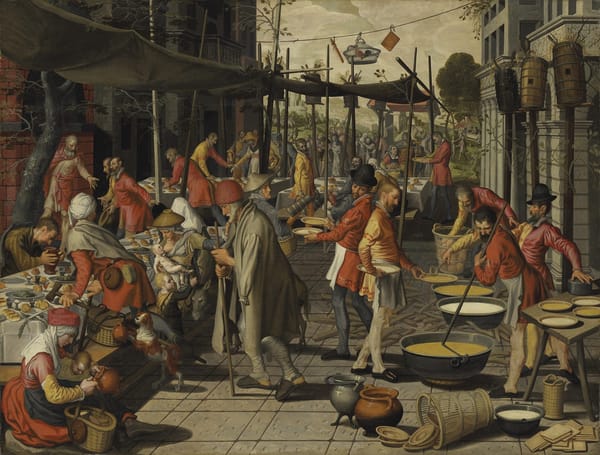
This Gospel has given to the present Sunday the name of the Sunday of the invited to the marriage. And yet, from the very opening of the dominical series, which began with the Descent of the Holy Ghost, the Church gave us the Gospel teaching which she offers to us, now a second time, for our consideration. On the second Sunday after Pentecost, she related to us, from St. Luke,19 the parable of the great supper, to which many were invited, and which St. Matthew, entering into fuller details, calls a marriage-feast.
Set thus before us, both at the beginning and at the close of the liturgical season over which the holy Spirit reigns supreme, this parable is, as it were, the interpreter of the whole portion of the year which it thus hems in : it is an additional revelation of the true aim of the Church. But how much has the light increased, since the first time we had these mystery-telling allegories! The certain man (homo quidam), who made a great supper, and invited many, has become the King, who makes a marriage for His Son, and, in this marriage, gives us an image of the kingdom of heaven. The world’s history, too, has been developing, as we gather from the terms respectively used by the two Evangelists. Those who were the first invited, and contented themselves with declining the kindness of the Master of the house, have grown in their impious ingratitude; laying hands on the messengers sent them by the loving kindness20 of the King, they treat them with contumely, and put them to death! We have seen the merited punishment inflicted on these deicides, by this Man, who was God Himself, the Father of Israel, now become King of the Gentiles : we have seen how He sent his armies to destroy them, and burn their city.21 And now at last, in spite of the refusal of the invited of Juda, in spite of the treacherous opposition put by them against the celebration of the nuptials of the Son of God, all things are ready for the marriage, and the banquet-hall is filled with guests.
Our heavenly King has confided, to the ministers of His love, the work of calling from every people the new guests. But now that His ambassadors, according to His command, have traversed the whole earth,22 bringing together all nations for this day of the joy of His heart,23 He Himself is coming in person, to see that nothing is wanting to the due preparation for the feast, and to give the signal for the eternal banquet of the divine nuptials. Now, for such a feast, and in such a place, if there be any deficiency, it can only be on the part of the guests. Let them, then, be careful not to draw down upon themselves, in this general and last examination, the displeasure of the great King, who has called them to an alliance with Himself. Though He has condescended to call them, notwithstanding their extreme poverty, from the public streets and highways, He has given them abundant time to lay aside their tatters; and knowing that they could not get ready of themselves, He has placed at their disposal, for the marriage-feast, the richest garments of His grace and virtues. Woe, then, to him who on the last day shall be found not having the wedding garment of charity! Such a want would admit of no excuse; and the King would justly punish it, by excluding the guilty man from the feast, as one that had insulted His Son.
Everything we have had on the preceding Sundays, has shown us how solicitous the Church ever is in preparing mankind for that wonderful marriage whose realization is the one object aimed at by the divine Word, in coming upon our earth. During her long exile, the bride of the Son of God has been a living model to her children; and, by her instructions, she has been unceasingly preparing them for the understanding of the great mystery of divine union. Three weeks ago,24 treating more directly than she had hitherto done on the great subject of her ambition as mother and bride, she reminded them of the great call. On the following Sunday, she gave them another lesson : she revealed to them the Bridegroom of the nuptials, to which they were invited, as the Man-God, the object of the twofold precept of love which embodies the whole Law. To-day, we have the teaching in all its perfection. It is condensed in the night Office, where we have St. Gregory explaining her whole teaching. The great doctor and the great Pope thus, in the name of the Church, explains our Gospel:
'The kingdom of heaven is the assembly of the just; for, the Lord says by a prophet: “Heaven is My throne";25 and Solomon says : “The soul of the just man is the throne of wisdom ”;26 and Paul calls Christ the Wisdom of God.27 If, therefore, heaven be the throne of God, we must evidently conclude that, as Wisdom is God, and the soul of the just man is the throne of Wisdom, this soul is a heaven . . . . The kingdom of heaven, then, is the assembly of the just . . . . If this kingdom is said to be like to a King, who made a marriage for his Son, your charity at once understands who is this King, who is the Father of a Son, King like Himself. It is He, of whom the psalmist says: “Give to the King Thy judgment, O God, and to the King’s Son Thy justice!”28 God the Father made the marriage of God His Son, when He wished that He, who had been God before all ages, should become Man towards the end of ages. But we must not, on that account, suppose that there are two persons in Jesus Christ, our God and our Saviour . . . . It is, perhaps, clearer and safer to say, that the King made a marriage for His Son, in that, by the mystery of the Incarnation, He united the Church to Him. The womb of the Virgin-Mother was the nuptial-chamber of that Bridegroom, of whom the psalmist says:29 He hath set His tabernacle in the sun : and He, as a Bridegroom, cometh out of His bride-chamber!'30
Notwithstanding her dignity of beloved bride of the Son of God, the Church is, none the less, subject to tribulations here below. The enemies of the Spouse, having ho longer any direct power to injure our Lord, turn all their rage against her. In these trials, endured as they are by the Church with love, Jesus sees a fresh trait of that resemblance which He wishes her to have to Himself; He, therefore, leaves her to suffer in this world, contenting Himself with ever upholding and saving her, as the Offertory says, in the midst of the evils which go on thickening around her.
Offertory
The august sacrifice, which is about to be offered, always obtains its effect, as far as the glory of the divine Majesty is concerned; but its virtue is applied to man in a greater or less degree, according to the dispositions of the creature, and depending on the divine mercy. Let us, in the Secret, beseech our heavenly Father, that we may experience abundantly the effects of the divine mysteries, which are so soon to be produced on our altar.
Secret
The other Secrets, as on page 130.
The Man-God, by His divine contact in the sacred banquet, has spiritually given vigour to our members; let us recall to mind that we must, henceforward, consecrate them to His service, and that our feet, now made sure, must run in the way of the divine commandments.
Communion
The Postcommunion, again, seems to be an allusion to the Gospel of the paralytic, which used formerly to be read on this Sunday. In it, we implore the assistance of the heavenly Physician, who sets man free from the palsy, which held him a prisoner; He also gives him the strength needed for fulfilling the law of God bravely and perseveringly.
Postcommunion
The other Postcommunions, as on page 181.
Vespers
The psalms, capitulum, hymn, and versicle, as above, pages 71-81.
Antiphon of the Magnificat
Oremus.
- St. John i. 14. ↩︎
- Heb. i. 3 ↩︎
- Col. ii. 3, 9, ↩︎
- St. John xiv. 6. ↩︎
- Eph. iv. 18. ↩︎
- Ibid. i. 10. ↩︎
- Col. i. 15-20. ↩︎
- Cf. St. John iv. 14; vii, 37, 39. ↩︎
- Ibid. xvii. 17. ↩︎
- Cf. St. John xv. 26. ↩︎
- Ibid. xvii. 21-23. ↩︎
- Ibid. 19. ↩︎
- Rom. xiii. 14. ↩︎
- Eph. iv. 3. ↩︎
- Ps. iv. 5. ↩︎
- S. Chrys., in ep. ad Eph. Hom., xiv. ↩︎
- Eph. v. 1, 2. ↩︎
- S. Basil, Const, mon., xviii ↩︎
- St. Luke xiv. 16-24. ↩︎
- See Time after Pentecost, vol. i., p. 358. ↩︎
- See Ninth Sunday after Pentecost. ↩︎
- Ps. xviii. 5. ↩︎
- Cant. iii. 11. ↩︎
- The Sixteenth Sunday after Pentecost. ↩︎
- Isa. lxvi. 1. ↩︎
- Wisd. vii. 27. ↩︎
- 1 Cor. i. 24. ↩︎
- Ps. lxxi. 2. ↩︎
- Ps. xviii. 6. ↩︎
- S. Greg., Hom, xxxviii. in Ev. ↩︎
First Sunday of October: Feast of the Most Holy Rosary
|
It is customary with men of the world to balance their accounts at the end of the year, and ascertain their profits. The Church is now preparing to do the same. We shall soon see her solemnly numbering her elect, taking an inventory of her holy relics, visiting the tombs of those who sleep in the Lord, and counting the sanctuaries, both new and old, that have been consecrated to her divine Spouse. But to-day’s reckoning is a more solemn one, the profits more considerable: she opens her balance-sheet with the gain accruing to our Lady from the mysteries which compose the cycle. Christmas, the cross, the triumph of Jesus, these produce the holiness of us all; but before and above all, the holiness of Mary. The diadem which the Church thus offers first to the august Sovereign of the world, is rightly composed of the triple crown of these sanctifying mysteries, the causes of her joy, of her sorrow, and of her glory. The joyful mysteries recall the Annunciation, the Visitation, the Birth of Jesus, Mary’s Purification, and the Finding of our Lord in the temple. The sorrowful mysteries bring before us the Agony of our blessed Lord, His being scourged, and crowned with thorns, the carrying of the cross, and the Crucifixion. While, in the glorious mysteries, we contemplate the Resurrection and Ascension of our Saviour, Pentecost, and the Assumption and Coronation of the Mother of God. Such is Mary’s rosary; a new and fruitful vine, which began to blossom at Gabriel’s salutation, and whose fragrant garlands form a link between earth and heaven.
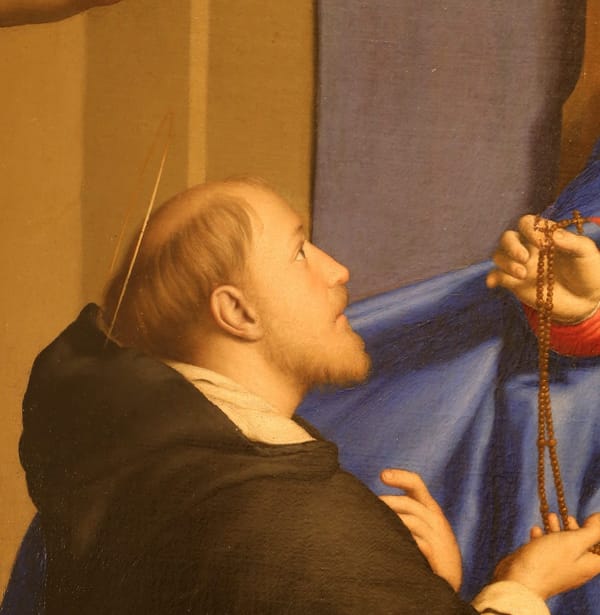
In its present form, the rosary was made known to the world by St. Dominic at the time of the struggles with the Albigensians, that social war of such ill-omen for the Church. The rosary was then of more avail than armed forces against the power of satan; it is now the Church’s last resource. It would seem that, the ancient forms of social prayer being no longer relished by the people, the holy Spirit has willed by this easy and ready summary of the liturgy to maintain, in the isolated devotion of these unhappy times, the essential of that life of prayer, faith, and Christian virtue, which the public celebration of the Divine Office formerly kept up among the nations. Before the thirteenth century, popular piety was already familiar with what was called the psalter of the laity, that is, the angelical salutation repeated one hundred and fifty times; it was the distribution of these Hail Marys into decades, each devoted to the consideration of a particular mystery, that constituted the rosary. Such was the divine expedient, simple as the eternal Wisdom that conceived it, and far-reaching in its effects; for while it led wandering man to the Queen of Mercy, it obviated ignorance which is the food of heresy, and taught him to find once more ‘the paths consecrated by the Blood of the Man-God, and by the tears of His Mother.’1
Thus speaks the great Pontiff who, in the universal sorrow of these days, has again pointed out the means of salvation more than once experienced by our fathers. Leo XIII, in his encyclicals, has consecrated the present month to this devotion so dear to heaven; he has honoured our Lady in her litanies with a new title, Queen of the most holy rosary;2 and he has given the final development to the solemnity of this day, by raising it to the rank of a second class feast, and by enriching it with a proper Office explaining its permanent object.3 Besides all this, the feast is a memorial of glorious victories, which do honour to the Christian name.
Soliman II, the greatest of the Sultans, taking advantage of the confusion caused in the west by Luther, had filled the sixteenth century with terror by his exploits. He left to his son, Selim II, the prospect of being able at length to carry out the ambition of his race: to subjugate Rome and Vienna, the Pope and the emperor, to the power of the crescent. The Turkish fleet had already mastered the greater part of the Mediterranean, and was threatening Italy, when, on October 7, 1571, it came into action, in the Gulf of Lepanto, with the pontifical galleys supported by the fleets of Spain and Venice. It was Sunday; throughout the world the confraternities of the rosary were engaged in their work of intercession. Supernaturally enlightened, St. Pius V watched from the Vatican the battle undertaken by the leader he had chosen, Don John of Austria, against the three hundred vessels of Islam. The illustrious Pontiff, whose life’s work was now completed, did not survive to celebrate the anniversary of the triumph; but he perpetuated the memory of it by an annual commemoration of our Lady of Victory. His successor, Gregory XIII, altered this title to our Lady of the rosary, and appointed the first Sunday of October for the new feast, authorizing its celebration in those churches which possessed an altar under that invocation.
A century and a half later, this limited concession was made general. As Innocent XI, in memory of the deliverance of Vienna by Sobieski, had extended the feast of the most holy name of Mary to the whole Church; so, in 1716, Clement XI inscribed the feast of the rosary on the universal calendar, in gratitude for the victory gained by Prince Eugene at Peterwardein, on August 5, under the auspices of our Lady of the snow. This victory was followed by the raising of the siege of Corfu, and completed a year later by the taking of Belgrade.
Mass
The joys experienced on the other feasts of the Mother of God, are all gathered up and resumed in this one, for us, for the angels, and for our Lady herself. Like the angels, then, let us offer, together with Mary, the homage of our just delight to the Son of God, her Son, her King and ours.
Introit
The mysteries of the Son and of the Mother are our instruction and our hope. The Church prays in the Collect that they may also be our rule of life and our pledge of eternal happiness.
Collect
Then is made a commemoration of the occurring Sunday.
Epistle
Prov. cap. viii.Dominus possedit me in initio viarum suarum antequam quidquam faceret a principio. Ab æterno ordinata sum, et ex antiquis, antequam terra fieret, Nondum erant abyssi, et ego jam concepta eram. Nunc ergo, filii, audite me: Beati qui cnstodiunt vias meas. Audite disciplinam, et estote sapientes, et nolite abjicere eam. Beatus homo qui audit me, et qui vigilat ad fores meas quotidie, et observat ad postes ostii mei. Qui me invenerit, inveniet vitam, et hauriet salutem a Domino.
Prov. ch. viii.The Lord possessed me in the beginning of his ways, before he made anything from the beginning. I was set up from eternity, and of old before the earth was made. The depths were not as yet, and I was already conceived. Now therefore, ye children, hear me: Blessed are they that keep my ways. Hear instruction and be wise, and refuse it not. Blessed is the man that heareth mo, and that watcheth daily at my gates, and waiteth at the posts of my doors. He that shall find me, shall find life, and shall have salvation from the Lord.
Our Lady’s mysteries are before all time in God’s sight, like those of her divine Son; like these they will endure for all eternity; like them they rule the ages, which circle round the Word and Mary, preparing for both in the days of figures, perpetuating their presence by the incessant glorification of the most holy Trinity, in whose name all Christians are baptized. Now the rosary honours all this series of mysteries; to-day’s feast is a glance back upon the cycle as it draws to its close. From these mysteries, from this view of them, we must draw the conclusion formulated by our Lady herself in this passage from Proverbs, which the Church applies to her: ‘Now therefore, my children, consider my ways; imitate me, that you may find happiness.’ Blessed is he that watcheth at her gate! Let us pray to her, rosary in hand, considering her at the same time, meditating on her life and her greatness, and watching, were it but for a quarter of an hour, at the entrance to the palace of this incomparable Queen. The more faithful we are, the more assured will be our salvation and our progress in true life.
In the Gradual, let us congratulate the Queen of the holy rosary on her perfect life, all truth, and justice, and meekness, which won her the love of the supreme King. In the Alleluia verse, let us proclaim the nobility of her race, unequalled in the whole world.
Gradual
The Gospel is the same as on the feast of the most holy name of Mary (page 176). ‘At that time, the angel Gabriel was sent from God, into a city of Galilee, called Nazareth, to a Virgin espoused to a man whose name was Joseph, of the house of David; and the Virgin’s name was Mary. And the angel being come in, said to her: Hail, full of grace! the Lord is with thee; blessed art thou among women? Blessed art thou among women, repeated Elizabeth a few days later, and blessed is the fruit of thy womb. These two salutations, with the name of Mary added to the angel’s greeting and the name of Jesus to Elizabeth’s, constituted the Ave Maria in the time of St. Dominic, the promulgator of the rosary. The prayer, 'Holy Mary Mother of God’ which now so beautifully completes the formula of praise, received the sanction of the Church in the sixteenth century. No better Gospel could, then, have been chosen for to-day, for it gives the original text of the rosary, and describes the first of its mysteries.
All grace, all light, all life, are to be found in our Lady; by her holy rosary she, as we sing in the Offertory, has multiplied flowers and fruits in the garden of the Church. Every offering acceptable to God, comes from Mary, with and by Jesus.
Offertory
As the Secret tells us, the rosary, piously meditated, prepares us for the Sacrifice of the altar, that supereminent and august memorial of the mysteries which it imprints in the heart and mind of the Christian.
Secret
Then a commemoration of the Sunday.
The Preface as on September 8, substituting ‘in solemnitate, on the solemnity,’ for ‘in Nativitate, on the Nativity,’ of the blessed Virgin Mary.
After the sacred banquet, our soul must not remain barren. The fragrance of virtue’s flowers must embalm all that surrounds us, and prove to the Spouse that His visit has not been made in vain.
Communion
In the Postcommunion, the Church prays that our Lady may, by her intercession, second the effects of this Sacrifice, and-of the mysteries in which she played so great a part.
Postcommunion
Then is added the Postcommunion of the Sunday, and the Gospel of the same is read at the end of the Mass.
Vespers
A few days ago, the Church borrowed from the Servites of Mary her Office of the Seven Dolours; to-day she seeks her responsories, hymns, and antiphons from the noble family which claims the rosary as its birthright. The Christian world owes a new debt of gratitude to the sons of St. Dominic for enriching it with these beautiful liturgical formulæ. But as the Use of the Friars Preachers gives but one antiphon for the psalms in the Vespers of the saints, the following antiphons have been added for the Roman rite. The hymn, which so gracefully and yet concisely resumes the triple series of the mysteries, is the fourth of the entire Office: the first celebrates, at first Vespers, the joyful mysteries; the second, at Matins, the sorrowful; the third, at Lauds, the glorious. 'From these mysteries let us gather roses, and weave garlands for the Mother of fair love.’
Ps. Dixit Dominus, page 38.
Ps. Laudate pueri, page 41.
Ps.Lætatus sum, page 152.
Ps. Nisi Dominus, page 153.
Ps. Lauda Jerusalem, page 154.
Capitultum
Eccli. xxiv. xxxix.
Hymn
Te sauciam doloribus,
Te jugi amictam gloria,
O Virgo Mater pangimus.
Dum concipis, dum visitas,
Et edis, offers, invenis,
Mater beata, Filium.
In corde agonem, verbera,
Spinas, crucemque Filii
Perpessa, princeps martyrum.
In ignibus Paracliti,
In regni honore et lumine,
Regina fulgens gloria.
Ex his rosas mysteriis,
Et pulchri amoris inclytæ
Matri coronas nectite.
Qui natus es de Virgine,
Cum Patre et almo Spiritu,
In sempiterna sæcula.
thee wounded with the sword of sorrow,
thee girt with everlasting glory,
we sing, O Virgin Mother.
when thou conceivest; when thou visitest thy cousin;
when thou bringest forth thy Son, offerest him to God,
findest him in the temple, O happy Mother!
in thy inmost heart the agony, the scourging,
the thorns, and the cross of thy Son,
O first of martyrs!
in the triumphs of thy Son,
in the fires of the Paraclete,
in the honour and splendour of thy queenliness.
gather roses from these mysteries,
and wreathe therewith garlands
for the Mother of fair love.
born of the Virgin;
together with the Father and the holy Spirit,
through everlasting ages.
Antiphon of the Magnificat
The Prayer as on page 299.
Then is made a commemoration of the Sunday.
October 3: St. Teresa of the Child Jesus, Virgin
Wonder-worker as is the saint of to-day, fulfilling her dying prophecy, “After my death I will let fall a shower of roses,” she is her own greatest miracle. Her world-wide popularity, to which is united in most cases a devotion which has reorientated many a life, and in all has been a stimulus and an encouragement, is recognized to be phenomenal. It has been said with respect to doctrinal definitions that the faithful have a passive “infallibility,” whereby their need answers exactly to the definition; the same would seem to be true in the case of devotions and saints; they are given to us when and as they are needed.
In an age which worships visible efficiency which, even in the spiritual sphere, too often demands substantial material results before it will revere and believe, the saint who has won hearts—and souls— as few indeed have done, is no great religious and social reformer nor, in her lifetime, an apostle carrying the truth to the ends of the earth; nor even a preacher upon whose words crowds have hung spellbound, nor a scholar gathering around his rostrumall that was best in the intellectual world of his day; but a girl who was unknown beyond a small circle of relatives and friends. She had received no special educational advantages; she lived her life in a quiet little Norman town to which few travellers found their way. Still a child in years, but mature already in the things of God, she entered the Carmel in the same town, an obscure convent of recent foundation, barren of the historical associations which cluster around many French Carmels. For ten years she lived a life made up for the most part of religious exercises and simple domestic duties; a life, to the average man or woman of the world, colourless and monotonous, in which of necessity talents were wasted and all chance of doing good service to the world forever forfeited. At twenty-four she died of consumption, but over the simple grave accorded to such as she were placed the mysterious words: “I will spend my heaven doing good upon earth.”
Shortly before her death, she, Teresa of the Child Jesus, always so humble and simple, had declared, among other startling prophetic sayings, that: All the world would love her. During the last two years of her life, in obedience to her Superiors, she had written in her scanty free time, on poor scraps of paper, an account of her life, and for this, likewise, she foretold a strange success. To-day “The Story of a Soul” has been translated into every civilized tongue; the literature which has gathered round the book and its writer would form a library, and Lisieux is one of the great pilgrimage centres of the world.
In her book the young Carmelite explained the theory and practice of her own spiritual life: her “little Way”; the “Way of Spiritual Childhood and, when dying, she spoke with a strange solemnity and certainty of the mission awaiting her in the eternal future—to teach her “Way” to souls. Too often described as something new, it is, as two Sovereign Pontiffs have pointed out, but a return to the way of the Gospels. Others have walked the same path to heaven before St. Teresa of Lisieux, but to her it has been given to show it once more to a self-sufficient, sophisticated world, and that in such wise that, to men of good will, it may be a sure and safe highway wherein even the foolish cannot err.
The Way of Spiritual Childhood stresses again that “love,” and not great outward achievement, is the fulfilling of the law; that it is character, not career, which counts; that since for most souls sanctity, if achieved at all, must be achieved in a restricted sphere, the daily round of little duties, little sacrifices, common tasks and trials, all fulfilled and accepted perfectly and for love, generous doing and suffering of the will of God, will provide all that is needful for the highest heroism. Beneath her childlike phrasing the saint has portrayed a life which calls for an unflagging generosity and courage which, united with the humility and confidence of a little child, is heroic indeed. Benedict XV has called her way “the secret of sanctity.”
And because she lived “a little one” she was “pleasing to the Most High.” All the world had loved her; popular acclamation had soon declared her a saint, but the voice which alone can pronounce thereon was not long silent. Her cause was exempted from the years of delay normally required; Pope Benedict XV pronounced the Decree of Heroicity of her virtues, and by Pius XI, now happily reigning, she was both beatified and canonized at an interval of but two years, the first beatification and the first canonization of his pontificate. Two years later the Pope declared her the special patroness of all Catholic Foreign Missions in the same rank as St. Francis Xavier.
The following lessons are assigned to the second Nocturn of her office. By special privilege of His Holiness Pius XI her feast is kept in her own convent on September 30, the anniversary of her death. In the Carmelite Order it is celebrated on October 1, and elsewhere is transferred to October 3.
The Church relates her life in the following Lessons:
| Previous October 2: The Holy Guardian Angels | Next First Sunday of October: Feast of the Most Holy Rosary |