Daily reading
After Pentecost
Vigil · Movable from Easter · Temporal
October 31, 2021
From Dom Guéranger’s The Liturgical Year.

|
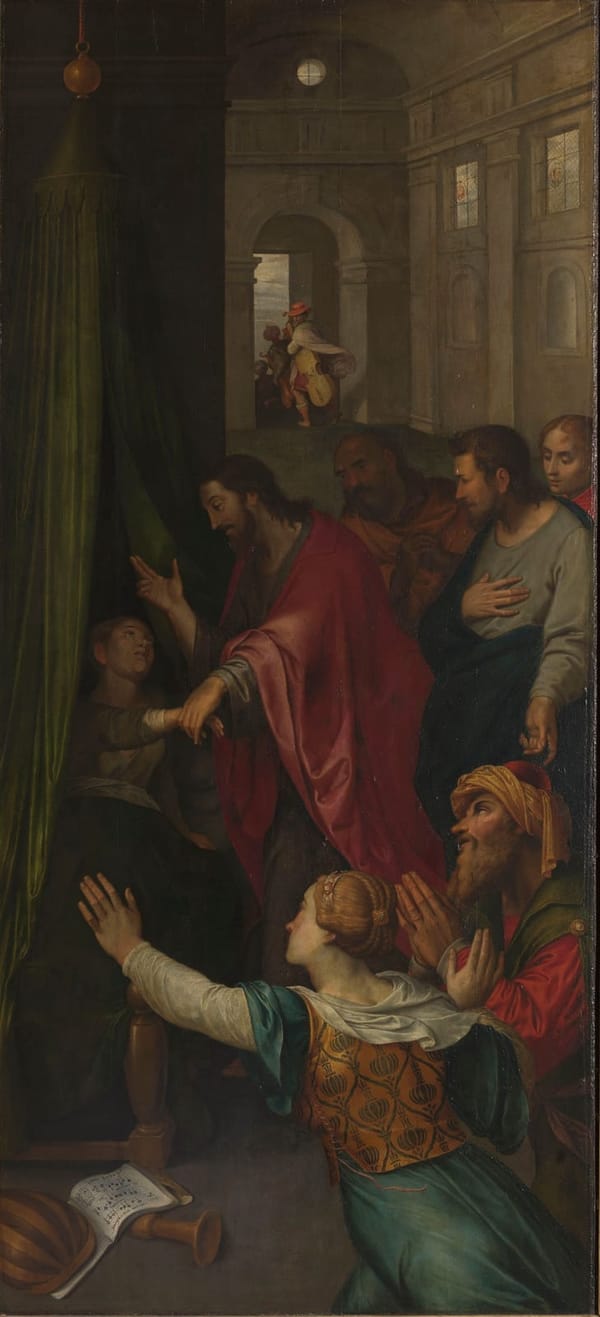
The Twenty-Third Sunday after Pentecost
When the number of the Sundays after Pentecost is only twenty-three, the Mass for to-day is taken from the twenty-fourth and last Sunday; and the Mass appointed for the twenty-third is said on the previous Saturday, or on the nearest day of the preceding week which is not impeded by a double or semi-double feast.
But, under all circumstances, the antiphonary ends to-day. The Introits, Graduals, Communions, and Postcommunions, which are given below, are to be repeated on each of the Sundays till Advent, which vary in number each year. Our readers will remember that, in the time of St. Gregory, Advent was longer than we now have it;1 and that, in those days, its weeks commenced in that part of the cycle which is now occupied by the last Sundays after Pentecost. This is one of the reasons for the lack of liturgical riches in the composition of the dominical Masses which follow the twenty-third.
Even on this one, the Church, without losing sight of the last day, used to lend a thought to the new season which was fast approaching, the season, that is, of preparation for the great feast of Christmas. There was read, as Epistle, the following passage from Jeremias, which was afterwards, in several Churches, inserted in the Mass of the first Sunday of Advent: 'Behold! the days come, saith the Lord, and I will raise up to David a just branch: and a King shall reign, and shall be wise: and shall execute judgment and justice in the earth. In those days, shall Juda be saved, and Israel shall dwell confidently: and this is the name that they shall call Him: The Lord our Just One. Therefore, behold the days come, saith the Lord, and they shall say no more: The Lord liveth, who brought up the children of Israel out of the land of Egypt! But: The Lord liveth, who hath brought out, and brought hither, the seed of the house of Israel, from the land of the north, and out of all the lands, to which I had cast them forth! And they shall dwell in their own land.’2
As is evident, this passage is equally applicable to the conversion of the Jews and the restoration of Israel, which are to take place at the end of the world. This was the view taken by the chief liturgists of the middle ages, in order to explain thoroughly the Mass of the twenty-third Sunday after Pentecost. Bearing in mind that, originally, the Gospel of this Sunday was that of the multiplication of the five loaves, let us listen to the profound and learned Abbot Rupert, who, better than anyone, will teach us the mysteries of this day, which brings to a close the grand and varied Gregorian melodies.
'Holy Church,’ he says,’is so intent on paying her debt of supplication, and prayer, and thanksgiving, for all men, as the apostle demands,3 that we find her giving thanks also for the salvation of the children of Israel, who, she knows, are one day to be united with her. And, as their remnants are to be saved at the end of the world,4 so, on this last Sunday of the year, she delights in them, as though they were already her members. In the Introit, calling to mind the prophecies concerning them, she thus sings every year: My thoughts are thoughts of peace, and not of affliction. Verily, His thoughts are those of peace, for He promises to admit to the banquet of His grace the Jews, who are His brethren according to the flesh; thus realizing what had been prefigured in the history of the patriarch Joseph. The brethren of Joseph, having sold him, came to him when they were tormented by hunger; for then he ruled over the whole land of Egypt. He recognized them; he received them; and made, together with them, a great feast. So, too, our Lord, who is now reigning over the whole earth, and is giving the bread of life, in abundance, to the Egyptians (that is, to the Gentiles), will see coming to Him the remnants of the children of Israel. He, whom they had denied and put to death, will admit them to His favour, will give them a place at His table, and the true Joseph will feast delightedly with His brethren.
‘The benefit of this divine Table is signified, in the Office of this Sunday, by the Gospel, which tells us of our Lord’s feeding the multitude with five loaves. For it will be then that Jesus will open to the Jews the five Books of Moses, which are now being carried whole, and not yet broken; yea, carried by a child, that is to say, this people itself, who, up to that time, will have been cramped up in the narrowness of a childish spirit.
Then will be fulfilled the prophecy of Jeremias, which is so aptly placed before this Gospel: “They shall say no more: The Lord liveth, who brought up the children of Israel out of the land of Egypt! But, the Lord liveth, who hath brought out the seed of Israel from the land of the north, and from all the lands into which they had been cast."
Thus delivered from the spiritual bondage which still holds them, they will sing with all their heart the words of thanksgiving as we have them in the Gradual: “Thou hast saved us, O Lord, from them that afflict us!"
‘The words we use in the Offertory: “From the depths I have cried to thee, O Lord," clearly allude to the same events; for, on that day, His brethren will say to the great and true Joseph: “We beseech thee to forget the wickedness of thy brethren!”5 The Communion: “Amen, I say to you, all things whatsoever ye ask, when ye pray," etc., is the answer made by that same Joseph, as it was by the first:6 “Fear not! Ye thought evil against me : but God turned it into good, that He might exalt me, as at present ye see, and might save many people. Fear not, therefore, I will feed you, and your children.”’7
Mass
The Introit, which we have just had explained to us by Rupert, is taken from the Prophet Jeremias,8 as was the ancient Epistle.
Introit
Prayer for pardon is continually on the lips of the Christian people, because the weakness of human nature is ever making itself felt, here below, even by the just man.9 God knows our frailty, and He is always ready to pardon us; but it is on the condition that we humbly acknowledge our faults, and have confidence in His mercy. These are the sentiments which suggest to the Church the words of the Collect.
Collect
The other Collects, as on page 120.
Epistle
Cap. iii. et iv.Fratres, Imitatores mei estote, et observate eos, qui ita ambulant, sicut habetis formam nostram. Multi enim ambulant, quos sæpe dicebam vobis (nunc autem et flens dico) inimicos crucis Christi : quorum finis interitus : quorum deus venter est : et gloria in confusione ipsorum, qui terrena sapiunt. Nostra autem conversatio in cœlis est: unde etiam Salvatorem exspectamus Dominum nostrum Jesum Christum, qui reformabit corpus humilitatis nostræ, configuratum corpori claritatis suæ, secundum operationem, qua etiam possit subjicere sibi omnia. Itaque, fratres mei charissimi et desideratissimi, gaudium meum et corona mea : sic state in Domino, charissimi. Evodiam rogo, et Syntichen deprecor idipsum sapere in Domino. Etiam rogo et te, germane compar, adjuva illas, quæ mecum laboraverunt in Evangelio, cum Clemente, et ceteris adjutoribus meis, quorum nomina sunt in libro vitæ.
Chapters iii. and iv.
Brethren: Be followers of me, and observe them who walk so as you have our model. For many walk, of whom I have told you often (and now tell you weeping) that they are enemies of the cross of Christ; whose end is destruction, whose god is their belly, and whose glory is in their shame: who mind earthly things. But our conversation is in heaven; from whence also we look for the Saviour, our Lord Jesus Christ, who will reform the body of our lowness, made like to the body of his glory, according to the operation whereby also he is able to subdue all things unto himself. Therefore, my dearly beloved brethren, and most desired, my joy, and my crown: so stand fast in the Lord, my dearly beloved. I beg of Evodia, and I beseech Syntyche, to be of one mind in the Lord. And I entreat thee also, my sincere companion, help those women that have laboured with me in the Gospel, with Clement and the rest of my fellow labourers, whose names are in the book of life.
The Clement here mentioned by the apostle was St. Peter’s second successor. Very frequently, the twenty-third Sunday after Pentecost comes close upon the feast of this great Pope and Martyr of the first century. Disciple of Paul, and, later on, in close intimacy with Peter, and named by the Vicar of Christ as the fittest to succeed him in the apostolic chair, Clement, as we shall see on November 23, was one of the saints most venerated by the faithful in those early times. The mention made of him in the Office of the time, just before his appearance on the cycle of holy Church, excited the Christian people to joy, and roused their fervour; it reminded them, that one of their best and dearest protectors would soon be visiting them.
At the time when St. Paul was writing to the Philippians, Clement, who was long to survive the apostles, was prominently one of those men spoken of in our Epistle, those illustrious models, who were called to perpetuate in the flock confided to their care10 the pattern of holy living; and that, not so much by their zealous teaching, as by the force of example. The Church, the one true bride of the divine Word, was known by the incommunicable privilege of possessing within her the truth; not only its dead letter, but its ever-living self. The Holy Ghost has not kept the Books of sacred Scripture from passing into the hands of the sects separated from the centre of unity; but He has reserved to the Church the treasure of tradition, which transmits, surely and fully, from one generation to another, the word which is life and light.11 This tradition is kept up by the truth and the holiness of the Man-God, ever existing in His members, ever tangible and visible in the Church.12 Holiness, which is inherent in the Church, is tradition in its purest and strongest form; because it is the truth, not only preached, but reduced to action and work,13 as it was in Christ Jesus, and as it is in God.14 It is the deposit,15 which the disciples of the apostles had the mission to hand faithfully down to their successors, just as the apostles themselves had received it from the Word, who had come upon the earth.
Hence, St. Paul did not content himself with entrusting dogmatic teaching to his disciple Timothy;16 he said to him : 'Be thou an example to the faithful, in word, and in living.,17 He said much the same to Titus: ‘Show thyself an example of good works, in doctrine and in integrity of life.’18 He repeated to all: 'Be ye followers of me, as I also am of Christ.'19 He sent Timothy to the Corinthians, that he might remind them, or, where it was necessary, might teach them, not only the dogmas of his Gospel, but likewise his ways in Christ Jesus, that is, his manner of life. For this manner of life of the apostle was, in a certain measure, his teaching everywhere in all the Churches;20 and he lauded the faithful of Corinth for being mindful to imitate him in all things, which was a keeping to the tradition of Christ.21 As for the Thessalonians, they had so thoroughly entered into this teaching, taken from their apostle’s life, that, as St. Paul says of them, they had become a pattern to all believers; this silent teaching of Christian revelation, which they showed forth in their conduct, made it superfluous for the messengers of the Gospel to say much.22
The Church is a magnificent temple, which is built up, to the glory of God, of the living stones, which let themselves be set into its walls.23 The constructing of those sacred walls on the plan laid down by Christ is a work in which all are permitted to share. What one does by word,24 another does by good example;25 but both of them build, both of them edify the holy city; and, as it was in the apostolic age, so always; example is more powerful than word, unless that word be supported by the authority of holiness in him who speaks it, unless, that is, he lead a life according to the perfection taught by the Gospel.
But, as the giving of edification to those around him is an obligation incumbent on the Christian—an obligation imposed both by the charity he owes to his neighbour, and by the zeal he should have for the house of God—so likewise, under pain of presumption, he should seek his own edification in the conduct of others. The reading of good books, the study of the lives of the saints, the observing, as our Epistle says, those holy people with whom he lives, all this will be an incalculable aid to him, in the work of his own personal sanctification and in the fulfilment of God’s purposes in this regard. This devout intercourse with the elect of earth and of heaven will keep us away from men who are enemies of the cross of Christ and mind earthly things, and put their happiness in carnal pleasures. It will make our conversation be in heaven. Preparing for the day which cannot now be far off, the day of the coming of our Lord, we shall stand fast in Him, in spite of the falling off of so many amongst us, who, by the current of the world’s fashion, are hurried into perdition. The troubles and sufferings of the last times will but intensify our hope in God; for they will make us long all the more ardently for the happy day when our Redeemer will appear and complete the work of the salvation of His servants by imparting to their very flesh the brightness of His own divine Body. Let us, as our apostle says, be of one mind in the Lord; and then, as he bids his dear Philippians, let us rejoice in the Lord always, for the Lord is nigh.26
Gradual
Gospel
Cap. ix.In illo tempore : Loquente Jesu ad turbas, ecce princeps unus accessit, et adorabat eum, dicens: Domine, filia mea modo defuncta est: sed veni, impone manum tuam super eam, et vivet. Et surgens Jesus sequebatur eum, et discipuli ejus. Et ecce mulier, quæ sanguinis fluxum patiebatur duodecim annis, accessit retro, et tetigit fimbriam vestimenti ejus. Dicebat enim intra se : Si tetigero tantum vestimentum ejus, salva ero. At Jesus conversus, et videns eam, dixit : Confide, filia, fides tua te salvam fecit. Et salva facta est mulier ex illa hora. Et cum venisset Jesus in domum principis, et vidisset tibicines, et turbam tumultuantem, dicebat : Recedite, non est enim mortua puella, sed dormii. Et deridebant eum. Et cum ejecta esset turba, intravit, et tenuit manum ejus. Et surrexit puella. Et exiit fama hæc in universam terram illam.
Ch. ix.At that time : As Jesus was speaking to the multitude: Behold a certain ruler came up and adored him, saying : Lord, my daughter is even now dead; but come lay thy hand upon her, and she shall live. And Jesus rising up followed him, with his disciples. And behold a woman who was troubled with an issue of blood twelve years, came behind him, and touched the hem of his garment. For she said within herself: If I shall touch only his garment I shall be healed. But Jesus turning and seeing her, said : Be of good heart, daughter, thy faith hath made thee whole. And the woman was made whole from that hour. And when Jesus was come into the house of the ruler, and saw the minstrels and the multitude making a rout, he said : Give place: for the girl is not dead, but sleepeth. And they laughed him to scorn. And when the multitude was put forth, he went in and took her by the hand. And the maid arose. And the fame hereof went abroad into all that country.
Although the choice of this Gospel for the twenty-third Sunday is not of great antiquity, yet is it in most perfect keeping with the post-pentecostal liturgy, and confirms what we have stated relative to the character of this portion of the Church’s year. St. Jerome tells us, in the homily selected for the day, that the hemorrhoissa, healed by our Lord, is a type of the Gentile world; whilst the Jewish people is represented by the daughter of the ruler of the Synagogue.27 This latter is not to be restored to life until the former has been cured; and this is precisely the mystery we are so continually commemorating during these closing weeks of the liturgical year, viz., the fullness of the Gentiles recognizing and welcoming the divine Physician, and the blindness of Israel at last giving way to the light.28
The liturgy at this close of the year continually alludes to the end of the world. The earth seems to be sinking away, down into some deep abyss; but it is only that it may shake off the wicked from its surface, and then it will come up again blooming in light and love. After the divine realities of this year of grace, we ought to be capable of feeling a thrill of admiration at the mysterious, yet, at the same time, the strong and sweet ways of eternal Wisdom.29 At the beginning, when man was first created, sin soon followed, breaking up the harmony of God’s beautiful world, and throwing man off the divine path where his Creator had placed him. Wickedness went on increasing, until God’s mercy fell upon one family. The light which beamed on that privileged favourite only showed more plainly the thick darkness in which the rest of mankind were enveloped. The Gentiles, abandoned to their misery, all the more terrible because they had caused it and loved it, saw God’s favours all bestowed on Israel, whilst they themselves were disregarded, and wished to be so. Even when the time came for original sin to be remedied, it seemed to be the very time for the final reprobation of the Gentiles; for the salvation that came down from heaven in the person of the Man-God was seen to be exclusively directed towards the Jews and the lost sheep of the house of Israel.30
But the people that had been treated with so much predilection, and whose fathers and first rulers had so ardently prayed for the coming of the Messias, was no longer in the position to which it had been raised by the holy patriarchs and prophets. Its beautiful religion, founded on desire and hope, was then nothing but a sterile expectancy, which kept it motionless and unable to advance a single step towards its Redeemer. As to its Law, Israel then minded nothing but the letter, and, at last, turned it into a mummy of sectarian formalism. Now, whilst in spite of all this sinful apathy it was mad with jealousy, pretending that no one else had any right to heaven’s favours, the Gentile, whose ever-increasing misery urged him to go in search of some deliverer, found one, and recognized him in Jesus the Saviour of the world. He was confident that this Jesus could cure him; so he took the bold initiative, went up to Him, and had the merit of being the first to be healed. True, our Lord had treated him with an apparent disdain; but that had only had the effect of intensifying his humility, and humility has a power of making way anywhere, even into heaven itself.31
Israel, therefore, was now made to wait. One of the Psalms he sang ran thus: ‘Ethiopia shall be the first to stretch out her hands to God.’32 It is now the turn for Israel to recover, by the pangs of a long abandonment, the humility which had won the divine promises for his fathers, the humility which alone could merit his seeing those promises fulfilled.
By this time, however, the word of salvation has made itself heard throughout all the nations, healing and saving all who desired the blessing. Jesus, who has been delayed on the road, comes at last to the house towards which He first purposed to direct His sacred steps; He reaches, at last, the house of Juda, where the daughter of Sion is in a deep sleep. His almighty compassion drives away from the poor abandoned one the crowd of false teachers and lying prophets, who had sent her into that mortal sleep, by all the noise of their vain babbling: He casts forth for ever from her house those insulters of Himself, who are quite resolved to keep the dead one dead. Taking the poor daughter by the hand, He restores her to life, and to all the charm of her first youth; proving thus, that her apparent death had been but a sleep, and that the long delay of dreary ages could never belie the word of God, which He had given to Abraham, His servant.33
Now therefore, let this world hold itself in readiness for its final transformation; for the tidings of the restoration of the daughter of Sion puts the last seal to the accomplishment of the prophecies. It remains now but for the graves to give back their dead.34 The valley of Josaphat is preparing for the great meeting of the nations;35 Mount Olivet is once more to have Jesus standing upon it,36 but this time as Lord and Judge!37
Offertory
The service we pay to God is, of itself, far beneath what His sovereign Majesty deserves; but the Sacrifice, which every day constitutes part of our service, ennobles it even to an infinite worth, and supplies all our own deficiencies of merit. This is what we are told in this Sunday’s Secret.
Secret
The other Secrets, as on page 130.
Communion
Having, by these sacred mysteries, entered into a participation of divine life, let us beseech our Lord, that we may no longer be subject to the dangers of this world. Let us say with the Church:
Postcommunion
The other Postcommunions, as on page 131.
Vespers
The psalms, capitulum, hymn, and versicle, as above, pages 71-81.
Antiphon of the Magnificat
- See our ‘Advent,’ chap. i., page 23 et seq. ↩︎
- Jer. xxiii. 5-8. ↩︎
- 1 Tim. ii. 1. ↩︎
- Rom. ix. 27. ↩︎
- Gen. l. 17. ↩︎
- Ibid. 19-21. ↩︎
- Rup., De Div. Off., xii. 28. ↩︎
- Jer. xxix. ↩︎
- Prov. xxiv. 16. ↩︎
- 1 St. Pet. v. 3. ↩︎
- St. John i. 4. ↩︎
- 1 St. John i. 1. ↩︎
- 1 Thess. ii. 13. ↩︎
- St. John v. 17. ↩︎
- 1 Tim. vi. 20. ↩︎
- 2 Tim. ii. 2. ↩︎
- 1 Tim. iv. 12. ↩︎
- Tit. ii. 7. ↩︎
- 1 Cor. iv. 16. ↩︎
- Ibid, 17. ↩︎
- Ibid. xi. 1-2. ↩︎
- 1 Thess. i. 5-8. ↩︎
- Eph. ii. 20-22. ↩︎
- 1 Cor. xiv. 3. ↩︎
- Rom. xiv. 19. ↩︎
- Phil. iv. 4, 5. ↩︎
- S. Hieron., in Matt., cap. ix. ↩︎
- Rom. xi. 25. ↩︎
- Wisd. viii. 1. ↩︎
- St. Matt. xv. 24. ↩︎
- Ecclus. xxxv. 21. ↩︎
- Ps. lxvii. 32. ↩︎
- St. Luke i. 54, 55. ↩︎
- Dan. xii. 1, 2. ↩︎
- Joel iii. 2. ↩︎
- Acts i. 11. ↩︎
- Zach. xiv. 4. ↩︎
October 31: Vigil of All Saints
Let us prepare our souls for the graces heaven is about to shower upon the earth in return for its homage. To-morrow the Church will be so overflowing with joy, that she will seem to be already in possession of eternal happiness; but to-day she appears in the garb of penance, confessing that she is still an exile. Let us fast and pray with her; for are not we too pilgrims and strangers in this world, where all things are fleeting and hurry on to death? Year by year, as the great solemnity comes round, it has gathered from among our former companions new saints, who bless our tears and smile upon our songs of hope. Year by year the appointed time draws nearer, when we ourselves, seated at the heavenly banquet, shall receive the homage of those who succeed us, and hold out a helping hand to draw them after us to the home of everlasting happiness. Let us learn, from this very hour, to emancipate our souls; let us keep our hearts free, in the midst of the vain solicitudes and false pleasures of a strange land: the exile has no care but his banishment, no joy but that which gives him a foretaste of his fatherland.
With these thoughts in mind, let us say with the Church the Collect of the vigil.
Prayer
Let us close this month, as we opened it, by homage to Mary, Queen of the holy rosary, and Queen of all the saints. The ancient Dominican missals furnish us with a formula.
Sequence
Verni pubent surculi
Et efflorent pulluli
Fecunda propagine.
Nix et imber abeunt,
Rosæ in terra prodeunt
E cœlesti germine.
Hæc ex horto filii
Toto cursu exsilii
Collegit plantaria.
Reis ad justitiam,
Electis ad gloriam
Cunctis salutaria.
Et de terris sustulit,
Christus mundo contulit
Contra mundum prælians.
Vulneratis sentibus,
Redimitis floribus,
Vocans, purgans, præmians.
Gemmis, spinis, foliis,
Affluentis patriæ
Fruemur deliciis,
Ubi satrix residet.
Læta sodalitiis
Triplicis hierarchiæ
Ter trinis consortiis
Imperatrix residet.
Et triumphi reparatrix
Antiqui certaminis.
Ni resistas, perit cultor
Christiani nominis.
Sancti Spiritus sacrarium,
Summi Patris filia.
Sub discrimen vitæ varium
Contra tela hostilia.
Quæ fert cœli viridarium
Mixta rosis lilia.
the young shoots of spring bud forth,
and burst into blossom
with fruitful abundance.
the snow and the rain are over;
and roses spring up on earth
from a heavenly seed.
during the whole time of her exile
she gathered the produce
of her Son’s garden:
and justification for sinners,
glory for the elect,
salvation for all.
and the sufferings he endured on earth,
he bestowed upon the world
when he overcame the world.
he was wounded by the thorns,
he was crowned with its flowers;
thus does he call us, purify us, reward us.
and thorns and flowers of the rose,
we shall enjoy the delights
of that rich land, where she,
the fair cultivator resides,
who joyfully presides
over our militant companies,
and over the nine choirs
of the triple hierarchy.
dost repair the loss we sustained
when the enemy triumphed in the first combat.
unless thou oppose him,
every Christian must perish.
sanctuary of the Holy Ghost,
daughter of the most high Father!
bring us unfailing assistance
against the darts of the enemy.
from the garden of heaven,
be our crown of victory after the combat.
The Last Sunday of October: The Feast of Our Lord Jesus Christ the King
The Kingdom of Heaven—Holy Church—is seen bringing forth out of her treasure “things new and old.” Although she can never add new dogmas to the deposit of Faith entrusted to her, as the ages go by she is seen understanding more perfectly and explaining more fully those treasures in her keeping. She is a living body, not a statue, and she can develop, though she can never change her nature. Hence, guided by the Holy Spirit of him who has promised to be with her not merely for a few centuries but unto the end of the world, she defines or emphasizes certain points of doctrine as she sees fit, considering the needs of the times. We have an example in the institution of the feast of the Kingship of our Lord Jesus Christ by the Sovereign Pontiff, Pope Pius XI, in the jubilee year 1925, and explained to the faithful in the Encyclical Quas Primas.
Christians have ever hailed our divine Lord as King of Kings and Lord of Lords. It was as a King that the representatives of the Eastern world came to adore him in the manger; it was as a King, albeit not knowing what he did, that the official representative of the Western world lifted him up upon the Cross. The patriarchs and prophets of the old dispensation foretold his royalty; he spoke constantly of his kingdom: when asked plainly whether he were in truth a king by the representative of Cæsar, he acknowledged that such indeed he was, though of a kingdom not of this world.
His Kingship is founded upon the ineffable hypostatic union. It is spiritual, and concerned with spiritual things. It is opposed to none other than to that of Satan, and to the powers of darkness. Christ is King over angels and men; King over men’s hearts and wills; his Kingship demands of its subjects a spirit of detachment from riches and earthly things, and a spirit of gentleness. They must hunger and thirst after justice and, more than this, they must deny themselves and carry the cross.1
Yet though his is a spiritual kingdom, opposed to no just earthly polity, “it would be a grave error to say that Christ has no authority whatever in civil affairs, since by virtue of the absolute empire over all creatures committed to him by the Father, all things are in his power. All men, whether collectively or individually, are under the dominion of Christ. In him is the salvation of the individual, in him is the salvation of society."2
To-day we sadly behold “a world undone,” largely paganized in principles and outlook, and, in recent years, in one country even glorying in the name “pagan.” At the best, governments mostly ignore God; and at the worst, openly fight against him, as we of to-day are witnessing in the Old World and in the New. Even the statesmen’s well-meant efforts to find a remedy for present ills and, above all, to secure world peace, prove futile because, whereas peace is from Christ, and possible only in the Kingdom of Christ, his name is never mentioned throughout their deliberations or their documents. Christ is kept out of the State schools and seats of higher education; and the rising generations seem to be taught anything and everything save to know, love and serve him. Art and literature all too frequently reflect the same tendencies.
And since the spirit of evil reigns inevitably wherever the spirit of Christ has ceased to reign, in public and in private men are flouting the moral laws of God, and some of the worst abominations of ancient paganism are becoming matters of every-day life. Moreover, be it remembered, modern paganism is worse than that of the ancient world, in that the former knows what it does as the latter did not. There is now an intense, positive hatred of Jesus Christ in the militant atheist, which differs in kind from the attitude of the fiercest Roman or Eastern persecutor: “If I had not come and spoken to them . . . if I had not done among them the works that no other man hath done, they would not have sin: but now they have both seen and hated both me and my Father.”3
Ever as practical as she is supernatural, the Church is not content with merely deploring the evil, nor even with counteracting it by sound teaching. She would also make definite reparation to the divine majesty thus denied and defied; to him whose royalty is slighted and insulted. Something must be done by those who, in a measure, understand and love, in order to atone for those who do not. “To repair the crime of lèse-divinity, which denies God’s rights over the human society whose author he is, we must exalt Jesus Christ as King over all individuals, families, and peoples. If his universal royalty be proclaimed and his reign in society recognized, one of the principal evils of the modern world—the secularizing of public and private life—will be attacked at its roots.”4 Hence we have the special exhortation of the Vicar of Christ, and the institution of the feast of this divine Kingship.
To this end nothing would serve better than the institution of a special feast in honour of the Kingship of Christ. For people are instructed in the truths of faith, and brought to appreciate the inner joys of religion, far more effectually by the annual celebration of our sacred mysteries than by any pronouncement, however weighty, of the teaching of the Church. Such pronouncements usually reach only a few, and those the more learned among the faithful; feasts reach them all; the former speak but once, the latter speak every year—in fact for ever. The Church’s teaching affects the mind primarily; her feasts affect both mind and heart, and have a salutary effect upon the whole of man’s nature . . . . We have commanded its observance on a Sunday, in order that not only the clergy may perform their duty by saying Mass and reciting the Office, but that the laity too, free from their daily tasks, may in a spirit of holy joy give ample testimony of their obedience and subjection to Christ . . . that they may so order their lives as to be worthy, faithful, and obedient subjects of the Divine King.5
Mass
Introit
Collect
Commemoration is made of the occurring Sunday.
Epistle
Cap. i.Fratres: Gratias agimus Deo Patri, qui dignos nos fecit in partem sortis sanctorum in lumine, qui eripuit nos de potestate tenebrarum, et transtulit in regnum Filii dilectionis sue, in quo habemus redemptionem per sanguinem ejus, remissionem peccatorum. Qui est imago Dei invisibilis, primogenitus omnis creature; quoniam in ipso condita sunt universa in cœlis et in terra, visibilia et invisibilia, sive throni, sive dominationes, sive principatus, sive potestates: omnia per ipsum et in ipso creata sunt: et ipse est ante omnes, et omnia in ipso constant. Et ipse est caput corporis Ecclesie, qui est principium, primogenitus ex mortuis: ut sit in omnibus ipse primatum tenens; quia in ipso complacuit omnem plenitudinem habitare; et per eum reconciliare omnia, in ipsum, pacificans per sanguinem crucis ejus, sive que in terris, sive que in cœlis sunt, in Christo Jesu Domino nostro.
Ch. i.Brethren: Giving thanks to God the Father, who hath made us worthy to be partakers of the lot of the saints in light: who hath delivered us from the power of darkness, and hath translated us into the kingdom of the Son of his love: in whom we have redemption through his blood, the remission of sins; who is the image of the invisible God, the firstborn of every creature: for in him were all things created in heaven and on earth, visible and invisible; whether thrones, or dominations, or principalities or powers. All things were created by him and in him. And he is before all: and by him all things consist. And he is the head of the body, the church: who is the beginning, the firstborn from the dead, that in all things he may hold the primacy: because in him, it hath well pleased the Father that all fulness should dwell: and through him to reconcile all things unto himself, making peace through the blood of his cross, both as to the things on earth and the things that are in heaven, in Jesus Christ our Lord.
Gradual
In votive Masses after Septuagesima, instead of the Alleluia and its ℣., there is said:
Tract
In Paschal time, omitting the Gradual, there is said: Alleluia, alleluia. Potestas ejus, etc., as above; then:
Gospel
Cap. xviii.In illo tempore: Dixit Pilatus ad Jesum: Tu es Rex Judæorum? Respondit Jesus: A temetipso hoc dicis, an alii dixerunt tibi de me? Respond it Pilatus: Numquid ego Judæus sum? Gens tua, et pontifices tradiderunt te mihi: quid fecisti? Respondit Jesus: Regnum meum non est de hoc mundo. Siex hoc mundo esset regnum meum, ministri mei utique decertarent ut non traderer Judæis: nunc autem regnum meum non est hinc. Dixit itaque ei Pilatus: Ergo Rex es tu? Respondit Jesus: Tu dicis quia Rex sum ego. Ego in hoc natus sum, et ad hoc veni in mundum, ut testimonium perhibeam ventati: omnis qui est ex ventate, audit vocem meam.
Ch. xviii.At that time: Pilate said to Jesus: Art thou the King of the Jews? Jesus answered: Sayest thou this thing of thyself, or have others told it thee of me? Pilate answered: Am I a Jew? Thine own nation and the chief priests have delivered thee up to me. What hast thou done? Jesus answered: My kingdom is not of this world. If my kingdom were of this world, my servants would certainly strive that I should not be delivered to the Jews: but now my kingdom is not from hence. Pilate therefore said to him: Art thou a king, then? Jesus answered: Thou sayest that I am a king. For this was I bom, and for this came I into the world, that I should give testimony to the truth. Everyone that is of the truth heareth my voice.
Offertory
Secret
Commemoration is made of the occurring Sunday.
Preface
Communion
Postcommunion
Commemoration is made of the occurring Sunday, the Gospel of which is read at the end of Mass.
Second Vespers
Ps. 109, Dixit Dominus
Ps. 110, Confitebor tibi
Ps. 111, Beatus vir
Ps. 112, Laudate pueri
Ps. 116, Laudate Dominum
Little Chapter
Col. i.
Hymn
Te, Christe, Regem Gentium,
Te mentium, Te cordium
Unum fatemur arbitrum.
Regnare Christum nolumus:
Te nos ovantes omnium
Regem supremum dicimus.
Mentes rebelles subjice,
Tuoque amore devios
Ovile in unum congrega.
Pendes apertis brachiis,
Diraque fossum cuspide
Cor igne flagrans exhibes.
Vini dapisque imagine,
Fundens salutem filiis
Transverberato pectore.
Honore tollant publico,
Colant magistri, judices,
Leges et artes exprimant.
Tibi dicata insignia:
Mitique sceptro patriam
Domosque subde civium.
Qui sceptra mundi temperas,
Cum Patre, et almo Spiritu,
In sempiterna sæcula.
O Christ, our King ere time began,
We kneel before thee, Lord, to own
Thy empire o’er the heart of man.
The homage due to Christ their Lord,
We own thee sovereign Lord of all.
The King by heaven and earth adored.
Those rebel hearts, thy peace restore;
Into thy sheep-fold lead anew
Thy scattered sheep, to stray no more.
Thy body hung, with arms spread wide,
The spear revealed the heart of flame
That burned within thy sacred side.
With mystic feast of bread and wine,
Still thy redeeming blood is shed
From that sore-stricken heart of thine.
And spread thy honour through their lands,
Our nation’s laws, our arts proclaim
The beauty of thy just commands.
As pledge of thy supremacy;
And thou all lands, all tribes enfold
In one fair realm of charity.
Who rulest all in equity
With Father, Spirit, ever One,
From age to age eternally.
Antiphon of the Magnificat
Commemoration is made of the occurring Sunday.
- Quas Primas, 13, Encyclical of Pope Pius XI, Dec. 11, 1925. ↩︎
- Quas Primas, 17. ↩︎
- John xv. 22, 24. ↩︎
- L'Amour de Dieu et de la Croix de Jesus, P. Garrigou-Lagrange, O. P. ↩︎
- Quas Primas, 21. ↩︎
| Previous October 28: Sts. Simon and Jude, Apostles | Next October 31: Vigil of All Saints |