Daily reading
Septuagesima
Greater Double · February 22 · Sanctoral
February 22, 2022
From Dom Guéranger’s The Liturgical Year.
A Greater Double leads the weekday.Rubric

|
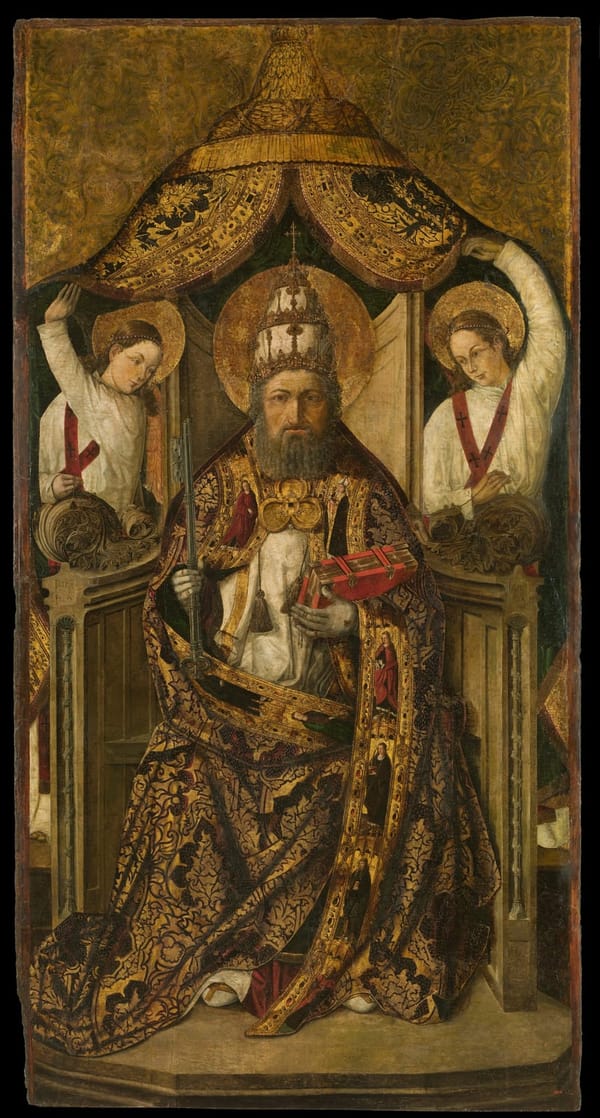
February 22: St. Peter's Chair at Antioch
We are called upon, a second time, to honour St. Peter’s chair: first, it was his pontificate in Rome; to-day, it is his episcopate at Antioch. The seven years spent by the prince of the apostles in the second of these cities, were the grandest glory she ever had; and they are too important a portion of the life of St. Peter to be passed by without being noticed in the Christian cycle.
Three years had elapsed since our Lord’s Ascension. The Church had already been made fruitful by martyrdom, and from Jerusalem she had spread into distant countries. Antioch, the first of the cities of Asia, had received the Gospel; and it was there that those who professed the faith of Jesus were first called Christians. Jerusalem was doomed to destruction for having not only refused to acknowledge, but even crucified, the Messias: it was time for Peter, in whom resided the supreme power, to deprive the faithless city of the honour she had heretofore enjoyed, of possessing within her walls the chair of the apostolate. It was towards the Gentiles that the Holy Spirit drove those clouds, which were shown to Isaias as the symbol of the holy apostles.1 Accordingly, it is in Antioch, the third capital of the Roman Empire, that Peter first places the august throne, on which, as vicegerent of Christ, he presides over the universal Church.
But the progress of the apostles was so rapid; the conquests they made, in spite of every opposition, were so extensive, that the vicar of Christ was inspired to leave Antioch, after he had honoured it with the chair during the space of seven years. Alexandria, the second city of the empire, is also to be made a see of Peter; and Rome, the capital of the world, awaits the grand privilege for which God has long been preparing her. Onwards, then, does the prince advance, bearing with him the destinies of the Church; where he fixes his last abode, and where he dies, there will he have his successor in his sublime dignity of vicar of Christ. He leaves Antioch, making one of his disciples, Evodius, its bishop. Evodius succeeds Peter as bishop of Antioch; but that see is not to inherit the headship of the Church, which goes whithersoever Peter goes. He sends Mark, another of his disciples, to take possession, in his name, of Alexandria; and this Church he would have to be the second in the world, and though he has not ruled it in person, he raises it above that of Antioch. This done, he goes to Rome, where he permanently establishes that chair, on which he will live, and teach, and rule, in his successors, to the end of time.
And here we have the origin of the three great patriarchal sees, which were the object of so much veneration in the early ages: the first is Rome, invested with all the prerogatives of the prince of the apostles, which, when dying, he transmitted to her; the second is Alexandria, which owes her preeminence to Peter’s adopting her as his second see; the third is Antioch, whither he repaired in person, when he left Jerusalem to bring to the Gentiles the grace of adoption. If, therefore, Antioch is below Alexandria in rank, Alexandria never enjoyed the honour granted to Antioch, of having been governed, in person, by him whom Christ appointed to be the supreme pastor of His Church. Nothing, then, could be more just, than that Antioch should be honoured, as having, for seven years, had the privilege of being the centre of Christendom; and this is the object of to-day’s feast.
The children of the Church have a right to feel a special interest in every solemnity that is kept in memory of St. Peter. The father’s feast is a feast for the whole family; for to him it owes its very life. If there be but one fold, it is because there is but one Shepherd. Let us, then, honour Peter’s divine prerogative, to which Christianity owes its preservation; and let us often reflect upon the obligations we are under to the apostolic see. On the feast of the chair at Rome, we saw how faith is taught, and maintained, and propagated by the mother-Church, which has inherited the promises made to Peter. To-day, let us consider the apostolic see as the sole source of the legitimate power, whereby mankind is ruled and governed in all that concerns eternal salvation.
Our Saviour said to Peter: ‘To thee will I give the keys of the kingdom of heaven,’2 that is to say, of the Church. He said to him on another occasion: ‘Feed My lambs, feed My sheep.’3 So that Peter is prince; for, in the language of the sacred Scriptures, keys denote princely power: he is also pastor, and universal pastor; for the whole flock is comprised under the two terms, lambs and sheep. And yet there are other pastors in every portion of the Christian world. The bishops, whom the Holy Ghost hath placed to rule the Church of God,4 govern, in his name, their respective dioceses, and are also pastors. How comes it that the keys, which were given to Peter, are found in other hands than his? The Catholic Church explains the difficulty to us by her tradition. She says to us, by Tertullian: ‘Christ gave the keys to Peter, and through him to the Church.’5 By St. Optatus of Milevis: 'For the sake of unity, Peter was made the first among all the apostles, and he alone received the keys, that he might give them to the rest.’6 By St. Gregory of Nyssa: ‘It is through Peter that Christ gave to bishops the keys of their heavenly prerogative.’7 By St. Leo the Great: 'If our Lord willed that there should be something common to Peter and the rest of the princes of His Church, it was only on this condition, that whatsoever He gave to the rest, He gave it to them through Peter.’8
Yes, the episcopate is most sacred, for it comes from the hands of Jesus Christ through Peter and his successors. Such is the unanimous teaching of Catholic tradition, which is in keeping with the language used by the Roman pontiffs, from the earliest ages, who have always spoken of the dignity of bishops as consisting in their being ‘called to a share of their own solicitude.' Hence St. Cyprian does not hesitate to say that 'our Saviour, wishing to establish the episcopal dignity and constitute His Church, says to Peter: “To thee will I give the keys of the kingdom of heaven and here we have both the institution of bishops, and the constitution of the Church.’9 This same doctrine is clearly stated in a letter written to Pope St. Symmachus by St. Cesarius of Arles, who lived in the fifth century: ‘The episcopate flows from the blessed apostle Peter; and consequently, it belongs to your holiness to prescribe to the several Churches the rules which they are to follow.’10 This fundamental principle, which St. Leo the Great has so ably and eloquently developed (as we have seen on the feast of the chair at Rome, January 18), this principle, which is taught us by universal tradition, is laid down with all possible precision in the magnificent letters, still extant, of Pope St. Innocent I., who preceded St. Leo by several years. Thus he writes to the Council of Carthage, that ‘the episcopate, with all its authority, emanates from the apostolic see’;11 to the Council of Milevis, that 'bishops must look upon Peter as the source whence both their name and their dignity are derived’;12 to St. Victricius, bishop of Rouen, that 'the apostolate and the episcopate both owe their origin to Peter.’13
Controversy is not our object. All we aim at by giving these quotations from the fathers on the prerogatives of Peter’s chair, is to excite the faithful to be devoted to it and venerate it. This we have endeavoured to do, by showing them that this chair is the source of the spiritual authority, which, in its several degrees, rules and sanctifies them. All spiritual authority comes from Peter; all comes from the bishop of Rome, in whom Peter will continue to govern the Church to the end of time. Jesus Christ is the founder of the episcopate; it is the Holy Ghost who establishes bishops to rule the Church; but the mission and the institution, which assign the pastor his flock, and the flock its pastor, these are given by Jesus Christ and the Holy Ghost through the ministry of Peter and his successors.
How sacred, how divine, is this authority of the keys, which is first given by heaven itself to the Roman Pontiff; then is delegated by him to the prelates of the Church; and thus guides and blesses the whole Christian world! The apostolic see has varied its mode of transmitting such an authority according to the circumstances of the several ages; but the one source of the whole power was always the same, the chair of Peter. We have already seen how, at the commencement, there were three chairs: Rome, Alexandria, and Antioch; and all three were sources of the canonical institution of the bishops of their respective provinces; but they were all three chairs of Peter, for they were founded by him that they might preside over their patriarchates, as St. Leo,14 St. Gelasius,15 and St. Gregory the Great,16 expressly teach. But of these three chairs, the Pontiff of Rome had his authority and his institution from heaven; whereas, the two other patriarchs could not exercise their rights, until they were recognized and confirmed by him who was Peter’s successor, as vicar of Christ. Later on, two other sees were added to these first three: but it was only by the consent of the Roman Pontiff that Constantinople and Jerusalem obtained such an honour. Let us notice, too, the difference there is between the accidental honours conferred on four of these Churches, and the divine prerogative of the Church of Rome. By God’s permission, the sees of Alexandria, Antioch, Constantinople, and Jerusalem, were defiled by heresy; they became chairs of pestilence;17 and having corrupted the faith they received from Rome, they could not transmit to others the mission they themselves had forfeited. Sad indeed was the ruin of such pillars as these! Peter’s hand had placed them in the Church. They had merited the love and veneration of men; but they fell; and their fall gave one more proof of the solidity of that edifice, which Christ Himself had built on Peter. The unity of the Church was made more visible. Obliged by the treachery of her own favoured children to deprive them of the privileges they had received from her, Rome was, more evidently than ever, the sole source of pastoral power.
We, then, both priests and people, have a right to know whence our pastors have received their power. From whose hand have they received the keys? If their mission come from the apostolic see, let us honour and obey them, for they are sent to us by Jesus Christ, who has invested them, through Peter, with His own authority. If they claim our obedience without having been sent by the bishop of Rome, we must refuse to receive them, for they are not acknowledged by Christ as His ministers. The holy anointing may have conferred on them the sacred character of the episcopate: it matters not; they must be as aliens to us, for they have not been sent, they are not pastors.
Thus it is that the divine Founder of the Church, who willed that she should be a city seated on a mountain,18 gave her visibility; it was an essential requisite; for since all were called to enter her pale, all must be able to see her. But He was not satisfied with this. He moreover willed that the spiritual power exercised by her pastors should come from a visible source, so that the faithful might have a sure means of verifying the claims of those who were to guide them in His name. Our Lord (we say it reverently) owed this to us; for, on the last day, He will not receive us as His children, unless we shall have been members of His Church, and have lived in union with Him by the ministry of pastors lawfully constituted. Honour, then, and submission to Jesus in His vicar! honour and submission to the vicar of Christ in the pastors he sends!
As a tribute of our devotion to the prince of the apostles, let us recite, in his honour, the following hymn, composed by St. Peter Damian:
Hymn
Princeps, et præco Domini:
Pastor prime fidelium,
Custodi gregem creditum.
Nos verbi fruge recrea:
Refectas oves prævius
Caulis infer cœlestibus.
Tibi, Petre, sunt traditæ:
Tuisque patent legibus
Terrena cum cœlestibus.
Tu basini sedificii
Fundas, in qua Catholica
Fixa surgit Ecclesia.
Fit medicina languidis;
Textrinis usa vestium
Sprevit Tabitha feretrum.
Virtus solvit angelica;
Veste sumpta cum caligis,
Patescunt fores carceris.
Sit decus Unigenito,
Sit utriusque parili
Majestas summa Flamini.
Herald of our Lord!
First pastor of the faithful!
watch over the flock entrusted to thee.
feeding us with the nourishment of the word;
and lead us, thus fed, into the heavenly fold,
whither thou hast already gone.
the keys of heaven’s gate;
and all things, both in heaven and on earth,
acknowledge thy authority.
where is to be established the rock of the true faith,
the foundation of the building,
on which the Catholic Church stands immovable.
heals the sick;
and Tabitha, that made garments for the poor,
was raised to life at thy bidding.
thou wast set free by an angel's power;
he bids thee put on thy garments and thy sandals,
and lo! the prisondoor is opened.
and to the only-begotten Son,
and to the coequal Spirit of them both,
be praise and kingly highest power.
Glory be to thee, O prince of the apostles, on thy chair at Antioch, where thou didst for seven years preside over the universal Church! How magnificent are the stations of thy apostolate! Jerusalem, Antioch, Alexandria (by thy disciple Mark), and Rome, these are the cities which have been honoured by thy august chair. After Rome, Antioch was the longest graced by its presence: justly, therefore, do we honour this Church, which was thus made, by thee, the mother and mistress of all other Churches. Alas! all her beauty has now left her; her faith is dead; she is in bondage to the Saracen. Save her, take her once more under thy power, bring her into allegiance to Rome, where thou hast thy chair, not for seven years only, but for all ages. The gates of hell have let loose the fury of every tempest upon thee, firm rock of the Church! and we ourselves have Been the immortal chair banished for a time from Rome. The words of St. Ambrose then came to our minds: ‘Where Peter is, there is the Church.’ How could we despair? Did we not know, that it was God’s inspiration which made thee choose Rome for the fixed resting-place of thy throne? No human will can put asunder what God has united; the bishop of Rome must ever be the vicar of Christ; and the vicar of Christ, let sacrilege and persecution banish him as they will, must ever be the bishop of Rome. Holy apostle! calm the wildness of the tempest, lest the weak should take scandal. Beseech our Lord that He permit not the residence of thy successor to be disturbed in that holy city, which has been chosen for so great an honour. If it be that her inhabitants deserve punishment for their offences, spare them for the sake of their brethren of the rest of the world; and pray for them, that their faith may once more become what it was when St. Paul praised it, and said to them: ‘Your faith is spoken of in the whole world.’19
- Isa. lx. 8. ↩︎
- St. Matt. xvi. 19. ↩︎
- St. John xxi. 15, 17. ↩︎
- Acts xx. 28. ↩︎
- Scorpiac., cap. x. ↩︎
- Contra Parmenianum, lib. vii. ↩︎
- Opp., tom. iii. ↩︎
- In Anniv. assumpt., serm. iv. ↩︎
- Epist. xxxiii. ↩︎
- Ibid., x. ↩︎
- Ibid., xxix. ↩︎
- Ibid., xxx. ↩︎
- Ibid., ii. ↩︎
- Epist. civ. Ad Anatolium. ↩︎
- Concli. Romanum. Labb., tom. iv. ↩︎
- Epist. Ad Eulogium. ↩︎
- Ps. i. 1. ↩︎
- St. Matt. v. 14. ↩︎
- Rom. i. 8. ↩︎
Tuesday of Sexagesima Week
When we reflect upon the terrible events which happened in the first age of the world, we are lost in astonishment at the wickedness of man, and at the effrontery wherewith he sins against his God. How was it that the dread words of God, which were spoken against our first parents in Eden, could be so soon forgotten? How could the children of Adam see their father suffering and doing such endless penance, without humbling themselves and imitating this model of repentance? How was it that the promise of a Mediator, who was to reopen the gate of heaven for them, could be believed, and yet not awaken in their souls the desire of making themselves worthy to be His ancestors, and partakers of that grand regeneration, which He was to bring to mankind? And yet, the years which followed the death of Adam were years of crime and scandal; nay, he himself lived to see one of his own children become the murderer of a brother. But why be thus surprised at the wickedness of these our first brethren? The earth is now six thousand years old in the continued reception of divine blessings and chastisements; and are men less dull of heart, less ungrateful, less rebellious towards their Maker? For the generality of men—we mean, of those who deign to believe in the fall and chastisement of our first parents, and in the destruction of the world by the deluge—what are these great truths? Mere historical facts, which have never once inspired them with a fear of God’s justice. More favoured than these early generations of the human race, they know that the Messias has been sent, that God has come down upon the earth, that He has been made Man, that He has broken Satan’s rule, that the way to heaven has been made easy by the graces embodied by the Redeemer in the Sacraments: and yet, sin reigns and triumphs in the midst of Christianity. Undoubtedly, the just are more numerous than they were in the days of Noah; but then, what riches of grace has our Redeemer poured out on our degenerate race by the ministry of His bride the Church! Yes, there are faithful Christians to be found upon the earth, and the number of the elect is every day being added to; but the multitude are living at enmity with God, and their actions are in contradiction to their faith.
When, therefore, the holy Church reminds us of those times, wherein all flesh had corrupted its way, she is urging us to think about our own conversion. Her motive in relating to us the history of the sins committed at the beginning of the world, is to induce us to examine our own consciences. Why, too, does she read to us those pages of sacred Writ, which so vividly describe the flood-gates of heaven opening and deluging the guilty earth, if not that she would warn us against mocking that great God, who thus chastised the sins of His rebellious creatures? Last week we were called upon to consider the sad consequences of Adam’s sin, a sin which we ourselves did not commit, but the effects of which lie so heavy upon us. This week we must reflect upon the sins we ourselves have committed. Though God has loaded us with favours, guided us by His light, redeemed us with His Blood, and strengthened us against all our enemies by His grace, yet have we corrupted our way, and caused our God to repent of having created us. Let us confess our wickedness, and humbly acknowledge that we owe it to the mercies of the Lord, that we have not been consumed.*
The Ambrosian missal contains the following exhortation for this season of the year.
Transitorium
(Dominica in Septuagesima.)
* Lam. iii. 22. ↩︎
| Previous Monday of Sexagesima Week | Next Tuesday of Sexagesima Week |