Daily reading
Septuagesima
Double of the II Class · February 24 · Sanctoral
February 24, 2022
From Dom Guéranger’s The Liturgical Year.
A Double of the II Class leads the weekday.Rubric

|
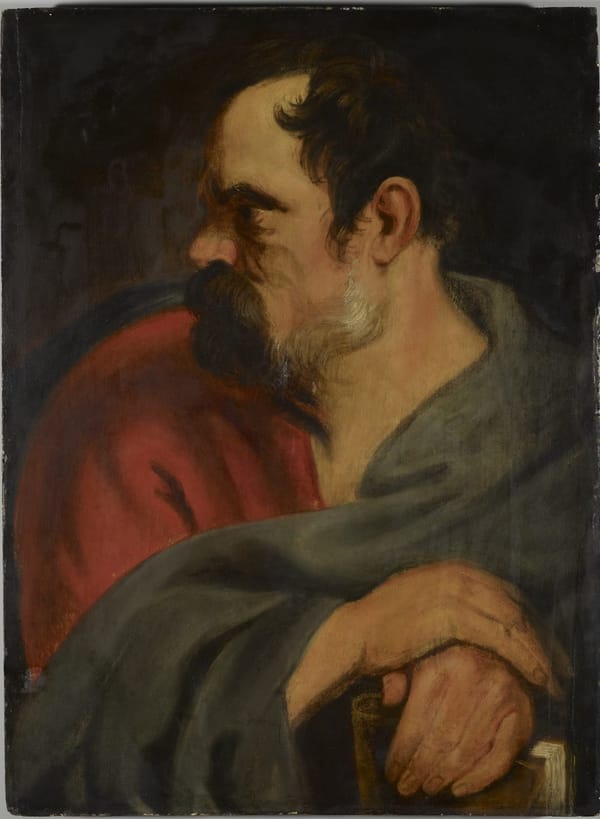
February 24: St. Mathias, Apostle
In leap-year, the feast of St Mathias is kept on February 25.
An apostle of Jesus Christ, St. Mathias, is one of the blessed choir which the Church would have us honour during the season of Septuagesima. Mathias was one of the first to follow our Saviour; and he was an eye-witness of all His divine actions up to the very day of the Ascension. He was one of the seventy-two disciples; but our Lord had not conferred upon him the dignity of an apostle. And yet, he was to have this great glory, for it was of him that David spoke, when he prophesied that another should take the bishopric1 left vacant by the apostasy of Judas the traitor. In the interval between Jesus’ Ascension and the descent of the Holy Ghost, the apostolic college had to complete the mystic number fixed by our Lord Himself, so that there might be the twelve on that solemn day, when the Church, filled with the Holy Ghost, was to manifest herself to the Synagogue. The lot fell on Mathias;2 he shared with his brother-apostles the persecution in Jerusalem, and, when the time came for the ambassadors of Christ to separate, he set out for the countries allotted to him. Tradition tells us that these were Cappadocia and the provinces bordering on the Caspian Sea.
The virtues, labours, and sufferings of St. Mathias have not been handed down to us: this explains the lack of proper lessons on his life, such as we have for the feasts of the rest of the apostles. Clement of Alexandria records in his writings several sayings of our holy apostle. One of these is so very appropriate to the spirit of the present season, that we consider it a duty to quote it. 'It behoves us to combat the flesh, and make use of it, without pampering it by unlawful gratifications. As to the soul, we must develop her power by faith and knowledge.’3 How profound is the teaching contained in these few words! Sin has deranged the order which the Creator had established. It gave the outward man such a tendency to grovel in things which degrade him, that the only means left us for the restoration of the image and likeness of God unto which we were created, is the forcible subjection of the body to the spirit. But the spirit itself, that is, the soul, was also impaired by original sin, and her inclinations were made prone to evil; what is to be her protection? Faith and knowledge. Faith humbles her, and then exalts and rewards her; and the reward is knowledge. Here we have a summary of what the Church teaches us during the two seasons of Septuagesima and Lent. Let us thank the holy apostle, on this his feast, for leaving us such a lesson of spiritual wisdom and fortitude. The same traditions, which give us some Blight information regarding the holy life of St. Mathias, tell us that his apostolic labours were rewarded with the palm of martyrdom. Let us celebrate his triumph by the following stanzas, which are taken from the Menææa of the Greeks.
Hymn (Die IX. Augusti)
Thursday of Sexagesima Week
God promised Noah that He would never more punish the earth with a deluge. But, in His justice, He has many times visited the sins of men with a scourge which, in more senses than one, bears a resemblance to a deluge: the invasion of enemies. We meet with these invasions in every age; and each time we see the hand of God. We can trace the crimes that each of them was sent to punish, and in each we find a manifest proof of the infinite justice wherewith God governs the world.
It is not requisite that we should here mention the long list of these revolutions, which we might almost say make up the history of mankind, for in its every page we read of conquests, extinction of races, destruction of nations, and violent amalgamations, which effaced the traditions and character of the several peoples that were thus forced into union. We will confine our considerations to the two great invasions, which the just anger of God has permitted to come upon the world since the commencement of the Christian era.
The Roman Empire had made itself as preeminent in crime as it was in power. It conquered the world, and then corrupted it. Idolatry and immorality were the civilization it gave to the nations which had come under its sway. Christianity could save individuals in the great empire, but the empire itself could not be made Christian. God let loose upon it the deluge of barbarians. The stream of the wild invasion rose to the very dome of the Capitol; the empire was engulfed. The ruthless ministers of divine justice were conscious of their being chosen for this mission of vengeance, and they gave themselves the name of ‘God's scourge.’
When, later on, the Christian nations of the east had lost the faith which they themselves had transmitted to the western world; when they had disfigured the sacred symbol of faith by their blasphemous heresies; the anger of God sent upon them, from Arabia, the deluge of Mahometanism. It swept away the Christian Churches, that had existed from the very times of the apostles. Jerusalem, the favoured Jerusalem, on which Jesus had lavished His tenderest love, even she became a victim to the infidel hordes. Antioch and Alexandria, with their patriarchates, were plunged into the vilest slavery; and at length Constantinople, that had so obstinately provoked the divine indignation, was made the very capital of the Turkish empire.
And we, the western nations, if we return not to the Lord our God, shall we be spared? Shall the flood-gates of heaven's vengeance, the torrent of fresh Vandals, ever be menacing to burst upon us, yet never come? Where is the country of our own Europe, that has not corrupted its way, as in the days of Noah? that has not made conventions against the Lord and against His Christ?1 that has not clamoured out that old cry of revolt: Let us break their bonds asunder, let us cast away their yoke from us?2 Well may we fear lest the time is at hand, when, despite our haughty confidence in our means of defence, Christ our Lord, to whom all nations have been given by the Father, shall rule us with a rod of iron, and break us in pieces like a potter’s vessel.3 Let us propitiate the anger of our offended God, and follow the inspired counsel of the royal prophets Serve ye the Lord with fear; embrace the discipline of His Law; lest, at any time, the Lord be angry, and ye perish from the just way.4
We find the following beautiful words in the Ambrosian liturgy for Septuagesima. They occur in the missal.
Transitorium
(Dominica in Quinquagesima.)
| Previous Wednesday of Sexagesima Week | Next Thursday of Sexagesima Week |