Daily reading
Lent
Simple · Movable from Easter · Temporal
March 6, 2022
From Dom Guéranger’s The Liturgical Year.
The Sunday leads; Sts. Felicitas and Perpetua are commemorated.Rubrics

|
The First Sunday of Lent
This Sunday, the first of the six which come during Lent, is one of the most solemn throughout the year. In common with the other Sundays of Lent, it has the privilege of taking precedence of all feasts, even that of the patron, titular saint, or dedication of the Church. In the ancient calendars, it is called Invocabit, from the first word of the Introit of the Mass. In the middle ages,1 it was called Brand Sunday, because the young people, who had misconducted themselves during the carnival, were obliged to show themselves to-day at the church with a torch in their hands, as a kind of public satisfaction for their riot and excess.
Lent solemnly opens to-day. We have already noticed that the four preceding days were added since the time of St. Gregory the Great, in order to make up forty days of fasting. Neither can we look upon Ash Wednesday as the solemn opening of the season; for the faithful are not bound to hear Mass on that day. The holy Church, seeing her children now assembled together, speaks to them, in her Office of Matins, these eloquent and noble words of St. Leo the Great:
Having to announce to you, dearly beloved, the most sacred and chief fast, how can I more appropriately begin, than with the words of the apostle, in whom Christ Himself spoke, and by saying to you what has just been read: Behold! now is the acceptable time; behold! now is the day of salvation. For although there be no time which is not replete with divine gifts, and we may always, by God’s grace, have access to His mercy, yet ought we all to redouble our efforts to make spiritual progress and be animated with unusual confidence, now that the anniversary of the day of our redemption is approaching, inviting us to devote ourselves to every good work, that so we may celebrate, with purity of body and mind, the incomparable mystery of our Lord’s Passion.
It is true that our devotion and reverence towards so great a mystery should be kept up during the whole year, and we ourselves should be at all times, in the eyes of God, the same as we are bound to be at the Easter solemnity. But this is an effort which only few among us have the courage to sustain. The weakness of the flesh induces us to relax our austerities; the various occupations of every-day life take up our thoughts; and thus even the virtuous find their hearts clogged by this world’s dust. Hence it is that our Lord has most providentially given us these forty days, whose holy exercises should be to us a remedy, whereby to regain our purity of soul. The good works and the holy fastings of this season were instituted as an atonement for, and an obliteration of, the sins we commit during the rest of the year.
Now, therefore, that we are about to enter upon these days, which are so full of mystery, and which were instituted for the holy purpose of purifying both soul and body, let us; dearly beloved, be careful to do as the apostle bids us, and cleanse ourselves from all defilement of the flesh and of the spirit: that thus the combat between the two substances being made less fierce, the soul, which, when she herself is subject to God, ought to be the ruler of the body, will recover her own dignity and position. Let us also avoid giving offence to any man, so that there be none to blame or speak evil things of us. For we deserve the harsh remarks of infidels, and we provoke the tongues of the wicked to blaspheme religion, when we who fast lead unholy lives. For our fast does not consist in the mere abstinence from food; nor is it of much use to deny food to our body, unless we restrain the soul from sin.2
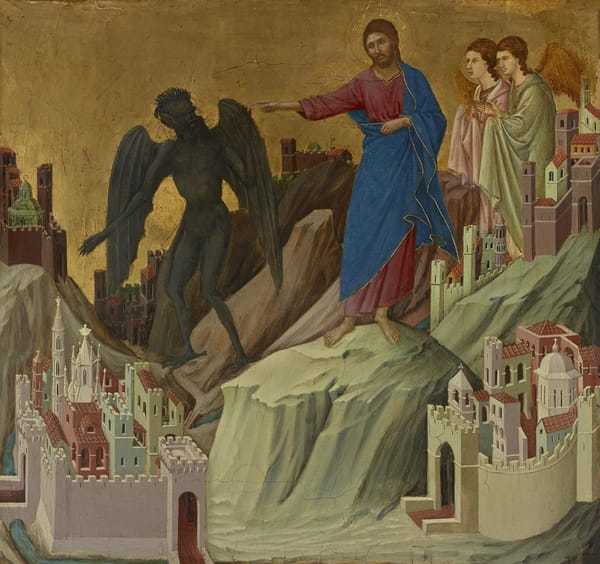
Each Sunday of Lent offers to our consideration a passage from the Gospel, which is in keeping with the sentiments wherewith the Church would have us be filled. To-day she brings before us the temptation of our Lord in the desert. What light and encouragement there is for us in this instruction!
We acknowledge ourselves to be sinners; we are engaged, at this very time, in doing penance for the sins we have committed—but how was it that we fell into sin? The devil tempted us; we did not reject the temptation; then we yielded to the suggestion, and the sin was committed. This is the history of our past; and such it would, also, be for the future, were we not to profit by the lesson given us to-day by our Redeemer.
When the apostle speaks of the wonderful mercy shown us by our divine Saviour, who vouchsafed to make Himself like to us in all things save sin, he justly lays stress on His temptations.3 He, who is very God, humbled Himself even so low as this, to prove how tenderly He compassionated us. Here, then, we have the Saint of saints allowing the wicked spirit to approach Him, in order that we might learn, from His example, how we are to gain victory under temptation.
Satan has had his eye upon Jesus; he is troubled at beholding such matchless virtue. The wonderful circumstances of His birth; the shepherds called by angels to His crib, and the Magi guided by the star; the Infant’s escape from Herod’s plot; the testimony rendered to this new Prophet by John the Baptist: all these things, which seem so out of keeping with the thirty years spent in obscurity at Nazareth, are a mystery to the infernal serpent, and fill him with apprehension. The ineffable mystery of the Incarnation has been accomplished unknown to him; he never once suspects that the humble Virgin, Mary, is she who was foretold by the prophet Isaias, as having to bring forth the Emmanuel;4 but he is aware that the time has come, that the last week spoken of to Daniel has begun its course, and that the very pagans are looking towards Judea for a deliverer. He is afraid of this Jesus; he resolves to speak with Him, and elicit from Him some expression which will show him whether He be or not the Son of God; he will tempt Him to some imperfection, or sin, which, should he commit it, will prove that the object of so much fear is, after all, but a mortal Man.
The enemy of God and men is, of course, disappointed. He approaches Jesus; but all his efforts turn only to his own confusion. Our Redeemer, with all the self-possession and easy majesty of a God-Man, repels the attacks of satan; but He reveals not His heavenly origin. The wicked spirit retires without having made any discovery beyond this—that Jesus is a prophet, faithful to God. Later on, when he sees the Son of God treated with contempt, calumniated and persecuted; when he finds that his own attempts to have Him put to death are so successful: his pride and his blindness will be at their height; and not till Jesus expires on the cross, will he learn that his victim was not merely Man, but Man and God. Then will he discover how all his plots against Jesus have but served to manifest, in all their beauty, the mercy and justice of God: His mercy, because He saved mankind; and His justice, because He broke the power of hell for ever.
These were the designs of divine Providence in permitting the wicked spirit to defile, by his presence, the retreat of Jesus, to speak to Him, and to lay his hands upon Him. But let us attentively consider the triple temptation in all its circumstances; for our Redeemer suffered it only in order that He might instruct and encourage us.
We have three enemies to fight against; our soul has three dangers; for, as the beloved disciple says, all that is in the world, is the concupiscence of the flesh, and the concupiscence of the eyes, and the pride of life!5 By the concupiscence of the flesh, is meant the love of sensual things, which covets whatever is agreeable to the flesh, and, when not curbed, draws the soul into unlawful pleasures. Concupiscence of the eyes expresses the love of the goods of this world, such as riches, and possessions; these dazzle the eye, and then seduce the heart. Pride of life is that confidence in ourselves, which leads us to be vain and presumptuous, and makes us forget that all we have, our life and every good gift, we have from God.
Every one of our sins comes from one of these three sources; every one of our temptations aims at making us accept the concupiscence of the flesh, or the concupiscence of the eyes, or the pride of life. Our Saviour, then, who would be our model in all things, deigned to subject Himself to these three temptations.
First of all satan tempts Him in what regards the flesh: he suggests to Him to satisfy the cravings of hunger, by working a miracle, and changing the stones into bread. If Jesus consent, and show an eagerness in giving this indulgence to His body, the tempter will conclude that He is but a frail mortal, subject to concupiscence like other men. When he tempts us, who have inherited evil concupiscence from Adam, his suggestions go further than this: he endeavours to defile the soul by the body. But the sovereign holiness of the Incarnate Word could never permit satan to use upon Him the power which he has received of tempting man in his outward senses. The lesson, therefore, which the Son of God here gives us, is one of temperance: but we know that, for us, temperance is the mother of purity, and that intemperance excites our senses to rebel.
The second temptation is to pride; ‘Cast Thyself down; the angels shall bear Thee up in their hands.’The enemy is anxious to see if the favours of heaven have produced in Jesus’soul that haughtiness, that ungrateful self-confidence, which makes the creature arrogate God’s gifts to itself, and forget its benefactor. Here, also, he is foiled; our Redeemer’s humility confounds the pride of the rebel angel.
He then makes a last effort: he hopes to gain over by ambition Him who has given such proofs of temperance and humility. He shows Him all the kingdoms of the world, and the glory of them; and says to Him: ‘All these will I give Thee, if falling down, Thou wilt adore me.’Jesus rejects the wretched offer, and drives from Him the seducer, the prince of this world;6 hereby teaching us that we must despise the riches of this world, as often as our keeping or getting them is to be on the condition of our violating the law of God and paying homage to satan.
But let us observe how it is that our divine Model, our Redeemer, overcomes the tempter. Does He hearken to His words? Does He allow the temptation time, and give it strength by delay? We did so, when we were tempted; and we fell. But our Lord immediately meets each temptation with the shield of God’s word. He says: ‘It is written: Not on bread alone doth man live. It is written: Thou shalt not tempt the Lord thy God. It is written: The Lord thy God shalt thou adore, and Him only shalt thou serve.’ This, then, must be our practice for the time to come. Eve brought perdition on herself, and on the whole human race, because she listened to the serpent. He that dallies with temptation is sure to fall. We are now in a season of extraordinary grace; our hearts are on the watch, dangerous occasions are removed, everything that savours of worldliness is laid aside; our souls, purified by prayer, fasting, and almsdeeds, are to rise with Christ, to a new life; but, shall we persevere? All depends upon how we behave under temptation. Here, at the very opening of Lent, the Church gives us this passage of the holy Gospel, that we may have not only precept but example. If we be attentive and faithful, the lesson she gives us will produce its fruit; and when we come to the Easter solemnity, we shall have those sure pledges of perseverance: vigilance, self-diffidence, prayer, and the never-failing help of divine grace.
The Greek Church, in spite of her principle of never admitting a feast during Lent, celebrates to-day one of her greatest solemnities. It is called Orthodoxia, and was instituted in memory of the restoration of sacred images in Constantinople and the eastern empire, in the year 842, when the empress Theodora, aided by the holy patriarch Methodius, put a stop to the Iconoclast persecution, and restored to the churches the holy images which the fury of the heretics had taken away.
Mass
The Station, at Rome, is in the patriarchal basilica of Saint John Lateran. It was but right, that a Sunday of such solemnity as this should be celebrated in the church which is the mother and mistress of all churches, not only of the holy city itself, but of the whole world. It is here that the public penitents were reconciled on Maundy Thursday; it is here, also, in the baptistery of Constantine, that the catechumens received Baptism on the night preceding Easter Sunday. No other basilica could have had such a claim for the Station of a day like this; for it is there that the Lenten Fast had been so often proclaimed by Leo and Gregory.
The Introit, as likewise the Gradual, Tract, Offertory, and Communion, are all taken from Psalm XC. We have elsewhere spoken of the appropriateness of this beautiful psalm to the spirit of the Church during the season of Lent. It bids the Christian soul confide in the divine aid. She is now devoting her whole energies to prayer; she is engaged in battle with her own and God’s enemies. She has need of support. Let her not be afraid: God tells her, in these words of the Introit, that her confidence in Him shall not be in vain.
Introit
In the Collect, the Church prays for her children, that their fast may not only purify them, but also obtain for them that divine assistance, which will secure their salvation by enabling them to abound in good works.
Collect
The two following Collects, for the general wants of the Church, are then added.
Second Collect
Third Collect
Epistle
2 Cap. vi.
Fratres, exhortamur vos, ne in vacuum gratiam Dei recipiatis. Ait enim: Tempore accepto exaudivi te, et in die salutis adjuvi te. Ecce nunc tempus acceptable, ecce nunc dies salutis. Nemini dantee ullam offensionem, ut non vituperetur ministerium nostrum: sed in omnibus exhibeamus nosmetipsos sicut Dei ministros, in multa patientia, in tribulationibus, in necessitatibus, in angustiis, in plagis, in carceribus, in seditionibus, in laboribus, in vigiliis, in jejuniis, in castitate, in scientia, in longanimitate, in suavitate, in Spiritu sancto, in charitate non ficta, in verbo veritatis, in virtute Dei, per arma justitiæ a dextris et a sinistris, per gloriam et ignobilitatem, per infamiam et bonam famam; ut seductores, et veraces; sicut qui ignoti, et cogniti; quasi morientes, et ecce vivimus: ut castigati, et non mortificati: quasi tristes, semper autem gaudentes: sicut egentes, multos autem locupletantes: tamquam nihil habentes, et omnia possidentes.
2 Ch. vi.
These words of the apostle give us a very different idea of the Christian life from that which our own tepidity suggests. We dare not say that he is wrong, and we are right; but we put a strange interpretation upon his words, and we tell both ourselves and those around us that the advice he here gives is not to be taken literally nowadays, and that it was written for those special difficulties of the first age of the Church, when the faithful stood in need of unusual detachment and almost heroism, because they were always in danger of persecution and death. The interpretation is full of that discretion which meets with the applause of our cowardice, and it easily persuades us to be at rest, just as though we had no dangers to fear, and no battle to fight; whereas, we have both: for there is the devil, the world, flesh and blood. The Church never forgets it; and hence, at the opening of this great season, she sends us into the desert, that there we may learn from our Jesus how we are to fight. Let us go; let us learn, from the temptations of our divine Master, that the life of man upon earth is a warfare,7 and that, unless our fighting be truceless and brave, our life, which we would fain pass in peace, will witness our defeat. That such a misfortune may not befall us, the Church cries out to us, in the words of St. Paul: Behold! now is the acceptable time. Behold! now is the day of salvation. Let us, in all things, comport ourselves as the servants of God, and keep our ground unflinchingly to the end of our holy campaign. God is watching over us, as He did over His beloved Son in the desert.
The Gradual tells us that we are under the protection of the angels, and that these blessed spirits leave us not, either day or night. During Lent they redouble their efforts against our enemies, and rejoice at seeing us sinners accept the penance which is to bring us to salvation.
The Tract, too, inspires us with confidence: it speaks to us of the goodness of God, and of His fatherly watchfulness over us His ungrateful children, whom He wishes to make His faithful friends and coheirs of His kingdom.
Gradual
Tract
Gospel
Cap. iv.In illo tempore, Ductus est Jesus in desertum a Spiritu, ut tentaretur a diabolo. Et, cum jejunasset quadraginta diebus et quadraginta noctibus, postea esuriit. Et accedens tentator, dixit ei: Si Filius Dei os, dic ut lapides isti panes fiant. Qui respondens, dixit: Scriptum est: Non in solo pane vivit homo, sed in omni verbo quod procedit de ore Dei. Tunc assumpsit cum diabolus in sanctam civitatem, et statuit eum super pinnaculum templi, et dixit ei: Si Filius Dei es, mitte te deorsum. Scriptum est enim: Quia angelis suis mandavit de te, et in manibus tollent te, ne forte offendas ad lapidem pedem tuum. Ait illi Jesus: Rursum scriptum est: Non tentabis Dominum Deum tuum. Iterum assumpsit eum diabolus in montem excelsum valde: et ostendit ei omnia regna mundi, et gloriam eorum, et dixit ei: Hæc omnia tibi dabo, si cadens adoraveris me. Tune dicit ei Jesus: Vade satana: scriptum est enim: Dominum Deum tuum adorabis, et illi soli servies. Tunc reliquit eum diabolus: et ecce angeli accesserunt, et ministrabant ei.
Ch. iv.At that time, Jesus was led by the Spirit into the desert, to be tempted by the devil. And when he had fasted forty days and forty nights, afterwards he was hungry. And the tempter coming, said to him: If thou be the Son of God, command that these stones be made bread. Who answered and said: It is written: Not in bread alone doth man live, but in every word that proceeded from the mouth of God. Then the devil took him up into the holy city, and set him upon the pinnacle of the temple, and said to him: If thou be the Son of God, cast thyself down: for it is written, that he hath given his angels charge over thee, and in their hands shall they bear thee up, lest perhaps thou dash thy foot against a stone. Jesus said to him: It is written again: Thou shalt not tempt the Lord thy God. Again the devil took him up into a very high mountain, and showed him all the kingdoms of the world, and the glory of them, and said to him: All these will I give thee, if falling down thou wilt adore me. Then Jesus saith to him: Begone, satan, for it is written: The Lord thy God shalt thou adore and him only shalt thou serve. Then the devil left him; and behold angels came and ministered to him.
Let us admire the exceeding goodness of the Son of God, who, not satisfied with atoning for all our sins by dying on the cross, deigns to suffer a fast of forty days and forty nights, in order to encourage us to do penance. He would not that the justice of His heavenly Father should exact any punishment from us, unless He Himself first suffered it, and that, too, a thousand times more severely than we could. What are all our penances, even were they done thoroughly, when we compare them with the severity of this fast of Jesus in the desert? Can we have the face to be ever seeking for dispensations from the little which our Lord asks of us in atonement for our sins—sins, alas! which deserve such rigorous penance? Instead of complaining at our feeling a slight inconvenience of a few days’duration, let us compassionate our innocent Jesus, who subjects Himself to forty days of most rigorous privation of food and drink.
What was it that supported Him? Prayer, devotedness to us, and the knowledge of the exigencies of His Father’s justice. And when the forty days were over, and His human Nature was faint from exhaustion, He is assailed by temptation; but here again He thinks upon us, and sets us an example: He triumphs over the temptation, calmly and resolutely, and thereby teaches us how to conquer. How blasphemous the boldness of satan, who dares to tempt the Just by excellence! But, how divine is the patience of Jesus, who permits the hellish monster to lay his hand upon Him, and carry Him from place to place! The Christian soul is oftentimes exposed to the vilest insults from this same enemy; nay, at times, she is on the point of complaining to her God, for permitting her to have such humiliations. Let her, on these occasions, think upon Jesus, the Saint of saints, who was given over, so to speak, to the wicked spirit; and yet, He is not the less the Son of God, the Conqueror of hell; and all that satan gains by his attack is utter defeat. In the same way, if the soul, when under the violence of temptation, resist with all her energy, she is not one jot less dear to God, and satan retires with one more eternal shame and chastisement upon him. Let us take part with the holy angels, who, as soon as the tempter is gone, come to our Redeemer, and respectfully administer food to Him. How affectionately do they compassionate His hunger and thirst! How zealously they make amends, by their adorations, for the frightful outrage offered to their King! How fervently they extol the charity of their God, who, out of His love for man, seems to have been forgetting His own dignity, in order to provide for the wants of the children of Adam.
At the Offertory, the Church borrows, once more, the words of David, and shows us our Lord overshadowing His faithful people with the wings of His tenderest care, and shielding us, with the truth of holy faith, from every attack.8
Offertory
Lent consists in something more than mere fasting. Fasting will not produce our conversion, unless we join with it the avoiding of dangerous occasions; for these would lead us into sin, and rob us at once of God’s grace. Hence it is that the Church, in her Secret, beseeches our Lord to bless us with the special grace of keeping from noxious pleasures.
Secret
Second Secret
Third Secret
In order to impress our minds with more and more confidence, the Church repeats, in her Communion-antiphon, the encouraging words already spoken to us in the Offertory. The sacrifice which has just been offered for us is a fresh earnest of how much God loves us.
Communion
In the Postcommunion, the Church reminds us that the holy Eucharist is our richest source of strength, because it purifies us. Let the sinner, therefore, lose no time in making his peace with his God; let him not wait for Easter, but receive, as soon as may be, that heavenly food, which saves us from the anger of God, because it makes us one with the very author of salvation.
Postcommunion
Second Postcommunion
Third Postcommunion
Vespers
The psalms and antiphons are given on page 99.
Capitulum (2 Cor . vi.)
For the hymn and versicle, see page 106.
Antiphon of the Magnificat
It sometimes happens, during Lent, that a double feast of the first or second class is kept on the Monday; in which case the Sunday Vespers are of the following feast, and only a commemoration is made of the Sunday.
We will finish our Sunday with the following two fine Prefaces; the first is from the Mozarabic, the second from the Ambrosian, missal. The truths proposed to-day by the Church for our instruction are here expressed with much unction and eloquence.
Prayer From The Mozarabic Missal
(Illatio. Feria VI. Hebdom. IV. Quadragesimæ.)
Prayer from the Ambrosian Missal
(Præfatio. Dom. I. in Quadrag.)
March 6: Sts. Felicitas and Perpetua, Martyrs
The real feast of these two illustrious heroines of the faith is to-morrow, which is the anniversary of their martyrdom and triumph; but the memory of the angel of the schools, St. Thomas of Aquin, shines so brightly on the seventh of March, that it almost eclipses the two glorious stars of Africa. In consequence of this, the Holy See orders the Church to anticipate their feast, and keep it to-day. We at once offer to the Christian reader the glorious spectacle of which Carthage was the scene in the year 203. Nothing could give us a clearer idea of that spirit of the Gospel, according to which we are now studying to conform our whole life. Here are two women, two mothers; God asks great sacrifices from them; He asks them to give Him their lives, nay, more than their lives; and they obey with that simplicity and devotedness which made Abraham merit to be the father of believers.
Their two names, as St. Augustine observes, are a presage of what awaits them in heaven: a perpetual felicity. The example they set of Christian fortitude, is, of itself, a victory, which secures to the true faith a triumph in the land of Africa. St. Cyprian will soon follow them, with his bold and eloquent appeal to the African Christians, inspiring them to die for their faith: but his words, grand as they are, are less touching than the few pages written by the hand of the brave Perpetua, who, though only twenty-two years of age, relates, with all the self-possession of an angel, the trials she had to go through for God; and when she has to hurry off to the amphitheatre, she puts her pen into another’s hand, bidding him go on where she leaves off, and write the rest of the battle. As we read these charming pages, we seem to be in the company of the martyrs; the power of divine grace, which could produce such heroism amidst a people demoralized by paganism, appears so great that even we grow courageous; and the very fact that the instruments employed by God for the destruction of the pagan world were frequently women, induces us to say with St. John Chrysostom: ‘I feel an indescribable pleasure in reading the “Acts of the Martyrs”; but when the martyr is a woman, my enthusiasm is doubled. For the frailer the instrument, the greater is the grace, the brighter the trophy, the grander the victory; and this, not because of her weakness, but because the devil is conquered by her, by whom he once conquered us. He conquered by a woman, and now a woman conquers him. She that was once his weapon, is now his destroyer, brave and invincible. That first one sinned, and died; this one died that she might not sin. Eve was flushed by a lying promise, and broke the law of God; our heroine disdained to live, when her living was to depend on her breaking her faith to Him who was her dearest Lord. What excuse, after this, for men, if they be soft and cowards? Can they hope for pardon, when women fought the holy battle with such brave, and manly, and generous hearts?’1
The lessons appointed to be read on this feast will be found in the Supplement. The following passage from the account written by Perpetua herself, which used to be read at Matins, will make some readers long to read the whole of what she has left us. They will find it in our first volume of the ‘Acts of the Martyrs.’
The Holy See has approved of the three following hymns composed in honour of our two martyrs. We unite them under one conclusion.
Hymn
Binas impavido pectore feminas:
In sexu fragili corda virilia
Hymnis pangat ovantibus.
Nunc ambæ pugiles actibus inclytis
In toto radiant orbe: micantibus
Fulgent tempora laureis.
Sponso connubiis juncta recentibus
Clarescit; sed honor hanc trahit altior:
Christi fœdera prætulit.
Dum servile jugum Felicitas subit;
Ad luctam properans gressibus æmulis,
Palmas ad similes volat.
Impugnai genitor: quæ simul angitur,
Errantem miserans. Oscula filio
Lactenti dedit ultima.
Horum sentit onus Felicitas grave;
Nunc et passa sibi parturiens gemit,
Mox passura Deo libens.
Inspectare datur: jam sibi prælia
Exortura videt; sed requiem Deus
Post certamina conferet.
Ast utrumque latus cuspidibus riget;
Lapsos terribilis faucibus excipit
Hanc infra recubans draco.
Contritumque caput sit tibi pro gradu,
Per quem sidereos incipias pede
Orbes scandere concito.
In quo mulget oves pastor amabilis:
Huc optata venis, filia: sic ait,
Hanc dulci recreans cibo.
Occurrit specie vir gladium vibrans:
Dejectus teritur femineo pede.
Victrix, suscipe præmia.
Athletis Domini. Pergite martyres:
Omnis Perpetuam curia cœlitum,
Et te, Felicitas, cupit.
Elidit sociam bellua. Te soror
Stans, o Felicitas, ad nova prælia
Erectam reparat manu.
Certamen, geminas ad bravium vocat.
Effuso properet sanguine spiritus,
In Christi remeans sinum.
Lictoris gladius: sed trepidam manum
Fortis Perpetuæ dextera dirigit,
Præbens guttura cuspidi.
In Sponsi thalamo carpite jugiter.
Vos exempla dedit: præsidium potens
Vestris ferte clientibus.
Par individuo gloria Flamini;
In cunctis resonet Christiadum choris
Virtus martyribus data.
celebrate in holy praise, the two dauntless women;
and sing, in joyous hymns,
how the weaker sex had here two manly hearts.
and now both shine throughout the whole world
as the two glorious combatants,
wearing bright laurels on their brows.
as being of high birth, and had but recently contracted
an honourable marriage. But there was an honour
far higher, in her eyes, the love and service of Christ.
was free in this, that she was a servant of the great King.
Like Perpetua, she thirsts for battle;
and like her, she culls a palm.
to make her deny her faith. She, on her side was full of grief,
and pity at seeing him a victim of error. Her babe was taken from her;
she kissed him and was content.
our mother, brought upon the earth.
Now, in child-birth, she suffers for herself, and she moans;
but, in her martyrdom, she suffers for her God, and she rejoices.
and she is permitted to look within.
She there learns that a contest awaits her,
but that, after the battle, God will grant her repose.
but both its sides are armed with spikes,
and at its foot lies an angry dragon,
which devours them that fall.
Trample on his head, and make it a steppingstone,
whereby thou mayst quickly mount
to the starry land above.
shepherd caresses his sheep. 'Thou art welcome here, my daughter!’
Thus did he address the martyr,
and then gave her to eat of sweetest food.
There she was met by a man, whose face was swarth and terrible to look at.
He brandished his sword. She encountered him, threw him on the ground, and trampled
on his head. A cry was heard: 'Thou hast conquered! Come, take the prize!’
of victory for the soldiers of Christ.
On, martyrs, to the field! Perpetua and Felicitas!
the court of heaven is longing to receive you!
tearing, and wounding their tender limbs.
See, Felicitas! thy sister’s hand
emboldens thee to renew the fight.
and calls them to the prize.
Their blood streams from the wounds,
and their spirits speed their way to the bosom of Christ.
the martyrs die, all save Perpetua;
bravely she takes the trembling lictor’s hand,
and offering him her neck, tells him his surest aim is there.
and there eternally enjoy the bliss he has in store for you.
He gave you to us as models;
Oh, show your power, and help us your clients.
and to the coequal Spirit!
And let every choir in Christian lands sound forth its praise
to the grace bestowed on the martyrs.
Perpetua! Felicitas! O glorious and prophetic names, which come like two bright stars of March, pouring out upon us your rays of light and life! You are heard in the songs of the angels; and we poor sinners, as we echo them on earth, are told to love and hope. You remind us of that brave woman, who, as the Scripture says, kept up the battle begun by men: The valiant men ceased: who will follow them? A mother in Israel.2 Glory be to that almighty power, which loves to choose the weak things of the world that it may confound the strong!3 Glory to the Church of Africa, the daughter of the Church of Rome; and glory to the Church of Carthage, which had not then heard the preachings of her Cyprian, and yet could produce two such noble hearts!
As to thee, Perpetua, thou art held in veneration by the whole Christian world. Thy name is mentioned by God's priests in the holy Mass, and thus thy memory is associated with the sacrifice of the Man-God, for love of whom thou didst lay down thy life. And those pages written by thine own hand, how they reveal to us the generous character of thy soul! How they comment those words of the Canticle: Love is strong as death!4 It was thy love of God that made thee suffer, and die, and conquer. Even before the water of Baptism had touched thee, thou wast enrolled among the martyrs. When the hard trial came of resisting a father, who wished thee to lay down the palm of martyrdom, how bravely didst thou triumph over thy filial affection, in order to save that which is due to our Father who is in heaven! Nay, when the hardest test came, when the babe that fed at thy breast was taken from thee in thy prison, even then thy love was strong enough for the sacrifice, as was Abraham’s, when he had to immolate his Isaac.
Thy fellow-martyrs deserve our admiration; they are so grand in their courage; but thou, dear saint, surpassest them all. Thy love makes thee more than brave in thy sufferings, it makes thee forget them. ‘Where wast thou,’ we would ask thee in the words of St. Augustine, ‘where wast thou, that thou didst not feel the goading of that furious beast, asking when it was to be, as though it had not been? Where wast thou? What didst thou see, that made thee see not this? On what wast thou feasting, that made thee dead to sense? What was the love that absorbed, what was the sight that distracted, what was the chalice that inebriated thee? And yet the ties of flesh were still holding thee, the claims of death were still upon thee, the corruptible body was still weighing thee down!’5 But our Lord had prepared thee for the final struggle, by asking sacrifice at thy hands. This made thy life wholly spiritual, and gave thy soul to dwell, by love, with Him, who had asked thee for all and received it; and thus living in union with Jesus, thy spirit was all but a stranger to the body it animated.
It was impatient to be wholly with its sovereign Good. Thy eager hand directs the sword that is to set thee free; and as the executioner severs the last tie that holds thee, how voluntary was thy sacrifice, how hearty thy welcome of death! Truly, thou wast the valiant, the strong woman,6 that conqueredst the wicked serpent! Thy greatness of soul has merited for thee a high place among the heroines of our holy faith, and for sixteen hundred years thou hast been honoured by the enthusiastic devotion and love of the servants of God.
And thou, too, Felicitas! receive the homage of our veneration, for thou wast found worthy to be a fellow-martyr with Perpetua. Though she was a rich matron of Carthage, and thou a servant, yet Baptism and martyrdom made you companions and sisters. The lady and the slave embraced, for martyrdom made you equal; and as the spectators saw you hand in hand together, they must have felt that there was a power in the religion they persecuted, which would put an end to slavery. The power and grace of Jesus triumphed in thee, as it did in Perpetua; and thus was fulfilled thy sublime answer to the pagan, who dared to jeer thee: that when the hour of trial came, it would not be thou that wouldst suffer, but Christ who would suffer in thee. Heaven is now the reward of thy sacrifice; well didst thou merit it. And that babe, that was born in thy prison, what a happy child to have for its mother a martyr in heaven! How wouldst thou bless both it and the mother who adopted it! Oh, what fitness, in such a soul as thine, for the kingdom of God!7 Not once looking back, but ever bravely speeding onwards to Him that called thee. Thy felicity is perpetual in heaven; thy glory on earth shall never cease.
And now, dear saints, Perpetua and Felicitas, intercede for us during this season of grace. Go, with your palms in your hands, to the throne of God, and beseech Him to pour down His mercy upon us. It is true, the days of paganism are gone by; and there are no persecutors clamouring for our blood. You, and countless other martyrs, have won victory for faith; and that faith is now ours; we are Christians. But there is a second paganism, which has taken deep root among us. It is the source of that corruption which now pervades every rank of society, and its own two sources are indifference, which chills the heart, and sensuality, which induces cowardice. Holy martyrs! pray for us that we may profit by the example of your virtues, and that the thought of your heroic devotedness may urge us to be courageous in the sacrifices which God claims at our hands. Pray, too, for the Churches which are now being established on that very spot of Africa, which was the scene of your glorious martyrdom: bless them, and obtain for them, by your powerful intercession, firmness of faith and purity of morals.
Appendix
At the recent revision of the Breviary the office of this feast was changed, and the following lessons were appointed to be read at Matins:
| Previous Saturday after Ash Wednesday | Next March 6: Sts. Felicitas and Perpetua, Martyrs |