Daily reading
Lent
Double · March 7 · Sanctoral
March 7, 2022
From Dom Guéranger’s The Liturgical Year.
A Double leads the weekday.Rubric
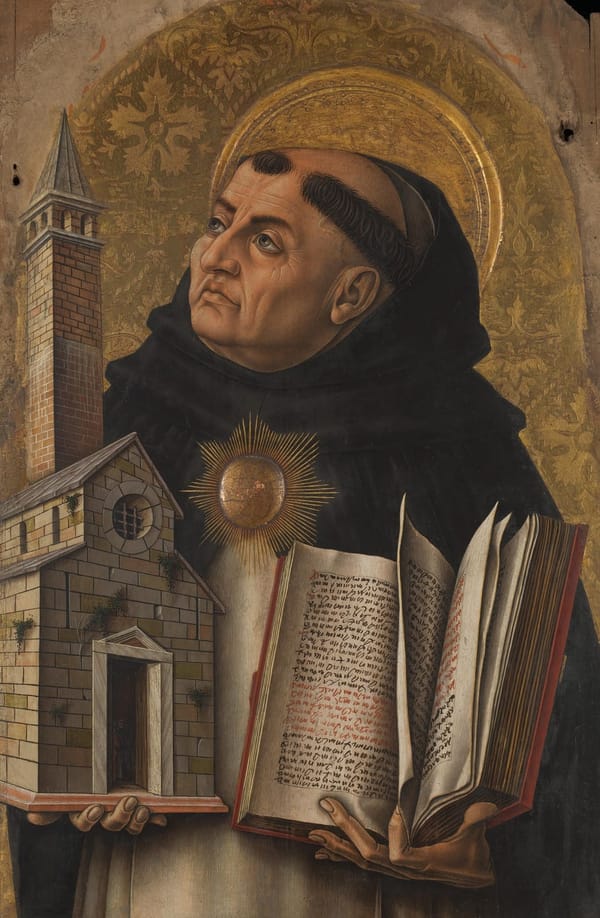 |
March 7: St. Thomas of Aquin, Doctor of the Church
The saint we are to honour to-day is one of the sublimest and most lucid interpreters of divine truth. He rose up in the Church many centuries after the apostolic age, nay, long after the four great Latin doctors, Ambrose, Augustine, Jerome, and Gregory. The Church, the ever young and joyful mother, is justly proud of her Thomas, and has honoured him with the splendid title of the angelical doctor, on account of the extraordinary gift of understanding wherewith God had blessed him; just as his contemporary and friend, St. Bonaventure, has been called the seraphic doctor, on account of the wonderful unction which abounds in the writings of this worthy disciple of St. Francis. Thomas of Aquin is an honour to mankind, for perhaps there never existed a man whose intellect surpassed his. He is one of the brightest ornaments of the Church, for not one of her doctors has equalled him in the clearness and precision wherewith he has explained her doctrines. He received the thanks of Christ Himself, for having well written of Him and His mysteries. How welcome ought this feast of such a saint to be to us during this season of the year, when our main study is our return and conversion to God! What greater blessing could we have than to come to the knowledge of God? Has not our ignorance of God, of His claims, and of His perfections, been the greatest misery of our past lives? Here we have a saint whose prayers are most efficacious in procuring for us that knowledge, which is unspotted, and converteth souls, and giveth wisdom to little ones, and gladdeneth the heart, and enlighteneth the eyes.1 Happy we if this spiritual wisdom be granted us! We shall then see the vanity of everything that is not eternal, the righteousness of the divine commandments, the malice of Bin, and the infinite goodness wherewith God treats us when we repent.
Let us learn from the Church the claims of the angelical doctor to our admiration and confidence.
The Dominican Order, of which St. Thomas is one of the greatest ornaments, has inserted the three following hymns in its liturgy of his feast:
Hymn
Laudans turba fidelium,
Errorum pulso nubilo
Per novi solis radium.
Fudit thesauros gratiæ:
Donis pienus ex æthere
Morum et sapientiæ.
Verbi coruscant faculæ,
Scripturæ sacræ Numinis,
Et veritatis regulæ.
Clarus vitæ munditia,
Splendens miris prodigiis,
Dat toti mundo gaudia.
Simulque sancto Flamini,
Qui sancti Thomæ merito
Nos cœli jungat agmini.
and give praise to God,
who has made a new sun to shine in our world,
and disperse the clouds of error.
that Thomas shed his treasures of heavenly light.
Heaven had enriched him
with gifts of virtue and wisdom:
we have derived a brighter knowledge of the Word,
the understanding of the divine Scriptures
and the rules of truth.
the light of his spotless life,
and the splendour of his miracles,
have filled the universe with joy.
and to the Holy Ghost.
And may our God, by the intercession and merits of his saint,
admit us into the choir of the blessed in heaven.
Hymn
Claram ducens originem,
Subit ætatis teneræ
Prædicatorum Ordinem.
Splendens in cœtu nubium,
Plusquam doctores cæteri
Purgans dogma Gentilium.
In lucem pandit abdita,
Dum supra sensus hominum
Obscura facit cognita.
Quadripartite pervius;
Fit Gedeonis gladius,
Tuba, lagena, radius.
Simulque sancto Flamini,
Qui sancti Thomæ merito,
Nos cœli jungat agmini.
Thomas, while in the bloom
of youth, embraced
the Order of Preachers.
brightly does he shine amidst the luminaries of earth,
and, more than any doctor of the Church,
refutes the doctrines of the Gentiles.
and brings to light the hidden gems of truth,
for he teaches us what the mind of man
had else never understood.
like to that four-branched river of paradise.
He made him to be her Gedeon’s sword,
her trumpet, her vase, her torch.
and to the Holy Ghost.
And may our God, by the intercession and merits of his saint,
admit us into the choir of the blessed in heaven.
Hymn
Thomæ felicem exitum,
Qui pervenit ad gaudia
Per Verbi vitæ meritum.
Thecam thesauri gratiæ,
Cum Christus Thomam efficit
Hæredem regni gloriæ.
Et funeris integritas,
Mira fragrans suavitas,
Ægris collata sanitas.
Terræ, ponto, et superis;
Nos juvet suis precibus,
Deo commendet meritis.
Simulque sancto Flamini,
Qui sancti Thomæ merito
Nos cœli jungat agmini.
the happy death of thy Thomas deserves a hymn of praise.
By the merits of him that is the Word of life,
he is now in endless joy.
of grace was welcomed as a guest.
It was there that he received from Christ
the inheritance of eternal glory.
he has loft us his glorious relics
which breathe forth a heavenly fragrance,
and work cures for the suffering sick.
earth, and sea, and heaven, all may give him praise.
May his prayers and merits
intercede for us with God.
and to the Holy Ghost.
And may our God, by the intercession and merits of his saint,
admit us into the choir of the blessed in heaven.
How shall we worthily praise thee, most holy Doctor! How shall we thank thee for what thou hast taught us? The rays of the divine Sun of justice beamed strongly upon thee, and thou hast reflected them upon us. When we picture thee contemplating truth, we think of those words of our Lord: 'Blessed are the clean of heart, for they shall see God.’2 Thy victory over the concupiscence of the flesh merited for thee the highest spiritual delights; and our Redeemer chose thee, because of the purity of thy angelic soul, to compose for His Church the Office whereby she should celebrate the divine Sacrament of His love. Learning did not impair thy humility. Prayer was ever thy guide in thy search after truth; and there was but one reward for which, after all thy labours, thou wast ambitious, the possession of God.
Thy life, alas! was short. The very masterpiece of thy angelical writings was left unfinished. But thou hast not lost thy power of working for the Church. Aid her in her combats against error. She holds thy teachings in the highest estimation, because she feels that none of her saints has ever known so well as thou, the secrets and mysteries of her divine Spouse. Now, perhaps more than in any other age, truths are decayed among the children of men;3 strengthen us in our faith, procure us light. Check the conceit of those shallow self-constituted philosophers, who dare to sit in judgment on the actions and decisions of the Church, and to force their contemptible theories upon a generation that is too ill-instructed to detect their fallacies. The atmosphere around us is gloomy with ignorance; loose principles, and truths spoilt by cowardly compromise, are the fashion of our times; pray for us; bring us back to that bold and simple acceptance of truth, which gives life to the intellect and joy to the heart.
Pray, too, for the grand Order which loves thee so devoutly, and honours thee as one of the most illustrious of its many glorious children. Draw down upon the family of thy patriarch St. Dominic the choicest blessings, for it is one of the most powerful auxiliaries of God’s Church.
We are on the eve of the holy season of Lent, preparing for the great work of earnest conversion of our lives. Thy prayers must gain for us the knowledge both of the God we have offended by our sins, and of the wretched state of a soul that is at enmity with its Maker. Knowing this, we shall hate our sins; we shall desire to purify our souls in the Blood of the spotless Lamb; we shall generously atone for our faults by works of penance
Monday of the First Week of Lent
Each feria of Lent has a proper Mass; whereas, in Advent, the Mass of the preceding Sunday is repeated during the week. This richness of the lenten liturgy is a powerful means for our entering into the Church’s spirit, since she hereby brings before us, under so many forms, the sentiments suited to this holy time. From these ferial Masses we intend giving, for the respective days, the Collect, which is always the principal prayer, the Epistle, the Gospel, and the Prayer which is said’over the people’ at the end of the Mass. All this will provide us with most solid instruction; and as the selections from the Bible, which are each day brought before us, are not only some of the finest of the sacred volume, but are, moreover, singularly appropriate to Lent, their attentive perusal will be productive of a twofold advantage.
At Rome, to-day’s Station is in the church of St. Peter ad Vincula. It was built in the fifth century, by the empress Eudoxia, wife of Valentinian III., and possesses the venerable relic of St. Peter’s chains. We shall speak more fully of this basilica when we keep the feast of the apostle’s deliverance from prison, on August 1.
Collect
Epistle
Cap. xxxiv.Hæc dicit Dominus Deus: Ecce ego ipse requiram oves meas, et visitabo eas. Sicut visitat pastor gregem suum in die quando fuerit in medio ovium suarum dissipatarum: sic visitabo oves meas, et liberabo eas de omnibus locis, in quibus dispersae fuerant in die nubis et caliginis. Et educam eas de populis, et congregabo eas de tenis, et inducam eas in terram suam, et pascam eas in montibus Israël, in rivis, et in cunctis sedibus terræ. In pascuis uberrimis pascam eas, et in montibus excelsis Israël erant pascua earum: ibi requiescent in herhis virentibus, et in pascuis pinguibus pascentur super montes Israël. Ego pascam oves meas: et ego eas accubare faciam, dicit Dominus Deus. Quod perierat requiram, et quod abjectum erat reducam, et quod confractum fuerat alligabo, et quod infirmum fuerat consolidabo, et quod pingue et forte custodiam: et pascam illas in judicio, dicit Dominus omnipotens.
Ch. xxxiv.Thus saith the Lord God: Behold I myself will seek my sheep, and will visit them. As the shepherd visiteth his flock in the day when he shall be in the midst of his sheep that were scattered; so will I visit my sheep, and will deliver them out of all the places where they have been scattered in the cloudy and dark day. And I will bring them out from the peoples, and will gather them out of the countries, and will bring them to their own land; and I will feed them in the mountains of Israel, by the rivers and in all the habitations of the land. I will feed them in the most fruitful pastures, and their pastures shall be in the high mountains of Israel: there shall they rest on the green grass and be fed in fat pastures upon the mountains of Israel. I will feed my sheep; and I will cause them to lie down, saith the Lord God. I will seek that which was lost, and that which was driven away I will bring again; and I will bind up that which was broken, and I will strengthen that which was weak, and that which was fat and strong I will preserve; and I will feed them in judgment, saith the Lord almighty.
Our Lord here shows Himself to us as a Shepherd full of love for His sheep. Such, indeed, He truly is to men, during this season of mercy. A portion of His flock had gone astray, and was wandering to and fro amidst the darkness of this world; but Jesus did not forget them. He went in search of them, that He might gather them together. He sought them through lonely deserts, and rocky places, and brambles. He now speaks to them through His Church, and invites them to return. He sweetly encourages them, for perhaps they might fear and be ashamed to appear before Him, after so any sins. He promises them that, if they will but return to Him, they shall be fed on the richest pastures, near the river bank, and on the mountains of Israel. They are covered with wounds, but He will bind them up; they are weak, but He will strengthen them. He will once more give them fellowship with the faithful ones who never left Him, and He Himself will dwell with them for ever. Let the sinner, then, yield to this tender love; let him not refuse to make the efforts required for his conversion. If these efforts of penance seem painful to nature, let him recall to mind those happy days, when he was in grace, and in the fold of his good Shepherd. He may be so again. The gate of the fold is open; and thousands who like himself had gone astray are going in with joy and confidence. Let him follow them, and remember how Jesus has said: ‘There shall be joy in heaven upon one sinner that doth penance, more than upon ninety-nine who need not penance.’1
Gospel
Cap. xxv.In illo tempore: dixit Jesus discipulis suis: Cum venerit Filius hominis in majestate sua, et omnes angeli cum eo, tunc sedebit super sedem majestatis suæ: et congregabuntur ante eum omnes gentes, et separabit eos ab invicem, sicut pastor segregat oves ab hædis: et statuet oves quidem a dextris suis, hædos autem a sinistris. Tunc dicet Rex his qui a dextris ejus erunt: Venite, benedicti Patris mei, possidete paratum vobis regnum a constitutione mundi. Esurivi enim, et dedistis mihi manducare: sitivi, et dedistis mihi bibere: hospes eram, et collegistis me: nudus, et cooperuistis me: infirmus, et visitastis me: in carcere eram, et venistis ad me. Tunc respondebunt ei justi, dicentes: Domine, quando te vidimus esurientem, et pavimus te? sitientem, et dedimus tibi potum? Quando autem te vidimus hospitem, et collegimus te? aut nudum, et cooperuimus te? aut quando te vidimus infirmum, aut in carcere, et venimus ad te? Et respondens Rex, dicet illis: Amen dico vobis, quamdiu feeistis uni ex his fratribus meis minimis, mihi feeistis. Tunc dicet et his, qui a sinistris erunt: Discedite a me, maledicti, in ignem æternum, qui paratus est diabolo et angelis ejus. Esurivi enim, et non dedistis mihi manducare: sitivi, et non dedistis mihi potum: hospes eram, et non collegistis me: nudus, et non cooperuistis me: infirmus, et in carcere, et non visitastis me. Tunc respondebunt ei et ipsi, dicentes: Domine, quando te vidimus esurientem, aut sitientem, aut hospitem, aut nudum, aut infirmum, aut in carcere, et non ministravimus tibi? Tunc respondebit illis, dicens: Amen dico vobis, quamdiu non fecistis uni de minoribus his, nec mihi fecistis. Et ibunt hi in supplicium æternum: justi autem in vitam æternam.
Ch. xxv.At that time, Jesus said to his disciples: When the Son of man shall come in his majesty, and all the angels with him, then shall he sit upon the seat of his majesty. And all nations shall be gathered together before him, and he shall separate them one from another, as the shepherd separateth the sheep from the goats; and he shall set the sheep on his right hand, but the goats on his left. Then shall the King say to them that shall be on his right hand: Come, ye blessed of my Father, possess you the kingdom prepared for you from the foundation of the world. For I was hungry, and you gave me to eat; I was thirsty, and you gave me to drink; I was a stranger, and you took me in; naked, and you covered me; sick, and you visited me; I was in prison, and you came to me. Then shall the just answer him, saying: Lord, when did we see thee hungry, and fed thee? thirsty, and gave thee drink? And when did we see thee a stranger, and took thee in? or naked, and covered thee? Or when did we see thee sick or in prison, and came to thee? And the King answering, shall say to them: Amen, I say to you, as long as you did it to one of these my least brethren, you did it to me. Then shall he say to them also that shall be on his left hand: Depart from me, you cursed, into everlasting fire, which was prepared for the devil and his angels. For I was hungry, and you gave me not to eat: I was thirsty, and you gave me not to drink; I was a stranger, and you took me not in; naked, and you covered me not; sick, and in prison, and you did not visit me. Then they also shall answer him, saying: Lord, when did we see thee hungry, or thirsty, or a stranger, or naked, or sick, or in prison, and did not minister to thee? Then he shall answer them, saying: Amen, I say to you, as long as you did it not to one of these least, neither did you do it to me. And these shall go into everlasting punishment, but the just into life everlasting.
We have just been listening to a prophet of the old Testament, inviting us to return to the good Shepherd; our Lord there put forth every argument which love could devise, to persuade His lost sheep to return to Him: and here, on the very same day that the Church speaks to us of our God as being a gentle and compassionate Shepherd, she describes Him as an inflexible Judge. This loving Jesus, this charitable Physician of our souls, is seated on His dread tribunal, and cries out in His anger: Depart from me, ye cursed, into everlasting fire! And where has the Church found this awful description? In the Gospel, that is, in the very Law of love. But if we read our passage attentively, we shall find that He who pronounces this terrible anathema is the same God, whom the prophet has been just portraying as a Shepherd full of mercy, patience, and zeal for His sheep. Observe how He is still a Shepherd, even on His judgment seat: He separates the sheep from the goats; He sets the sheep on His right hand, and the goats on His left; the comparison of a flock is still kept up. The Son of God will exercise His office of Shepherd even to the last day: only then, time will be at an end, and eternity will have begun; the reign of justice, too, will have succeeded the reign of mercy, for it is justice that will reward the good with the promised recompense, and that will punish impenitent sinners with eternal torments. How can the Christian, who believes that we are all to stand before this tribunal, refuse the invitation of the Church, who now presses him to make satisfaction for his sins? How can he hesitate to go through those easy penances, with which the divine mercy now deigns to be satisfied? Truly, man is his own worst enemy, if he can disregard these words of Jesus, who now is his Saviour, and then will be his Judge: ‘Unless ye do penance, ye shall all perish.’2
Let us close the day by reciting the following hymn, which was composed by St. Gregory the Great, and is used by the Church in her Matins during Lent.
Hymn
Servemus hoc jejunium,
Deno dierum circulo
Ducto quater notissimo.
Hoc prætulerunt, postmodum
Christus sacravit, omnium
Rex atque factor temporum.
Verbis, cibis et potibus,
Somno, jocis, et arctius
Perstemus in custodia.
Quæ subruunt mentes vagas:
Nullumque demus callidi
Hostis locum tyrannidi.
Ploremus ante judicem;
Clamemus ore supplici,
Dicamus omnes cernui:
Tuam, Deus, clementiam;
Effunde nobis desuper
Remissor indulgentiam.
Licet caduci, plasmatis:
Ne des honorem nominis
Tui, precamur, alteri.
Auge bonum quod poscimus:
Placere quo tandem tibi
Possimus hic et perpetim.
Concede simplex Unitas,
Ut fructuosa sint tuis
Jejuniorum munera.
fast of forty days,
which has been handed down to us
by sacred tradition.
introduced it; and afterwards, Christ,
the Master and Maker of all seasons,
consecrated it by himself observing it.
let us retrench somewhat of our food,
and drink, and sleep, and merriment,
and redouble our watchfulness.
which play such havoc with unguarded souls:
and let us avoid whatsoever
could strengthen the tyranny of our crafty enemy.
and pour out our tears before him;
let us prostrate ourselves,
and thus cry to him in suppliant prayer:
O God, by our sins:
forgive us, and pour out
thy mercy upon us.
frail though we be:
we beseech thee, suffer not another
to usurp the honour of thy name.
and grant us good things, even beyond our prayer:
that thus we may be well pleasing to thee,
now and for ever.
O undivided Unity, grant us,
thy servants, to reap fruit
from the fast thou hast given us.
| Previous March 6: Sts. Felicitas and Perpetua, Martyrs | Next Monday of the First Week of Lent |