Daily reading
Lent
Double · March 9 · Sanctoral
March 9, 2022
From Dom Guéranger’s The Liturgical Year.
A Double leads the weekday.Rubric
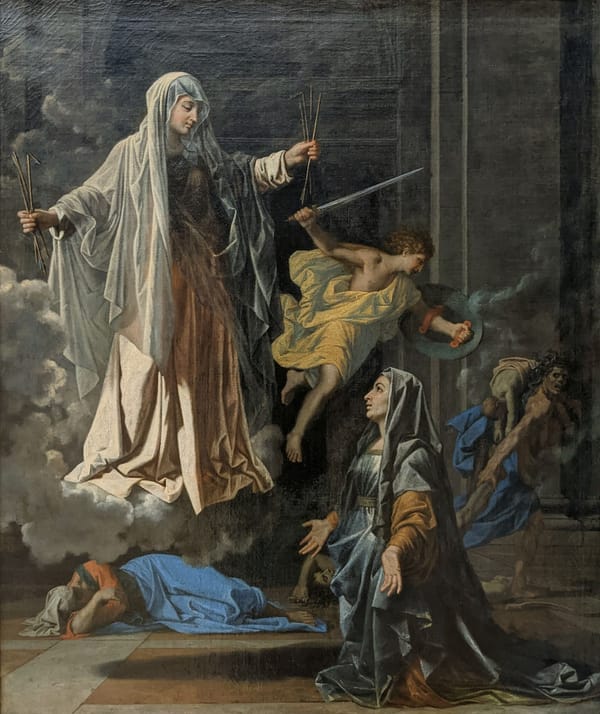 |
March 9: St. Frances of Rome, Widow
The period intervening between the Purification of our blessed Lady and Ash Wednesday (when it occurs at its latest date), gives us thirty-six days; and these offer us feasts of every order of saint. The apostles have given us St. Mathias, and St. Peter’s Chair at Antioch; the martyrs have sent us, from their countless choir, Simeon, Lucius, Blase, Valentine, Faustinus and Jovita, Perpetua and Felicitas, and the forty soldiers of Sebaste, whose feast is kept to-morrow; the holy pontiffs have been represented by Titus, Andrew Corsini, and also by Cyril of Alexandria and Peter Damian, who, like Thomas of Aquin, are doctors of the Church; the confessors have produced Romuald of Camaldoli, John of Matha, John of God, the Seven Founders of the Servites, and the angelic prince Casimir; the virgins have gladdened us with the presence of Agatha, Dorothy, Apollonia, and Scholastica, three wreathed with the red roses of martyrdom, and the fourth with the fair lilies of the enclosed garden* of her Spouse; and lastly, we have had a penitent saint, Margaret of Cortona. The state of Christian marriage is the only one that has not yet deputed a saint during this season, which is less rich in feasts than most of the year. The deficiency is supplied to-day by the admirable Frances of Rome.
Having, for forty years, led a most saintly life in the married state, upon which she entered when but twelve years of age, Frances retired from the world, where she had endured every sort of tribulation. But she had given her heart to her God long before she withdrew to the cloister. Her whole life had been spent in the exercise of the highest Christian perfection, and she had ever received from our Lord the sublimest spiritual favours. Her amiable disposition had won for her the love and admiration of her husband and children: the rich venerated her as their model, the poor respected her as their devoted benefactress and mother.
God recompensed her angelic virtues by these two special graces: the almost uninterrupted sight of her guardian angel, and the most sublime revelations. But there is one trait of her life, which is particularly striking, and reminds us forcibly of St. Elizabeth of Hungary, and of St. Jane Frances Chantal: her austere practices of penance. Such an innocent, and yet such a mortified, life is full of instruction for us. How can we think of murmuring against the obligation of mortification, when we find a saint like this practising it during her whole life? True, we are not bound to imitate her in the manner of her penance; but penance we must do, if we would confidently approach that God who readily pardons the sinner when he repents, but whose justice requires atonement and satisfaction.
The Church thus describes the life, virtues, and miracles of St. Frances.
O Frances, sublime model of every virtue! thou wast the glory of Christian Koine, and the ornament of thy sex. How insignificant are the pagan heroines of old compared with thee! Thy fidelity to the duties of thy state, and all thy saintly actions, had God for their one single end and motive. The world looked on thee with amazement, as though heaven had lent one of its angels to this earth. Humility and penance put such energy into thy soul, that every trial was met and mastered. Thy love for those whom God Himself had given thee, thy calm resignation and interior joy under tribulation, thy simple and generous charity, to every neighbour—all was evidence of God’s dwelling within thy soul. Thy seeing and conversing with thy angel guardian, and the wonderful revelations granted thee of the secrets of the other world, how much these favours tell us of thy merits! Nature suspended her laws at thy bidding; she was subservient to thee, as to one that was already face to face with the sovereign Master, and had the power to command. We admire these privileges and gifts granted thee by our Lord; and now beseech thee to have pity onus, who are so far from being in that path, in which thou didst so perseveringly walk. Pray for us, that we may be Christians, practically and earnestly; that we may cease to love the world and its vanities; that we may courageously take up the yoke of our Lord, and do penance; that we may give up our pride; that we may be patient and firm under temptation. Such was thy influence with our heavenly Father, that thou hadst but to pray, and a vine produced the richest clusters of fruit, even in the midst of winter. Our Jesus calls Himself the true Vine; ask Him to give us of the wine of His divine love, which His cross has so richly prepared for us. When we remember how frequently thou didst ask Him to let thee suffer, and accept thy sufferings for poor sinners, we feel encouraged to ask thee to offer thy merits to Him for us. Pray, too, for Rome, thy native city, that her people may be stanch to the faith, edifying by holiness of life, and loyal to the Church. May thy powerful intercession bring blessings on the faithful throughout the world, add to their number, and make them fervent as were our fathers of old.
* Cant. iv. 12. ↩︎
Wednesday in Ember Week of Lent
The fast of to-day is prescribed by a double law: it is Lent, and it is Ember Wednesday. It is the same with the Friday and Saturday of this week. There are two principal objects for the Ember days of this period of the year: the first is to offer up to God the season of spring, and, by fasting and prayer, to draw down His blessing upon it; the second is, to ask Him to enrich with His choicest graces the priests and sacred ministers who are to receive their Ordination on Saturday. Let us, therefore, have a great respect for these three days; and let those who violate, upon them, the laws of fasting or abstinence, know that they commit a twofold sin.
Up to the eleventh century the Ember days of spring were kept in the first week of March; and those of summer, in the second week of June. It was St. Gregory VII. who fixed them as we now have them; that is, the Ember days of spring in the first week of Lent, and those of summer in Whitsunweek.
The Station for to-day is in the basilica of Saint Mary Major. Let us honour the Mother of God, the refuge of sinners; and let us ask her to present to our divine Judge the humble tribute of our penance.
Collect
On all the Ember Wednesdays are read, in place of the Epistle at Mass, two lessons from sacred Scripture. To-day the Church brings before us the two great types of Lent, Moses and Elias, in order to impress us with an idea of the importance of this forty days’fast, which Christ Himself solemnly consecrated when He observed it, thus fulfilling, in His own Person, what the Law and the Prophets had but prefigured.
First Lesson
Cap. xxiv.In diebus illis: dixit Dominus ad Moysen: Ascende ad me in montem et esto ibi, dab oque tibi tabulas lapideas, et legem ac mandata, quæ scripsi, ut doceas filios Israël. Surrexerunt Moyses, et Josue minister ejus. Ascendensque Moyses in montem Dei, senioribus ait: Exspectate hic donec revertamur ad vos. Habetis Aaron et Hur vobiseum. Si quid natum fuerit quæstionis, referetis ad eos. Cumque ascendisset Moyses, operuit nubes montem, et habitavit gloria Domini super Sinai, tegens ilium nube sex diebus: septimo autem die vocavit eum de medio caliginis. Erat autem species gloriæ Domini, quasi ignis ardens super verticem montis in conspectu filiorum Ieraël. Ingressusque Moyses medium nebulæ, ascendit in montem: et fuit ibi quadraginta diebus et quadraginta noctibus.
Ch. xxiv.In those days: the Lord said to Moses: Come up to me into the mount, and be there; and I will give thee tables of stone, and the law, and the commandments which I have written, that thou mayst teach them. Moses rose up, and his minister Josue; and Moses going up into the mount of God, said to the ancients: Wait ye here till we return to you. You have Aaron and Hur with you: if any question shall arise, you shall refer it to them. And when Moses was gone up, a cloud covered the mount. And the glory of the Lord dwelt upon Sinai, covering it with a cloud six days; and the seventh day he called him out of the midst of the cloud. And the sight of the glory of the Lord was like a burning fire upon the top of the mount, in the eyes of the children of Israel. And Moses entering into the midst of the cloud, went up into the mountain; and he was there forty days and forty nights.
Second Lesson
3. Cap. xix.In diebus illis: venit Elias in Bersabee-Juda, et dimisit ibi puerum suum. et perrexit in desertum, viam unius diei. Cumque venisset, et sederet subter unam janiperum, petivit animæ suæ ut moreretur, et ait: Sufficit mihi, Domine: tolle animam meam: neque enim melior sum quam patres mei. Projecitque se et obdormivit in umbra juniperi: et ecce angelus Domini tetigit eum, et dixit illi: Surge, et comede. Respexit, et ecce ad caput suum subcinericius panis, et vas aquæ: comedit ergo et bibit, et rursum obdormivit. Reversusque est angelus Domini secundo, et tetigit eum, dixitque illi: Surge, comede: grandis enim tibi restat via. Qui cum surrexisset, comedit et bibit, et ambulavit in fortitudine cibi illius quadraginta diebus et quadraginta noctibus usque ad montem Dei Horeb.
Moses and Elias fast for forty days and forty nights, because God bids them come near to Him. Man must purify himself, he must unburden himself, in some measure at least, of the body which weighs him down, if he would enter into communication with Him who is the Spirit. And yet the vision of God granted to these two holy personages was very imperfect: they felt that God was near them, but they beheld not His glory. But when the fulness of time came,1 God manifested Himself in the flesh: and man saw, and heard, and touched Him.2 We, indeed, are not of the number of those favoured ones who lived with Jesus, the Word of life: but in the holy Eucharist He allows us to do more than see Him: He enters into our breasts, He is our food. The humblest member of the Church possesses God more fully than either Moses on Sinai, or Elias on Horeb. We cannot, therefore, be surprised that the Church, in order to fit us for this favour at the Easter solemnity, bids us go through a preparation of forty days, though its severity is not to be compared with the rigid fast which Moses and Elias had to observe as the condition of receiving what God promised them.
Gospel
Cap. xii.In illo tempore: Responderunt Jesu quidam de scribis et pharisæis, dicentes: Magister, volumus a te signum videre. Qui respondens, ait illis: Generatio mala et adultera signum quærit: et signum non dabitur ei, nisi signum Jonæ prophetæ. Sicut enim fuit Jonas in ventre ceti tribus diebus et tribus noctibus, sic erit Filius hominis in corde terræ tribus diebus et tribus noctibus. Viri Ninivitæ surgent in judicio cum generations ista, et condemnabunt eam: quia pœnitentiam egerunt in prædicatione Jonæ; et ecce plus quam Jonas hie. Regina Austri surget in judicio cum generations ista, et condemnabit eam: quia venit a finibus terræ audire sapientiam Salomonis; et ecce plus quam Salomon hic. Cum autem immundus spiritus exierit ab homine, ambulat per loca arida, quærens requiem, et non invenit. Tunc dicit: Revertar in domum meam, unde exivi. Et veniens invenit eam vacantem, scopis mundatam, et ornatam. Tunc vadit, et assumit septem alios spiritus secum nequiores se, et intran tes habitant ibi: et hunt novissima hominis illius pejora prioribus. Sic erit et generationi huic pessimæ. Adhuc eo loquente ad turbas, ecce mater ejus et fratres stabant foris quærentes loqui ei. Dixit autem ei quidam: Ecce mater tua, et fratres tui foris stant, quærentes te. At ipse respondens dicenti sibi, ait: Quæ est mater mea, et qui sunt fratres mei? Et extenderia manum in discipulos suos, dixit: Ecce mater mea, et fratres mei: quicumque enim fecerit voluntatem Patris mei, qui in cœlis est, ipse meus frater, et so ror, et mater est.
Ch. xii.At that time: Some of the scribes and pharisees answered him, saying: Master we would see a sign from thee. Who answering said to them: An evil and adulterous generation seeketh a sign; and a sign shall not be given it, but the sign of Jonas the prophet. For as Jonas was in the whale’s belly three days and three nights, so shall the Son of Man be in the heart of the earth three days and three nights. The men of Ninive shall rise in judgment with this generation, and shall condemn it, because they did penance at the preaching of Jonas; and behold a greater than Jonas here. The queen of the south shall rise in judgment with this generation, and shall condemn it, because she came from the ends of the earth to hear the wisdom of Solomon; and behold a greater than Solomon here. When an unclean spirit ie gone out of a man, he walketh through dry places, seeking rest and findeth none. Then he saith: I will return into my house, from whence I came out. And coming, he findeth it empty, swept, and garnished. Then he goeth, and taketh with him seven other spirits more wicked than himself, and they enter in and dwell there; and the last state of that man is made worse than the first. So shall it be also to this wicked generation. As he was yet speaking to the multitudes, behold his Mother and his brethren stood without, seeking to speak to him. And one said unto him: Behold thy Mother and thy brethren stand without, seeking thee. But he answering him that told him said: Who is my mother, and who are my brethren? And stretching forth his hand towards his disciples, he said: Behold my mother and my brethren; for whosoever shall do the will of my Father that is in heaven, he is my brother, and sister, and mother.
Our Lord forewarns Israel of the chastisements which its voluntary blindness and hardness of heart will bring upon it. The men of Israel refuse to believe, unless they see signs and prodigies; they have them in abundance, but will not see them. Such are the unbelievers of the present day. They say they want proofs of the divine origin of the Catholic religion. What is history but a tissue of proofs; what are the events of the present age, but testimony of the truth? And yet they remain incredulous. They have their own views and prejudices, and they intend to keep to them; how, then, can it be wondered at that they never embrace the true faith? Infidels, who have not had the like opportunities, will rise in judgment with such a generation and condemn it for its resistance to grace. Let us Catholics remember that amidst the great religious movement which is now going on, it is our duty to be not only most firm in our faith, but also most zealous in the observance of the laws of the Church, such, for example, as Lent. The apostolate of example will produce its fruits; and if a mere handful of Christians was to the Roman empire like that leaven of which our Saviour speaks,3 and which leavened the whole mass, what results might we not expect in a country like our own, which has retained so much Catholic practice and doctrine, if the Catholics themselves were but zealous in the exercise of their duties?
We take the following devout stanzas on fasting from the Triodion of the Greek Church
Hymn
- Gal. iv. 4. ↩︎
- 1 St. John i. 1. ↩︎
- See the Gospel for the sixth Sunday after the Epiphany, in our Septuagesima. ↩︎
| Previous Tuesday of the First Week of Lent | Next Wednesday in Ember Week of Lent |