Daily reading
Lent
Double · March 12 · Sanctoral
March 12, 2022
From Dom Guéranger’s The Liturgical Year.
A Double leads the weekday.Rubric
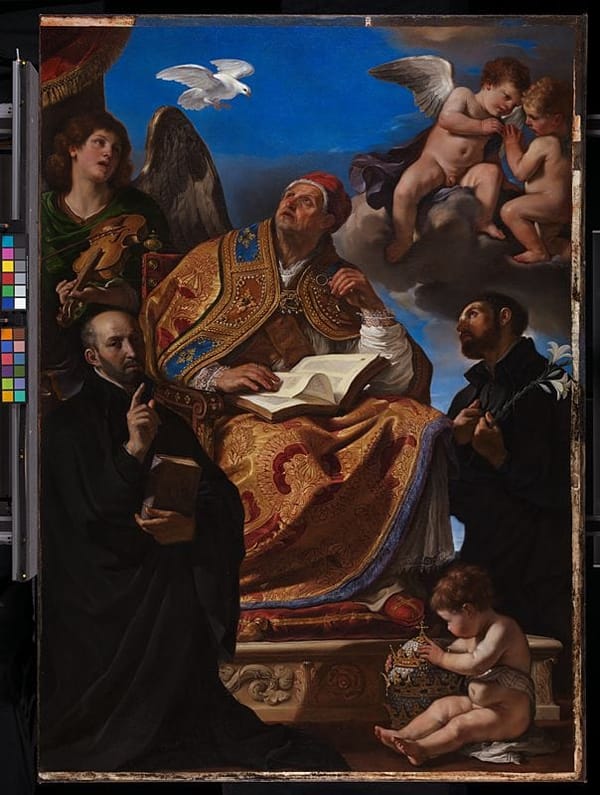 |
March 12: St. Gregory the Great, Pope and Doctor of the Church
Among all the pastors whom our Lord Jesus Christ has placed, as His vicegerents, over the universal Church, there is not one whose merits and renown have surpassed those of the holy Pope, whose feast we keep to-day. His name is Gregory, which signifies watchfulness; his surname is ‘the Great,’ and he was in possession of that title, when God sent the Seventh Gregory, the glorious Hildebrand, to govern His Church.
In recounting the glories of this illustrious Pontiff, it is but natural we should begin with his zeal for the services of the Church. The Roman liturgy, which owes to him some of its finest hymns, may be considered as his work, at least in this sense, that it is he who collected together and classified the prayers and rites drawn up by his predecessors, and reduced them to the form in which we now have them. He collected also the ancient chants of the Church, and arranged them in accordance with the rules and requirements of the divine Service. Hence it is, that our sacred music, which gives such solemnity to the liturgy, and inspires the soul with respect and devotion during the celebration of the great mysteries of our faith, is known as the Gregorian chant.
He is, then, the apostle of the liturgy, and this alone would have immortalized his name; but we must look for far greater things from such a Pontiff as Gregory. His name was added to the three, who had hitherto been honoured as the great Doctors of the Latin Church. These three are Ambrose, Augustine, and Jerome; who else could be the fourth but Gregory? The Church found in his writings such evidence of his having been guided by the Holy Ghost, such a knowledge of the sacred Scriptures, such a clear appreciation of the mysteries of faith, and such unction and authority in his teachings, that she gladly welcomed him as a new guide for her children.
Such was the respect wherewith everything he wrote was treated, that his very letters were preserved as so many precious treasures. This immense correspondence shows us that there was not a country, scarcely even a city, of the Christian world, on which the Pontiff had not his watchful eye steadily fixed; that there was not a question, however local or personal, which, if it interested religion, did not excite his zeal and arbitration as the Bishop of the universal Church. If certain writers of modern times had but taken the pains to glance at these letters, written by a Pope of the sixth century, they would never have asserted, as they have, that the prerogatives of the Roman Pontiff are based on documents fabricated, as they say, two hundred years after the death of Gregory.
Throned on the apostolic See, our saint proved himself to be a rightful heir of the apostles, not only as the representative and depositary of their authority, but as a fellow-sharer in their mission of calling nations to the true faith. To whom does England owe her having been, for so many ages, ‘the island of saints’? To Gregory, who, touched with compassion for those Angli, of whom, as he playfully said, he would fain make Angeli, sent to their island the monk Augustine with forty companions, all of them, as was Gregory himself, children of St. Benedict. The faith had been sown in this land as early as the second century, but it had been trodden down by the invasion of an infidel race. This time the seed fructified, and so rapidly that Gregory lived to see a plentiful harvest. It is beautiful to hear the aged Pontiff speaking with enthusiasm about the results of his English mission. He thus speaks in the twenty-seventh Book of his Morals: ‘Lo! the language of Britain, which could once mutter naught save barbarous sounds, has long since begun to sing, in the divine praises, the Hebrew Alleluia! Lo! that swelling sea is now calm, and saints walk on its waves. The tide of barbarians, which the sword of earthly princes could not keep back, is now hemmed in at the simple bidding of God’s priests.’*
During the fourteen years that this holy Pope held the place of Peter, he was the object of the admiration of the Christian world, both in the east and in the west. His profound learning, his talent for administration, his position, all tended to make him beloved and respected. But who could describe the virtue of his great soul? That contempt for the world and its riches, which led him to seek obscurity in the cloister; that humility, which made him flee the honours of the papacy, and hide himself in a cave, where, at length, he was miraculously discovered, and God Himself put into his hands the keys of heaven, which he was evidently worthy to hold, because he feared the responsibility; that zeal for the whole flock, of which he considered himself not the master, but the servant, so much so indeed that he assumed the title, which the Popes have ever since retained, of ‘servant of the servants of God’ that charity which took care of the poor throughout the whole world; that ceaseless solicitude, which provided for every calamity, whether public or private; that unruffled sweetness of manner, which he showed to all around him, in spite of the bodily sufferings which never left him during the whole period of his laborious pontificate; that firmness in defending the deposit of the faith, and crushing error wheresoever it showed itself; in a word, that vigilance with regard to discipline, which made itself felt for long ages after in the whole Church? All these services and glorious examples of virtue have endeared our saint to the whole world, and will cause his name to be blessed by all future generations, even to the end of time.
Let us now read the abridged life of our saint, as given us in the liturgy.
To these admirable lessons we subjoin a selection of antiphons and responsories, which are taken from an Office approved of by the holy See, for this feast of so great a saint.
Antiphons and Responsories*
St. Peter Damian, whose feast we kept a few days back, composed the following hymn in honour of our apostle:
Nunc angelorum eocius,
Ut tunc, Gregori, gentibus
Succurre jam credentibus.
Omnemque mundi gloriam
Spernis, ut inops inopem
Jesum sequaris principem.
Dum stipem petit angelus;
Tu munus jam post geminum,
Præbes et vas argenteum.
Suæ præfert Ecclesiæ:
Sic Petri gradum percipis,
Cujus et normam sequeris.
Lux et decus Ecclesiæ,
Non sinas in periculis,
Quos tot mandatis instruis.
Tua distillant labia,
Fragrantum vim aromatum
Tuum vincit eloquium.
Mire solvis ænigmata,
Theorica mysteria
Te docet ipsa Veritas.
Vicem simul et gloriam,
Nos solve culpæ nexibus,
Redde polorum sedibus.
Sit decus Unigenito,
Sit utriusque pariti
Majestas summa Flamini.
and now art a companion of the angels!
protect now, as of old, the nations
that believe in Christ.
and all the glory of the world,
that so thou, being poor,
mayst follow the Lord Jesus, who was poor.
in the garb of one that was shipwrecked, and asks an alms;
thou first makest him a double gift,
and then thou givest him a silver vase.
for thou didst imitate the virtues,
and now thou hast
the honours, of Peter.
Light and ornament of the Church!
Thou hast so richly instructed us,
assist us in our dangers.
that brings sweetness to the heart.
Thy words are more fragrant
than the richest perfume.
the obscure figures of sacred Writ.
The divine mysteries are taught thee
by him that is the very Truth.
the office and the glory of the apostles,
pray for us, that we may be loosed from the bonds of sin,
and obtain the thrones prepared for us above.
and to his only-begotten Son,
and to the Spirit of them
both be praise and highest kingship.
Father of the Christian people! Vicar of the charity, as well as of the authority, of Christ! O Gregory, vigilant Pastor! the Church, which thou hast so faithfully loved and served, turns to thee with confidence. Thou canst not forget the flock, which keeps up such an affectionate remembrance of thee; hear the prayer she offers thee on this thy solemnity. Protect and guide the Pontiff, who now holds the place of Peter, as thou didst; enlighten and encourage him in the difficulties wherewith he is beset. Bless the hierarchy of the pastors, which has received from thee such magnificent teachings and such admirable examples. Assist it to maintain inviolate the sacred trust of faith; bless the eSorts it is now making for the restoration of ecclesiastical discipline, without which all is disorder and confusion. God chose thee as the regulator of the divine service, the holy liturgy; foster, by thy blessing, the zeal which is now rising up among us for those holy traditions of prayer, which have been so neglected; teach us the long-forgotten secret, that the best way of praying is to use the prayers of the Church. Unite all Churches in obedience to the apostolic See, which is the ground and pillar of faith, and the fountain of spiritual authority.
But there is one country which was most dear to thee—our own native land. O apostle of England! look down with aSection on this island, which has now rebelled from Rome, and has become the resort of countless false religions. But now, after three centuries of apostasy from the true faith, the hand of God’s mercy is pressing her to conversion. She is thine own child in Christ Jesus: wilt thou not aid her to return to Him? Wilt thou not guide her, by thy prayers, to come forth out of the darkness, which still so thickly clouds her, and follow the light which heaven holds out to her? Oh! if England were once more Catholic, who can tell the good she would do? For what country is there that can do grander things for the propagation of the faith? Pray for her, then; she may regain her glorious title of Isle of Saints, for she has thee for her apostle!
These are the days of salvation; pray for the faithful, who have entered on their career of penance. Obtain for them compunction of heart, love of prayer, and an appreciation of the liturgy and its mysteries. The solemn ami devout homilies which thou didst address, at this season, to the people of Rome, are still read to ns; may they sink into our hearts and fill them with fear of God’s justice, and hope in His mercy, for His justice and mercy change not to suit the time. We are weak and timid, and this makes us count as harsh the laws of the Church which oblige us to fasting and abstinence; get us brave hearts, brave with the spirit of mortification. Thy holy life is an example to us, and thy writings are our instruction; what we still want is to be made true penitents, and this thy intercession must do for us: that so we may return, with the joy of a purified conscience, to the divine Alleluia, which thou hast taught us to sing on earth, and which we hope to chant together with thee in heaven.
* We may be permitted to express a hope, that the day is not far distant, when the Proper Offices, approved of by the holy See, will be adopted in England, for those saints in whom England has a special interest. Proper hymns, &c., have been composed and approved for St. Augustine of Canterbury and St. Anselm. [TRANSULATOR.]
* Moral, in Job. Lib. xxvii. Cap. xi. ↩︎
Saturday in Ember Week of Lent
The Station is in the basilica of Saint Peter on the Vatican, where the people were wont to assemble towards evening, that they might be present at the Ordination of the priests and sacred ministers. This day was called Twelve-Lesson-Saturday, because, formerly, twelve passages from the holy Scriptures were read, as upon Holy Saturday. The Mass, during which the Ordinations were given, was celebrated during the night; so that by the time it was over, the Sunday had begun. Later on, the Ordination Mass was said early on the Saturday, as we now have it; but in memory of the ancient practice, the Gospel for Saturday is repeated on the Sunday. The same is observed on the Saturday in the Advent Ember week; because the Ordination Mass of that season was also anticipated.
Collect
Lesson
Cap. xxvi.In diebus illis: Locutus est Moyses ad populum dicens: Quando compleveris decimam cunctarum frugum tuarum, loqueria in conspectu Domini Dei tui: Abstuli quod sanctificatum eat de domo mea, et dedi illud levitæ et advenæ, et pupillo ao viduæ, sicut jussisti mihi: non præterivi mandata tua, neo sum oblitua imperii tui. O bedi vi voci Domini Dei mei, et feci omnia eicut præcepisti mihi. Respice de sanctuario tuo, et de excelso cœlorum habitaculo, et benedio populo tuo Israël, et terræ quam dedisti nobis, eicut jurasti patribus nostris, terræ lacte et melle manan ti. Hodie Dominus Deus tuus præcepit tibi ut facias mandata hæc atque judicia; et custodias et impleas ex toto corde tuo, et ex tota anima tua. Dominum elegisti hodie, ut sit tibi Deus, et ambules in viis ejus, et custodias cæremonias illius, et mandata atque judicia, et obedias ejus imperio. Et Dominus elegit te hodie, ut sis ei populus peculiaris, sicut locutus est tibi, et custodias omnia præcepta illius: et faciat te excelsiorem cunctis gentibus quas cbeavit, in laudem, et nomen, et gloriam suam: ut sis populus sanctus Domini Dei tui, si cut locutus est.
Ch. xxvi.In those days: Moses spoke to the people, saying: When thou hast made an end of tithing all thy fruits thou shalt speak thus in the sight of the Lord thy God: I have taken that which was sanctified out of my house, and I have given it to the levite and to the stranger, and to the fatherless and to the widow, as thou hast commanded me; I have not transgressed thy commandments, nor forgotten thy precepts. I have obeyed the voice of the Lord my God, and have done all things as thou hast commanded me. Look from thy sanctuary, and thy high habitation of heaven, and bless thy people Israel, and the land which thou hast given us, as thou didst swear to our fathers, a land flowing with milk and honey. This day the Lord thy God hath commanded thee to do these commandments and judgments, and to keep and fulfil them with all thy heart, and with all thy soul. Thou hast chosen the Lord this day to be thy God, and to walk in his ways and keep his ceremonies and precepts, and judgments, and obey his command. And the Lord hath chosen thee this day to be his peculiar people, as he hath spoken to thee, and to keep all his commandments; and to make thee higher than all nations, which he hath created, to his own praise, and name, and glory; that thou mayst be a holy people of the Lord thy God, as he hath spoken.
God here assures us that a nation, which is faithful in observing the laws regarding the divine service, shall be blessed above other nations. History is one long illustration of the truth of this promise. Of all the nations which have fallen, there is not one that has not brought the chastisement upon itself by its neglect of the Law of God. At times, the Almighty delays to strike; but it is only that the chastisement may be the more evident and produce a more salutary effect upon mankind. When we would know the future of a country, we need only observe how it comports itself with regard to the laws of the Church. If its own laws are based on the principles and practices of Christianity, that country is sound, in spite of certain weaknesses here and there: revolutions may disturb its peace, but it will triumph over all. If the bulk of its people is faithful in the observance of external practices prescribed by the Church: for example, if they observe the Lord’s day and the holy fast of Lent; there is a fund of morality in that country, which is sure to draw down upon it the blessings of heaven. Irreligious men will scoff at all this, and call it superstition, prejudice of weak minds, and out of date for an age of progress like ours, but if their theories were to rule, and a country, which up to this time had been practically Catholic, were to seek progress by infringing the law of Christian ritual, it would, in less than a hundred years, find that public and private morality had lost ground, and its own security would be menaced. Man may talk and write as he likes: God wishes to be served and honoured by His people, and it is for Him to prescribe what are to be the forms of this service and adoration. Every injury offered to external worship, which is the great social link, is an injury to the interests of mankind. Even were there not the word of God for it, it is but just that such a consequence should follow.
Gospel
Cap. xvii.In illo tempore: Assumpsit Jesus Petrum, et Jacobum, et Joannem fratrem ejus, et duxit illos in montem excelsum seorsum: et transfiguratus est ante eos. Et resplenduit facies ejus sicut sol, vestimenta autem ejus facta sunt alba sicut nix. Et ecce apparuerunt illis Moyses et Elias cum eo loquentes. Respondens autem Petrus dixit ad Jesum: Domine, bonum est nos hic esse: si vis, faciamus hic tria tabernacula, tibi unum, Moysi unum, et Eliæ unum. Adnuc eo loquente, ecce nubes lucida obumbravit eos. Et ecce vox de nube, dicens: Hic est Filius meus dilectus, in quo mihi bene complacui: ipsum audite. Et audientes discipuli, ceciderunt in faciem suam, et timuerunt valde. Et accessit Jesus, et tetigit eos, dixitque eis: Surgite et nolite timere. Levantes autem oculos suos, neminem viderunt nisi solum Jesum. Et descendentibus illis de monte, præcepit eis Jesus, dicens: Nemini dixeritis visionem, donee Filius hominis a mortuis resurgat.
Ch. xvii.At that time: Jesus taketh unto him Peter and James, and John his brother, and bringeth them up into a high mountain apart: and he was transfigured before them. And his face did shine as the sun: and his garments became white as snow. And behold there appeared to them Moses and Elias talking with him. Then Peter answering, said to Jesus: Lord, it is good for us to be here; if thou wilt, let us make here three tabernacles, one for thee, and one for Moses, and one for Elias. And as he was yet speaking, behold a bright cloud overshaded them. And lo, a voice out of the cloud, saying: This is my beloved Son, in whom I am well pleased: hear ye him. And the disciples hearing, fell upon their face, and were very much afraid. And Jesus came and touched them, and said to them: Arise and fear not. And they, lifting up their eyes, saw no one, but only Jesus. And as they came down from the mountain, Jesus charged them, saying: Tell the vision to no man, till the Son of Man be risen from the dead.
This Gospel, which, as we have already explained, is to be repeated to-morrow, is the one that is read in the Mass of to-day’s Ordinations. The following is the interpretation given by the ancient liturgists, among whom we may especially mention the learned abbot Rupert. The Church would have us think upon the sublime dignity which has been conferred upon the newly ordained priests. They are represented by the three apostles, who were taken by Jesus to the high mountain, and favoured with the sight of His glory. The rest of the disciples were left below; Peter, James, and John were the only ones permitted to ascend to Thabor, and they, when the time should come, were to tell their fellow-apostles, and the whole world, how they had seen the glory of their Master, and heard the words of the Father declaring the Divinity of the Son of Man. ‘This voice,’ says St.Peter, ‘coming down to Him from the excellent glory: This is My beloved Son, in whom I have pleased Myself; hear ye Him. And this voice we heard, brought from heaven, when we were with Him in the holy mount.’1 In like manner, these priests who have just been ordained, and for whom you have been offering up your prayers and fast, will enter into the cloud with the Lord. They will offer up the Sacrifice of your salvation in the silence of the sacred Canon. God will descend into their hands, for your sake; and though they are mortal and sinners, yet will they, each day, be in closest communication with the Divinity. The forgiveness of your sins, which you are now preparing to receive from your heavenly Father, is to come to you through their hands; their superhuman power will bring it down from heaven upon your souls. It is thus that God has cured our pride. The serpent said to us, through our first parents: ‘Eat of this fruit, and you shall be as gods.’We unfortunately believed the tempter, and the fruit of our transgression was death. God took pity on us, and resolved to save us; but it is by the hands of men that He would save us, and this in order to humble our haughtiness. His own eternal Son became Man, and He left other men after Him, to whom He said: ‘As the Father hath sent Me, I also send you.’2 Let us, then, show honour to these men, who have, this very day, been raised to so high a dignity. One of the duties imposed on us by our holy religion is respect to the priesthood.
This is Saturday; let us have recourse to Mary, the refuge of sinners. Let us put under her maternal protection the humble penances we are now going through; for this end we may make use of the following sequence, taken from the Cluny missal:
Sequence
Mundi hujus spes Maria,
Ave plena gratia.
Maris portus ad quem rei
Currunt cum fiducia.
Cunctis demens et benigna,
Operum suffragio.
Nudis Martha et Maria,
Mentis desiderio.
Sic flos flori patuisti,
Pietatis gratia.
Regem regum peperisti,
Virgo viri nescia.
Quem lactasti et pavisti,
More matris debito.
Et Regina facta pridem,
Operum pro merito.
Apud Regem ut ruina
Relaxentur debita.
A reatu expurgatos,
Pietate solita.
dear Mother of Jesus,
and hope of the world!
O haven of the sea, where sinners
confidently seek shelter and repose.
and, by thy powerful prayers,
thou art kind and loving to all.
Thou art, by thy loving affection,
both Martha and Mary to the needy.
the flower that, by its rich graces,
bloomed to the divine Flower, thy Jesus.
thou didst give birth to the King of kings,
thou that wast a pure Virgin.
and, using a mother’s privilege,
thou didst feed him at thy breast.
and in reward for thy merits,
thou art made the Queen of heaven and earth.
to him that is our King,
beseeching him to pardon us poor fallen sinners.
and, having obtained us the new life of remission of our sins,
bring us to the kingdom, there to reign for ever.
| Previous Friday in Ember Week of Lent | Next Saturday in Ember Week of Lent |