Daily reading
Lent
Double of the I Class · March 19 · Sanctoral
March 19, 2022
From Dom Guéranger’s The Liturgical Year.
A Double of the I Class leads the weekday.Rubric

|
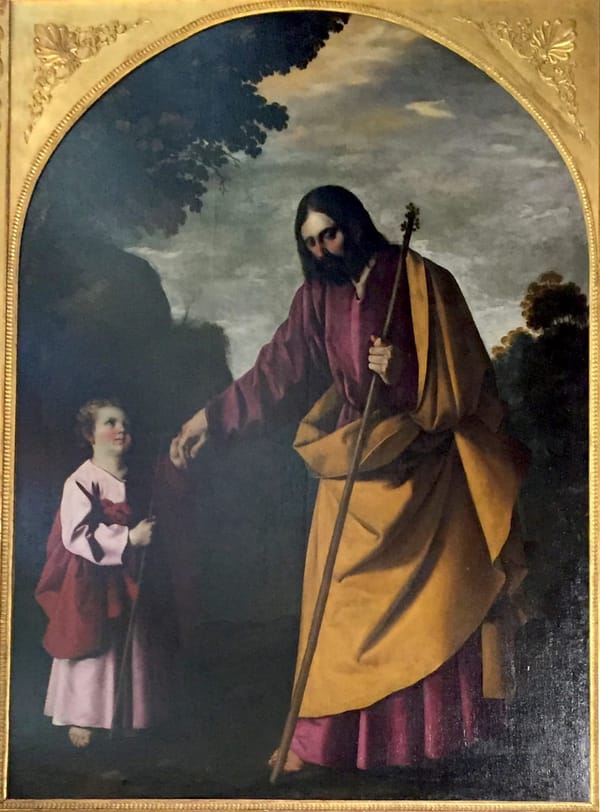
March 19: St. Joseph, Spouse of the Blessed Virgin
To-day, Joseph, the spouse of Mary, the fosterfather of the Son of God, comes to cheer us by his dear presence. In a few days hence, the august mystery of the Incarnation will demand our fervent adoration: who could better prepare us for the grand feast, than he that was both the confidant and thd faithful guardian of the divine secret?
The Son of God, when about to descend upon this earth to assume our human nature, would have a Mother; this Mother could not be other than the purest of Virgins, and her divine maternity was not to impair her incomparable virginity. Until such time as the Son of Mary were recognized as the Son of God, His Mother’s honour had need of a protector: some man, therefore, was to be called to the high dignity of being Mary’s spouse. This privileged mortal was Joseph, the most chaste of men.
Heaven designated him as being the only one worthy of such a treasure: the rod he held in his hand in the temple suddenly produced a flower, as though it were a literal fulfilment of the prophecy of Isaias: ‘There shall come forth a rod from the root of Jesse, and a flower shall rise up out of his root.’1 The rich pretenders to an alliance with Mary were set aside; and Joseph was espoused to the Virgin of the house of David, by a union which surpassed in love and purity everything the angels themselves had ever witnessed.
But he was not only chosen to the glory of having to protect the Mother of the Incarnate Word; he was also called to exercise an adopted paternity over the very Son of God. So long as the mysterious cloud was over the Saint of saints, men called Jesus the Son of Joseph and the carpenter's Son. When our blessed Lady found the Child Jesus in the temple, in the midst of the doctors, she thus addressed Him: ‘Thy father and I have sought Thee sorrowing’;2 and the holy evangelist adds that Jesus was subject to them, that is, that He was subject to Joseph as He was to Mary.
Who can imagine or worthily describe the sentiments which filled the heart of this man, whom the Gospel describes to us in one word, when it calls him the just man?3 Let us try to picture him to ourselves amidst the principal events of his life: his being chosen as the spouse of Mary, the most holy and perfect of God’s creatures; the angel’s appearing to him, and making him the one single human confidant of the mystery of the Incarnation, by telling him that his Virgin bride bore within her the fruit of the world’s salvation: the joys of Bethlehem, when he assisted at the birth of the divine Babe, honoured the Virgin Mother, and heard the angels singing; his seeing first the humble and simple shepherds, and then the rich eastern magi, coming to the stable to adore the new-born Child; the sudden fears which came to him, when he was told to arise, and, midnight as it was, to flee into Egypt with the Child and the Mother; the hardships of that exile, the poverty and the privations which were endured by the hidden God, whose foster-father he was, and by the Virgin, whose sublime dignity was now so evident to him; the return to Nazareth, and the humble and laborious life led in that village, where he so often witnessed the world's Creator sharing in the work of a carpenter; the happiness of such a life, in that cottage where his companions were the Queen of the angels and the eternal Son of God, both of whom honoured, and tenderly loved him as the head of the family—yes, Joseph was beloved and honoured by the uncreated Word, the Wisdom of the Father, and by the Virgin, the masterpiece of God’s power and holiness.
We ask, what mortal can justly appreciate the glories of St. Joseph? To do so, he would have to understand the whole of that mystery, of which God made him the necessary instrument. What wonder, then, if this foster-father of the Son of God was prefigured in the old Testament, and that by one of the most glorious of the patriarchs? Let us listen to St. Bernard, who thus compares the two Josephs: ‘The first was sold by his brethren, out of envy, and was led into Egypt, thus prefiguring our Saviour’s being sold; the second Joseph, that he might avoid Herod’s envy, led Jesus into Egypt. The first was faithful to his master, and treated his wife with honour; the second, too, was the most chaste guardian of his bride, the Virgin Mother of his Lord. To the first was given the understanding and interpretation of dreams; to the second, the knowledge of, and participation in, the heavenly mysteries. The first laid up stores of corn, not for himself, but for all the people; the second received the living Bread that came down from heaven, and kept It both for himself and for the whole world.’4
Such a life could not close save by a death that was worthy of so great a saint. The time came for Jesus to quit the obscurity of Nazareth, and show Himself to the world. His own works were henceforth to bear testimony to His divine origin; the ministry of Joseph, therefore, was no longer needed. It was time for him to leave this world, and await, in Abraham’s bosom, the arrival of that day, when heaven’s gates were to be opened to the just. As Joseph lay on his bed of death, there was watching by his side He that is the master of life, and that had often called this His humble creature, father. His last breath was received by the glorious Virgin-Mother, whom he had, by a just right, called his bride. It was thus, with Jesus and Mary by his side, caring for and caressing him, that Joseph sweetly slept in peace. The spouse of Mary, the fosterfather of Jesus, now reigns in heaven with a glory which, though inferior to that of Mary, is marked with certain prerogatives which no other inhabitant of heaven can have.
From heaven, he exercises a powerful protection over those that invoke him. In a few weeks from this time, the Church will show us the whole magnificence of this protection; a solemn feast will be kept in his honour in the third week after Easter. To-day the Liturgy sets before us his glories and privileges. Let us unite with the faithful throughout the world, and ofier to the spouse of Mary the hymns which are this day sung in his praise.
Hymn I
Te cuncti resonent Christiadum chori,
Qui clams meritis junctus es inclytæ
Casto fœdere Virgini.
Admirans, dubio tangeris anxius,
Afflatu superi Flaminis angelus
Conceptum puerum docet.
Ægypti profugum tu sequeris plagas:
Amissum Solymis quæris, et invenis,
Miscene gaudia fletibus.
Palmamque emeritos gloria suscipit;
Tu vivens, Superis par, frueris Deo,
Mira sorte beatior.
Da Joseph meritis sidera scandere:
Ut tandem liceat nos tibi perpetim
Gratum promere canticum.
May the choirs of Christendom resound with thy name,
for great are thy merits,
who wast united by a chaste alliance to the holy Virgin.
a cruel doubt afflicts thy heart; but an angel visits thee,
telling thee that she had conceived of the Holy Ghost
the Child she bore in her womb.
and go with the little fugitive to Egypt’s distant land.
When he was lost in Jerusalem, thou didst seek after him;
and having found him, thy tears were mingled with joy.
has crowned their life; they receive their glory, when they have won the palm:
but thou, by a strange, happy lot, hadst, even during life,
what the blessed have in heaven—thou hadst the sweet society of thy God.
and may the intercession of Joseph aid us to reach heaven:
that there we may sing to thee
our eternal hymn of grateful love.
Hymn II
Certa spes vitæ, columenque mundi,
Quas tibi læti canimus, benignus
Suscipe laudes.
Virginia sponsum, voluitque Ver bi
Te patrem dici, dedit et ministrum
Esse salutis.
Quem chorus vatum cecinit futurum,
Aspicis gaudens, humilisque natum
Numen adoras.
Cujus ad nutum tremit inferorum
Turba, cui pronus famulatur æther,
Se tibi subdit.
Quæ tibi præbens superos honores,
Det tuis nobis meritis beatæ
Gaudia vitae.
the sure hope of our life, and the pillar of the world!
Receive, in thy kind love,
the praises we now joyfully sing to thee.
the spouse of the holy Virgin;
willed thee to be called the father of the Word;
and gave thee to be an instrument of our salvation.
on the Redeemer lying in the stable,
him that the prophets had foretold was to come;
and seeing him, thou didst humbly adore the new-born King.
at whose bidding hell trembles
and before whom heaven prostrates ready to do his will,
yea, even he makes himself subject to thee.
May he that has conferred such high honours upon thee,
grant us, through the merits of thine intercession,
to come to the joys of heavenly life.
Hymn III
Cujus excelsos canimus triumphos,
Hac die, Joseph meruit perennis
Gaudia vitæ.
Cujus extremam vigiles ad horam
Christus et Virgo simul adstiterunt,
Ore sereno.
Camis, ad sedes placido sopore
Migrat æternas, rutilisque cingit
Tempora sertis.
Adsit ufc nobis, veniamque nostris
Obtinene culpis, tribuat supernæ
Munera pacis.
Trine qui regnas, Deus; et coronas
Aureas servo tribuis fideli,
Omne per ævum.
whose praises we, the faithful,
now gladly tell, and whose high triumph we sing,
deserved to receive the joys of eternal life.
thrice blessed saint,
at whose last hour Jesus and Mary
stood watching in tender love.
and Joseph, sweetly sleeping,
passed to the eternal home,
and received upon his brott the glittering crown.
let us beseech him to help us,
obtain us the pardon of our sins,
and procure us the gift of heavenly peace.
O God, O blessed Trinity,
who art our sovereign Lord!
who givest to thy faithful servant an everlasting crown of gold.
The Greek liturgy, which honours St. Joseph on the Sunday following the feast of Christmas, thus hymns his praise in the Menæa:
Hymn (Dominica post Natale Domini)
We praise and glorify thee, O happy saint! We hail thee as the spouse of the Queen of heaven, and foster-father of our Redeemer. These titles, which would seem too grand for any human being to enjoy, are thine; and they are but the expression of the dignities conferred on thee by God. The Church of heaven admires the sublime favours thou hast received; the Church on earth joyfully celebrates thy glories, and blesses thee for the favours thou art so unceasingly bestowing upon her.
Though born of the kingly race of David, thou wast the humblest of men; thy spirit led thee to seek obscurity, and a hidden life was thine ambition: but God chose thee to be an instrument in the sublimest of all His works. A noble Virgin of the same family of David, the object of heaven’s admiration, and the glory and hope of the world, is to be thy bride. The Holy Ghost is to dwell within her as in a most pure tabernacle; it is to thee, the just and chaste, that He entrusts her as an inestimable treasure. Espouse, then, to thyself her whose beauty the very King of heaven so greatly desires.5
The Son of God comes down to this earth, that He may live the life of man; He comes that He may sanctify the ties and affections of kindred. He calls thee father; He obeys thy orders. What strange emotions must have filled thy heart, O Joseph! when, knowing the prerogatives of thy bride and the divinity of thy adopted Son, thou hadst to be the head of this family, which united heaven and earth into one! What respectful and tender love for Mary, thy blessed bride! What gratitude and profound worship of Jesus, who obeyed thee as thy Child! Oh mysteries of Nazareth! a God dwells among men, and permits Himself to be called the Son of Joseph!
O sublime minister of the greatest of blessings, intercede for us with God made Man. Ask Him to bestow humility upon us, that holy virtue which raised thee to such exalted dignity, and which must be the basis of our conversion. It is pride that led us into sin, and made us prefer our own will to that of God: yet will He pardon us if we offer Him the sacrifice of a contrite and humble heart.6 Get us this virtue, without which there can be no true penance. Pray also for us, O Joseph, that we may be chaste. Without purity of mind and body we cannot come nigh the God of all sanctity, who suffers nothing defiled to approach Him. He wills to make our bodies, by His grace, the temples of His holy Spirit: do thou, great saint, help us to maintain ourselves in so exalted a dignity, or to recover it if we have lost it.
And lastly, O faithful spouse of Mary! recommend us to our Mother. If she cast a look of pity upon us during these days of reconciliation, we shall be saved: for she is the Queen of mercy, and Jesus, her Son, will pardon us and change our hearts, if she intercede for us, O Joseph! Remind her of Bethlehem, Egypt, and Nazareth, in all of which she received from thee such marks of thy devotedness. Tell her that we, also, love and honour thee; and Mary will reward us for our devotion to him who was given her by heaven as her protector and support.
Saturday of the Second Week of Lent
The Station is in the church of Saints Peter and Marcellinus, two celebrated martyrs of Rome under the persecution of Diocletian. Their names are inserted in the Canon of the Mass.
Collect
Epistle
Cap. xxvii.In diebus illis: Dixit Rebecca filio suo Jacob: Audivi patrem tuum loquentem cum Esaü fratre tuo et dicentem ei: Affer mihi de venatione tua, et fac cibos ut comedam, et benedioam tibi coram Domino antequam moriar. Nunc ergo, fili mi, acquiesce consiliis meis: et pergens ad gregem, affer mihi duos hcedos optimos, ut faciam ex eis escas patri tuo, quibus libenter vescitur: quas cum intuleris, et comederit derit, benedicat tibi priusquam moriatur. Cui ille reepondit: Nosti quod Esaü frater meus homo pilosus sit, et ego lenis: si attrecta verit me pater meus, et senserit, timeo ne putet me sibi voluisse illudere, et inducam super me maledictionem pro benedictione. Ad quem mater: In me sit, inquit, ista maledictio, fill mi: tantum audi vocem meam, et pergens affer quæ dixi. Abiit, et attulit, deditque matri. Paravit illa cibos eicut velle noverat patrem illius. Et vestibus Esaü valde bonis, quas apud se habebat domi, induit eum: pelliculasque hædorum circumdedit manibus, et colli nuda protexit. Deditque pulmentum, et panes quos coxerat tradidit. Quibus illatis dixit: Pater mi! At ille respondit: Audio. Quis es tu, fili mi? Dixitque Jacob: Ego sum primogenitus tuus Esaü: feci sicut præcepisti mihi: surge, eede, et comede de venatione mea, ut benedicat mihi anima tua. Kursumque Isaac ad filium suum: Quomodo, inquit, tam cito invenire potuisti fili mi? Qui respondit: Voluntas Dei fuit, ut cito occurreret mihi quod volebam. Dixitque Isaac: Accede hue, ut tangam te, fili mi, et probem utrum tu sis filiue meus Esaü, an non. Accessit ille ad patrem, et palpato eo, dixit Isaac: Vox quidem, vox Jacob est: sed manus, manus sunt Esaü. Et non cognovit eum, quia pilosæ manus similitudinem majoris expresserant. Benedicens ergo illi, ait: Tu es filiua meufl Esaü? Respondit: Ego sum. At ille: Affer mihi, inquit, cibos de venatione tua, fill mi, ut benedicat tibi anima mea. Quos cum oblatos comedieset, obtulit ei etiam vinum. Quo hausto, dixit ad eum: Accede ad me, et da mihi osculum, fili mi. Accessit, et osculatus est eum. Statimque ut sensit vestimentorum illius fragrantiam, benedicens illi, ait: Ecco odor filii mei, sicut odor agri pleni, cui benedixit Dominus. Det tibi Deus de rore cœli, et de pinguedine terræ, abundantiam frumenti et vini. Et serviant tibi populi, et adorent te tribus: esto dominus fratrum tuorum, et incurventur ante te filii matris tuæ. Qui maledixerit tibi, sit ille maledictus: et qui benedixerit tibi, benedictionibus repleatur. Vix Isaac sermone m impleverat: et egresso Jacob foras, venit Esaü, coctoeque de venatione cibos intulit patri, dicens: Surge, pater mi, et comede de venatione filii tui, ut benedicat mihi anima tua. Dixitque illi Isaac: Quis enim es tu? Qui respondit: Ego sum filius tuus primogenitus Esaü. Expavit Isaac stupore vehementi, et ultra quam credi potest, admirans, ait: Quis igitur ille est, qui dudum captam venationem attulit mihi, et comedi ex omnibus priusquam tu venires? Benedixique ei, et erit benedictus. Auditie Esaü sermonibus patris, irrugiit clamore magno: et conetematus, ait: Benedio etiam et mihi, pater mi. Qui ait: Venit germanus tuus fraudulenter, et accepit benedictionem tuam. At ille subjunxit: Juste vocatum est nomen ejus Jacob: supplantavit enim me in altera vice: primogenita mea ante tulit, et nunc secundo surripuit benedictionem meam. Rursumque ad patrem: Numquid non reservasti, ait, et mihi benedictionem? Respondit Isaac: Dominum tuum ilium conetitui, et omnes fra tres ejus servituti illius subjugavi: frumento et vino stabilivi eum; et tibi post haec, fili mi, ultra quid faciam? Cui Esaü: Num unam, inquit, tan turn benedictionem habes, pater? Mihi quoque obsecro ut benedicas. Cumque ejulatu magno fleret, motus Isaac, dixit ad eum: In pinguedine terræ, et in rore caeli desuper erit benedictio tua.
Ch. xxvii.In those days: Rebecca said to her son Jacob: I heard thy father talking with Esau thy brother, and saying to him: Bring me of thy hunting, and make me meats that I may eat, and bless thee in the sight of the Lord before I die. Now, therefore, my son, follow my counsel: and go thy way to the flock, bring me two kids of the best, that I may make of them meat for thy father, such as he gladly eateth; which when thou hast brought in, and he hath eaten, he may bless thee before he die. And he answered her: Thou knowest that Esau my brother is a hairy man, and I am smooth; if my father shall feel me, and perceive it, I fear lest he will think I would have mocked him, and I shall bring upon me a curse instead of a blessing. And his mother said to him: Upon me be this curse, my son; only hear thou my voice, and go, fetch me the things which I have said. He went, and brought, and gave them to his mother. She dressed meats such as she knew his father liked. And she put on him very good garments of Esau, which she had at home with her; and the little skins of the kids she put about his hands, and covered the bare of his neck. And she gave him the savoury meat, and delivered him bread that she had baked. Which when he had carried in, he said: My father? But he answered: I hear; who art thou, my son? And Jacob said: I am Esau thy first-born; I have done as thou didst command me; arise, sit and eat of my venison, that thy soul may bless me. And Isaac said to his son: How couldst thou find it so quickly, my son? He answered: It was the will of God, that what I sought came quickly in my way. And Isaac said: Come hither, that I may ioel thee, my sun. and may prove whether thou be my son Esau or not. He came near to his father, and when he had felt him, Isaac said: The voice, indeed, is the voice of Jacob, but the hands are the hands of Esau. And he knew him not, because his hairy hands made him like to the elder. Then blessing him, he said: Art thou my son Esau? He answered: I am. Then he said: Bring me the meats of thy hunting, my son, that my soul may bless thee. And when they were brought and he had eaten, he offered him wine also; which after he had drunk, he said to him: Come near me, and give me a kiss, my son. He came near, and kissed him. And immediately as he smelled the fragrant smell of his garments, blessing him, he said: Behold the smell of my son is as the smell of a plentiful field, which the Lord hath blessed. God give thee of the dew of heaven, and of the fatness of the earth, abundance of com and wine. And let peoples serve thee, and tribes worship thee; be thou lord of thy brethren, and let thy mother’s children bow down before thee. Cursed be he that curseth thee, and let him that blesseth thee be filled with blessings. Isaac had scarce ended his words when Jacob being now gone out abroad, Esau came, and brought in to his father meats made of what he had taken in hunting, saying: Arise, my father, and eat of thy son’s venison; that thy seul may bless me. And Isaac said to him: Why! who art thou? He answered: I am thy firstborn son Esau. Isaac was struck with fear, and astonished exceedingly, and wondering beyond what can be believed, said: Who is he then that even now brought me venison that he had taken and I ate of all before thou earnest? and I have blessed him and he shall be blessed. Esau having heard his father’s words, roared out with a great cry, and being in a consternation, said: Bless me also, my father. And he said: Thy brother came deceitfully and got thy blessing. But he said again: Rightly is his name called Jacob, for he hath supplanted me, lo! this second time; my first birth-right he took away before, and now this second time he hath stolen away my blessing. And again he said to his father: Hast thou not reserved me also a blessing? Isaac answered: I have appointed him thy lord, and have made all his brethren his servants: I have established him with corn and wine, and after this, what shall I do more for thee, my son? And Esau said to him: Hast thou only one blessing, father? I beseech thee, bless me also. And when he wept with a loud cry, Isaac being moved, said to him: In the fat of the earth and in the dew of heaven from above, shall thy blessing be.
The two sons of Isaac are another illustration of God’s judgments upon Israel, and His vocation of the Gentiles. The instruction contained in this passage from Genesis was intended for the catechumens. Here we have two brothers, Esau the elder, and Jacob the younger; Esau represents the Jewish people; he is his father’s heir, and, as such, he has a glorious future before him. Jacob, though twin-brother to Esau, is the second-born, and has no right to the special blessing which Esau claimed; he is the figure of the Gentiles. How, then, is it that Jacob receives the blessing and not Esau? The sacred volume tells us that Esau is a carnal-minded man. Rather than deny himself the momentary gratification of his appetite, he sacrifices the spiritual advantages which his father’s blessing is to bring him; he sells his birthright to Jacob for a mess of pottage. We know the mother’s plan for securing Jacob’s claim; and how the aged father is, unsuspectingly, the instrument in God’s hands, ratifying and blessing this substitution, of which he himself has no knowledge. Esau, having returned home, is made aware of the greatness of his loss; but it is too late, and he becomes an enemy to his brother. The same thing happens with the Jewish people; they are carnal-minded and lose their birthright, their pre-eminence over the Gentiles. They refuse to acknowledge a Messias who is poor and persecuted; their ambition is for earthly triumph and earthly greatness; and the only kingdom that Jesus holds out to His followers is a spiritual one. The Jews, then, reject this Messias; but the Gentiles receive Him, and they become the first-born, the favoured people. And, whereas the Jews repudiate this substitution (to which, however, they assented, when they said to Pilate: ‘We will not have this Man to reign over us’),1 they are indignant at seeing the heavenly Father bestowing all His love and blessings on the Christian people. They that are children of Abraham according to the flesh are disinherited; and they that are the children of Abraham by faith alone are evidently the children of the promise; according to those words of the Lord, which He spoke to that great patriarch: ‘I will multiply thy seed as the stars of heaven, and as the sand that is by the sea-shore . . . . In thy seed (that is, in Him who is to be born of thy race) all the nations of the earth shall be blessed.’2
Gospel
Cap. xv.In illo tempore: Dixit Jesus pharisæis et scribis parabolam istam: Homo quidam habuit duos filios: et dixit adolescentior ex illis patri: Pater, da mihi portionem substantiae quæ me contingit. Et divisit illis substantiam. Et non post multos dies, congregatis omnibus, adolescentior filius peregre profectus est in regionem longinquam, et ibi dissipavit substantiam suam vivendo luxuriose. Et postquam omnia consummasset, facta est fames valida in regione ilia, et ipse coepit egere. Et abiit, et adhæsit uni civium regionis illius. Et misit ilium in villain suam ut pasceret porcos. Et cupiebat implere ventre m suum de siliquis quas porci manducabant: et nemo illi dabat. In se autem reversus, dixit: Quanti mercenarii in domo patrie mei abundant panibus: ego autem hicfame pereo! Surgam, et ibo ad patrem meum, et dicam ei: Pater, peccavi in cœlum et coram te; jam non sum dignus vocan filius tuus: fac me sicut unum de mercenariis tuis. Et surgens venit ad patrem suum. Cum autem adhue longe esset, vidit ilium pater ipsius, et misericordia motus est, et accurrens cecidit super collum ejus, et osculatus est eum. Dixitque ei filius: Pater, peccavi in ccelum, et coram te: jam non sum dignus vocari filius tuus. Dixit autem pater ad servos suos: Cito proferte stolam primam, et induite ilium, et date annulum in manum ejus, et calceamenta in pedes ejus: et * adducite vitulum saginatum, et occidite, et manducemus et epulemur: quia hicfilius meus mortuus erat, et revixit: perierat, et inventus est. Et coeperunt epulari. Erat autem filius ejus senior in agro: et cum veniret, et appropinquaret domui, audivit symphoniam, et chorum; et vocavit unum de servis, et interrogavit quid hæc essent. Isque dixit illi: Frater tuus venit, et occidit pater tuus vitulum saginatum, quia salvum ilium recepit. Indignatus est autem, et nolebat introire. Pater ergo illius egressus, cœpit rogare ilium. At file respondens, dixit patri suo: Ecce tot annis servio tibi, et numquam mandatum tuum præterivi, et numquam dedisti mihi hcedum, ut cum amicis meis epularer: sed postquam filius tuus hie, qui devoravit substantiam suam cum meretricibus, venit, oceidisti illi vitulum saginatum. At ipse dixit illi: Fili, tu semper mecum es, et omnia mea tua sunt: epulari autem et gaudere oportebat, quia frater tuus hic mortuus erat, et revixit: perierat et inventus est.
Ch. xv.At that time: Jesus spoke to the scribes and pharisees this parable: A certain man had two sons; and the younger of them said to his father: Father, give me the portion of substance that falleth to me. And he divided unto them his substance. And not many days after, the younger son, gathering all together, went abroad into a far country, and there wasted his substance, living riotously. And, after he had spent all, there came a mighty famine in that country, and he began to be in want. And he went and cleaved to one of the citizens of that country. And he sent him into his farm to feed swine. And he would fain have filled his belly with the husks the swine did eat; and no man gave unto him. And returning to .himself hesaid: How many hired servants in my father’s house abound with bread, and I here perish with hunger! I will arise and will go to my father, and say to him: Father, I have sinned against heaven, and before thee; I am not now worthy to be called thy son; make me as one of thy hired servants. And rising up, he came to his father. And when he was yet a great way off, his father saw him, and was moved with compassion; and running to him, fell upon his neck, and kissed him. And the son said to him: Father, I have sinned against heaven, and before thee; I am not now worthy to be called thy son. But the father said to his servants: Bring forth quickly the first robe, and put it on him, and put a ring on his hand, and shoes on his feet; and bring hither the fatted calf, and kill it, and let us eat, and make merry; because this my son was dead, and is come to life again, was lost, and is found. And they began to be merry. Now his elder son was in the field: and when he came and drew nigh to the house, he heard music and dancing, and he called one of the servants, and asked what these things meant. And he said to him: Thy brother is come, and thy father hath killed the fatted calf, because he hath received him safe. And he was angry, and would not go in. His father therefore coming out began to entreat him. And he answering said to his father: Behold for so many years do I serve thee, and I have never transgressed thy commandment, and yet thou hast never given me a kid to make merry with my friends; but as soon as this thy son is come, who hath devoured his substance with harlots, thou hast killed for him the fatted calf. But he said to him: Son, thou art always with me, and all I have is thine. But it was fit that we should make merry and be glad; for this thy brother was dead, and is come to life again, he was lost, and is found.
The mystery brought before us in the Epistle is repeated in our Gospel. Again it is the history of two brothers; the elder is angry at seeing his father show mercy to the younger. This younger brother has gone abroad into a far country; he has quitted his father’s house, that he might be under no control, and indulge in every kind of disorder. But when a mighty famine came, and he was perishing with hunger, he remembered that he had a father; and, at once, he arose, and humbly besought his father to receive him, and give him the last place in that housey which, but for his own folly, might have been all his own. The father received the prodigal with the tenderest affection; not only did he pardon him, he restored him to all his family rights; nay, he would have a feast kept in honour of this happy return. The elder brother, hearing what the father had done, was indignant, and conceived the bitterest jealousy against his younger brother. Let the Jews be jealous, if they will; let them be indignant with their God for showing His mercy to any but themselves. The time has come when all the nations of the earth are to be called to the one fold. The Gentiles, notwithstanding all the misery into which their errors and their passions had led them, are to receive the preaching of the apostles. Greeks and Romans, Scythians and barbarians, are to come, humbly acknowledging the evil of their ways, and ask to share in the favours offered to Israel. Not only are they to be allowed to eat of the crumbs that fall from the table, which was all the poor woman of Chanaan dared to hope for; they are to be made sons and heirs of the Father, with all the attendant rights and privileges. Israel will be jealous, and will protest; but to no purpose. He will refuse to take part in the feast; it matters not, the feast is to be. This feast is the Pasch. The prodigals that have come, starved and naked, to the Father’s house, are our catechumens, on whom God is about to bestow the grace of adoption.
But there are also the public penitents, who are being prepared by the Church for reconciliation; they, too, are the frodigals, who come seeking mercy from their offended Father. This Gospel was intended for them as well as for the catechumens. But now that the Church has relaxed her severe discipline, she offers this parable to all those who are in the state of sin, and are preparing to make their peace with God. They know not, as yet, how good is the God from whom they have strayed by sin: let them read to-day’s Gospel, and see how mercy exalteth itself above judgment,3 in that God, who so loved the world as to give His only-begotten Son.4 How far soever they may have gone astray, or how great soever may have been their ingratitude, let them take courage; a feast is being prepared in their Father’s house, to welcome them home again. The loving Father is waiting at the door to receive and embrace them; the first robe, the robe of innocence, is to be restored to them; the ring, which they alone wear that are of God’s family, is to be once more placed on their hand. There is a banquet being prepared for them, at which the angels, out of joy, will sing their glad songs. Let these poor sinners, then, cry out with a contrite heart: Father! I have sinned against heaven, and before Thee; I am not now worthy to be called Thy son: make me as one of Thy hired servants. This tender-hearted Father asks only this much of them: sincere sorrow for their sins, humble confession, and a firm resolution of being faithful for the time to come. Let them accept these easy terms, and He will receive them, once more, as His dearest children.
This being Saturday, let us have recourse to Mary the Queen of mercy. Let us address ourselves to her in these devout words of a sequence, taken from the ancient Cluny missals. This is our request: that she would obtain for us the pardon of our sins.
Sequence
Stella promens radium,
Quo nostræ propaginis
Deletur opprobrium.
Tu nostrum refugium,
In hora discriminis
Placa nobis Filium.
Vera veris primula,
Salutem initians.
Tota sine macula,
Maculosos expians.
Fons hortorum, puteus
Aquarum viventium.
In quo Rex æthereus
Coronavit Filium.
Quam arte mirifica
Fecit summus Artifex.
Sumpta camis tunica,
Consecratur Pontifex.
Imo rorem melleum,
Per amoris fistulas.
Purgans omne felleum,
Et peccati maculas.
Penetrarunt vulnera
Patientis Filii.
Nos a pænis libera
Tremendi judicii.
that yieldest a ray of new light,
whereby is blotted out
the shame of our race.
O thou our refuge!
Appease thy Son,
at the hour of our judgment.
thou art the true first spring-flower,
bringing us our Jesus.
there is not a stain upon thee,
and thy Fruit taketh our stains away.
the source of him
that is the water of life.
whereon the King of heaven
crowned his Son.
formed with exquisite skill
by the hand of the great Artificer;
having put on the garment of our flesh,
was consecrated High Priest.
yea, a dew sweet as honey;
for thou art all love.
that washeth away
the bitterness and the stains of sin.
was pierced by the wounds
of thy suffering Son.
and when the dread judgment comes,
deliver us from punishment.
| Previous Friday of the Second Week of Lent | Next Saturday of the Second Week of Lent |