Daily reading
Movable from Easter · Temporal
March 24, 2022
From Dom Guéranger’s The Liturgical Year.
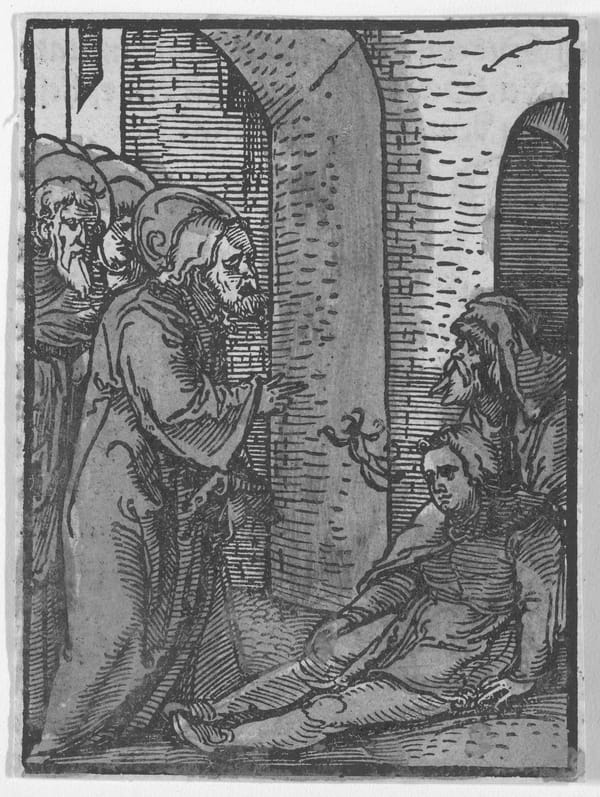
Thursday of the Third Week of Lent
This day brings us to the middle of Lent, and is called mid-Lent Thursday. It is the twentieth of the forty fasts imposed upon us, at this holy season, by the Church. The Greeks call the Wednesday of this week Mesonestios, that is, the mid-fast. They give this name to the entire week, which, in their liturgy, is the fourth of the seven that form their Lent. But the Wednesday is, with them, a solemn feast, and a day of rejoicing, whereby they animate themselves to courage during the rest of the season. The Catholic nations of the west, though they do not look on this day as a feast, have always kept it with some degree of festivity and joy. The Church of Rome has countenanced the custom by her own observance of it; but, in order not to give a pretext to dissipation, which might interfere with the spirit of fasting, she postpones to the following Sunday the formal expression of this innocent joy, as we shall see further on. Yet, it is not against the spirit of the Church that this mid-day of Lent should be marked by some demonstration of gladness; for example, by sending invitations to friends, as our Catholic forefathers used to do; and serving up to table choicer and more abundant food than on other days of Lent, taking care, however, that the laws of the Church are strictly observed. But alas! how many even of those calling themselves Catholics have been breaking, for the past twenty days, these laws of abstinence and fasting! Whether the dispensations they trust to be lawfully or unlawfully obtained, the joy of mid-Lent Thursday scarcely seems made for them. To experience this joy, one must have earned and merited it, by penance, by privations, by bodily mortifications; which is just what so many, nowadays, cannot think of doing. Let us pray for them, that God would enlighten them, and enable them to see what they are bound to do, consistently with the faith they profess.
At Rome, the Station is at the church of Saints Cosmas and Damian, in the forum. The Christians of the middle ages (as we learn from Durandus, in his Rational of the Divine Offices) were under the impression that this Station was chosen because these two saints were, by profession, physicians. The Church, according to this explanation, would not only offer up her prayers of this day for the souls, but also for the bodies of her children: she would draw down upon them—fatigued as she knew they must be by their observance of abstinence and fasting—the protection of these holy martyrs, who, whilst on earth, devoted their medical skill to relieving the corporal ailments of their brethren. The remarks made by the learned liturgiologist Gavantus, in reference to this interpretation, lead us to conclude that, although it may possibly not give us the real motive of the Church’s selecting this Station, yet it is not to be rejected. It will, at least, suggest to the faithful to recommend themselves to these saints, and to ask of God, through their intercession, that they may have the necessary courage and strength for persevering to the end of the holy season in what they have, so far, faithfully observed.
Collect
Epistle
Cap. vii.In diebus illis: Factum est verbum Domini ad me dicens: Sta in porta domus Domini, et prædica ibi verbum istud, et die: Audite verbum Domini, omnis Juda, qui ingredimini per portas has, ut adoretis Dominum. Hæc dicit Dominus exercituum, Deus Israël: Bonas facite vias vestras, et studia vestra: et habitabo vobiseum in loco isto. Nolite confidere in verbis mendaeii, dicentes: Templum Domini, templum Domini, templum Dominiest. Quoniam si bene direxeritis vias vestras, et studia vestra: ei feceritis judicium inter virum et proximum ejus: ad venae et pupillo, et viduae non foceritis calumniam, nec sanguinem innoeentem effuderitis in loco hoc, et post deos alienos non ambulaveritis in malum vobismetipeis: habitabo vobiscum in loco isto, in terra quam dedi patribus vestris, a sæculo et usque in saeculum, ait Dominus omnipotens.
Ch. viiIn those days: The word of the Lord came to me, saying: Stand in the gate of the house of the Lord, and proclaim there this word, and say: Hear ye the word of the Lord, all ye men of Juda, that enter in at these gates, to adore the Lord. Thus saith the Lord of hosts, the God of Israel: Make your ways and your doings good; and I will dwell with you in this place. Trust not in lying words, saying: The temple of the Lord, the temple of the Lord, it is the temple of the Lord. For if you will order well your ways and your doings; if you will execute judgment between a man and his neighbour; if you oppress not the stranger, the fatherless and the widow, and shed not innocent blood in this place, and walk not after strange gods to your own hurt; I will dwell with you in this place, in the land which I gave to your fathers from the beginning and for ever more, saith the Lord almighty.
There is not a single duty in which the Church does not instruct her children. If, on the one hand, she insists on their fulfilling certain exterior practices of penance, she, on the other, warns them against the false principle of supposing that exterior observances, however carefully complied with, can supply the want of interior virtues. God refuses to accept the homage of the spirit and the heart, if man, through pride or sensuality, refuse that other service which is equally due to his Creator, namely, his bodily service; but to make one’s religion consist of nothing but material works, is little better than mockery; for God bids us serve Him in spirit and in truth.1 The Jews prided themselves on having the temple of Jerusalem, which was the dwelling-place of God’s glory; but this privilege, which exalted them above other nations, was not unfrequently turned against themselves, inasmuch as many of them were satisfied with a mere empty respect for the holy place; they never thought of that higher and better duty, of showing themselves grateful to their divine Benefactor, by observing His Law. Those Christians would be guilty of a like hypocrisy, who, though most scrupulously exact in the exterior duty of fasting and abstinence, were to take no pains to amend their lives, and to follow the rules of justice, charity, and humility. They would deserve that our Lord should say of them what He said of Israel: ‘This people glorify Me with their lips; but their heart is far from Me.’2 This Christian pharisaism is very rare now-a-days. What we have to fear is a disregard for the exterior practices of religion. Those of the faithful who are diligent in the fulfilment of the laws of the Church, are not, generally speaking, behindhand in the practice of other virtues. Still, this false conscience is sometimes to be met with, and is a scandal which does much spiritual injury. Let us, therefore, observe the whole law. Let us offer to God a spiritual service, which consists in the heart's obedience to all His commandments; and to this let us join the homage of our bodies, by practising those things which the Church has prescribed. The body is intended to be an aid to the soul, and is destined to share in her eternal happiness; it is but just that it should share in the service of God.
Gospel
Cap. iv.In illo tempore: Surgens Jesus de synagoga, introivit in domum Simonis. Socrus autem Simonis tenebatur magnis febribus: et rogaverunt ilium pro ea. Et stans super illam, imperavit febri: et dimisit illam. Et continuo surgens, minist ra bat illis. Cum autem sol occidisset, omnes qui habebant infirmos variis languoribus, ducebant illos ad eum. At file singulis manus imponens, curabat eos. Exibant autem dæmonia a multis, clamantia et dicentia: Quia tu ee Filius Dei. Et increpans non sinebat ea loqui, quia sciebant ipsum esse Christum. Facta autem die egreseus ibat in desertum locum, et turbæ requirebant eum, et venerunt usque ad ipsum: et detinebant ilium ne discederet ab eis. Quibus file ait: Quia et aliis eivitatibus oportet me evangelizare regnum Dei, quia ideo missus sum; et erat prædicans in synagogis Galilææ.
Ch. iv.At that time: Jesus rising up out of the synagogue, went into Simon’s house. And Simon’s wife’s mother was taken with a great fever, and they besought him for her. And standing over her, he commanded the fever, and it left her. And immediately rising, she ministered to them. And when, the sun was down, all they that had any sick with divers diseases, brought them to him. But he, laying his hands on every one of them, healed them. And devils went out from many, crying out and saying: Thou art the Son of God. And rebuking them, he suffered them not to speak, for they knew that he was Christ. And when it was day, going out, he went into a desert place, and the multitude sought him, and came unto him; and they stayed him that he should not depart from them. To whom he said: To other cities also I must preach the kingdom of God; for therefore am I sent. And he was preaching in the synagogues of Galilee.
Let us here admire the goodness of our Redeemer, who deigns to exercise His power for the cure of bodily infirmities. How much more ready will He be to heal our spiritual ailments! Our fever is that of evil passions; Jesus alone can allay it. Let us imitate the eagerness of these people of Galilee, who brought all their sick to Jesus; let us beseech Him to heal us. See with what patience He welcomes each poor sufferer! Let us also go to Him. Let us implore of Him not to depart from us, but abide with us for ever; He will accept our petition, and remain. Let us pray for sinners: the days of the great fast are quickly passing away: we have reached the second half of Lent, and the Passover of our deliverance will soon be here. Look at the thousands that are unmoved, with their souls still blind to the light, and their hearts hardened against every appeal of God’s mercy and justice; they seem resolved on making their eternal perdition lees doubtful than ever, by neglecting both the Lent and the Easter of this year. Let us offer up our penances for them; and beg of Jesus by the merits of His sacred Passion, to redouble His mercies towards them, and to deliver from satan these souls, for whose sake He is about to shed His Blood.
The Mozarabic liturgy offers us this beautiful exhortation. It will inspire us to persevere in our lenten penances and duties.
Missa
(Missale Gothicum. Dominica IV. in Quadragesima)
March 24: St. Gabriel, the Archangel
So far in the Church’s calendar, we have not met with any feast in honour of the holy angels. Amidst the ineffable joys of Christmas night, we mingled our timid but glad voices with the hymns of these heavenly spirits, who sang around the crib of our Emmanuel. The very recollection brings joy to our hearts, saddened as they now are by penitential feelings and by the near approach of the mournful anniversary of our Jesus’ death. Let us, for a moment, interrupt our sadness, and keep the feast of the Archangel Gabriel. Later on, we shall have Michael, Raphael, and the countless host of the angel guardians; but to-day, the eve of the Annunciation, it is just that we should honour Gabriel. Tomorrow we shall see this heavenly ambassador of the blessed Trinity coming down to the Virgin of Nazareth; let us, therefore, recommend ourselves to him, and beseech him to teach us how to celebrate, in a becoming manner, the grand mystery of which he was the messenger.
Gabriel is one of the first of the angelic kingdom. He tells Zachary that he stands before the face of God.1 He is the angel of the Incarnation, because it is in this mystery, which apparently is so humble, that the power of God is principally manifested: and Gabriel signifies the strength of God. We find the Archangel preparing for this sublime office, even in the old Testament. First of all, he appeared to Daniel, after this prophet had had the vision of the Persian and Grecian empires; and such was the majesty of his person that Daniel fell on his face trembling.2 Shortly afterwards, he appeared again to the same prophet, telling him the exact time of the coming of the Messias: ‘Know thou and take notice: that from the going forth of the word to build up Jerusalem again, unto Christ the Prince, there shall be seven weeks and sixty-two weeks,’3 that is, sixty-nine weeks of years.
When the fulness of time had come, and heaven was about to send the last of the prophets, who, after preaching to men the approach of the Messias, is to show Him to the people, saying: ‘Behold the Lamb of God, who taketh away the sins of the world,’ Gabriel descends from heaven to the temple of Jerusalem, and prophesies to Zachary the birth of John the Baptist,4 which was to be followed by that of Jesus Himself.
Six months later on, the holy Archangel again appears on the earth; and this time it is Nazareth that he visits. He brings the great message from heaven. Angel as he is, he reveres the humble Maid, whose name is Mary; he has been sent to her by the most high God, to offer her the immense honour of becoming the Mother of the eternal Word. It is Gabriel that receives the great Fiat, the consent of Mary; and when he quits this earth, he leaves it in possession of Him, for whom it had so long prayed in those words of Isaias: Drop down Dew, O ye heavens!5
The hour at length came, when the Mother of the Emmanuel was to bring forth the blessed Fruit of her virginal womb. Jesus was born amidst poverty; but heaven willed that His crib should be surrounded by fervent adorers. An angel appeared to some shepherds, inviting them to go to the stable near Bethlehem. He is accompanied by a multitude of the heavenly army, sweetly singing their hymn: ‘Glory to God in the highest, and on earth peace to men of good will!’ Who is this angel that speaks to the shepherds, and seems as the chief of the other blessed spirits that are with him? In the opinion of several learned writers, it is the Archangel Gabriel, who is continuing his ministry as messenger of the good tidings.6
Lastly, when Jesus is suffering His agony in the garden of Gethsemani, an angel appears to Him, not merely as a witness of His sufferings, but that he might strengthen Him under the fear His human nature felt at the thought of the chalice of the Passion He was about to drink.7 Who is this angel? It is Gabriel, as we learn not only from the writings of several holy and learned authors, but also from a hymn which the holy See has permitted to be used in the liturgy, and which we give below.
These are the claims of the great Archangel to our veneration and love; these are the proofs he gives of his deserving his beautiful name, the strength of God. God has employed him in each stage of the great work, in which He has chiefly manifested His power; for Jesus, even on His cross, is the Power of God,8 as the apostle tells us. Gabriel prepares the way for Jesus. He foretells the precise time of His coming; he announces the birth of His Precursor; he is present at the solemn moment when the Word is made Flesh; he invites the shepherds of Bethlehem to come to the crib, and adore the divine Babe; and when Jesus, in His agony, is to receive strength from one of His own creatures, Gabriel is found ready in the garden of Gethsemani, as he had been at Nazareth and Bethlehem.
Let us, then, honour the angel of the Incarnation. For this purpose, let us recite in his praise some of the pieces which liturgical piety has composed for his feast. The two following hymns are from the old Franciscan breviary:
Hymn I
Plectra tangentes fidibus canoris,
Inclytus quando Gabriel ab alto
Fulget Olympo.
Hodie nobis, simul Angelorum,
Plurimis Christum venerans triumphis,
Concio tota.
Concinat noster chorus, ipse quando est
Unus ex septem, Domino qui adstant
Jussa sequentes.
Exstat a summis Gabriel ubique
Lætus, et mundo reserat secreta
Omnipotentis.
Pacis æternæ speciale munus,
Quo poli tandem teneamus aulam
Semper ovantes.
Patris, ac Nati, pariterque sancti
Spiritus cujus resonat per omnem
Gloria mundum.
and strike the tuneful lyre;
’tis the great Gabriel that comes in all his brightness
from the high heavens.
and with him comes the whole
host of angels, singing in varied hymns
the praise of Christ.
sing the praises of Gabriel the prince,
for he is one of the seven
that stand before the Lord and do his biddings.
for he is the messenger of heaven,
nay the mediator that reveals to the world
the secret decrees of the omnipotent God.
messenger to us of the special gift of eternal peace,
wherewith we may finally reach heaven,
and everlastingly rejoice.
Son, and Holy Ghost, whose glory is proclaimed
through the whole world,
grant us this our prayer.
Hymn II
Cantemus Domino jam nova cantica;
Hac hora Gabriel nam fuit omnibus
Vitæ nuntius optimus.
Humano generi protulit; insuper
Devictis pariter funditus hostibus,
Victor surgit ab inferis.
Oremus precibus ccelica Numina:
Praesertim Dominum, qui dedit angelum
Curam qui gerit hominum.
Quæ mundo Gabriel munera conferat?
Banctas hic animas visere Dominum
Præsto ducit in æthera.
Pro nobis miseris poscito gratiam;
Fac et propitium, qui valet omnia,
Nobis ut veniam afferat.
and sing your new canticles to the Lord;
for it is at this hour that was sent
the most welcome messenger of life to the world.
brought forth our Lord, for the salvation of mankind:
and at the same, that he arose from the grave,
having defeated his enemies.
make supplication to the heavenly spirits;
let us pray especially to the God
who gave us an angel to guard us.
brought by Gabriel to the world?
He it is that leads holy souls to heaven,
there to contemplate our Lord.
pray for us miserable sinners.
Propitiate him that can do all things,
and obtain for us his pardon.
The Dominican breviary contains this beautiful hymn in honour of the holy Archangel:
Hymn
Quem de principibus signat Emmanuel:
A. quo promeruit discere Daniel
Hirci prodigium feri.
Monstras hebdomadum sacrata tempora:
Quæ nos ætherei germine Principis,
Ditabunt bene gaudiis.
Affers a superis lætaque nuntia,
Quod mater, sterili corpore, pignora
Longævo pariet patri.
Hoc sacræ veniens tu piene Virgini
Longo mysterium pandis ab ordine,
Verum quod pariet Deum.
Implesti, reserans ccelica nuntia:
Et tecum celebrat turba canentium
Nati mysterium Dei.
Dum sudor madidum sanguine conficit,
Adstas a superis, ut calicem bibat,
Assensum Patris indicans.
Confirma fidei munere cælico:
Da nobis gratiam, nos quoque gloriam
Per cuncta tibi sæcula.
whom our Emmanuel selected from the rest of the heavenly princes,
that thou shouldst expound unto Daniel
the mystery of the savage goat.
and didst tell him of the sacred weeks,
which were to give us the birth of the King of heaven,
and enrich us with plenteous joy.
the wondrous and gladsome tidings that Elizabeth,
though barren, and Zachary,
though old, should have a son.
this thou didst announce in all the fulness
of the mystery to the holy virgin,
telling her that she was to be the true Mother of God.
when thou didst tell them the heavenly tidings;
and with thee a host of angels sang
the praises of the newborn God.
when a bloody sweat bathed his limbs,
thou didst leave heaven to be near him,
and offer him the chalice that his Father willed him to drink.
strengthen Catholic hearts with the heavenly gift of faith.
Give us grace,
as we to thee give glory for ever.
The whole human race is indebted to thee, O Gabriel! and, on this day, we would fain pay thee the honour and gratitude we owe thee. Thou wast moved to holy compassion on seeing the miseries of the world; for all flesh had corrupted its way, and the forgetfulness of God increased with each new generation of men. Then did the Most High commission thee to bring to the world the good tidings of its salvation. How beautiful thy steps, O prince of the heavenly court, as thou earnest down to this our humble sphere! How tender and fraternal is thy love of man, whose nature, though so inferior to thine own, was to be raised, by the mystery of the Incarnation, to union with God Himself! With what respectful awe didst thou approach the Virgin, who surpassed all the angels in holiness!
Blessed messenger of our redemption, whom God selects as His minister when He would show His power, we beseech thee, offer the homage of our gratitude to Him that thus sent thee. Help us to pay the immense debt we owe to the Father, who so loved the world, as to give it His only-begotten Son;9 to the Son, who emptied Himself, taking the form of a servant;10 and to the Holy Ghost, who rested on the Flower that sprang up out of the root of Jesse.11
’Tis thou, O Gabriel! that taughtest us the salutation wherewith we should greet Mary full of grace. Thou wast the first to pronounce these sublime words, which thou broughtest from heaven. The children of the Church are now, day and night, repeating these words of thine; pray for us that we may say them in such a manner, that our blessed Mother may find them worthy of her acceptance.
Angel of strength, friend of mankind! continue thy ministry of aiding us. We are surrounded by terrible enemies: our weakness makes them bold; come to our assistance, procure us courage. Pray for us during these days of conversion and penance. Obtain for us the knowledge of all we owe to God in consequence of that ineffable mystery of the Incarnation, of which thou wast the first witness. We have forgotten our duties to the Man-God, and we have offended Him: enlighten us, that so, henceforth, we may be faithful to His teachings and examples. Raise up our thoughts to the happy abode where thou dwellest; assist us to merit the places left vacant by the fallen angels, for God has reserved them for His elect among men.
Pray, O Gabriel, for the Church militant, and defend her against the attacks of hell. The times are evil; the spirits of malice are let loose, nor can we make stand against them, unless with God’s help. It is by His holy angels that He gives victory to His bride. Be thou, O strength of God! foremost in the ranks. Drive heresy back, keep schism down, foil the false wisdom of men, frustrate the policy of the world, arouse the well-minded from apathy; that thus the Christ whom thou didst announcemay reign over the earth He has redeemed, and that we may sing together with thee and the whole angelic choir: ‘Glory be to God, peace to men!’
| Previous Wednesday of the Third Week of Lent | Next March 24: St. Gabriel, the Archangel |