Daily reading
Semidouble · Movable from Easter · Temporal
April 23, 2022
From Dom Guéranger’s The Liturgical Year.
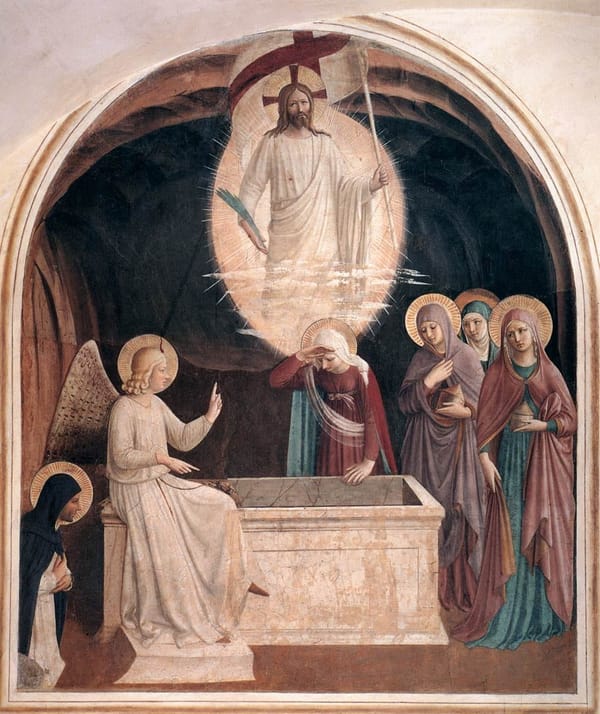
Saturday in Easter Week
Including:
THE seventh day of the gladdest of weeks has risen upon us, bringing with it the memory of the Creator's rest, after the six days of creation. It also reminds us of that other rest, which this same God took in the tomb; like a warrior, who, when sure of the victory, calmly reposes before the final combat with the enemy. Our Jesus slept his rest in the sepulchre, after permitting death to vanquish him: but when he awoke by his Resurrection, what a victory over the tyrant! Let us, to-day, visit this holy sepulchre and venerate it: it will speak to us of him we love, and make our love the warmer. Here, we shall say to ourselves, here rested our dear Master, after he had died for us! Here was the scene of the glorious victory, when he arose again, and this, too, for us!
The prophet Isaias had said: ‘In that day, the root of Jesse, who standeth for an ensign of people, him shall the gentiles beseech; and his sepulchre shall be glorious.’1 The prophecy has been fulfilled. There is not a nation under the sun where Jesus has not his adorers. The tombs of other men are either destroyed, or they are monuments of death; the tomb of Jesus is everlasting, and speaks but of life.
What a sepulchre this, the sight of which fills us with thoughts of glory, and whose praises had been celebrated so many ages beforehand! When the fullness of time came, God raised up in Jerusalem a holy man, named Joseph of Arimathea, who secretly but sincerely became one of Jesus’ disciples. He was a rich counsellor, or senator. He had prepared his own tomb, and the place he chose was on the side of the hill of Calvary. It was hewn out of the live rock, and consisted of two cells, one serving as a sort of entry into the other. Joseph thought he was labouring for himself, whereas he was preparing the sepulchre of a God. He only thought of the debt which every man has to pay, in consequence of Adam’s sin; but heaven had decreed that Joseph should never lie in that tomb, and that here should originate man’s immortality.
Jesus had expired on the Cross, amidst the insults of his people; the entire city had risen up against the Son of David, whom, but a few days before, it had hailed as its King. Then did Joseph brave the fury of the deicides, and ask permission from the Roman governor to be allowed the honour of burying the Body of the Crucified. He at once repaired to Calvary, accompanied by Nicodemus, and, having taken down the sacred corpse from the Cross, he devoutly laid it upon the stone which he had intended as his own restingplace. He felt that it was a happiness and an honour to give up his own tomb to the dear Master, for whom he had not been ashamed to profess, and that in the very court of Pilate, his devoted attachment. Right worthy art thou, O Joseph! of the thanks of mankind. Thou wast our representative at the burial of our Jesus. And Mary, too, the afflicted Mother, who was present, recompensed thee, in her own way, for the sacrifice thou didst so willingly make for her Son.
The Evangelists draw our attention to one special circumstance of the sepulchre. St Matthew, St Luke, and St John, tell us that it was new, and that no man had ever been laid in it. The holy Fathers teach us that we must see here a mysterious dispensation, and one of the grand glories of the holy tomb. It marks, as they observe, the resemblance that exists between the sepulchre, which restored the Man-God to the life of immortality, and the virginal womb which gave him birth that he might be a victim for the world’s redemption: and they bid us learn from this, how God, when he deigns to dwell in any of his creatures, would have the dwelling to be pure and worthy of his infinite holiness. Here, then, is one of the glories of the holy sepulchre—that it was an image of the incomparable purity of the Mother of Jesus.
During the few hours that it possessed the precious trust, where was there glory on earth like unto what it enjoyed? Within that silent cave, there lay, wrapt in shrouds that were bedewed with Mary’s tears, the Body which had ransomed the world. Hosts of holy angels stood in that little rocky cell, keeping watch over the corpse of him who was their Creator; they adored it, in its sleep of death; they longed for the hour to come when this Lamb, that was slain, would arise a Lion in power and majesty. And when the moment fixed by the eternal decree came, that humble spot was made the scene of the grand prodigy; Jesus rose to life, and, swifter than lightning, passed through the rock to the outer world. An angel then rolled back the stone from the entrance to the sepulchre, thus proclaiming the departure of the divine Captive. Other angels showed themselves to Magdalen and her companions, when they came to visit it. Peter, too, and John were soon there. O truly, most holy is this place! The Son of God deigned to dwell within it; his Mother honoured it with her presence and her tears; angels adored in it; the holiest souls on earth visited, venerated, and loved it. O sepulchre of the Son of Jesse, thou art indeed glorious!
Hell witnesses this glory, and would fain destroy it. The sight of this sepulchre is insufferable to Satan’s pride, for it is the trophy of the defeat of death, the offspring of sin. He flatters himself on having succeeded, when Jerusalem is destroyed by the Roman legions, and on her ruins there rises up a new and pagan city, called Ælia. But no! neither the name of Jerusalem, nor the glory of the holy sepulchre, shall perish. The pagans cover it with a mound of earth, on which they build a temple to Jupiter; it is the same spirit that dictated their raising an altar to Venus on Calvary, and another to Adonis over the cave of Bethlehem. But all these sacrilegious efforts only serve to tell the Christians the exact site of these several sacred places. The pagans think by this artifice to turn the respect and homage of the Christians from Jesus to their false gods: here again they fail. The Christians abstain from visiting the holy places, as long as they are desecrated by the presence of these idols; but they keep their eye fixed on what their Redeemer has endeared to them, and wait in patience for the time when it shall please the eternal Father again to glorify his Son.
The time comes. God sends to Jerusalem a Christian empress, mother of a Christian emperor: she is to restore the holy places, the scenes of our Redeemer’s love. Like Magdalen and her companions, Helen hastens to the sepulchre. God would have it so—woman’s privilege in all that happened on the great morning of the Resurrection is to be continued now. Magdalen and her companions sought Jesus; Helen, who adores him as her risen Lord, only seeks his sepulchre: but their love is one and the same. The pious empress orders the temple of Jupiter to be pulled down, and the mound of earth to be removed; which done, the trophy of Jesus’ victory once more gleams in the light of day. The defeat of death is again proclaimed by this resurrection of the glorious sepulchre. A magnificent temple is built at the expense of the imperial treasury, and is called the basilica of the Resurrection. The whole world is excited by the news of such a triumph; the already tottering structure of paganism receives a shock which hastens its destruction; and pilgrimages to the holy sepulchre are begun by Christian people throughout the world, forming a procession of universal homage which is to continue to the end of time.
During the three centuries following, Jerusalem was the holy and free city, and the sepulchre of Jesus reflected its glory upon her; but the East became a very hot-bed of heresies, and God, in his justice, sent her the chastisement of slavery. The Saracen hordes inundated the land of prodigy. If the torrent of invasion was checked, it was for a brief period, and the waters returned with redoubled power. Meanwhile, what becomes of the holy sepulchre? Let us not fear: it is safe. The Saracens themselves look upon it with awe, for it is, they say, the tomb of a great Prophet. True, a tax is imposed on the Christians who visit it; but the sepulchre is safe. One of the caliphs presented the keys of the venerable sanctuary to the emperor Charlemagne, hereby evincing, not only the respect he had for this greatest of Christian monarchs, but, moreover, the veneration wherein he held the sacred grotto. Thus did our Lord's sepulchre continue to be glorified even in the midst of dangers which, humanly, would have wrought its utter destruction.
Its glory shone out still more brightly, when, at the call of the Father of Christendom, the western nations rose up in arms, and marched, under the banner of the Cross, to the deliverance of Jerusalem. The love of the holy sepulchre was in every heart, its name on every tongue. The first engagement drove back the Saracen, and left the city in possession of the crusaders. A sublime spectacle was then witnessed in the church of the holy sepulchre; the pious Godfrey of Bouillon was consecrated king of Jerusalem, and the holy mysteries were celebrated, for the first time in the language and ritual of Rome, under the oriental dome of St Helen's basilica. But the reign of Japheth in the tents of Sem was of short duration, owing partly to the short-sighted policy of the western sovereigns, which kept them from appreciating the importance of such a conquest; and partly to the treachery of the Greek Empire, which betrayed the defenceless Jerusalem once more into the hands of the Saracens. Still, the period of the Latin kingdom in the holy city was one of the glories of Jesus' sepulchre, foretold by Isaias.
What are to be its future glories? At present, it is profaned by the sacrifices which are offered, in its basilica, by schismatical and heretical priests; it is entrusted, for a few hours each year, to the Catholics of Jerusalem, and during that brief interval it receives the fervent homage of the true spouse of Jesus. When will the holy sepulchre be reinstated in its honour? Will the nations of the West return to the fervour of faith, and emulate the holy chivalry of the crusaders of old? Or will the East renounce the schism, which has cost her her liberty; stretch out her hand to the mother and mistress of all churches; and, on the rock of the Resurrection, sign the covenant of a union, which would be the death-warrant of Islamism? Only God knows: but this much he has revealed to us in sacred Scripture, that before the end of the world, Israel will return to the Messias he despised and crucified, and that the glory of Jerusalem is to be restored by the Jews who shall be converted.2 Then will the sepulchre of the Son of Jesse be at the height of its glory, and soon will this Son of Jesse himself appear. Our bodies will then be on the eve of the general resurrection; and thus the final result of the Pasch will be simultaneous with the last and greatest glory of the holy sepulchre. As we rise from our graves, we shall fix our eyes upon our Jesus' tomb, and love it as the origin and source of the immortality we shall then have. Until the time of our death comes, when our bodies must be laid in the temporary prison of the grave, let us love the sepulchre of our dear Saviour; let us be zealous for its honour; and, imitating our forefathers in that earnest faith which made them its defenders and soldiers, let us get well into us that portion of the Easter spirit, which consists in understanding and loving the glories of Jesus' sepulchre.
The name given in the Liturgy to this day is Saturday in albis, or more correctly, in albis deponendis; because it was to-day that the neophytes were to lay aside the white robes they had been wearing during the whole Octave. This Octave had, indeed, begun earlier for them than for the rest of the faithful, inasmuch as it was on the night of Holy Saturday that they were regenerated, and vested with these white garments, the emblem of the purity of their souls. It was, therefore, on the evening of the following Saturday, and after the Office of Vespers, that they put off their baptismal robes, as we will describe farther on.
In Rome, the Station is in the Lateran basilica, the mother and mistress of all churches. It is close to the baptistery of Constantine, where, eight days back, the neophytes received the grace of regeneration. The basilica, wherein they are now assembled, is that from which they set out, during the still and dark night, to the font of salvation, led on by the mysterious light of the Paschal torch. It was to this same church that they returned after their Baptism, clad in their white robes, and assisted, for the first time, at the entire celebration of the Christian Sacrifice, and received the Body and Blood of Christ Jesus. No other place could have been more appropriate for the Station of this day, whereon they were to return to the ordinary duties of life. Holy Church sees assembled around her these her new-born children. It is the last time that she will see them in their white garments, and she looks at them with all the affection of a joyful mother. They are most dear to her, as the fruit of heaven’s own giving; and during the week she has frequently given expression to her maternal pride, in canticles such as she alone can sing.
Sometimes she thought how they had feasted at the divine Banquet, and how they were strengthened and beautified by the Flesh of him who is all wisdom and sweetness; and she sang these words:
Sometimes she was elated with joy, as she saw transformed into innocent lambs those who, heretofore, had led worldly lives; they had now begun a new life, and with all the innocence of little children; to describe them, she sings this pastoral strain:
Again, at other times, she looked with holy pride on the splendid virtues which Baptism had infused into their souls, and on the spotless purity which made them beam with light; she thus enthusiastically speaks of their beauty:
These three Responsories are taken from the Offices of the holy Church during Paschal time.
Mass
The Introit is composed of words from the 104th Psalm, wherein Israel gives praise to the Lord, for that he brought his people out of their exile. By this people, we must understand our neophytes, who were exiled from heaven because of original sin and of those they themselves had committed: Baptism has restored them to all the rights they had forfeited, for it has made them members of the Church.
Introit
Ps. Confitemini Domino, et invocate Nomen ejus: annuntiate inter gentes opera ejus. ℣. Gloria Patri.
Eduxit.
Ps. Praise the Lord, and call upon his Name: publish his works among the gentiles, ℣. Glory, etc.
The Lord, etc.
Paschal Week is about to close; the Church, therefore, now asks our Lord to grant to us, her children, that the joy we have experienced during this happy Octave may lead us to the still greater joy of the eternal Pasch.
Collect
To this is added one of the Collects given in Wednesday’s Mass, p. 218.
Epistle
I Cap. ii.Charissimi, deponentes igitur omnem malitiam, et omnem dolum, et simulationes, et invidias, et omnes detractiones, sicut modo geniti infantes, rationabile sine dolo lac concupiscite, ut in eo crescatis in salutem: si tamen gustastis quoniam dulcis est Dominus. Ad quem accedentes lapidem vivum, ab hominibus quidem reprobatum, a Deo autem electum et honorificatum: et ipsi tanquam lapides vivi superædificamini, domus spiritualis, sacerdotium sanctum, offerre spirituales hostias, acceptabiles Deo per Jesum Christum. Propter quod continet Scriptura: Ecce pono in Sion lapidem summum angularem, electum, pretiosum: et qui crediderit in eum non confundetur. Vobis igitur honor credentibus: non credentibus autem, lapis quem reprobaverunt ædificantes, hic factus est in caput anguli: et lapis offensionis, et petra scandali his, qui offendunt verbo, nec credunt in quo et positi sunt. Vos autem genus electum, regale sacerdotium, gens sancta, populus acquisitionis: ut virtutes annuntietis ejus, qui de tenebris vos vocavit in admirabile lumen suum. Qui aliquando non populus, nunc autem populus Dei: qui non consecuti misericordiam, nunc autem misericordiam consecuti.
I Ch. ii.Dearly beloved: Laying away all malice, and all guile and dissimulations, and envies, and all detractions, as newborn babes, desire the rational milk without guile; that thereby you may grow unto salvation: if so be you have tasted that the Lord is sweet; unto whom coming, as to a living stone, rejected indeed by men, but chosen and made honourable by God: be you also as living stones built up, a spiritual house, a holy priesthood, to offer up spiritual sacrifices, acceptable to God by Jesus Christ. Wherefore it is said in the Scripture: ‘Behold I lay in Sion a chief corner-stone, elect, precious: and he that shall believe in him shall not be confounded.’ To you therefore that believe, honour; but to them that believe not,’the stone which the builders rejected, the same is made the head of the corner:’and a stone of stumbling and a rock of scandal, to them who stumble at the word, neither do believe, whereunto also they are set. But you are a chosen generation, a kingly priesthood, a holy nation, a purchased people: that you may declare his virtues, who hath called you out of darkness into his marvellous light. Who in time past were not a people: but are now the people of God. Who had not obtained mercy; but now have obtained mercy.
The neophytes could not have received any more appropriate instruction than this, which the prince of the Apostles addresses to us all. St Peter wrote this first Epistle to the newly baptized of those days. He affectionately calls them new-born babes. He urges them to that virtue, which so becomes the age of infancy —the virtue of simplicity. He tells them that the doctrine they have been taught will be to them a milk, which will feed and strengthen them. He invites them to taste how sweet is the Lord they have now vowed to serve.
After this, he speaks of one of the leading characteristics of Christ, namely, his being the foundation and corner-stone of God’s house. It is upon him that the faithful, who are the living stones of the spiritual edifice, must rest. He alone can give them solidity; and hence, when about to return to his Father, he chose and established upon earth another rock—a rock that should be ever visible, united with and based upon his own divine self, and partaking of his solidity. The Apostle’s humility forbids his developing the whole truth as related in the Gospel,3 which tells us of his glorious prerogative; but if we remember the words spoken by our Lord to St Peter, we understand the whole doctrine implied in our Epistle.
The Apostle is silent about his own dignity as the rock, on which Jesus has built his Church; but observe the glorious titles he gives to us, who have been made members of that Church by Baptism. You are, says he, a chosen generation, a kingly priesthood, a holy nation, a purchased people. Oh, yes! what a difference there is between one that is baptized and one that is not! Heaven is opened to the one, and shut against the other; the one is a slave of the devil, and the other is a king in Christ Jesus, the eternal King, whose brother he has now become; the one cut off from God, the other offering him a sacrifice of infinite worth by the hands of the great High Priest, Jesus. And all these gifts have been bestowed upon us by a purely gratuitous mercy; we had done nothing to merit them. Let us, then, offer to the Father, who has thus adopted us, our humble acts of thanksgiving; let us go back, in thought, to the time when we ourselves were neophytes, and renew the promises which were made, in our name, as the essential condition of our being admitted to all these graces.
From this day forward, the Church ceases to use, during Paschal time, the Responsory called the Gradual. She substitutes, in its stead, two versicles, with the Alleluia repeated four times: the formula is less solemn, but more joyous. During the first six days of the Octave, which bear an analogy with the six days of creation, she would maintain the customary majestic gravity of her chants; now that she has reached the day whereon the Creator rested after his work was finished, she gives free scope to the holy joy, wherewith she is filled.
The Sequence Victimœ Paschali, p. 145.
Gospel
Cap. xx.In illo tempore: Una sabbati Maria Magdalene venit mane, cum adhuc tenebræ essent, ad monumentum: et vidit lapidem sublatum a monumento. Cucurrit ergo, et venit ad Simonem Petrum, et ad alium discipulum, quem amabat Jesus, et dicit illis: Tulerunt Dominum de monumento, et nescimus ubi posuerunt eum. Exiit ergo Petrus, et ille alius discipulus, et venerunt ad monumentum. Currebant autem duo simul, et ille alius discipulus præcucurrit citius Petro, et venit primus ad monumentum. Et cum se inclinasset, vidit posita linteamina, non tamen introivit. Venit ergo Simon Petrus sequens eum, et introivit in monumentum, et vidit linteamina posita, et sudarium, quod fuerat super caput ejus, non cum linteaminibus positum, sed separatim involutum in unum locum. Tunc ergo introivit et ille discipulus, qui venerat primus ad monumentum: et vidit, et credidit: nondum enim sciebant Scripturam, quia oportebat eum a mortuis resurgere.
Ch. xx.At that time: The first day of the week, Mary Magdalen cometh early, while it was yet dark, to the sepulchre: and she saw the stone taken away from the sepulchre. She ran, therefore, and cometh to Simon Peter, and to the other disciple, whom Jesus loved, and saith to them: They have taken away the Lord out of the sepulchre, and we know not where they have laid him. Peter therefore went out, and that other disciple and they came to the sepulchre. And they both ran together, and that other disciple did outrun Peter, and came first to the sepulchre. And when he stooped down, he saw the linen cloths lying: but yet he went not in. Then cometh Simon Peter, following him, and went into the sepulchre, and saw the linen cloths lying. And the napkin, that had been about his head, not lying with the linen cloths, but apart, wrapt up into one place. Then that other disciple also went in, who came first to the sepulchre: and he saw, and believed; for as yet they knew not the Scripture, that he must rise again from the dead.
This incident, which happened on the morning of our Lord's Resurrection, has been reserved by the Church for to-day’s Liturgy, because it again brings St Peter before our notice. This is the last day on which the neophytes assist at the holy Sacrifice in their white garments; after this, there will be nothing to distinguish them, exteriorly, from the rest of the faithful. It is important, therefore, to give them a clear idea of the foundation of the Church—a foundation, without which the Church could not exist, and upon which they must rest, if they would persevere in the faith wherein they have been baptized. They cannot obtain salvation unless they keep their faith inviolate. Now they alone have this firm and pure faith who are docile to the teachings of Peter, and recognize him as the rock on which our Lord has built his Church. In the episode related in our Gospel, we are taught by an Apostle what respect and deference are due to him whom Christ appointed to feed both lambs and sheep,4 that is, the whole flock. Peter and John run together to the sepulchre; John, the younger of the two, arrives there before Peter; he looks in, but does not enter. What means this humble reserve of the disciple who was so specially beloved of Jesus? For whom does he wait? He waits for him, whom the Master has placed over all, and who is to act as their head. Peter, at length, comes to the sepulchre; he goes in; he examines the holy place; and then John also enters. It is John himself who writes this, and gives us the admirable instruction embodied in what he relates. Yes, it is for Peter to lead the way, and judge, and decide as master; it is the Christian’s duty to follow him, to listen to his teachings, to honour and obey him. How can we have any difficulty in doing this, when we see an Apostle, and such an Apostle, behaving thus to Peter, and this, too, at a time when Peter had received the promise only of the keys of the kingdom of heaven, which were not really given to him until some days after?
The words of the Offertory are taken from the 117th Psalm, which is par excellence the Psalm of the Resurrection. They hail the divine Conqueror, who rises like a bright star, and gladdens us with his benediction.
Offertory
In the Secret, the Church teaches us that the mysteries we celebrate during the year exercise a lasting influence upon us. Each feast, as it comes round to us, brings with it fresh life and joy; and it is by its annual celebration that the Church applies to her children the graces which each mystery brought with it at the actual time of its accomplishment.
Secret
To this is added one of the Secrets given in Wednesday’s Mass, p. 224.
Our neophytes are to lay aside to-day their white robes; but there is a garment which they are never to •put away: it is Christ himself, who became united with them by Baptism, as the Apostle of the gentiles here reminds them:
Communion
The Church returns once more, in her Postcommunion, to the subject of faith. Without faith there is no Christianity: now it is the Eucharist which has the power of fostering it in the soul, for the Eucharist is the mystery of faith.
Postcommunion
To this is added one of the Postcommunions given in Wednesday’s Mass, p. 225.
THE TAKING OFF OF THE WHITE GARMENTS
The Vespers, on each of the days of this week, were celebrated in the manner we described on the Sunday. There was a numerous attendance, each day, in the basilica; and the faithful thus testified their affectionate interest in the white-robed neophytes, who visited, during the Vespers of each day, the sacred font where they had been born to the new life of grace. This afternoon, the concourse of people is greater than on the preceding days, for an interesting ceremony is to take place. The neophytes are about to lay aside the outward symbol of innocence which they have been wearing; but they are also to give a solemn promise to maintain the inward purity of soul. By this public ceremony the Church restores the newly baptized to the duties of their ordinary station of life: they must now return to the world, and comport themselves as Christians—disciples of Christ—for such they are.
The visit to the baptistery has been made, and the Office of Vespers has terminated with the Station before the crucifix of the chancel: the neophytes are then led to a room adjoining the cathedral, in which is prepared a large vessel of water. The bishop goes to his throne. Seeing the newly baptized standing around him, he addresses them in a discourse, wherein he expresses the joy he feels, as pastor, at the increase wherewith it has pleased God to bless his much-loved flock. He congratulates them upon the grace they have received; and then, alluding to the main object of their coming together this afternoon—that is, the laying aside of the white garments they received after Baptism—he warns them, with paternal affection, to keep a guard over themselves, and see that they never sully the purity of soul, of which their white robes have been but an emblem.
These were lent to the neophytes by the Church, as we said on Holy Saturday; they come now to restore them. The water in which the garments are to be washed is blessed by the pontiff. As soon as he has finished the address to which we have just been alluding, he says a prayer, wherein he speaks of the power given to this element of cleansing the stains of the soul herself. Then turning to the neophytes, he recites the 116th Psalm, in thanksgiving; to which he adds this beautiful prayer:
Visit, O Lord, thy people with thy salvation! Behold it now illumined with the Paschal joy! But do thou vouchsafe to preserve in our neophytes what thou thyself hast wrought in them unto salvation. Grant that whilst laying aside these white robes, the change may be but exterior; that the spotless purity of Christ, which the eye cannot see, may ever be in their souls, so that they may never lose it; and that thy grace may assist them to gain, by good works, that immortal life whereunto the Paschal mystery obliges us to aspire.
After this, aided by their sponsors—the men by their godfathers, the women by their godmothers—the neophytes take off their white garments, which are then consigned to those whose duty it is to wash and keep them. The sponsors having assisted their spiritual children to put on their ordinary dress, lead them to the pontiff, who distributes to each an image of the divine Lamb, stamped on wax: it is the Paschal symbol.
A last vestige of this interesting ceremony is the distribution of the Agnus Dei. This distribution is made by the Pope, on this day, in Rome, the first and every seventh year of his pontificate. We have already described the rite observed in their blessing, and we then drew the attention of our readers to the allusion to the ancient form of Baptism by immersion. The Agnus Dei are blessed on the Wednesday of Easter Week: on the following Saturday, there is what is called Papal Chapel in the palace. After High Mass, the Agnus Dei are brought before the pontiff, who is seated on a throne. The prelate, who presents them, sings the following words, which are taken from one of the beautiful Responsories given above:’Holy Father! These are the new lambs, and they have announced to us the Alleluia: they have come but now to the fount: they are filled with light.' The Pope answers: Deo gratias! They who are happy enough to witness this function are forcibly reminded of the ancient ceremony we have been describing, in which the newly baptized were led before the bishop, as the innocent lambs whom he so gladly welcomed. The Pope then distributes the Agnus Dei to the cardinals, prelates, and others presented by the master of ceremonies: and thus is concluded this function, which is interesting, not only because of its signification, but also because of the sacred object wherewith it consoles us.
We cannot conclude this last day of our neophytes' Octave without saying a few words upon the Annotine Pasch. It was the anniversary day of the previous Easter Sunday, and was looked upon as the especial feast of those who were a year old in the grace of their Baptism. The Mass was solemnly celebrated for them. The remembrance of the happy day when they were made children of God was thus brought before them; and, of course, their families kept the glorious anniversary as a glad holiday. If it came during Lent, the Annotine was not kept, or it was deferred till Easter Monday. It would seem that in some places, in order to avoid these continual changes, the anniversary of Baptism was regularly fixed for this the Saturday of Easter Week. When the custom of administering Baptism at Easter fell into disuse, the Annotine Pasch also ceased to be observed: however, we find traces of it as late as the thirteenth century. The custom of looking on the anniversary of our Baptism as a feast-day is one of those which may be called Christian instincts. The pagans made much of the day which had given them temporal birth; surely, we ought to show quite as much respect to the anniversary of our Baptism, when we were born to the supernatural life. St Louis used to sign himself Louis of Poissy, because it was in the little church of Poissy that he had received Baptism. Let us learn from this holy king to love the day and the place of our Baptism, that is, of our being made children of God and of his Church.
We have been considering, during the preceding days of this week, the divine work of the creation. We began with the Sunday, whereon light was called forth from nothingness; and in this we recognized a type of the mystery of the Resurrection; for our Jesus, the uncreated Light, was to rise from his grave on that same day of the week. This is Saturday, the seventh day, the day whereon the Lord rested, after the creation. But it is also the day whereon this same Lord rested in his glorious sepulchre. Let us, then, honour this second mystery, which even more than the first reveals to us the love of the Son of God for man. Let us give him our Saturday's homage, by addressing him in these words of the Mozarabic breviary:
Capitula
The Greek Church shall provide us to-day with a hymn in honour of the Resurrection. We take the following stanzas from its Liturgy for Easter Sunday:
In Dominica Resurrectionis
In the Proper Offices of the Order of the Holy Sepulchre, there is given the following beautiful hymn, which we offer to our readers as being most appropriate to the day:
Hymn
Læta mens, miracula;
Quo velut matris pudicæ
Christus alvo prodiit:
Ut prophetarum fideles
Paginæ spoponderant.
Virginis puerperæ,
In novo compostus antro
Conquievit pumicis:
Gloriosus hoc et illa,
Vir, puerque prodiit.
Omnium spe serius;
Æviternum reddit illud,
Omnium spe citius;
Illa pannis involutum,
Linteis hoc conditum.
Ad salutem nascitur;
At salute jam parata,
Rupis alvus reddidit;
Ad crucem parens produxit,
At silex ad gloriam.
Purpurata sanguine
Aula ter felix, adorent
Terra, pontus, æthera;
Nec sepulchrum quis vocarit,
Vita de quo nascitur.
Usquequaque altissimo,
Una Patri, Filioque,
Inclyto Paraclito,
Cui laus est, et potestas
Per immensa sæcula.
and sing the wonders
of the glorious sepulchre,
whence came thy Christ, as, heretofore,
from the womb of his Virgin Mother.
Thus was it foretold by the truthful prophets.
of a Virgin Mother;
so, too, he was buried in a tomb,
wherein no other man had been placed;
from both he comes the glorious Jesus,
as infant first, and then as man.
brings him forth created in mortal flesh;
the tomb, though none had hoped it,
restores him clad in immortality:
Mary wrapped him in swathing-bands;
the sepulchre held him in the winding-sheet.
from the womb of his Mother;
he rises from the tomb,
after our salvation has been wrought:
the Mother nursed him for the Cross;
the tomb, for glory.
beautified with the Blood
of the Lamb of God!
let earth, and sea, and heaven, venerate thee.
How strange to call that a sepulchre,
whence life was born!
to the most high God!
To the Father, Son,
and Holy Paraclete,
one praise and power,
for everlasting ages.
And, lastly, let us turn to the blessed Mother, for this is her day. Let us congratulate her upon the Resurrection of her divine Son, in the words of this devout sequence, taken from the ancient missals of the churches of Germany:
Sequence
Mater, plaude, qui prostrato regnat mortis principe;
Tuum virgo pone luctum,
Jesum ventris tui fructum Redivivum suscipe.
Corde dure sauciata Passionis gladio:
Voce jubilationis,
Jam de resurrectionis Jocundare gaudio.
De sepulchro teque vexit sua in palatia,
Nobis placa, supplicamus
A peccatis ut surgamus ad æterna gaudia.
who reigns triumphant over the prince of death.
Cease thy mourning: for Jesus, the fruit of thy womb,
is restored to life, and visits thee.
the sword that cruelly pierced thy Heart:
but now, sing a hymn of joy,
and be glad, because of his Resurrection.
and has taken thee to his heavenly court:
pray to him for us, we beseech thee,
that we may rise from our sins to everlasting joy.
April 23: St. George, Martyr
|
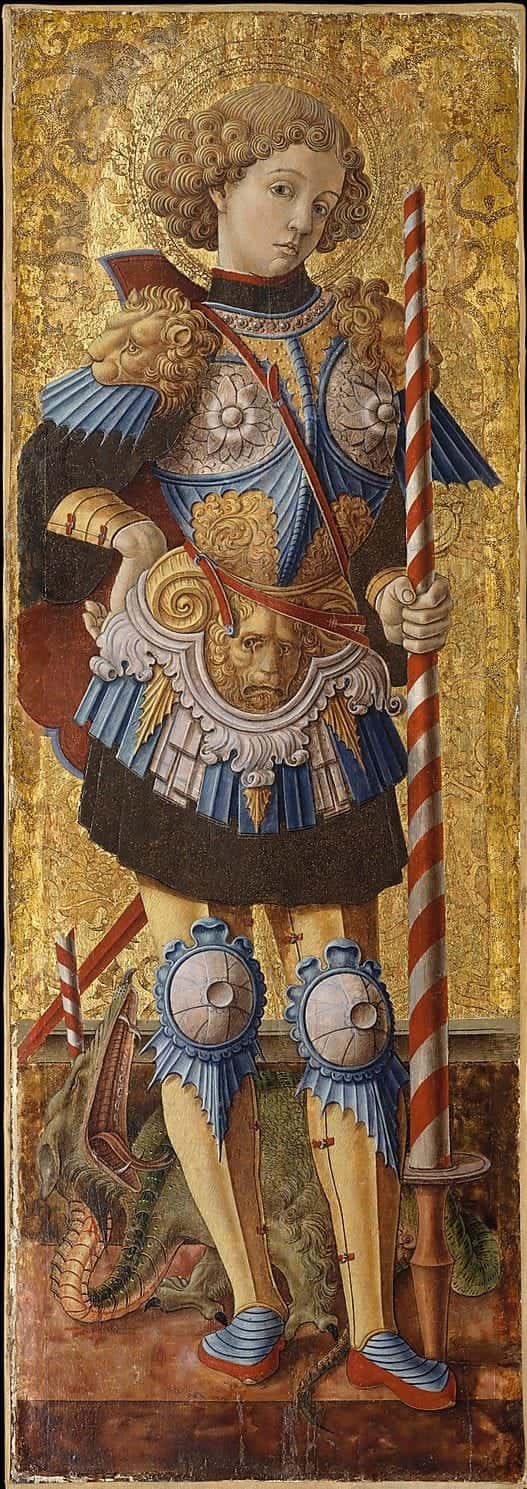
CLAD in his bright coat of mail, mounted on his war-steed, and spearing the dragon with his lance, George, the intrepid champion of our Risen Jesus, comes to gladden us today with his feast. From the East, where he is known as the great Martyr, devotion to St George soon spread in the Western Church, and our Christian armies have always loved and honoured him as one of their dearest patrons. His martyrdom took place in Paschal Time; and thus he stands before us as the guardian of the glorious sepulchre, just as Stephen, the Protomartyr, watches near the crib of the Infant God.
The Roman Liturgy gives no lessons on the life of St George; but, in their stead, reads to us a passage from St Cyprian on the sufferings of the martyrs. This derogation from the general rule dates from the fifth century. At a celebrated Council held in Rome in the year 496, Pope St Gelasius drew up, for the guidance of the faithful, a list of books which might or might not be read without danger. Among the number of those that were to be avoided, he mentioned the ‘Acts of St Georg,' as having been compiled by one who, besides being an ignorant man, was also a heretic. In. the East, however, there were other ' Acts ' of the holy martyr, totally different from those current in Rome; but they were not known in that city. The cultus of St George lost nothing, in the holy city, by this absence of a true legend. From a very early period, a church was built in his honour; it was one of those that were selected as Stations, and gave a Title to a Cardinal; it exists to this day, and it is called Saint George in Velabro (the Veil of Gold) .
The Bollandists were in possession of several copies of the forbidden ‘Acts '; they found them replete with absurd stories, and, of course, they rejected them. Father Papebroch has given us other and genuine ‘Acts ' written in Greek, and quoted by St Andrew of Crete. They bring out the admirable character of our martyr, who held an important post in the Roman army during the reign of the Emperor Diocletian. He was one of the first victims of the great persecution and suffered death at Nicomedia. Alexandra, the Emperor's wife, was so impressed at witnessing the Saint’s courage, that she professed herself a Christian, and shared the crown of martyrdom with the brave soldier of Christ.
As we have already said, devotion to St George dates from a very early period. St Gregory of Tours gives us several proofs of its having taken root in Gaul. St Clotilde had a singular confidence in the holy martyr, and dedicated to him the Church of her dear Abbey of Chelles. But this devotion became more general and more fervent during the Crusades, when the Christian armies witnessed the veneration in which St George was held by the Eastern Church, and heard the wonderful things that were told of his protection on the field of battle. The Byzantine historians have recorded several remarkable instances of the kind; and the Crusaders returned to their respective countries publishing their own experience of the victories gained through the Saint's intercession. The Republic of Genoa chose him for its patron; and Venice honoured him as its special protector, after St Mark. But nowhere was St George so enthusiastically loved as in England. Not only was it decreed in a Council held at Oxford, in the year 1222, that the feast of the Great Martyr should be observed as one of obligation; not only was devotion to the valiant soldier of Christ encouraged, throughout Great Britain, by the first Norman Kings; but there are documents anterior to the invasion of William the Conqueror, which prove that St George was invoked as the special patron of England even so far back as the ninth century. Edward III did but express the sentiment of the country when he put the Order of the Garter, which he instituted in 1330, under the patronage of the warrior Saint. In Germany, King Frederic III founded the Order of St George in the year 1468.
St George is usually represented as killing a dragon; and where the representation is complete, there is also given the figure of a princess, whom the Saint thus saves from being devoured by the monster. This favourite subject of both sacred and profane art is purely symbolical, and is of Byzantine origin. It signifies the victory won over the devil, by the martyr's courageous profession of faith; the princess represents Alexandra, who was converted by witnessing the Saint’s heroic patience under his sufferings. Neither the ' Acts ' of St George nor the hymns of the Greek Liturgy allude to the martyr's having slain a dragon and rescued a princess. It was not till after the fourteenth century that this fable was known in the West; and it arose from a material interpretation of the emblems with which the Greeks honoured St George, and which were introduced among us by the crusaders.
Although, as has been said, the Office of St George in the Roman Breviary has been taken from the Common of Martyrs in Paschal Time, the following historical lesson has recently been approved for the Dioceses of England:
Let us, in honour of our glorious patron, recite the following stanzas, taken from the Menæa of the Greek Church:
Hymn (Die XXIII Aprilis)
Thou, O George, art the glorious type of a Christian soldier. Whilst serving under an earthly monarch, thou didst not forget thy duty to the King of heaven. Thou didst shed thy blood for the faith of Christ; and he, in return, appointed thee protector of Christian armies. Be their defender in battle, and bless with victory them that fight in a just cause. Protect them under the shadow of thy standard; cover them with thy shield; make them the terror of their enemies. Our Lord is the God of Hosts; and he frequently uses war as the instrument of his designs, both of justice and mercy. They alone win true victory who have heaven on their side; and such soldiers, when on the battle-field, seem to the world to be doing the work of man, whereas it is the work of God they are furthering. Hence are they more generous, because more religious, than other men. The sacrifices they have to make, and the dangers they have to face, teach them unselfishness. What wonder, then, that soldiers have given so many martyrs to the Church!
But there is another warfare, in which we Christians are all enlisted, and of which St Paul speaks, when he says: Labour as a good soldier of Christ; for no man is crowned, save he that striveth lawfully.1 That we have thus to strive and fight during our life, the same Apostle assures us in these words: Take unto you the armour of God, that ye may be able to resist in the evil day, and to stand in all things perfect. Stand, therefore, having your loins girt about with truth, and having on the breastplate of justice, and your feet shod with the preparation of the Gospel of peace. In all things taking the shield of faith, wherewith ye may be able to extinguish all the fiery darts of the most wicked one. And take unto you the helmet of the hope of salvation, and the sword of the spirit, which is the word of God.2 We, then, are soldiers, as thou wast, O holy martyr! Before ascending into heaven, our divine leader wishes to review his troops; do thou present us to him. He has loaded us with honours, notwithstanding our past disloyalties; we must, henceforth, prove ourselves worthy of our position. In the Paschal Communion which we have received, we have a pledge of victory; how can we ever be so base as to permit ourselves to be conquered! Watch over us, O sainted warrior! Let thy prayers and example encourage us to fight against the dragon of hell. He dreads the armour we wear; for it is Jesus himself that prepared it for us, and tempered it in his own precious Blood: may we, like thee, present it to him whole and entire, when he calls us to our eternal rest!
There was a time when the whole Christian world loved and honoured thy memory with enthusiastic joy: but now, alas! this devotion has grown cold, and thy feast passes unnoticed by thousands. O holy martyr! avenge this ingratitude by imitating thy divine King, who maketh his sun to rise upon both good and bad; take pity on this world, perverted as it is by false doctrines, and tormented at this very time by the most terrible scourges. Have compassion on thy dear England, which has been seduced by the dragon of hell, and by him made the instrument for effecting his plots against the Lord and his Christ. Take up thy spear as of old; give the monster battle, and emancipate the isle of Saints from his slavish yoke. Heaven and earth join in this great prayer! In the name of our Risen Jesus, aid thine own and once devoted people to a glorious resurrection!
| Previous April 22: Sts. Soter and Caius, Popes and Martyrs | Next April 23: St. George, Martyr |