Daily reading
Paschal Time
Double of the II Class · April 25 · Sanctoral
April 25, 2022
From Dom Guéranger’s The Liturgical Year.
A Double of the II Class leads the weekday.Rubric

|
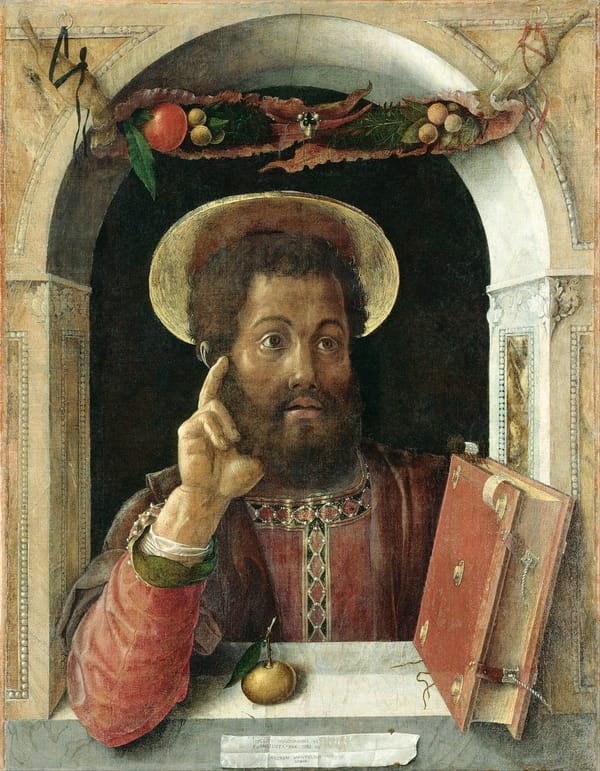
April 25: St. Mark, Evangelist (and the Greater Litanies)
THE cycle of holy Mother Church brings before us to-day the Lion, who, together with the Man, the Ox, and the Eagle, stands before the throne of God.1 It was on this day that Mark ascended from earth to heaven, radiant with his triple aureole of Evangelist, Apostle and Martyr.
As the preaching made to Israel had its four great representatives—Isaias, Jeremias, Ezechiel, and Daniel —so, likewise, would God have the New Covenant to be embodied in the four Gospels, which were to make known to the world the life and teachings of his divine Son. The holy Fathers tell us that the Gospels are like the four streams which watered the garden of pleasure.2 and that this garden was a figure of the future Church. The first of the Evangelists—the first to register the actions and words of our Redeemer—is Matthew, whose star will rise in September; the second is Mark, whose brightness gladdens us today; the third is Luke, whose rays will shine upon us in October; the fourth is John, whom we have already seen in Bethlehem, at the crib of our Emmanuel.
Mark was the beloved disciple of Peter; he was the brilliant satellite of the sun of the Church. He wrote his Gospel at Rome, under the eyes of the Prince of the Apostles. The Church was already in possession of the history given by Matthew; but the faithful of Rome wished their own Apostle to narrate what he had witnessed. Peter refused to write it himself, but he bade his disciple take up his pen, and the Holy Ghost guided the hand of the new Evangelist. Mark follows the account given by Matthew; he abridges it, and yet he occasionally adds a word, or an incident, which plainly prove to us that Peter, who had seen and heard all, was his living and venerated authority. One would have almost expected that the new Evangelist would pass over in silence the history of his master’s fall, or at least have said as little as possible about it; but no—the Gospel written by Mark is more detailed on Peter's denial than is that of Matthew; and as we read it, we cannot help feeling that the tears elicited by Jesus’ look when in the house of Caiphas, were flowing down the Apostle’s cheeks as he described the sad event. Mark’s work being finished, Peter examined it and gave it his sanction; the several Churches joyfully received this second account of the mysteries of the world’s redemption, and the name of Mark was made known throughout the whole earth.
Matthew begins his Gospel with the human genealogy of the Son of God, and has thus realized the prophetic type of the Man; Mark fulfils that of the Lion, for he commences with the preaching of John the Baptist, whose office as precursor of the Messias had been foretold by Isaias, where he spoke of the voice of one crying in the wilderness—as the Lion that’ makes the desert echo with his roar.
Mark, having written his Gospel, was next to labour as an Apostle. Peter sent him first to Aquileia, where he founded an important Church: but this was not enough for an Evangelist. When the time designed by God came, and Egypt, the source of countless errors, was to receive the truth, and the haughty and noisy Alexandria was to be raised to the dignity of the second Church of Christendom—the second see of Peter—Mark was sent by his master to effect this great work. By his preaching, the word of salvation took root, grew up, and produced fruit in that most infidel of nations; and the authority of Peter was thus marked, though in different degrees, in the three great cities of the Empire: Rome, Alexandria and Antioch.
St Mark may be called the first founder of the monastic life by his instituting, in Alexandria itself, what were called the Therapeutes. To him, also, may be justly attributed the origin of that celebrated Christian school of Alexandria which was so flourishing even in the second century.
But glorious as were these works of Peter's disciple, the Evangelist and Apostle Mark was also to receive the dignity of martyr. The success of his preaching excited against him the fury of the idolaters. They were keeping a feast in honour of Serapis; and this gave them an opportunity which they were not likely to lose. They seized Mark, treated him most cruelly, and cast him into prison. It was there that our Risen Lord appeared to him during the night, and addressed him in these words, which afterwards formed the arms of the Republic of Venice: ' Peace be to thee, Mark, my Evangelist!' To which the disciple answered: ‘Lord '—for such were his feelings of delight and gratitude that he could say but that one word, as it was with Magdalen, when she saw Jesus on the morning of the Resurrection. On the following day Mark was put to death by the pagans. He had fulfilled his mission on earth, and heaven opened to receive the Lion, who was to occupy the place allotted to him near the throne of the Ancient of days, as shown to the Prophet of Patmos in his sublime vision.3
In the ninth century the West was enriched with the relics of St Mark. They were taken to Venice; and, under the protection of the sacred Lion, there began for that city a long period of glory. Faith in so great a patron achieved wonders; and from the midst of islets and lagoons there sprang into existence a city of beauty and power. Byzantine art raised up the imposing and gorgeous church, which was the palladium of the Queen of the Seas; and the new Republic stamped its coinage with the Lion of St Mark. Happy would it have been for Venice had she persevered in her loyalty to Rome and in the ancient severity of her morals.
Let us listen to the Churches of the East and West speaking his praise. We will begin with a hymn composed in the ninth century by St Paulinus, one of St Mark’s successors as bishop of Aquileia.
Hymn
Lux ilia Patris quæ iucet de solio,
Quæ fons, origo, splendor lucis aureæ,
Habensque semper lumen indeficiens,
Cœlum serenat arcens mundi tenebras.
Suscepit almum radium sub pectore
Marcus beatus, doctor evangelicus;
Factus lucerna more tanti luminis,
Ardens fugavit sæculi caliginem.
Aureis septem unum de candelabris,
Cingitque totum mundum claro sidere:
Ecciesiarum nititur sub culmine,
Sustentat altæ fundamenta fabricæ.
Propheta sanctus, animai lætissimum
Vidit Joannes, ceu Christi recubitor,
Leonis hoc et typice sub specie
Clamore multo per deserta frendere.
Aquileiensem dudum famosissimam
Urbem sacrati Verbi pullulantia
Disseminavit, satosque centuplices
Fructus ad alta vexit felix horrea.
Nam fundamentum fidei fortissimum
Fixerat unum petram super limpidam,
Quam flumen undans, nec ventorum fulmina
Quassare possunt, torrentes nec pluviæ.
Athleta Chris ti compta pulchris liliis,
Mistumque palmis, lauro atque rosulis,
Portabat gaudens diadema vertice
Ingressus urbem Romam Christo comite.
Sancto repletus Spiritu, lætissimos
Fines per omnes jugiter Memphiticos
Patris tremendi prædicabat unicum
Venisse mundi pro salute Filium.
Tumens parabat tormentorum spicula:
Vinxit catenis, transfixit aculeis,
Dilaniando flagris sancta viscera:
Carceris umbras misit ad phantasticas.
Dedit in urbem Marcus Alexandriam:
Christi dicavit mox ibi basili cam,
Quam expiavit pretioso sanguine:
Vallavit almæ fidei munimine.
Sit Nate semper tibi super sidera
Honor, potestas, Sanctoque Spiritui;
Sit Trini tati virtus individuæ,
Per infinita sæculorum sæcula.
the light which shines from the Father's throne:
the light which is the fount and source and splendour of the golden light:
the light that never fails,
beautifies heaven, and expels darkness from the world.
received into his heart
a lovely ray of this sparkling sacred light.
He became as a lamp reflecting that great light
and dispelling the gloom of this world by his brilliant flame.
and one of the seven golden candlesticks
whose brightness shines as a star throughout the universe.
He was one of the foundations
that support lofty structure of the Church
seen of old by the holy prophet Ezechiel,
and by John, the disciple that leaned on Jesus' breast.
Mark was prefigured under the type of a lion,
whose wild roar is heard in the wilderness.
that city of ancient fame.
There he sowed the seed of the divine word,
and with joy garnered into heaven
a hundredfold of fruit.
He gave it solidity of unshaken faith
by building it on that faultless Rock,
against which the billows and storms
and floods vent their rage in vain.
wearing a wreath of fair lilies,
with palm and laurel and roses:
and thus crowned, he joyfully entered Rome,
led thither by Christ.
and, filled with the Holy Ghost,
traverses the ever fertile land of Egypt,
preaching that the only begotten Son of the Father Almighty
had come into the world for the world's salvation.
prepared various torments for him:
he was bound with chains, pierced with arrows,
and after his holy flesh had been torn by scourges,
he was thrust into a dismal dungeon.
Alexandria to know the true God.
He there built a church, which he dedicated to Christ,
consecrated by the shedding of his own blood,
and fortified by the solidity of holy faith.
To thee, O Jesus, who reignest in heaven above,
and to the Holy Ghost, be honour and power!
To the undivided Trinity be adoration paid
for endless ages!
The Greek Church celebrates the memory of the holy Evangelist in the Menæa: we extract the following stanzas:
Hymn (Die XXV Aprilis)
Thou, O Mark, art the mystic Lion, who, with the Man, the Ox and the Eagle, art yoked to the chariot whereon the King of kings pursues his triumphant course through the earth. Ezechiel, the prophet of the Ancient Testament, and John, the prophet of the New Law, saw thee standing nigh the throne of Jehovah. How magnificent is thy glory! Thou art the historian of the Word made Flesh, and thou publishest to all generations his claims to the love and adoration of mankind. The Church reveres thy writings, and bids us receive them as inspired by the Holy Ghost.
It was thou that, on the glad day of Easter, didst announce to us the Resurrection of our Lord: pray for us, O holy Evangelist, that this divine mystery may work its effects within us; and that our hearts, like thine own, may be firm in their love of our Risen Jesus, that so we may faithfully follow in him that new life which he gave us by his Resurrection. Ask him to give us his peace, as he did to his Apostles when he showed himself to them in the Cenacle, and as he did to thee when he appeared to thee in thy prison.
Thou wast the beloved disciple of Peter; Rome was honoured by thy presence: pray for the successor of Peter, thy master; pray for the Church of Rome, against which the wildest storm is now venting its fury. Pray to the Lion of the Tribe of Juda: he seems to sleep; and yet we know that he has but to show himself, and the victory is gained.
Apostle of Egypt! what has become of thy flourishing Church of Alexandria, Peter’s second see, the hallowed scene of thy martyrdom? Its very ruins have perished. The scorching blast of heresy made Egypt a waste, and God, in his anger, let loose upon her the torrent of Mahometanism. Twelve centuries have passed since then, and she is still a slave to error and tyranny: is it to be thus with her till the coming of the Judge? Pray, we beseech thee, for the countries thou didst so zealously evangelize, but whose deserts are now the image of her loss of faith.
And can Venice be forgotten by thee, who art her dearest patron? Her people still call themselves thine for the faith; bless her with prosperity; obtain for her that she may be purified by her trials, and return to the God who had chastised her in his justice. A nation that is loyal to the Church must prosper: let Venice, then, return to her former fidelity to Rome, and who knows but that the sovereign Ruler of the world, being appeased by thy powerful intercession, may make thy Venice what she was before she rebelled against the Holy See and tarnished the glories she won at Lepanto!
April 25 (the Same Day): The Greater Litanies
SAINT MARK’S PROCESSION
This day is honoured in the Liturgy by what is called Saint Mark's Procession. The term, however, is not a correct one, inasmuch as a procession was a privilege peculiar to April 25 previously to the institution of our Evangelist’s feast, which even so late as the sixth century had no fixed day in the Roman Church. The real name of this procession is The Greater Litanies. The word Litany means Supplication, and is applied to the religious rite of singing certain chants whilst proceeding from place to place in order to propitiate heaven. The two Greek words Kyrie eleison (Lord, have mercy on us) were also called Litany, as likewise were the invocations which were afterwards added to that cry for mercy, and which now form a liturgical prayer used by the Church on certain solemn occasions.
The Greater Litanies (or processions) are so called to distinguish them from the Minor Litanies, that is, processions of less importance as far as the solemnity and concourse of the faithful were concerned. We gather from an expression of St Gregory the Great that it was an ancient custom in the Roman Church to celebrate, once each year, a Greater Litany, at which all the clergy and people assisted. This holy Pontiff chose April 25 as the fixed day for this procession, and appointed the Basilica of St Peter as the Station.
Several writers on the Liturgy have erroneously confounded this institution with the processions prescribed by St Gregory for times of public calamity. It existed long before his time, and all that he did was to fix it on April 25. It is quite independent of the feast of St Mark, which was instituted at a much later period. If April 25 occur during Easter week, the procession takes place on that day (unless it be Easter Sunday), but the feast of the Evangelist is not kept till after the octave.
The question naturally presents itself—why did St Gregory choose April 25 for a procession and Station in which everything reminds us of compunction and penance, and which would seem so out of keeping with the joyous season of Easter? The first to give a satisfactory answer to this difficulty was Canon Moretti, a learned liturgiologist of the eighteenth century. In a dissertation of great erudition, he proves that in the fifth, and probably even in the fourth, century, April 25 was observed at Rome as a day of great solemnity. The faithful went, on that day, to the Basilica of St Peter, in order to celebrate the anniversary of the first entrance of the Prince of the Apostles into Rome, upon which he thus conferred the inalienable privilege of being the capital of Christendom. It is from that day that we count the twenty-five years, two months and some days that St Peter reigned as Bishop of Rome.* The Sacramentary of St Leo gives us the Mass of this solemnity, which afterwards ceased to be kept. St Gregory, to whom we are mainly indebted for the arrangement of the Roman Liturgy, was anxious to perpetuate the memory of a day which gave to Rome her grandest glory. He therefore ordained that the Church of St Peter should be the Station of the Great Litany, which was always to be celebrated on that auspicious day. April 25 comes so frequently during the octave of Easter that it could not be kept as a feast, properly so called, in honour of St Peter’s entrance into Rome; St Gregory, therefore, adopted the only means left of commemorating the great event.
But there was a striking contrast resulting from this institution, of which the holy Pontiff was fully aware, but which he could not avoid: it was the contrast between the joys of Paschal Time and the penitential sentiments wherewith the faithful should assist at the procession and Station of the Great Litany. Laden as we are with the manifold graces of this holy season, and elated with our Paschal joys, we must sober our gladness by reflecting on the motives which led the Church to cast this hour of shadow over our Easter sunshine. After all, we are sinners, with much to regret and much to fear; we have to avert those scourges which are due to the crimes of mankind; we have, by humbling ourselves and invoking the intercession of the Mother of God and the Saints, to obtain the health of our bodies, and the preservation of the fruits of the earth; we have to offer atonement to divine justice for our own and the world’s pride, sinful indulgences, and insubordination. Let us enter into ourselves, and humbly confess that our own share in exciting God’s indignation is great; and our poor prayers, united with those of our holy Mother the Church, will obtain mercy for the guilty, and for ourselves who are of the number.
A day, then, like this, of reparation to God’s offended majesty, would naturally suggest the necessity of joining some exterior penance to the interior dispositions of contrition which filled the hearts of Christians. Abstinence from flesh meat has always been observed on this day at Rome; and when the Roman Liturgy was established in France by Pepin and Charlemagne, the Great Litany of April 25 was, of course, celebrated, and the abstinence kept by the faithful of that country. A Council of Aix-la-Chapelle, in 836, enjoined the additional obligation of resting from servile work on this day: the same enactment is found in the Capitularia of Charles the Bald. As regards fasting, properly so called, being contrary to the spirit of Paschal Time, it would seem never to have been observed on this day, at least not generally. Amalarius, who lived in the ninth century, asserts that it was not then practised even in Rome.
During the procession, the Litany of the Saints is sung, followed by several versicles and prayers. The Mass of the Station is celebrated according to the Lenten Rite, that is, without the Gloria in excelsis, and in purple vestments. We have inserted the Litany of the Saints in the following volume, for the Rogation Days.
We take this opportunity of protesting against the negligence of Christians on this subject. Even persons who have the reputation of being spiritual think nothing of being absent from the Litanies said on St Mark’s and the Rogation Days. One would have thought that when the Holy See took from these days the obligation of abstinence, the faithful would be so much the more earnest to join in the duty still left—-the duty of prayer. The people’s presence at the Litanies is taken for granted: and it is simply absurd that a religious rite of public reparation should be one from which almost all should keep away. We suppose that these Christians will acknowledge the importance of the petitions made in the Litanies; but God is not obliged to hear them in favour of such as ought to make them and yet do not. This is one of the many instances which might be brought forward of the strange delusions into which private and isolated devotion is apt to degenerate. When St Charles Borromeo first took possession of his see of Milan, he found this negligence among his people, and that they left the clergy to go through the Litanies of April 25 by themselves. He assisted at them himself, and walked barefooted in the procession. The people soon followed the sainted pastor’s example.
* Moretti, De Festo in honorem Principis Apostolorum Romæ ad diem XXV Aprilis instituto. Romæ, 1742, 10. ↩︎
Monday of the Second Week after Easter
THE first week has been devoted to the joyous celebration of our Emmanuel’s return to us. He has been visiting us each day, in order to make us sure of his Resurrection. He has said to us: See me! Touch me! Feel! it is indeed I!1 But we know that his visible presence among us is not to last beyond forty days. This happy period is rapidly advancing; the time seems to go so quickly! In a few weeks, he, for whom the whole earth has been in such expectation, will have disappeared from our sight. O Expectation and Saviour of Israel! why wilt thou he as a stranger in the land, and as a wayfaring man turning in to lodge? Why wilt thou be as a wanderer?2—So much the more precious are the hours, then! Let us keep close by his side; when we cannot hear his words, let us fix our eyes upon him; but when he does speak, let us treasure up the beautiful words, for they are as the last will of our dearest Master.
During these forty days he is continually with his disciples, not indeed to persuade them of his Resurrection (for of that they had no longer any doubt), but, as St Luke says, that he might speak to them of the Kingdom of God.3 He has redeemed man by his Blood, and his victory over death; he has wrought reconciliation between heaven and earth—all that now remains to be done is the organization of the Church. The Church is the Kingdom of God; for it is in and by her that God is to reign upon the earth. The Church is the Spouse of the risen Jesus; it is he that raised her up to so exalted an honour; and now he would give her the dowry which will prepare her for that glorious day when the Holy Ghost is to descend upon her, and proclaim her to all nations as Spouse of the Incarnate Word, and Mother of the elect.
Three things are needed by the Church in order that she may carry on her mission: a constitution framed by the very hand of the Son of God, whereby she will become a visible and permanent society; the possession of all the truths which her divine Lord came upon this earth to reveal or confirm—and in this is included the right to teach, and teach infallibly; thirdly, the means whereby she may efficaciously apply to the faithful the fruit of Jesus’ sacrifice on the Cross, that is to say, the graces of salvation and sanctification. Hierarchy, Doctrine, Sacraments—these are the all-important subjects upon which our Lord instructs his disciples during the forty days between his Resurrection and Ascension.
But before following him in his divine work of organizing the Church, let us spend the rest of this week in considering him as the Risen Jesus, dwelling among men, and winning their admiration and love. We have contemplated him in the humility of his swathing-bands and Passion; let us now exultingly feast on the sight of his glory.
He presents himself to us as the most beautiful of the sons of men.4 He was always so, even when he veiled the splendour of his beauty under the infirmity of the mortal flesh he had assumed; but what must not this splendour be now that he has vanquished death, and permits the rays of his glory to shine forth without restraint? His age is for ever fixed at that of thirtythree: it is the period of life wherein man is at the height of his strength and beauty, without a single sign of decay. It was the state in which God created Adam, whom he formed to the likeness of the Redeemer to come; it will be the state of the bodies of the just on the day of the general Resurrection—they will bear upon them the measure of the perfect age5 which our Lord had when he arose from his tomb.
But it is not only by the beauty of his features that the Body of our Risen Jesus delights the eye of such as are permitted to gaze upon him: it is now endowed with the glorious qualities of which the three Apostles caught a glimpse on Mount Thabor. In the Transfiguration, however, the Humanity shone as the sun because of its union with the Person of the Word; but now, besides the Brightness due to it by the Incarnation, the glorified Body of our Redeemer has that which comes from his being Conqueror and King. His Resurrection has given him such additional resplendence that the sun is not worthy to be compared with him; and St John tells us that he is the Lamp that lights up the heavenly Jerusalem.6
To this quality which the Apostle of the Gentiles calls Brightness,7 is added that of Impassibility, whereby the Body of our Risen Lord has ceased to be accessible to suffering or death, and is adorned with the immortality of life. This Body is as truly and really a Body as ever; but it is now impervious to any deterioration or weakness; its life is to bloom for all eternity. The third quality of our Redeemer’s glorified Body is Agility, by which it can pass from one place to another, instantly and without effort. The Flesh has lost that weight which, in our present state, prevents the body from keeping pace with the longings of the soul. He passes from Jerusalem to Galilee in the twinkling of an eye, and the Spouse of the Canticle thus speaks of him: The voice of my Beloved! Behold he cometh leaping upon the mountains, skipping over the hills!8 Finally, the Body of our Emmanuel has put on the quality of Subtility (which the Apostle calls ‘Spirituality’),9 whereby it is enabled to penetrate every material obstacle more easily than a sunbeam makes its way through glass. On the morning of his Resurrection, he passed through the stone that stood against the mouth of the sepulchre; and on the same day he entered the Cenacle, though its doors were shut, and stood before his astonished disciples.
Such is our Saviour, now that he is set free from the shackles of mortality. Well may the little flock that is favoured with his visits exclaim on seeing him: How fair and comely art thou,10 O dearest Master! Let us join our praises with theirs, and say: Yes, dearest Jesus, thou art beautiful above all the sons of men! A few days back and we wept at beholding thee covered with wounds, as though thou hadst been the worst of criminals: but now our eyes feast on the resplendent charm of thy divine beauty. Glory be to thee in thy triumph! Glory, too, be to thee in thy generosity, which has decreed that these our bodies, after having been purified by the humiliation of the tomb, shall one day share in the prerogatives which we now admire in thee!
Let us, destined as we are to share in the glory of our Jesus, offer to him this beautiful canticle, which used to be sung in the churches of Germany during the Middle Ages:
Sequence
Leo Juda magne, crucis virtute
Mors peccati, vita justitiæ.
Pro gustu scientiae, medicina gratiae
Pro rapina gloriae.
Jus romphææ restrinxit flammeae,
Paradisi pandis hortum,
Stirps obedientiæ, medicina gratiae.
Pax est in terris, fulgur inferis,
Et lux superis;
Dies duplicis baptismi, Legis et Evangelii.
Dum vetus transit, novum surgit.
Haec dies Domini,
Gaude mens expers fermenti, plena panis azymi.
Signatis postibus, assum Pascha
Nocte domo una,
Jam cum lactucis ede agrestibus.
Pellitis pedibus, cum baculo propera,
Et caput cum intestinis
Et pedibus vora.
Christe, mundans hyssopo,
Fac et dignos hoc mysterio;
Mare siccans, Leviathan perforans
Maxillam hamo armilla.
Sopi, suscita;
De torrente bibens in via
Damna nostra;
Tu Pontifex, hostia,
Torcular calcans, tu uva.
Plena septemplici rore,
Specie rosæ rubor,
Lilii candor,
Quo te tantæ clementiae Consilio,
Microcosmi inclinaveras Auxilio,
Ut miseris particeps
Redemptor esses,
Absque peccati naevo,
Gestans formulam peccati?
Servi, Domine,
Spes anastaseos primae,
Ultimae, per jusjurandum
Semini Abrahæ firma et nos.
Dux athanatos,
Nos tuo convivificans corpori,
Commortuos Adæ parent veteri;
Tu membris fortioribus
Jungens infirma,
Vitæ æternæ des pascua, tu Pascha.
Strong Lion of Juda! by the power of the Cross,
|thou art the Death of sin, and the Life of justice.
thou now givest us the fruit of the Tree of Life: to remedy the theft
committed by his ambition for glory, thou givest the medicine of grace.
the fiery sword which justly menaced us.
Thou openest heaven to us,
O Root of obedience! O Medicine of Grace!
which brings peace to earth, and terror to hell,
and light to heaven.
It is the day of the twofold baptism—of the Law and the Gospel.
the old one passes away, and the new rises in its stead.
This is the day which the Lord hath made: let us,
who have put away the old leaven and feed on the unleavened, let us rejoice!
thy threshold is signed with the Blood of the Lamb: eat the Pasch
prepared by fire in the night;
eat it in the One House; yea, eat it with wild lettuce.
shoe thy feet, and, with a stave in thy hand,
hasten and eat the head and entrails
and feet of the Lamb.
this day, with hyssop;
make us worthy of the Mystery.
Dry up the sea that we may pass; and with the hook
(of thy Cross) take the Leviathan.
inspirit us with thy chalice,
O thou that didst drink
of the torrent of our miseries in the way!
O thou our High Priest,
our Victim, our Wine-presser, our Vine!
rich with the dew of the seven gifts,
ruddy as the rose,
and fair as the lily!
—whence that merciful design of thine,
that made thee stoop to aid this little world,
sharing our nature
that thou mightest redeem us miserable men,
and taking the likeness of sin,
O thou the sinless God!
thou that hast made thyself Brother of thy creature man!
O Hope of our first and eternal Resurrection!
we beseech thee, by the promise
made to Abraham’s seed,
give us strength, O immortal King!
and make us, who were sharers
in our First Parent’s death, to be fellow-members of thy life.
Unite our weakness with thy strength, and bless us,
O Blessed Paschal Lamb!
with the pastures of eternal Life.
| Previous April 24: St. Fidelis of Sigmaringen, Martyr | Next April 25 (the Same Day): The Greater Litanies |