Daily reading
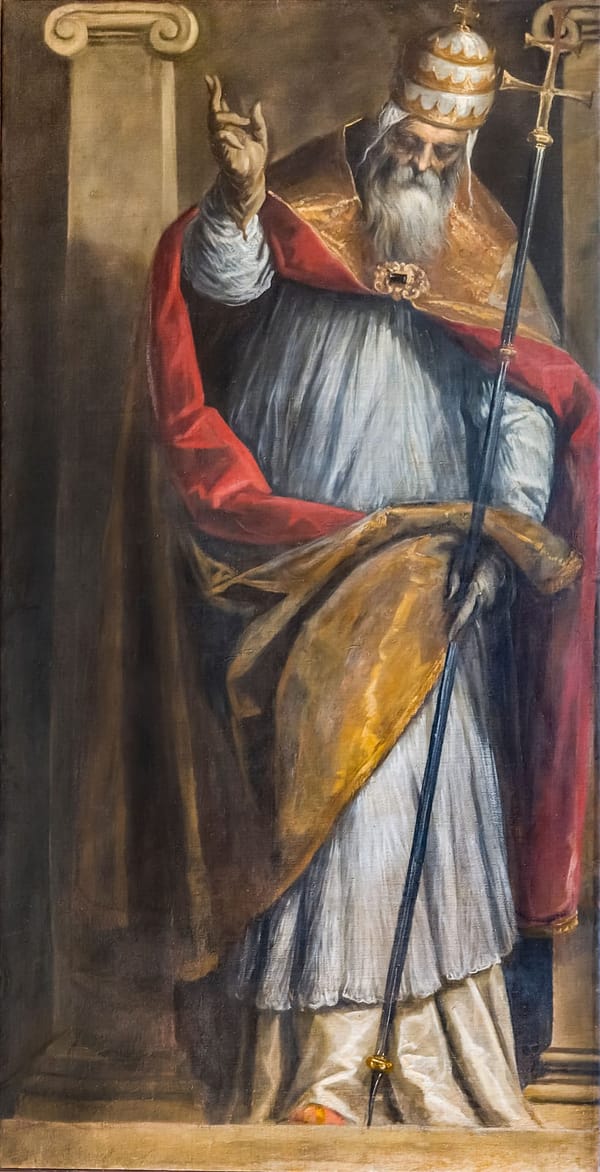
April 26: Sts. Cletus and Marcellinus, Popes and Martyrs
TWO bright stars appear this day on the ecclesiastical cycle, proclaiming the glory of our Jesus, the Conqueror of death. Again they are two pontiffs, and martyr pontiffs. Cletus leads us to the very commencement of the Church, for he was a disciple of Peter, and his second successor in the See of Rome. Marcellinus was a witness of the great persecution under Diocletian; he governed the Church on the eve of her triumph. Let us honour these two fathers of Christendom, who laid down their lives in its defence; and let us offer their merits to Jesus, who supported them by his grace, and cheered them with the hope that one day they would share in his Resurrection.
The following is the account given of St Cletus by the Liturgy:
The Life of St Marcellinus is thus given in the Breviary:
Pray for us, O holy Pontiffs, and look with fatherly love upon the Church on earth, which was so violently persecuted in your times, and at the present day is far from enjoying peace. The worship of idols is revived; and though they be not of stone or metal, yet they that adore them are as determined to propagate their worship as were the pagans of former days to make all men idolaters. The gods and goddesses now in favour are called Liberty, Progress, and Modern Civilization. Every measure is resorted to, in order to impose these new divinities upon the world; they that refuse to adore them are persecuted; governments are secularized, that is, unchristianized; the education of youth is made independent of all moral teaching; the religious element is rejected from social life as an intrusion: and all this is done with such a show of reasonableness that thousands of well-minded Christians are led to be its advocates, timid perhaps and partial, but still its advocates. Preserve us, O holy martyrs! from being the dupes of this artful impiety. It was not in vain that our Jesus suffered death, and rose again from the grave. Surely after this he deserves to be what he is—King of the whole earth, under whose power are all creatures. It is in order to obey him that we wish no other liberty save that which he has based upon the Gospel; no other progress save that which follows the path he has marked out; no other civilization save that which results from the fulfilment of the duties to our fellow-men, which he has established. It is he that created human nature, and gave it its laws; it is he that redeemed it, and restored to it its lost rights. Him alone, then, do we adore. O holy martyrs! pray that we may never become the dupes or slaves of the theories of human pride, even if they that frame or uphold them should have power to make us suffer or die for our resistance.
Tuesday of the Second Week after Easter
WHAT are these wounds in the midst of thy hand?1 Such was the exclamation of the Prophet Zacharias, who lived five hundred years before the Birth of our Emmanuel: and we are almost forced to use it, now that we behold the Wounds that shine so brightly in the glorified Body of our Risen Lord. His hands and feet bear the mark of the nails, and his side that of the spear; the Wounds are as visible and as deep as when he was first taken down from the Cross. Put in thy finger hither, said Jesus, holding out his wounded hands to Thomas; put thy hand into my Side!2
We assisted at this wonderful interview on Sunday last—the incredulity of the disciple was made an occasion for the most incontestable proof of the Resurrection: but it also taught us that, when our Lord rose from the tomb, he retained in his glorified Flesh the stigmata of his Passion. Consequently, he will retain them for ever, inasmuch as no change can have further place in his Person. What he was the moment after his Resurrection, that will he be for all eternity. But we are not to suppose that these sacred stigmata, which tell of his humiliation on Calvary, are in the slightest degree a lessening of his glory. He retains them because he wishes to do so; and he wishes it, because these Wounds, far from attesting defeat or weakness, proclaim his irresistible power and triumph. He has conquered death; the Wounds received in the combat are the record of his victory. He will enter heaven on the day of his Ascension, and the rays of light which beam from his Wounds will dazzle the eyes of even the angels. In like manner, as the holy Fathers tell us,3 his martyrs who have imitated him in vanquishing death will also shine with special brightness in those parts of their bodies where they were tortured.
And is not our Risen Jesus to exercise, from his throne in heaven, that sublime mediatorship for which he assumed our human nature? Is he not to be ever disarming the anger of his Father justly irritated by our sins? Is he not to make perpetual intercession for us, and obtain for mankind the graces necessary for salvation? Divine Justice must be satisfied; and what would become of poor sinners, were it not that the Man-God, by showing the precious Wounds on his Body, stays the thunderbolts of heaven, and makes mercy preponderate over judgement?4 O sacred Wounds! the handiwork of our sins, and now our protection! we shed bitter tears when we first beheld you on Calvary; but we now adore you as the five glories of our Emmanuel! Hail most precious Wounds! our hope and our defence!
And yet the day will come when these sacred stigmata, which are now the object of the angels’ admiration, will be again shown to mankind, and many will look upon them with fear; for, as the Prophet says: They shall look upon him whom they have pierced.5 These men, who, during life, heeded neither the sufferings of the Passion, nor the joys of the Resurrection, but rather despised and insulted them, will have treasured up for themselves the most terrible vengeance; for could it be that a God could be crucified, and rise again, and both to no purpose? We can understand how sinners will say, on that last day: Fall upon us, ye mountains! and ye hills, cover us!6—‘hide us from the sight of these Wounds, which now dart upon us the lightnings of angry justice!’
O sacred Wounds of our Risen Jesus! be a source of mercy and joy, on that dread day, to all them that spent the Easters of their earthly pilgrimage in rising to a holy life! Happy the disciples who were privileged to gaze upon you during these forty days! and happy we, if we venerate and love you! Let us here borrow the devout words of St Bernard:7 ‘Where can I that am weak find security and rest, but in the Wounds of Jesus? The greater is his power to. save, the surer am I in my dwelling there. The world howls at me, the body weighs me down, the devil sets snares to take me: but I fall not, for I am on the firm rock. I have sinned a grievous sin; my conscience will throw me into trouble, but not into despair, for I will remember the Wounds of my Lord. Yes, he was wounded for our iniquities!8 What I have not of mine own I take to myself from the Heart of my Jesus, for it is overflowing with mercy. Neither are there wanting outlets, through which it may flow—they have pierced his hands and feet9 and with a spear they have opened his side, enabling me, through these chinks, to suck honey out of the rock, and oil out of the hardest stone,10 that is, to taste and see how sweet is the Lord.11 He thought thoughts of peace,12 and I knew it not, for who hath known the mind of the Lord? or who hath been his counsellor?13 But the nail that wounded is the key that opened to me to see the design of the Lord. I looked through the aperture, and what saw I? The nail and Wound both told me that truly God was in Christ reconciling the world to himself.14 The iron pierced his soul,15 and reached even to his heart, so that henceforth he cannot but know how to compassionate with me in my infirmities. The secret of his heart is revealed by the Wounds of his Body; the great mystery of mercy is revealed—the bowels of the mercy of our God, in which the Orient from on high hath visited us.16 What, O Lord, could more clearly show me than do thy Wounds, that thou art sweet and mild, and plenteous in mercy?’17
Let us express our Paschal joy, to-day, in the words of a charming sequence of the eleventh century. We have taken it from a missal of the Abbey of Murbach:
Sequence
Ecclesia Christi canat,
Ob quam patrem matremque deserens,
Se vestiit natura,
Et synagogam respuit.
Tuo sacro latere
Sacramenta manarunt illius;
Conservatur in salo saeculi.
Sed portas offracturus,
Hanc etiam hostibus Illius Eruiturus,
Tyranno Goliath, Quem lapillo
Prosternis unico.
Amoena, Christe,
Ludit in pace
Omnis Ecclesia tute in horto;
Resurgens, Christe,
Hortum florentis
Paradisi tuis Obstructum
Diu, reseras, Domine,
Rex regum.
a canticle to her Beloved,
who out of love for her, left father and mother,
clad himself with our nature,
and cast off the Synagogue.
O Christ,
flowed from thy sacred Side.
on the wood of thy Cross.
but thou didst break its gates:
and, to deliver her from her enemies,
the tyrant Goliath, and with a single stone
didst lay him low.
under the shade
of the pleasant Vine,
enjoys peace,
and safely lives in the garden.
By thy Resurrection,
O Lord, King of kings,
thou openest the long-closed garden
of thy flowery Paradise.
- Zach. xiii 6. ↩︎
- St John xx 27. ↩︎
- St Augustine De Civitate Dei, Lib. xxii, Cap. xxix. St Ambrose In Lucam, Lib. x. ↩︎
- St James ii 13. ↩︎
- Zach. xii 12. ↩︎
- St Luke xxiii 30. ↩︎
- In Cantica, Serm. lxi ↩︎
- Isa. liii 5. ↩︎
- Ps. xxi 17. ↩︎
- Deut. xxxii 13. ↩︎
- Ps. xxxiii 9. ↩︎
- Jer. xxix 11. ↩︎
- Rom. xi 34. ↩︎
- 2 Cor. v 19. ↩︎
- Ps. civ 18. ↩︎
- St Luke i 78. ↩︎
- Ps. lxxxv 5. ↩︎
| Previous Monday of the Second Week after Easter | Next Tuesday of the Second Week after Easter |