Daily reading
Paschal Time
Double · April 28 · Sanctoral
April 28, 2022
From Dom Guéranger’s The Liturgical Year.
A Double leads the weekday; St. Vitalis is commemorated.Rubrics
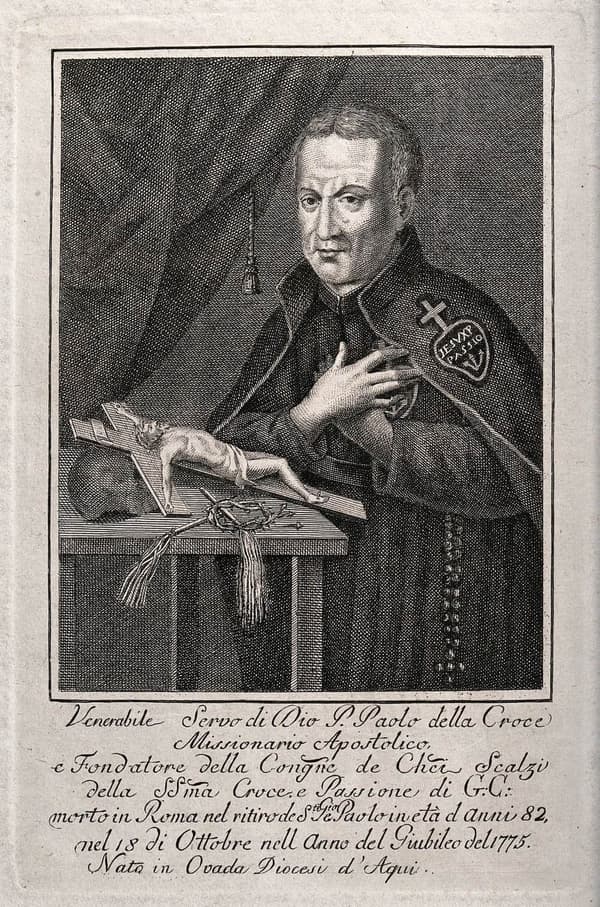 |
April 28: St. Paul of the Cross, Confessor
SPLENDIDLY adorned with the sacred sign of the Passion, Paul of the Cross comes to-day to pay homage to the Conqueror of Death. It behoved Christ to suffer and so enter into his glory. It behoves the Christian, the member of Christ, to follow his Head in suffering that he may share his triumph. Even as a child Paul penetrated deeply into the ineffable mystery of the suffering of a God. He was filled with an ardent love for the cross, and ran with giant strides along this royal road. He passed through the torrent, following his divine Head, he was buried with him in death, and has won a share in his Resurrection.
The diminution of truths among the children of men seemed to have dried up the fount of sanctity, when Italy, ever fruitful in her vivid faith, gave birth to the Christian hero, who stands out in the arid waste of the eighteenth century, like a saint of olden times. God never deserts his Church. He confronts a century of revolt and sensualism veiled under the name of philosophy with the Cross of his Son. A new Paul, recalling both in his name and his works the great Apostle of the Gentiles, rises in the midst of a generation intoxicated with pride and falsehood, to whom the Cross has become once more a folly and a scandal. This apostle was weak, poor, isolated and long misunderstood, but his heart was full of love and self-abnegation, and he sought to put to confusion the wisdom of sages and the prudence of prudent men. Clad in a coarse habit, with bare feet, his head crowned with thorns and a heavy cross on his shoulder, he journeyed through cities, claiming the attention of both the humble and the mighty, and desiring to know nothing but Jesus Crucified. The Cross made his zeal fruitful and showed itself to be indeed the power and the wisdom of God. Those who prided themselves on having banished the miraculous from history and the supernatural from the life of the people, might exult in their triumph, but, unknown to them, wonderful prodigies, countless miracles, were making whole peoples submissive to the voice of this man who, by completely destroying sin in his own person, had regained the power which Adam once had over nature, and seemed to possess in his mortal flesh the qualities of a glorified body.
But the apostolate of the Cross was not to end with Paul’s death. The resources of ancient times were no longer sufficient for a decrepit age. We are far from the days when the exquisite delicacy of Christian sentiment was strongly moved by the sight of the cross amid flowers, as it is seen in the paintings of the catacombs. Man’s senses have been dulled by unhealthy emotions, and there is need of a stimulant in the form of a constant representation of the tears, the Blood, and the gaping wounds of our divine Redeemer. Paul of the Cross received the mission to supply this need. At the cost of unspeakable sufferings he became the father of a new religious family, which adds to the three ordinary vows of religion a fourth vow—to propagate devotion to the sacred Passion of our Lord, the badge of which each Religious wears visibly on his breast.
We must not forget that the Passion of our Lord is for the Christian soul only a preparation for the great mystery of the Pasch, the glorious term of the manifestations of the Word, the supreme end of the elect, whose piety finds therein its completion and its crown. The Holy Spirit, who guides the Church throughout the admirable course of the liturgical cycle, has no other end in view for the souls who abandon themselves unreservedly to his sanctifying power. Paul's desire was to be nailed to the cross on Calvary, but he was often carried thence to the heights of heaven where he heard mysterious words such as it is not granted to man to utter.1 He assisted at the triumph of the Son of Man, who, after having lived on earth a mortal life and passed through death, is living now for ever and ever.2 He saw on the throne of God the Lamb standing as though slain, and giving light to the heavenly city,3 and this sublime vision of the realities of heaven inspired him with that divine enthusiasm, that intoxication of love, which, in spite of his terrifying austerities, gives an incomparable charm to his whole person. ‘Fear not,' he said to his children who were terrified by the furious attacks of the Devil, ' fear not, cry “Alleluia.” The devil is afraid of the Alleluia; it is a word that comes from Paradise.' He could not restrain his feelings when he saw nature born again with her Saviour in these days of spring, the flowers blossoming under the steps of his Risen Lord, the birds celebrating his victory in their harmonious songs. His heart was full to overflowing with love and poetry; he touched the flowers gently with his stick and upbraided them, saying: ‘Hold your peace, hold your peace.’ ‘To whom do these lands belong?’ he said one day to a companion, ‘to whom do these lands belong, I say? You do not understand. They belong to our great God.’ And his biographer relates that he was rapt in an ecstasy of love and carried some distance through the air. ‘Love God, my brethren,' he repeated to all those whom he met, ‘love God, who so well deserves our love. Do you not hear the very leaves on the trees telling you to love God? O love of God, love of God!'
We yield to the charm of a sanctity which is so sweet and yet so strong. It is a divine attraction, such as could never be exercised by the false spirituality, so much in vogue in the eighteenth century, even among the holiest. Under pretext of subduing man's evil nature and avoiding possible excesses, the new teachers allied themselves, though unwittingly, with Jansenism, checked the flight of the soul, disciplined it, remade it according to their own fashion, and confined it within the limits of certain rules which were supposed to lead all souls to perfection at the same rate. But saints are made by the divine Spirit, the spirit of love and holiness, to whose essence liberty belongs. He does not confine himself within the bounds of human methods. Our Lord says: ' The Spirit breatheth where he will . . . but thou knowest not whence he cometh and whither he goeth. So is every one that is bom of the Spirit.'4 The Holy Ghost chose Paul in his earliest infancy. He took possession of this child, so richly endowed by nature, destroyed nothing and sanctified everything. He formed him according to ancient models, always ardent, always attractive, and exceedingly holy. Such a one could never have been produced by a school whose over-correct methods wear the soul out by a barren and self-centred asceticism.
The Liturgy gives the following short account of St Paul of the Cross:
Romam profectus, theologicis disciplinis rite imbutus, a summo Pontifice Benedicto Decimo tertio ex obedientia sacerdotio auctus est. Facta sibi ab eodem potestate aggregandi socios, in solitudinem recessit Argentarii montis, quo eum beata Virgo jampridem invitaverat, veste illi simul ostensa atri coloris, Passionis Filli sui insignibus decorata, ibique fundamenta jecit novæ Congregationis. Quæ brevi, plurimis ab eo toleratis laboribus, præclaris aucta viris, cum Dei benedictione valde succrevit; a Sede Apostolica non semel confirmata una cum regulis, quas orando ipse a Deo acceperat, et quarto addito voto pergratam Dominicæ Passionis memoriam promovendi. Sacras Virgines quoque instituit, quæ excessum caritatis divini Sponsi sedulo meditarentur. Hæc inter, animarum inexhausta aviditate ab Evangelii prsedicatione numquam deficiens, homines pene innumeros etiam perditissimos aut in hæresim lapsos, in salutis tramitem adduxit. Præsertim Christi enarranda Passione, mirifica ejus prationis vis erat, qua una cum adstantibus in fletum effusus quælibet obdurata corda ad poenitentiam scindebat.
Thou hadst but one thought, O Paul. Hidden in those ‘clefts of the rock,’5 which are the sacred Wounds of the Saviour, thou wouldst bring all men to these divine fountains which quench the thirst of the true Israel in the desert of this life. Happy were they who could hear thy victorious word and save themselves by the Cross in the midst of a perverse generation. But in spite of thy apostolic zeal, thy voice could not make itself heard in all lands, and where thou wast absent evil was let loose upon the world. False science and mistaken piety, mistrust of Rome and the corruption of the great had prepared the way for the destruction of the old Christian social order, and the world was given over to teachers of lies. Thy prophetic gaze saw the abyss in which kings and peoples were soon to be engulfed. The successor of St Peter, unable to quell the storm which raged against the Church, sought by his efforts and sacrifices to hold back the floods, even for a time. Thou wert the friend of the Pontiffs and their support in those sad days, the witness of Christ suffering in his Vicar. What sorrows were confided to thee! And what must have been thy thoughts when at thy death thou didst bequeath the venerated image of the Mater Dolorosa to a Pontiff who was destined to drain the cup of bitterness and die a captive in a strange land! Thou didst promise to watch over the Church from thy throne in heaven with that tender compassion which identified thee on earth with her suffering Spouse. Keep this promise to-day, O Paxil! This age of social disintegration has neither made atonement for the sins of the past nor learnt wisdom from misfortune. The Church is the victim of oppression on all sides, the power is in the hands of her persecutors, and the Vicar of Christ is a prisoner in his palace and lives on alms. The Bride has no bed but the Cross of her Spouse, she lives on the memory of his sufferings. The Holy Spirit who guards her and is preparing her for the final summons, has raised thee up to keep her perpetually in mind of those sufferings which are to strengthen her in the trials of the last days.
Thy children all the world over are true to the spirit of their father and continue thy work on earth. They have gained a footing in England where thy prophetic gaze foresaw their labours, and this kingdom, for which thou didst pray so earnestly, is being gradually freed, through their influence, from the bonds of schism and heresy. Bless their apostolate. May they grow and be multiplied to meet the ever-increasing needs of these unhappy times! May their zeal ever continue to minister to the Church, and may the holiness of their lives ever redound to the glory of their father!
Thou, O Paul, wast faithful to thy crucified Master in his humiliation, and he has been faithful to thee in his triumphant Resurrection. In the hour of darkness thou didst live hidden in the clefts of the mysterious Rock. But what must be thy glory, now that Christ victorious ‘enlighteneth wonderfully from the everlasting hills’!6 Enlighten and perfect us, we beseech thee. We give thanks to God for thy triumph. Do thou in return help us to be faithful to the standard of the Cross, so that we, like thee, may be illuminated by its glory, when it appears in the clouds of heaven on the day of judgement.7 O Apostle of the Cross, initiate us into the mystery of the Pasch, which is so closely connected with that of Calvary. Only he who has shared the combat can comprehend the victory and have part in the triumph.
April 28 (the Same Day): St. Vitalis, Martyr
THERE are few martyrs of the West whose names are more celebrated than those of SS Gervasius and Protasius. The veneration in which they aie held by the Roman Church has led her to honour the memory of their father, who also won the palm under the persecution of Nero. She has chosen for his feast the glad season of Easter. The account given by the Liturgy of St Vitalis is short; but we can gather, from the few circumstances related, what fine characters these primitive Christians were who received the crown of martyrdom under the first of all the persecutions—the one that numbers among its choicest victims the two Apostles SS Peter and Paul.
Sin is the enemy of the soul; it throws her back again into that death whence Jesus had drawn her by his Resurrection. To preserve one of thy brethren from this misery, thou, O Vitalis, didst bravely raise a cry of zealous warning to him in the midst of his torments, and thy words awakened him to self-possession and courage. Show this same fraternal charity to us. We are living the life of our Risen Jesus; but the enemy is bent on robbing us of this life. He will seek to intimidate us; he will lay all manner of snares wherewith to deceive us; he will give us battle, and this untiringly. Pray then for us, O holy martyr, that we may be on our guard, and that the mystery of the Pasch may be fully accomplished within us, now and for ever!
Thursday of the Second Week after Easter
THE Apostles and holy women are not the only ones to enjoy the presence of our Risen Jesus: a countless people of the just made perfect claim and have the happiness of seeing and reverencing the sacred humanity of their beloved King. The magnificence of the Resurrection has caused us somewhat to forget those venerable captives of Limbo, with whom the soul of our Redeemer spent the hours that elapsed between his Death and Resurrection. They were the friends of God, and were awaiting in Abraham's bosom (as the Scripture expresses it) the dawning of light eternal. From the hour of None (three o'clock) of the great Friday till the daybreak of Sunday, the soul of our Emmanuel abode with these holy prisoners, who were thus put in possession of infinite happiness. But when the hour of his triumph came, how was the Conqueror of Death to leave behind him these souls whom he had enfranchised by his Death and Resurrection? At the moment fixed by the eternal decree, Jesus' Soul passes from Limbo to the sepulchre, and is reunited to his Body; but he is accompanied by a jubilant choir of other souls—the souls of the long-imprisoned Saints.
On the day of the Ascension, they will form his court, and rise together with him; but Heaven’s gate is not yet open, and they must needs wait for these forty days to pass, during which our Redeemer will organize his Church. They are invisible to the eyes of men, but they dwell in the space above this lowly earth, where once they passed their days, and merited an eternal recompense. Adam again sees the land which he had tilled in the sweat of his brow; Abel is in admiration at the power of the divine Blood, which has sued for mercy, whereas his prayed but for vengeance;1 Noe looks upon this globe, and finds it covered with an immense multitude of men, all of whom are descendants of his three sons; Abraham, the father of believers, Isaac also, and Jacob, hail the happy moment when is to be fulfilled the promise which was made to them, that all generations should be blessed in him who was to be bom of their race; Moses recognizes his people, in whose midst the Messias (whom he had announced,2 and who is greater than he),3 has found so few followers and so many enemies; Job, who represents the elect among the Gentiles, is filled with joy at seeing his Redeemer living,4 in whom he had hoped in all his trials; David, fired with holy enthusiasm, is preparing canticles for heaven, grander far than those he has left us, to be sung in praise of the Incarnate God, who has espoused our human nature; Isaias and the other Prophets behold the literal fulfilment of all they had foretold; in a word, this countless army of saints, formed from the elect of all times and countries, is grieved at finding the earth a slave to the worship of false gods; they beseech our Lord, with all the earnestness of prayer, that he would hasten the time for the preaching of the Gospel, which is to rouse from their sleep them that are seated in the shadow of death.
As the elect, when they rise from their graves on the last day, will ascend through the air to meet Christ5 as eagles who gather together wheresoever the body may be;6 so now these holy souls cluster around their divine Deliverer. He is their attraction; seeing him, speaking with him, is truly a heaven on earth to them. Jesus indulges these Blessed of his Father, who are soon to possess the Kingdom prepared for them from the foundation of the world;7 he allows them to follow and accompany him; and thus does he pass the days which are to be spent before that glorious one of his triumphant Ascension.
What must not have been the happiness of the faithful and chaste Joseph in being thus near his adopted Son—his Creator? with what affection must he not have looked upon his virginal Spouse, who has been made, at the foot of the Cross, the Mother of men! Who could describe the delight wherewith Anne and Joachim gaze upon their daughter, the august Mother whom all generations shall call ‘blessed’?8 And John, the Precursor—how must he not have exulted at seeing her, at whose voice he was sanctified in his Mother’s womb, and who has given to the world the Lamb that taketh all sin away! How affectionately must not these ransomed souls have looked upon the Apostles, those future conquerors of the world, who are now being prepared for the combat by their divine Master! It is through them that the earth once brought to the knowledge of the true God will be ever sending up elect ones to heaven until time shall give place to eternity.
Let us to-day honour these hidden but august witnesses of what God's mercy is preparing for the world’s salvation. We shall soon see them ascending to heaven, of which they will take possession in the name of mankind, that has been redeemed by Christ. Let us not forget how, on their way from Limbo to Heaven, they rested with Jesus for forty days on this earth of ours, where they themselves had once lived and merited an eternal crown. Their visit brought a blessing with it; and their departure was the signal for us to follow them—it opened the way to the blissful home, which is one day to be ours!
The following sequence, taken from the Cluny Missal of 1523, is appropriate to the reflections we have just been making:
Sequence
Concio cantica,
Organa subnectens
Hypodorica.
Deo tartarea
Rumpenti, decanta
Nunc symphonia.
Resurgens, gaudia
Mundo gestat colenda.
Mirantes perdita
Cocyti confinia,
Intrante illo
Vita beata.
Tremescit daemonum
Plebs valida.
Fletuum alta:
Repagula
Quis sic audax fregerit,
Mirantur nunc fortia.
Redit cum turma
Gloriosa,
Et timida
Refovet discipulorum corda.
Hujus trophæa
Admirantes,
Flagitamus nunc
Voce decliva.
Mereamur pretiosa
Colere ut pascha:
In qua sacrata
Prae fulgore contueri
Lucis exordia.
O holy choir,
mourning,
but full of hope.
to the divine King,
who has broken down
the gates of hell.
and rising from the tomb,
brings festive joy to the world.
wonder
at the strange event.
he is Eternal Life,
and they see his power.
of demons
tremble with fear,
and weep,
asking each other,
who this may be that dares to break
the massive bolts.
our Lord returns to earth,
surrounded by a glorious troop;
and hastens to console
the timid hearts of his disciples.
who celebrate
his noble victory,
beseech him
in humble prayer,
to celebrate the great Pasch,
in the choir of Virgins.
sanctified by light,
to see
the Source of Light.
| Previous Wednesday of the Second Week after Easter | Next April 28 (the Same Day): St. Vitalis, Martyr |